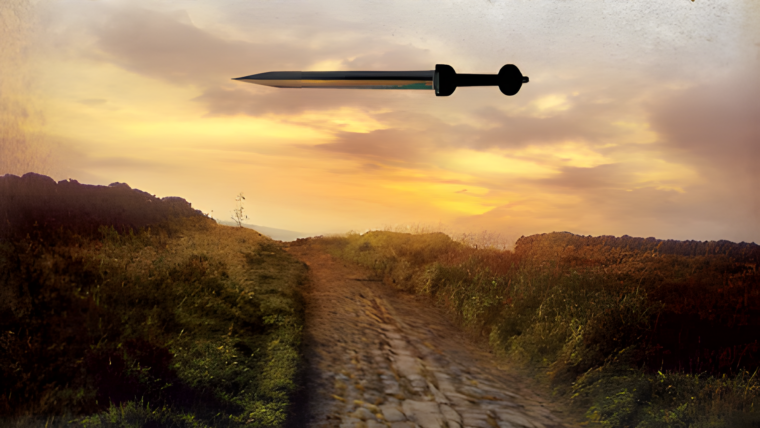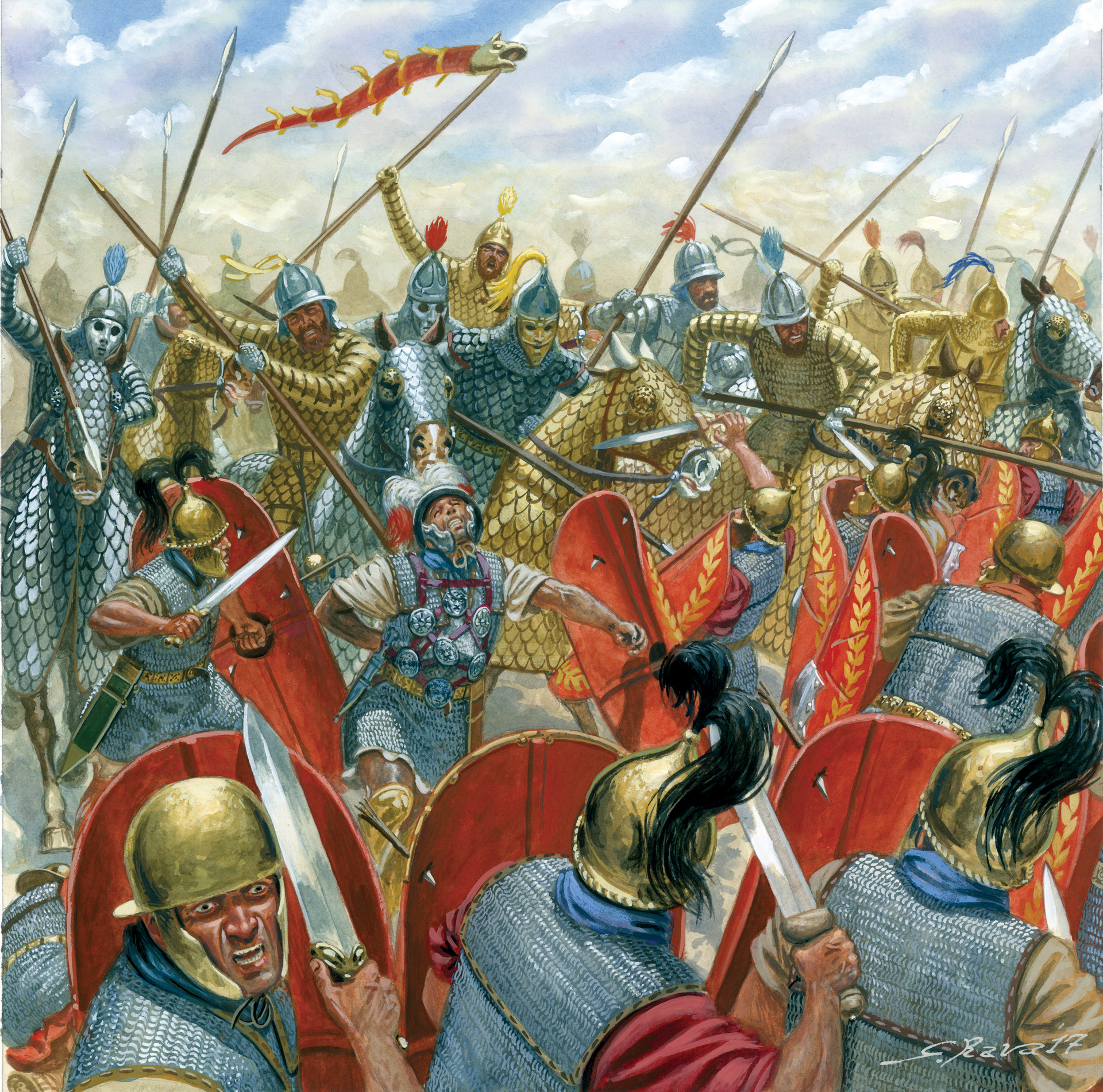
A modern illustration shows Roman legionnaires on the march. The front ranks typically charged into battle, stopping to hurl their pilum before closing with the enemy using their gladius. In the melee, they used their scutum to knock their opponents off balance.

Roman Armageddon at Pharsalus

By William E. Welsh

The snow-capped peaks of the Ceraunian Mountains stared down on the sturdy barks hunting for a suitable place to land on the coast of Epirus on January 5, 48 bc. Read more

American Airborne In Operation Torch

By Michael E. Haskew

Only two years after the U.S. Army officially sanctioned the formation of an airborne arm, American paratroopers were committed to a vast offensive against Axis forces on the coast of French North Africa. Read more

Alexander the Great’s soldiers are shown attacking Tyre in a modern illustration. Simultaneous attacks by Alexander’s fleet on both of the city’s harbors after six months of fighting put an impossible strain on the Tyrians’ resources.

The Fall of Tyre

By Alexander Zakrzewski

As Alexander the Great marched his army south along the Levantine coast in January 332 bc, he must have felt as if the fates were unquestionably on his side. Read more

A Flash of Sabers

By Alexander Zakrzewski

On­ the foggy morning of November 30, 1808, Napoleon Bonaparte, Emperor of France, watched impatiently as his Grande Armée lumbered up the rocky slopes of the Sierra de Guadarrama Mountains of central Spain. Read more

A 19th-century print offers a fanciful depiction of the desperate fighting along the Orange Plank on the second day of the Battle of the Wilderness. Although the battle ended in a draw with both sides suffering heavy casualties, the Army of the Potomac under the watchful eye of Commander-in-Chief Lt. Gen. Ulysses S. Grant chose not to retreat, but continue south.

James Longstreet’s Daring Advance

By Arnold Blumberg

The column of Confederates marched east as quietly as possible along the bed of an unfinished railroad that knifed through the Wilderness south of the Rapidan River shortly before midday on May 6, 1864. Read more

Soldiers with the pro-Western Union for the Total Independence of Angola (UNITA) on patrol during the Bush War. A communist push into southeastern Angola in 1897 triggered a major ground response from South Africa.

Bloody Clash On The Lomba

By William Stroock

With its pro-Western ally in southern Angola facing destruction by an all-out communist offensive in 1987, Apartheid South African President P.W. Read more

Americans troops enter Messina on August 17, 1943. Despite Adolf Hitler’s orders to fight to the last man, Kesselring skillfully employed hundreds of antiaircraft guns to cover the withdrawal of 40,000 Germans to the mainland.

Drive to Messina

By Phil Zimmer

Sergeant Alfred Johnson peered from behind a boulder on a rock-strewn hillside at Piano Lupo about six miles inland from the southern coast of Sicily. Read more

Russia’s Four Immortal Generals

By Victor Kamenir

In 1242, Russian Prince Alexander Nevsky faced the armored might of the Teutonic knights. Generals Alexander Suvorov and Peter Kotlyarevski were Napoleon’s contemporaries, while General Mikhail Skobelev exemplified the panache of the Victorian Era. Read more

Death of Himmler’s Henchman

By Richard Rule

In a desperate bid to avoid another war in Europe, both Britain and France signed the notorious Munich Agreement in 1938, which annexed the Sudetenland of Czechoslovakia to the Nazis. Read more

The 614th Tank Destroyer Battalion: Fighting on Both Fronts

By Christopher Miskimon

The men of the 614th Tank Destroyer Battalion fought two opponents during World War II. From the moment they began their training in 1942, the African American soldiers assigned to the unit faced the prejudice endemic in American society of the time, and by extension the United States Army. Read more