Armored Soldiers at the Battle of the Bulge
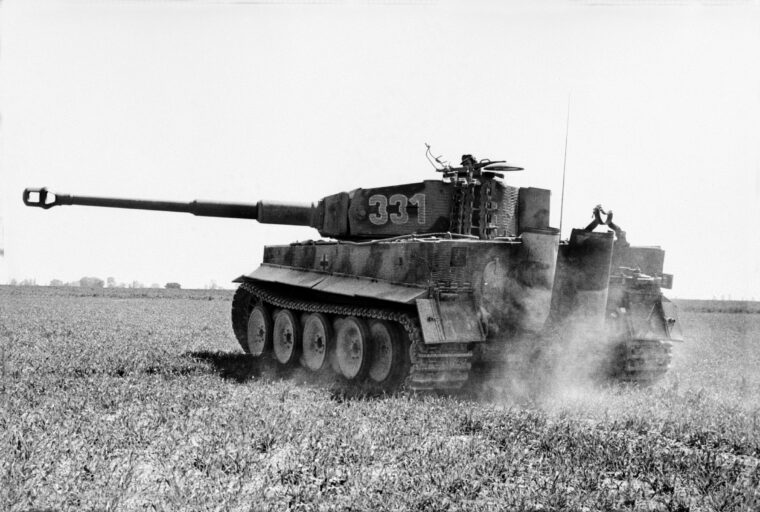
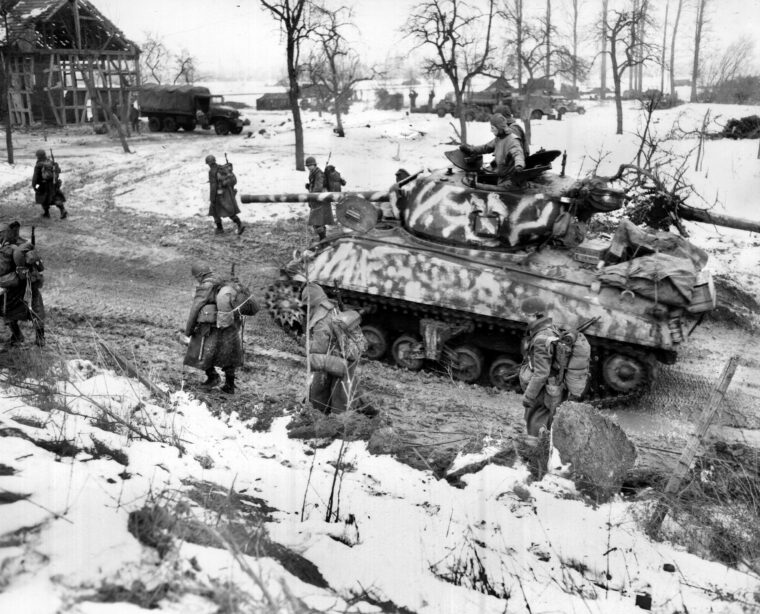
By William HoganBy mid-December 1944, the 3rd Battalion, 33rd Armored Regiment, Third Armored Division “Spearhead” had seen plenty of action. Read more
By mid-December 1944, the 3rd Battalion, 33rd Armored Regiment, Third Armored Division “Spearhead” had seen plenty of action. Read more
In the late hours of April 14, 1865, Secretary of War Edwin Stanton sat at a small table in the Petersen House across the street from Ford’s Theater in Washington, D.C. Read more
The lieutenant had reached the end of his tether. It was time to cut this impudent American wagoner down to size with the flat of his sword. Read more
On August 23, 1939, Soviet Deputy Minister of Foreign Affairs, V.P. Potemkin, waited at the Moscow Airport for Joachim von Ribbentrop, Foreign Minister of Nazi Germany. Read more
Imagine a time when human knowledge of elephants was not widespread. Just think how threatening these large animals would be coming over a hillside or out of a mist during battle. Read more
An angry gloom hung like dust over the 6,000 Confederate cavalrymen trooping up the York Turnpike in the early dawn of July 3, 1863. Read more
By Dante Brizill
In a message to the Red Ball Express in October of 1944, Supreme Commander Dwight D. Eisenhower wrote, “To it falls the tremendous task of getting vital supplies from ports and depots to combat troops, when and where such supplies are needed, material which without armies might fail. Read more
Like bees guarding their hive, the royal host of King Richard III swarmed atop 400-foot-high Ambion Hill near the Leicestershire village of Market Bosworth on the morning of August 22, 1485. Read more
Aboard each of the hundreds of Liberators and Flying Fortresses that daily left the soil of England bound for targets in Germany were ten young men. Read more
By the 1870s, the agitation for Irish independence, already centuries old, had spread to America. The revolutionary Irish Republican Brotherhood, known as the Fenians, began organizing thousands of Irish immigrants trained on both sides during the recent Civil War into its own army. Read more
Although located 420 miles west of Tokyo, the city of Hiroshima is today a tourist mecca, drawing tens of thousands of visitors from around the world for one single reason: to stand at the epicenter of history’s first nuclear explosion used against an enemy population. Read more
As he watched the preliminary bombardment from the railing of his ship, Colonel Lewis B. “Chesty” Puller had deep reservations. Read more
By early April 1862, the Civil War was already closing in on the South, but the trains still ran on time. Read more
During World War II, the U.S. Navy built more than 1,000 destroyer escorts, ships whose primary duty was to escort supply convoys across the world’s oceans to insure that their precious cargo of food, fuel, war material, and personnel got to their destinations safely. Read more
When summer arrived in Bavaria in late June ad 955, thousands of unwelcome barbarians from the Carpathian basin were gathering on its eastern fringe, poised to invade the southern part of the East Frankish kingdom once again. Read more
One of the most interesting yet little known aspects of World War II was the role played by the Duke of Windsor, previously King Edward VIII of England, and his covert relationship with Adolf Hitler’s Germany. Read more
England’s survival hung in the balance. She had only recently clashed with an imposing Continental alliance, in a futile war characterized by unprecedented slaughter on obscure fields in Flanders. Read more
Major General John Brown Gordon guided his horse past fields where stalks of waist-high corn glistened in the sun. Read more
On August 2, 1945, two weeks prior to Japan’s surrender, the highest ranking Japanese officer captured during the war in the Pacific was taken on the island of Morotai, Dutch New Guinea. Read more
Lieutenant Colonel William Washington of the Continental 3rd Light Dragoons stood in his stirrups and looked out over the open drover’s field stretching before him. Read more