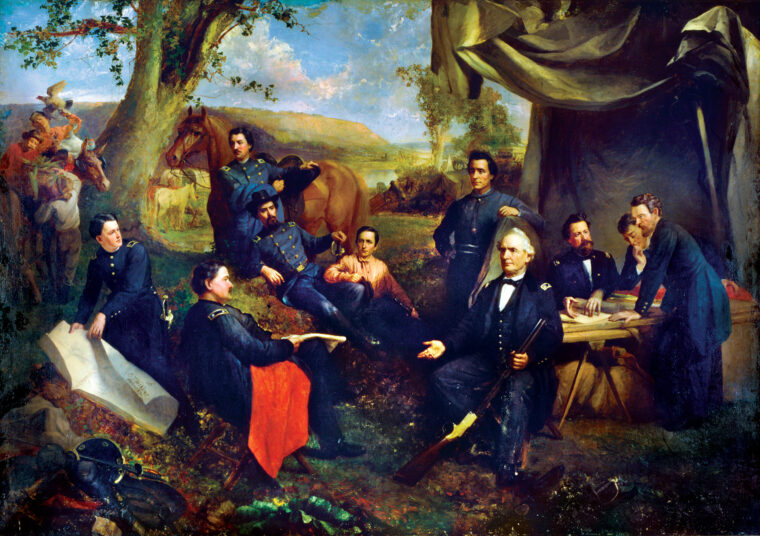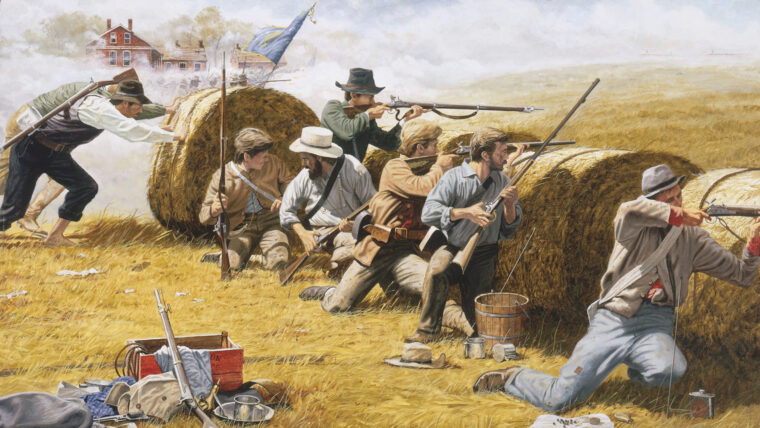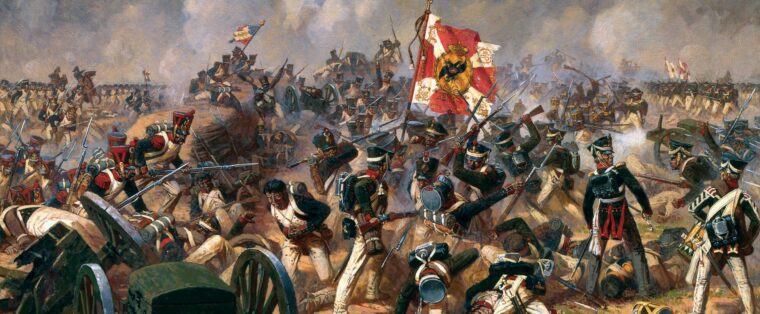
Union troops assail the Confederate center at Champion’s Hill midway between the state capitol of Jackson, Mississippi, and the stronghold of Vicksburg. The action at Champion’s Hill proved to be the decisive action of the Vicksburg campaign.

Savage Encounter at Champion’s Hill

By Robert L. Durham

The barren summit of Champion’s Hill presented an ideal site for Lt. Gen. John C. Pemberton’s Confederate army to deploy artillery batteries on the morning of May 16, 1863. Read more

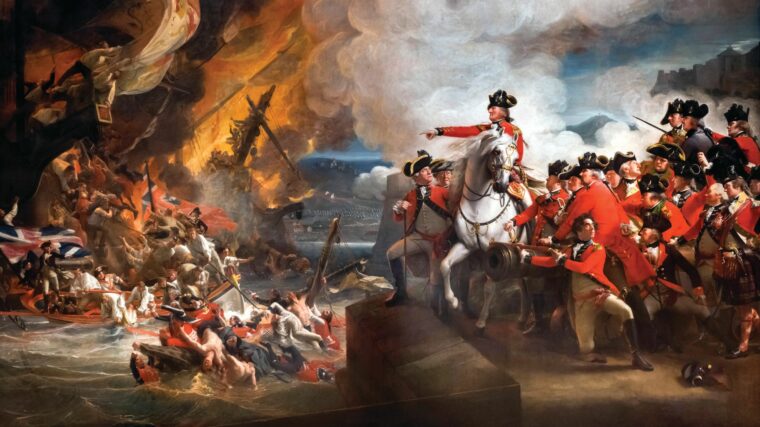
In a painting by John Hamilton, the battle cruiser HMS Hood (left) explodes and breaks up as the battleship HMS Prince of Wales moves out of range of the assailant, the Bismarck, in the Denmark Strait, May 24, 1940. Over 1,400 British sailors went down with Hood in one of history's last clashes between capital ships.

Three Minutes of Fury

by Mark Carlson

The era of the battleship reached its apogee at Tsushima Strait in May 1905, when Admiral Heihachiro Togo’s powerful Japanese battleships annihilated the Russian fleet in the Russo-Japanese War. Read more

British soldiers hoist a lightweight, inflatable dummy Sherman tank. Soldiers in the U.S. Army’s top-secret “23rd Headquarters Special Troops” unit, also known as the “Ghost Army,” were detailed to deceive the Germans about Allied troop build-ups and positioning and draw the enemy away from the actual Allied intentions.

Deception in WWII

by Mason B. Webb

For Operation Neptune/Overlord, the Allies had 6,939 naval vessels, 11,590 aircraft, and 156,000 infantrymen and airborne soldiers (both parachute and glider) ready to participate in the D-Day invasion of northern France on June 6, 1944. Read more

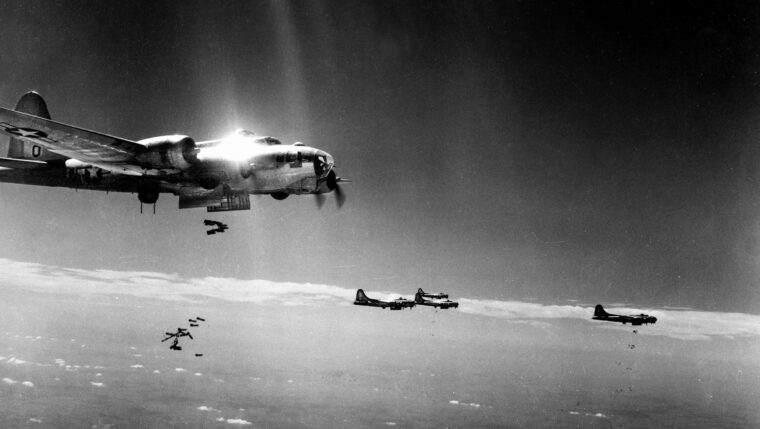
Ground crewmen check the B-17 Flying Fortress Yankee Doodle of the 97th Bomb Group, which participated in the first bombing raid of U.S. Eighth Air Force planes in World War II, targeting the railroad marshaling yards at Sotteville, near Rouen in northern France, on August 17, 1942. Eaker was aboard as an observer.

Eaker and the Mighty Eighth

By Michael D. Hull

Forty-eight Wright Cyclone aero engines coughed into life on the hardstands at windswept Polebrook Airfield in Northamptonshire, England, early on the afternoon of Monday, August 17, 1942. Read more

Tigers on the Prowl

By Mason B. Webb

During World War II, the United States fielded 16 armored divisions, and all contributed to the Allied victory. Read more

Operation Catapult: Churchill’s Desperate Measure

By Brooke C. Stoddard

Steaming through the summer Mediterranean night, the world having gone sour in two awful months, British Vice Admiral Sir James Somerville read the message just sent to him from London: “You are charged with one of the most disagreeable and difficult tasks that a British Admiral has ever been faced with, but we have complete confidence in you and rely on you to carry it out relentlessly.” Read more

Roman legionaries clamber out of galleys and wade toward the battle on the English shore.

Julius Caesar’s Expedition to Brittania

By Ludwig Dyck

By the summer of 55 bc, 45-year-old Roman proconsul Gaius Julius Caesar was a veteran military campaigner. For the past three years, under his lead, the tramp of hobnailed sandals had resounded across the countryside of Gaul, the westernmost province of the Roman empire. Read more

The wreckage of the American Boeing B-17 bomber named Raunchy is removed from a lake in Switzerland, where it ditched during a mission to bomb Stuttgart, Germany, on September 6, 1943. The crew survived and were interned in Switzerland for the duration of the war.

“What Are You Doing in My Country?”

By Duane Schultz

Lieutenant Martin Andrews was not scheduled to fly that day. He and his Boeing B-17 Flying Fortress bomber crew had survived 12 missions out of the required 25 and were due for a much needed week of rest and recuperation. Read more

The Corporal M2 Missile

By Peter A. Goetz

Six days after the Allies’ D-Day landings on the coast of Normandy in June 1944, Germany retaliated by launching its first Vergeltungswaffe, or Vengeance Weapon, at the city of London. Read more

Sergeant W.W. Bigoray, radio operator aboard the harrowing flight to learn the properties of the Germans’ airborne Lichtenstein radar, though wounded, continued to perform valiantly.

Reading Nazi Radar

By Neil Taylor

To the crews of the Royal Air Force Bomber Stream Droning Toward Germany in the early morning hours of December 3, 1942, this mission seemed indistinguishable from the countless others that had preceded it. Read more

Baker’s men fought valiantly, but their counterattacks failed to reverse the tide of battle.

Death on a High Bluff

By Mike Phifer

It was almost dark when Captain Chase Philbrick led a reconnaissance party of 20 volunteers from Company H of the 15th Massachusetts Infantry across to Harrison’s Island situated in the middle of the Potomac River. Read more