WWII

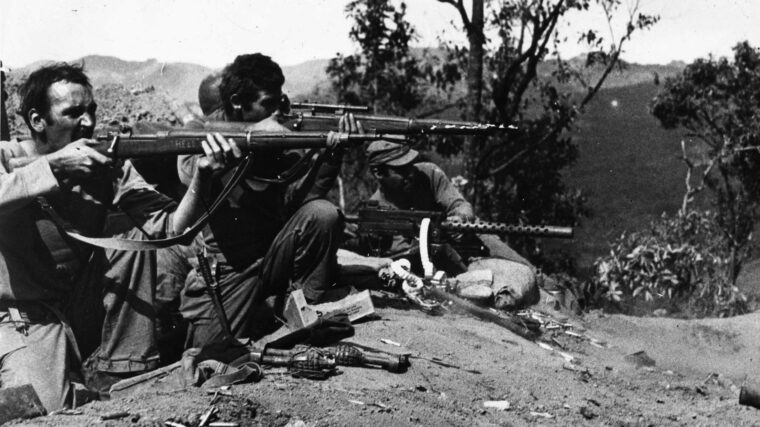
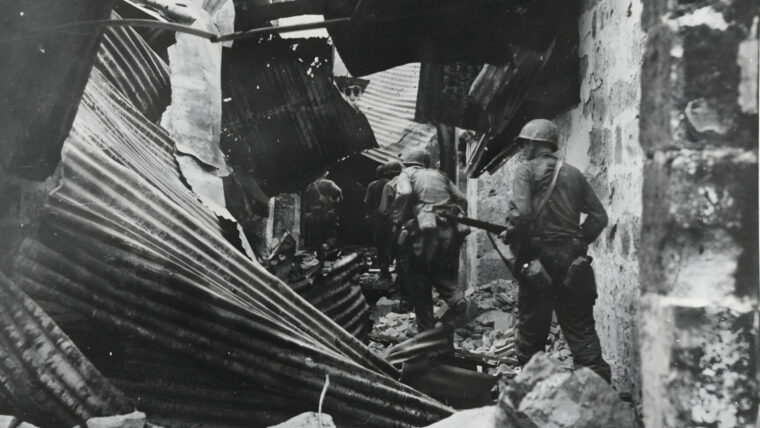
Lying in the rubble of Weisweiler, a German town between Aachen and Jülich, an American rifleman from the 84th Infantry Division takes aim at an enemy position. A massive American-British-Canadian offensive in early 1945 was designed to quickly break through enemy lines and cross the Rhine, but a combination of winter weather, flooded fields, and determined German resistance made progress slower than the Allies had hoped for.

WWII

Operation Grenade: Race to the Roer

By Allyn Vannoy

In early 1945, while the American First Army was focusing on the dams of the Roer River near the German-Belgium border and Patton’s Third Army was probing the Eifel and clearing the Saar-Moselle triangle, the First Canadian Army was about to open their offensive as part of Operation Veritable in a drive southeast up the left bank of the Rhine from the vicinity of Nijmegen. Read more

WWII

Going for Broke

By Stephen D. Lutz

Thousands of Japanese American men demonstrated their loyalty to the U.S. by volunteering to serve in the 100th Infantry Battalion and the 442nd Infantry Regiment, to which the 100th would later be joined. Read more

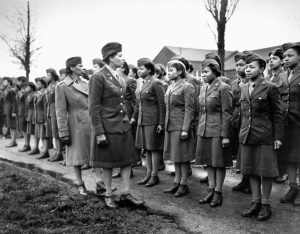
Major Charity Adams (center) commanded the 6888th Central Postal Directory Battalion, the only all-black, all-female Women’s Army Corps unit to serve overseas during World War II. PFC Romay Johnson remembered her as a strict officer.

WWII

A Black WAC in the U.S. Army

By Kevin M. Hymel

Although Private First Class (Pfc) Romay C. Johnson served in war-torn England and France during World War II, it was her tumultuous voyage across the Atlantic Ocean that she remembered most vividly. Read more

WWII

Faces of Battle

By Kevin M. Hymel

What was it like to come to grips with the enemy, to fight and survive combat? For each men, the experience was different; for many, it was almost impossible to relate to those behind the lines or an ocean away. Read more

Oradour today looking southeast along the Main Street, Rue Desourteaux. On a hot summer afternoon, 200 SS soldiers drove up unannounced from the St Julien road (bottom right) sealed off the town and rounded up its inhabitants into a central recreational area. The townspeople were then bombed, shot or burned to death. The Germans then set the town ablaze, with the exception of the house of a cloth and wine merchant, which was looted and occupied until around 10 p.m.

WWII

The Execution of Oradour-sur-Glane

By Alan Davidge

Known throughout France as the Village des Martyrs—“Village of Martyrs,”—the pillaged remains of Oradour-sur-Glane have stood nearly eight decades now as a memorial to the dead and reminder of the atrocities of war. Read more

An 81mm mortar crew from the 3rd Infantry Division’s 15th Infantry Regiment fires at enemy positions during the division’s drive on Campobello, Sicily, July 1943. Of the 40 Medals of Honor awarded to men of the 3rd, two were earned during the month-long campaign for Sicily.

WWII

Above & Beyond

By Mason B. Webb

The U.S. 3rd Infantry Division has one of the longest legacies in the United States Army. Originally formed in November 1917 at Camp Greene, North Carolina, it gained a reputation for toughness. Read more

Field Marshal Erwin Rommel (right) inspects members of an assault gun battalion standing in front of their guns—10.5cm leFH 18 (Sf.) auf Geschützwagen 39H(f)—a self-propelled howitzer designed by Alfred Becker—in Normandy, France, a month before the Allied invasion. Only 48 were produced during the war.

WWII

Oberstleutnant Alfred Becker

By Craig Van Vooren

Students of World War II know the name Percy Hobart—a British general who raised and trained several armored divisions and who invented all sorts of unique and unusual weapons of war—swimming tanks, flail tanks (for exploding landmines), a flame-throwing tank, a tank that laid down its own roadway, and many other odd-but-useful devices. Read more

A Jagdpanzer 38(t) tank destroyer in Hungary, circa 1944. Nicknamed “Hetzer,” baiter or agitator, this compact , powerful weapon was Hitler’s response to British and Russian tanks that were too heavily armored for towed German anti-tank guns.

WWII

The Jagdpanzer 38

By William E. Welsh

It became glaringly apparent to the German Wehrmacht in 1943 that it needed a solution to the threat of heavily armored British and Russian tanks whose armor proved too thick for German towed anti-tank guns. Read more

WWII

Into The Bitter Forest

By David H. Lippman

“In the early hours of 8 February 1945, I climbed into my command post, which consisted of a small platform halfway up a tree,” Lt. Read more

Four Yank-piloted Spitfire Vbs of RAF Squadron 71 return to their base at North Weald after combat above the English Channel in this painting by Robert Taylor.

WWII

The American “Few”

By John W. Osborn, Jr.

The “few” who defended Great Britain in the sky during the days it stood alone against Hitler would have been hundreds fewer without the volunteers from outside the British Empire. Read more

Allied forces achieved complete surprise when they stormed ashore 40 miles south of Rome on January 22, 1944, but they failed to exploit their advantage with a rapid advance inland.

WWII

Brutal Slugfest at Anzio

By Joshua Shepherd

For the Americans of 2nd Battalion, 13th Armored Regiment, their arrival at Anzio in early May 1944 was anything but heartening. Read more

A patrol of the 77th Infantry Division makes its way along a dirt path on the island of Guam in the Marianas in the summer of 1944. The capture of Guam was a key event in the securing of the Marianas for forward air bases from which American heavy B-29 Superfortress bombers could strike the Japanese home islands.

WWII

Fighting for Water

By Patrick J. Chaisson

Staff Sergeant Chester B. Opdyke, Jr., crouched down at the tree line. He could see his objective, a crossroads village named Barrigada, shimmering in the hot August sun across a large open field just 300 yards away. Read more

First Lieutenant Rudolf Schutze of Wekusta 5 and his flight crew gather near a Heinkel He-111weather aircraft on the ice of Advent, Fjord.

WWII

Wekusta: Weathermen of the Wehrmacht

By William McPeak

The fundamental pillars of war—strategy and tactics— inevitably depend on an imponderable and uncontrollable factor: the weather. With the increasing sophistication of weather data gathering, analysis, and forecasting in the early 20th century, predicting the weather became an integral part of World War II. Read more

Their foxhole reinforced with logs, a pair of American soldiers of the 99th Infantry Division watch and wait for a German attack during the Battle of the Bulge. The heroic stand at Lanzerath by 20 year old Lt. Bouch and the 21 men under his command slowed the advance of Kampfgruppe Peiper.

WWII

Hold at All Costs

By Brent Dyck

After D-Day, the Allied armies slowly advanced across Europe and pushed the German army back. Paris was liberated on August 25, 1944, the Belgian capital of Brussels fell on September 3, and the important port of Antwerp was taken two days later. Read more