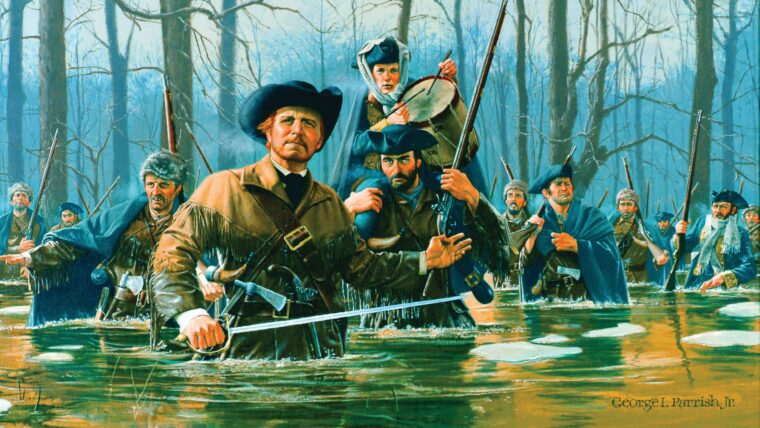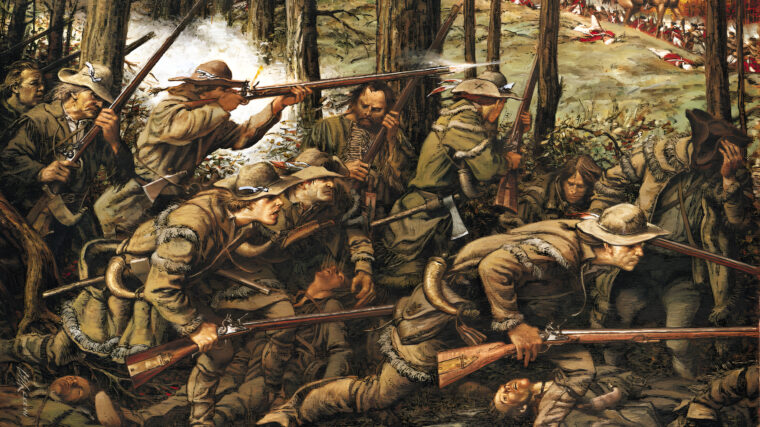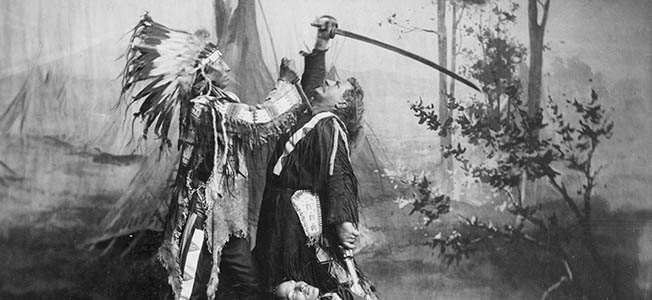
Indians attack a building party in the woods. Settlers had to be on their guard for such ambushes.

Cameron Colby’s ‘Jamestown 1622’

By Christopher Miskimon

English settlers arrived in North America and established the Jamestown colony in 1607. They hoped for fortune growing tobacco and maintained difficult relations with the Powhatan Confederacy. Read more

American Marines armed with a Browning .30-caliber water-cooled machine gun and other light weapons pose during efforts to evacuate former Japanese Army personnel after their surrender in China following World War II.

Caught in the Chinese Conflict

By Eric Niderost

On September 2, 1945, Japanese representatives boarded the battleship USS Missouri, riding at anchor in Tokyo Bay, to sign an instrument of unconditional surrender. Read more

Profiles: ROTC Success

By Bruce Petty

More than 16 million Americans served in the U.S. military during World War II, but as fluid as the situation was in the Pacific, and considering the priority given to the European Theater, it is difficult to obtain an accurate count of how many served in the Pacific at any one time during World War II. Read more

The Fate of the USS Sculpin

By Richard Camp

Two days after receiving intelligence on the route of an important enemy convoy, the USS Sculpin (Sargo-class submarine SS-191) made radar contact with the Japanese ships near the Caroline Islands in the Western Pacific Ocean. Read more

Insight: Bombing the Abbey

By Duane Schultz

For the thousands of Allied soldiers who had fought and suffered for so long in the shadow of the abbey of Monte Cassino, Tuesday morning, February 15, 1944, was a time of joy and celebration. Read more

Gustav was the best kind of reformer. He thoroughly understood the tactics he was changing, he had keen insight, and he put himself into the field to observe the results of his reforms.

Gustavus Adolphus: Lion of the North

By Isaac Blatter

Oddly, the fall of the brilliant King Gustavus Adolphus on the field of battle marked both the beginning of Sweden’s rise to power and the end of one of the most aggressive ages of military reform. Read more

Robert the Bruce stands up in his stirrups to aim a blow at Henry de Bohun, a champion of Edward II’s large army of invasion.

The Battle of Bannockburn: Edward II vs Robert the Bruce

By Terry Gore

Robert the Bruce, self-proclaimed King of the Scots, grasped his axe as the heavily armored English nobleman, a member of the vanguard of the 20,000-strong English army, bore down upon him, lance leveled and clods of earth arching from his charger’s hoofs. Read more

The Modoc War of 1872

By Kurt R. Nelson

Most Indian battles were small affairs, often company-sized engagements. Many were fought between equally numbered forces, or if disproportional, the U.S. Read more

Paratroopers of the 101st Airborne Division march into Bastogne, Belgium, on December 19, 1944. Combat veteran Private Brad Freeman, a mortarman with the division’s East Company, 506th Parachute Infantry Regiment, passed through the town, thinking to himself, “Here we go again.”

Easy Company Mortarman in Bastogne

By Kevin Hymel

When word reached 21-year-old Private Bradford “Brad” Freeman in Mourmelon-le-Grand, France, that the entire 101st Airborne Division was being put on 24-hour alert for movement to the front, he was neither surprised nor shocked. Read more

Popular bandleader Glenn Miller and his orchestra entertain a crowd in England in 1943.

Hero with a Horn

By Michael D. Hull

One of the best known and most effective champions of the Allied cause in World War II was a dour, slightly built Iowa native wearing rimless glasses who never fired a shot in anger and collected no ribbons for gallantry. Read more

The Saga of Piyamaradu

By Steven Weingartner

Western Anatolia in the 13th century bc was the main arena for a protracted trial of strength between two vital and aggressive empires, Hatti and Ahhiyawa. Read more

Soldiers of the 42nd Highlanders maneuver in the jungle during the Ashanti War of 1874. Their general, Garnet Joseph Wolseley, disliked war correspondents but put them to good use.

General Garnet Wolseley & The First War Correspondents

By Harold E. Raugh, Jr.

War correspondents are relatively new to history. The Crimean War (1854-1856), pitting Great Britain, France, Turkey, and Sardinia against Russia, was the first conflict in which an organized effort was made for civilian correspondents reporting news directly to the civilian population of the home country. Read more

Wellington’s artillery commander at Waterloo said that without Henry Shrapnel’s devastating new shell, Allied forces could not have taken a key position on the battlefield.

Henry Shrapnel & The Battle of Waterloo

by Robert Whiter

“And the rockets’ red glare, the bombs bursting in air …”

That, as most people know, is a line from the American national anthem, words by Francis Scott Key, to the tune of Anacreon in Heaven by John Stafford Smith. Read more