By Mark Carlson
Ships of the line represented the pinnacle of military power by the end of the 18th century and would remain the dominating force on the seas for more than 200 years. The largest wooden vessels ever built, these sailing warships commonly mounted 74 to more than 100 heavy cannon on two or three decks and carried a crew of more than 700 officers and men. They sailed loaded with 120 tons of shot and 35 tons of powder for their heavy guns, which could deliver half a ton of iron in a single devastating broadside.
But despite their immense power and influence, they were as vulnerable as any weapon when used improperly or worse, confronted with radical new tactics. Thus it was in 1781 when the Royal Navy, whose supremacy of the seas had been virtually unbroken since the mid-17th century, was challenged and defeated by a French fleet off the coast of North America. The British naval debacle also led directly to the victory of George Washington’s Continental Army over General Cornwallis at Yorktown.
“Nothing equals the beautiful order of the English at sea,” wrote French Adm. Michel de la Roche-Courbon, Comte de Saint-Saint-Pierre in 1666. “Never was a line drawn straighter than that of their ships; thus they bring all their fire to bear upon those who draw near them.”
Those words were written by an admiring French admiral in 1666, Comte de Saint-Pierre wrote those words during the Second Anglo-Dutch War, when the Royal Navy was beginning its ascendancy to global domination.
The British Admiralty’s core belief was in the sheer power of a formation of several huge ships of the line delivering broadsides to reduce an enemy fleet to splinters. Supremely powerful, but heavy and slow, these ships were the backbone of the Royal Navy.
At the time the Spanish Armada attacked in 1588, warships acted independently, with each captain moving against an enemy and delivering broadsides. With no reliable means of communication between ships, this approach made things difficult for fleet commanders and often brought less of a victory than might have been achieved with a coordinated plan.
By the time of Oliver Cromwell, a supporter of an organized navy, the concept of concentrating a fleet’s firepower by following a single line under the command of a fleet admiral had become the Royal Navy’s standard formation. With the large ships following in a single line a cable length apart (roughly 200 yards), the full might of all the ships could be concentrated on an enemy fleet. In 1663, this doctrine was published in the revised Fighting Instructions, known as the “Royal Navy’s bible.”
For the next 120 years no seafaring nation on Earth, including England’s longtime adversaries France and Spain, could successfully defeat a Royal Navy fleet or squadron in battle. By the time of the Seven Years’ War of 1756 to 1763, the Admiralty, flush with a string of victories by fleets using the tried and true line-ahead formation had made it a punishable offense for any ship’s captain or fleet admiral to divert from it. No captain was allowed to move independently under any circumstance, even when a golden opportunity presented itself.
Naval warfare in the 18th century was governed by three factors. Foremost was the weather and especially the wind direction. The second was the number of guns, with more considered better. Lastly, and most important, the skill of the fleet commander and his captains. But by the early 1780s, the skill of British admirals was of little use against the French navy, in fact, experience was a liability instead of a benefit.
Though they were the most advanced sailing vessels of their era, ships of the line were still dependent on the direction of the wind. The most favorable position for any fleet was the weather gauge, or upwind of an enemy. With the wind behind them, a fleet could close with or refuse battle with the enemy. At a maximum speed of six to eight knots, it could take a fleet several hours to move a fleet into position—even as the opposing force attempted to do the same. Nothing happened fast in an 18th century naval battle.
After losing several battles, the French navy began a serious study of how it might gain an advantage over the larger British Navy. King Louis XVI, believing it was the “First Service of the Realm,” provided large sums to renovate and improve his fleet. Beginning in 1765, the French designed and built dozens of large, powerfully armed and faster warships. New training academies were established for shipwrights, sailors and gunners, resulting in a higher standard of gunnery and sail handling. Entire forests were cut down and transported to dozens of new dockyards along the southern and western coast.

By 1775 France possessed the most advanced navy in the world—with 64 ships of the line and more than 50 frigates, manned by more than 10,000 trained gunners.
The French took some of their larger ships of the line—First (100-130 guns on 3 decks), Second (90-98 guns on 3 decks) and Third Rate (64-80 guns on 2 decks) warships—and cut them down, creating what were known as “Razee” from the French vaisseau rasé, meaning a razed ship. For instance, a warship of 74 guns was cut down to fewer than 50. Another type of Razee only removed the upper deck guns, thus lightening the weight and making the ship more nimble without reducing its structural strength. Reducing a ship’s tonnage and height made it more maneuverable and faster, a great advantage for the French Navy. With much of the high freeboard cut down, a 50-gun razee still had the heavy oak timbers and solidity of a larger ship, but it was lighter and had a lower center of gravity, improving its sailing qualities. Moreover, instead of the 800 men needed to sail and fight the larger ship, it only needed two-thirds that number. This of course meant the navy could man two ships for every large 74-gun ship of the line. The loss of guns was negligible since improved gunnery and tactics favored the smaller, swifter Razees.
The French also developed new gunnery techniques, such as heating cannonballs in brick ovens on the gun decks, then firing the lethally glowing shot onto British decks. Tarred hempen rigging and sails were notoriously vulnerable to fire. Once a blaze flared up, the men fighting fires were taken away from their guns. Another was Chain shot, two cannonballs connected by a short length of chain and expanding bar shot consisting of two cylindrical ends connected by a sliding iron joint would expand as they spun wildly like pinwheels, tearing through wood, rigging, sails and human flesh. Like a huge shotgun shell made of scrap iron, glass, even stones, Langridge was a hideous form of anti-personnel weapon. The French Navy was ready to employ these new tactics, training, weapons and ships the next time they faced the vaunted and mighty Royal Navy.
While this did not go unnoticed in England, the fossilized Admiralty saw no reason to spend huge amounts of money to improve its own fleet, neither in strength, tactics nor efficiency.
Every new ship was constructed under what was known as the “Rule of King’s Thumb,” meaning without any refinement or change.
It had been a popular dictum in the Royal Navy that “Just lay a Frenchman close alongside and you will defeat him every time.” This was certainly true, but only if the Frenchman was unwise enough to come within close range of the British guns. While British gunners were trained to fire into enemy hulls, intending to stove in and crush ribs and structural damage, the better trained French gunners aimed higher. Even with heavy 32-pound cannon firing solid shot as large as a man’s head, it could take dozens of broadsides to do significant damage to stout oak timbers. But the masts, yardarms, sails and rigging, not to mention the men who handled them, were far more vulnerable. A single well-directed broadside of chain or bar shot could seriously impair a ship’s ability to maneuver or maintain its position in the line of battle. In short, the French had learned not to destroy a ship’s hull, but to immobilize it. With shredded sails and toppled masts, British ships were unable to catch the faster French ships, which were able to sail away at their leisure. The French now had a decided lead over the conceited Royal Navy.
It would not be until the time of Admiral Lord Horatio Nelson in 1798 that the old practices would be discarded in favor of new tactics.
The Razee conversions proved their value against British cannonballs. Since most of the Razees had been 74-gun or larger ships of the line, their hull planking and ribs were correspondingly heavier. Even though the Razee’s outward appearance was of a Fourth or Fifth Rate, its robust timbers withstood the pounding of the British 32-pound carronades. While there is no way to know for certain how effective Razees did stand up to the enemy shot, there is little doubt they survived long enough to wreak havoc on the larger Royal Navy ships of the line. As soon as a mast fell over the side or rigging lay like dead snakes on the bloody splintered decks, those powerful ships were virtually helpless.
By 1780 the American Revolution had turned from a series of land battles to one defined by the actions of the British and French navies. While the land armies fought from the Canadian border to the Carolinas, it was a single sea battle that decided the final outcome of the war for American Independence. When France joined the American colonies in 1778 she possessed 80 modern and fast ships of the line. The still larger Royal Navy had more of the large ships of the line, but their design and how they were commanded fell far short of the French. This was how affairs stood during the fall of 1781 when Washington made one of the most important decisions of the war.
His army was facing the 7,000 redcoats of Major General Earl Cornwallis encamped on the Yorktown Peninsula along the western shore of Chesapeake Bay. With Washington were the French troops of Jean-Baptiste Donatien de Vimeur, comte de Rochambeau. If the revolutionary army could be reinforced by more troops, artillery, cavalry and supplies, there was a good chance that the combined armies could surround and defeat the British. At that time the bulk of the French fleet was in the West Indies, where Rear Admiral Francois Joseph Paul de Grasse was making plans to retake the islands seized by the British during the Seven Years’ War. Writing via the French minister to the colonies, Washington sent word to de Grasse to come as fast as possible. He hoped the French fleet could bring the needed reinforcements to the combined army, while blocking the entrance to Chesapeake Bay. This would not only support his army, but would deny the British any help from their own fleet, then anchored in New York.
The French admiral responded by turning his fleet north through the Bahamas Channel and working up the Florida coast. On the way his fleet lost the 74-gun Intrepide and the 40-gun Inconstante in identical accidents. While a quartermaster doled out portions of Tafia brandy, the French equivalent of grog, a candle had been knocked over which started a fire. To lose two powerful warships to such avoidable mishaps was inexcusable, and de Grasse took steps to assure it never happened again. His force consisted of 28 ships of the line, carrying three regiments of infantry and 350 artillerymen. Accompanying the warships were 15 merchantmen that de Grasse had chartered with his own funds, each carrying a portion of the supplies, cannon and ammunition.
Rear Admiral Samuel Hood, the British commander in the Caribbean, learned of de Grasse’s departure and rightly assumed the French were headed to support Washington and Rochambeau. Aboard his 92-gun flagship Barfleur, Hood sailed from Antigua with 14 ships of the line on August 10 and set a direct course for Virginia. But de Grasse had taken a circuitous route before heading west into Chesapeake Bay. When Hood reached the entrance to the bay on August 25, he found no French fleet, and continued north towards New York.

Four days later the French warships and transports entered the huge bay. The transports moved north towards the rendezvous with the allied forces while the warships anchored in Lynnhaven Roads at Cape Henry along the southern coast of the bay. Twelve miles north was Cape Charles at the southern end of the Delmarva Peninsula. While the mouth of the bay was wide, the dredged ship channel was only three miles across.
Hood reached New York and met with the senior British admiral in North America, Vice Admiral Thomas Graves. At 52, Graves was a respected and experienced commander who was confident he and his force could defeat the French fleet coming from the south. But he had other prey in mind. Commodore Comte de Barras was bringing eight warships loaded with heavy siege artillery, men and ammunition from Rhode Island. He was to rendezvous with de Grasse coming from the Caribbean. Knowing that the British Navy was hunting him, de Barras sailed far out to sea and south to the Carolinas before turning west.
With 19 ships of the line, Graves, in his flagship the 90-gun London, sailed south to Virginia. The fleet carried 2,000 fresh troops to reinforce Cornwallis, as well as 400 New Yorkers forcibly impressed into the Royal Navy. It was a clear indication of the poor state of the British fleet that Graves had to kidnap colonists, even those who were not loyal to the Crown.
Graves and Hood reached the mouth to the bay on the late morning of September 5. At first his leading ships reported masts visible just past Cape Henry, and Graves assumed it to be de Barras. They would be an easy target for the big British men of war. But when his lookouts reported a veritable “forest of masts,” it was obvious there were far more than the eight ships they had expected. These were 24 of de Grasse’s ships of the line.
De Grasse found himself at a great disadvantage. The British had the weather gauge, with the wind out of the northeast and the tide coming in. Worse, the French warships were anchored on the lee shore of Virginia with little room to maneuver. Yet that was not what worried de Grasse. The 15 transports that had sailed up the Chesapeake estuary were accompanied by some of his frigates and more than 1,300 of his men. His own flagship, the 104-gun Ville de Paris was short almost 200 men. Upon sighting the big British warships bearing down on the entrance to the bay, he gave orders to clear for action. Immediately his captains responded to the signal by casting off anchor lines and buoying them, loosing sail and loading the guns. But time was short. The only edge de Grasse had was in numbers. He had 24 ships of the line to 19 for the British.
But the French commander was unaware he had one element in his favor. Graves was an ardent follower of the Fighting Instructions and would not deviate from what the Royal Navy had been doing since 1663.
Graves had the French fleet and transports in his grasp. If he simply moved in among the French fleet, he could destroy them with near impunity. Yet true to the Admiralty’s standing orders, he raised the signal to form a line ahead with his flagship, the London in the vanguard.
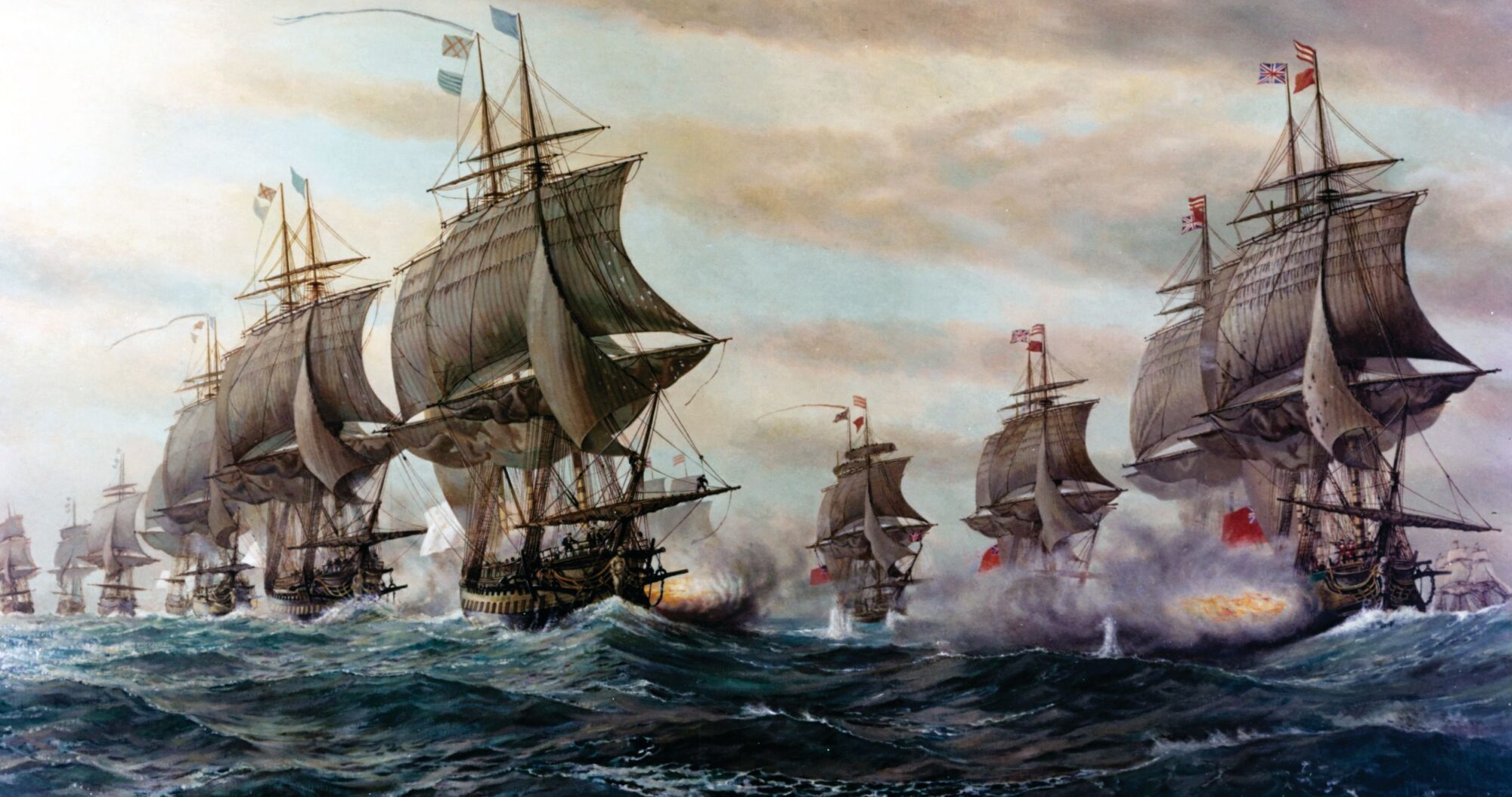
De Grasse must have felt like cheering as he saw the perfect orchestration of the British men of war lining up to enter the bay through the channel. It was a splendid sight with all the sails set along the British line, hundreds of black gun muzzles bared like iron teeth, flags and signals flying and white bones churning at their bows. Graves’s ships executed the maneuver to perfection. It was magnificent and imposing.
But it was also useless. By the time Graves’s London had entered the wide bay, de Grasse’s ships had managed to clear Lynnhaven Roads and formed up in the open ocean.
With startling speed for an 18th century naval battle, the advantage had gone to the French. Now Graves found himself inside the bay with de Grasse to his rear and widening the gap. If he had been a bit cleverer, he might have moved up the estuary where his ships could have destroyed the transports carrying troops and guns for Rochambeau and Washington. But Graves saw only de Grasse. With the signal for line ahead still flying, he ordered his fleet to turn about in place and pursue the fleeing French. With this order each ship turned and headed east. The tide and wind were now against him. This took nearly an hour, during which de Grasse took up a heading of northeast. Graves had to chase the French fleet, but instead of having his most powerful ships in the van, the weakest, the 74-gun Shrewsbury and the 64-gun Intrepid were leading. The London was now 10th in the line of battle.
Graves soon found himself facing a situation for which he and the vaunted Fighting Instructions had no answer. De Grasse’s ships had reached open waters off the coast, but had not formed into a line of battle. The French ships were in small knots. The neat British line of battle was useless. By late afternoon de Grasse had formed his ships into a loose line that was intended as a way of maintaining control rather than be used in ship to ship battle.
With his “line ahead” signal still flying, Graves sent his leading ships at the French vanguard. But because of the wind and the ragged enemy formation, the Shrewsbury approached at an angle, so the two fleets formed a “V” pointed east.

This meant that only the lead British warships were able to engage the French. The following ships of the line were still too far away to begin firing.
Graves compounded the worsening situation by raising the signal to “bear down and engage the enemy more closely.” While this signal by itself meant for each captain to order his ship to break out of the line and attack the nearest French ship, the “line ahead” signal was sacrosanct. In other words, the two signals contradicted each other. Confusion reigned in the British fleet. Far to the rear, Admiral Hood followed the Fighting Instructions dictum that the “line ahead” superseded every other order, while Rear Admiral Francis Samuel Drake chose to follow the second signal. Aboard the 70-gun Princessa he led the lead ships at the French van. But this only created more havoc.
Almost immediately the Shrewsbury received heavy damage from the leading French ship, the Pluton. After two French broadsides, 27 of her crew were dead, including the captain. With her masts teetering and rigging shot apart and more than 50 of her crew wounded, the British ship veered away. Then the 64-gun Intrepid moved in and was battered by the bigger Marseillais. With 20 men killed and 35 wounded, the Intrepid also left the broken British line. The French gunners were proving the merit of their training. Every British ship that came near de Grasse’s guns had its rigging and masts shredded by chain and bar shot.
Orange and yellow flashes strobed like lightning in the thick clouds of white smoke while the roar of cannon vied with the dull thud of impacting balls on solid oak hulls. Tall waterspouts erupted from the blue sea from cannonballs around and beyond the two fleets. The sea air was rent with the stink of gun smoke. Hundreds of men lay in pools of blood that ran across the scrubbed decks. Tarred rigging hung like torn black webs while shredded sails flapped in the wind. The Terrible was so battered that Graves ordered her to be scuttled.
Graves’s big guns did damage the French ships. Drake’s Princessa delivered a withering broadside against the RefMehl, shattering planking, ribs and bulwarks. Jagged splinters of wood tore across the desks, killing and dismembering men as they worked the guns and sails.
The first shots of the Battle of the Capes were fired just after noon but it was late afternoon when Graves at last lowered his “line ahead” signal. This was the point where all his captains were free to steer independently at the French line and engage them in a series of ship to ship fights. But it was far too late to matter.
By now de Grasse was far out into the Atlantic with plenty of room to maneuver. What is more, his ships had suffered no crippling damage, while nearly every British ship had torn sails and fallen masts. As night fell Graves was determined to catch and stop de Grasse from reinforcing Rochambeau. The following morning, with temporary repairs made to his ships, Graves ordered Hood and Drake to resume the chase. But the wily de Grasse led the British far from the coast, using his fleet’s better maneuverability to keep the lumbering British ships within view. It was cat and mouse for the next five days while de Grasse remained enticingly close. By the time the British turned back to the entrance to the bay, Commodore de Barras had entered and sent his transports north to deliver the siege artillery to Washington and Rochambeau.
When de Grasse at last took up a blocking position between capes Henry and Charles, Graves was forced to accept defeat. His weakened fleet of 18 battered ships were now facing 33 fully manned and ready men of war.
Consultations with Hood and Drake led Graves to order the fleet return to New York for repairs and reinforcements. By October 20, with 25 ships of the line, Graves headed for Chesapeake Bay to confront de Grasse again. But he learned that the French had done what they had intended. Washington and Rochambeau had bombarded General Earl Cornwallis until on October 19, the British surrendered.
While this was not the end of land fighting, the American victory was sealed at Yorktown.
As for Graves, he faced a court-martial in England, not only for losing the battle, but to explain how the line ahead tactics had failed to beat the French. He was forced to defend himself against criticism of his handling of the fleet.
But the sacred cows of the Admiralty refused to accept that the line ahead was flawed and responsible for the loss at Chesapeake Bay. They also refused to see any alternative to the old system, insisting that what had always worked in the past was still the best way to fight at sea.
It would take almost 20 years and a series of minor and major battles and the audacity of men like Admirals George Bridges Rodney, Sir John Jervis and most notably Lord Horatio Nelson to cast the useless Fighting Instructions into the sea forever.

Join The Conversation
Comments
View All Comments