By Michael D. Hull
When powerful German forces stormed through the Low Countries and France was about to fall in the late spring of 1940, Great Britain faced the darkest hour in its history.
Its battered army had just been miraculously extricated from the beaches of Dunkirk but had to leave its weapons and equipment behind. The threat of invasion was imminent, and there were scant resources to stop it. Britain was alone, and a new foe lined up with the victorious Germans.
Anxious to share in their glory, Fascist dictator Benito Mussolini of Italy declared war on Britain and France on June 10. Although his people and economy were not well-prepared for war, he could call on a powerful navy and a large army. So, as well as a German attack across the narrow English Channel, the British faced another threat far from the homeland—an Italian assault on their strategic interests in the Middle East. There was nothing available to reinforce the small fraction of the British Army guarding Egypt and Sudan, and the Mediterranean Sea had now become too precarious to use.
Britain depended on control of the Mediterranean because her empire’s “lifeline”—the short sea route to India, Australia, and New Zealand—ran through it. Egypt was Britain’s principal base to protect the Suez Canal, but Mussolini planned to seize the strategic waterway with a pincer movement from Libya, Ethiopia, and Italian Somaliland. At the same time, he prepared to invade Greece and secure the northern shore of the Mediterranean. Despite the fear of a cross-Channel invasion, Prime Minister Winston Churchill wisely rushed Britain’s sole remaining armored division to Egypt.
But General Sir Archibald Wavell, the gallant, scholarly British commander in the Middle East, had scant forces with which to confront the Italian threat. Besides the understrength 7th Armored Division, he had 36,000 troops in Egypt, 9,000 in Sudan, 5,500 in Kenya, 1,475 in British Somaliland, 27,500 in Palestine, 2,500 in Aden, and 800 in Cyprus. In East Africa, Italy’s elegant, cultivated Duke of Aosta commanded about 110,000 men, while in Libya, Marshal Italo Balbo had 200,000 Italian and colonial troops and a sizable air force. When Aosta’s plane was shot down by his own antiaircraft batteries, he was succeeded by the six-foot-tall, brutal Marshal Rodolfo “Lucky” Graziani. After sending bombers against the British bastion of Malta on June 11, 1940, Mussolini spent the summer planning operations against Egypt, Sudan, Kenya, and British Somaliland.
General Wavell, meanwhile, chose not to remain passive. A series of harassing raids were launched against Italian outposts in Libya by Lt. Col. John F.B. Combe’s 11th Hussars, an armored-car regiment of the 4th Armored Brigade, and Major Gen. Sir Michael Creagh’s 7th Armored Division, which was to gain fame as the “Desert Rats.” A mobile column led by Brig. J.A. “Blood” Caunter captured the frontier stronghold of Fort Capuzzo but did not try to hold it permanently because the British wanted to keep mobile and induce the Italians to concentrate and provide targets. The raids cost the Italians 3,500 casualties, and the British just over 150.
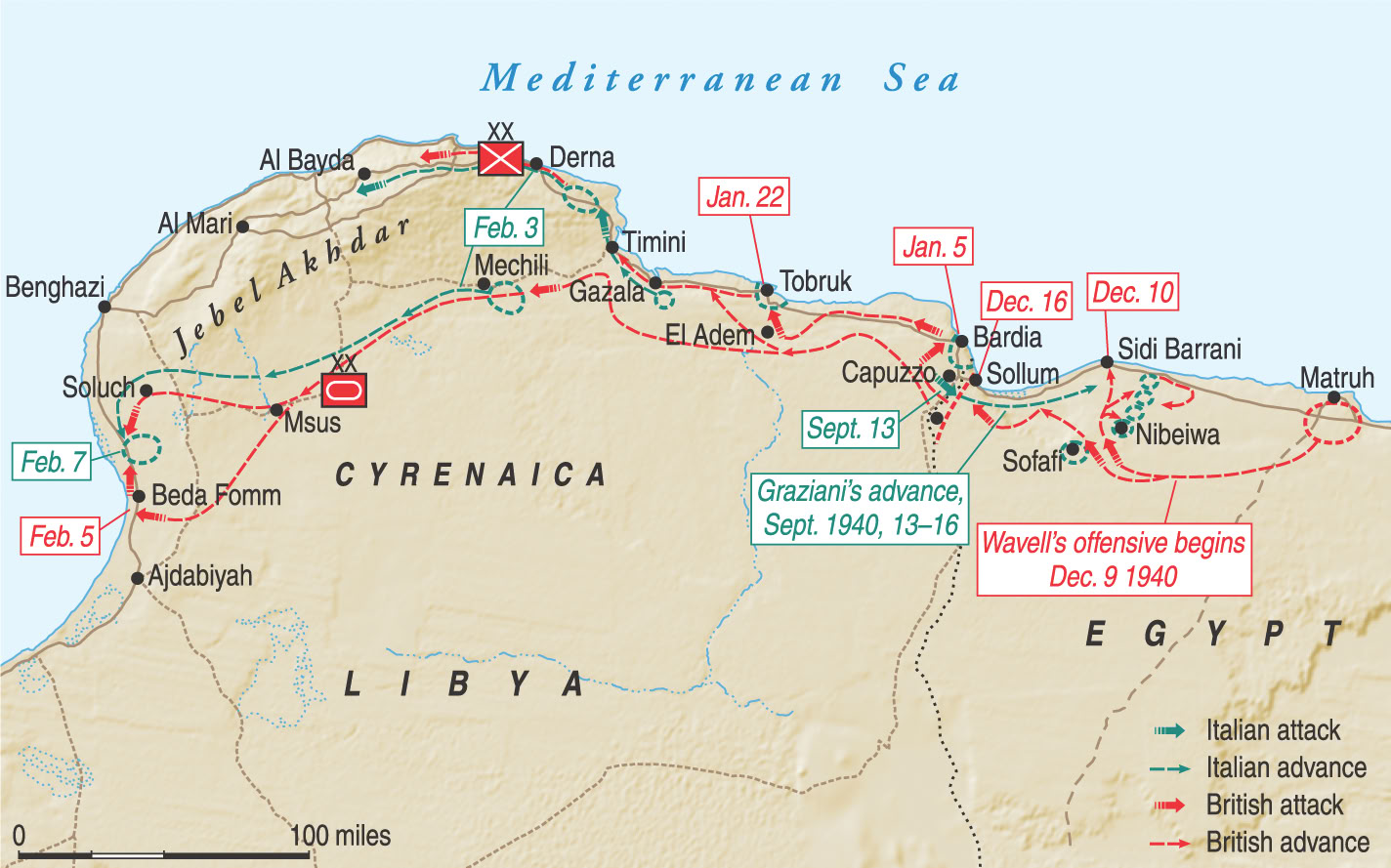
Beginning a cautious offensive from Libya, Graziani led five divisions into Egypt on September 13, 1940. Moving at the rate of 12 miles a day, they went down the Halfaya Pass and advanced on a narrow front along the Mediterranean coast. Sparse British covering forces, including a Coldstream Guards platoon holding Sollum, the first town in British Egypt, fell back. After reaching Sidi Barrani, 50 miles inside Egypt on September 16, the Italians set up a series of widely separated, fortified camps over a 50-mile area. Wavell’s forces—now two divisions strong—stood firm at Mersa Matruh, 75 miles to the east and 200 miles west of the Nile Delta. Both sides received reinforcements. Wavell gained three tank regiments, which had been rushed from England in three fast merchant ships on Churchill’s initiative.
General Sir Henry “Jumbo” Wilson, the bulky, able tactical commander in Egypt, hastily drew up plans to attack the Italians, but operations were delayed when Wavell was ordered to occupy Crete and send part of his air force to counter an Italian thrust into Greece. The Italians sat in their chain of camps in Libya and Egypt for several weeks without attempting to move on, so Wavell decided to sally forth and strike at them. He planned a large-scale raid, codenamed Operation Compass, rather than a sustained offensive—a sharp punch to stun the Italians in Libya while he diverted part of his strength to push back their army in Sudan. Although there were no resources for a followup, Operation Compass—a daring assault against a force four times its size—was to have an astonishing effect.
After careful planning and raids on Italian airfields by Royal Air Force Wellington and Blenheim medium bombers, Wavell’s thrust got underway on the cold night of December 7, 1940, as the Western Desert Force moved out from Mersa Matruh and headed westward across the desert. Comprising 31,000 men, 275 tanks, and 120 field guns of the 7th Armored Division, the 4th Indian Infantry Division, and the all-arms Selby Brigade, the force was commanded by bantam-sized, 51-year-old Lt. Gen. Richard N. O’Connor. A decorated veteran of the Western and Italian Fronts in World War I, he was to emerge as one of the most successful British generals of the 1939-45 conflict.

Spearheaded by 50 slow but heavily armored 26.5-ton Matilda tanks of the crack 7th Royal Tank Regiment, O’Connor’s Highland and Indian infantry—some riding Bren gun carriers—slipped through a gap in the enemy’s chain of camps on the night of December 8-9 and stormed the Nibeiwa camp from the rear. The garrison was taken by surprise, and 4,000 Italians were captured. The British suffered seven casualties.
The Matildas then led the way northward to swiftly seize the Italians’ Tummar West and Tummar East camps, while the 7th Armored Division pushed westward to reach the coast road and get astride the enemy’s line of retreat at Buq Buq. The Desert Rats captured 14,000 retreating Italians and 88 guns. The British troops pushed on toward the Italian camps clustered around Sidi Barrani, which had been heavily shelled by Royal Navy ships. The enemy were now on the alert, and sandstorms hindered the advance, but O’Connor’s force—supported now by truck-borne New Zealand infantry—seized the greater part of the Sidi Barrani position on December 10.
Some of Graziani’s green-uniformed troops—such as a small rearguard at Sollum on the Egyptian-Libyan border—held firm and fought bravely, but the dispirited majority tossed away their weapons and equipment and waited patiently for their captors to hand them rations, water, and cigarettes. Then, long columns started trudging toward Cairo. At Sidi Barrani, the British took 38,000 prisoners, 73 tanks, and 237 guns. On December 16, Marshal Graziani abandoned Sollum and retreated with four divisions up the coast to take refuge in a fortress at Bardia on the coast road in northeastern Libya.
Confident that his well-entrenched 45,000 troops and 400 guns could hold out indefinitely, General Annibale “Electric Whiskers” Bergonzoli declared, “We are in Bardia, and here we stay.” But General O’Connor had other ideas. Aided by RAF planes and shellfire from three Royal Navy battleships and seven destroyers, his force pressed westward as the Italians continued to surrender in droves. Great quantities of materiel fell into British hands. During a two-week pause, O’Connor’s overextended force waited for reinforcements. The 4th Indian Division was ordered to Sudan, and Major Gen. I.G. Mackay’s well-trained but unblooded 6th Australian Division was moved up 350 miles from the Nile Delta to join the assault on Bardia.
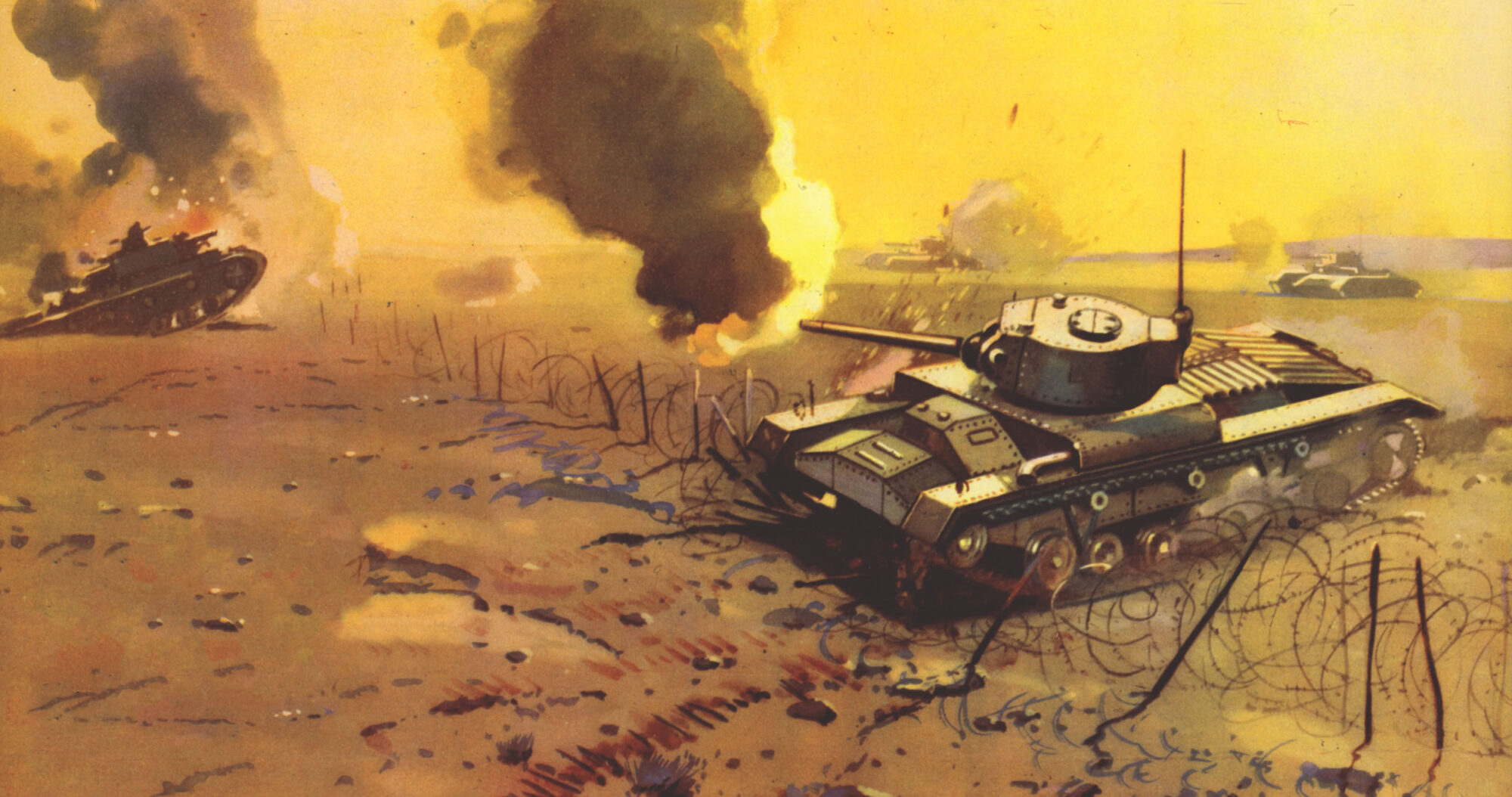
The attack began early on January 3, 1941, with the thunder of land and naval guns and 22 Matildas of the Royal Tank Regiment leading the way as “tin openers.” Sappers cut barbed wire, lifted mines, rammed Bangalore torpedoes into pillbox slits, and slung bridges across an antitank ditch. Yelling war cries, the Australians surged forward on foot and in Bren-gun carriers as the Matildas lumbered through breaches in defense positions and fanned out. Some Italian positions fought bravely, while others surrendered quickly when they saw their tank and antitank rounds bouncing harmlessly off the Matildas’ thick armor. General Mackay said that each Matilda was worth an infantry battalion to him.

As the tanks and Bren-gun carriers blasted their way through Bardia, thousands of dazed Italians crawled out of cellars and caves to surrender. General Bergonzoli took advantage of the fiery confusion to escape on foot westward to the coastal fortress of Tobruk. Resistance quickly collapsed in Bardia, and the British attackers rounded up 45,000 prisoners along with 129 tanks, 462 guns, and stockpiles of food, fuel, and water. The gallant Australians suffered 456 casualties.
Even before Bardia had fallen, General O’Connor ordered the 7th Armored Division to drive westward and isolate Tobruk before the Australians could mount an assault there. The only suitable deep-water harbor west of Alexandria, its capture was vital because the Western Desert Force was now operating at the extreme limits of logistical support. Tobruk was protected by a semicircle of sea defenses and a land perimeter of tripwire booby traps.
Backed by O’Connor’s 16 remaining Matilda tanks, the Australian infantry assaulted Tobruk on January 21. Sandstorms hindered air support, and the Italian artillery fired resolutely, but the attackers broke the defenses and by nightfall had occupied half of the Tobruk perimeter. That night, the defenders began blowing up their installations. Burning and wrecked, the fortress fell on the afternoon of January 22, yielding a bag of 30,000 prisoners, 87 tanks, 236 guns, 200 vehicles, and large quantities of materiel.
After many Australians were injured by mines and booby traps, Italians rushed to show British sappers where they were. The attackers suffered 400 casualties.
O’Connor’s force continued its westward offensive through the rest of January and early February. Reinforced with speedy British medium Cruiser tanks, the battered Matildas, Bren-gun carriers, and armored cars pushed westward through sandstorms across the desert and along the coast road to isolate and overwhelm a series of Italian outposts, from Sidi Rezegh, Gazala, and Derna, all the way to Beda Fomm, El Agheila, and Benghazi on the western Libyan coast.

Boldly executed and reminiscent of General Edmund Allenby’s breakthrough in Palestine in 1917, Operation Compass routed Graziani’s army and crushed almost all Italian resistance in North Africa. In two months, the Western Desert Force had advanced 400 miles, destroyed 400 tanks, 1,292 artillery pieces, and bagged 130,000 prisoners. At the cost of 476 dead and 1,225 wounded, the WDF had routed an army five times its number, enabling General O’Connor to signal Wavell, “Fox killed in the open.” Foreign Secretary Anthony Eden exulted to Churchill, “If I may debase a golden phrase, ‘never has so much been surrendered by so many to so few.’”
Without delay, the Royal Navy began to clear the Tobruk harbor of wrecks and make it usable so that O’Connor would no longer have to wait for all his supplies to be brought overland from the Nile Delta.
For the British people, bombed almost daily by the Germans and tested by a series of defeats, General O’Connor provided a much-needed morale boost. A delighted Churchill said, “Victory sparkled in the Libyan Desert, and across the Atlantic the great republic drew ever nearer to her duty and our aid.” But the euphoria was soon short-lived. The Germans planned to intervene in the Middle East, and a different kind of fox was about to arrive in North Africa.
After receiving a telegram from the prime minister on February 12, 1941, Wavell halted O’Connor’s offensive at the frontier of Tripolitania so that troops could be redirected to the defense of Greece, which ended with another Dunkirk. A strategic opportunity was lost in not pushing on to Tripoli, and the British were about to be confronted by a formidable foe and lose their gains during two years of seesaw struggles in North Africa.
On February 6, a young German general was summoned to Berlin by Nazi dictator Adolf Hitler and told to lead a small mechanized force—the 5th Light and the 15th Panzer Divisions—to Tripoli. He was Erwin Rommel, who had ably commanded the 7th Panzer Division in the 1940 French campaign. His orders were to recapture Benghazi and Cyrenaica, the eastern region of Libya. He flew to Tripoli on February 12, followed two days later by the first units, the nucleus of his Afrika Korps.

Rommel had been ordered not to start an offensive until his forces were up to strength. The tank regiment of the 5th Light Division did not reach Tripoli until March 11, but the audacious, resourceful general who would come to be known as the “Desert Fox” was eager to take the initiative against the overextended and depleted British forces. His timing was right. The Desert Rats were resting and refitting in Egypt, the 6th Australian Division had been sent to Greece, and Wavell’s replacement formations were inexperienced and short of equipment.
While waiting for more men, armor, and guns, Rommel rushed dummy tanks mounted on Volkswagen cars to the front in order to deceive the British about his strength. Disregarding higher orders to wait until the end of May, he decided to push on. He successfully occupied the El Agheila bottleneck and advanced on April 2 with 50 panzers followed by two new Italian divisions. The British fell back hastily in confusion as Rommel’s mechanized columns rumbled northward and eastward.
The fast-moving Germans rolled along the coast road toward Barce and Derna after bursting into Benghazi, which the British evacuated on April 3. During the retreat, General O’Connor, who had been given a rest, was sent up to advise his untried successor, Lt. Gen. Philip Neame. But their unescorted staff car ran into the rear of a German spearhead group on the night of April 6, and both officers were captured by a motorcycle patrol.
One of Rommel’s panzer columns captured inland fuel dumps and burst out onto the coastal plain at Gazala, and another column made a wide flanking movement to try and capture British units leaving Cyrenaica. Pushing on relentlessly eastward, Rommel’s increasing forces seized Bardia on April 11 and Sollum four days later. The British were in full retreat.
But the strategic port of Tobruk was bypassed in the enemy advance. As long as it remained in British hands, Rommel’s offensive was jeopardized. In a waterfront hotel there on April 8, General Wavell told a group of senior officers simply, “Tobruk must be held.” It would not be easy, he warned. Rommel would make every effort to drive the defenders into the sea, and all reinforcements and supplies would have to be brought in by ship under fire from German planes. Pointing out on a map the few remaining British units scattered across 450 miles of arid, scrubby desert, Wavell told the officers dryly, “There is nothing between you and Cairo.”

Rommel was aware of this. As he pushed eastward, the British stronghold of Tobruk posed a serious threat to his flank and rear, and its seizure became a seven-month obsession. The Desert Fox told one of his divisional commanders, “We must attack Tobruk with everything we have, before Tommy has time to dig in.” But Tommy had already dug in.
After withdrawing from Derna to escape Rommel’s net, the 9th Australian Division had moved into Tobruk to reinforce the British and Indian Army units there. The 23,000-man garrison was braced behind two old Italian inner defense perimeters that embraced a 30-foot antitank ditch, 70 strongpoints, and a minefield crisscrossed with barbed wire. The 30-mile outer perimeter, called the Red Line, was studded with concrete dugouts manned by machine-gun and Bren-gun crews. Elsewhere in the 220-square-mile Tobruk enclave were Matilda tanks, 25-pounder field guns, and antiaircraft batteries.
The garrison commander was Major Gen. Leslie J. Morshead, leader of the 9th Division and a resolute disciplinarian known to his troops as “Ming the Merciless,” after the villain in the popular Flash Gordon comic strips and serials. A former school teacher in Sydney, he was as tenacious as Rommel. “There’ll be no Dunkirk here,” he told his staff. “If we should have to get out, we shall fight our way out. There is to be no surrender and no retreat.”
Rommel started a drive to isolate Tobruk on April 11 with reconnaissance probes against the perimeter by panzer and infantry units. They were beaten off by artillery. Next, he decided to launch an armored assault on the southern perimeter in the early hours of April 14, Easter Monday. Expecting a swift victory, he wrote to his wife, Lucie, early that day, “Dear Lu, today may well see the end of the Battle of Tobruk.”
At 5:20 a.m., supported by artillery and screaming Stuka dive bombers, panzers clanked through a gap torn in the southern perimeter wire. Infantry followed. Australians huddling in the strongpoints let the tanks pass before loosing a murderous fire from the rear. Moving on until the leading battalion was two miles inside the perimeter, the panzers suddenly found themselves caught in a gauntlet of heavy fire, with British and Australian howitzers blasting both flanks at a range of 600 yards. Joining in the barrage were two-pounder antitank guns and captured Italian coastal guns.

The panzers milled around in confusion. One hit sheared off the turret of a panzer, a staff car was blown to bits, and a German machine-gun battalion suffered 75 percent casualties. The Allied gunners destroyed 16 out of 38 panzers, and the rest were forced to withdraw from the trap. One enemy tank commander later described the action as a “witches’ cauldron,” and said, “We were lucky to escape alive.” A furious Rommel stormed that his officers “lacked resolution.”
Another assault on Tobruk was tried on April 16. Rommel took personal command and sent the Italian Ariete Armored Division and an Italian infantry division against the western perimeter. The Italian tanks took refuge in a wadi, and Rommel could not induce their commanders to attack. The infantry took the brunt of an Australian assault and swiftly surrendered. A whole company gave up to a British scout car crew, and a total of 800 Italians were bagged. The Ariete Division lost 90 percent of its tanks to breakdowns. Rommel called off the attack the following day. He still believed that Tobruk could be taken, but he was underestimating the spirit of its defenders.
Twenty-man patrols sneaked out from Tobruk when darkness fell to harass the enemy. An entire battalion of a crack Italian Bersaglieri rifle regiment was captured one night, and an Indian Army patrol returned on another night with two small sacks containing 32 human ears. The men guarding the perimeters stayed underground in daytime to escape the attention of German snipers, and they swept away footprints outside their camouflaged dugouts so that Luftwaffe air crews would not see the tracks.
Besides the Germans and Italians, the Tobruk defenders battled heat, dust, lice, flies, dysentery, and fleas. “The desert fleas are famous,” reported a Royal Artillery battery sergeant, “and ours were obviously in the pay of the enemy. They marched up and down our twitching bodies until we thought we would go crazy.” After the defenders had been dubbed “rats in a trap” by Nazi propaganda, they started calling themselves the “Rats of Tobruk.” The name soon resounded in headlines throughout the British Empire.
Strafed and bombed regularly by the Luftwaffe, the soldiers stood firm in Tobruk. They slept and took shelter in stone houses, tunnels that had been dug by the Italians, and makeshift bunkers. Fresh food was sparse, but vitamin tablets were issued. Water was rationed to six pints a day. Some drinking water was produced in stills made from old gasoline cans, but the taste was sulfurous. The troops subsisted mainly on the old British Army standby of bully beef, along with canned stew and fruit, and rocky army biscuits.
Morale remained high despite boredom and the dust that blew almost constantly through the town. When not manning their guns, the defenders staged variety shows in an improvised theater, gambled, and listened nightly to BBC news broadcasts and the famous chimes of Big Ben from London, and to Lale Andersen’s haunting Lili Marlene. The German soldiers’ favorite ballad became the unofficial anthem of all desert soldiers.
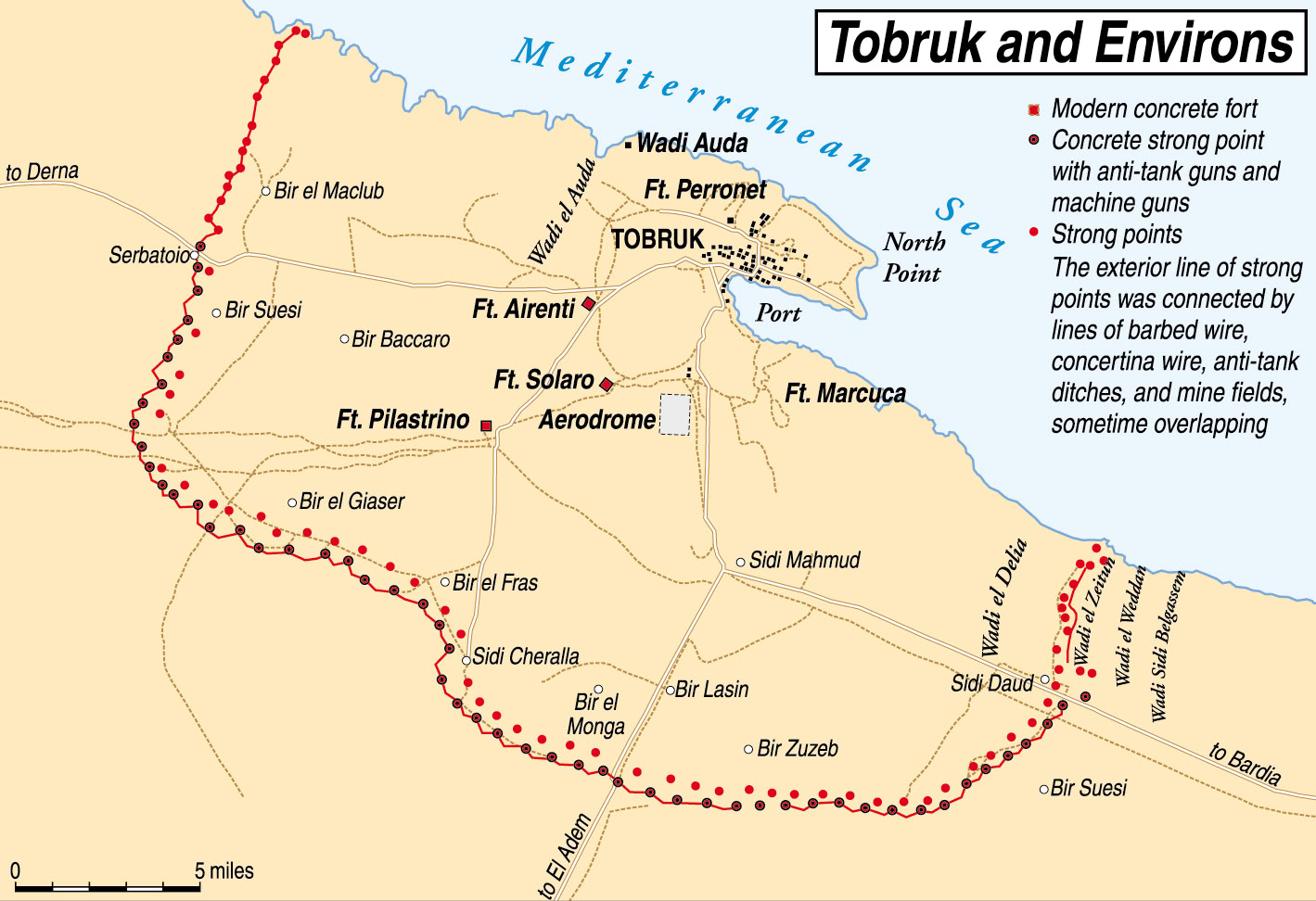
After receiving panzer reinforcements, General Rommel hastily planned a third attack on the stronghold, his heaviest yet. At 6:30 p.m. on April 30, 1941, Stukas and artillery pounded the Allied positions while tank and grenadier units rushed the southwestern corner of the Tobruk enclave. Although British intelligence had forewarned of the operation, the enemy managed to gain a toehold on the outer defense lines and push two miles inside the perimeter. But Rommel’s losses were again heavy.
The invaders failed to eliminate several outposts manned by Australian troops, who fought, Rommel reported, “with remarkable tenacity.” He noted, “Even their wounded went on defending themselves and stayed in the fight to their last breath.” The action raged on through the night, and the Allied strongpoints were still firing the following morning. As they harassed the enemy from behind, British units retaliated with tank and 25-pounder salvoes. Dust storms hampered tactical coordination on both sides.
The seesaw struggle continued for three days until Rommel called off the operation on May 4. It had been his most costly attack, and the Afrika Korps had lost more than 1,000 men. His troops retained a two-mile-deep salient near Fort Pilastrino for the rest of the siege. Lt. Gen. Friedrich Paulus, who had been sent by the Army High Command to observe the campaign, was shocked by the casualties and reported that the German troops were “fighting in conditions that are inhuman and intolerable.” He told Rommel that there was no chance of capturing the British stronghold.
The failure to seize Tobruk—the forward base Rommel sorely needed for a proposed thrust into Egypt—was the Wehrmacht’s first major reverse of the war. The Desert Fox received orders from Berlin forbidding him to attack Tobruk again or from advancing further. He was told to hold his position and conserve his strength. The hard-driving general bitterly resented waging a defensive campaign.
Heartened by Rommel’s unexpected setback, British troops pushed out from their defensive line in western Egypt and drove the Germans and Italians back toward the strategic Halfaya Pass near Sollum. The British and Commonwealth forces destroyed about 300 German tanks and inflicted 38,000 casualties (twice those of the Allies). They had been reinforced by the arrival of a fast convoy carrying almost 300 tanks, on the orders of Prime Minister Churchill.
In fierce fighting, the British cleared the enemy from “Hellfire Pass,” but were then driven off themselves by panzers and the fire of deadly 88mm flak guns. Both sides suffered heavy losses. The Afrika Korps was able to recapture most of the territory gained by O’Connor the previous year, but Tobruk held out.

While Wavell’s costly Operations Brevity and Battleaxe kept the Afrika Korps occupied during May and June 1941, the Tobruk garrison enjoyed a brief lull. But General Morshead faced problems. His brigades had lost 823 men killed, 2,214 wounded, and about 700 captured in the April fighting. Believing that the “Diggers” had done enough, the government in Canberra demanded that its remaining troops pull out and rejoin other Australian units in Egypt.
So, in daring night operations carried out under the noses of the enemy, most of the garrison was replaced by a total of 34,000 fresh British, Indian, South African, and Polish troops. Morshead’s division was replaced by the newly-formed British 70th Infantry Division, and only one Australian battalion was left within the perimeter. Getting the Aussies out and their replacements in under the constant threat of air strikes and U-boat attacks involved a high risk for the hard-pressed Royal Navy, and Admiral Sir Andrew “ABC” Cunningham, commander of the Mediterranean Fleet, protested.
He rose to the challenge, nevertheless, and the operation was carried out on nine moonless nights between mid-August and late October. Along with the infantry, British ships ferried in an armored brigade and more than 60 tanks, most of them Matildas. The transports berthed in darkness between the rusting hulks of Italian vessels in the harbor, were swiftly unloaded and were on their way back to Alexandria or Mersa Matruh within the hour. Seven thousand wounded and 7,000 prisoners were taken out of Tobruk, now commanded by the gallant but inexperienced South African Major Gen. Hendrik B. Klopper.
After four months of relative calm, the Germans started increasing their attacks on the stronghold. This time, the defenders faced the scourge of 88mm flak guns. Originally used as an antiaircraft gun, the versatile 88 proved devastating as an artillery and antitank weapon. “It could go through all our tanks like a knife through butter,” reported one British soldier.
Tobruk was hammered by 100 Stukas at the beginning of September 1941, and panzer assaults were beaten off through October, the sixth month of the siege. On November 17, heavy rains lashed the Western Desert, turning the sands into a sea of mud as Lt. Gen. Sir Alan Cunningham’s newly-formed British Eighth Army churned forward in Operation Crusader. The ambitious plan was aimed at luring Rommel’s armor into battle and relieving Tobruk.
On the following day, Royal Tank Corps formations clashed in driving rain with panzer elements around Sidi Rezegh, 10 miles southeast of the Tobruk perimeter. Eventually, after bitter fighting with heavy losses on both sides, hardy New Zealand infantrymen with fixed bayonets linked up with Matildas from Tobruk that had battered through the German lines. With highland bagpipes skirling, relieving troops marched into Tobruk on December 10. On the following day, Churchill rose in the House of Commons and triumphantly announced, “The enemy, who has fought with the utmost stubbornness and enterprise, has paid the price of his valor, and it may well be that the second phase of the Battle of Libya will gather more easily the fruits of the first than has been our experience, so far.” Through the rest of December 1941, the Afrika Korps withdrew westward, skillfully thwarting each British outflanking movement.

But the determined Rommel was far from being finished. After a five-month lull during which his German and Italian forces were further built up, he launched another offensive on May 26, 1942. Panzers and infantry regiments hit the Gazala Line, swung south around Bir Hacheim, valiantly defended by dynamic General Marie-Pierre Koenig’s 1st Free French Brigade, and battled with British Guards Brigade and armored units in the “Cauldron,” an area so called because of its relentless heat and the intensity of the action there.
After inflicting heavy losses in men and armor on the British, the Afrika Korps panzers clanked out of the Cauldron, swept northward, and headed for Tobruk. After bombings and fierce raids by Stukas in the early hours of June 20, 1942, Rommel’s tanks and infantry blasted their way into the stronghold. They were through the main defense positions by the afternoon and reached the harbor by the evening. The British, Indian, and South African defenders had fought bravely, but, outgunned and outnumbered three to one, were overwhelmed.
The garrison surrendered on June 21, though not all of Klopper’s troops obeyed the order to cease fighting. The 2nd Battalion of the 7th Gurkha Rifles broke through the perimeter, and it took an Italian corps several weeks to round up the tough little Nepalese warriors, some of whom reached Sollum. One enterprising sergeant scrounged Arab garments and a camel and trudged 400 miles back to Egypt to rejoin the Eighth Army. A truck convoy carrying about 400 British troops, half of them Coldstream Guards, skirted Italian defense lines and German supply columns and managed to reach the Eighth Army.
The last unit to lay down its arms in Tobruk was the 2nd Battalion of the Cameron Highlanders, which fought on for 24 hours before it became obvious that there had been a general capitulation. While some of his men tried to escape on foot, Lt. Col. Colin Duncan, the commanding officer, marched his battalion into captivity with heads high and bagpipers playing the regimental march. Angered by the display of swagger, a German major tried to order the Highlanders off the road, and Duncan felled him with his fist.
Rommel’s troops took 33,000 prisoners, mountains of rations and other stores, and 500,000 gallons of much-needed fuel to replenish his scanty reserves. The triumphant Desert Fox, who had succeeded in removing a troubling thorn from his side, told a group of captured British officers, “Gentlemen, you have fought like lions and been led by donkeys.”
After the Allied troops had been herded into a temporary prisoner-of-war cage in Derna, Rommel allowed General Klopper to address his fellow captives through a loudspeaker. Heckled and booed, he had to withdraw without delivering his message. “Everyone believed he had sold out to the enemy,” reported Gunner W.A. Lewis of the Royal Artillery. After the war, the hapless Klopper faced a court of inquiry but was exonerated.

Coming four months after the disastrous surrender of Singapore, the fall of Tobruk dismayed the hard-pressed British and their far-flung colonial allies. Visiting Washington to confer with President Franklin D. Roosevelt about plans for Operation Bolero, the buildup for the Allied invasion of France, Churchill took the news badly on June 21. Burdened by a series of defeats since 1940, he said, “I did not attempt to hide from the president the shock I received. It was a bitter moment. Defeat is one thing; disgrace is another.” He confessed privately that he was the most miserable Englishman in America since Burgoyne had surrendered at Saratoga.
Roosevelt asked, “What can we do to help?” Churchill responded, “Give us as many Sherman tanks as you can spare, and ship them to the Middle East as quickly as possible.” FDR called in General George C. Marshall, Army chief of staff, to explain the prime minister’s plight. Three hundred brand-new M4 Sherman medium tanks and 100 self-propelled 105mm artillery pieces were promptly loaded aboard six fast ships and sent to the Suez Canal. When one of the freighters was torpedoed off Bermuda, FDR and Marshall dispatched another vessel with 70 tanks. The weapons reached Egypt in September, just in time to be used when the revitalized Eighth Army launched its next major offensive.
Returning to the House of Commons, Churchill said of the surrender of Tobruk, “Not only were its military effects grievous, but it had affected the reputation of the British armies.” He faced a vote of no confidence but survived it 475 to 25 votes.
Rommel held onto Tobruk, which changed hands three times during the desert campaigns. But his fortunes waned when the Eighth Army, now led by the able, peppery General Bernard Montgomery, started pushing back on the night of October 23, 1942, in the Second Battle of El Alamein, the first major turning point of the war. With the Afrika Korps in full retreat, British and Commonwealth armor and infantry reached the Egyptian border on November 11, and retook Tobruk on the 13th.
The 242-day siege of Tobruk was dramatized effectively in a 20th Century-Fox film, The Desert Rats. Released in 1953 and directed by Robert Wise, it starred Richard Burton, James Mason, Robert Newton, and Chips Rafferty.
The late Michael D. Hull wrote on a variety of topics for WWII History. He resided in Enfield, Connecticut.
Join The Conversation
Comments
View All Comments