Latest Posts
Claringbould and Ingman’s ‘Solomons Air War Volume 1’
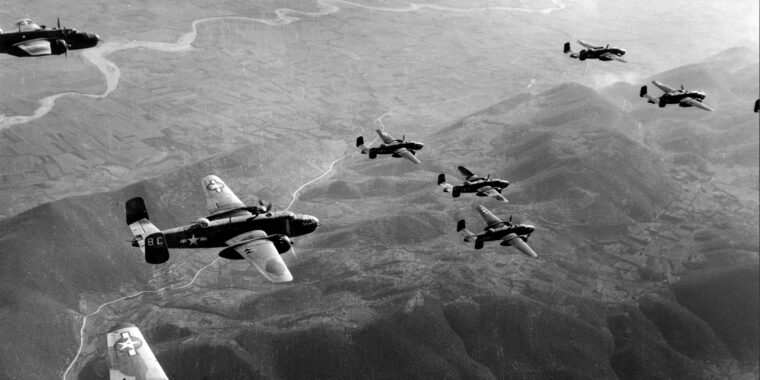
By Christopher MiskimonAt 1 p.m. on August 7, 1942, Lieutenant (jg) Gordon Firebaugh took off from the carrier USS Enterprise leading six Grumman F4F Wildcat fighters. Read more
Latest Posts
At 1 p.m. on August 7, 1942, Lieutenant (jg) Gordon Firebaugh took off from the carrier USS Enterprise leading six Grumman F4F Wildcat fighters. Read more
Latest Posts
By April 1945, Hitler suffered from several mental and physical ailments. These included an advanced case of Parkinson’s Disease, heart disease, and gastrointestinal disorders along with other minor illnesses. Read more
Latest Posts
The 1st Marine Division was on the move toward the Yalu River. With any luck, if the weather cooperated, the Korean War, or rather, the United Nations police action in Korea, would be over in weeks. Read more
Latest Posts
By the early spring of 1865, the Southern Confederacy was on the cusp of extinction. In every theater of the four-year-old Civil War, the gray-clad Rebels were getting the worst of things. Read more
Latest Posts
Welcome to WWII History’s new format and publishing frequency—you’ll now find more pages, and more stories, in each issue. Read more
Latest Posts
Despite the incessant German shelling that had been hammering away at the French lines to their immediate left near the rubble-strewn city of Ypres in northwestern Belgium, the largely untested soldiers of the Canadian 1st Division found the early spring day of April 22, 1915, surprisingly warm and pleasant. Read more
Latest Posts
It was the autumn of 333 bc and Alexander the Great stood triumphant on the battlefield of Issus. Read more
Latest Posts
When rebel peasants under a charismatic army deserter named Liu Pang descended on the capital city of Hsien Yang in 206 bc, they did so under the considerable shadow of the Ch’in dynasty’s former ruler, Shih Huang-ti. Read more
Latest Posts
In the Age of Reason, even wars were fought reasonably. Well-ordered marches, carefully dressed ranks of impeccably turned-out soldiers, and elaborately sketched battle plans were the order of the day in the so-called “lace wars” of the mid-18th century. Read more
Latest Posts
Two men were seated on either side of a paper-strewn table inside an office of MI5, the British intelligence service, in the Royal Victoria Patriotic School at Clapham, London, shortly after the fall of France in the spring of 1940. Read more
Latest Posts
By the spring of 1645, the open warfare between King Charles I and his rebellious Parliament had dragged on for nearly three years, with no apparent end in sight. Read more
Latest Posts
On a gloomy Friday morning, September 26, 1777, an advance party of the British Army marched into Philadelphia to take possession of the city. Read more
Latest Posts
When the United States entered World War I in April 1917, the nation’s Navy was shockingly short of combat ships—particularly the submarine chasers that would be vital to combating the German U-boat menace. Read more
Latest Posts
The British Army of soldiers, Royal Marines and naval infantry—actually sailors from His Majesty’s Navy fighting on dry land with musket, pike and cutlass—were marching full-tilt for the capital of the United States this hot, sweltering August 24, 1814. Read more
Latest Posts
In the long and distinguished history of the U.S. Marine Corps, thousands of marines have been awarded medals for meritorious service on the battlefield. Read more
Latest Posts
By mid-afternoon on September 17, 1862, the Army of the Potomac and the Army of Northern Virginia were locked in mortal combat on the rolling hills overlooking the sluggish waters of Antietam Creek in northwestern Maryland. Read more
Latest Posts
On a hot, dusty September morning in 1631, the Imperial Army of the Holy Roman Emperor rested easily on the plains outside the village of Breitenfield, six miles north of Leipzig, Saxony. Read more
Latest Posts
Before the fighting even began, before the first impassioned chorus of “On to Richmond!” was raised by the men in blue, the soldiers comprising the Union Army of the Potomac during the Civil War had to create their own precarious living quarters in the forested wilderness of the eastern seaboard. Read more
Latest Posts
On April 23, 1809, Prince Jerome Bonaparte, king of Westphalia, a German satellite state given to him by his elder brother Emperor Napoleon I, sat astride a large white horse at the Holland Gate leading into the capital city of Cassel. Read more
Latest Posts
The author enlisted in the U.S. Army at 18 in 1975. He later went to West Point and gained a commission. Read more