
By Michael E. Haskew
By 1945, refinements in technology and military doctrine had resulted in the acknowledgment that control of the air was critical to successful operations on land or sea. Those who had doubted that air power would become preeminent need only assess the fates of the U.S. Pacific Fleet at Pearl Harbor or the Italian Navy at Taranto, attacked and seriously damaged from the air, not by other ships. They might grudgingly admit that the British battleship Prince of Wales and battlecruiser Repulse, sunk by Japanese planes, had been on their own without air cover. They may have borne witness to the fact that waves of heavy four-engine bombers had pounded the Third Reich and laid waste to Japan’s cities. It was also apparent that U.S. and British forces had been victorious on the Western Front in large part due to their domination of the air. German forces simply could not move in daylight for fear of devastation from Allied fighter bombers.
Even in its infancy, air power had played a role in shaping the psyche of military thinkers. During World War I, the aerial dogfights between canvas and wood fighter planes received the greatest attention, but both Germany and Britain did bomb one another from the air. The Germans sent planes and lighter-than-air zeppelins against London, for example.
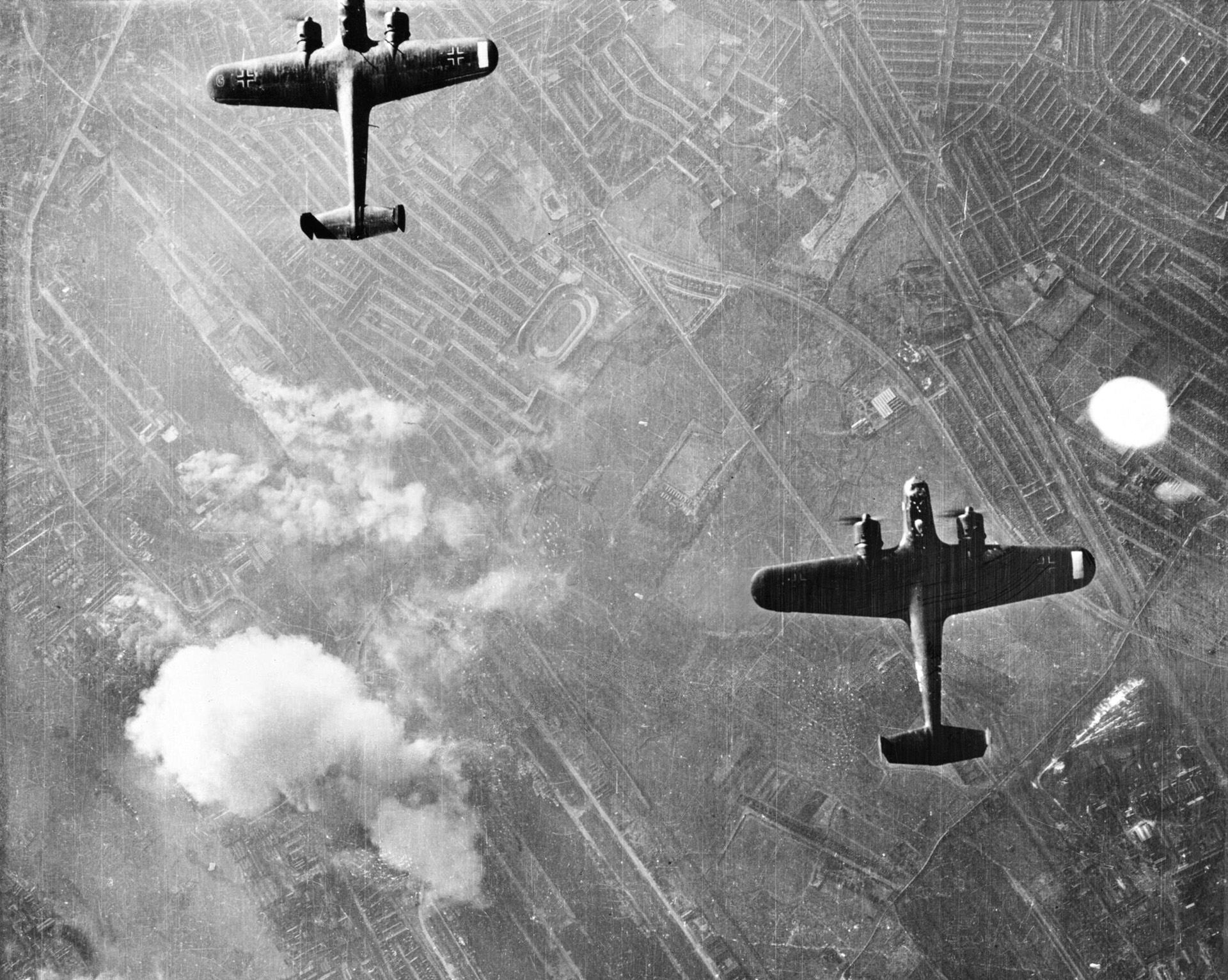
Less than two decades later, the air war in Europe escalated quickly, from uncoordinated and ineffective raids and fighter sorties to major operations involving numbers of aircraft and personnel in the thousands. The Nazi terror bombing of British cities, the tactical coordination of the blitzkrieg, and the Pyrrhic sacrifice of the Luftwaffe in the last days of the war proved the validity of the warnings offered by air power pioneers, as did the growth of the Royal Air Force and the U.S. Army Air Forces, whose planes and pilots won control of the skies.
Few military leaders may truly be categorized as visionaries; however, in the case of aviation the moniker applies to three forward thinkers. In the United States, General Billy Mitchell, assistant commander of the Army Air Corps, was so vocal in his condemnation of the Army and Navy for refusing to recognize the necessity of a separate air arm that he was court-martialed for insubordination. Mitchell even demonstrated the capabilities of aircraft by sinking six obsolete ships with bombs. He staked his career on his belief in air power and was ultimately vindicated.
In Great Britain, Air Chief Marshal Hugh Trenchard had commanded the Royal Flying Corps during World War I. Trenchard argued against those who would have slashed appropriations for aircraft during a time when his cash-strapped nation was looking to cut its defense budget. He also spoke of the important role strategic bombing would play in the next war. Trenchard wanted at least to maintain a small, well-equipped Royal Air Force that could potentially expand to meet any growing threat. When the victorious German Army stood poised to cross the English Channel and invade Britain in 1940, it was indeed a handful of young fighter pilots who denied control of the air to the Germans and thwarted Hitler’s Operation Sea Lion.
In 1921, Italian General Giulio Douhet published a book titled Command of the Air. In it, he described the tremendous destructive power of strategic bombing. Prophetically, he was a proponent of striking at an enemy’s capacity to wage war, destroying factories and supply centers while eroding the morale of the enemy’s civilian population. For Douhet, the bomber was the premiere weapon of future wars.
In the midst of an incredible aerial bombardment, Douhet reasoned, “the time would soon come when, to put an end to horror and suffering, the people themselves, driven by the instinct of self preservation, would rise up and demand an end to the war—this before their Army and Navy had time to mobilize at all!”
Douhet may have carried his rationale somewhat beyond the outcome of actual events, but the roll call of European cities devastated by bombing validates to a large extent his vision of war in the mid-20th century. The air war in Europe was an epic struggle the likes of which had never been seen before—and will never be seen again.
Join The Conversation
Comments
View All Comments