By Robert T. Ross
On June 2, 2019, just days ahead of the 75th anniversary of D-Day, the June 6, 1944, Allied landings on the northern coast of France, the Washington Post published an article written by Pulitzer Prize-winner Scott Higham, which asked these questions: Was the attack on the German coastal battery atop Pointe du Hoc—“one of D-Day’s most famous, heroic assaults”—necessary? Did the commander of the Ranger force disobey his orders? Were the guns at Pointe du Hoc moved and abandoned by the time of D-Day? Did Allied Intelligence completely fail to detect a massive German artillery battery that would inflict terrible casualties on the troops landing at Omaha Beach? Then, did the Allies attempt to bury the facts?
Higham’s is the latest in a line of articles that ask the same questions, amplifying claims that are fueling a historical debate. Recent additions and alterations to certain Wikipedia pages now also call the circumstances and events surrounding the battle at Pointe du Hoc, and the integrity of one of that battle’s central figures, into question.
Some of the controversy may stem from the rediscovery by some writers of the long-forgotten Wehrmacht Widerstandsnest 83 (Wn83), the center of which lies in a Norman field some 3.58 miles (5.77 kilometers) west of the tip of Pointe du Hoc, approximately 7 miles from the western-most boundary of Omaha Beach proper, near the village of Maisy. Wn83 was one of forty-two such fortified resistance nests, or strong points, dotted along what became known as the Omaha sector of Normandy, between Isigny and La Fosse-Buhot. In all, more than a hundred such Atlantikwall positions crouched at the Norman channel coast behind the eventual D-Day landing beaches code-named Utah, Omaha, Gold, Juno and Sword.
The Most Dangerous Battery In France
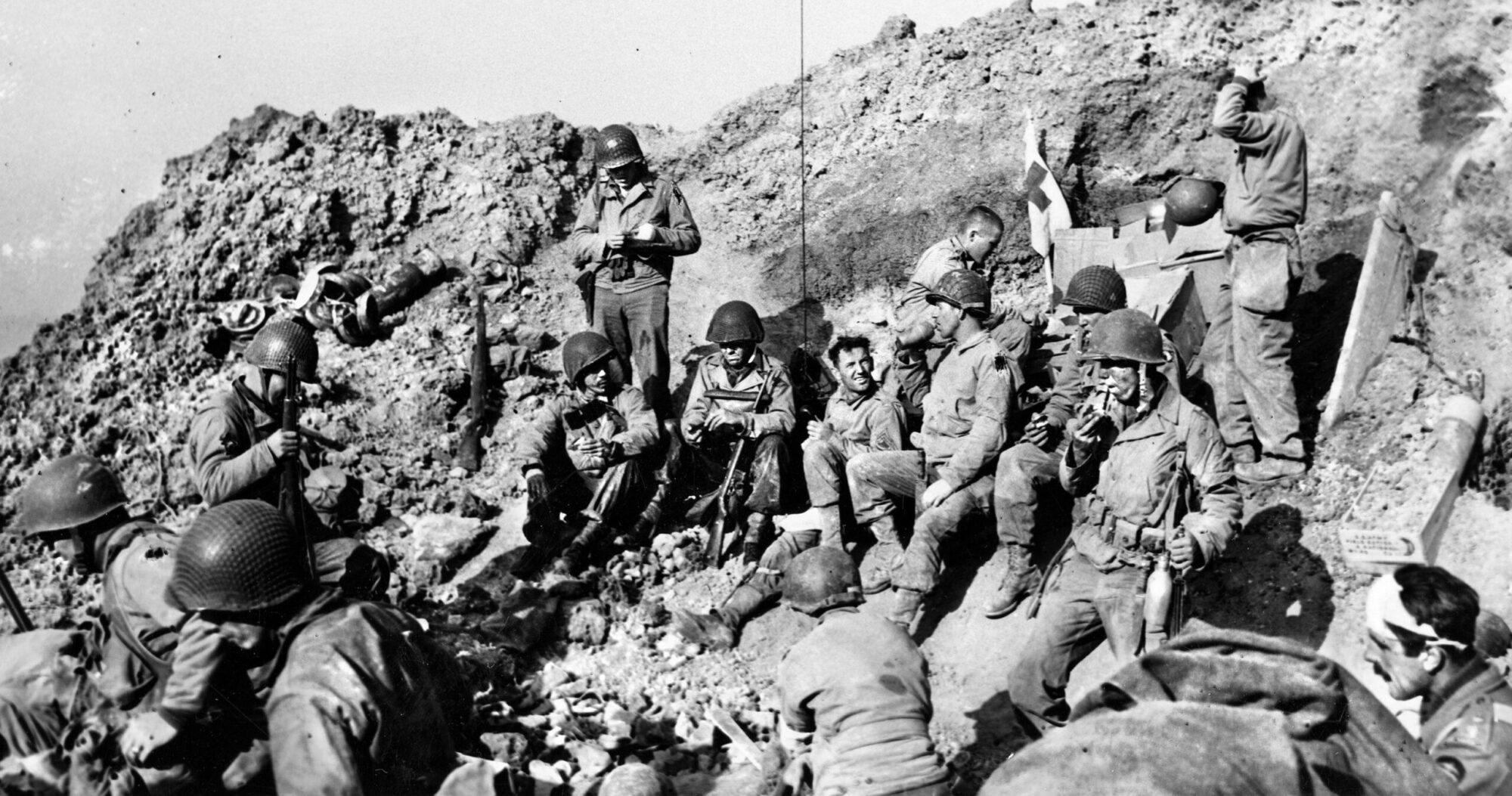
At 0708 on D-Day morning, after a miserable two-hour run-in to the shore, suffering heavy seas and enemy fire along the way, nine British-crewed assault landing craft (LCA) carrying the men of D, E and F Companies of the U.S. 2nd Ranger Infantry Battalion, along with headquarters elements, touched down along the narrow, shell-pocked, strip of beach at the base of Pointe du Hoc’s 100-foot-high cliffs. Along with these specially trained Rangers—themselves comprising about half the 2nd Ranger Infantry Battalion—was a small medical detachment, an air liaison officer, forward observers from the 58th Armored Field Artillery Battalion (105-mm), two British Commandos, four soldiers from the 29th Division Reconnaissance Troop, men of Naval Shore Fire Control Party #1, and several Stars & Stripes Photographers. Known collectively as “Force A,” there were 194 in all, commanded by Lieutenant Colonel James E. Rudder. Their mission was to scale the cliffs, capture the enemy battery position and observation post atop it, and destroy six 155-mm cannons that could hurl their 95-pound projectiles farther than 10 miles; within range of the transport areas at sea, endangering both the Utah and Omaha Beach landing forces.
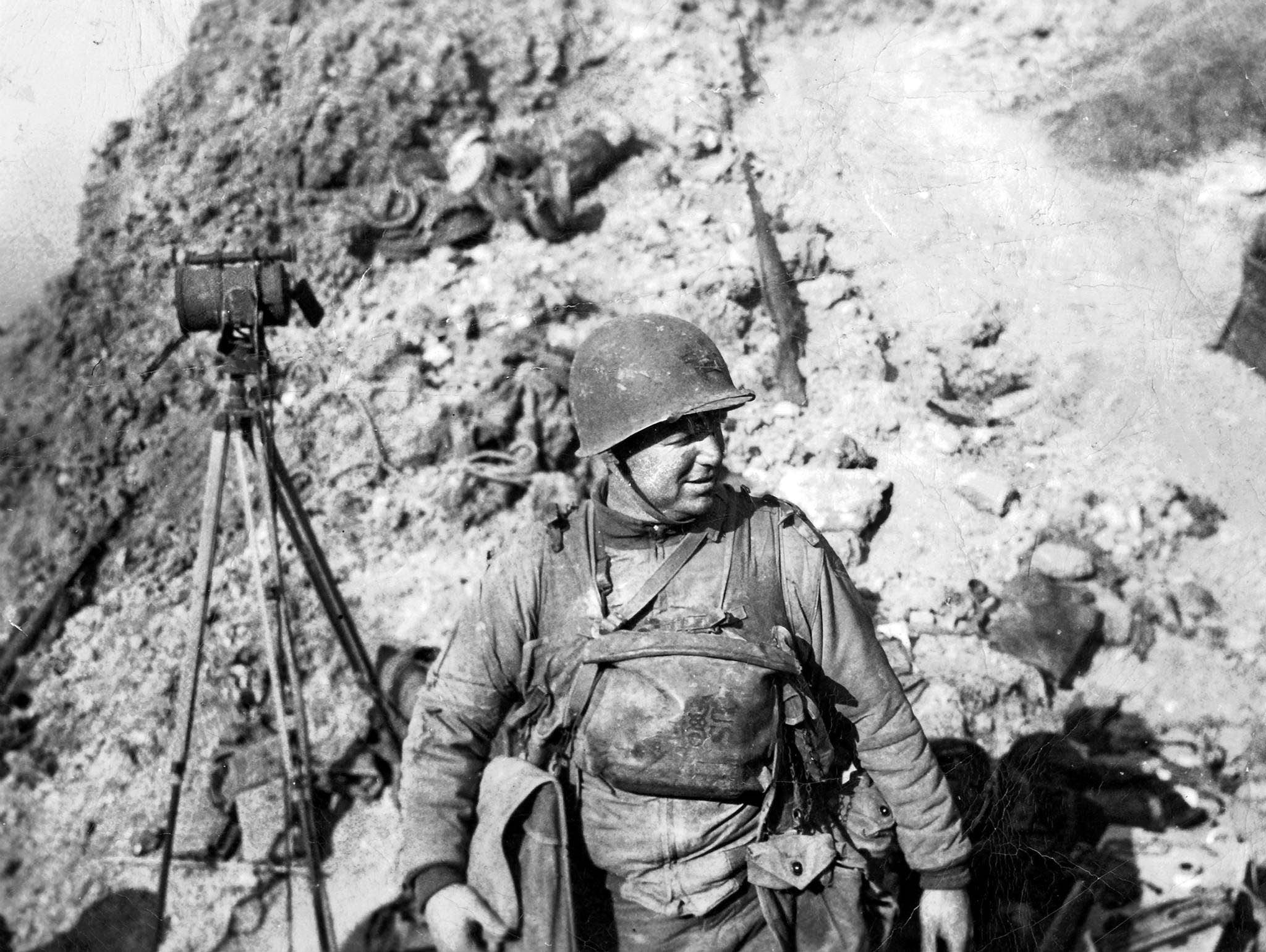
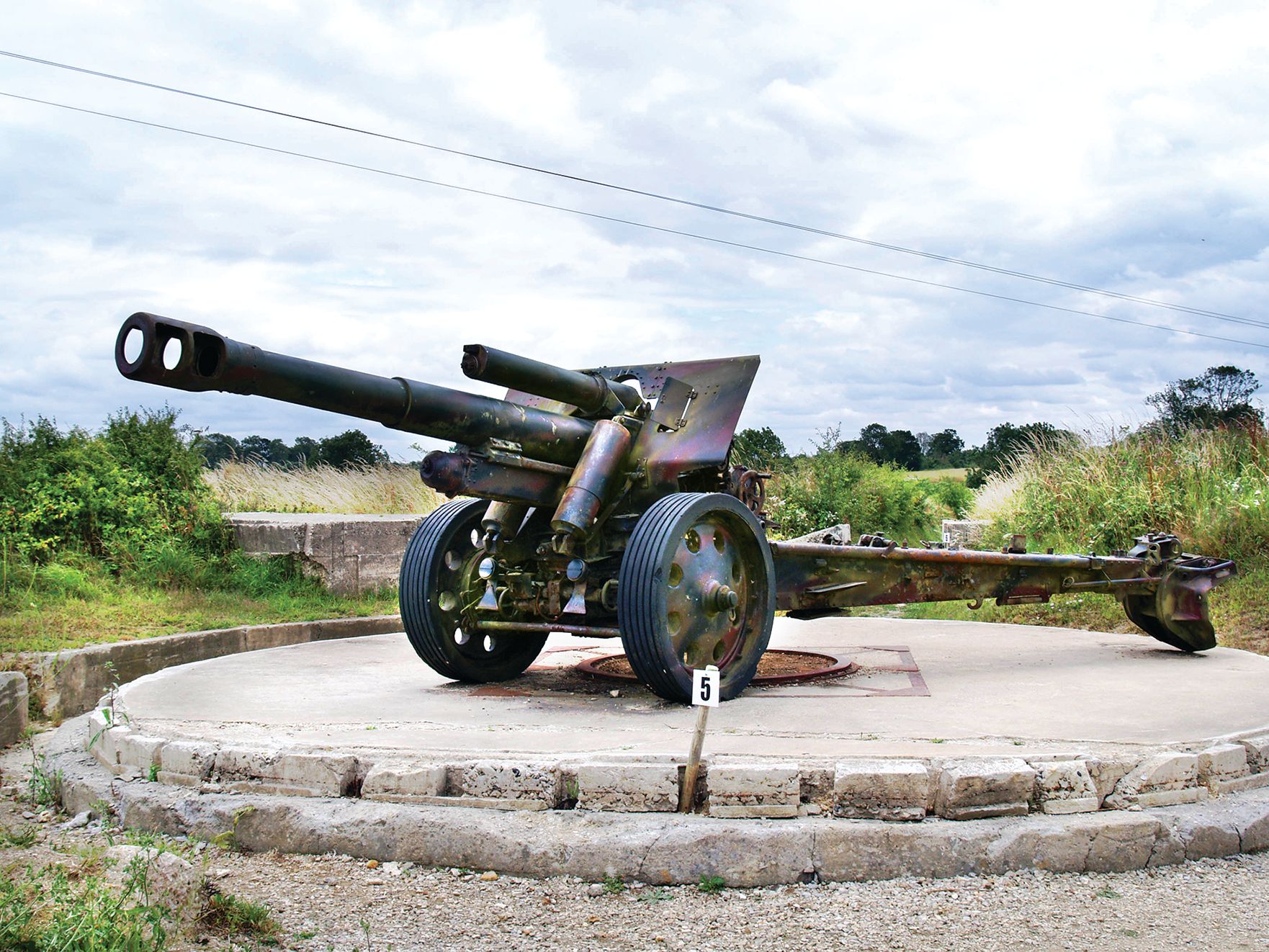
These big guns were officially designated as 155-mm Mle 1917 Grande Puissance Filloux of immediate post-World War I French manufacture, seized and put into service by the Germans soon after the defeat of the French Army in 1940. The Germans had reclassified the cannons to their own ordnance specifications as 15.5 cm K 418(f). Known as “Stp. Point du Hoe” on German maps, the Pointe du Hoc battery was manned by Wehrmacht 2./1260 HKA-Abt. (Heeres Küsten Artillerie Abteilung HKAA) or Army Coast Artillery Battalion). The approximately 80 artillerymen of the 2nd Battery, 1260th Battalion were further reinforced by 140 infantrymen of I. / Grenadier-Regiment 726.
Months before, when informed of his D-Day mission by Truman Thorson, G-3 (Plans and Operations Officer) of the U.S. First Army, Rudder, accompanied by Lt. Col. Max F. Schneider, commander of the 5th Ranger Infantry Battalion, who was with him that day to receive the order, was in near disbelief. One naval staff officer present was even heard to say, “Three old women with brooms could keep the Rangers from climbing that cliff.” U.S. First Army commander, Omar N. Bradley admitted that “No soldier in my command has ever been wished a more difficult task than that which befell the 34-year-old commander of this Provisional Ranger Force.”
The Pointe du Hoc battery was designated priority as “Target 1” on Allied pre-D-Day bombing plans. Commencing two months prior to D-Day, tactical bombers, in three separate missions, pounded Pointe du Hoc’s defenses to slow down further hardening of the site. The air attacks culminated in a major strike by RAF heavy bombers during the night of 5/6 June. At 0550 on D-Day, the battleship USS Texas unleashed a devastating barrage upon the site with her 14-inch main guns. As one final step, medium bombers again struck the Pointe from the air at H-minus 20 minutes [or H-20].
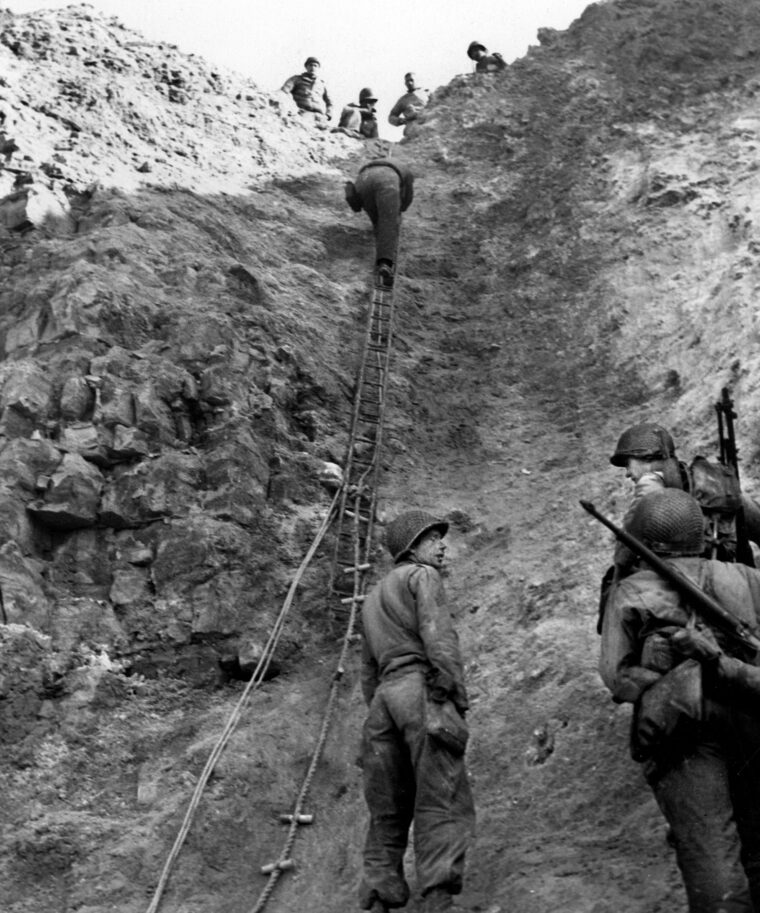
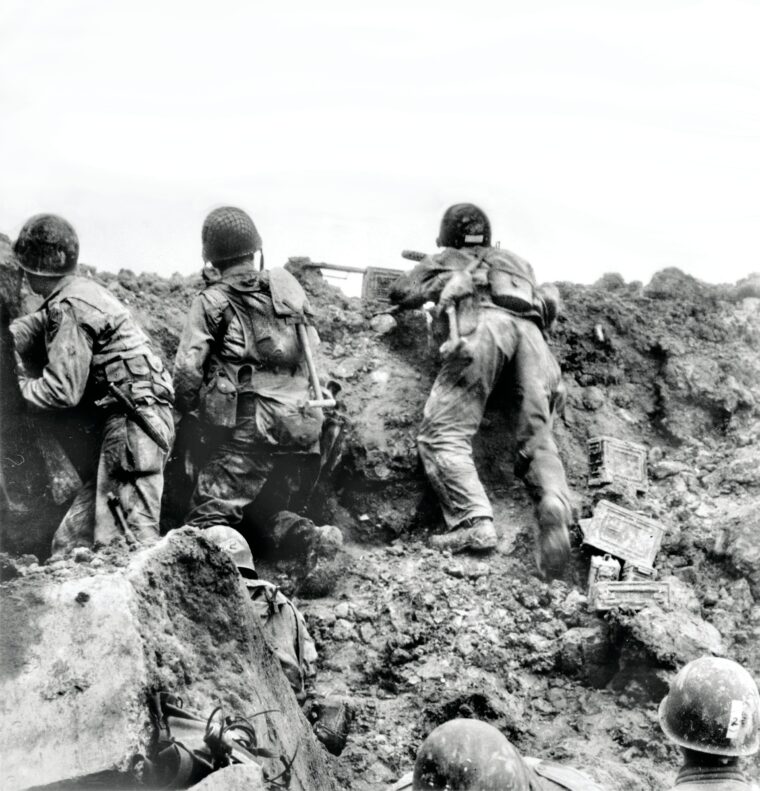
Using specially designed grapnel-tipped rocket projectors fitted to their landing craft to fire ropes and rope-ladders over the cliff face, the Rangers, in full view of the enemy, struggled ashore and began to climb. All the while, the German defenders rained down grenades and small arms fire upon them. Many Rangers were hit and fell. Others returned fire. One by one, some managed to surmount the cliff. Others followed. Reaching the top, the Rangers found a bomb-rent lunar-like terrain, nearly devoid of previously existing landmarks. As individuals, and in small groups, the men set out toward their separate objectives: chief among them the six revetted gun emplacements and the observation post at the Pointe’s tip.
By 0900 that morning, against determined resistance, the Rangers accomplished their primary mission, sealing off German coastal observation from the Pointe, and putting the 155-mm cannons out of action. Two weak Ranger patrols had discovered five of the guns—it was later determined that the sixth had been destroyed in its original revetted gun pit position by pre-D-Day aerial bombardment—some three-quarters of a mile south of their former battery position at Pointe du Hoc, dug in and well-camouflaged in firing position along a “tunneled lane” with ample supply of ammunition.
“In order to prevent further damage to the cannons from bombing attacks, the guns were removed during the night of the 25th to 26th April (1944) from the ring emplacements and drawn with great difficulty by the four old horses to a site 1300 meters away, in a narrow depression at the edge of a small apple plantation. There, they were placed under trees and made operational again over the next few days…. In order to make the five guns relatively invisible from the air, they were covered with camouflage netting that was hung between the trees. The gun crews had to conduct operations from this position from that time forward. Since it was to be expected that the position would now be identifiable by reconnaissance aircraft, the battery commander gave the order immediately that decoys were to be built, using telegraph poles that remained in the reasonably intact ring emplacements.”
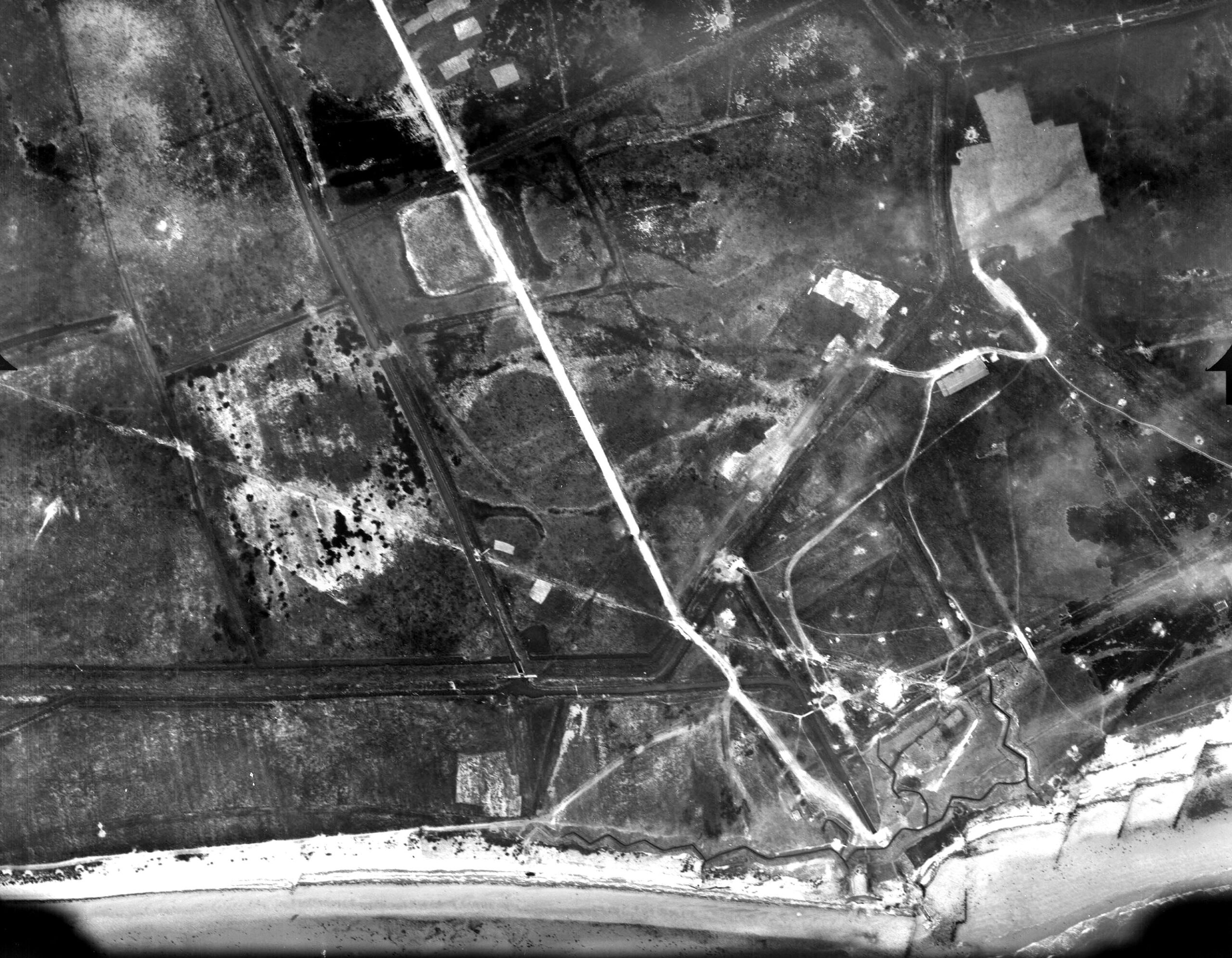
In fact, even ten years after the battle, when Rudder returned to the location where the guns from Pointe du Hoc had been located and destroyed, one could still see the recoil “pits dug into the drainage ditch along the hedgerow, almost covered with creeping vines.”
The landing of the 2nd Ranger Battalion’s D, E and F companies was “a final guarantee that the Pointe du Hoc guns would be neutralized.” This accomplished, the Rangers set about consolidating another of their D-Day objectives, the Beachhead Maintenance Line which, not coincidentally, corresponded exactly to the paved Grandcamp-Vierville Road running laterally along the coast. Rudder set up his command post in a large bomb crater at the cliff’s edge. Now, running low on ammunition, their ranks depleted, Rudder’s men would have to hold on until troops landed across Omaha Beach, more than four miles to the east, could fight their way through to link up with them.
Omaha Beach was the overall responsibility of the U.S. V Corps. For the initial phase of the D-Day landings, the 2nd Ranger Battalion was attached to the U.S. 1st Infantry Division. Also attached to the 1st Division were the 5th Ranger Battalion and the 116th Combat Team Reinforced of the U.S. 29th Infantry Division. The battle plan for D-Day had anticipated that assault troops landing at Omaha Beach would quickly overcome the beach defenses then move inland to expand the beachhead and capture their D-Day objectives by two hours before nightfall. A key component of that plan was that the other half of the 2nd Ranger Battalion (Companies A, B and C), along with the 5th Ranger Battalion, in coordination with elements of the 116th Infantry and other units, were to attack toward Pointe du Hoc to relieve Rudder’s force. Then the American forces would continue to press the attack south and west with the final D-day objective to capture Isigny, at the base of the Vire Estuary. To that end, the 2nd and 5th Battalion Rangers were to roll up enemy opposition along the right flank of the advance, moving through the coastal towns of Grandcamp, Maisy and Géfosse-Fontenay, along the way to the day’s final objective. But, from the moment the battle was joined, all of the Allies’ plans in the Omaha sector began to fall apart.
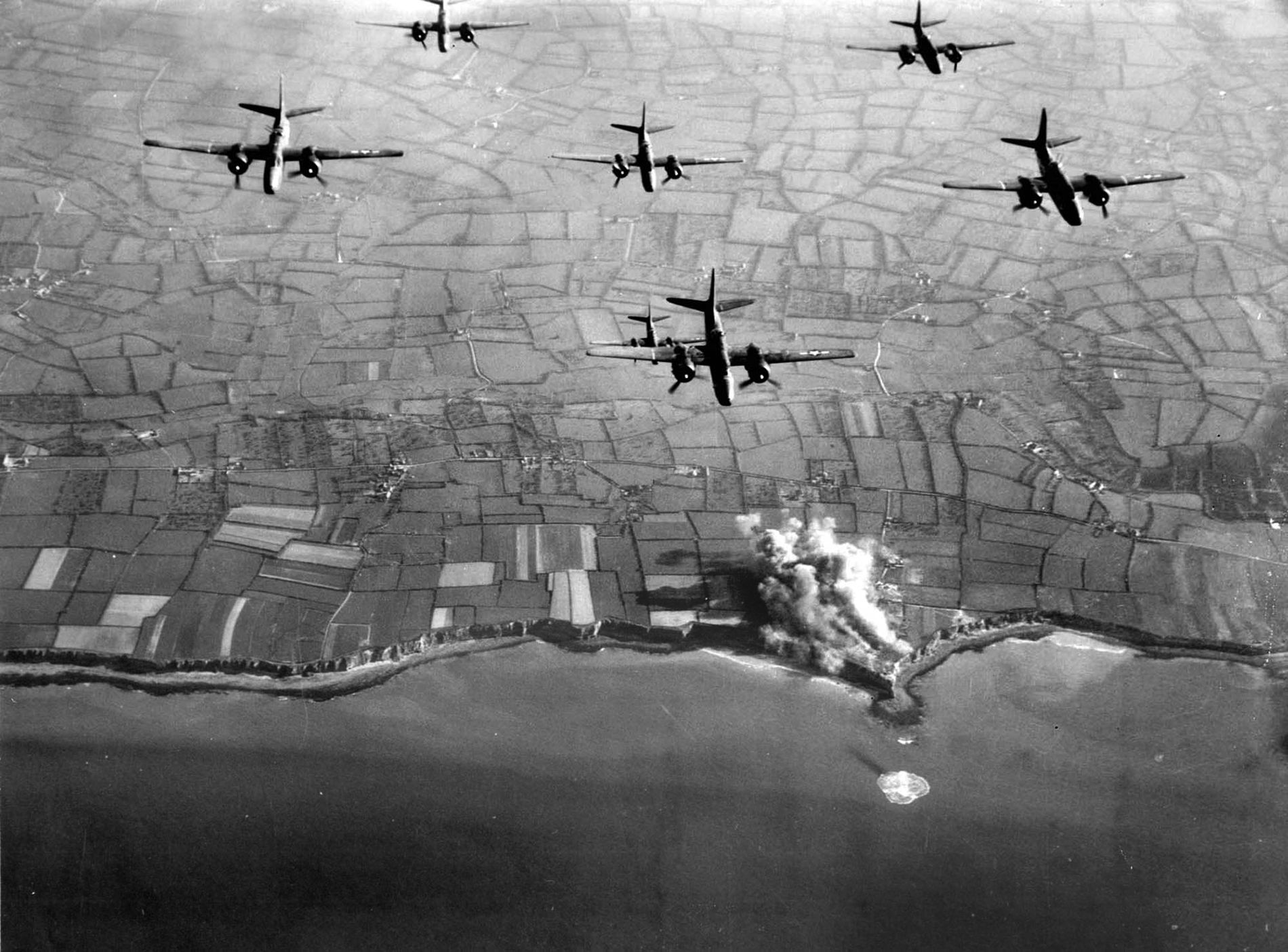
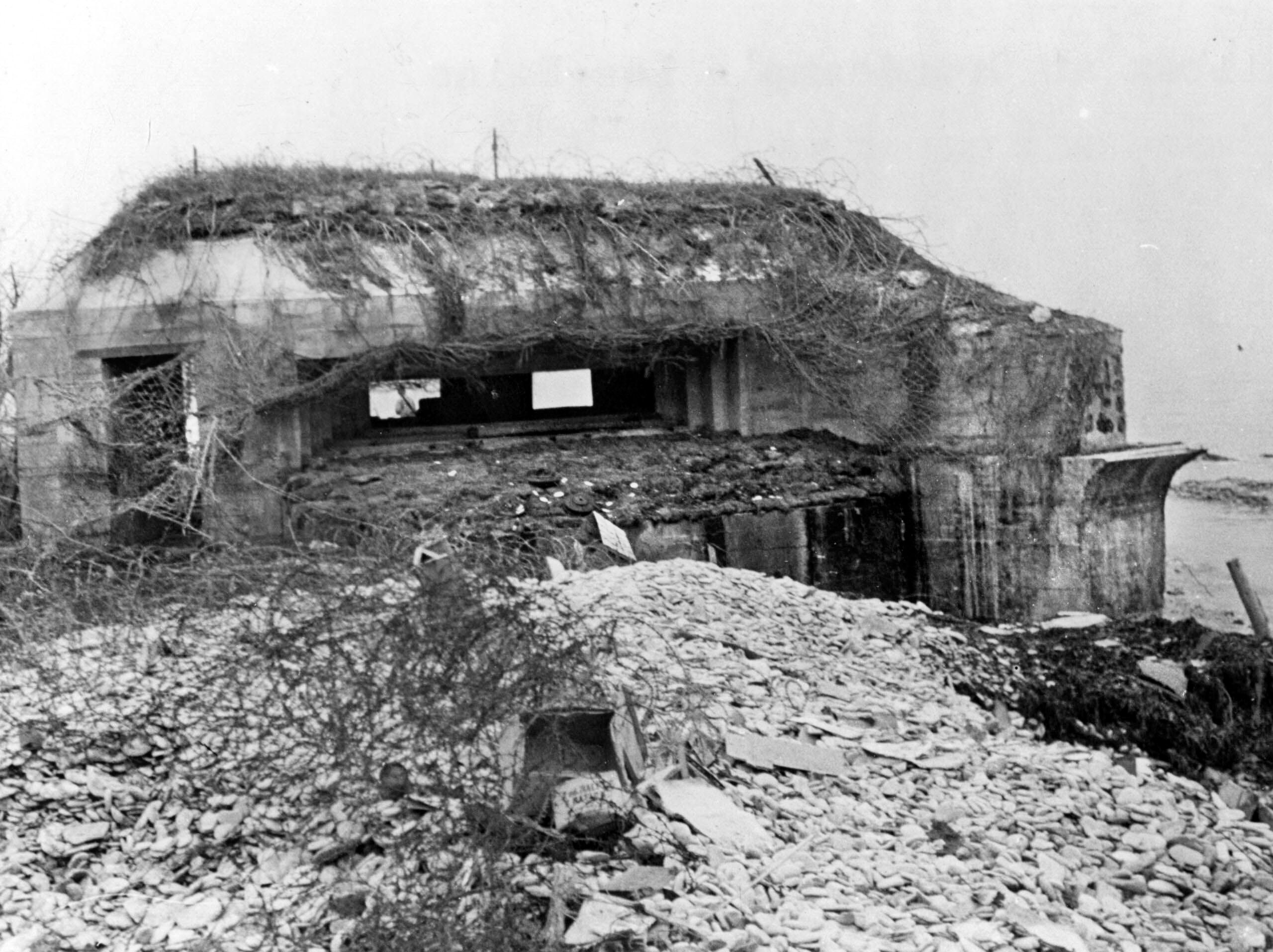
The German reaction to the American landings along Omaha Beach was swift, severe and shocking. The pre-landing aerial and naval bombardment meant to soften up the defenses and keep the Germans pinned down was largely ineffective. Greeting the infantry, special engineer units and tanks of the American landing force was a “devil’s garden” of armed blockhouses and pillboxes, well-defiladed and constructed of reinforced concrete, mined approaches, underwater obstacles, forests of barbed wire, machine guns sighted to sweep the length of the beach, well-hidden mortars firing from positions atop the steep bluff, rockets, and pre-registered artillery of all calibers. Landing craft were ravaged and sunk by enemy fire, and troops wading ashore were met with machine gun fire that looked like rain hitting the water all around them. Some boat teams of the first wave simply melted away. Successive waves also foundered and were pinned down on the beach or at the water’s edge. German artillery and mortar fire crashed all along the beach and in the surf flaying the hapless assault troops. At one point the situation ashore was so desperate that there was serious consideration given to withdrawing what survivors there may be, and landing the rest of V Corps’ forces across Utah Beach. Yet, through individual acts of heroism by U.S. Army and Navy personnel ashore, tactical air support and the close-in fire support rendered by destroyers, enemy positions, one by one, were overcome, and the infantry began to move off the beach and inch up the bluff.
By midday, the situation on what would become known as “bloody” Omaha, began to improve and the crisis passed, but not before the timetable for accomplishing the D-Day objectives was completely derailed. The forces coming from Omaha Beach who were—according to V Corps’ battle plan—to link up with Rudder’s men almost four miles away at Pointe du Hoc later on that morning, would not get there until D+2. During the intervening days and nights, under constant pressure from the enemy, Rudder’s dwindling force at Pointe du Hoc would, according to numbers offered by author Higham, suffer a total of 77 killed, 152 wounded and 38 captured or missing in action, in a grueling test of duty and endurance.
In fact, nowhere did American units landing on Omaha Beach, reach their D-Day objectives. The clichés that “no battle plan survives first contact with the enemy,” and “the enemy always gets a vote,” were never more appropriate than they were on D-Day. Plans had gone awry, timetables could not be met, and the enemy had gotten his “vote.” Yet, by nightfall on D-Day, even though isolated pockets of resistance remained in the Omaha Beach area, V Corps had miraculously established a firm lodgment ashore and would not be pushed back into the sea. “In preparing for battle,” commented Supreme Allied Commander, Gen. Dwight D. Eisenhower, “I have always found that plans are useless, but planning is indispensable.” It was the combination of careful planning and preparation, integration of land, naval and air forces, and the courage and sacrifice of many individuals that had carried the day.

So, was the attack on the German coastal battery position atop Pointe du Hoc necessary? Did the Allied planners “know” that the 155-mm long-range cannons had been removed and abandoned prior to D-Day? Did planners fail to detect a “massive” German battery position at Maisy that was the “real cause” of the terrible American casualties at Omaha Beach, then later cover it all up? Did Lt. Col. Rudder disobey his orders by not attempting to carry out the rest of his D-Day assignments as soon as the German defenses atop Pointe du Hoc were reduced?
Here are the facts. Allied planners had some inkling that the big guns at Pointe du Hoc had been removed from their casemates well before D-Day. However, the three companies of Rangers would make a direct assault on Pointe du Hoc as a “final guarantee” that the guns would be destroyed. Included in the Intelligence Annex to F.O. 35, Rudder’s men landing at Pointe du Hoc were to, along with their other missions, “Reconnoiter n[e]w battery position east of POINTE DU HOE [sic] at 598934 [near present day Hameau Lefevre] and report type and condition of artillery, if present….” Therefore, if the 155-mm guns were no longer in their casemates, they were to be found if possible, and this “new battery position” was one place for the Rangers to investigate. Whether in casemated positions at Pointe du Hoc or dug in along a secluded hedgerow-fringed lane, these guns still had an effective range of over ten miles, and remained a serious threat to the boat lanes and ships in the transport areas. When they were discovered and knocked out by Ranger patrols on D-Day morning the guns were arrayed in firing order with ample stocks of ammunition at hand. Therefore, these guns were not abandoned by the Germans.
An Underappreciated Threat?
“Maisy Battery” was a German artillery battery complex comprised of two separate and nearby Widerstandsnester, Wn83 (Maisy-Les Perruques) and Wn84 (Maisy-La Martinière), each sited to defend the Vire Estuary, and located along the route that U.S. forces would travel to move west along the coast from Omaha Beach toward Isigny and the crossings of the Vire. Naturally, Maisy would have to be swept from the path of the U.S. advance. The site received aerial bombing prior to H-Hour on D-Day, and also had naval gunfire directed against it. At 0740 and again at 0820 on D-Day the Maisy batteries were taken under fire and silenced by the destroyer USS Shubrick. Also on bombardment station, the USS Herndon, the HMS Hawkins, and the HMNS Soemba, were all “designated to take care of these batteries” which “were reported neutralized after repeated hits.” Still, by the close of June 8, there was reported to be very active German artillery emanating from the Grandcamp-Maisy area “despite a great volume of Naval fire that had been placed in that area.”
Nevertheless, by D+3, the rapid landing of follow-on forces across Omaha Beach, in the form of infantry, armor and field artillery, was tipping the balance of power in the invasion area firmly in favor of the Allies. German reinforcements were prevented from reaching the battle space. Enemy resistance in the western Omaha Sector was dwindling, reduced to pockets inland at La Cambe, St.-Germain-du-Pert and Cardonville, and along the coast at Grandcamp, Maisy, and Géfosse-Fontenay. As U.S. forces began to near what had been their original D-Day objectives, they simultaneously threatened to envelop enemy forces and block their retreat. Spearheads of the U.S. 29th Infantry Division probed south and west toward Isigny and the crossings of the Vire, while at the base of the Cotentin Peninsula to the west, the U.S. 101st Airborne Division prepared to capture Carentan, barely seven kilometers from Isigny, then to effect the linkup of the Omaha and Utah Beachheads as quickly as possible.
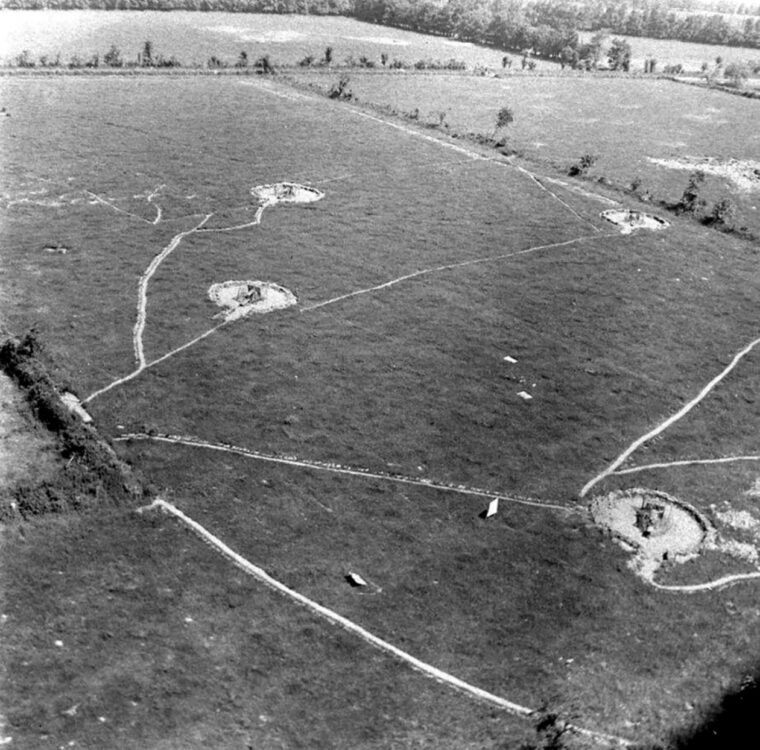
On the morning of June 9, Companies A, C and F, of the U.S. 5th Ranger Infantry Battalion, “were given the mission of cleaning out the strongpoint of batteries at Maisy. They were supported by two halftracks of the Second Rangers and a company of the 81st Chemical Weapons Battalion [4.2” mortars]. In an enveloping attack, the mission was a successful one and three [100-mm Skoda light field howitzers], numerous small arms and large stocks of ammunition were captured. In addition, approximately 90 POWs were taken.” The cost to the Rangers in this fight was a mere handful of wounded.
The combined Wn83/Wn84 battery complex was well-known to Allied planners prior to D-Day, and they had a fairly detailed picture of the enemy disposition at both of the separate battery locations. Maisy-La Martinière was designated as “Target 16” in Allied battle plans. This position was manned by soldiers of the Wehrmacht 716. Infanterie-Division’s 8./Artillerie-Regiment 1716. It consisted of three finished casemates sited toward Utah Beach, with a fourth still under construction on D-Day. The three finished casemates each housed a captured Czechoslovakian Skoda 100-mm Model 14/19 light field howitzer—10 cm leFH 14/19(t) being the Wehrmacht designation—with a maximum effective range of 9,800–9,970 meters meters. A fourth Skoda was positioned in an open emplacement approximately 400 meters east-southeast of Maisy-La Martinière (Wn84), and was destroyed by naval gunfire or air bombardment early in the D-Day battle. This temporary position was designated by Allied planners as “Target 16a” and the other three, aforementioned, Skoda guns had been located here, as well, at one time, but had been redeployed to the casemates at Maisy-La Martinière as their construction was completed.
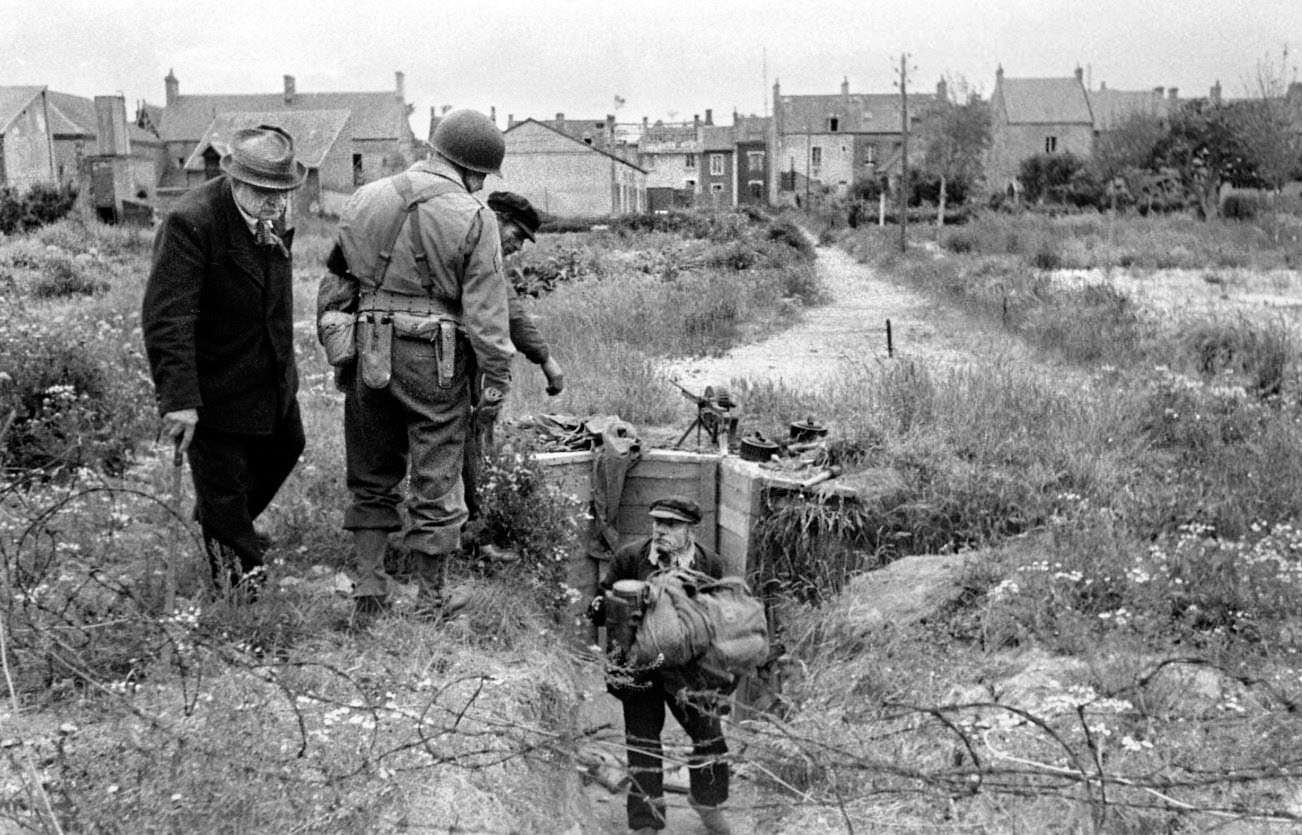
Artillerymen of the Wehrmacht 716. Infanterie-Division’s 9./Artillerie-Regiment 1716 occupied Maisy-Les Perruques, designated as “Target 5.” Here, there were installed four captured French 155-mm Schneider Modèle C 1917 Howitzers in revetted concrete pits; Wehrmacht designation for these guns was 15.5 cm sFH 414(f). These heavy howitzers had a range of up to 11,300 meters. During one of the bombardment missions carried out by air and naval forces against this position one of the gun pits sustained a direct hit overturning a howitzer and permanently putting it out of commission. When U.S. troops advanced to capture this location on June 9, they found that the remaining three guns had already been withdrawn when the enemy retreated.
Noting the maximum range of each of the separate types of howitzers that the Germans had at Wn83 and Wn84, and that the location of the nearest gun from either of these batteries was more than 11 kilometers in a straight line from the westernmost edge of the Omaha landing beaches, it is hard to imagine either of these batteries being the “massive” threat to the Allied landings that has been claimed. To be sure, these guns fired on both American landing beaches, but so did an overwhelmingly greater number of guns from other German units—chief among them the Wehrmacht 352. Infanterie-Division—stationed just behind Omaha Beach itself. The 352. Infanterie-Division’s organic arms included approximately fifty 81-mm mortars, over a hundred various howitzers and guns ranging from 75-mm all the way up to 105-mm and 150-mm, (more than 20 of the 75-mm weapons being mounted on motorized vehicles), approximately 280 light and heavy machine guns (MG34s and MG42s) and 22 flame throwers (if all the machine guns, mortars and artillery weren’t enough). There were also four 155-mm howitzers of the German 10th Battery, 1716th Field Artillery Regiment at Formigny, barely 2.5 miles inland from the beach. Every inch of Omaha Beach had been pre-registered for fire.
Writers who have overemphasized the threat posed by the Maisy batteries, have also failed to include in their calculus the number of active German beach defense weapons positioned at Omaha on D-Day. Across its 7,500-yard length were arrayed eight casemates occupied by 75-mm or better, 35 pillboxes occupied by guns smaller than 75-mm; four open field positions of 75-mm or better; 18 antitank—37-mm to 75-mm; 85 positions less than 37-mm (MG); eight infantry mortars; and 38 rocket pits bearing on the beach with four 32-cm rockets per pit.
Lastly, Lt. Col. Rudder certainly did not disobey his orders on D-Day. Field Order 35 gave explicit instructions that the D, E and F companies of Rudder’s 2nd Rangers landed at Pointe du Hoc were to “destroy enemy installations in that vicinity. Be prepared to repel hostile counter-attack and assist the advance of the remainder of the Ranger Force and 116th Infantry.” Until those latter forces arrived, there would be no further advance. Rudder’s force, at a very dear cost in casualties, maintained its tenacious grip on the captured Pointe du Hoc battery and to the Beachhead Maintenance Line, against repeated German counter-attacks, until they were finally relieved on D+2. Rudder, himself, was wounded twice during the battle yet refused evacuation, and was awarded the Distinguished Service Cross for his actions.
Companies A, B and C of the 2nd Ranger Battalion had also been part of the holocaust on Omaha Beach, so when the remnants of the 2nd Rangers were finally reunited, what was left of this battalion were placed in a reserve position. The 5th Ranger Battalion, thanks to the canny leadership of its commanding officer, Lt. Col. Max Schneider, had landed across Omaha largely intact. During the run in to the shore, Schneider had spotted a seam in the German fire and had re-directed his flotilla of landing craft to the quieter landing sector, thus saving many lives. The 5th Rangers were still an effective force on D+2, and thus would carry the advance a bit farther.
Pointe du Hoc still matters, and the batteries at Maisy matter, too, but each for their own reasons. Though some of the incidental points about Maisy may yet be obscured by historical distance, and debated by historians, undoubtedly, the greater truth is that Maisy did not play the decisive role in the grand events of D-Day as has been recently claimed. Ultimately, its presence had very little effect on the outcome of the battle. Soon after the swift capture of the Wn83/Wn84 complex on D+3, the position quickly became a footnote to the Normandy invasion. In stark contrast, Pointe du Hoc stands as testimony to the courage and intrepidity of the combined Anglo-American naval, air and ground personnel who, together, were able to render what had been considered prior to D-Day, “the most dangerous battery in France,” a complete non-factor during the Normandy invasion. “The gallant fight of … [Rudder’s] Rangers against tremendous odds and difficulties was an inspiration to all naval personnel fortunate enough to witness this phase of the battle. The Rangers were magnificent.”
Robert Todd Ross is a historian and author specializing in World War II special operations. He is the author of The Supercommandos and other works on elite Allied units. Ross has served as a historical consultant for History Channel and the Canadian History Channel. He lives on Maryland’s Eastern Shore.
Just another article on a non-issue. Just like the reason of why we should have used the 2 atomic bombs on Hiroshima (military base and depot) and Nagasaki (naval base) instead of killing over 500,000 of our own troops and an estimated 5 million Japanese. The atomic bombings killed approximately 250,000 in both cities. Tokyo suffered over 300,000 deaths (still don’t know how many were really killed) in the 300 B-29 Superfortress firebombing raids in March 1945. The military had made up between 500,000 and 1,000,000 Purple Heart medals for the invasion of Japan–Operation Downfall, Operation Olympic and Operation Coronet proposed for late 1945-1946. Saving those lives was more paramount in war than killing Japanese.
Good article!
Most of the contrarian discussions do not hold water. I talked often to ISgt Lem Lomell and Rudder’s Comms officer Eikner-both said, independently, that they were not told of any guns being removed prior to the assault. Lomell and Kuhn’s discovery of the guns was a hunch based on following deep wagon tracks. Concurrently, an element of 2d Rangers led by a plt ldr found the guns from the opposite direction.
Rudder had no capability to expand beyond road outposting. He lost 3/4 of his force between A-C Co’s being hammered at Omaha and 5th Bn diverting to Omaha.
Maisey was well known and was clearly marked on the invasion bombardment maps. Insofar as I know, there is no record of meaningful arty fire emanating from Maisey or the Grandcamp Wiederstansnest.