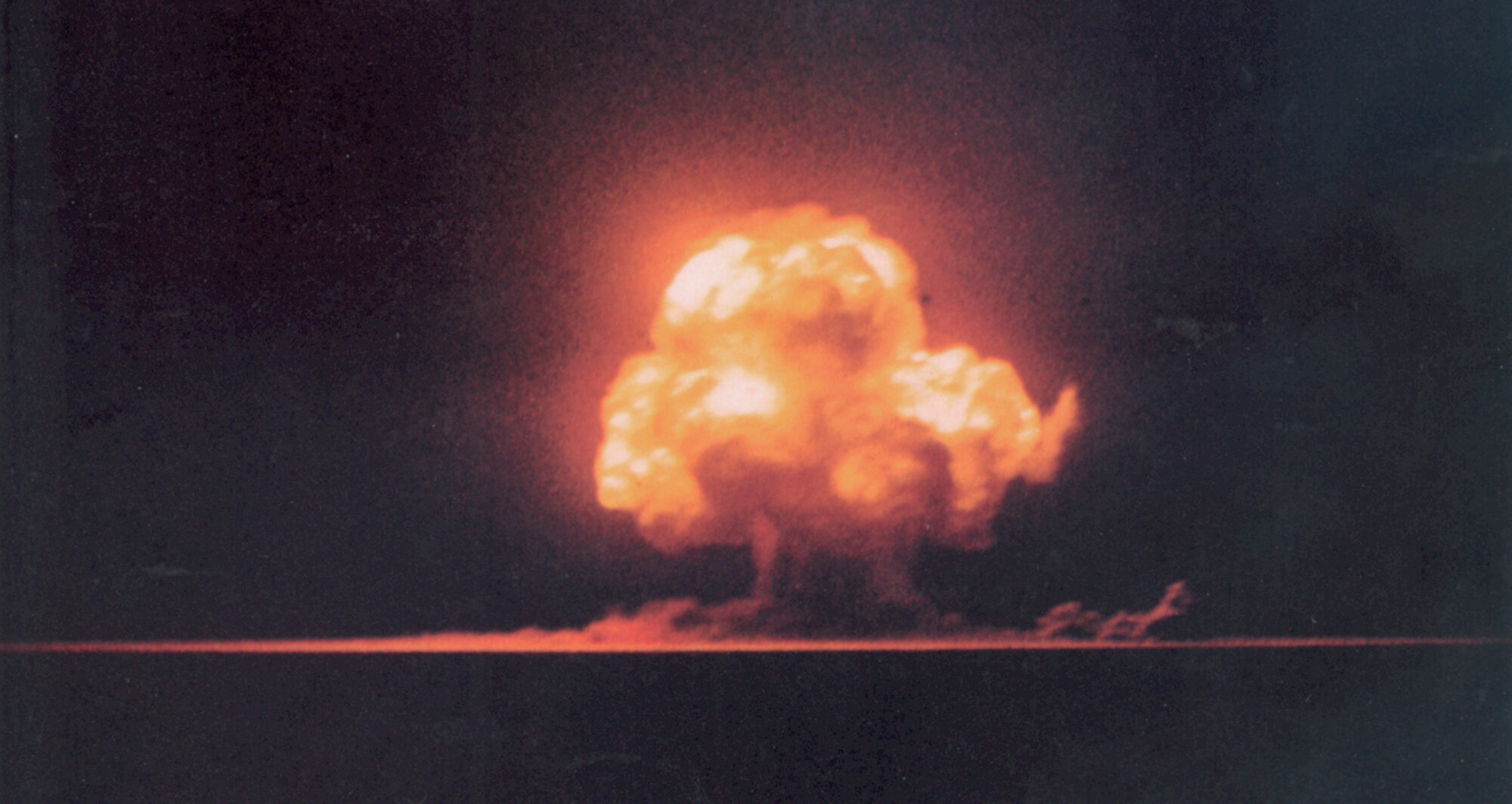
The events of early August 1945 brought World War II in the Pacific to an end and ushered in a new era of warfare, one with the potential for apocalyptic annihilation. U.S. President Harry Truman had weighed the consequences of two terrible courses of action. The American military was marshalling its might off the coast of the Japanese home islands as an outright invasion loomed. In the effort to subdue Japan and forcibly occupy the country, there was no doubt that a bloodbath would occur. Casualties among American forces were estimated at a million or more.
The alternative for Truman was to authorize the use of a new and terrifying weapon, its destructive force far greater than any ordnance the world had ever known. Truman had only become aware of the Manhattan Project and the development of the atomic bomb after the death of President Franklin D. Roosevelt in April, and he understood the magnitude of the decision he was compelled to make. The destruction of one or two Japanese cities meant the deaths of thousands of civilians as well as military personnel and infrastructure, but it might well bring the war to an end and save the lives of many Americans who would return home, go to college, marry, and live their lives.
The choice for Truman was difficult but inevitable.
Colonel Paul W. Tibbets, a 29-year-old pilot who had participated in the first U.S. air raid on Nazi-occupied Europe two years earlier, was then halfway around the world. At the controls of his Boeing B-29 Superfortress, nicknamed “Enola Gay” after his mother, Tibbets revved the engine of the big plane. Burdened by the weight of the atomic bomb nicknamed “Little Boy,” the bomber strained into the night sky from North Field on the island of Tinian in the Marianas in the early hours of August 6, 1945.
Four Japanese cities, Hiroshima, Nagasaki, Kokura, and Kyoto, had been left relatively untouched thus far during the massive American bombing of the Japanese home islands. These, therefore, were selected as possible targets for the first atomic bomb. Kyoto was later removed from the target list due to the presence of numerous religious shrines in the city, and Hiroshima, an industrial center of 350,000 people, was selected for destruction.
Having flown 1,750 miles, “Enola Gay” released Little Boy—equivalent to 12,500 tons of TNT—which exploded at an altitude of 1,900 feet, incinerating an estimated 80,000 people instantly. A huge mushroom cloud boiled skyward as temperatures on the ground reached an estimated 300,000 degrees Centigrade. Many more people died in the days that followed, victims of burns or radiation poisoning.
Captain Robert A. Lewis, co-pilot of “Enola Gay”, recalled that an immediate cheer at the release of the bomb was swiftly followed by an eerie and reverent silence. He whispered, “My God, what have we done?”
Despite the tremendous destruction, the Japanese government remained torn between factions that advocated continuing the fight to the death and those who desperately sought peace with the United States to prevent further such catastrophic attacks.
Emperor Hirohito was caught between the vise of national pride and the obvious conclusion that Japan could not win World War II. The hesitation and infighting in Tokyo precipitated the dropping of the second atomic bomb, “Fat Man,” on Nagasaki, three days later.
This event shook the Japanese further, and Hirohito, uncertain whether the U.S. possessed many more such devastating weapons and could soon rain them down on other Japanese cities, addressed his people with the news of their defeat on August 15.
In the days ahead, celebrations took place in the Allied countries as the most destructive armed conflict in human history finally ended. However, the story of the atomic bomb is a cautionary tale, and its shadow stalks mankind to this day.
Michael E. Haskew
Thank you so much to the page and the photos Kraft
The causes of the Japanese surrender are more complex than just the BOMB. The USSR joined the war against Japan on August 9, per the Yalta agreements. It intended to invade Hokkaido, the northernmost of the Japanese main islands. Japan faced the possibility of partition between the US and the USSR. The Zaibatsu, fearing communism, needed Japan to surrender quickly to avoid USSR control of part of the country. The BOMB certainly accelerated the surrender but so did the USSR invasion, particularly of lower Sakhalin island.
For more on the end of the war with Japan, some readers may find this story of interest:
https://warfarehistorynetwork.com/article/reign-of-ruin/
President Truman had no choice. Using the atomic bombs saved innumerable lives, both Japanese and Allied, and also effectively prevented a Soviet landing on the Japanese home islands. Have read more than one account of Allied POWs in Japan being told they would be executed should the US invade Japan. Those POWs got to go home, instead. So did a great many Allied service members who wouldn’t be needed as an invasion force.
And no, I don’t do revisionist history.