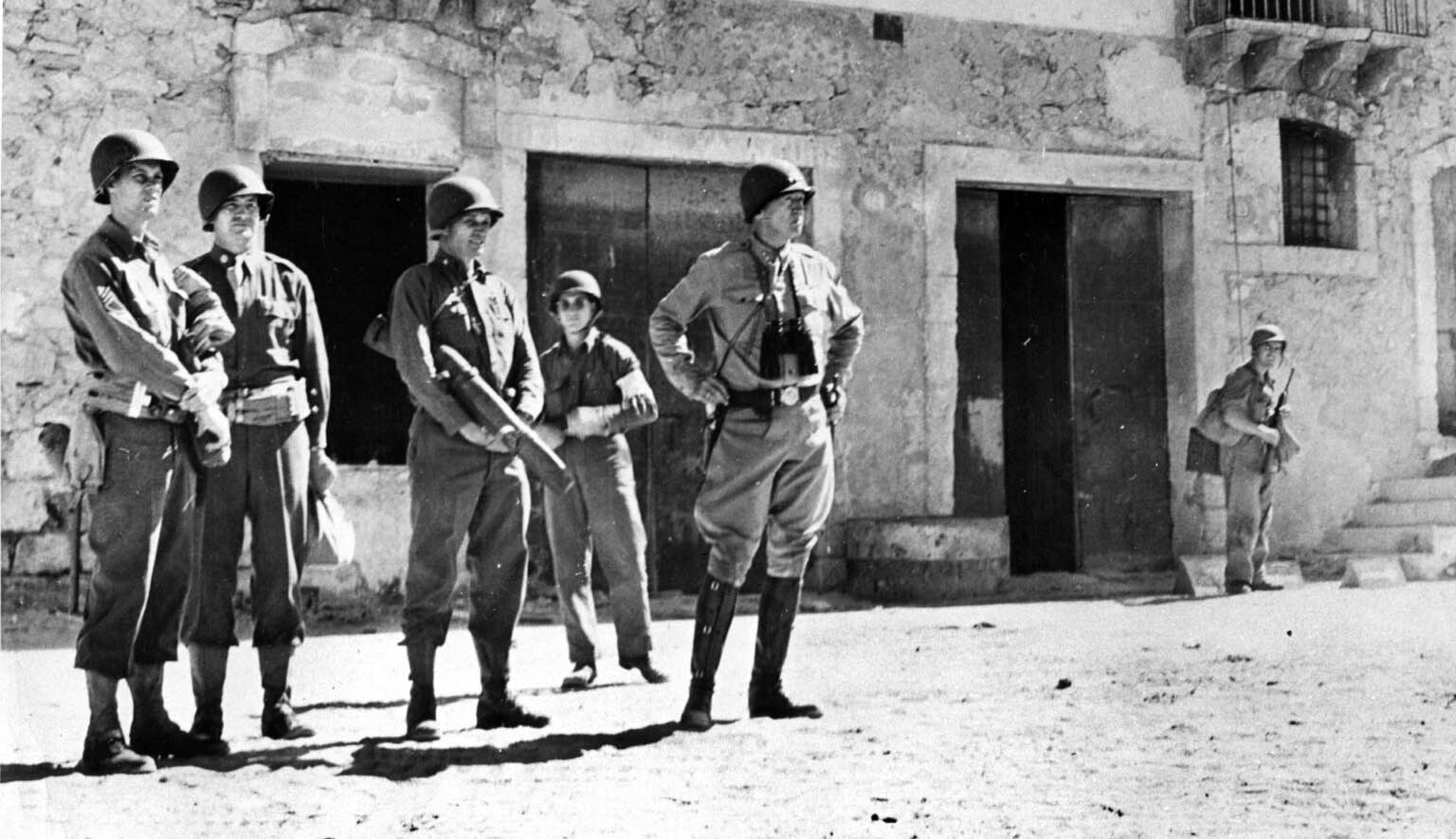
By Kevin Seabrooke
Launched on the night of July 9-10, 1943, the amphibious assault of Operation Husky was the largest the world had ever seen—more than 3,200 vessels and half a million Allied soldiers, sailors, and airmen attacked the island of Sicily, Adolf Hitler’s “Fortress Europe.”
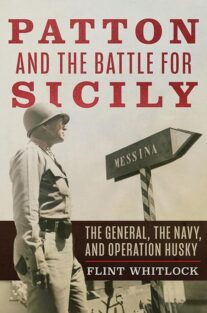 In the middle of it all was George S. Patton, America’s larger-than-life general and one of the most gritty, aggressive, and controversial commanders of World War II. Patton was almost pathological in his need to best his rival, Eighth Army commander Gen. Bernard Montgomery, by beating him to the key port of Messina and proving that American GIs were just as good as, if not better, than the Brits.
In chronicling the events of one of the most critical campaigns of the war, author Flint Whitlock makes use of Patton’s letters and diaries to reveal his unvarnished opinions of all those around him. In addition to Montgomery, Patton held low opinions of most of the Allied command, including Eisenhower, Marshall, Clark, Bradley, Alexander.
Criticized as “wasteful,” Whitlock argues that Husky began the ultimate take-down of Mussolini’s fascist regime and drained Axis resources from the Russian front, which benefitted Joseph Stalin. The land-sea logistics learned in Italy would also pay huge dividends on France’s Normandy coast in June 1944.
Patton and the Battle for Sicily: The General, The Navy, and Operation Husky (Flint Whitlock, Naval Institute Press, Annapolis, MD, 320 pp., 5 Maps, 12 b/w photos, Nov. 18, 2025 $29.95 HC)
Is the book any good? Is it accurate?