By Eric Niderost
Landsman Robert Fleming was on watch aboard the U.S.S. Housatonic, a Union steam sloop patrolling the waters just off Charleston, South Carolina, in the winter of 1864. “Landsman” was the lowest Navy rank at the time, signaling a novice seaman still learning the trade, and Housatonic was part of the Atlantic Blockading Squadron, whose express mission was to cut the Confederacy’s vital overseas trade with Europe.
It was a chilly February night and being on watch was normally a tedious, even boring duty, but Confederate torpedo boats nicknamed “Davids” were in the area—which made the African-American Fleming as sharp-eyed as he could be. In fact Capt. Charles Pickering had ordered Housatonic’s fires banked, so the ship could make steam at a moment’s notice. The wind-dimpled waters were dark, but a pale full moon allowed maximum visibility.
It was about 8:45 p.m. when Fleming noticed something floating about 400 feet from the Housatonic’s starboard side. What was it? It might be a dolphin; those playful marine mammals were often seen in the vicinity of patrolling ships. Fleming immediately reported it to Lt. Lewis Cornhwait, but after having a look, Cornhwait said it was a floating log, Fleming respectfully disagreed, pointing out that the object “was not floating with the tide as a log would, but against the tide.” Another officer, John Crosby, was convinced it was a porpoise or dolphin.
The debate ended when the object began to approach Housatonic at a faster rate, the speed churning up the water enough to make small waves and a trailing wake. Crosby beat the gong, the signal for all officers and men to report to the battle stations. The ship came alive as bluejackets scrambled to their posts. A few even had the presence of mind to grab a rifle and begin shooting at the rapidly approaching object.
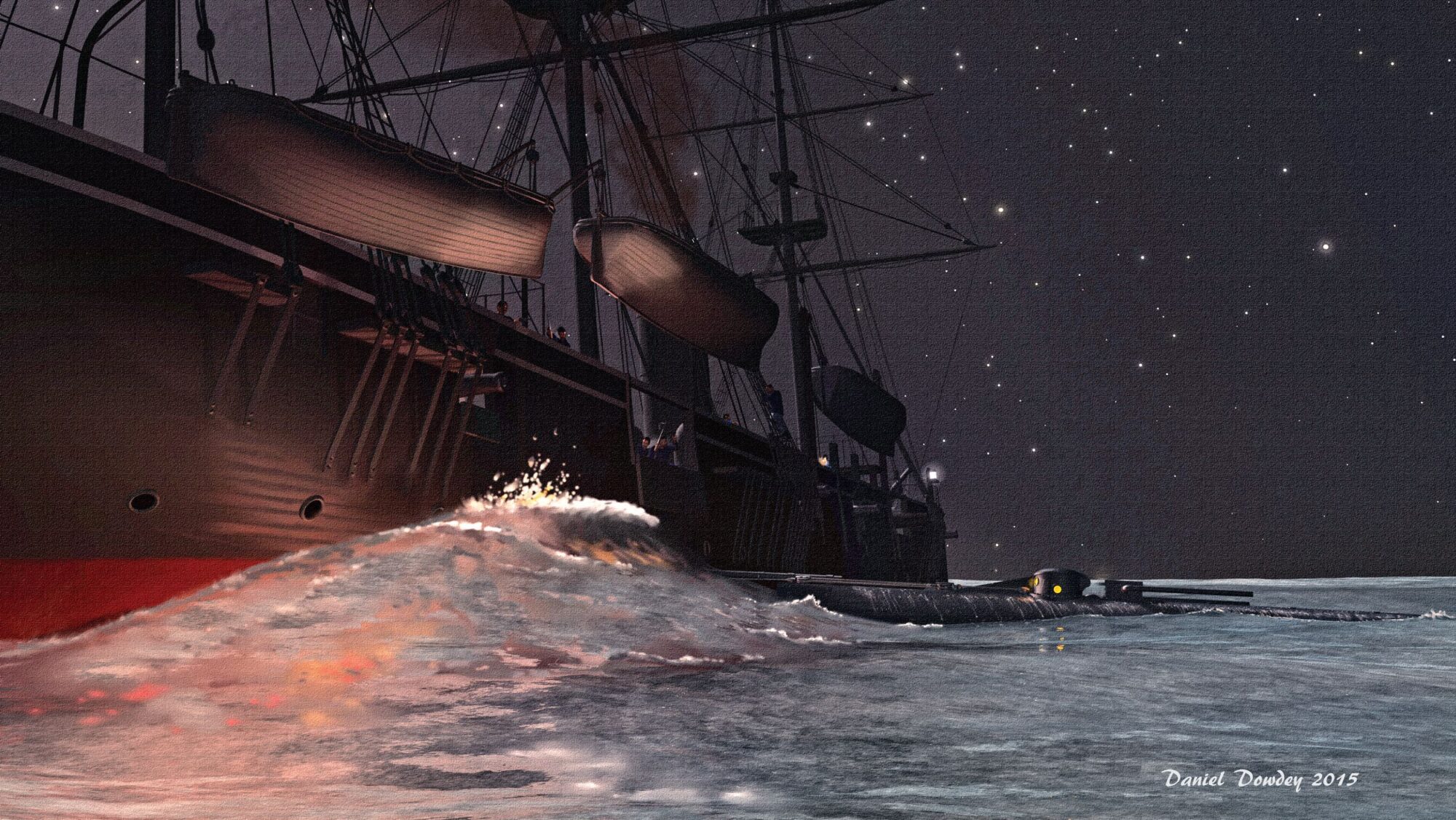
But it was too late to escape. Housatonic shuddered as something below the waterline hit it with great force, and moments later there was a terrific explosion. Black coils of smoke arose from the stricken vessel, and the ship began to list sharply to port. The crew didn’t know it at the time, but they had been successfully attacked by a Confederate submarine, the H.L. Hunley.
The idea of a submarine had been around for centuries. It is said that a Dutchman named Cornelis Drebbel built one in the 1620s. It wasn’t too sophisticated, and looked more like a rowboat that had a leather cover, but supposedly it worked. A one-man wooden contraption was created by David Bushnell during the American Revolution. Technically a semi-submersible—it didn’t go completely under water—it worked after a fashion but was unable to sink the British warships that were anchored in New York harbor.
It is said that necessity is the mother of invention, and this was literally true in the case of the Confederacy. Largely agricultural, the South needed foreign trade to obtain the sinews of war it could not itself produce. The Confederacy began the war in 1861 with virtually no navy to speak of, and no seafaring traditions of a type that existed in places like New England. On the other hand, they were free of any hidebound conservatism that might hinder innovation.
At first individual blockade runners managed to slip past Union warships, bringing in supplies of guns and other desperately needed goods. But as time wore on, and the blockade grew more effective, the Confederacy found itself in dire straits. There had to be a way to break the blockade’s economic stranglehold.
It is a measure of Southern desperation that they were even considering submarines. Anything that suggested stealth offended Victorian concepts of honorable behavior and fair play. Submarines were classed in the same category as underwater mines, then called “torpedoes.” Such devices were labeled “infernal machines” by the press, unworthy of any civilized nation.
That’s why the development of both northern and southerner submarines were usually shrouded in secrecy. Even after the war, some letters and other documents were purposely destroyed to protect the identities of the individuals involved in these clandestine projects. There was always a possibility, however remote, that Southerners that developed or manned submarines might be prosecuted after the war.
There seems to be evidence for more than 20 operational submarines during the Civil War, a figure that includes attempts by both the North and South. Many were privately built and probably were failures, while quite a few never got past the drawing board. The secrecy which shrouded most of them has further muddied the historical waters.
During the summer of 1861 an underwater explosives engineer by the name of William Cheeney designed a two-man submarine, but very little is known about it. It is known that the craft had a large 46-inch propeller. It is not known if the Cheeney boat had a system of gears to allow such a small crew to operate it. A practice demonstration on the James River near Richmond was witnessed by Mrs. E. H. Baker, a Union spy.
Apparently there was a third crew member, a diver, who attached an explosive device on a barge while underwater. A hose from the submarine supplied the diver with the necessary air. The device exploded, and the barge quickly sank. The sub’s hose was supported by a sea green flotation collar that sucked in fresh air for the crew as well, but was easy to spot from the surface.
When the Cheeney sub tried to attack the U.S.S. Minnesota, a sharp-eyed sailor spotted the boat and cut the hose that supplied the rebel crew with oxygen. We do not know the ultimate fate of the Cheeney submarine and a sister vessel that was reported being built also disappeared from history.
There’s evidence of other submarine development attempts, including one boat at Savannah that was lost in 1862 during sea trials. Once again, secrecy and lack of proper documentation has hampered modern efforts to study and understand these underwater experiments. But it is clear that the Confederates were willing to try anything to break the blockade, even if they violated the norm of what was considered “proper” warfare.
The North was just as interested in submarines, but they took a different approach. Submarines could be used not to attack enemy warships, but to clear underwater obstacles that hampered efforts to capture rebel seaports. Charleston’s defense system was a prime example of what the U.S.Navy was up against. Besides the forts and gun batteries that ringed the harbor, there were also underwater obstacles. Stout piles were driven into the shallow harbor waters, and in addition there was a boom made of heavy logs weighted and fastened with iron.
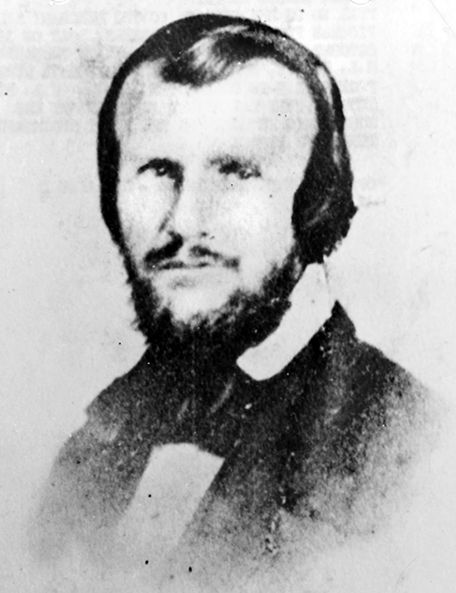
On May 17, 1861, a strange contraption showed up off the Philadelphia Navy Yard, and the mere sight of it caused considerable consternation. Was this an “infernal machine” invented by the southern “rebels” to destroy navy ships or the port facilities? The police arrived on the scene and quickly arrested a man who claimed ownership of the strange vessel. He was a French immigrant named Brutus de Villeroi. It was a “submarine boat” that was floating placidly in Philadelphia
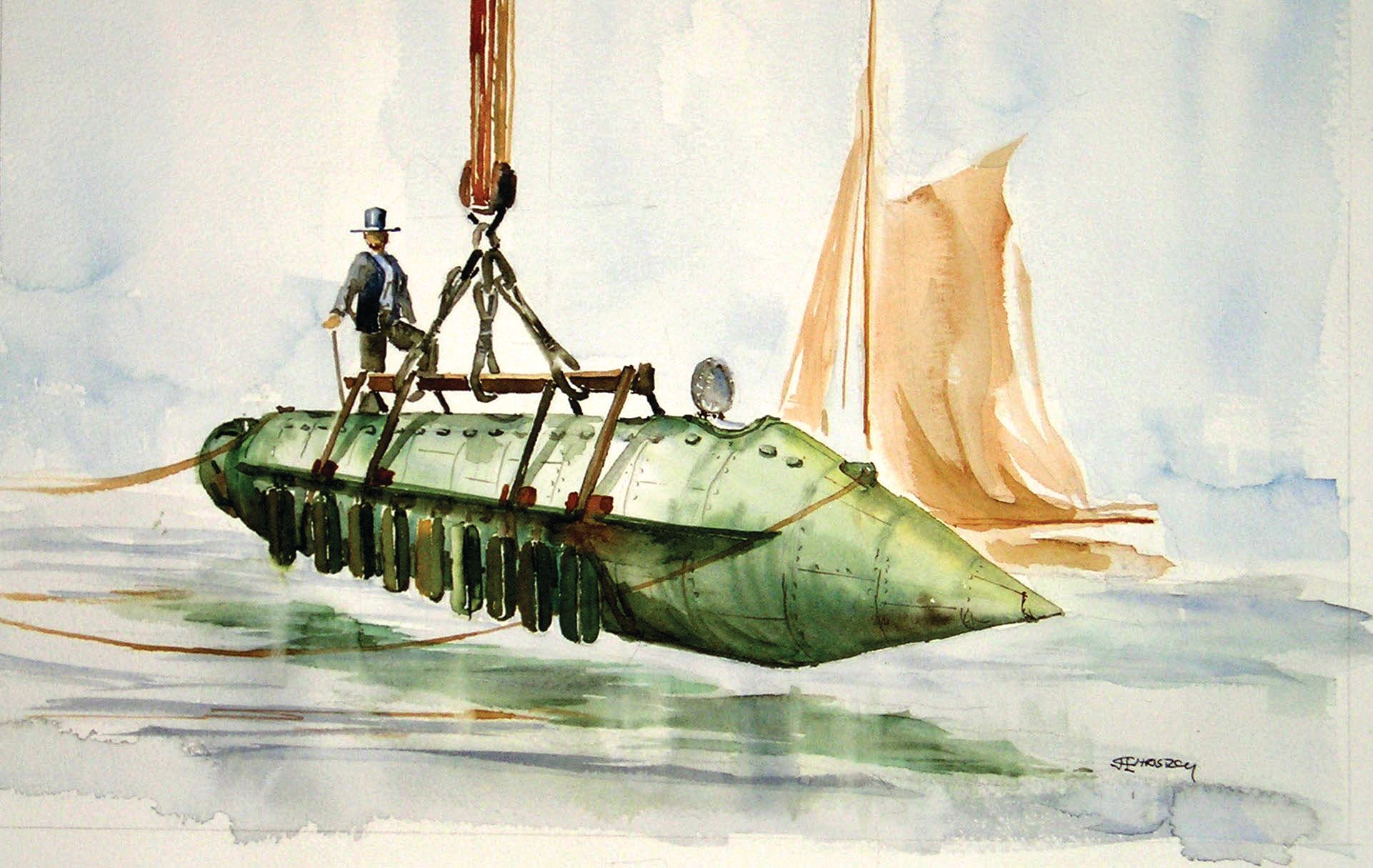
The boat was impounded at Noble Street Pier, but it—and its owner/inventor—attracted the attention of Adm. Samuel Francis Du Pont, who ordered three naval officers to inspect the boat for any wartime potential. The ad hoc committee ruled that the small vessel, only about 30 feet long, was interesting, but unworkable in practice. The vessel, nicknamed “Alligator Junior” by modern researchers, had been around since 1859, apparently unused and ignored.
Nevertheless it had features that might be applied more successfully in a larger version. Plans went forward for de Villeroi to design a larger version for the U.S. Navy. The committee particularly liked the idea of an airlock that would permit divers to exit the sub and plant explosive devices on any Confederate water obstructions they might encounter.
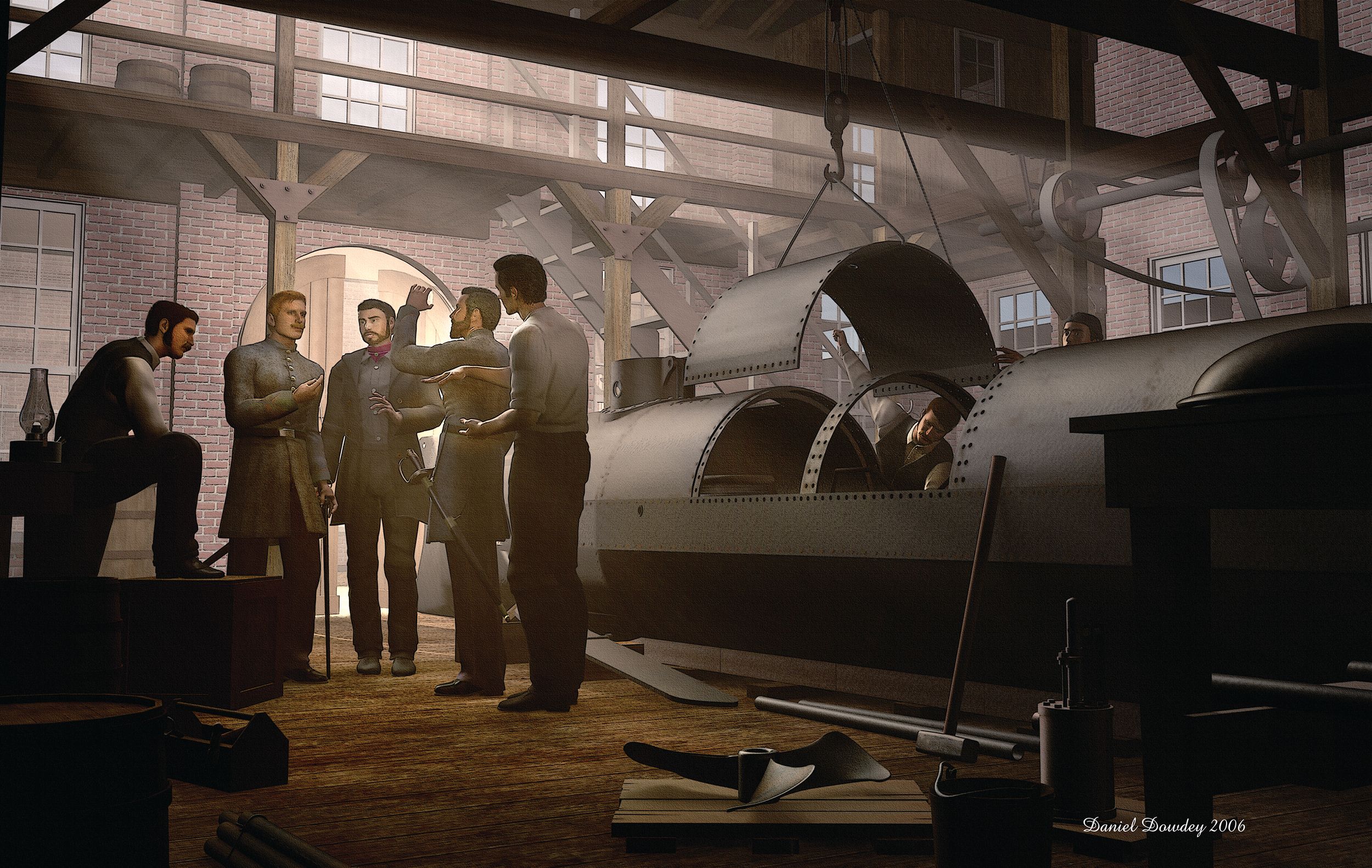
The Frenchman might have been boastful, and perhaps narcissistic—he once called himself a “natural genius”—but the Alligator shows the inventor was brilliant and innovative. It had an air purifying system that filtered oxygen through lime to remove carbon dioxide. Air was supplied from the surface by two tubes attached to floats. The 47-foot long boat also had that forward airlock, which permitted a diver to leave and return while the sub was still underwater.
The Alligator had a crew of 18, with no less than 16 sailors manning oars. Later, the oars were replaced by a hand-cranked propeller, which was clumsy, but increased the sub’s speed to four knots. The boat was formally accepted by the U.S. Navy in the Spring of 1862. It had two missions: to destroy a bridge across Swift Creek, a tributary of the Appomattox River, and clear away obstructions along the James River.
At the eleventh hour both assignments were cancelled. It seems the waterways were too shallow for the Alligator to submerge completely. It was feared that, if spotted, the boat would be captured by the Confederates, who would turn the tables and use her against Union ships. In the meantime, de Villeroi had worn out his welcome with the Navy brass. He was removed from the project after an acrimonious flurry of letters were exchanged.
During the winter of 1862-1863 there were further improvements to the Alligator, like adding a small conning tower with viewing ports. Acting Master Samuel Eakins, a professional diver, was put in overall command. Unfortunately the revised Alligator never got a chance to prove itself. Assigned to the blockading squadron off Charleston, it was lost at sea during a heavy storm.
There has been an ongoing attempt to try and locate Alligator, a seemingly “needle in a haystack” quest in the deep and vast reaches of the coastal Atlantic Ocean. Researchers have not given up, but more recently there seems to be evidence of the first sub, the prototype that caused such an alarm in Philadelphia. In 2024, a drone equipped with a magnetometer detected an anomaly that would correspond to the sub. The anomaly is in a New Jersey creek, which is exactly where “junior” might have been scuttled. The privately funded search is ongoing.
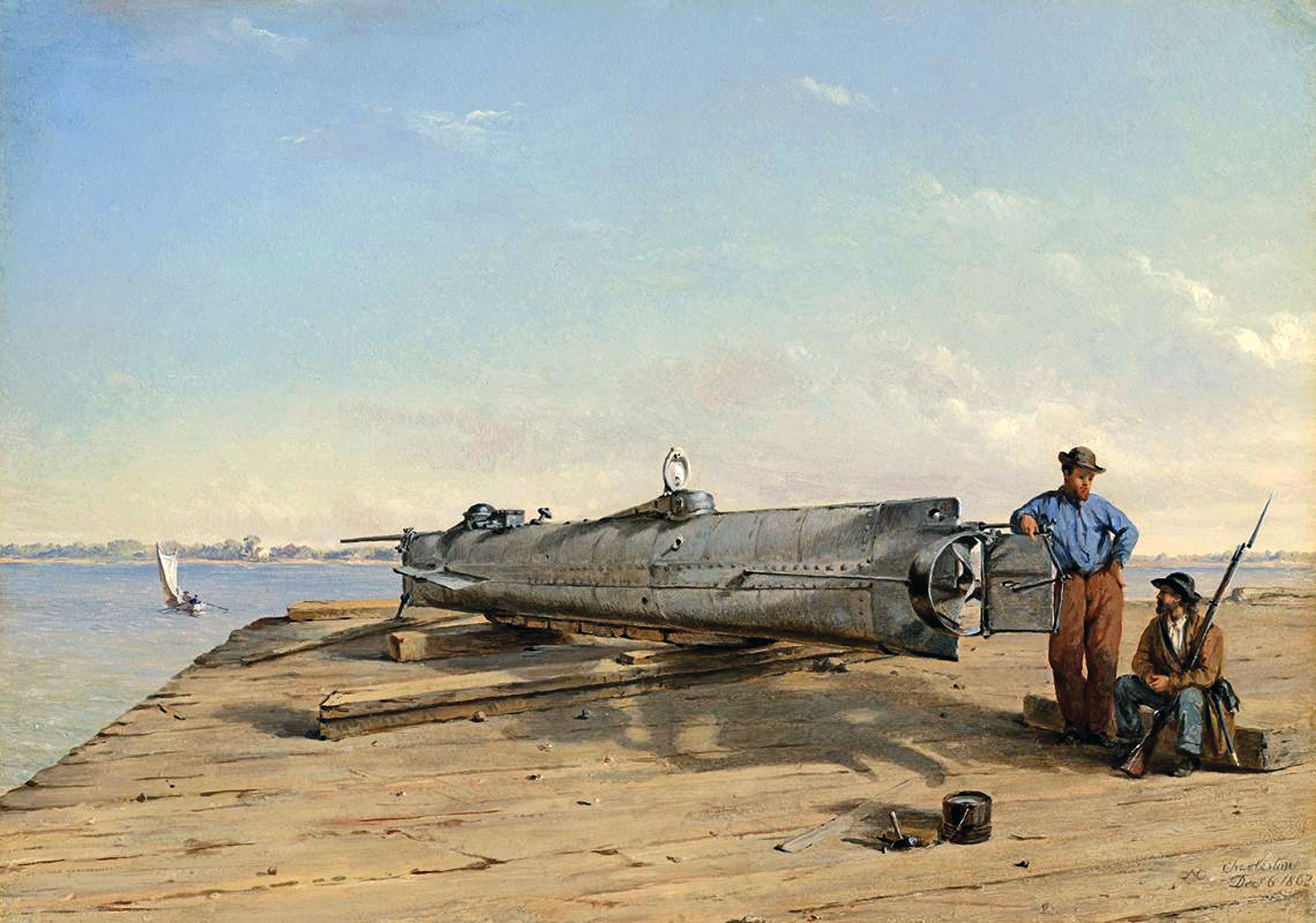
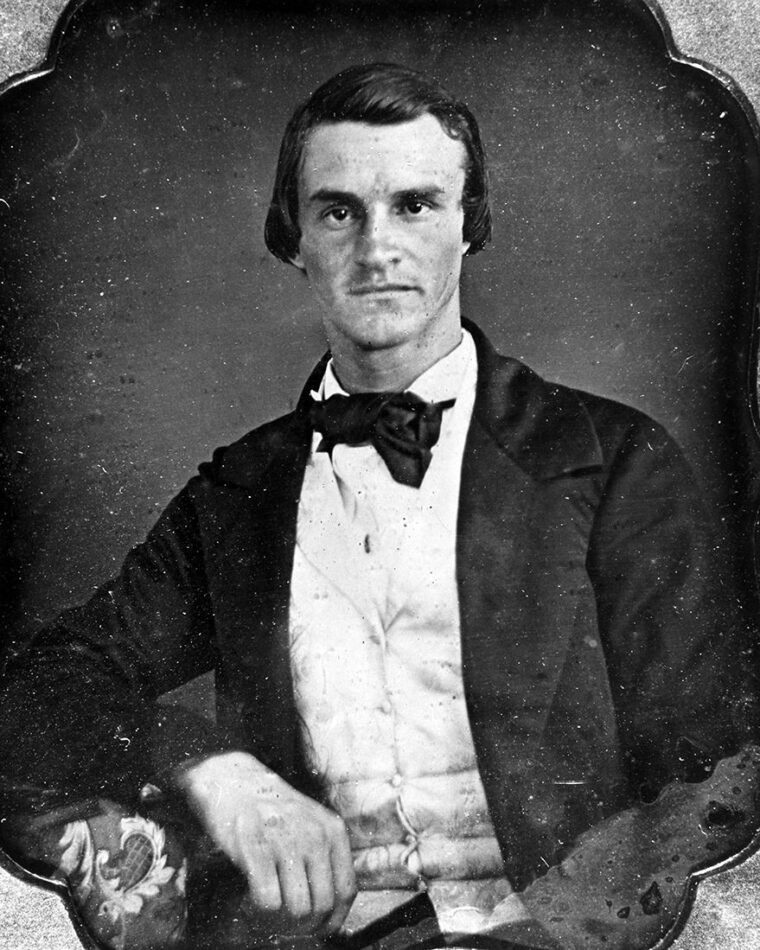
James McClintock was an engineer and part owner of a machine shop in New Orleans, a business that made gauges for steam-operated equipment. He felt he had the expertise to build a submarine, but needed funds to make his dream come true. Horace Lawson Hunley, plantation owner, lawyer, and customs agent, was wealthy and more than happy to bankroll what must have seemed a dubious project at best.
Their first effort, aptly named Pioneer, was clumsy and slow, and was scuttled when the Federals captured New Orleans. Undeterred, McClintock and Hunley moved their operation to Mobile, Alabama. A second submarine called American Diver was created, but rough seas in Mobile Bay swamped and sank her. Other men might have been discouraged, but not Hunley and McLintock. They were learning by trial and error, and were confident that they could ultimately build a submarine that could break the Union blockade.
In the summer of 1863, a third submarine was finished, incorporating features based on knowledge gained from its predecessors It was dubbed H.L.Hunley, honoring the man who had given so much to make it a reality. The submarine was transferred from Mobile to Charleston by rail, then put through a series of test dives before it was deemed ready for action. Local Confederate commanders grew restless, impatient at these delays, but McClintock wanted to familiarize himself and his crew with the treacherous South Carolina waters.
Finally General Pierre P.T. Beauregard took control of the Hunley and handed it to the Confederate Navy. McClintock was first incredulous, then angry. He was the inventor and designer, and knew every inch of his diving machine. The men who had crewed the subs in Mobile also were experienced and ready to fulfill any mission they were assigned.
Lieutenant John Payne was given command of Hunley; inexperienced but confident he and his green crew would overcome all obstacles they might find in their way. On August 29, 1863, disaster struck as the crew was boarding the vessel. There are several versions of the mishap; at least one puts the blame squarely on Payne.
According to survivor Charles Hasker, Payne got “fouled by the hawser (a rope) and in trying to clear himself got his foot on the lever that controlled the fins (dive planes). The boat made a dive while the manholes (entrances) were open and she began to fill.” Five of the crewmen were unable to escape and drowned; only three men, including Payne, survived. As might be expected, the overall confidence in the project was badly shaken. It is a measure of Confederate desperation that Beauregard gave the green light to raise the sub, respectfully bury the dead, and recruit a second crew.
The second crew had experienced men from the Hunley’s Mobile Bay days, including Horace Hunley himself. The second crew worked well as a team, and several test dives were successful, boosting confidence in the sub. But on October 15, 1863, tragedy struck again as the Hunley did another test dive under a friendly ship, the Indian Chief.
Something was obviously wrong as after a time air bubbles were seen rippling the surface. The Hunley never resurfaced and all hands, including Horace Hunley himself, perished by drowning. The excitement and novelty the submarine had once sparked was long forgotten and it was referred to by many as the “Iron Coffin.”
Lieutenant George F. Dixon arrived at the scene, determined to succeed where others had perished. Beauregard gave reluctant permission to proceed only if Hunley remained on the surface before, during, and after an attack. Dixon managed to get volunteers for the third crew, even though they had been told about the boat’s previous mishaps.
A 20-foot iron spar with a copper container on its tip holding 135 pounds of black powder was attached to Hunley’s bow. Dixon would be ready with a lanyard once the device—called a “torpedo” at the time—was firmly planted in the hull of the target ship. Then the crew would crank the propeller as fast as they could in reverse. When the Hunley was at a safe distance Dixon would pull the lanyard, and the device would explode.
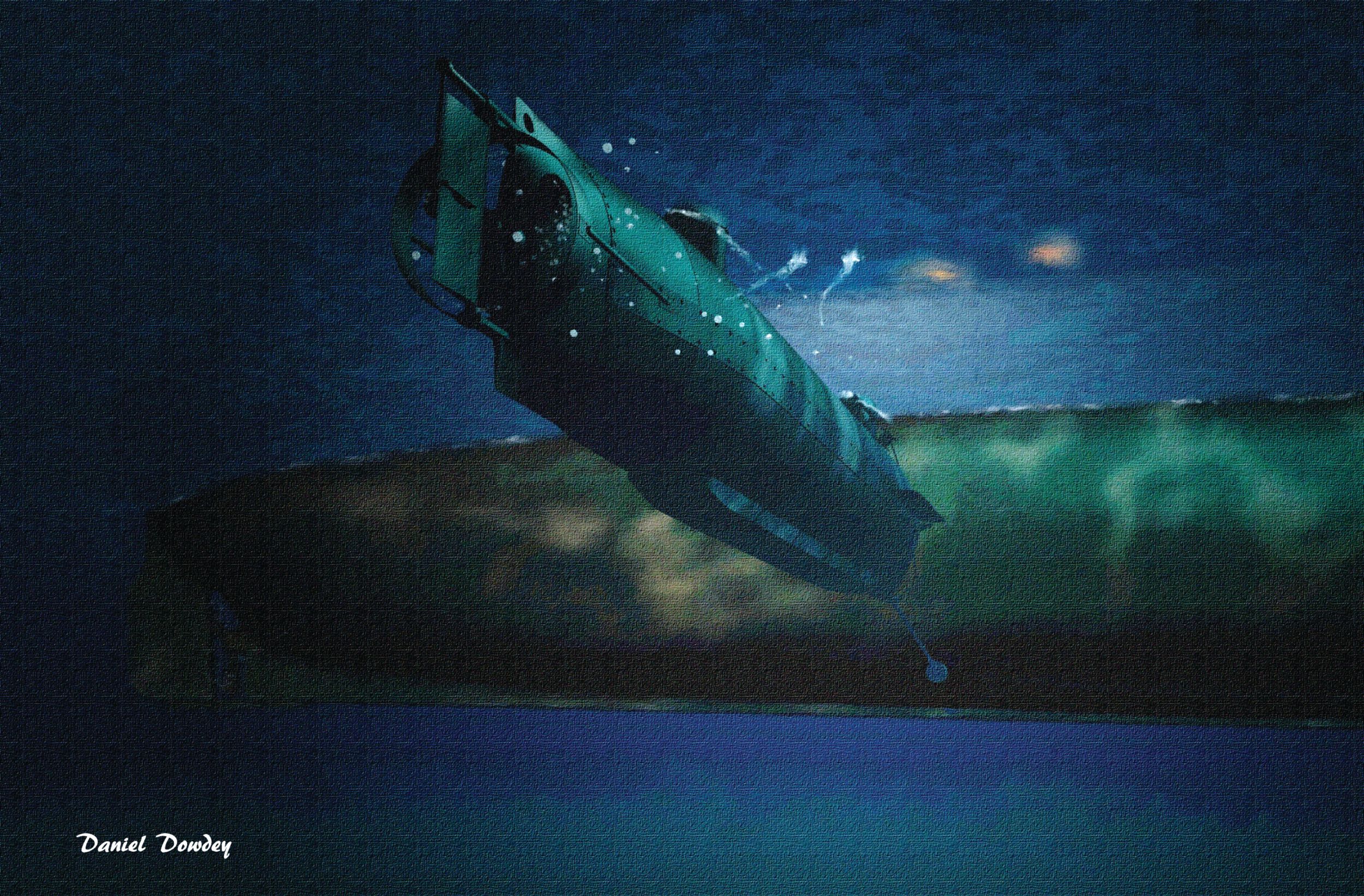
Initially everything went as planned, and the resulting explosion sank the Housatonic in a few brief minutes. Five Union sailors were killed, but the rest of the ship’s complement was rescued by other Union warships. Hunley had the distinction of being the first submarine to sink an enemy ship in wartime.
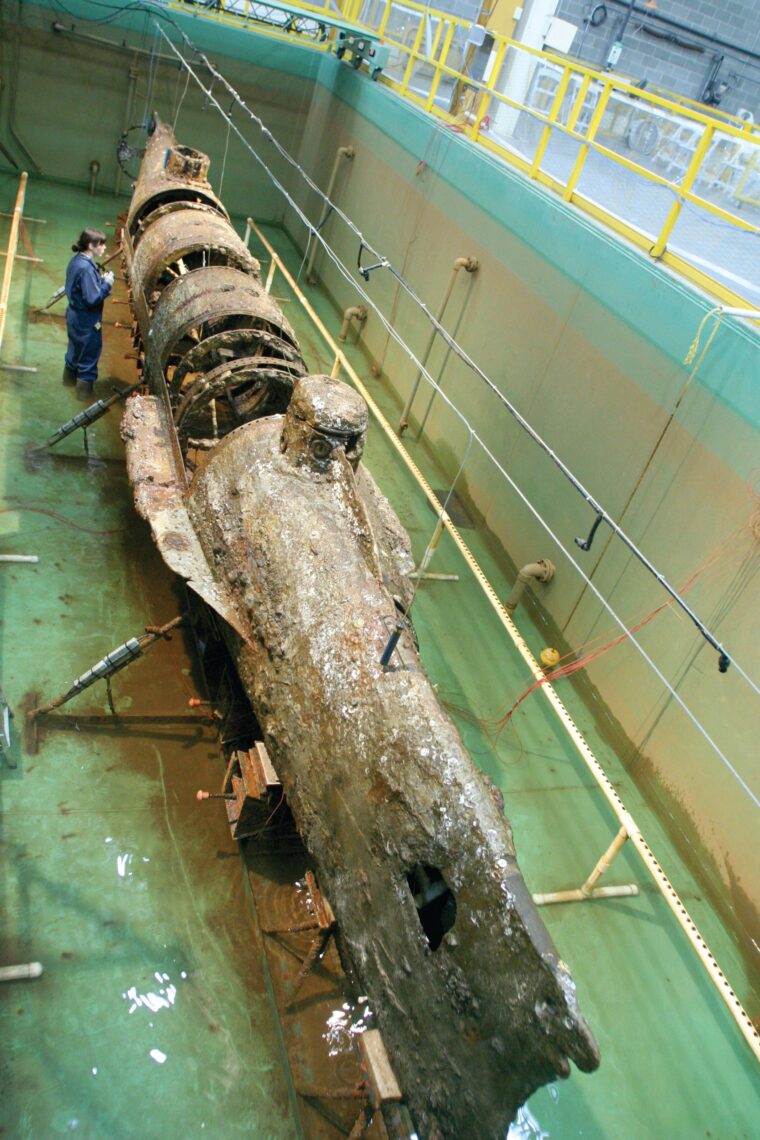
Unfortunately the Confederate sub never returned from its mission and the whereabouts of the lost vessel was unknown for more than a century. Located in 1995 and raised in 2000, the vessel is being studied at the Warren Lasch Conservation Center in North Charleston. Conservation efforts are ongoing, and the public is able to view H.L. Hunley on the weekends.
Hunley has revealed some of its secrets, but why the sub was lost may remain a mystery. But it continues to amaze, given the limitations of 19th century technology. Chief archaeologist Michael P. Scafuri, one of Hunley’s researchers, notes that he “was amazed how well constructed the sub was. The engineers who built it understood hydrodynamics, iron plate rivet construction, and the limitations of the vessel being hand powered.” The sub’s rivets were countersunk, that is, set in indentations, so they would not produce friction between the hull and the water and slow its speed. The bow was also narrow and rounded, the better to cut through the water.
But all subs, whether produced for the north or the south, had the same Achilles heel: the means of propulsion. In the 1860s steam power was the wonder of the age, but it was decidedly problematic for fully submerged vessels. Batteries capable of providing a submarine with adequate power would not be produced for decades. That meant human muscle was the only alternative, which is why clumsy crank propellers or even oars were used.
In spite of their limitations, Civil War submarines showcase the ingenuity, resourcefulness, and courage of the men, North and South, who fought in that tragic and fratricidal war. There is also a curious postscript to the submarine story—anecdotal and unproven—that DeVilleroi taught math to a young boy named Jules Verne, who grew up to write the classic adventure Twenty Thousand Leagues Under the Sea.
Join The Conversation
Comments
View All Comments