Latest Posts

British commandos march through the ruins of the French town of Caen. An objective of the Allied D-Day landings that was supposed to have been captured on June 6, stiff German resistance prevented the city from being liberated until a month later.

Latest Posts

Fleming, Ian Fleming

By Hervie Haufler

Some accounts of Ian Fleming’s life make it seem that only at the age of 44, as an antidote to the shock of finally agreeing to get married, did he suddenly commit himself to the unplanned task of creating his James Bond novels. Read more

Hueys prepare to pick up members of Company A, 5th Battalion, 7th Cavalry to airlift them to a reported enemy ammunition dump in Thang Binh province, 24 miles north of Chu Lai, Jan. 17, 1968.

Latest Posts

The UH-1 Iroquois “Huey” Helicopter

By Ignacio Pullum

As an icon of the Vietnam War and an angel of mercy for American troops who fought there, the Bell UH-1 Iroquois, affectionately known as the “Huey,” has gone on to become the most recognizable helicopter in the world. Read more

U.S. Navy dive-bombers attack a Japanese cruiser at the Battle of Midway in this painting by Robert Benny.

Latest Posts

Lifting the Japanese Military

By John W. Whitman

Japanese military successes in 1941 and 1942 shocked the West. Behind those successes lay a logistics effort not often appreciated, that of shipping. Read more

Latest Posts

King Arthur Saves Britain

By Robert Barr Smith

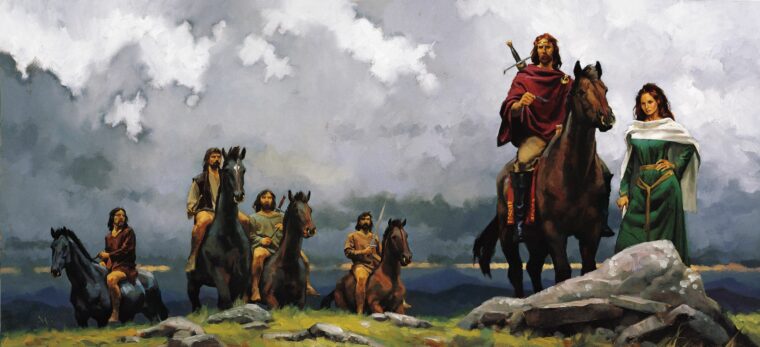
Britain was a battleground in the last years of the fifth century. The occupying, and in some sense stabilizing, Roman legions long since had gone, never to return, and the native Britons found themselves locked in a long, heartbreaking struggle against waves of brutal North German invaders—Angles, Saxons, and Jutes—who delighted in bloodshed, rape, and murder. Read more

Latest Posts

Bairnsfather’s “Fragments from France”

By Robert Whiter

You should send that into one of the illustrated papers or magazines,” said a young subaltern, looking over the shoulder of an officer who was sitting in front of a makeshift table finishing a pen-and-ink drawing. Read more

Latest Posts

Ian Baxter’s ‘The Soviet Destruction of Army Group South’

By Christopher Miskimon

After the destruction of the German Sixth Army at Stalingrad in February 1943, the German Army Group South began a slow westward withdrawal, inexorably pressed by advancing Soviet forces of what would eventually be named the First through Fourth Ukrainian Fronts. Read more

Members of an all-black Seabee battalion practice disembarking from an LCP(L) (Landing Craft Personnel, Large), December 1942.

Latest Posts

Peter Harmsen ‘Darkest Christmas’

By Christopher Miskimon

The darkest, deadliest Christmas in human history occurred in December 1942. Around the globe, as Christians celebrated their holiday of peace and goodwill, peoples of many different faiths and beliefs continued to slaughter one another. Read more

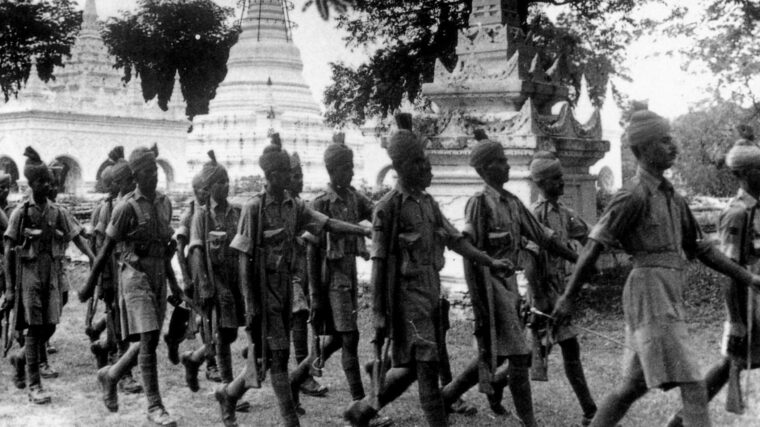
In a rare photo that includes Japanese armored vehicles, victorious infantrymen cross a makeshift bridge during the advance through Burma. The Japanese capture of Rangoon marked a low point for the Allies in the China-Burma-India Theater. (National Archives)

Latest Posts

Tim Moreman’s ‘Conquest of Burma 1942’

By Christopher Miskimon

The Japanese invasion of Burma in January 1942 pitted its well-trained, mobile, and hard-hitting Fifteenth Army against a conglomerate Allied force composed of British, Commonwealth, Indian and Burmese troops in various states of training, equipment and experience. Read more

A German Tiger I tank rumbles along a road near Villers-Bocage, a key objective west of Caen. Two companies of Heavy Tank Battalion 101, a Waffen SS unit, on June 13 ambushed tank columns of the British 7th Armored Division.

Latest Posts

Otto Henning’s ‘Panzer Leader’

By Christopher Miskimon

Otto Henning, born in 1924, joined the German Army in the summer of 1941. Volunteering allowed him to avoid the compulsory labor service and choose his branch of service. Read more

A Japanese balloon bomb in flight during World War II. The Japanese launched some 9,000 such weapons, one-tenth of which reached the continental United States.

Latest Posts

Project Fugo: The Japanese Balloon Bombs

By Allan T. Duffin

On Saturday, May 5, 1945, three days before the end of World War II in Europe and just three months before the Japanese surrendered, spinning shards of metal ripped into the tall pine trees, burrowing holes into bark and tearing needles from branches outside the tiny logging community of Bly, Oregon. Read more