By Gerald Felix
As the pilots of the U.S. Army Air Force’s 510th Fighter Squadron hit their bunks on the night of June 5, 1944, the chatter among the “Buzzards” was the usual moaning about boring missions and wondering when they would see some real action. Since they’d arrived in March at RAF Christchurch in Dorset, England, they’d had little more than escort, dive bombing and strafing assignments—part of the job, but not very exciting. After a short night’s sleep, they were up the next morning before the sun, pulling on flight gear, and attending the squadron briefing. By daybreak they were airborne in their P-47s, looking down at Operation Overlord’s Neptune phase—the greatest invasion fleet in history. There would be more than enough of the much-awaited action to go around.
The 510th FS, along with the 509th and the 511th, was part of the 405th fighter group of the 9th Air Force. Unlike the 8th AF—designed for strategic air strikes deep into Germany at altitude—the 9th AF’s mission was tactical air support in close, brutal cooperation with the ground forces, such as Gen. Omar Bradley’s 1st Army and Gen. George Patton’s 3rd, as well as others as the situation dictated. Normandy would be the proving ground, as the 510th would fly thousands of daily sorties tied to ground battles.
To provide timely support for the D-Day landing, the 510th FS’s first operating base at Christchurch on England’s southern coastline was ideal—only 100 miles directly across from Utah Beach, a distance Allied fighters could cover in 20-30 minutes. As the Allies moved inland from the beaches, they were slowed by Normandy’s Bocage—an agricultural region of thick hedgerows, sunken lanes, and boggy ground that favored the German defenders. The fighting was intense, but the Allies continued to push inland, which meant the airmen of the 510th would have to leave Christchurch to provide support along the 1st Army front lines.
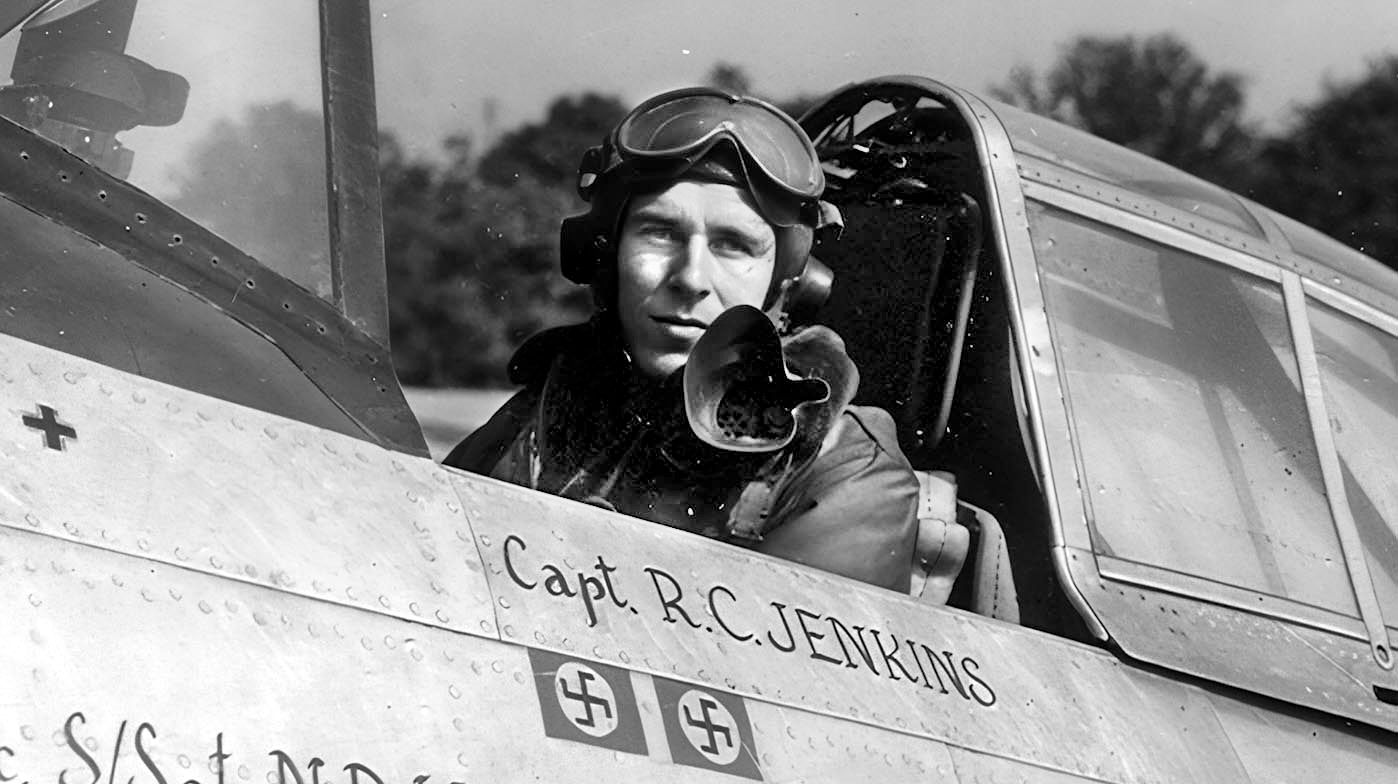
The 405th FG had arrived at Christchurch in March 1944 from Walterboro Army Airfield, South Carolina, where it had been formed in September 1943. Fighter pilots were assigned from various training bases located throughout Florida and would serve in command positions throughout the group. In the 510th, Major Bruce Parcell became squadron commander and 1st Lt. Ralph Jenkins, who already had 1,000 hours in a fighter, was one of three flight commanders.
Newly assigned second and first lieutenant pilots, having completed initial training, soon followed, most in their early twenties and typically from farms, factories, and small towns across the United States. Second Lt. John “Ace” Drummond, at one time a weaver in a textile mill, remembers, “I was an old man compared to some of the pilots, I was 24 years old. I think Williams was probably 20, K Kid only 19.”
With the 510th transitioning from the P-39 to the P-47, the boys found themselves flying one of the heaviest single-engine fighters ever built, the Republic Thunderbolt. “The Jug,” as the pilots called it, was not elegant. It was massive with the 2000-hp Pratt and Whitney engine out front and heavily armored. With eight 50-caliber machine guns and the ability to carry bombs, rockets and napalm, it was perfectly suited for the low-altitude Army support missions the 9th AF envisioned.
Training for future combat operations included five months of flight training at Walterboro Army Airfield in South Carolina that included escort, bombing, strafing, and bare-base operations. In retrospect, that training would prove to be somewhat deficient in preparing them for their primary mission—interdiction and close air support. Second Lt. Dick Parker remembers that he was only able “to get in 40 hours of fighter time. The first bombs I dropped were in combat; the first gunnery was all in combat.”
With the final phases of training and inspection completed the squadron stood down on January 26, 1944, and boarded a steam train for New York with orders to proceed to the Port of Embarkation. “We were pretty confident, maybe even cocky,” Jenkins said. “We were ready to go.”
Arriving at Camp Shanks, “Last Stop USA,” the squadron personnel entrained for overseas processing—two weeks to dry run abandon-ship procedures, get shots, gas masks and helmets. “We all had a chance to visit the Big Apple in our pinks and greens before they hit the bottom of a duffle bag,” Jenkins recalled. The men would receive their P-47s in England.
Having fulfilled all requirements for the looming ocean passage, 40 officers and 255 enlisted men boarded the Cunard Liner Mauritania at the end of February for the 6-day crossing. A winter storm set in on the second day, with seasickness the order of the day for the duration. “The thing I remember most was the bedbugs; they got into the hammocks,” remembered Sgt. Lynn Trank, squadron operations specialist and nose art painter. The men were very happy to leave ship when it docked in Liverpool.
From ship to another steam train, the next stop was Southampton, then into British lorries for the last segment and finally into Christchurch arriving on March 6, 1944. Bed-down planning had been previously set up under direction of the advance party group personnel. Pilots occupied cottages, with squadron staff and ground officers housed in a manor house across the field. Enlisted personnel moved into primordial tents with Sibley stoves set up in gardens around the manor house.
Here the pilots went through more training—in briefing rooms, not in the air—attending special classes in basic French, enemy aircraft identification, escape, and evasion. Pilots and ground personnel visited other P-47 bases in the UK. It was during this time they learned what the French word “bocage” meant, and they were none too eager to step into it.
Released from classroom duties, the pilots made way for the flight line and the newly arrived P-47s, shipped over in pieces and reconstructed upon arrival. During the first 10 days of April, they began orientation flying, which included bombing, strafing, navigation, and aerobatics. Both pilots and ground crew were excited and eager, looking forward in anticipation of what lay ahead.
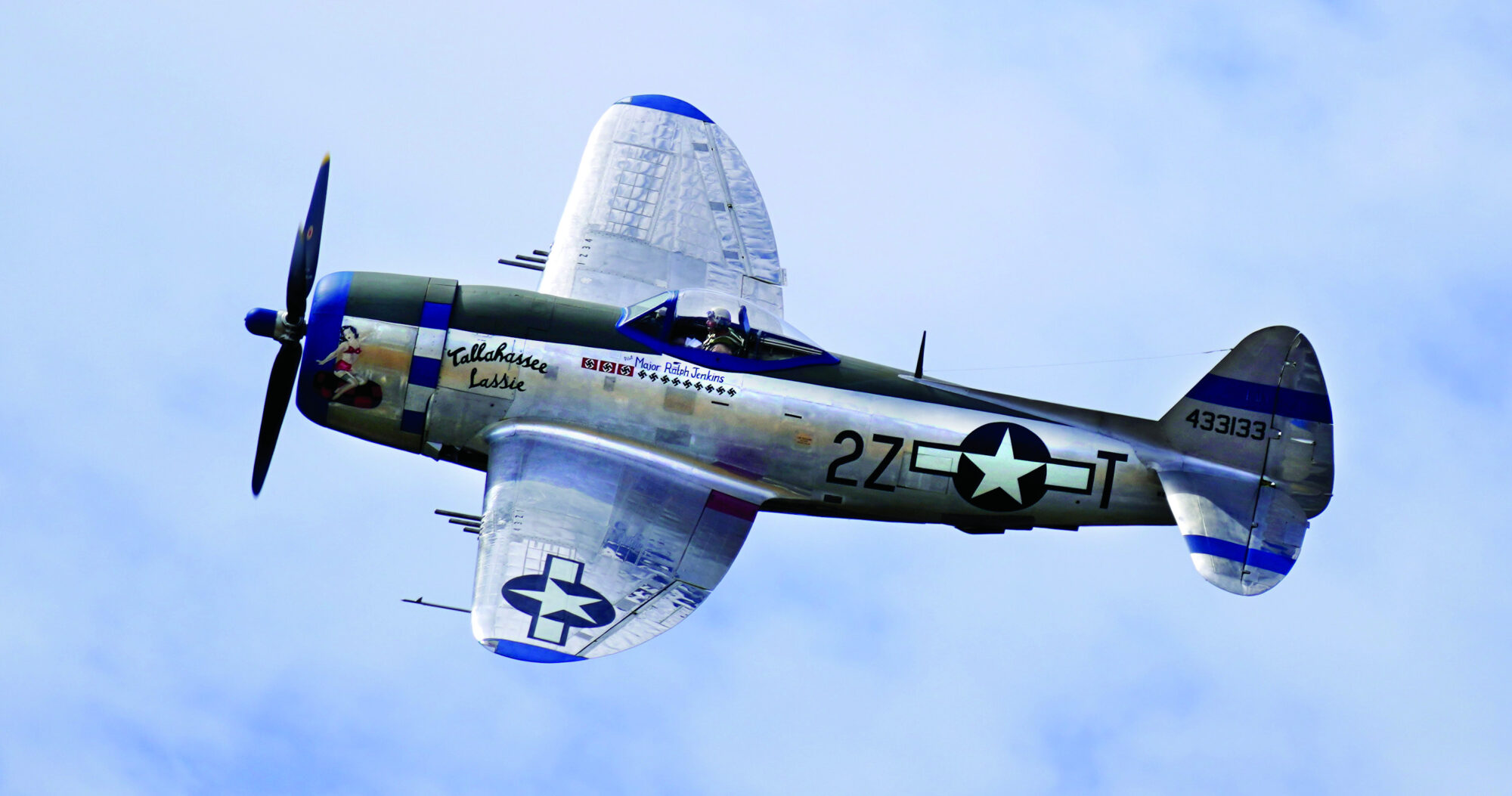
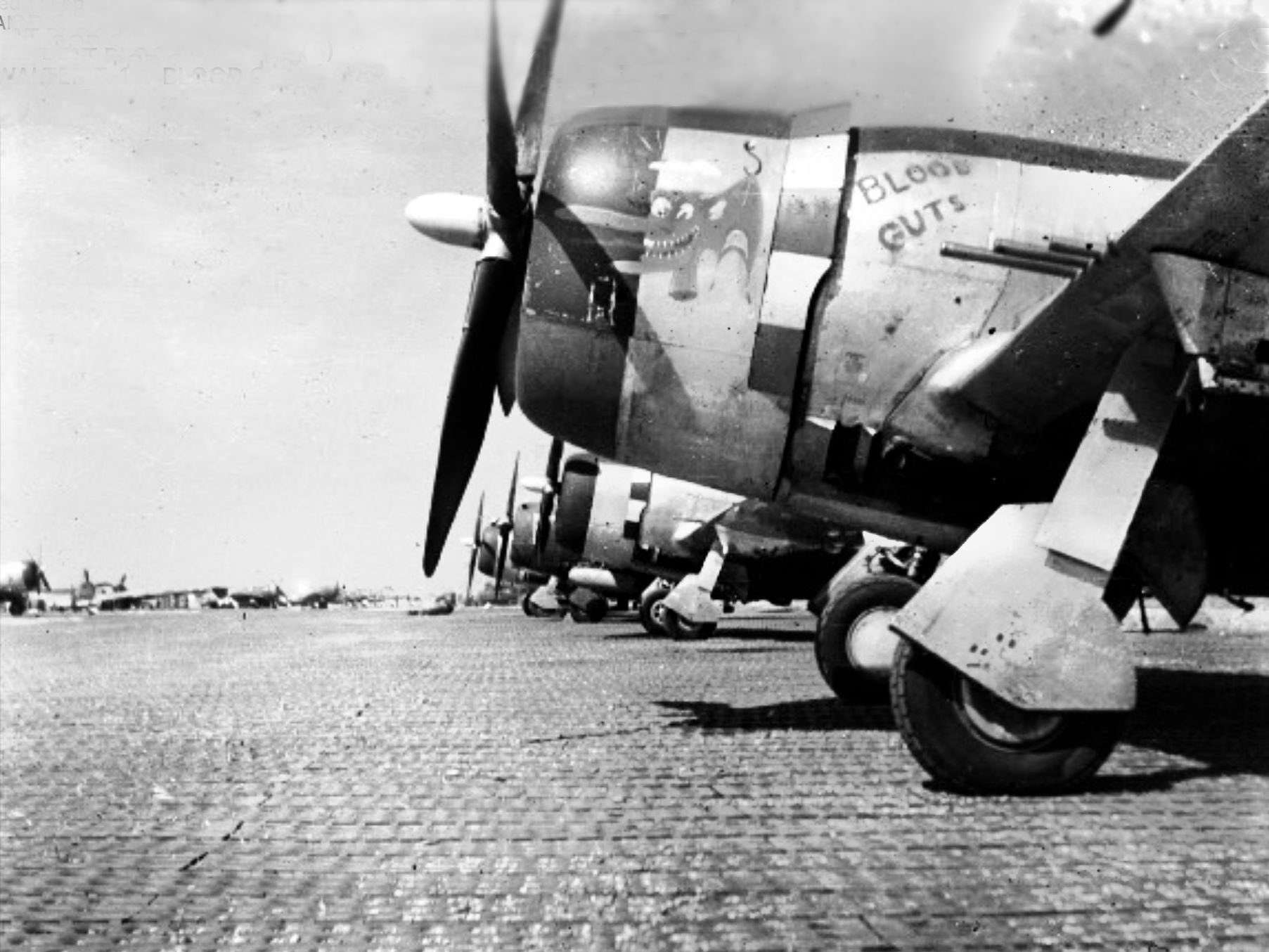
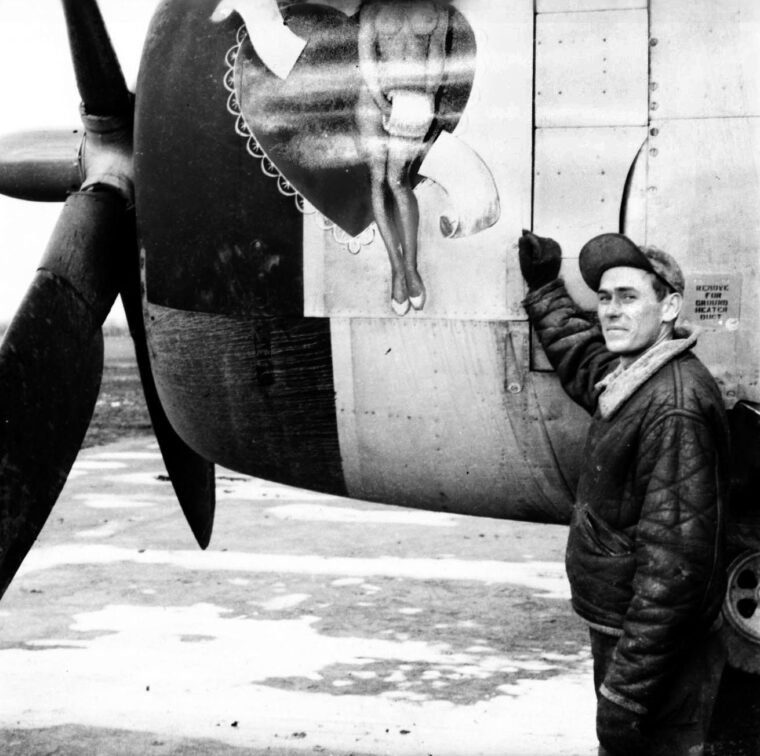
While the emphasis was on achieving combat-ready status, the pilots engaged Trank in painting nose art and pilot names, along with assigned crew chiefs and armorers, on the brand-new Jugs with nicknames like Ex-Lax, The Bug, Raid Hot, Little Lu Lu, Parson’s Wife, Sweepstake, K-Kid, The Scarab, The Lookout, Tallahassee Lassie, and Squirt. For the pilots, Trank was “the only irreplaceable man in the 510th.”
The squadron flew their first combat flight on April 11, a fighter sweep over the west coast of France, encountering flak in the Le Havre area; the mission was otherwise uneventful and seven sweeps followed with similar results. Fighter sweeps made up most of the remaining April missions and consisted of Red, White, Blue, and Yellow flights each with four P-47s. Pilots encountered flak on most missions with two returning with battle damage sustained while attacking targets in the Nogent-Andouville area. While the sweeps were unsuccessful in destroying air and ground assets, they did provide valuable actionable intelligence information for future offensive operations.
Dive bombing missions began with two missions on April 26 against marshaling yards in the Kontes-Gassicourt area west of Paris, and on April 27, bombing and strafing the Luftwaffe base at Omer-Longuenesse south of Calais. Pilots reported damage assessment as significant with one P-47 experiencing slight flak damage.

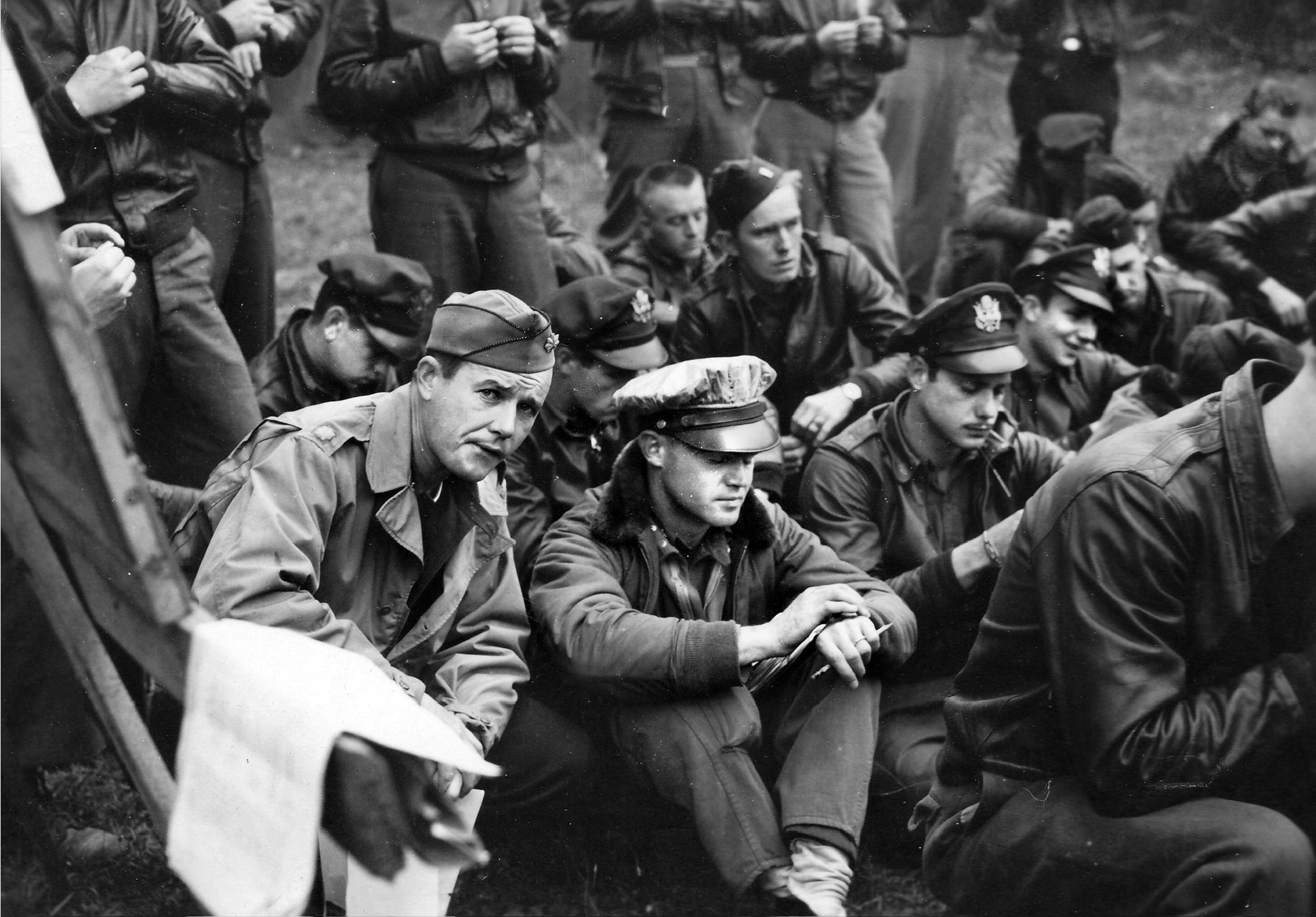
By the end of April with occasional down time available during periods of poor weather, a dozen pilots could be found dozing, playing darts, or hand-flying their latest adventure over France in the Mercury Bar or Interrogation Tent. Back at quarters there was always a game being played in Ace’s room, or a discussion of the latest plans and adventures in Major Parcell’s room. Most significantly, Capt. John “Doc” Milligan, squadron flight surgeon, kept an open house in his room almost every evening. Down at the local Haven Inn, a quartet of pilots could be found singing, “Iron Men of Old 510th.”
May opened with a bombing mission at the airdrome in Dreux, France, and a coordinated mission with B 26 Marauders against three gun positions just south of Calais. These missions were indicative of those flown the rest of the month–escorts, dive bombing and strafing, all effective but uneventful.
That changed on May 15, when the war was brought closer to home. While on an escort mission enroute to Hanover, Germany, Captain Taylor was hit by flak and forced to bail out over Belgium; he was captured and became a POW. Jenkins would move up to become the new squadron operations officer.
May 21 was a happy hunting day—the target was a train on a sweep in the Brest Peninsula. Red, White, Blue and Yellow flights took turns strafing several trains, destroying nine engines, three trains, eight goods wagons on a siding, and two radio towers.
On May 24, while leading a flight, Lt. Arlie Blood attacked a train east of Landevant in northwest France. Ace Drummond, flight element lead, observed direct hits on the train engine, and then smoke coming from Blood’s plane. Blood safely bailed out, but he would be captured, then escape, and finally return to the squadron before heading home.
The month ended with the 9th AF commander, Gen. Pete Quesada’s visit for the purpose of presenting Air Medals to a group of 510th pilots. Approaching 2nd Lt. Boleslaw Kociencki, the general asked, “How old are you son?” “K-Kid” said he was 20. “Does your mother know you are over here?” Quesada quipped.
At 0330 on June 6, line personnel observed a large group of C-47s returning from their missions on the day the world was waiting for—the invasion, D-Day—and the 405th FG was ready. Pilots from the 510th patrolled an area east of the Brest Peninsula looking for German naval assets capable of disrupting invasion plans. They found none.
And so it went for the next four long days. Impatience reared its ugly head as pilots clamored for bombs. On June 10 they got their wish as the 510th launched 15 P-47s with 1,000-pounders headed for a radar station at Vaast on the Cherbourg peninsula. The mission was a success, the pilots back in the groove.
Over the course of the next 10 days, the 510th would fly 25 interdiction missions against targets located on the Cherbourg Peninsula with the goal of capturing the ports at Cherbourg. The flak was significant, but the Luftwaffe activity was limited. Countless tanks, trucks, supply wagons, staff cars, flak emplacements were knocked out. The Allies captured the Cherbourg ports on June 26, relieving the Mulberry harbor and cutting off German troops on the Cotentin Peninsula. The 405th had completed its opening act at Normandy.
While the pilots met with success on these early missions, they also found tactics that needed further examination. “We were at group strength, south of Avranches, when all three squadrons sighted a single train and all three attacked, 36 P-47s after a single train,” Jenkins recalled. “Highly inefficient and dangerous.” The group thereafter would assign individual squadrons specific areas where targets of opportunity could be acquired and attacked without the risk of a sister squadron attacking the same target.
This became the technique that proved so devastating to German armies in the field. The squadron would fly parallel to the highway or railroad at about 5,000 feet. Upon sighting a target, a split S maneuver would put the Thunderbolt into a near vertical dive towards the target; bomb release and recovery had to be simultaneous. Then a gunnery pattern with the pilot making repeated strafing runs. Skip bombing with 500-pounders and napalm was effective against targets that had a vertical dimension, while dive bombing from 10,000 feet would offer more safety, but less accuracy.
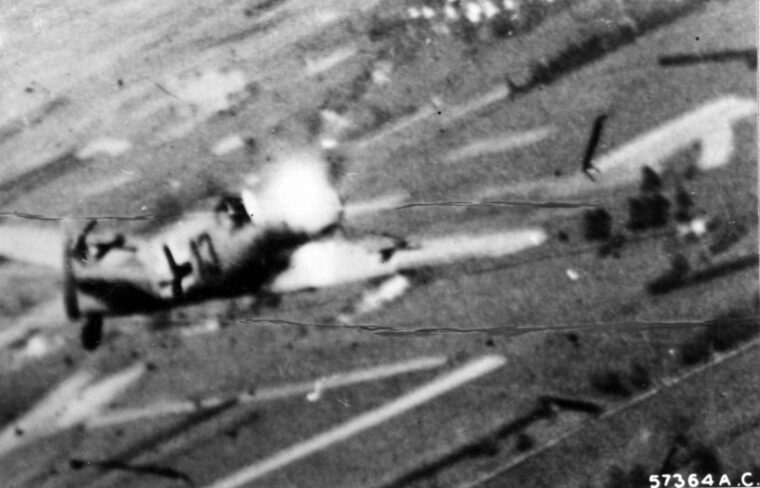
On June 22, Yellow Flight was on a skip-bombing mission over Cloyes, France, against a marshaling yard. As the bombing ensued, three Luftwaffe ME-109s entered the fray and Yellow Flight engaged, with K-Kid turning for a head-on shot against one of the invaders. As both pilots began firing, the ME-109 exploded, and the planes collided. As the wreckage plummeted to earth, no chutes were seen. The 510th had lost its youngest pilot.
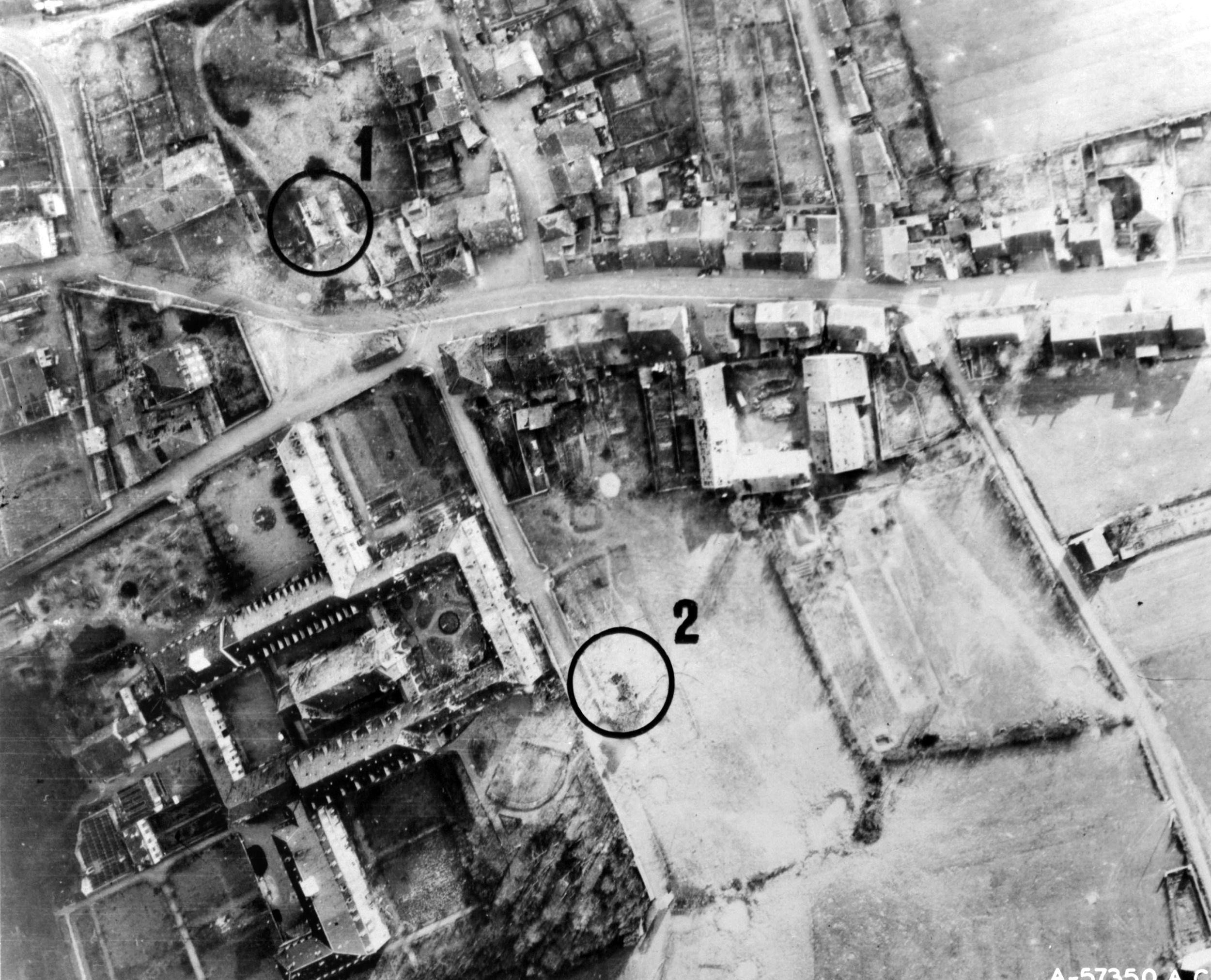
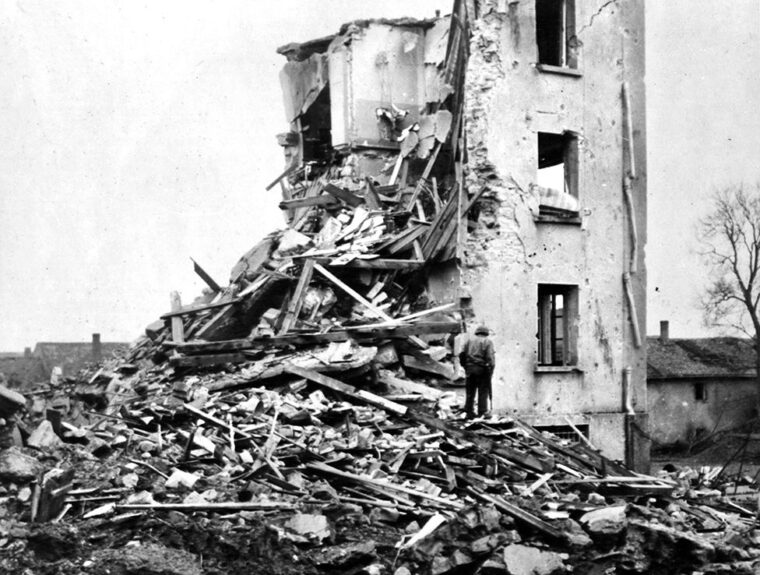
On June 29, the 405th FG experienced another disaster as a 509th pilot lost power on takeoff and crashed into a block of houses bordering the end of the runway. The belly tank exploded, setting the plane on fire as eight machine guns started firing and one of the bombs exploded. Returning from a flight and seeing the devastation, 510th pilots lieutenants Mohrle, Drummond and Williams responded to warn people away from the burning plane. While they were in range of the wreckage the unexploded bomb went off, nicking both Mohrle and Drummond. Lt. Arthur Williams took the full force of the blast. In all, 14 died and 24 were injured.
The end of June met with an advanced party of six ground officers and 194 enlisted men leaving for an unknown destination somewhere in France. The second echelon would have to contend with their boasting of seeing more “action in WW2 than we.” The 510th would be leaving Christchurch.
On June 24, the A echelon—the new name for the advanced party—left the marshaling area and boarded LCIs for crossing the Channel to the Normandy beaches. Much like the invasion troops, they waded ashore with full packs, gas masks, and rifles. Ahead was a two-mile hill, but with the “undaunted spirit of the fighting 510th” they set out.
Once atop the hill they were met by trucks and transported to their new home. There was the stench of death in the air as German soldiers and cows lay everywhere. The pilots dug foxholes with trench knives and helmets, having only two shovels they got from the engineers. The whistle of German 88 antiaircraft and ground guns kept them awake most of the night. The squadron record notes, “the A echelon worked like demons to make a halfway decent place out of the torn up earth and that they did do a fine job goes without saying for when the 17th of this month the B echelon arrived there was a darn modern up-to-date base waiting for them.”
Meanwhile back at Christchurch, the 510th celebrated Independence Day with a confirmed ME-109 kill. On the afternoon of July 4, after completing a dive bomb mission and cutting a rail line between Laval and Craon, 1st Lt. Howard Curran sighted a single ME-109. “Shooting the water” to it, (turbocharger), he rolled in behind and fired two short bursts. The German dove for the deck, Curran chased, but the German never came out of the dive and crashed.
On July 6, the squadron lost another of its pilots to German flak. First Lt. Ralph Hinckley, “Hinck,” was the popular kid of the squadron. He became separated from his flight while taking evasive action and was never seen again.
During the last four days at Christchurch the squadron flew five dive bomb missions and departed on July 11. Twenty-eight enlisted men, known as the X echelon, were left behind at Christchurch to handle all remaining flight operations. They left for Picauville on July 17 by C-47s after enjoying an eight-day break as a reward for their non-stop work.
July 13 was a day of rest and a chance for everyone to orient themselves. For the enlisted men, there was little change—back to tents. But for the officers, it was not so easy as they exchanged their UK cottages for six-man tents with Sibley stoves. “The only thing that was uncomfortable was living out of your helmet,” 1st Lt. Larry Gaughran recalled. “You washed and bathed out of your helmet.” The pilots now realized why they were given all that gear—mess kits, canteens, tents, and jeeps—but they adjusted quickly. “On the ground we lived like infantry; in the air we lived like kings,” Jenkins said.
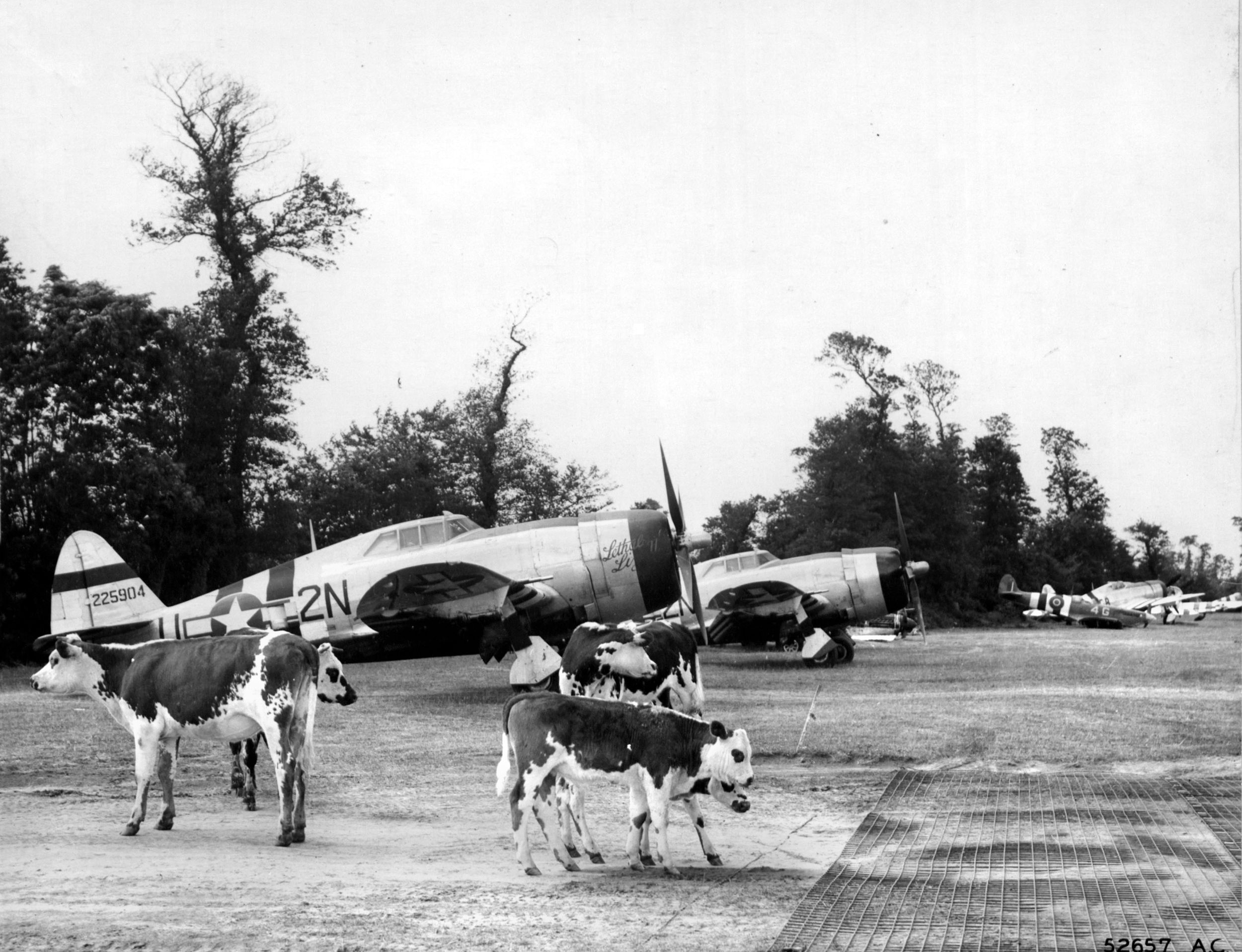
Picauville was just south of Utah Beach near Sainte-Mère-Église. It was a true forward operating base carved out of an apple orchard with a tar-paper runway. Time to targets was mere minutes; flights had to circle overhead to gain the necessary 10,000 feet for crossing the front lying to the south.
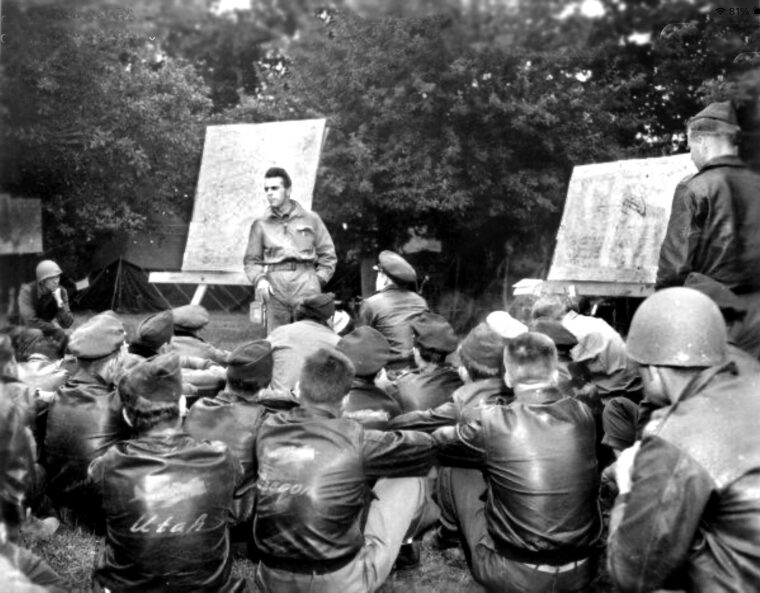
Picauville was wet and muddy. They used the hedgerows and trees as windbreaks because there were no permanent buildings in the area. The troops lived entirely under canvas, camouflaged tents—mess tents, maintenance, and supply tents, medical and operations tents, headquarters tents, and flight briefing tents with maps and chalk boards.The 510th began operations out of Picauville on July 14, flying armed reconnaissance over the next three days and knocking out the usual quota of train engines, supply cars, tanks and gun emplacements.
On July 17, the 510th attacked a bridge in Le Mesnil Raoul, five miles south of St Lo. The bridge was heavily defended by the German 7th Army and its accompanying Lehr Panzer Division. Hamilton and Ellison were both hit, but bailed out and landed safely—but the bridge still stood. It had to be destroyed in advance of Operation Cobra, so the squadron went out twice more that day to hit that same bridge and when at 2015 the last flight left the bridge, nothing could cross.
One of the pilots in that final flight was 2nd Lt. Dick Parker, who along with 2nd Lt. Larry Gaughran, joined the squadron as replacement pilots while still at Christchurch. Their reception had been a bit frosty; the close-knit Walterboro boys had not lost anyone at that time and did not need any help. “Someone said let’s let the new boys try,” Parker recalled. “So we went down and knocked the bridge out. From then on, we got a lot of flying and we got to be part of the squadron.”
More rain and more mud prevailed over the next five days with only three uneventful missions flown and it was during this time that Milligan, the squadron flight surgeon, became recognized as the “heart and soul of the squadron,” according to Jenkins. “Just a super guy,” recalled Parker. “He was your pastor, he was your confidant, he would pick you up at the end of the runway.”
Since D-Day the squadron had flown multiple sorties, day after day, into high threat areas at low altitudes. There was no “off switch.” Pilot stress levels had become elevated, but while fear was in the air, most were reluctant to talk about it. “Well fear is kinda hard to talk about,” Parker recalled. “I guess I began to wonder why they didn’t get you but the only answer I could come up with was it wasn’t your turn.” Lieutenant Gilson said that he sweated and drank a lot. “Fear is something that goes along with being a pilot. How do you deal with it? Best you can.” Some did not deal with it well, and under the advice of Doc Milligan, those few suffering combat fatigue were sent to hospital in England.
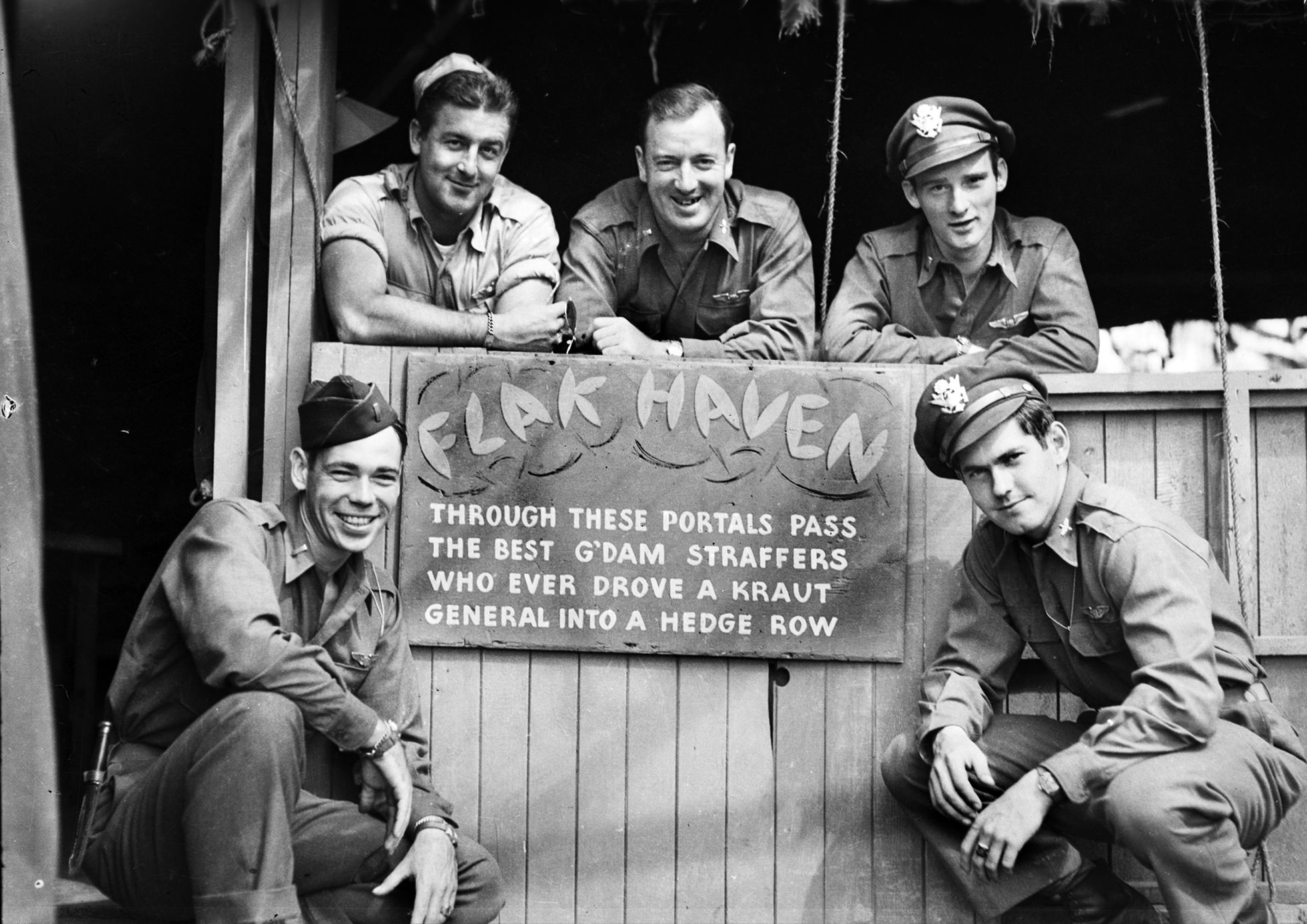
After leaving Christchurch and the Haven Inn, the pilots decided they needed a social replacement, a squadron bar. After collecting scrap wood from packing crates, they built one and called it “Flak Haven.” Trank painted a sign for it: “Through these portals pass the best g’dam straffers who ever drove a Kraut general into a hedgerow.” Needing refreshments to replace the left-behind UK bitters, Doc Milligan mixed medicinal alcohol with grapefruit juice. “We called it Doc’s Kickapoo Joy Juice,” Jenkins recalled, “That meant a lot.”
The P-47 was a featured point of discussion when the pilots met at Flak Haven after a day’s work and the verdict was unanimous: they loved the Jug. “The Thunderbolt was extremely rugged,” Jenkins recalled. “I had to fly across the channel a time or two with the canopy back because the windscreen was just solid with engine oil.” Capt. Harry Sanders remembers bringing back a Jug with a hole in the left wing big enough for his crew chief to stand in.
On July 23, with the weather finally clearing and the pilots chomping at the bit, Jenkins set out with 11 planes to dive bomb a bridge south of Picauville in the Avranches area. After taking out the bridge, “Sweepstakes,” the coastal radar site, called and advised that there were 20 enemy aircraft in the area. Jenkins gained altitude and while flying over an undercast, observed a flight of 15 FW-190 through a hole in the clouds. Diving through it, he engaged one and then another, shooting both down. His element lead, 1st Lt. Howie Curran, engaged three more and shot them all down. Trank met the men upon returning to base, ready to paint swastikas on both the Tallahassee Lassie and Kansas Tornado.
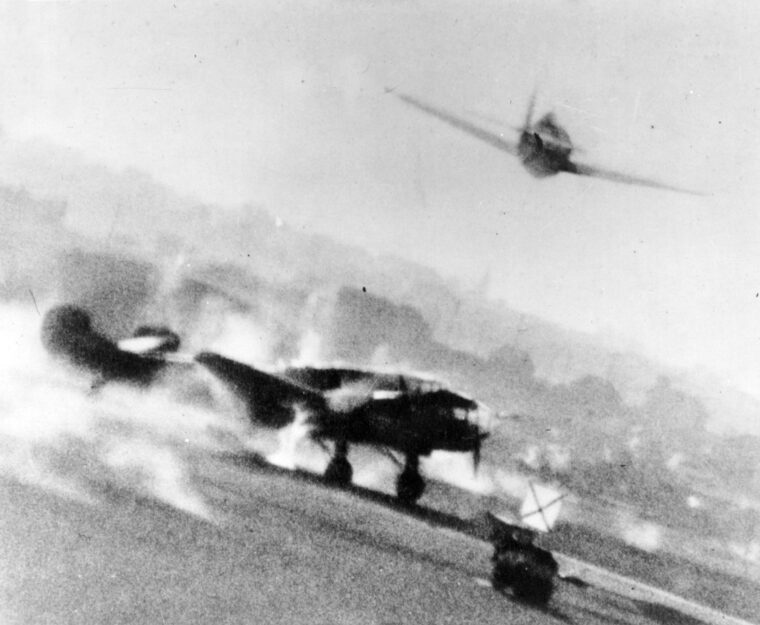
Beginning on July 25, the squadron would enter an extended period contending with very heavy German resistance as they worked the heavily guarded area south of St. Lo in preparation of the breakout. Lt. Woody Wilson on a dive bomb mission against a bridge was hit by flak and bailed out. He was seen running for shelter.
On July 26 the squadron flew six missions from 0630 to 2200 against continued significant German resistance. On the fourth mission while returning to base, Lt. Anton Swanson’s plane caught fire in the cockpit. He stayed with it until over friendly territory, then bailed out, was picked up by friendly troops, and returned to Picauville.
Later that day the flak gunners scored another victory when Lt. Ace Drummond was hit, and with the engine failing and the plane on fire, he bailed out. He landed safely, was captured, placed on a rail car destined for a German POW camp, and was joined by a severely burned Woody Wilson who had bailed the day before.
On the afternoon of July 27, squadron commander Bruce Parcell led an armed reconnaissance mission to Coutances, France, in the Avranches area, a major road and rail hub east of St. Lo, in support of Operation Cobra, the major objective being degrading German movement and command in anticipation of allied ground forces punching through enemy lines. The Germans knew that losing Coutances would mean encirclement; they defended it accordingly.
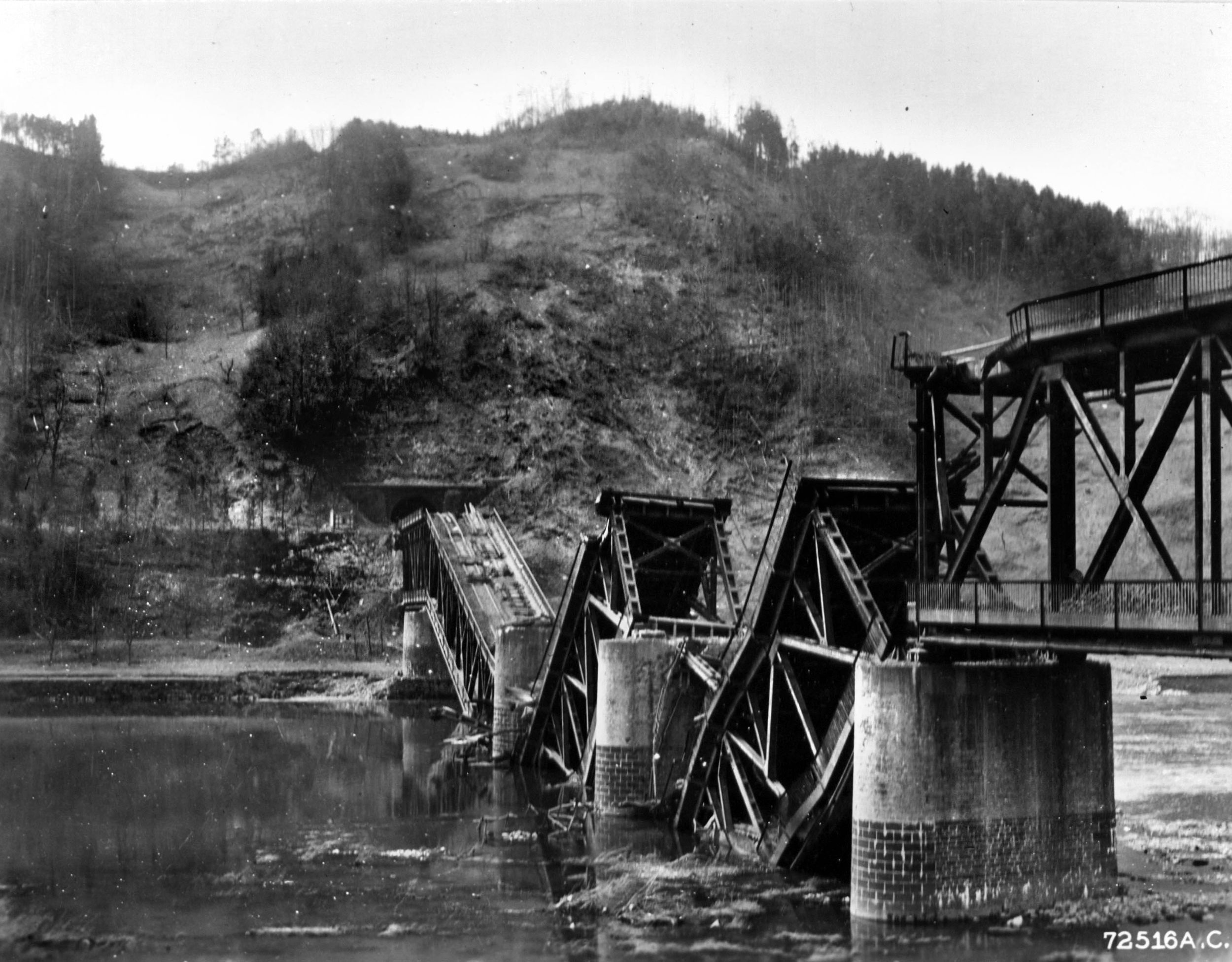
The 510th suffered two telling losses on the mission, the first very telling: their commander. Lieutenant Colonel Parcell was hit while on glide bomb pass, recovered in time to release his canopy, and raised his body halfway out of the cockpit in an attempt to jump. Little Lu Lu nosed over, crashed, and exploded; he was not seen to leave the plane. Parcell left behind a daughter he had never seen. On the same mission, Lt. Stephen Gurd was hit, bailed out, and waved to the flight when he landed.
Capt. Jenkins recalled, “the group commander, Col. Robert Delashaw, whipped into our main control area about four in the afternoon and said, “Jenkins take over the squadron.” Jenkins continued, “I was very lucky. It was a pretty hazardous operation, but if you survived, you might very likely be selected to command a squadron.”
The 510th went back the very next day. From the written squadron record, “In the pilots’ eyes was murder and determination to gain revenge a thousand-fold. Wee be-tide any dirty little Nazi who crossed the sights of Jenkins’ Jerry Junkers. Our first mission was at 1653 that afternoon and as you know Jerry was backpedaling in high gear. There were vehicles clogging every road and highway going South from the front and sure enough it was inevitable that we should run across a convoy…a huge convoy. Not carrying any bombs and we began strafing and when we left the area with empty guns, we left a heap of trash and twisted metal behind. We returned to base only to rearm and load frag bombs and at 1900 that evening we again went out after the same convoy. Returning once more with empty guns, we again reloaded and this time with two 500- pound bombs on each plane we again hit the ill-fated convoy. By the time we returned at 2200 it was dark and we had to call it a day.”
While the 405 FG was heavily bombing the Avranches area, the 8th AF B-17s and B24s with 9th B-26s were blasting a hole through German lines allowing General Patton’s 3rd Army to break out over open ground and out of the bocage. Group tasking priority would shift from 1st Army to 3rd Army, from close support to armed reconnaissance and interdiction.
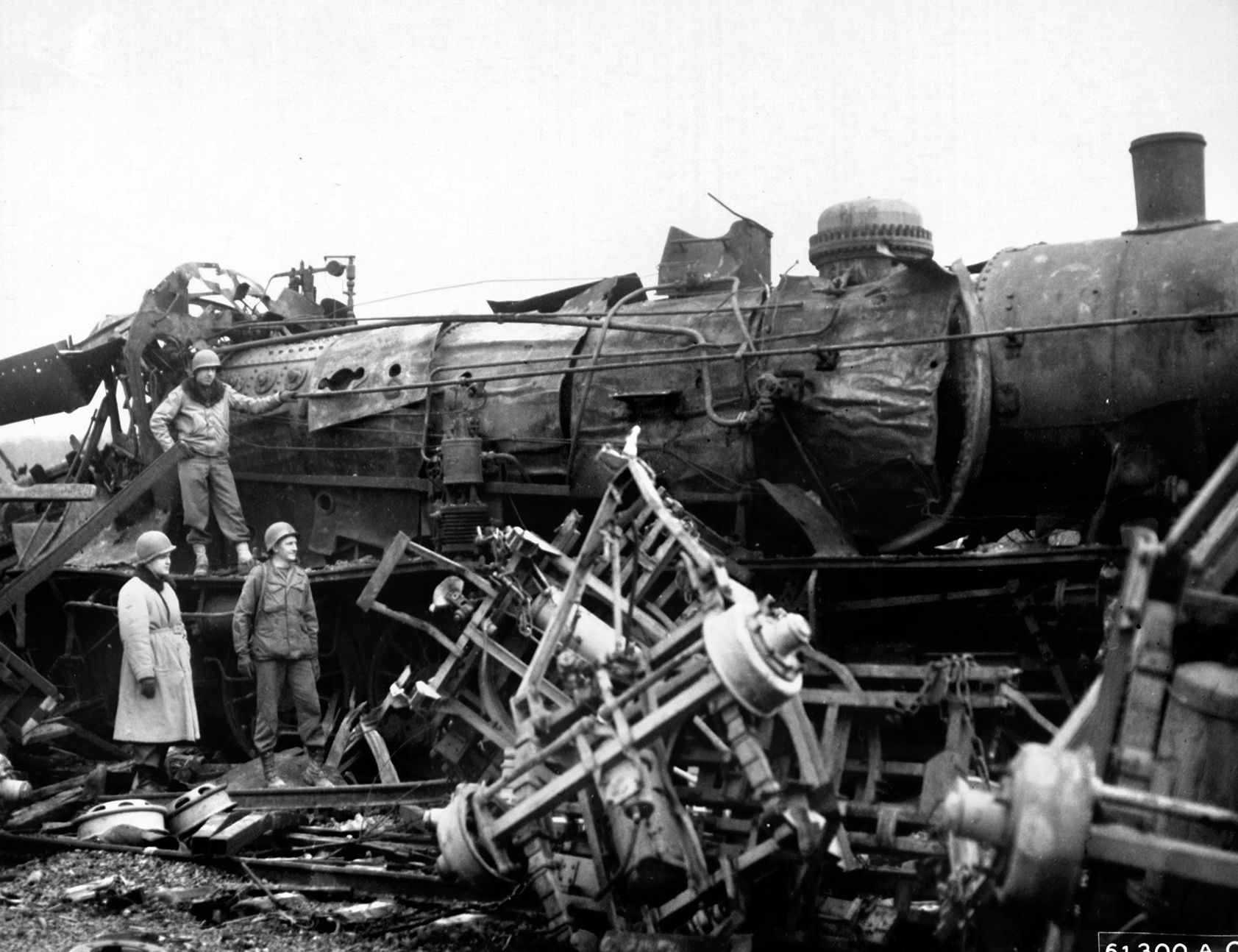
Upon breaking through at St Lo, the 3rd Army headed west and then south, arriving at Avranches in a matter of days, then turning back east, exposing the German left flank. Patton found the area well prepped for his breakout. From Major Jenkins’ written account: “Early the next morning as the fog began to burn off the 510th was airborne to reconnoiter the road leading south to Avranches. A thin cloud layer dissipated and there, 5,000 feet below us, was a column of German vehicles stretching for miles bumper to bumper in a grand retreat; the attack was on. By day’s end the 405th FG would be credited with the destruction of 440 vehicles. It is doubtful that any escaped; armored troops and motorized artillery men were reduced to walking infantry if they could walk at all.”
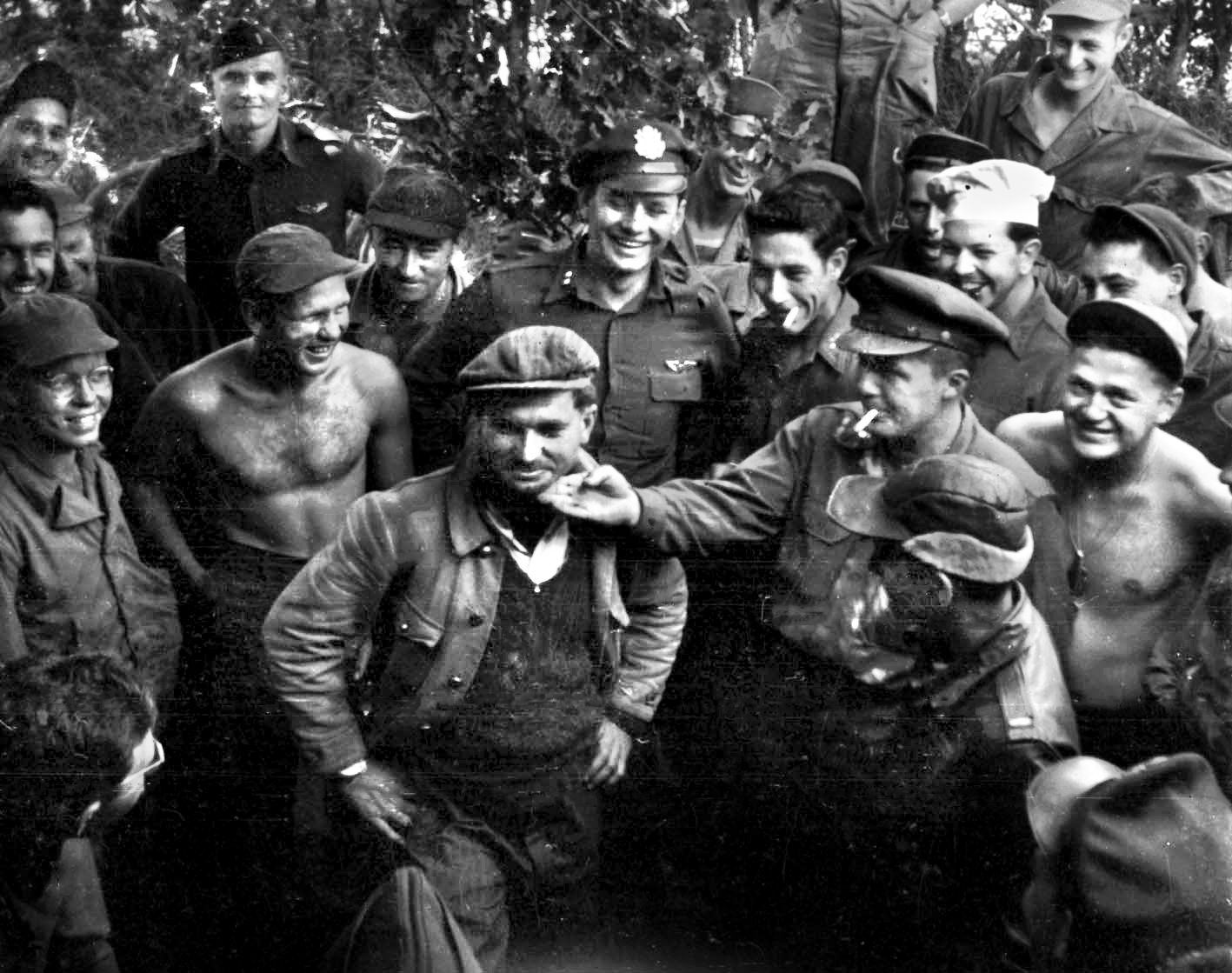
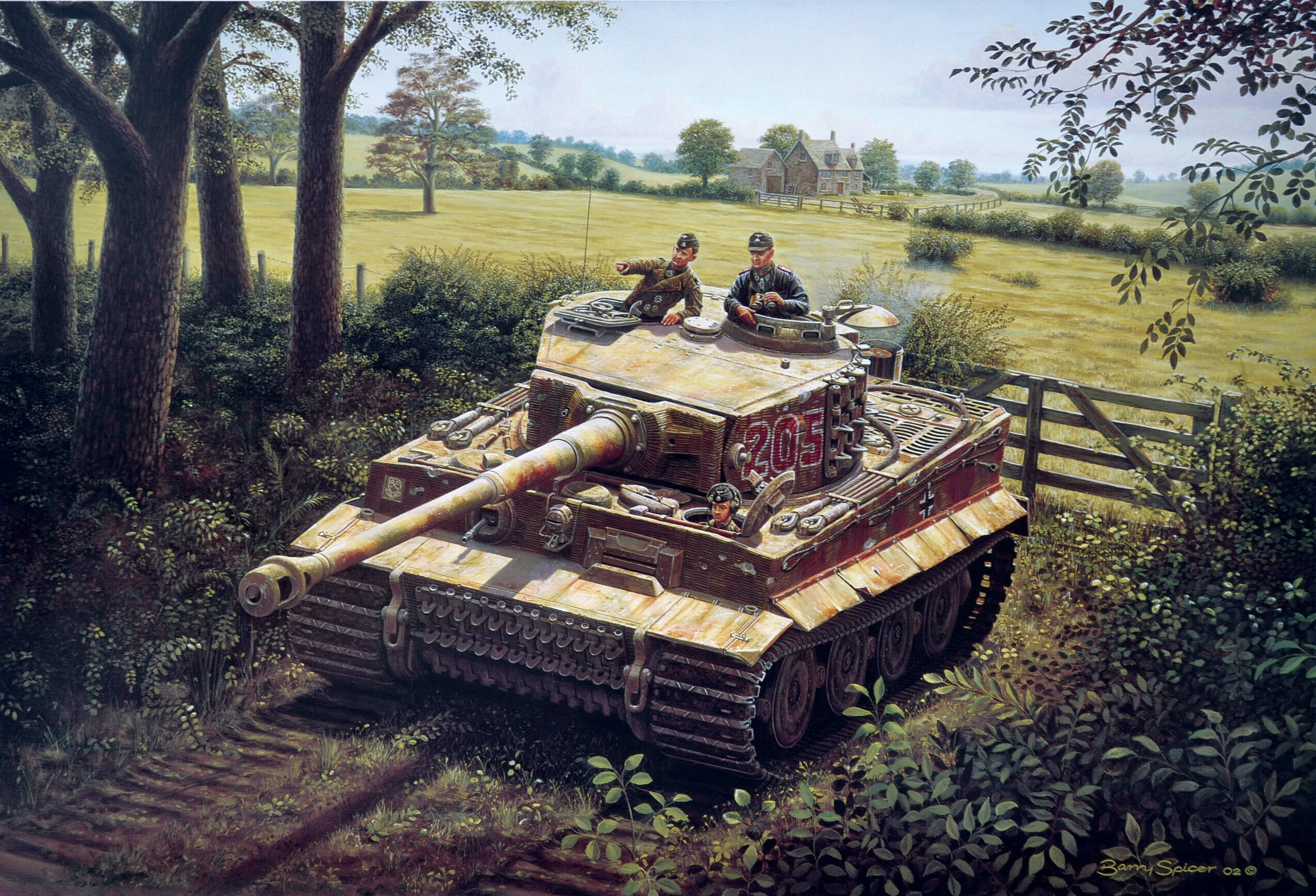
Back at Picauville, with planning underway for breaking camp and moving forward to keep pace with Patton, the squadron received a welcome shock; two of its missing pilots returned home. First arriving was the bedraggled figure of Lt. Paul “Spot” Ellison, 20 pounds lighter, telling sorties of unmitigated hell and riding atop a Tiger tank at St Lo. Next came Lt. Tom Hamilton, driving up in a jeep looking like a French laborer, wearing a cap, sweater, corduroy jacket, and ripped trousers. French resistance farmers had sheltered him; he had assumed the role of a deaf and dumb worker.
While these two would return home, the rest would soon move forward. Walterboro boys, upon reaching required combat hours, would return home; replacement pilots would fill in. The journey would continue: the Great Pursuit, Battle of the Bulge, Bridge at Remagen, crossing the Rhine, and finally landing at the Luftwaffe air base, Kitzengen Germany. The 510th carried the war from Normandy to Germany.
Gerry Felix, Col (ret), USAF, had the honor of commanding the 510th while flying the A-10 during the early 1980s. He attended his first of many WW2 reunions while in command, and followed it with several more. He attended his last reunion in 1999, and with help of his daughter, filmed several squadron mates. These videos, along with the squadron history and personal correspondence, provided the basis for the story.
Join The Conversation
Comments
View All Comments