By Neil Taylor
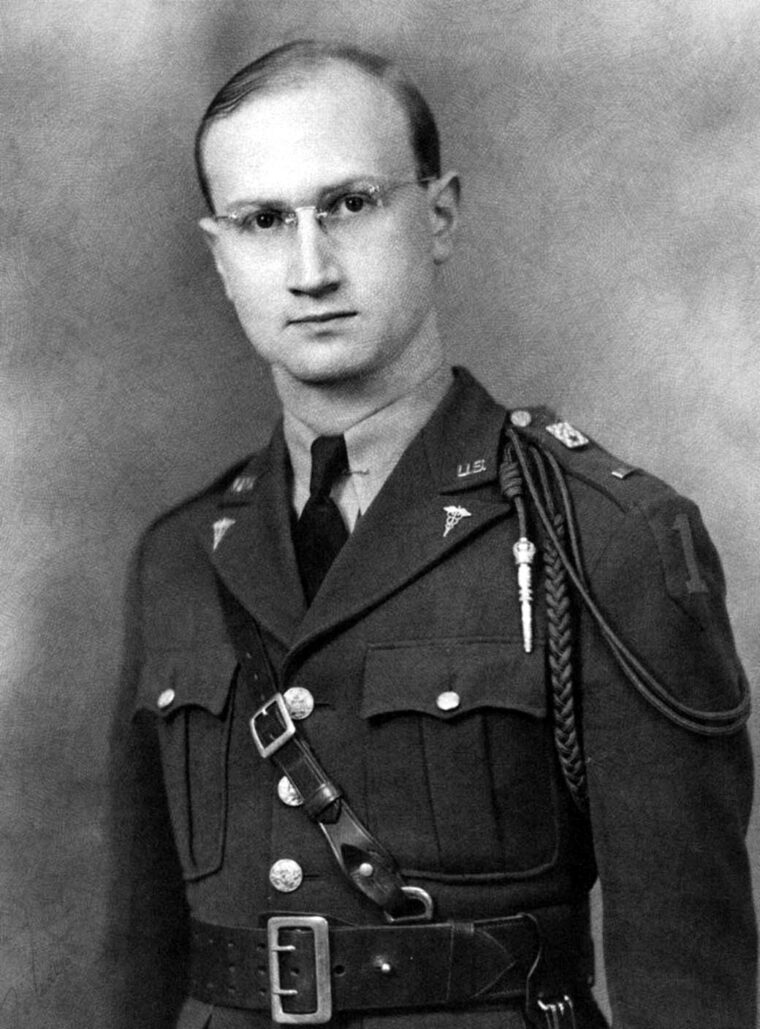
Ensign Kay Kopl Vesole, USNR, did not like being a sitting duck. Normally he would have enjoyed the warm Italian sunshine, but as commander of the Navy Armed Guard aboard the John Bascom, a 7,176-ton Liberty ship, he was not permitted to relax while his ship lay moored in crowded Bari harbor, a small though vital port on the heel of Italy.
In the 12 weeks since elements of the British 1st Airborne Division had secured Bari on September 11, 1943, the port had become a logistical base critical to the advance of the British Eighth Army fighting its way up Italy’s Adriatic coast. More recently the U.S. Fifteenth Air Force had moved into the array of airbases on the Foggia plain approximately 80 miles northwest. Now a steady stream of Allied convoys arrived in Bari carrying all manner of war materials from ammunition and jeeps to aviation fuel and spare parts.
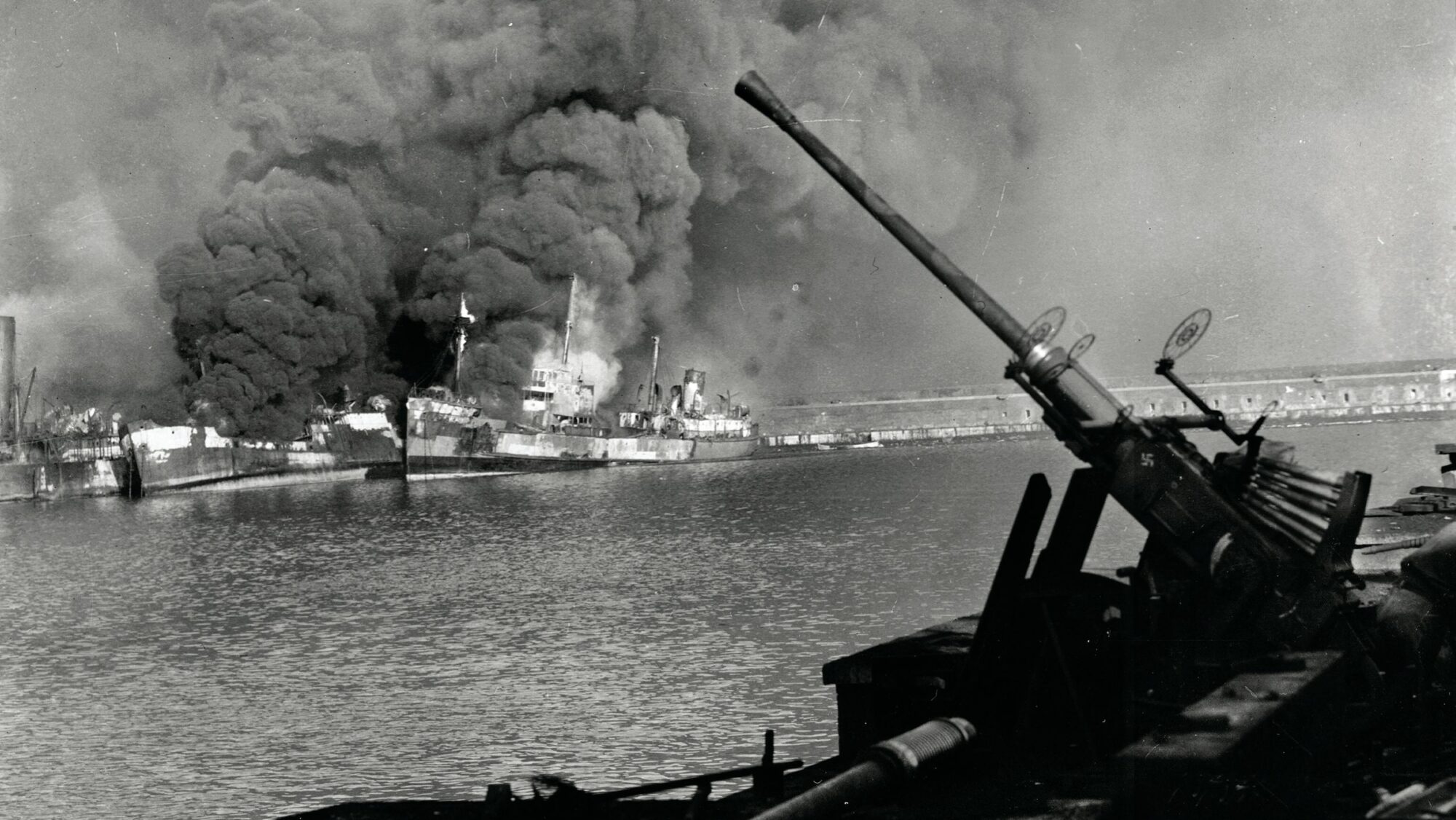
The John Bascom, with Vesole and his gunnery crews aboard, had departed the Sicilian port of Augusta on November 28 as part of Convoy AH.10A arriving in Bari on December 1. The ship, commanded by veteran Capt. Otto Heitmann, sailed through the harbor entrance into the midst of a floating menagerie of more than 50 merchantmen and warships. Given the sheer number of vessels and the lack of port unloading capacity, cargo ships were forced to anchor throughout the inner basin or stern-first against the long Nuovo Molo (New Pier) that formed the northern and eastern boundaries of the harbor.
Berth 31 of the Nuovo Molo became the temporary anchorage of the John Bascom as it waited its turn to unload. To starboard lay the 5,202-ton Italian cargo ship Frosinone and to port another Liberty ship, the John L. Motley, its holds crammed with 5,231 tons of ammunition. The John Bascom carried its own deadly cargo—50-gallon drums of acid and high-test gasoline. Nearly every ship in the harbor carried volatile war materiel.
Vesole’s previous voyages had been uneventful, but here in Bari, surrounded by a floating and highly flammable arsenal, he felt uneasy. Despite assurances from port authorities that the Luftwaffe seldom ventured this far south, Vesole instructed his men to check their guns again and be on the lookout for enemy aircraft.
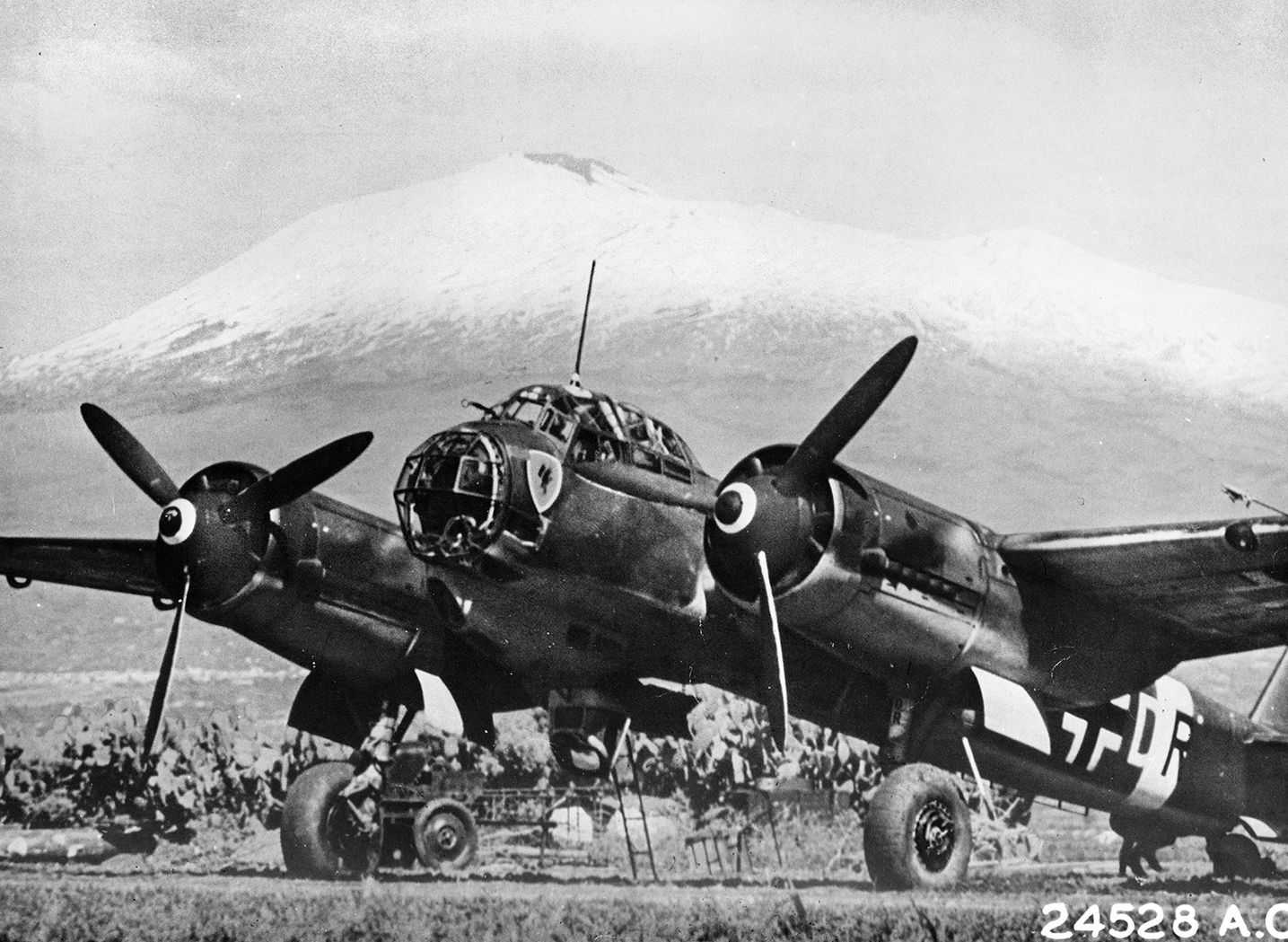
Vesole’s concerns were well founded. After a week of reconnaissance, Luftflotte 2 commander Feldmarschall Freiherr von Richthofen sent a strike force of 105 twin-engine Junkers Ju-88 bombers from I. and II./Kampfgeschwader 30 (KG 30) based at Ghedi and Villafranca, I. and II./KG 54 at Cameri and Bergamo, and I and II../KG 76 at Villaorbia and Aviano.
Along the way a number of aircraft were forced to return to base for mechanical and other reasons, leaving 88 aircraft to press home the attack as they neared Bari.
Several factors contributed to the success of the imminent raid. The main radar station for Bari’s antiaircraft defenses, operated by the American 548th Mobile Signals Unit was out of service. Second, only one light antiaircraft unit was located in Bari, the British No. 2862 AA Squadron equipped with 40mm Bofors guns, although these were supplemented by the merchant ships’ gun batteries.
At 1907 hours the ground controlled interception radar of 8010 Air Ministry Experimental Station north of Bari detected two aircraft inbound, but in a matter of seconds these contacts disintegrated into a confusing mass of echoes. Unbeknownst to the defenders, the leading aircraft in the Luftwaffe formation, three Ju-88s of 6. Staffel KG 54, had dropped Düppel, aluminum strips similar to the “window” used by British and American aircraft, to jam Allied radar. A handful of night fighters from the U.S. Army Air Forces 416th Night Fighter Squadron and the Royal Air Force Nos. 255 and 600 Squadrons scrambled but failed to make contact with any enemy aircraft.
At 1923 hours other pathfinder aircraft from 6./KG 54 made a pass over the harbor, dropping parachute flares to illuminate targets. Seven minutes later Oberleutnant Gustav Teuber led the first wave of Ju-88s onto the target. The first bombs hit the city, but soon Luftwaffe bombers swarmed over the harbor, striking hard and fast. Many of the leading aircraft conducted shallow diving attacks while approaching ships from abeam.
Moored along the Nuovo Molo, the first ship hit was the Joseph Wheeler, a 7,176-ton Liberty ship packed with ammunition that immediately caught fire. Farther down the row, the John L. Motley took a direct hit in its No. 5 hold and burst into flames.
In the adjacent berth, the John Bascom went to battle stations as soon as the first flare dropped. Vesole’s guns crews leaped to action, firing blindly into the night sky as damage control parties readied their fire hoses. The first bracket of bombs seemed to spare the John Bascom; then suddenly four bombs hit in rapid succession and fires erupted everywhere. Hit in the shoulder and chest, Vesole moved from gun to gun directing their fire before assembling a party to go below decks to rescue wounded sailors.

Two ships down the line, a bomb struck the 5,074-ton Norwegian naval coal ship Vest, burying itself in the vessel’s coal hold before exploding.
Other ships along the Nuovo Molo took hits. The Lars Kruse, a former Danish cargo ship hauling 1,400 tons of aviation spirit, took two direct hits and exploded. The 1,268-ton Norwegian cargo ship Lom, with its 906 tons of equipment and benzene, was ablaze. Next to it, the 646-ton British coastal tanker Devon Coast, had a parachute flare lodge in the ship’s mast, starting a fire that quickly spread out of control before a bomb exploded in the No. 2 hold.
The 1,409-ton Polish cargo ship Lwow received a direct hit and burst into flames. A second bomb rocked the vessel, blowing seamen overboard. HMS Vienna, depot ship for the 20th and 24th MTB Flotillas, was damaged by flying chunks of concrete.
Just outside the harbor, three ships, the 7,176-ton American Liberty ship Samuel J. Tilden, the Polish cargo ship Lublin, and the British trawler minesweeper HMS Mullet, witnessed the destruction unfolding inside Bari harbor. The Samuel J. Tilden, clearly lit by one of the harbor searchlights, was hit by an incendiary bomb and the captain ordered the ship abandoned.
The attack ended as suddenly as it began. By 2000 hours, the last Ju-88 had banked to the northwest and fled over the Adriatic.
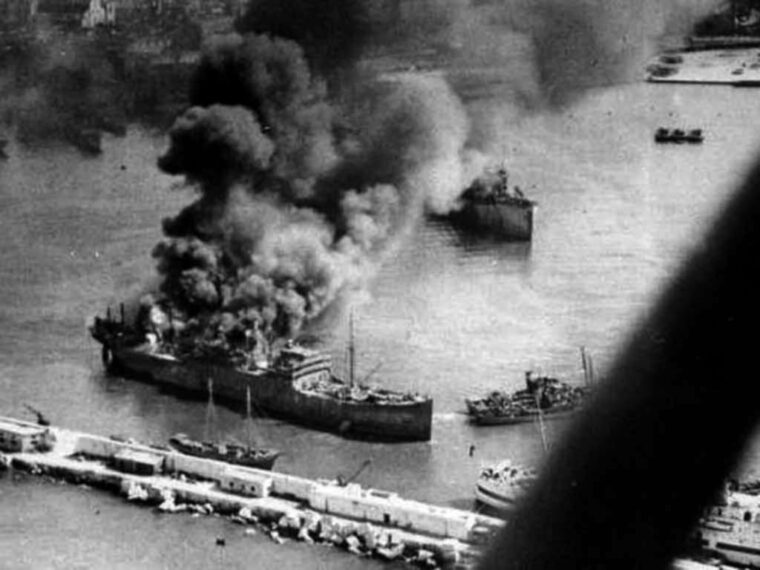
The ships moored against the Nuovo Molo had suffered the worst of the attack. The John L. Motley broke free and drifted toward the John Bascom. From the John Bascom’s shattered bridge, Heitmann saw his ship was doomed and turned to evacuating his crew. Vesole oversaw the loading of the wounded into the sole surviving lifeboat.
Noting Vesole’s severe wounds, Heitmann ordered him into the lifeboat, but Vesole refused choosing instead to assemble his gun crews on deck for evacuation. It was only when they physically forced him into the lifeboat that Vesole reluctantly left the ship.
After carefully maneuvering between the John Bascom and the John L. Motley, the packed lifeboat pulled alongside the Nuovo Molo, but there were no stairs, just sheer stone wall to the top of the mole. Covered in oil and grasping the cracks in the stone with their fingertips, the uninjured clawed their way to the top. Then, with the assistance of jury-rigged stretchers they hoisted the more seriously injured out of the lifeboat.
Once atop the pier, the crew found their way to the main dockyard blocked by the row of burning cargo ships. Heitmann ordered everyone to retreat to the end of the pier, where they found two open shelters in the seawall beneath the harbor lighthouse.
Time, however, was running out. Thefiercely burning John L. Motley crashed into the Nuovo Molo just as its cargo of cyanide and ammunition went up in a thunderous explosion and it began to sink rapidly. Nearby, the 7,176-ton cargo ship John Harvey caught fire. Less than 1,000 feet away, the Liberty ship Lyman Abbott was showered by debris from the John L. Motley, including a six-ton section of steel deck plating, that heeled the ship to port.

Nearby, the Italian merchant auxiliary cruiser Barletta erupted in flames and began to drift toward the Lyman Abbott. With 2,300 tons of fragmentation bombs in the No. 3 hold, the ship’s master ordered the the crew to abandon ship. Picking their way through expanding oil slicks and scattered debris, the escaping crew members made it to the Vecchio Molo Foraneo, one of the inner harbor piers, where they joined survivors from other ships. British troops identified those in need of medical treatment and rushed them off to hospital while the others walked to the nearby Navy House, where they received dry clothing and hot tea.
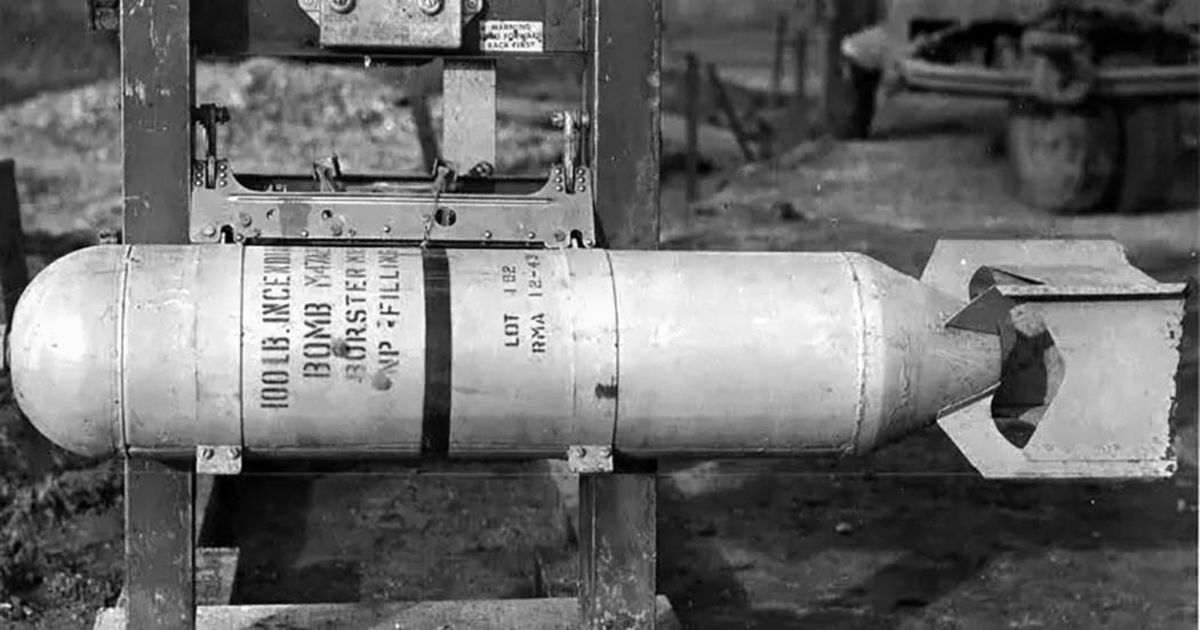
Aboard the John Harvey , the crew fought a losing battle against the rapidly spreading flames. One unit in particular fought to prevent the unthinkable from happening. Members of the 701st Chemical Maintenance Company, led by 1st Lt. Howard D. Beckstrom, were among the few who knew of the John Harvey ’s secret cargo. Stored in her holds were 2,000 100-pound M47A1 pressurized liquid mustard bombs, loaded in Baltimore with the express permission of the White House. They were shipped to Italy for possible retaliatory action by the Allies if the Axis powers used chemical weapons in the Italy. Beckstrom’s soldiers, who regularly checked for cracks in the bomb casings to guard against dangerous leaks, were now fighting for their lives.
As the fires intensified, the John Harvey ’s mooring ropes burned away, and the ship started to drift into the harbor. Nearby ships’ crews, fighting their own desperate battles, had no idea what was about to happen. In a blinding flash, the bombs in John Harvey ’s hold ignited, exploding in a towering, technicolor cloud of smoke and toxic gas that rose more than 1,000 feet in the air. The John Harvey disappeared in the cataclysmic explosion, instantly killing everyone aboard and showering nearby ships with massive chunks of steel and red hot shrapnel. Air rushed into the vortex created by the mushroom cloud, spiraling upward before the concussion from the blast pounded ships and buildings all around the harbor, blowing out windows and straining moorings. Then, a blast-created tidal wave swept across the harbor nearly swamping other vessels and crews who were struggling to survive.
The 5,083-ton British Coastal Forces tanker Testbank, moored to port of the John Harvey, had managed to avoid bomb damage during the raid, but when the John Harvey exploded the tanker was ripped apart killing all aboard. A similar fate befell the small Yugoslavian coastal vessel Yug.
Moored further away in the outer basin, the Fort La Joie, a 7,134-ton British cargo ship, had avoided any serious bomb damage except for a parachute flare that fell into the starboard defensive gun position, setting it and the gunners’ quarters below on fire. When the John Harvey exploded, shrapnel peppered the British ship igniting new fires. A 10-foot by 6-foot piece of plating wrapped itself around one of the winches, and all the hatches were blown off. Its crew attempted to move the vessel to safer waters, but the steel pins on the anchor cable shackles refused to budge, forcing the Fort La Joie to remain put. Luckily it suffered no further damage. Nearby, the derrick from another ship (possibly the John Harvey ) struck the Latvian 1,096-ton naval ammunition ship Dago and buried itself in the lower deck. Although the Dago carried a load of ammunition, no fires or explosions occurred, and the ship survived its ordeal.

The blast from the John Harvey fanned the fires aboard the Joseph Wheeler moored further down the Nuovo Molo. When flames reached the ammunition stored throughout the ship, the Joseph Wheeler became the third ship to blow up. Next to it the 10,000-ton British freighter Fort Athabaska broke into flames, and minutes later the fire reached the hold carrying two captured PC-RS500 German rocket bombs slated for examination by Allied weapons specialists in Algiers. The rocket bombs exploded in the intense heat, leaving the Fort Athabaska a shattered hulk. Except for two men who had gone ashore earlier, none of her crew survived.
Amid the explosions, panic, and pandemonium, many men ignored their own safety to save others. The small motor torpedo boats of the 20th and 24th MTB flotillas, many of them only partly crewed, moved among the burning hulks taking aboard stranded seamen or pulling half-drowned and severely injured sailors out of the water. Many were so badly injured that MTB officers and crewmen had to partially disrobe and dive into the harbor to assist them into the boats. Two crewmen aboard MTB 243 pulled many survivors out of the water and at one point boarded a cargo ship to attend to another sailor whose leg was trapped between the bridge structure and a vent pipe. While fires raged around them, they used a hacksaw to slowly carve off pieces of the pipe to finally free the sailor. All then reboarded MTB 243, which ferried those rescued to the depot ship HMS Vienna, now functioning as a temporary aid station.
For those still trapped onboard ships, marooned on jetties, or floundering in the fouled and burning waters of the harbor, it was a life and death struggle to escape the inferno. Although Vesole, his captain, and crewmates had found temporary sanctuary at the extreme end of the Nuovo Molo, their situation was dire. Flames from the row of exploding ships lining the pier barred their only escape route to the main dockyard, and it was too far to swim from the lighthouse to the Molo San Cataldo on the other side of the harbor entrance.
Vesole dispatched a signalman to the end of the jetty to signal for help. Fortunately, the USS Pumper, an American tanker moored near the Molo San Cataldo, had launched its whaleboat to rescue survivors in the water when it noticed signals coming from the base of the lighthouse. Several burning ships blocked the whaleboat’s path, making it nearly impossible to reach these trapped men; only by approaching from the ocean side was the whaleboat able to reach the jetty and begin extracting survivors from their perilous perch. Vesole, although severely injured, continued to put others’ needs ahead of his own and refused to leave with the first boatload of survivors. It took the remaining crewmen to force him into the next load.
The British destroyers HMS Zetland and HMS Bicester, both damaged when the Joseph Wheeler exploded, also participated in the rescue effort. Five crewmen from the Zetland took their launch into the blazing inferno as flames spread from ship to ship and across the harbor’s surface. Relentlessly, they trawled the inner harbor rescuing seamen from certain death. Another Zetland work party, ordered to board the drifting Devon Coast, attempted to secure a tow rope so the Zetland could pull the tanker away from the spreading flames. Hampered by debris and searing flames, the work party realized the futility of their efforts and reluctantly abandoned the tanker.
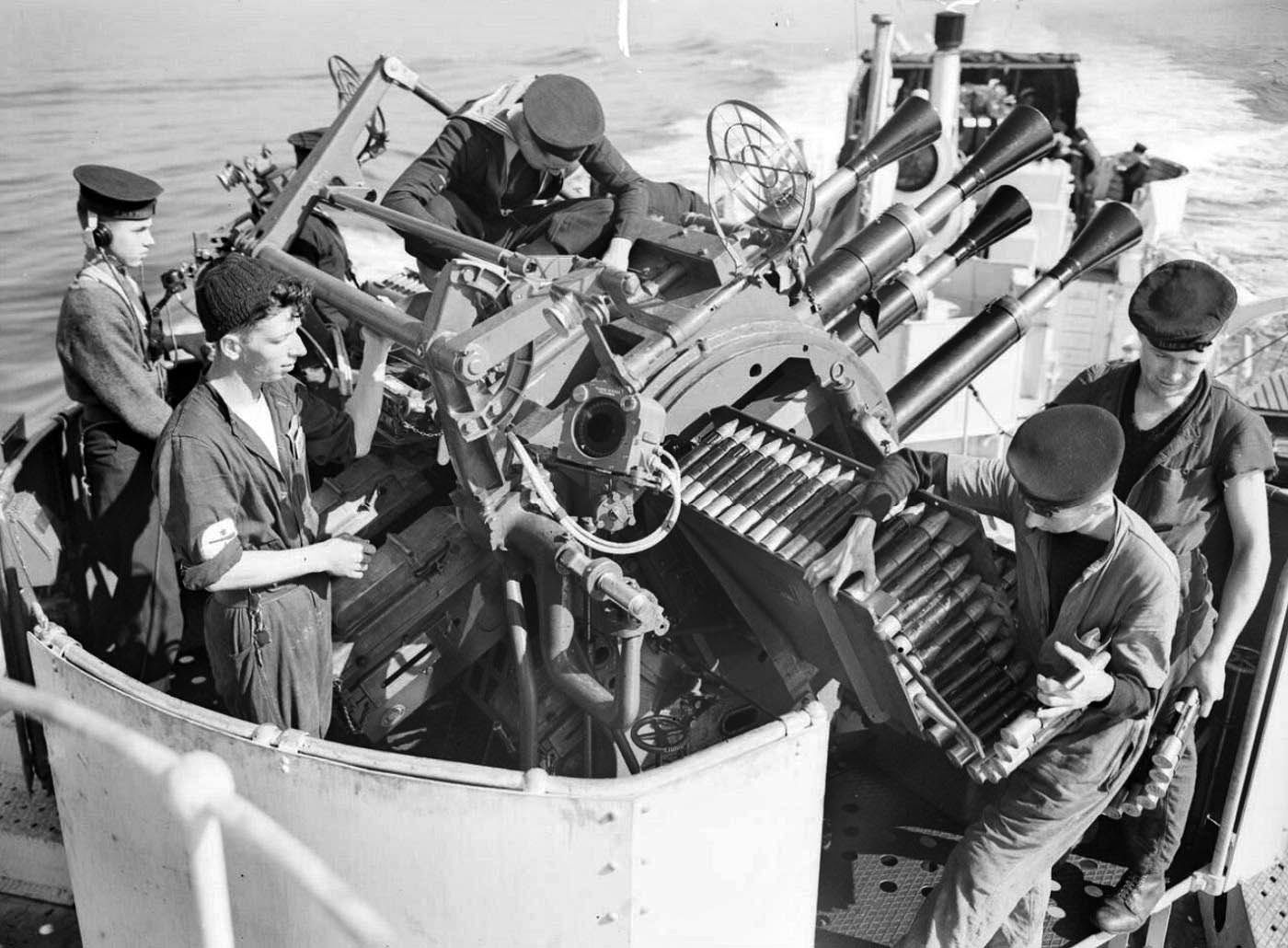
The burning Devon Coast then threatened the nearby French tanker SS La Drome, whose moorings were still holding. This time the Zetland work party managed to secure a tow line, and slowly the British destroyer maneuvered the tanker into a more secure berth nearer the dockyard. Another heavily damaged ship, HMS Vulcan, a former trawler now acting as a repair ship for the British MTB flotillas, also drifted perilously close to the spreading fire. When the John Harvey exploded, the resulting tidal wave had smashed Vulcan against its jetty, severing the mooring lines and cracking her steam pipes. Her courageous engineers battled the damage and finally succeeded in starting the auxiliary dynamo, enabling them to navigate the ship to a safer berth along an inner harbor pier.
Outside the harbor, the abandoned and burning Samuel J. Tilden now posed a hazard to the small number of cargo vessels and warships seeking to escape the harbor inferno. If she sank and blocked the harbor entrance, it could be weeks or months before the ships trapped inside could escape. MTB 297 was dispatched to take care of this threat. After ensuring there were no more survivors awaiting rescue in the immediate vicinity, the torpedo boat put two torpedoes into the side of the Samuel J. Tilden, sinking her in deep water away from the harbor entrance.
As more explosions erupted from burning and gutted cargo ships along the Nuovo Molo and elsewhere in the harbor, several ships capable of producing steam and navigating under their own power were ordered out of the harbor.
Moored at the Nuovo Molo berth closest to the harbor entrance, the 1,057-ton Dutch freighter SS Odysseus survived several near misses before a bomb exploded portside. Although the vessel suffered no damage below the waterline, its funnel was blown away. Crew members fashioned a makeshift funnel out of several hatch covers to facilitate raising steam, then hurriedly steered the Odysseus out of the harbor. Meanwhile, the 1,124-ton British MV Coxwold, after surviving several near misses, set sail for Barletta where she unloaded her dangerous cargo of high-octane fuel and ammunition. The 7,128-ton Canadian-built British cargo ship Fort Assiniboine, caught unloading at the main pier close to the port director’s offices in Navy House when the raid began, escaped damage but was ordered to clear the harbor since her holds were packed with blockbuster bombs. Slowly, she picked her way through the outer basin, squeezing past several burning ships. A few days later, she returned to Bari to continue unloading her cargo.
The destroyers Zetland and Bicester, after taking many survivors aboard, were ordered to sail for Taranto. During this voyage strange symptoms appeared among their crews. Men began to develop painful blisters across all parts of their bodies—some went blind, and others lost their hair. Upon reaching safety in Taranto, many sailors were sent to hospital for treatment. They were not the only ones to suffer these strange afflictions.

Back in Bari, bombing survivors were rushed to the various service hospitals scattered throughout the city, including the 3rd New Zealand General Hospital, the 98th British General Hospital, and the 26th U.S. General Hospital. Wards rapidly filled beyond capacity, and casualties spilled into the hallways. Many patients had sustained serious blast injuries, while others were covered in a choking, thick coating of oil. Other less seriously injured patients exhibited typical signs of shock: exhaustion, weakness, pale skin and low blood pressure. Doctors and nurses swamped by emergency cases gave priority to those requiring immediate surgery. Other survivors, coated in oil, badly burned, and seemingly suffering from shock, were wrapped in blankets and given hot tea to comfort them.
Plasma was administered to many of the burned. There was no time to strip the men of their fouled clothes or to wash them down. Instead, they sat or lay in whatever space was available and were urged to remain calm. Medical staff, unaware they were dealing with noxious chemicals, only made matters worse by keeping the men wrapped in their fouled clothes. The liquefied mustard gas remained in constant contact with their skin, enabling the toxic mixture to be absorbed into their bodies or inhaled with each breath.
Within hours of arrival, patients began exhibiting skin blisters and mysterious burns. Many of them complained about burning eyes and vision loss. Those diagnosed as suffering from shock exhibited low blood pressure and a slow pulse but not the other normal symptoms of clinical shock, such as restlessness or shallow breathing. Instead, they acted lethargically and apathetically. Doctors suspected something else was happening but were unable to identify a cause.
In the following days, as patients began to die from the strange symptoms, doctors raised the alarm. Gen. Fred Blesse, deputy chief surgeon at Allied headquarters in Algiers, was notified of the strange symptoms and advised that some of the medical staff believed a toxic agent was involved, possibly associated with chemical bombs that the Germans might have used during their attack. Blesse immediately dispatched Lt. Col. Stewart F. Alexander, consultant officer in chemical warfare medicine, to Bari to investigate.
Alexander was well suited for the assignment. He had graduated from Columbia University College of Physicians and Surgeons in 1937 and was commissioned a 1st lieutenant in the Medical Corps Reserve, U.S. Army, that same year. After briefly serving as a surgeon with the 16th Infantry Division, he transferred to the Medical Research Division, Edgewood Arsenal, Maryland, where he studied the effects of mustard and nitrogen mustard agents.
After flying to Bari, Alexander rushed to the nearest hospital. Upon arrival, he immediately noticed a distinct garlic odor permeating the medical wards, an odor that was often associated with mustard poisoning. Next, he focused on the terrible skin lesions. The burns and blisters matched the level of patient exposure to the contaminated water in the harbor. Those who had been blown into the harbor were covered from head to toe by the reddish-brown burns. Those who had only reached into the water to pull men out were limited to burns on their arms. Clearly something in the water had caused the burn patterns.
Alexander ordered autopsies of the dead and a chemical analysis of the oil from the harbor. The lungs of the deceased often exhibited extensive congestion and a mottled mauve surface, effects that could be attributed to the inhalation of a toxic agent. For Alexander all the evidence pointed to mustard gas. When he received a call from a British officer advising they had found a mustard bomb casing in the harbor, Alexander concluded that the Germans had used chemical weapons during their attack. It was only when U.S. Fifteenth Air Force officers examined the casing and identified it as an American M47A1 100-pound bomb normally used to carry liquid mustard that Alexander learned the awful truth—the mustard bombs belonged to the Allies.
Upon learning the cause of the burns and blisters, hospital staff changed their course of treatment. Blisters were lanced and drained, oral sulfonamide was administered to treat irritated respiratory tracts, and fluids were forced down patients’ throats even though the process was extremely painful. Despite these emergency measures, the death toll from mustard exposure began to climb but eventually ran its course over several days.
Initially, British port authorities denied that any of the Allied ships carried mustard, but after Alexander assembled technical data and eyewitness accounts he was able to pinpoint the John Harvey as the source. Only then did port authorities acknowledge the existence of mustard bombs.
In the end, more than 1,000 men were reported killed or missing after the Bari raid. Vesole was one of those who died. Rushed to hospital after his rescue from the Nuovo Molo, he later succumbed to his wounds. For his actions on December 2, 1943, Vesole was posthumously awarded the Navy Cross. The citation read in part, “… His exceptional fortitude and self-sacrificing concern for others were in keeping with the highest tradition of the United States Naval Service. He gallantly gave his life for his country.”

An additional 800 servicemen were hospitalized, and of these 628 suffered from mustard exposure. Two weeks after the raid, 69 men had died, wholly or partially as a result of this exposure. Many Italian civilians died or suffered from mustard poisoning, their true numbers never to be known.
For the Germans, unaware of the chemical disaster, the raid was a tremendous success. Twenty-eight merchant ships carrying more than 31,000 tons of cargo were sunk or so badly damaged that they were written off. A further 12 ships were damaged but able to continue in service. This devastating blow had been accomplished for the loss of only two Ju-88s downed by antiaircraft fire. The significant loss of ships and cargo has led many historians and commentators to refer to the Bari raid as “the second Pearl Harbor.”
A cover-up was immediately imposed at the highest levels of Allied command to prevent the Germans from learning about the Allies’ stockpile of chemical weapons and possibly retaliating. British officials, at the insistence of Prime Minister Winston Churchill, struck all references to mustard gas from their official reports – deaths were attributed to “burns as a result of enemy action.”
American officials also tried to keep the existence of mustard a secret but eventually admitted to the accident in February 1944. Official U.S. records were sealed and only declassified in 1959. The British took even longer, only admitting to the presence of mustard gas at Bari in 1986. Although largely forgotten by the general public, for the families of the debilitated and horribly suffering survivors of the raid, the nightmare continued.
Author Neil Taylor has written numerous articles for WWII History magazine. He resides in Edmonton, Alberta, Canada.
A sad fact is that the John Harvey was not a priority for offloading its deadly cargo of mustard gas munitions.