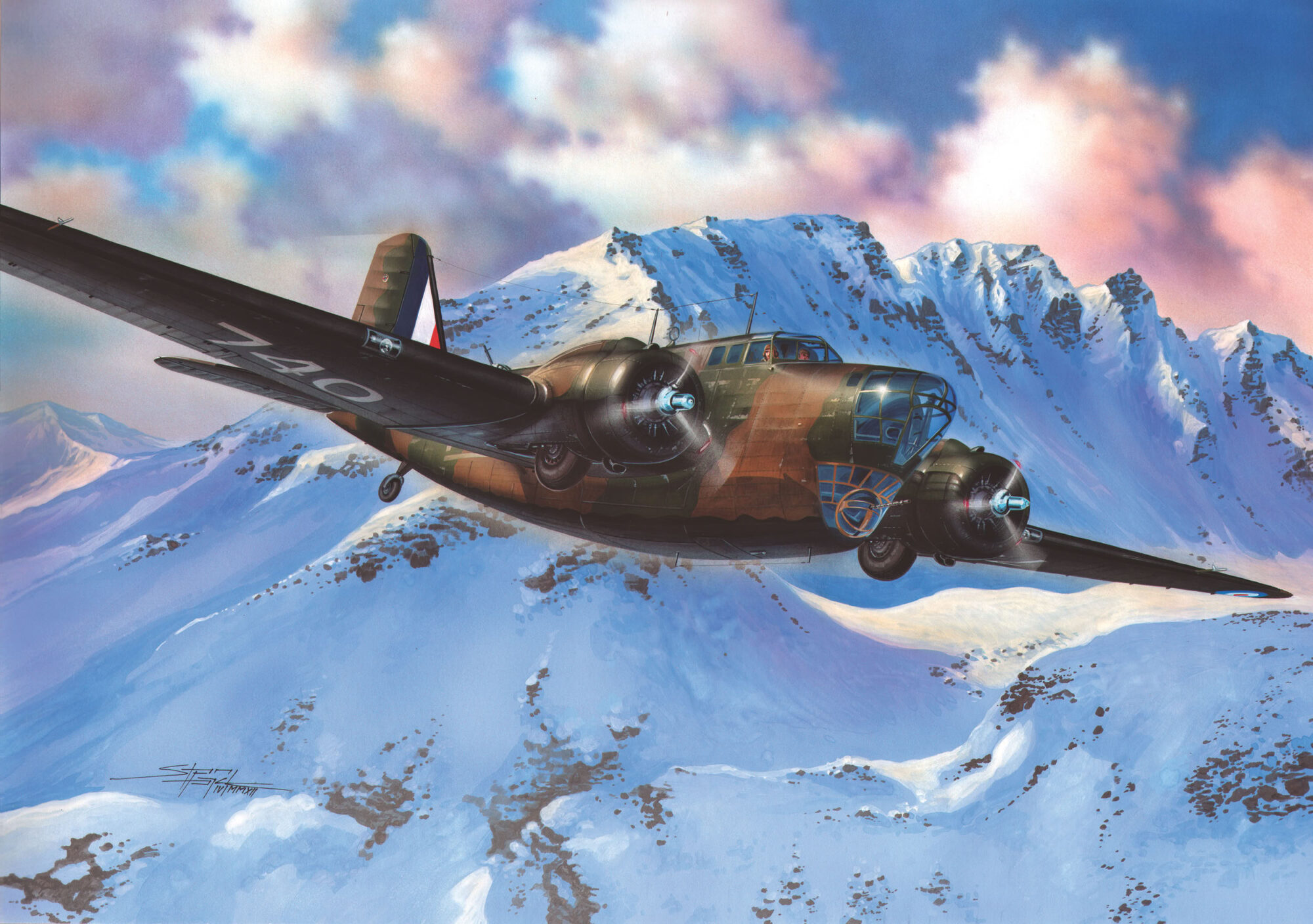
By Patrick J. Chaisson
Seaman Franz Machon was enjoying a smoke on deck when lookouts sounded the alarm. “Enemy aircraft!” they shouted before dropping down inside their vessel, a German Type IXC submarine named U-512. The skipper, Kapitänleutnant Wolfgang Schultze, ordered an emergency crash-dive while Machon moved to his battle station in the U-Boat’s galley.
These desperate actions came too late to save U-512. The sub took at least two direct hits by air-dropped depth bombs that sent it down in an uncontrolled descent to rest on the ocean floor 137 feet beneath the waves. Deadly chlorine gas then filled its spaces, killing most of the 52 sailors on board. Machon, however, managed to don an “escape lung” and reach the surface. After 10 harrowing days spent floating on the Caribbean Sea, he was rescued by a passing American destroyer.
The sinking of U-512, which occurred October 2, 1942, marked the second successful attack on a German U-boat by United States Army Air Force (USAAF) aircrewmen flying outdated Douglas B-18 medium bombers. Slow, old, and lacking the defensive armament needed to ward off modern interceptors, many B-18s assumed a new role as aerial sub-hunters on patrol over the Atlantic, Pacific, and Caribbean coastlines from 1941 to 1943. These elderly warplanes also served as transports, troop carriers, and test platforms for experimental weapons later used to great effect in combat.
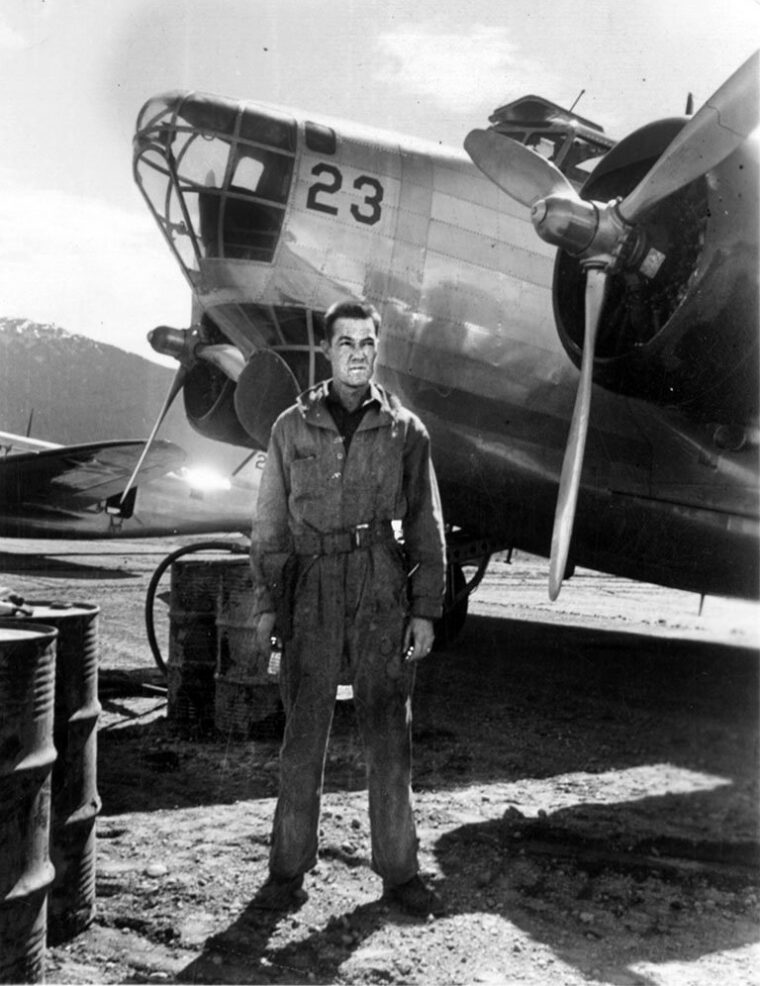
Responding to a 1934 military requirement, engineers at the Douglas Aircraft Company in Santa Monica, California, began work on a new bomber that incorporated elements of the DC-2 airliner then entering production. Of all-metal construction, it was to hold a crew of five or six and carry one ton of bombs to a range of 1,020 miles (2,200 miles was desired). Top speed had to exceed 200 miles per hour (mph), with 250 mph preferred.
The DB-1 (for Douglas Bomber #1) first flew in April of 1935. That summer, Douglas’ prototype went up against designs from Martin and Boeing in an Army Air Corps competition held at Wright Field, Ohio. The Martin 146, an upgraded version of the aging B-10 bomber, fell out early due to issues with its weight and performance. In October, Boeing’s innovative four-engine Model 299 suffered a catastrophic accident that disqualified it from further testing. (The Model 299 went on to achieve aviation immortality as the B-17 Flying Fortress.)
Boeing’s misfortune meant the Douglas DB-1, which the Air Corps designated XB-18, was destined for a major production contract. On January 17th 1936, the Army placed an order for 82 B-18s, later increased to 133. By February of 1937, newly-manufactured bombers were rolling off Douglas Aircraft’s Santa Monica assembly lines for delivery to Army Air Corps squadrons located throughout the continental United States, Hawaii, the Panama Canal, Alaska, and the Philippine Islands.
Feedback from Air Corps personnel resulted in a number of modifications intended to boost performance and crew efficiency. Beginning with the 134th airframe in production, an improved “shark nose” replaced the cramped forward space occupied by the nose gunner and bombardier. More powerful engines were also fitted, causing the Army to name this variant the B-18A.
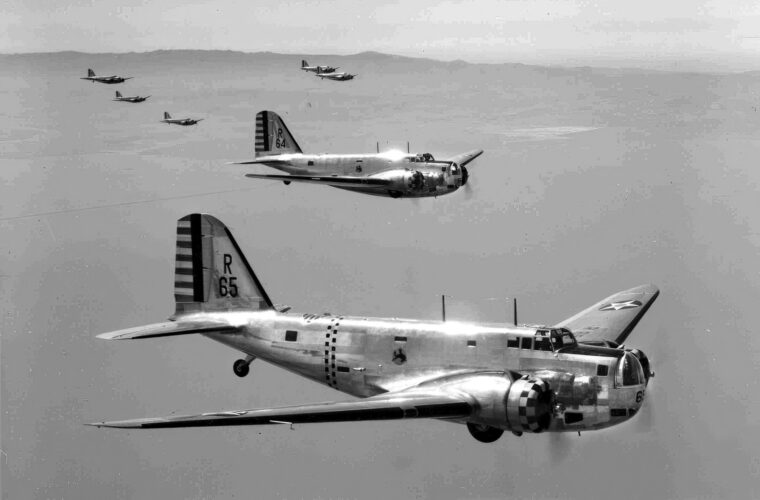
A production B-18A measured 57 feet 10 inches in length and 15 feet 2 inches tall, with a wingspan of 89 feet 6 inches. Weighing in at 16,321 lbs. empty, it listed a maximum take-off weight of 27,673 lbs. The bomber held a crew of six—pilot, co-pilot, navigator/bombardier, and three gunners.
Powered by two 1,000-horsepower Wright Cyclone R-1820-53 engines, the B-18A’s service ceiling topped out at 23,900 feet. Top speed at 10,000 feet was 215 mph, with a cruising speed of 167 mph. The bomber’s combat range exceeded 1,200 miles.
Within the B-18A’s deep belly was a bomb bay able to hold 4,400 lbs. of ordnance. Defensive weapons included three Browning .30-caliber machine guns—one in the nose, another in the lower fuselage facing aft, and a third mounted in a retractable, manually-operated dorsal turret.
Douglas Aircraft Co. built 217 B-18As from June 1937 to mid-1938. The Royal Canadian Air Force (RCAF) purchased 20 more in 1939 under the name Digby Mk. I. Some older B-18s were brought up to the B-18A standard, while others underwent modifications for special use. At least three B-18s were converted into unarmed C-58 transport planes, while others took aloft bombardiers-in-training as these budding aviators learned to operate the newly-developed Norden bombsight.

One B-18 (some reports indicate it was the original DB-1 prototype) was fitted with a 75-mm cannon in an experimental ventral mount. Tests proved that high-caliber weapons could, in fact, be fired from a bomber while in flight; this eventually led to the development of a North American B-25 Mitchell gunship armed with a 75-mm cannon.
Occasionally, B-18s served in the photo-reconnaissance role or as troop carriers. In 1940, 38 bombers took one day to move a battalion of 352 soldiers plus equipment from Hamilton Field (near San Francisco, California), to March Field outside Los Angeles. One day later, they brought everyone back. Also in 1940, the men of the U.S. Army’s Parachute Test Platoon at Fort Benning, Georgia, made their first five qualifying jumps from B-18s.
Meanwhile, momentous events were transpiring throughout Europe and the Far East that would make the B-18 obsolete as a medium bomber. As German, Italian, and Japanese forces opened the global cataclysm that became World War II, U.S. military planners looked on with alarm. These officers quickly perceived that a significant technological gap existed between the Axis powers’ advanced aircraft and those in the American arsenal. Underpowered, poorly-protected Douglas B-18s could never survive combat against such fighters as the Japanese Zero and German Me-109.
As the likelihood of American involvement in the war grew, the nation’s defense industry needed time to construct faster, more powerful bombers like the Boeing B-17, Consolidated B-24, North American B-25, and Martin B-26. To deter foreign aggression as long as possible, air planners decided to base a large percentage of the USAAF’s existing bomber fleet in forward locations. Of the 220 operational B-18s in service on December 7th 1941, 112 were stationed overseas.


When Japanese carrier-based planes appeared over Oahu, Hawaii, that morning, there were 33 B-18s parked on Hickam and Wheeler Fields. By day’s end, enemy air attacks had reduced that number to 11 bombers still in commission. Nine more could be repaired, while 13 B-18s were either extensively damaged or totally destroyed. Surviving aircraft soldiered on for many months until they were eventually replaced by Boeing B-17s.
B-18s located in the Philippine Islands suffered a similar fate. A total of 18 Douglas bombers operated from Nichols, Neilson, and Clark Fields on the island of Luzon, as well as Del Monte Airfield in Mindanao. Surprise air attacks by Japanese warplanes destroyed all 10 B-18s stationed at Clark Field, while several more on Nichols Field were wrecked when enemy bombs demolished their hangar.
The five flyable B-18s left in the Philippines were pressed into service as armed transports, hauling badly-needed ammunition, repair parts, and high-priority passengers through hostile skies to beleaguered Allied forces. Finally, as defenses crumbled, the war-worn Douglas bombers undertook one last hazardous mission to Australia loaded to capacity with U.S. fighter pilots whose skill and experience would be needed in the long fight ahead.
Well before the U.S. declared war against Japan, the territory of Alaska was considered both a strategic outpost and a logistical nightmare. Alaska-based mechanics dealt with a chronic shortage of repair parts as they struggled to keep six worn-out B-18s flying, while aircrewmen battled boredom and the forbidding Alaskan weather to fly out in search of a foe who never appeared. After more capable aircraft became available, the Douglas bombers were retired or put to use as transports.
Just as vital as Alaska to the United States defense strategy was the Panama Canal. Dozens of B-18s stationed at Albrook, David, and France Fields patrolled the Canal Zone’s approaches, scrambling frequently in response to panicky (and false) reports of an approaching enemy fleet. Bombers operating along the U.S. Atlantic, Pacific, and Gulf coasts stood ready to help repel a much-feared but never-realized Axis invasion of North America throughout late December 1941 and well into the new year.

Although the B-18 first saw combat against Japan, this warplane would find its niche in a desperate battle for control of critical shipping lanes on the Atlantic and Caribbean sea frontiers. Its chief opponent: a fleet of dangerous and elusive German submarines that in 1942 was strangling the Allied war effort.
Not long after Hitler declared war on the United States, oceangoing U-boats began torpedoing a frightful number of unprotected merchantmen all along the Eastern Seaboard. Efforts to stop the slaughter were hampered by a wholly inadequate force of Anti-Submarine Warfare (ASW) aircraft and patrol vessels. Put simply, there did not exist enough warships and planes to escort convoys and attack undersea predators. Worse, those assets the U.S. Army and Navy did manage to send out on coastal patrol missions were largely unsuited for the highly-specialized task of finding and sinking submarines.
Fortunately for the Allies, several technological marvels began to appear in 1942. These devices, mostly developed in the United Kingdom but built in U.S. factories, now allowed ASW aircraft to detect surfaced submarines in all weather, then attack them using sophisticated munitions designed to detonate under a submerged U-boat and break its back.
Among these new systems were a radio altimeter (which reliably measured how high a plane was flying over the ocean) and a microwave air-to-surface radar transmitter called the SCR-517. A magnetic anomaly detector (MAD) mounted on some bombers would alert the crew if they flew over a large metal object like a submarine, while sonobuoys could “ping” a target with sound waves and broadcast its location. Mark XVII (325 lb.) and Mark XXIX (650 lb.) depth charges were set off by hydrostatic fuses adjustable to explode at a predetermined depth or on contact with the target.
Another intriguing air weapon featured a set of wing-mounted depth bomb racks that fired projectiles backwards in a prearranged pattern. These “retro-bombs” worked in concert with the plane’s MAD receiver—when a U-boat’s magnetic field was detected, the flight crew would immediately fire off a volley of retro-bombs that then (theoretically) fell straight down on top of the enemy vessel.

The emerging ASW technology that enabled Allied airmen to effectively strike back at the submarine menace required a high-performance aircraft like the Consolidated B-24 Liberator to best fulfil its potential. Although Liberators stood in short supply, there were on hand plenty of Douglas B-18s. Deemed too vulnerable for combat operations overseas, these aging bombers were about to be repurposed as guardians of the nation’s sea lanes.
In August 1942, workers at the San Antonio Air Depot began transforming some 122 USAAF B-18As into sub-hunters. First, they ripped out each plane’s bombardier’s compartment and replaced it with a bulbous radome containing an SCR-517 surface vessel detection radar set. Other upgrades included adding radio altimeters and navigation systems. As many as 77 aircraft also received a MAD boom mounted behind and below the tail assembly.
These modifications resulted in another nomenclature change. Now known as the B-18B, this patrol bomber began anti-submarine operations alongside B-18A variants during the autumn of 1942. About this time, the Douglas bomber received an informal nickname—“Bolo,” after the large, curved knife.
Two ex-USAAF B-18B sub-hunters were transferred to the Forca Aerea Brasileria (Brazilian Air Force) in February of 1942. Brazilian aviators used these planes to fly a number of ASW missions in the Caribbean and South Atlantic regions until more capable North American B-25 and Lockheed Hudson patrol planes arrived as part of the Lend-Lease program.
The appearance of radar-equipped ASW aircraft over the Caribbean came not a minute too soon, as German U-boats had recently moved their hunting grounds into the target-rich waters off Central and South America. In response, the recently-created U.S. Sixth Air Force stationed patrol planes on airbases located all across the area. Douglas B-18s (and other types) operated from fields in the Panama Canal Zone, British Guiana, Puerto Rico, the Antilles, Trinidad, St. Lucia, Antigua, Cuba, the United States Virgin Islands, and Surinam (Dutch Guiana).

The earliest recorded encounter between a B-18 and a U-boat in the Caribbean took place on February 15, 1942. While refueling their Bolo at Aruba’s airport, Lt. Col. Ivan Palmer and Lt. Ira Matthews of the 40th Bomb Group saw a surfaced German submarine brazenly sailing into the nearby harbor. Taking off, the airmen managed to release a brace of depth bombs over the rapidly-submerging U-156 without effect.
B-18A pilot Capt. Perier A. Koenig of the 45th Bombardment Squadron had better luck on August 22nd when, flying out of France Field in Panama, he spotted a conning tower about 150 miles north of Colón, Panama. Koenig attacked with four Mk. XVII munitions that caused a large film of oil to spread out from the vessel’s last known position. Five additional B-18s soon arrived overhead, using the oil slick as an aiming point for 20 more depth charges. After the war, German records confirmed that U-654, a Type VIIIC boat under Korvettenkapitän Hans-Joachim Hesse, went down that day with all 44 hands.
Bolo crews in the West Indies saw and attacked U-boats regularly as summer turned to autumn, but did not score another kill until October 2. That morning, a B-18B piloted by Capt. Howard Burhanna, Jr. (some accounts credit 1st Lt. Robert Lehti as the pilot-in-command) of the 99th Bombardment Squadron, operating out of Zandery Field in Surinam, got a radar return off U-512 fifty miles north of Dutch Guiana’s coast. Diving to an altitude of 50 feet, Burhanna straddled the unsuspecting submarine with four depth bombs and sent it to the bottom.
Circling U-512’s debris field, Burhanna’s crew then saw a survivor in the water and dropped him a partially-inflated life raft. Matrosengefreiter (Senior Seaman) Franz Machon floated around for a week and a half until sailors aboard the destroyer U.S.S. Ellis (DD–154) spotted him and effected a rescue.
The next U-boat kill credited to a Douglas bomber took place 3,500 miles to the north of sunny Surinam. On October 30th 1942, an RCAF Digby of 10 (Bomber Reconnaissance) Squadron commanded by Flight Officer Daniel F. Raymes left its base at Gander, Newfoundland, on a routine patrol. Around 2000 hours, Raymes’ crew spotted a surfaced U-boat 115 miles east of St. John and pressed in to prosecute the target. Blown apart by a salvo of four 450-lb. depth charges, the submarine—later identified as U-520, a Type IXC vessel skippered by Kapitänleutnant Volkmar Schwartzkopff—went down with 53 souls on board.
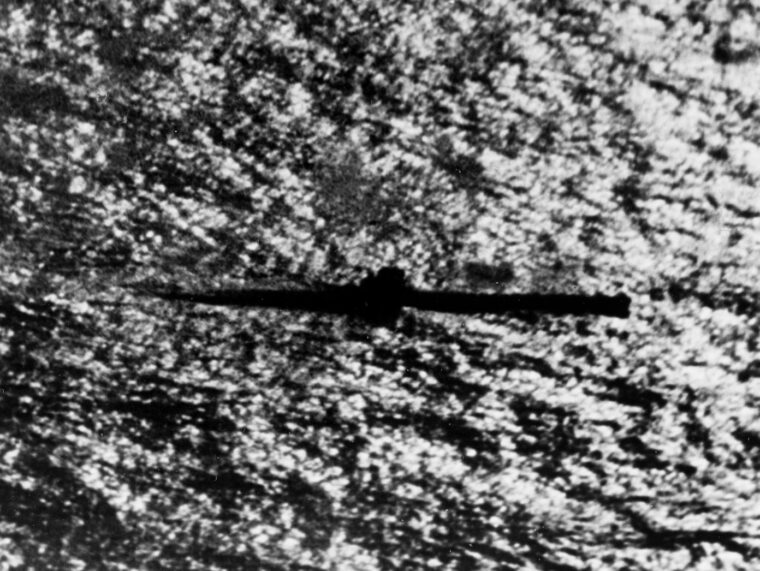
By mid-1943, as up-to-date ASW platforms became available, Sixth Air Force’s worn-out B-18s were flying their last missions over the Caribbean Sea. Yet events would prove that these aging Bolos still possessed a sharp edge.
Before dawn on July 29, crewmen aboard 1st Lt. Thomas L. Merrill’s 12th Bombardment Squadron B-18B flying out of Aruba established radar contact with an unknown surface vessel about 60 miles northwest of Curaçao. After dropping illumination flares, Merrill’s men observed below them a fully-surfaced U-boat and commenced their attack.
This submarine—U-615, a Type VIIC boat with Kapitänleutnant Ralph Kapitzky in command, surprised the American airmen by shooting back at their B-18B instead of diving. Heavy anti-aircraft fire may have spoiled Merrill’s aim—his depth charges went wide.
This attack initiated an epic eight-day battle between the wily Kapitzky and a pack of U.S. hunter-killers. Participating in the fight alongside USAAF B-18s were several U.S. Navy Martin PBM Mariner flying boats, Lockheed PV-2 Harpoon patrol planes, and even a Goodyear K-class airship (blimp) designated K-68. Although it sustained fatal damage from as many as 14 separate American air attacks, U-615 gave as good as it got by shooting down one of its persecutors and crippling two more (including the K-68).
At 2115 hours on August 6, 1st Lt. Milton L. Wiederhold of the 10th Bombardment Squadron, piloting a B-18B nicknamed “Robust Man,” finally ended Ralph Kapitzky’s Caribbean rampage. Flying through intense AA fire, Wiederhold covered the surfaced U-615 with a barrage of depth bombs that forced Kapitzky to scuttle his boat. Some 43 survivors were later rescued by U.S. destroyers.

Overshadowed by more modern designs, the B-18 served as a USAAF sub-hunter for barely 18 months. Canadian and Brazilian air commands also retired their war-weary Douglas bombers by late 1943. Afterwards, an occasional Bolo might be seen in use as a “squadron hack” (utility plane) or, more commonly, just left abandoned on some tropical airbase.
An even more rarely-seen aircraft during the war years was the B-18’s younger brother, a medium bomber known as the Douglas B-23 Dragon. Only 38 of them were manufactured, all in 1939 and 1940, and none flew operationally. While the B-23 outperformed its elderly sibling, this updated model fared poorly against the North American B-25s and Martin B-26s then entering service. The Dragon is chiefly recognized today as the first U.S. warplane to feature a tail gunner’s position.
Ultimately, Douglas Aircraft Company’s B-18 medium bomber failed in its primary wartime mission to deter Japanese aggression in the Pacific. Yet this aerial workhorse played a vital role in the battle against Hitler’s submarine fleet. Four vessels sunk for untold thousands of hours spent fruitlessly patrolling the empty ocean may seem a poor return on investment, but one must also consider the B-18 Bolo’s impact on U-boat commanders’ freedom of movement.
Whenever a German sub crash-dived to escape the attention of a prowling B-18, it lost the ability to recharge its batteries, communicate with headquarters, or sneak up on a merchant convoy. After radar-equipped Bolos became operational in late 1942, even the cover of night or foul weather was denied to Unterseeboot skippers.
In no way was the Douglas B-18 an ideal submarine-hunter. The U.S. Army Air Forces knew this and still employed scores of them, quite successfully, all across the Caribbean region during a dangerous period in the war. Sometimes, quantity has a quality all its own.
Great article! Thanks!