By John E. Spindler
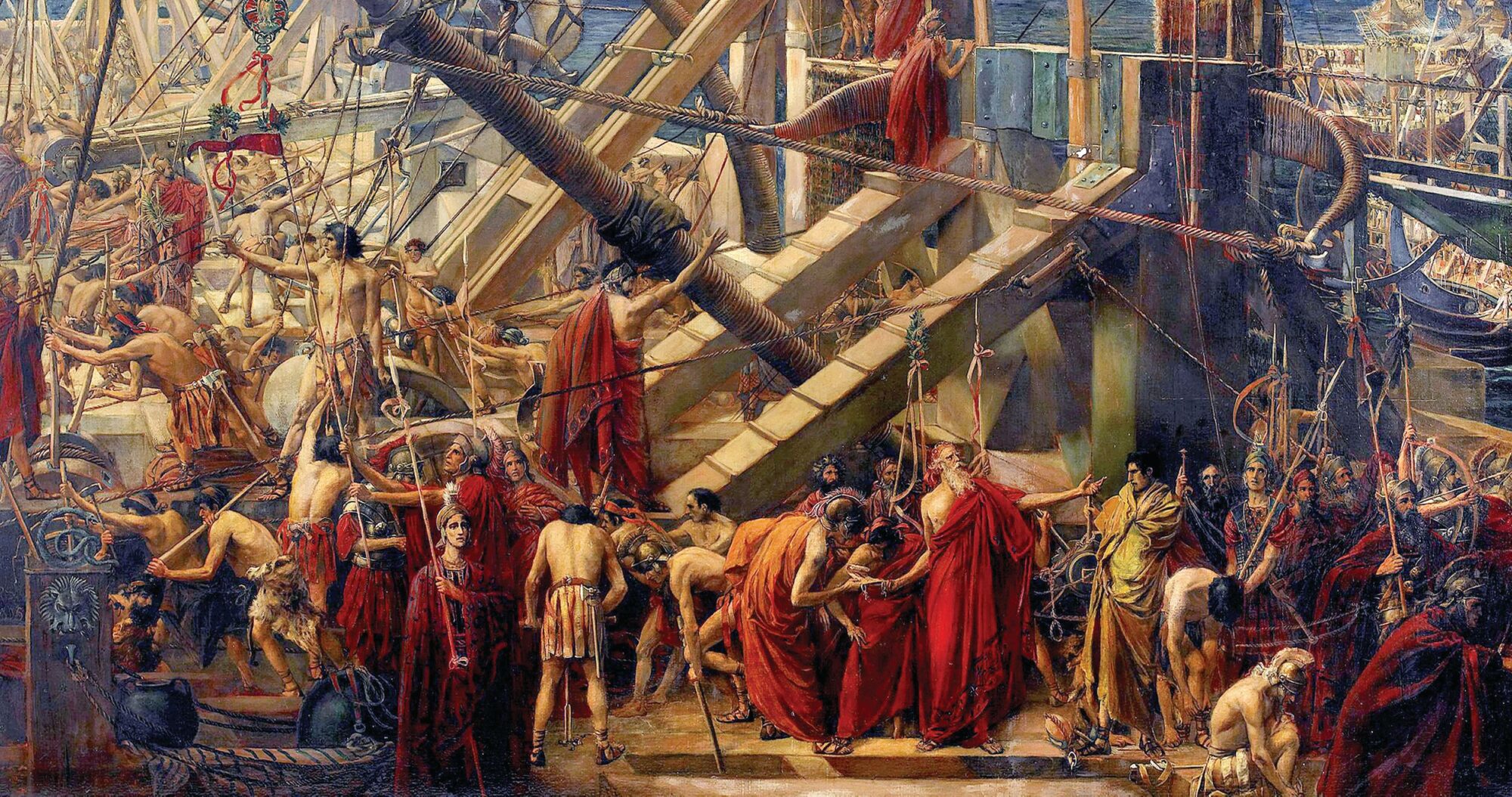
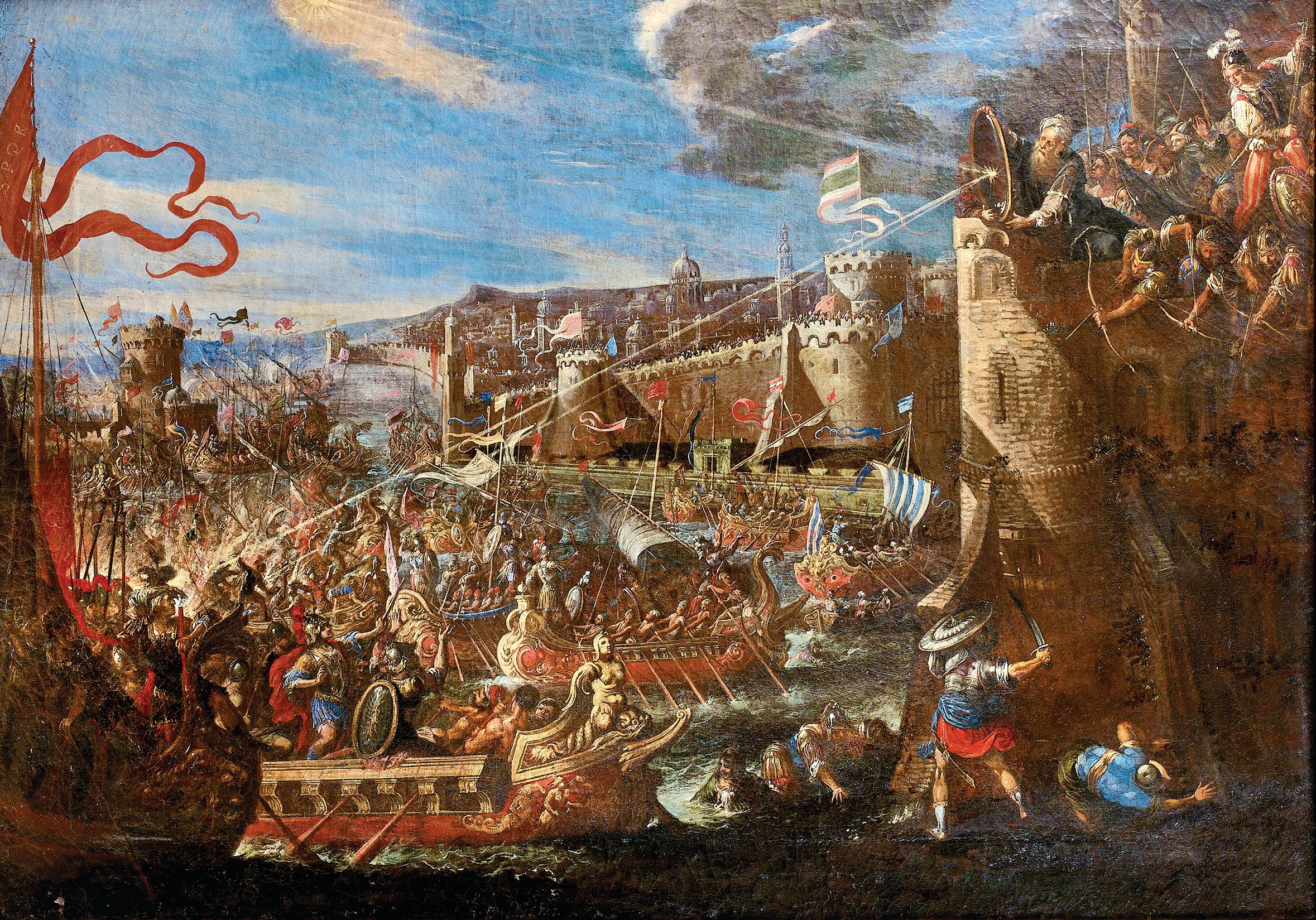
From the deck of a quinquereme, one of 60 in his invasion fleet, Roman Consul Marcus Claudius Marcellus surveyed Syracuse’s Little Harbor on the coast of Sicily. He had anticipated that a direct assault on these sea walls of Achradina would greatly test the Romans, but the reception from the Syracusan defenses had been a surprise. Catapults and other missile-throwing weapons harassed the fleet throughout its entire approach. There had not been the normal respite by an enemy forced to readjust for changing ranges.
Marcellus felt better as he saw that his specially prepared ships had survived the Syracusan barrage to arrive at the base of the sea wall. Eight quinqueremes had been lashed together in pairs to form four massive platforms that bore a siege weapon specifically built for this attack. Secured to the bow of each was a solid four-foot-wide scaling ladder that could be raised using ropes and pulleys. Earning the name sambuca—after the triangular-shaped, multi-stringed musical instrument—they would be the way his Roman soldiers would storm Achradina’s sea wall. Additional warships with archers and slingers accompanied the floating siege platforms.
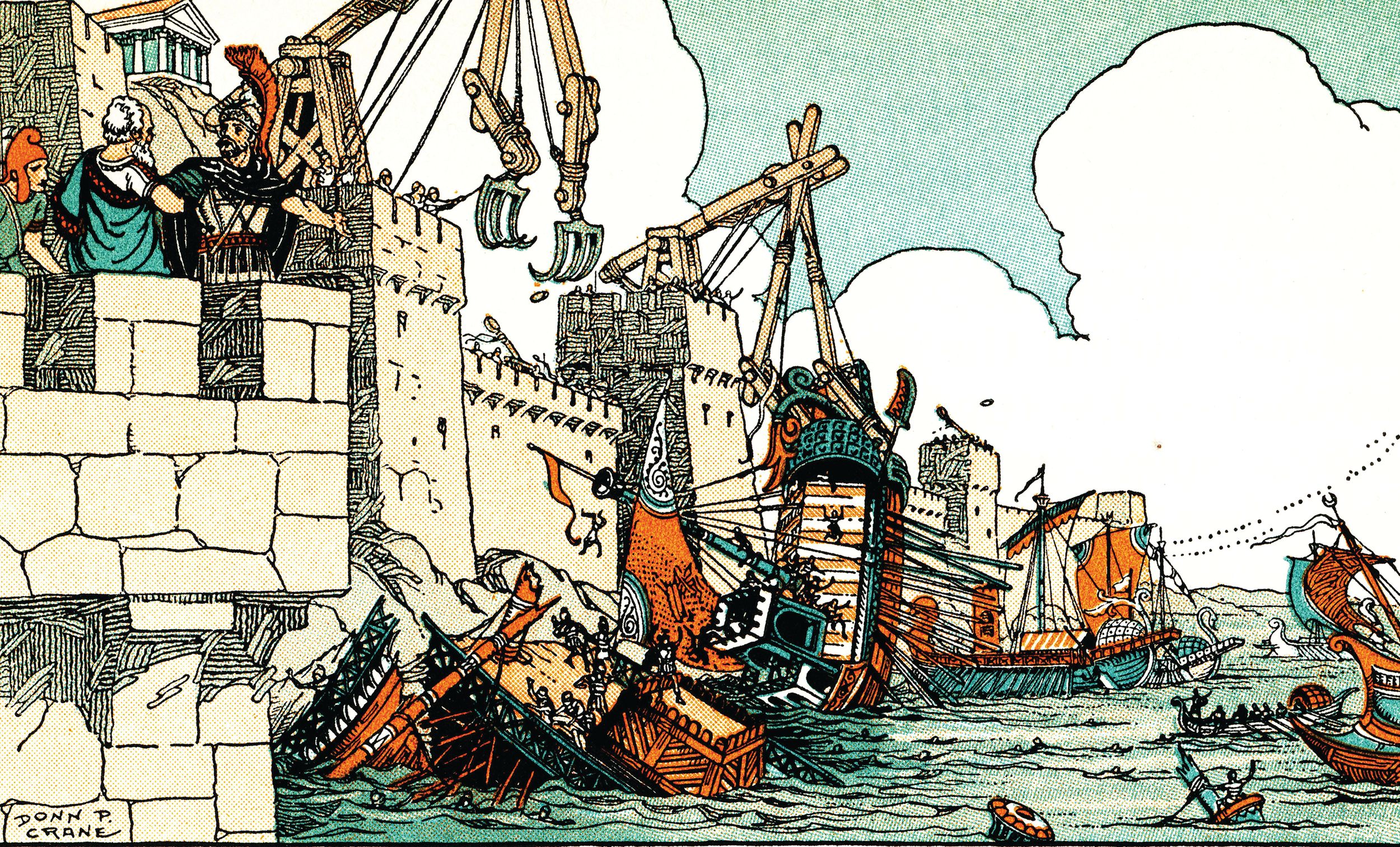
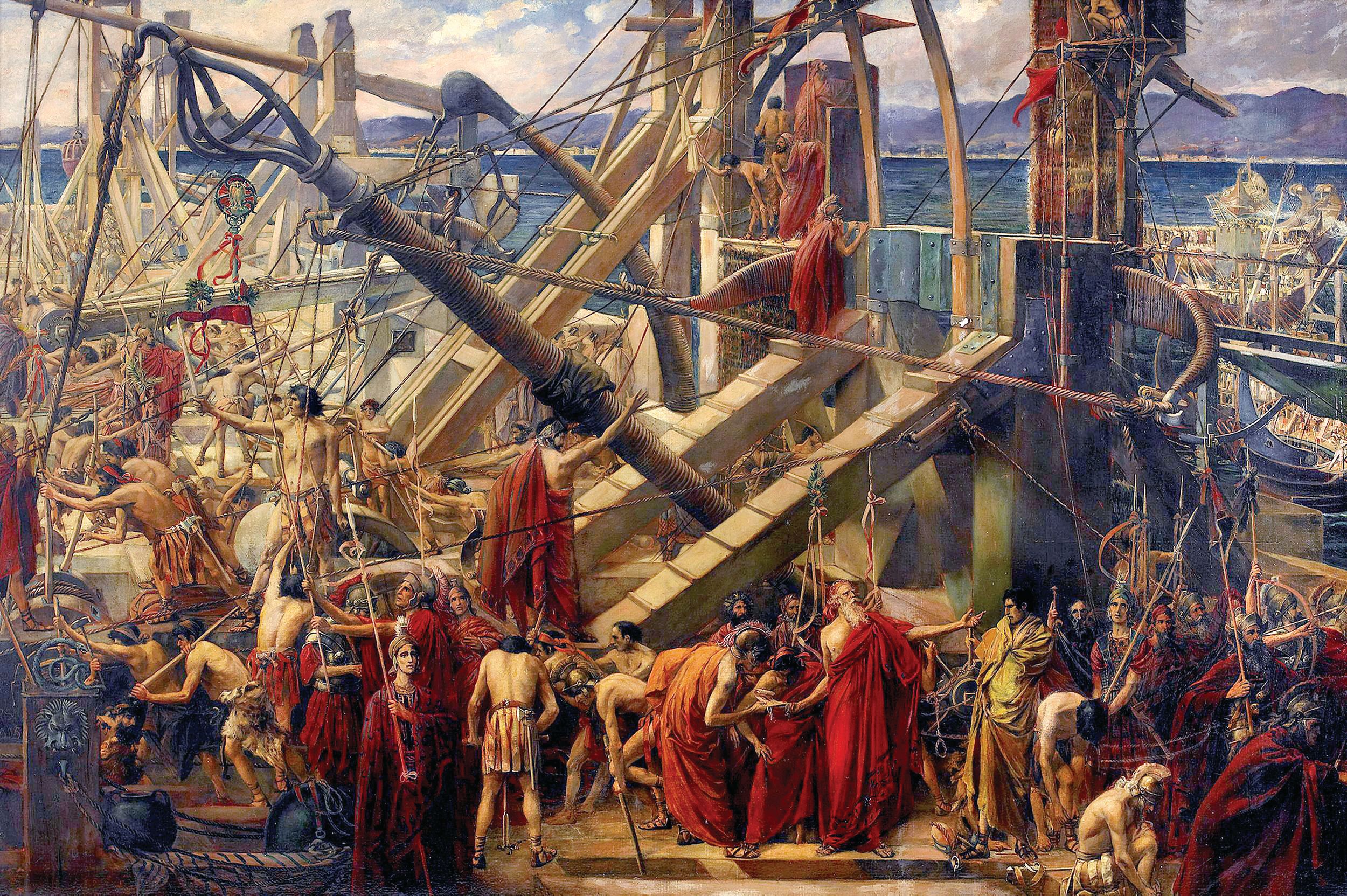
Before the sambucae could be raised, several wooden beams swung out from the battlement atop the seawall. The Romans worked frantically to get their over-sized scaling ladders up, but couldn’t help but gape as huge grapnels on chains swung out from each beam. As they stared at these large “claws,” large stones began striking their vessels from above. As the stones punched through upper decks, men and debris went into the sea. Encased in metal armor, the soldiers sank rapidly and drowned.
Keeping the Romans off-balance, the grapnels dropped onto the prows of the closest quinqueremes. Using a series of pulleys, these grappling hooks were dragged around until catching on a piece of the upper structure. The claws were attached to counter weights that the Syracusans then released. Already possessing great instability due to being top heavy, it did not require much effort to tip or capsize the huge Roman warships. In some cases, the prow was lifted into the air, then sent crashing back to the water when the grapnel was released. After losing a number of ships and men, Marcellus called off his direct assaults on the fortification. He had been aware the simultaneous land attacks against the city had also been repulsed.

Probably unknown to the consul at the time, the defense of Syracuse had been designed and implemented under the guidance of antiquity’s greatest geometrician, Archimedes. From this initial assault in the spring of 213 BCE until the city’s capture in the fall of 212 BCE, Archimedes successfully defended his home city during the Roman siege. After months of land attacks ended in failure, Marcellus and his Roman commanders would never again attempt a frontal assault during the siege. Opportunism, treachery and guile would lead to the successful capture of Syracuse.
Founded by colonists from the Greek city-state Corinth in 733 BCE, the site of Syracuse was defensible and situated between two natural harbors. The core around which the future city was built began on the off-shore island of Ortygia. While increasing Syracuse’s position and influence, its tyrant Gelon made enemies of Carthage, who controlled western portion of Sicily. During the First Greco-Persian War, he defeated his Carthaginian opponents in the little-known Battle of Himera, solidifying Syracuse’s status as the island’s greatest city.
From 415 to 413 BCE, as part of the Peloponnesian War, the city successfully withstood a siege by the Athenian-led Delian League. Through the strength of its own populace, along with Spartan assistance, and aided by a plague that swept through the Athenian army, Syracuse emerged victorious. Not wishing to endure those brutal conditions in the future, tyrant Dionysus I commenced a plan of improving the city’s defenses.. Dionysus expanded Syracuse’s defensive perimeter from along the harbors to include the high ground known as the Epipolae. In six years, a series of fortifications encompassed the Epipolae and urban districts in a 17-mile-long defensive structure that would be named the Wall of Dionysus. A pair of key gates allowed for access control. These were the Hexapyla (or Hexapylon) located in the northern section of the Wall of Dionysus, and on the western end of the Epipolae, the Euryalus. The tyrant also promoted the development of siege engines.
In 270 BCE, Hiero II (sometimes spelled Hieron) became Syracuse’s king. In the early years of his reign, relations with Carthage seemed to thaw. That changed during the First Punic War, which lasted from 264 to 241 BCE as Rome battled Carthage for dominance of the Mediterranean. Hiero II sided with Rome and as a reward for their assistance during the war, Syracuse was exempt from paying tribute to the Empire. They were allowed to remain independent and in control of southeast Sicily.
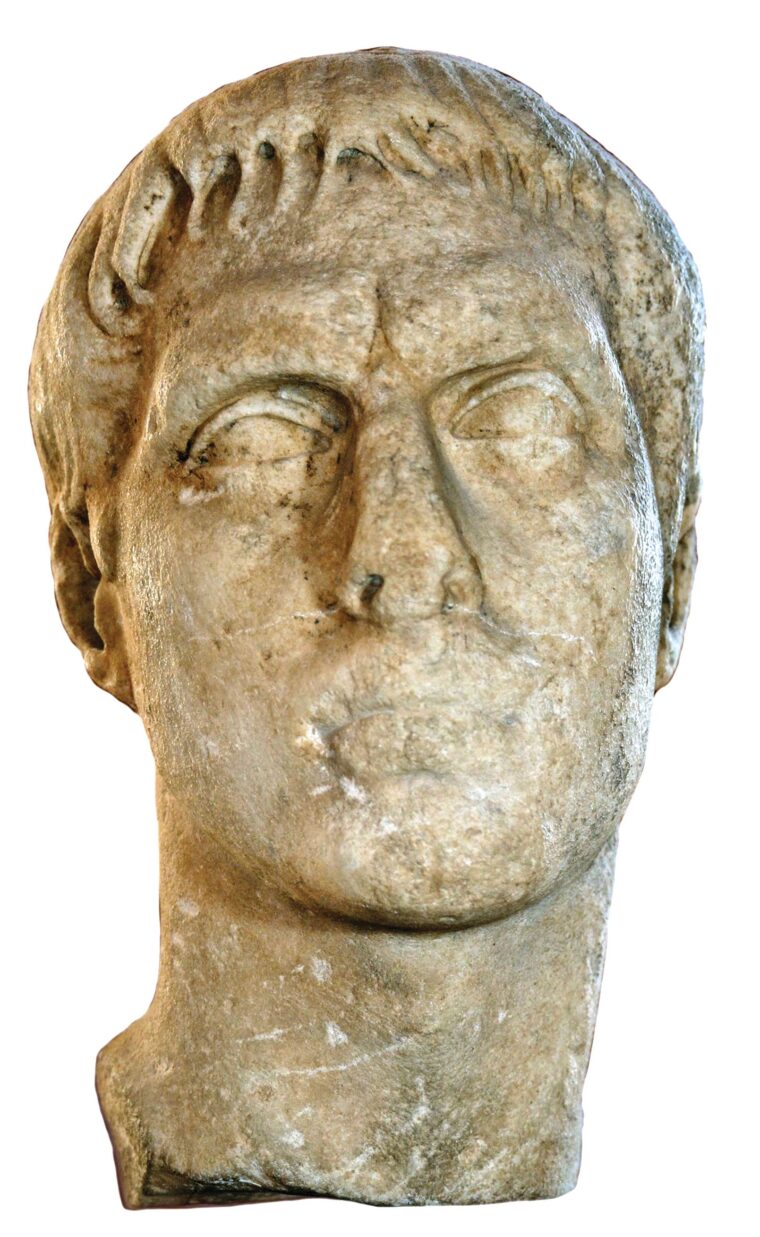
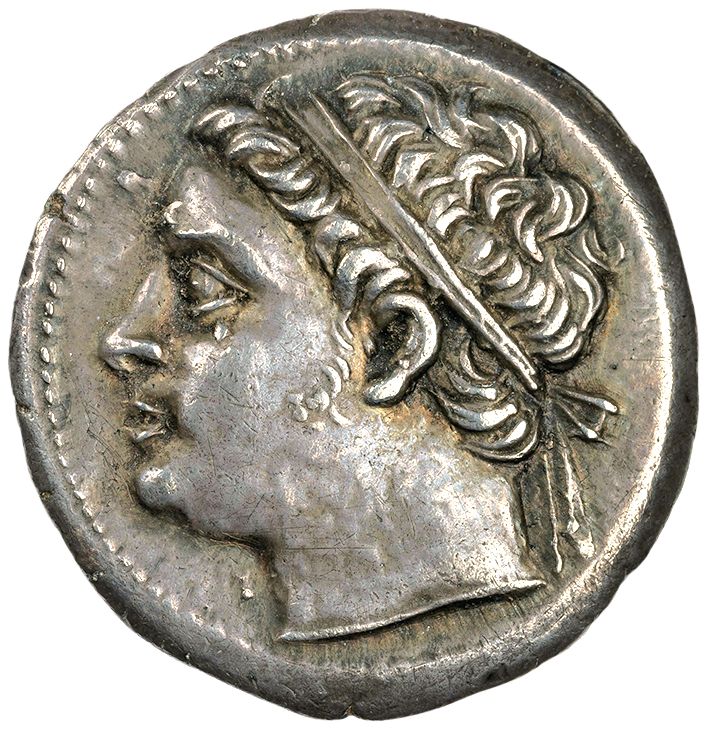
For the next quarter century, Hiero II used the existing peace to further develop and expand Syracuse. Ruling moderately, he used the growing economy to build and expand the city’s infrastructure. The king was an important sponsor of the arts and science. He welcomed men of learning and literature into his court, among them Archimedes. The 12th Century Byzantine historian John Tzetzes wrote, “Archimedes, that machinist, was a Syracusan by race, an old geometrician, [who drove] past seventy-five seasons.” Being killed in 212 BCE, this places Archimedes’ birth in the year 287 BCE. Allegedly related to the royal family, he was asked by the king to use his innovative mind and unmatched imagination to design and build war engines. This expanded into “modernizing” the Wall of Dionysus as well as the city’s sea walls. Perhaps Hiero II foresaw a time when Rome would turn against Syracuse.
The peace lasted 23 years, before Rome declared war on Carthage after the latter captured and razed the Iberian pro-Roman city of Saguntum. Later that same year, 218 BCE, Hannibal invaded the Italian peninsula after crossing the Alps. Carthaginian forces also raided Sicily causing the Roman Senate to install a garrison on the island, supported by a naval contingent. Over the next two years, Carthage’s masterful general inflicted a series of catastrophic defeats on Roman armies. After the loss at Lake Trasimene, King Hiero II dispatched a force of light infantry, which included Cretan archers, to help bolster the Eternal City. As Hannibal also ravaged the countryside, the Syracusan tyrant sent food to help feed Rome’s citizens.
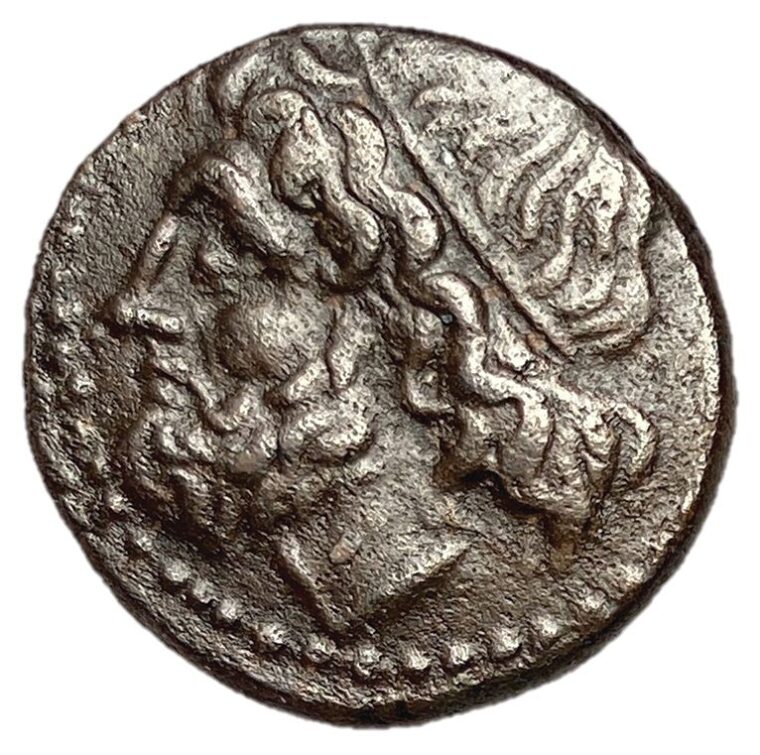
Any further military or economic assistance to Rome ended with the death of Hiero II in late 216/early 215 BCE. He had ruled Syracuse for 54 years and was reportedly 92 when he died. His only son had preceded him in death. Taking up the mantle of tyrant of Syracuse would be Hiero’s 15-year-old grandson, Hieronymus, who ancient authors described as “the personification of a third-generation tyrant, brought up in wealth and privilege.”
Citizens of Syracuse watched their young king grow increasingly arrogant and cruel. A rift began to grow between those who desired to remain allied to Rome and a rising pro-Carthaginian side, who were encouraged by Hannibal’s victories. In 215 BCE, the young tyrant sent a delegation to visit Hannibal on the Italian mainland. Seeing the potential of eliminating Roman control on Sicily, Hannibal dispatched his own diplomatic delegation. It consisted of a Carthaginian and a pair of brothers whose maternal grandmother was Syracusan. Hippocrates and Epicydes arrived in Syracuse and soon afterwards won over the teenage ruler by regaling him with accounts of Hannibal’s spectacular victories. Negotiations of an alliance between Syracuse and Carthage began in earnest. In return for severing ties with Rome, Syracuse would sign a treaty with Carthage under two conditions. First, Carthage will assist Syracuse with land and naval forces. Second, after expelling Rome from Sicily, Syracuse and Carthage would divide the island with the River Himera set as the boundary. Carthage readily agreed to the terms.
Word of the ongoing negotiations between Syracuse and Carthage reached Rome’s praetor on Sicily, Appius Claudius Pulcher. He sent his own delegation to convince Syracuse to remain Rome’s friend. Per Polybius, Hieronymus told the Roman diplomats that his city would abide by the Rome-Syracuse treaty—if Rome repaid all the gold given to them by his grandfather; returned all the corn and gifts given to them during Hiero II’s reign; and acknowledged that all towns and land east of the River Himera belong to Syracuse.
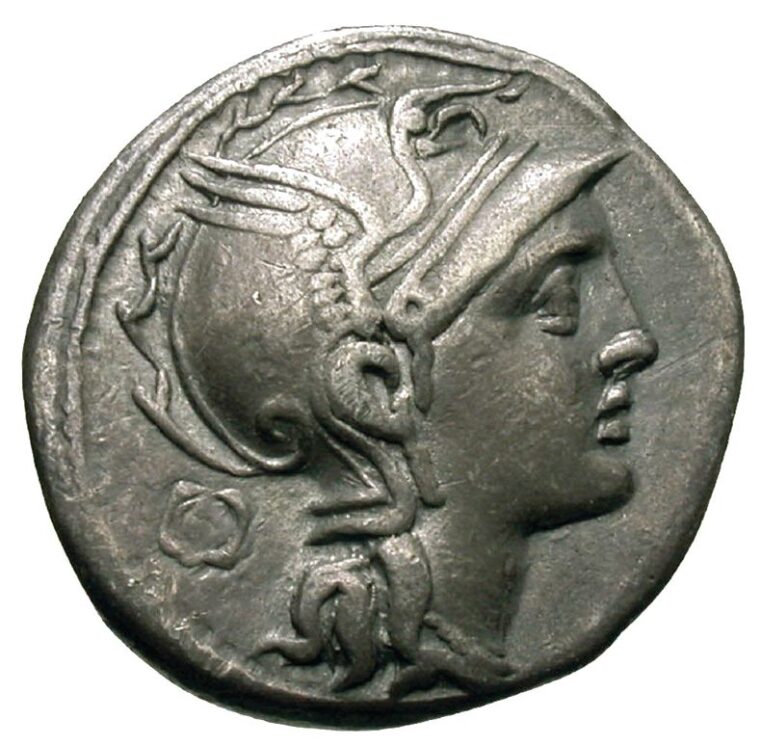
In early 214 BCE, Hieronymus sent a force of 15,000 infantry and cavalry to the city of Leontini, 22 miles northwest of Syracuse. At the same time, he gave Hippocrates and Epicydes each 2,000 men to attack pro-Roman towns and villages to “liberate” them from the Empire’s influence. Hieronymus was assassinated in Leontini by members of his bodyguard, ending his 13-month reign. The brothers made their way back to Syracuse after having been deserted by their men. Hippocrates and Epicydes began spreading dissent about the leadership of the city, talking with Roman deserters, mercenaries and the lowest class of the city and deceitfully informing them that a secret plan to sell Syracuse to Rome existed. Plots and political factions rose to the forefront. A leaked plan of rebellion led to the slaughter of the royal family. As public unrest appeared to be proceeding towards an uprising at the same time of the increasing popularity of the two brothers, senior magistrates declared Hippocrates and Epicydes as magistrates of Syracuse.
Rome responded to the news by dispatching Gen. Marcus Claudius Marcellus, who was serving his third time as Consul. He arrived in Sicily in 214 BCE. with the core of his 10,000-strong force being Cannae survivors who desired redemption. Presumably the two legions and naval forces previously sent had been recalled to fight Hannibal. An assembly was called in Syracuse, and after much debate a diplomatic mission was sent to the Romans suing for peace. Appius Claudius received the delegation who asked for a 10-day peace—much to the ire of the recently-appointed brothers. Part of a Roman fleet sailed into Syracuse’s Great Harbor on orders from Appius Claudius to boost morale of the pro-Roman faction. While the envoys met with Marcellus, a delegation from Leontini arrived. They presented a request for Syracusan troops to assist in protecting their city from Roman forces. The request was granted and Hippocrates was sent with a force of 4,000 men, primarily Roman deserters.
Based out of Leontini, Hippocrates and his men conducted raids on Roman-controlled lands. Appius Claudius reacted to the aggressive acts by sending men to protect the farmlands of those still allied to Rome. Joined by Epicydes, Hippocrates responded by openly attacking a Roman garrison and annihilating it. The two rapidly spread false rumors that Syracuse was ready to ally with Rome and had worked out a deal that would have a negative impact on the citizens of Leontini.
While approaching Leontini with his two legions, Marcellus issued an ultimatum to Syracuse that the peace between the two cities had been broken and in order to consider repairing it, the city must surrender Hippocrates and Epicydes to him. Marcellus arrived at Leontini to find its population efficiently aroused against Rome and Syracuse by the agitation of the two brothers. With negotiation attempts rebuffed, Marcellus assaulted Leontini. His forces successfully captured it in their first attack. Any Roman deserters that had been captured were subsequently beheaded. In the chaos of battle, Hippocrates, Epicydes escaped to the town of Herbesus with a small force.
The Syracusan councilors, to show their allegiance, had sent 8,000 troops to reinforce Marcellus at Leontini. While en route, they learned the city had already fallen. Reports of Romans slaughtering soldiers and civilians rapidly spread through the Syracusan army. The Syracusan generals learned Hippocrates and Epicydes had sought refuge in Herbeus and headed towards the town. Upon learning that a Syracusan force was in the field, the brothers rode to intercept them. Luck was on their side. The first troops they encountered were 600 Cretan archers. These archers were originally sent by Hiero II to assist Rome, but had been captured by Hannibal. After having been treated with honor, the Cretans were released. As a result of this gesture, the Cretan force sided with the brothers and protected them. Through treachery and false speeches designed to play on the soldiers’ emotions, the brothers won over the men and advanced upon Syracuse.
Upon arrival at the Hexapyla, Hippocrates and Epicydes contacted allies within Syracuse to stir up the population with anti-Rome propaganda. These allies subsequently opened the Hexapyla Gate, allowing the force into the city. The magistrates who opposed the brothers fled to Achradina with their supporters. Spearheaded by the remaining Roman deserters, Achradina fell on the first try. Ever calculating, Hippocrates and Epicydes released criminals from prison and freed slaves on the day after taking Achradina. These actions helped lead to the election of both Hippocrates and Epicydes as generals of Syracuse. Marcellus established the Roman camp near the Temple of Olympus Jupiter, the same location Athenians forces based themselves in the great siege of 415—413 BCE.
Marcellus, upon hearing of the rise of Hippocrates and Epicydes, marched to the Hexapyla. The Roman general sent envoys ahead to demand the surrender of the two brothers. At the gate, Epicydes denied the delegation entry into the city. After arriving themselves, Marcellus and Appius Claudius discussed with Syracusans in the Roman army the layout and strength of the port city’s defenses. Livy recorded that Marcellus, Appius Claudius, and other senior Roman officers believed that Syracuse would fall almost as easily as Leontini.
Whether it was Roman optimism or arrogance, history would show they could have not been more wrong. Marcellus devised a simultaneous assault on two fronts. Appius Claudius would lead the land attack portion of the operation with a direct assault at the Hexapyla. Marcellus took charge of the naval force that would storm the city’s sea wall at Achradina, north of the Little Harbor.
Both Marcellus and Appius Claudius led their men against a Syracuse stirred up by Hippocrates and Epicydes. The soldiers manning the Wall of Dionysus and the sea wall stood ready to defend their city. Romans had successfully conducted sieges in the past and had confidence in their ability to take the rebellious and rich city of Syracuse. However, the soldiers and seamen experienced a great shock as Syracuse was not just defended by Syracusans, mercenaries, and Roman deserters. The men were greatly assisted by mechanical devices, devised and organized by the most intelligent men of the city, chiefly by Archimedes.
The fortifications varied, depending on what was required in the location to be defended. Those countering naval attacks utilized modifications that their counterparts situated along the Wall of Dionysus did not require. All defenders used varying types of missile-throwing weapons, such as catapults and mangonels, calibrated at specific ranges. Attackers would find themselves under a barrage without any respite, an incoming bombardment of heavy stones whose purpose was to sink enemy ships. The catapults fired more than boulders, an anti-personal catapult called a “scorpion” fired salvos of iron darts.
Described more in the records of Marcellus’s amphibious attack, the sea walls had built into them a calculated system of apertures. Wide enough for a smaller design of catapults to fire through, the openings were too small for an enemy soldier to fit through. While archers fired mercilessly from some of the apertures, “scorpions” unleashed their arrows and darts from loopholes closer to the fortification’s foundation. Along the tops of the battlements, hidden beams, had grapnels attached to them. Although their use against the Roman vessels received more notoriety, scaled-down versions of these claws, which one author labeled “Archimedes Iron Hand,” were also positioned on the Wall of Dionysus. Instead of snagging warships, these claws hooked unlucky Roman legionnaires. If the enemy made it to the base of the wall, the Syracusan defenders on top of the battlement could continue to fire missile weapons or drop a variety of objects including large stones, wooden beams, and anything else at hand.
It would be against these siege engines and defensive measures that Marcellus at sea and Appius Claudius on land launched their simultaneous attacks in spring 213 BCE. Aboard the Roman warships, archers, slingers, and javelin-throwers prepared themselves to eliminate or drive the Syracusans defenders from the positions atop the sea wall as the invasion fleet approached the targeted section of sea wall in Achradina. Believing the attack would be successful on its first try, Marcellus sailed straight at Achradina. The 60 quinqueremes found themselves subjected to a reception whose strength and ferocity outdid expected responses. The wooden vessels were subjected to incoming fire from catapults and stone-throwers at an extreme range. As the force rowed closer, smaller siege weapons took over bombarding the Romans who became demoralized at unending salvos. Normally remaining out of range of the Syracusan siege weapons, Marcellus used the sambucae when he felt the opportunity existed and then the oarsmen put on a burst to get the special craft to the base of the wall. At these moments, the grapnels dropped down and latched onto it or whichever Roman warship happened to be within reach. Archimedes probably would have known that the quinquereme’s instability greatly increased the effectiveness of the claw. During one of the attack attempts, an unlucky vessel disappeared under the weight of a ten-talent (670-pound) boulder. Marcellus got so desperate that he even tried a surprise night assault. The number of attempts to breach the sea wall remains unknown. At some point the loss of men, increasing number of damaged or destroyed ships, and a decreasing morale caused Marcellus to end the sea-borne invasion.
The accomplishments of Archimedes’ weapons grew over time. Centuries after the siege, the success of the grappling claws increased from simply causing ships to capsize to stories of the enormous quinqueremes being hooked and pulled completely out of the sea before being released to crash into the harbor stern first. Another myth developed in late 5th/early 6th century, was that the Syracusans used mirrors to focus the power of the sun rays onto a Roman warship causing it to burst into flames. As none of the contemporary historians such as Livy or Polybius mention incendiary devices, let alone a “death ray,” records of Archimedes constructing such a weapon are nothing more than embellished creations of these later historians.
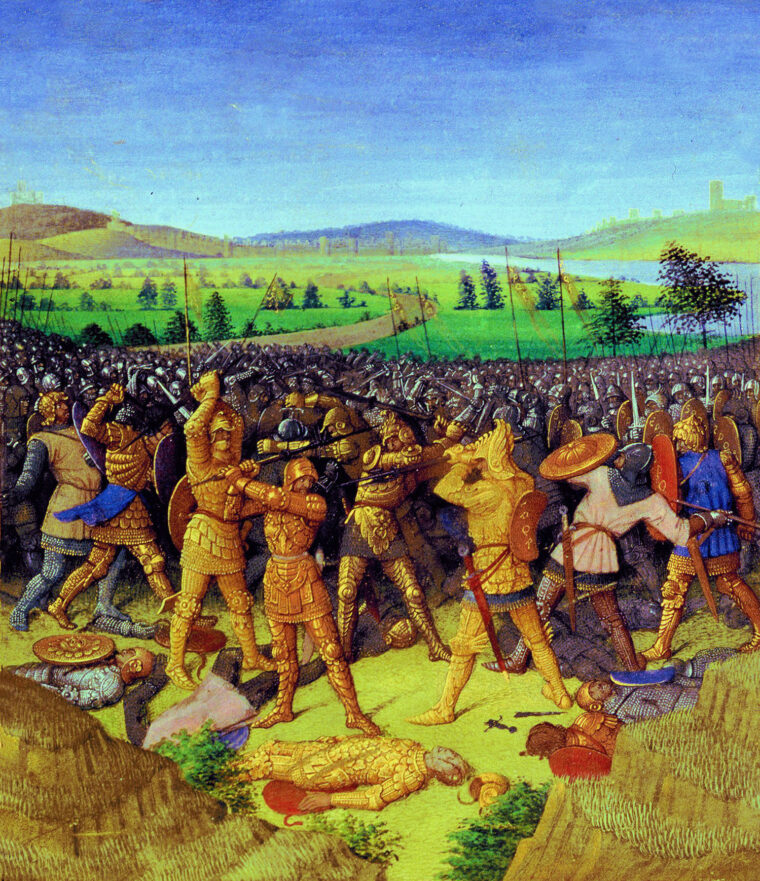
On land, Appius Claudius Pulcher fared no better. Starting with an army reportedly numbering 16,000 men, the legionnaires advancing on the Wall of Dionysus experienced the same torment as their naval comrades, with catapults and mangonels set to varying power and ranges. Smaller versions of the claw hooked individual soldiers, yanking them off the ground. For eight months Appius Claudius kept up the frontal attacks, focusing on the Hexapyla. Having incurred serious casualties and plummeting morale among the troops, Appius Claudius ended direct assaults. For the duration of the siege, the Romans would never again attempt an open frontal attack on either land or sea.
Marcellus and Appius Claudius held a war council. On both land and sea, the Romans resorted to a blockade of Syracuse, hoping to starve the city into submission or set conditions right for treachery. Appius Claudius kept two-thirds of the remaining Roman military forces and proceeded to set up a siege line along as many of the enemy’s fortifications as feasible. Taking a third of the army, Marcellus struck out for the rest of Sicily with the purpose to bolster pro-Roman towns and force those towns supporting Carthage and Syracuse to submit. Helorus and Herbesus capitulated without a fight. Megara was sacked and annihilated as an example to dissuade Sicilian towns from siding with their foe. Towards the end of Pulcher’s attempts to seize the Hexapyla, Carthage decided to take advantage of Roman attention on Syracuse. Under the leadership of Himilco, a Punic army of 25,000 infantry, 3,000 cavalry, and 12 elephants landed on the southern coast of Sicily. The cities of Heraclea Minoa and Agrigentum (originally called Akragas) fell quickly, with the latter becoming the Carthaginian base of operations on the island.
Upon hearing of the Carthaginian landing, Marcellus headed for Agrigentum before learning it had fallen to Carthage. While en route, Marcellus unexpectedly ran into a Syracusan force. This army of 10,000 infantry and 500 cavalrymen led by Hippocrates, had found an unguarded section of a wall and during the cover of darkness escaped to rendezvous with Himilco. Taking the Syracusans completely by surprise, the Romans killed or captured everyone, except for Hippocrates and the cavalry detachment. These survivors arrived at Agrigentum.
Both sides then raced to Syracuse. Himilco and Hippocrates stopped their advance eight miles from the Wall of Dionysus along the River Anapus. Morale received a boost upon news that a Carthaginian fleet of 55 warships under Bomilcar broke through the Roman blockade and entered the Great Harbor. Soon afterwards, a Roman legion arrived at Panormus. Its commander managed to evade an ambush Himilco had prepared and reinforced the Roman army encamped around Syracuse. Marcellus had four legions plus allied auxiliary troops to take control of Sicily. Syracusan and Punic hope sank when Bomilcar sailed back to Carthage upon the arrival of Roman naval reinforcements.
As winter progressed, both sides traversed Sicily to add towns as allies. A garrison betrayed Murgentia, a Roman granary storage site, to Himilco. To prevent the possibility of this happening in Enna, its Roman garrison commander rounded up all the men and killed them in the belief such action would act as a deterrent. Unfortunately for Marcellus, this brutal reprisal had the opposite effect, rallying more cities, towns, and villages against Rome. During this time Appius Claudius Pulcher’s term ended and he returned to Italy. In Syracuse, Epicydes dealt with a plot by pro-Roman conspirators by having the 80 involved executed.
In the spring 212 BCE, fortune favored Marcellus. An envoy sent by Syracuse to Rome’s bitter enemy, Philip V of Macedon, was intercepted and captured. The Syracusans wanted to ransom him and other prisoners. At first Marcellus was reluctant but as negotiations always took place near the Galeagra tower, either the consul or another Roman noted the area near the tower seemed to be scalable. The Romans dragged out negotiations in order for their engineers to calculate the wall height in the section by getting a measurement of the stone height and counting the number of rows. Scaling ladders were constructed to the estimated height. All that was lacking was an opportune moment for an assault.
That moment presented itself when a deserter brought much needed information. The three-day Festival of Artemis was about to take place. He also informed the Romans that certain food items were in short supply. As a result, Epicydes provided generous quantities of wine to offset the rationing. Marcellus and his senior officers devised a plan. On the third night of the festival, a selected company of soldiers stealthily arrived at the base of the wall with their ladders. Behind them were 1,000 legionnaires ready to exploit any success. The commando force erected the scaling ladders. Finding the battlement guards asleep from being drunk, they quickly secured that section of the wall. More ladders arrived along the Roman-controlled section of the wall and an initial wave of 1,000 troops secured more sections including the Hexapyla. With surprise gone, a horn blared through the air. Roman soldiers poured through the Hexapyla.
Now on alert, most Syracusan troops fled to the fortified urban sections of Syracuse—Achradina and Ortygia. Those who chose to stand were overwhelmed. By daybreak the Epipolae was secured. Epicydes, unaware of the extent of the Roman success, rallied a small force to repel the invaders. Upon seeing at least one Roman legion marching forward, he returned to Achradina. Only the Euryalus Gate remained in Syracusan control. Its garrison commander, an Argive named Philodemus, stood fast and ensured negotiations stretched out. Philodemus believed that Himilco and Hippocrates would soon arrive to break the siege. Marcellus knew a frontal assault would be futile and soon recognized the negotiations were a dead end. He had most of the invasion force set up camp between the urban districts of Neapolis and Tyche. When Philodemus learned about the fall of these city districts, he surrendered the Euryalus without incident. With control of this key gate, the Romans no longer had to fear fighting a battle on two fronts.
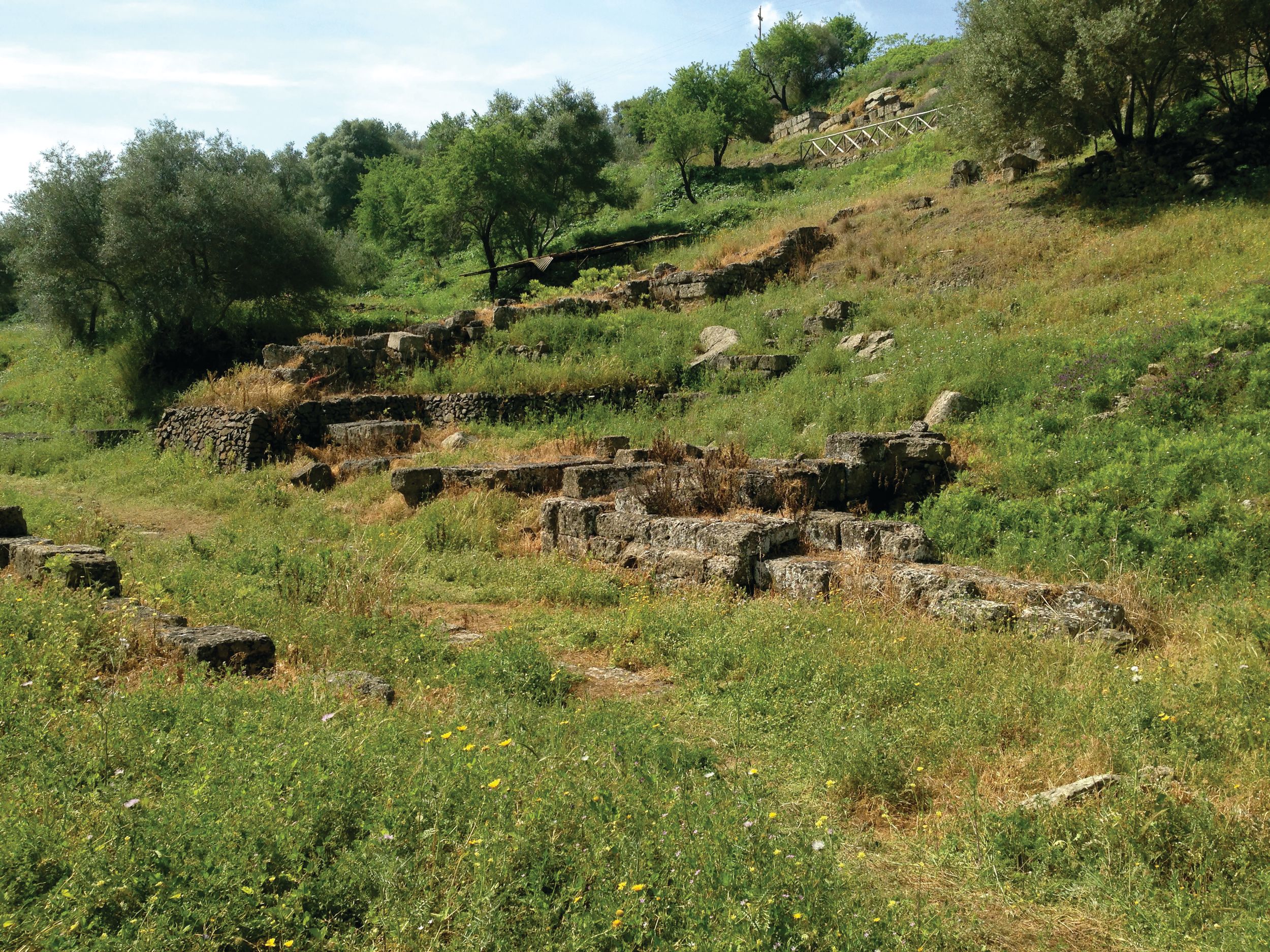
Bomilcar took 35 ships and headed back to Carthage for help, but left 55 vessels in the Great Harbor. Hippocrates and Himilco brought their force south of the Wall of Dionysus and camped in a low-lying area. In late spring/early summer, the Syracusans and Carthaginians developed a coordinated effort between the two forces who received assistance from Bomilcar’s newly-arrived reinforcements. At the prearranged time, from a fortified position along the Great Harbor, Hippocrates attacked a Roman outpost south of the city. Carthaginian troops landed to prevent reinforcements from reaching the embattled Roman troops. While the Romans dealt with these attacks, Epicydes surged out of Achradina. The Roman forces dealt with all three attacks without any difficulties.
The Syracusan and Carthaginian forces returned to their original positions and waited. As in the Athenian siege two centuries previously, a plague swept through Sicily during the autumn of 212 BCE, affecting both sides. Possibly due to having built up a resistance due to previous exposure to plagues, the Roman troops were not affected as badly as the Syracusans and Carthaginians. It also helped that Marcellus was able to rotate men into urban sections which provided much-needed shade. Hippocrates and Himilco both died from the disease.
While Sicilians in the Punic army brought towns and villages to their side, Bomilcar returned to Carthage and sailed back to the island with the large fleet of 700 transports escorted by 130 quinqueremes. Unfortunately, wind direction prevented the Punic fleet from progressing past Cape Pachynes. Having sent the transport back to Agrigentum, Bomilcar waited until the winds changed to a favorable direction. At the same time, Marcellus had decided to confront the Punic fleet. Upon seeing the Romans, Bomilcar lost confidence. Sailing past the Roman warships, he went straight to Tarentum on the mainland. Hearing this, plus the fact the Carthaginian transport ships went back to Africa, Epicydes slipped out of Syracuse and arrived in Agrigentum.
Negotiations began in earnest, but the large number of Roman deserters who knew capital punishment awaited if they surrendered, made the task almost impossible. Eventually the leaders of the Roman traitors convinced the mercenaries that they also awaited this fate. A governing system of six elected generals arose, with three presiding over Achradina and three on Ortygia. As this occurred, the mercenaries learned that they had been misled by the Roman deserters, their situation would be considered different to the Romans. Knowing over the past 18 months that frontal assaults and negotiation had not brought about the surrender of Syracuse, Marcellus looked for opportunities in which treachery would have best chances to succeed.
Secret communication evolved between representatives of Marcellus and a Spaniard named Moericus. Moericus was able to slip out of Syracuse and met with Marcellus. After finding what the Roman consul had to say, he allied himself with Rome. Back in Syracuse, Moericus persuaded the other five generals to end the exchange of envoys between the two sides. The Spaniard also convinced them that Achradina and the Island of Ortygia were each to be divided into three districts with a general assigned to a district. He made it known to the Romans that his sector ranged from the mouth of the Great Harbor to the Fountain (alternately called Spring) of Arethusa on the western side of Ortygia.
On a selected night, Marcellus sent a merchant ship loaded with troops that was towed by an old quadrireme. Landing near the Fountain of Arethusa, the Romans were secretly admitted onto Ortygia by Moericus in the pre-dawn hours. At dawn, Marcellus launched a diversionary attack against Achradina’s fortifications. Troops stationed in Ortygia flowed across the bridge and into Achradina. When he felt enough of the Ortygia’s garrison had left, Moericus and his loyal supporters, along with the Roman troops took control. Resistance on Ortygia and Achradina was quickly eliminated. Wanting to prevent the looting of Syracuse’s Royal Treasury, Marcellus had the majority of Roman troops withdrawn from the city. In this chaotic atmosphere, Roman deserters and anti-Romans snuck out of the city, escaping to pro-Carthage cities.
After brief negotiations with newly-formed Syracuse officials, Marcellus opened the gates of Achradina to his men. The Roman general sent a detachment ahead to secure the Royal Treasury. He issued two orders to his men before they were allowed to vent the frustration built up over the nearly two-year siege. First, the property of pro-Roman citizens was off-limits to looting. Second, Marcellus requested that Archimedes be spared and brought to him. The Romans found the treasury did not contain the amount that rumors had suggested. A significant amount of treasure had been used to help fund the Punic fleets aiding Syracuse. The Roman troops rampaged through Syracuse, pillaging and slaughtering civilians. For his crucial help, Moericus earned Roman citizenship.
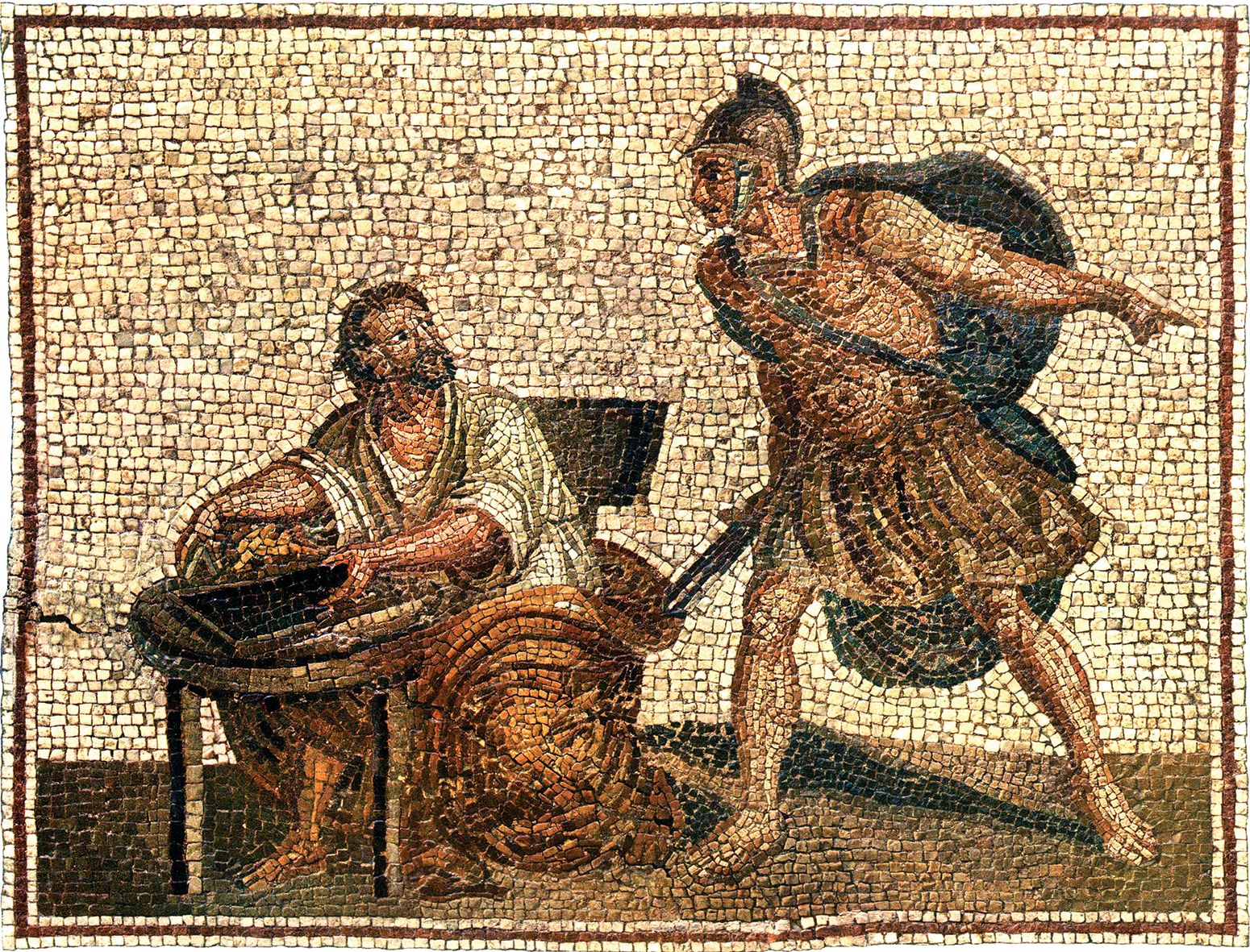
Despite Marcellus’order, Archimedes was killed. Several accounts of the events of the geometrician’s death have survived. Among the more notable include Archimedes peacefully surrendering. He went with the Roman escort while carrying brass scientific instruments. Along the way, the group was set upon by Roman soldiers who believed the scientific instruments were gold and killed him for it. Another tale has a legionnaire finding Archimedes working out a problem in the dirt and when Archimedes refused to leave his work, the Roman grew impatient and slew him. Feeling regret, Marcellus had Archimedes interred in his family’s tomb.
As with many battles in antiquity, military strength and casualty figures can only be estimated by reading into what historians such as Livy and Polybius had recorded in their works. By the time Moericus and Marcellus collaborated, four legions and auxiliary allied troops had been fighting on Sicily. Naval involvement varied from 30 warships to 100 at any given time. The initial frontal assaults by Marcellus and Appius Claudius were repulsed with heavy losses. The Romans also incurred deaths in battles across Sicily as well as from the plague.
The opposition, which consisted of Syracusans, Carthaginians, Roman deserters, and mercenaries, varied in size depending on location and date. Casualties for Syracusans, deserters, and mercenaries were mainly caused by fighting, such as defending their fortifications or when Marcellus wiped out Hippocrates’s 10,000-man force in an unexpected confrontation. A majority of the Punic losses can be attributed to the plague in 212. Civilian deaths through the siege probably numbered in the thousands. Besides the plague, Roman forces inflicted some with their attacks and then the sacking of the city.
Although Syracuse was finally in Roman control, Carthage continued to control a number of cities, towns, and rural areas. Marcellus led a campaign across the island to eliminate these enemy strongholds. In early 211 BCE, Carthaginian influence on Sicily ended at the Battle of the River Himera. Though Epicydes escaped, Punic losses were stated to be in the thousands. Roman forces captured eight elephants, which accompanied Marcellus when he returned to Rome, succeeded by a new consul. Later he would be killed in a Carthaginian ambush.
For 18 months, the city of Syracuse had defied Roman attempts to capture it. Rome employed a range of tactics and strategies before finally capturing the city with betrayal from the inside. The initial frontal assaults were a simultaneous land attack and amphibious assault to overcome Syracuse’s fortifications. Unknown to them, the mighty Roman war machine met one of antiquity’s greatest geniuses, Archimedes. Livy wrote that Rome’s coordinated land-sea operation would have been successful if Archimedes had not been there. The geometrician devised and designed Syracusan defenses and siege engines, such as catapults as well as claws that hooked ships, that inflicted heavy enough casualties that Rome ceased frontal attacks. Using betrayal by disillusioned individuals at the most opportune of times, Consul Marcus Claudius Marcellus captured the most important city on Sicily. Within a couple of years, the island was Roman and provided grain to feed its armies and a naval base from which to exert dominance over the central Mediterranean.


Join The Conversation
Comments
View All Comments