By Chuck Lyons
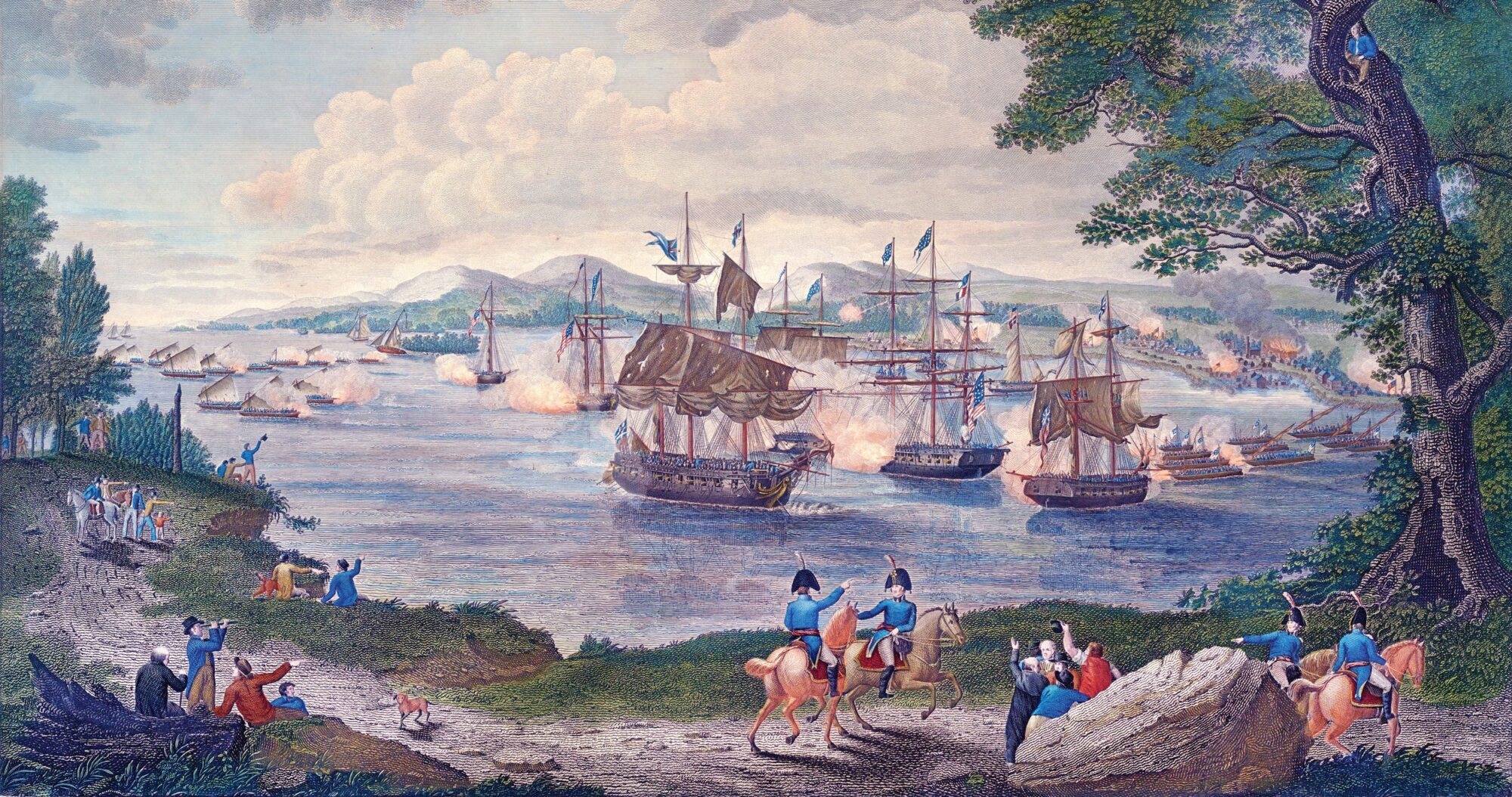
Four British warships and a dozen gunboats entered the northern end of Lake Champlain in September 1814, sailing down to the generally peaceful Cumberland Bay, where they clashed with American vessels under the command of 30-year-old Master Commandant Thomas Macdonough. Broadsides were fired at point-blank range and gunboats exchanged fire within pistol shot of each other as spectators in Plattsburgh, New York, and on nearby Cumberland Head struggled to see the fighting through the heavy smoke.
Witness Julius Hubbell would later write that “the firing was terrific, fairly shaking the ground, and so rapid that it seemed to be one continuous roar, intermingling with spiteful flashing from the mouths of guns.”
A major turning point in the War of 1812, this would be its “greatest naval battle” and Macdonough would be called “the ablest sea-captain our country has produced,” according to historian John B. McMaster.
British ships had sailed south from Lower Canada (now the Province of Quebec) up the Richelieu River in support of an invasion force of 11,000-14,000 under Lt. Gen. Sir George Prevost marching toward Albany, New York. Called “the finest army… that had ever been sent to North America,” by another noted 19th-century historian, Henry Adams, more than half of these men were veterans of the Duke of Wellington’s Peninsular Campaign that defeated Napoleon.

In the autumn of 1813, a string of American victories had dramatically reshaped the war’s northern frontier. Following Master Commandant Oliver Hazard Perry’s triumph on Lake Erie, American forces decisively defeated a combined British and Indigenous force at the Battle of the Thames on October 5. By neutralizing the British threat in the West and dissolving Tecumseh’s Confederacy, the United States successfully secured the Northwestern theater. This pivotal victory allowed American commanders to move thousands of seasoned troops eastward to the Niagara Peninsula, which became the primary, bloody focal point of the American offensive strategy heading into 1814.
However, the subsequent campaign along the Niagara frontier rapidly devolved into a grueling war of attrition. Fierce, close-quarters engagements like the exceptionally violent Battle of Lundy’s Lane in July 1814 and the protracted Siege of Fort Erie pushed both armies to their absolute limits, ultimately grinding the American advance into Upper Canada to a standstill. With the bulk of American resources and frontline regulars heavily tied down defending the Niagara corridor, the strategic spotlight shifted eastward. The British command realized that while the main American army was deadlocked in the West, the vital and vulnerable invasion route running directly through the Lake Champlain valley lay open for a decisive, war-ending counter-offensive.
Meanwhile, in Europe, after his disastrous 1812 Russian campaign and his defeat at Leipzig in October 1813, Napoleon abdicated the throne of France, freeing veteran British troops that had opposed him in the Napoleonic Wars. Many of those troops were redeployed in North America. Prevost, Commander-in-Chief in Canada and Governor General of Canada, bolstered with some of these troops, was authorized to launch an offensive into American territory aimed at separating the New England states from the rest of the fledgling United States. The attack was launched as a response to Procter’s defeat and to strengthen England’s negotiating position at the peace talks then going on at Ghent, Belgium.
As A. J. Langguth wrote in his 2006 book Union 1812, now that he was “reinforced by infantrymen from Wellington’s grizzled army, Prevost was ready to change the course of the war and force America’s capitulation at Ghent.”
But all was not as well as it seemed.
Wellington’s veterans “disliked the prospect of fighting in a war that promised so little glory, and they resented being led by a commander who could not compare with their Iron Duke,” according to Langguth. Prevost had further antagonized the troops with what they considered petty, “by the book” orders. Wellington, for example, never cared what his men wore into battle as long as they had their equipment and ammunition. But according to Langguth, Prevost further aggravated the situation by issuing an order denouncing the uniforms of the Wellington men as “a fanciful variety inconsistent with the rules of the Service” and ordering them into “the established uniforms of their Corps.”
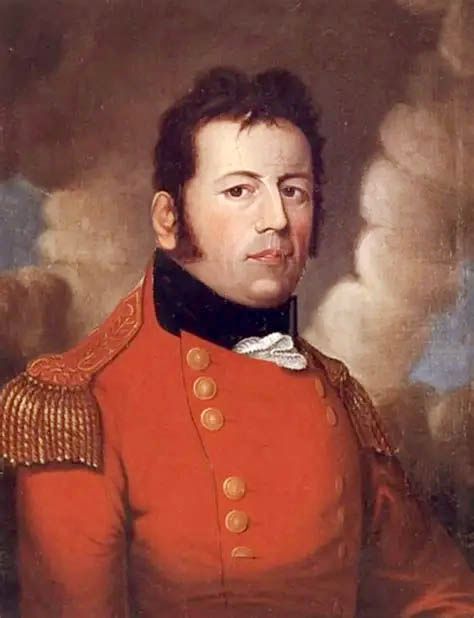
The officious Prevost, named a baronet in 1805 for his services in the West Indies, had ironically been born in New Jersey, the eldest son of a Genevan soldier named Augustine Prévost who fought for England in the Seven Years’ War and the American Revolution. The younger Prevost joined the British Army as a youth, served during the earlier Napoleonic Wars, and by 1811 had risen to be Governor General and military Commander-in-Chief in British North America.
But by the time Prevost was ready to march south toward Albany in 1814, American ships had gained control of Lake Ontario, the easternmost of the Great Lakes, so Prevost decided to go through Lower Canada, then south alongside Lake Champlain. He was aware that Vermont, on the lake’s eastern shore, had shown some sympathy for the American cause by supplying beef cattle for its troops and even naval supplies. He therefore intended to concentrate his advance on the western shore in New York, with British ships and gunboats on the lake offering naval support.
Prevost finally was ready to lead his troops south at the end of August 1814. It was late in the season to begin a campaign, but he had been delayed in Canada awaiting the construction of a new British frigate, the 37-gun Confiance, which had not been launched until August 25.
Meanwhile, a British fleet commanded by Capt. George Downie had been gathering at the British naval base on Isle-aux-Noix in the Richelieu River north of Lake Champlain. Among this fleet were the Eagle and Growler, American sloops the British had captured a year earlier.
It had been June 1813 when the two sloops had been ordered to the north end of the lake to deal with British gunboats harassing American small craft. From the lake, the Eagle and Growler proceeded down the Richelieu River, chasing off three British gunboats. But as they neared Ash Island, well into Canadian territory, they found themselves battling both contrary wind and the river current. British galleys armed with 24-pounders then attacked, while musket fire was loosed from both banks of the river. During the fighting, a shot from one of the galleys struck the Eagle, tore off an underwater plank, and came out the other side of the sloop, sinking it almost immediately.
“Fortunately,” American novelist and writer James Fenimore Cooper wrote in his 1853 book, History of the Navy of the United States of America, “the water was so shoal, where she was at the moment, that her bulwarks remained on one side, above water, and the wounded were got on them, and remained in safety until taken off by boats sent from the enemy.”
Fifteen minutes later, the mast of the Growler was shot away and ran aground. Both vessels were seized by the British, repaired, and renamed. Now the Finch and the Chubb, they were transferred to the British Navy and took part in British actions on the lake including an attack on the village of Plattsburgh itself where, in a letter published in the Albany Register newspaper on August 5, 1813, a reader wrote that the British “burnt barracks, arsenal and public property…. Swanton [Vermont] has shared the same fate since … [and] Burlington [Vermont] was cannonaded, shot thrown into buildings, the people of Water Street had to leave their homes…. The British came with two sloops and one small row galley with a twenty-four pounder.”
The two captured sloops would also take part in the upcoming battle near Plattsburgh.
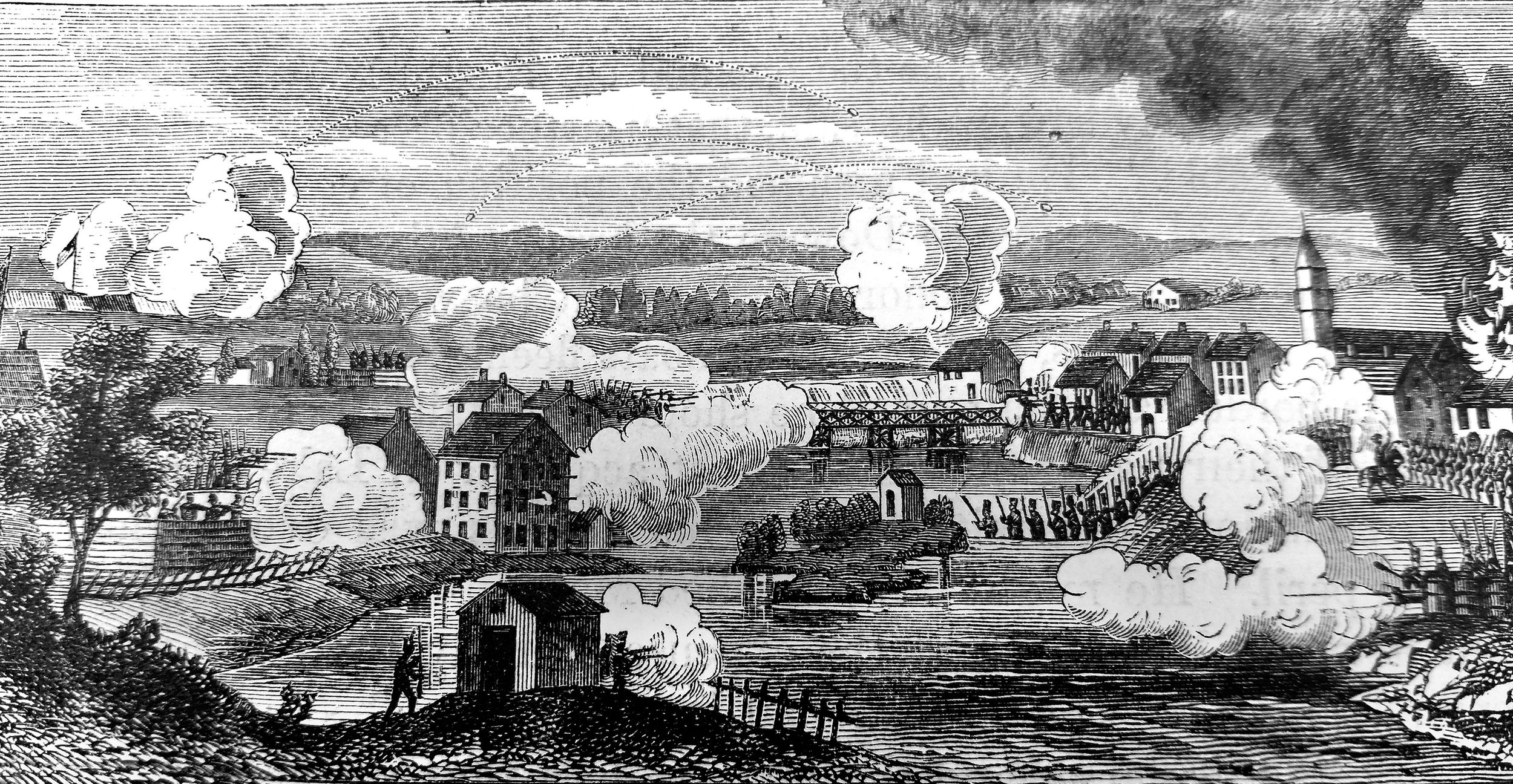
Prevost’s southbound force reached the shores of Lake Champlain near Plattsburgh, the night of September 6, 1814, having met only light resistance from local militia. For the next five days, the American and British forces skirmished.
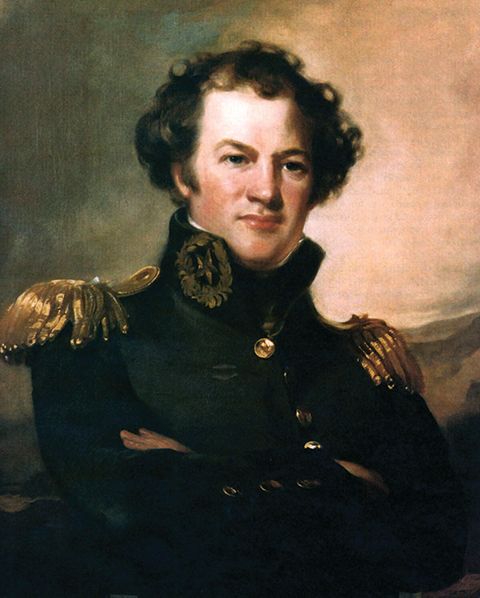
The British force’s 11,000 men were organized into three brigades, each supported by a battery of five 6-pounder guns and a small howitzer. A squadron of light dragoons was also attached to the force. Once near Plattsburgh, the British encountered an American force of only 1,500 regulars as well as 2,000 untrained militiamen under Brig. Gen. Alexander Macomb who ironically had grown up and been educated in New Jersey as had Prevost. He also was one of the earliest graduates of the newly established United States Military Academy at West Point.
The Americans were deployed in a strong position near the Saranac River, which emptied into Lake Champlain from the New York side south of where the Richelieu River flowed out of the lake. The American position included three redoubts and two blockhouses, with the lake covering its flanks. The lake in turn was guarded by Macdonough’s American ships. Prevost also had received intelligence that Macomb was expecting reinforcements. He decided the American position was too strong to be overrun and that a siege would take weeks, time he did not have. His only alternative was to rout Macdonough’s ships sitting in Cumberland Bay and attack Macomb’s position backed by British naval support.
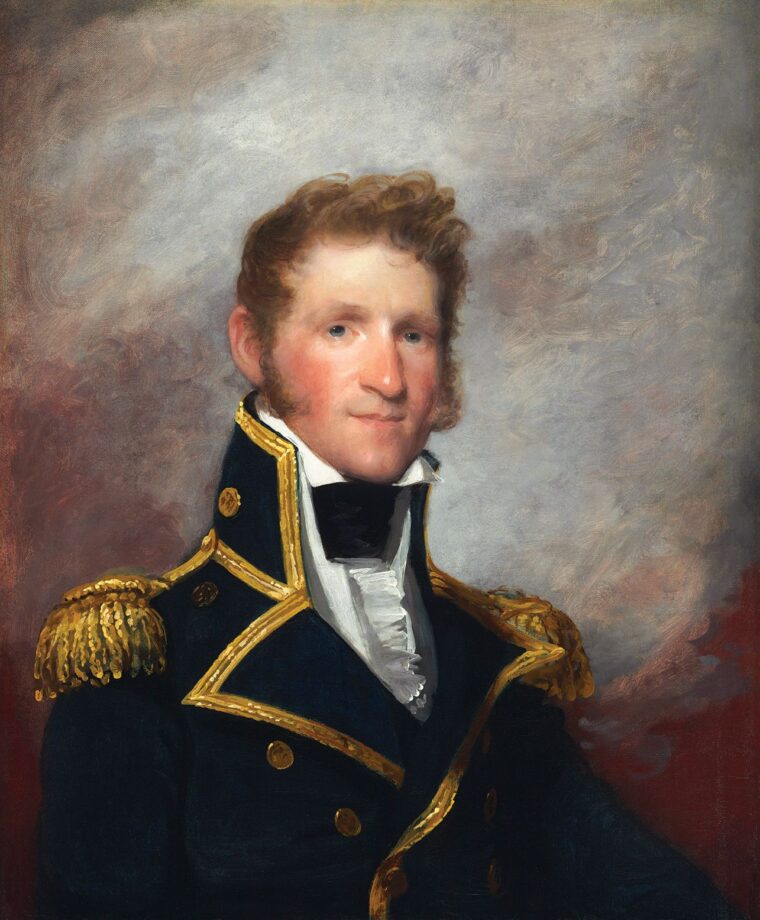
Macdonough was born in Delaware, joined the United States Navy at 16 and fought with Stephen Decatur in the First Barbary War, taking part in Decatur’s famous 1804 raid upon the harbor of Tripoli. His reputation in the Navy continued to grow and he was placed in command of Lake Champlain naval operations in October 1812. Cooper noted that he was “an officer already well known to the service for his spirit and experience, and who fought side by side with Decatur, in all that officer’s brilliant achievements.”
On September 6, Cooper wrote that Macdonough had ordered the galleys to the head of the bay “to annoy the [approaching] English army, and a cannonading occurred that lasted two hours [before] the wind coming on to blow a gale that menaced the galleys with shipwreck, Mr. Duncan, a midshipman of the Saratoga, was sent in a gig to order them to retire. It is supposed that the appearance of the boat induced the enemy to think that Captain M’Donough himself had joined his galleys, for [they] concentrated a fire on the galley Mr. Duncan was in, and that young officer received a severe wound, by which he lost the use of his arm. Afterwards one of the galleys drifted in, under the guns of the enemy, and she also sustained some loss, but was eventually brought off.”
On September 7, the British naval force meant to support Prevost’s land troops and to seize control of Lake Champlain had finally been joined by the Confiance and had begun sailing from the British base at Isle-aux-Noix in the Richelieu where they too had been awaiting the completion of the Confiance, which was to be their flagship. The British naval force was under the command of newly arrived Capt. George Downie.
It reached Lake Champlain on September 9.
About that same time, the Americans had spotted the British soldiers building a rocket battery near Fort Brown, an American installation on the Saranac River just inland of Plattsburgh Bay, and 50 men were sent to attack it. When the American troops had crossed the river and reached the foot of the hill where the battery was, they divided into two parties, one of which circled around to the rear of the battery while the other remained to the battery’s front. At an officer’s command, both parties charged, surprising the 300 veteran British troops, who panicked and fled. The Americans then destroyed the work done on the proposed rocket battery. Prevost was said to have been “much mortified” that the British veterans had been routed by 50 Americans.
With the Confiance, which was finally among them, the British ships waited at the entrance to the bay. She was a 1,200-ton frigate carrying 37 guns, nearly double the size of the 734-ton American flagship Saratoga, and she could fire a broadside that was only 96 pounds short of the long- gun firepower of the entire American fleet.
But her crew, like Prevost’s land force, was in less than tip-top shape.
They had been gathered from other ships in the St. Lawrence River and when that was insufficient, from infantry units in Canada. Her gun crews had not had their first practice with the new equipment until September 9 and some supplies and fittings were still lacking. (Carpenters were working on the ship until shortly before the September 11 battle installing quoins, wedges used to elevate a ship’s cannons, and slides for the guns). The Confiance had been accompanied from Isle-aux-Noix by the newly built sloop Linnet, which carried 16 guns, the captured 11-gun sloops Chubb and Finch, as well as 12 gunboats, each carrying one or two guns.
In all, the British had 16 vessels of about 2,402 tons worked by 937 men, and a total of 92 guns that could throw a total broadside of 1,192 pounds, 660 pounds from long guns and another 532 pounds from short. Opposing them on the lake would be America’s 14 vessels of 2,244 tons and 882 men. They were the Eagle, a 500-ton brig with 20 guns, the flagship Saratoga, a frigate armed with 26 guns, the Ticonderoga, a 17-gun schooner, Preble, a 7-gun sloop, and 10 gunboats or galleys each with a single gun. The American ships could throw a combined broadside of 1,194 pounds of shot, 480 from long guns and 714 from short. The American and British squadrons were roughly even in numbers, but the British had a slight advantage in fire power.
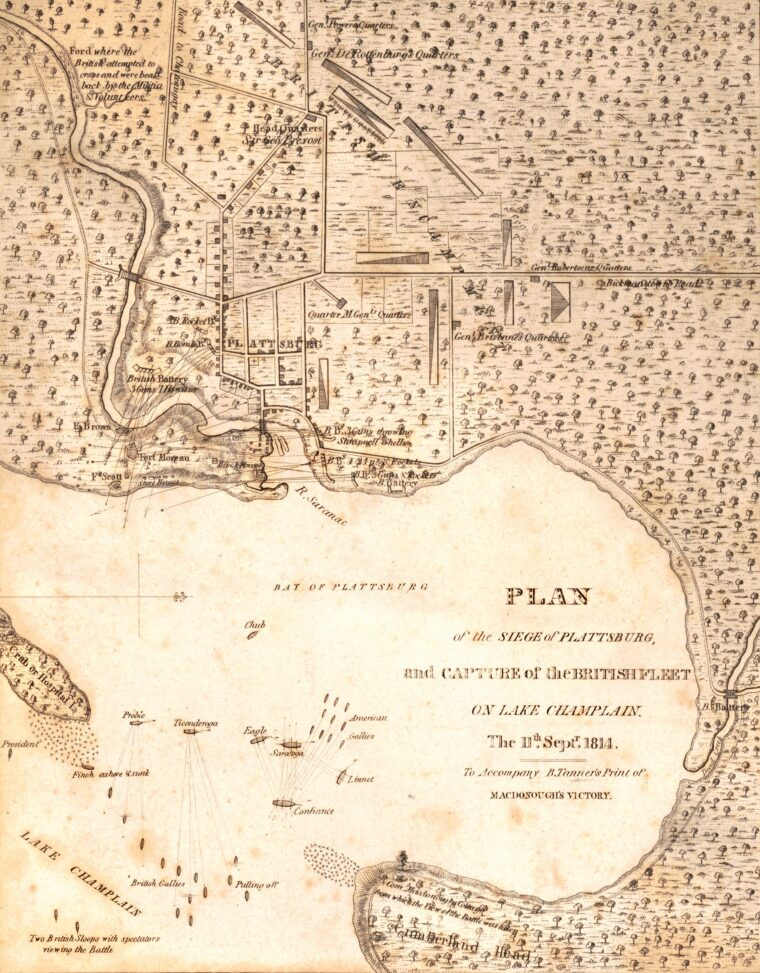
Macdonough, knowing his ships were outgunned in long-range power, had retired to Plattsburgh Bay where the British superiority in long guns would be nullified, and he anchored his four largest ships across the bay close to the promontory of Cumberland Head and extending down the bay to Crab Island. To approach the American fleet, Downie would have to round Cumberland Head in a narrow line facing winds off the lake.
Macdonough had deployed his force in a straight line—from north to south—just below the mouth of the Saranac River with gunboats anchored between the larger vessels. Expecting the British would face a north wind in the bay, which they did, he anchored the flagship Saratoga in line with Ticonderoga, which had originally been built as a merchant steamer but was later converted to a schooner, and the Preble to her south. The Eagle served as the northern anchor of this defensive line to prevent the British from flanking them around Cumberland Head.
On the previous night, British commander Downie had entered the bay in a small boat to investigate the American position. At about 9 a.m. on Sunday, September 11, the British vessels rounded Cumberland Head on the eastern side of the bay firing blank charges to notify Prevost of their arrival. Close-hauled in line were the Chubb and Linnet, which immediately sailed to confront the Eagle. The Confiance engaged the Saratoga, while the Finch and the gunboats focused their assault on the Ticonderoga.
Passing the Saratoga on its way to attack the Eagle, the Linnet loosed a broadside that did little damage to the American vessel but did destroy a deck coop releasing a gamecock that flew into the ship’s rigging and began crowing, which was taken by many of the Americans as an auspicious omen. Meanwhile, aboard the American flagship Macdonough himself sighted and fired a 24-pounder to open the American firing. After anchoring, the Confiance replied with a double-shotted broadside.
Just as the Confiance entered the bay, she was hit by fire from the American ships. Downie anchored and returned fire on the Saratoga from 500 yards, severely damaging it and knocking a fifth of her crew out of action.
Fifteen minutes into the battle, the Chubb was drifting helplessly—sails in ribbons, with her cable, bowsprit, and main boom shot away—and surrendered, as an American gunboat eased her toward the shore. By then the Linnet had reached the head of the American line, and she opened a raking fire against the Eagle. To the south, the British Finch drifted out of line and struck a reef near Crab Island close to the New York shoreline after taking full broadsides from the Ticonderoga. There a six-pound gun manned by invalids from a hospital on the island forced her surrender.
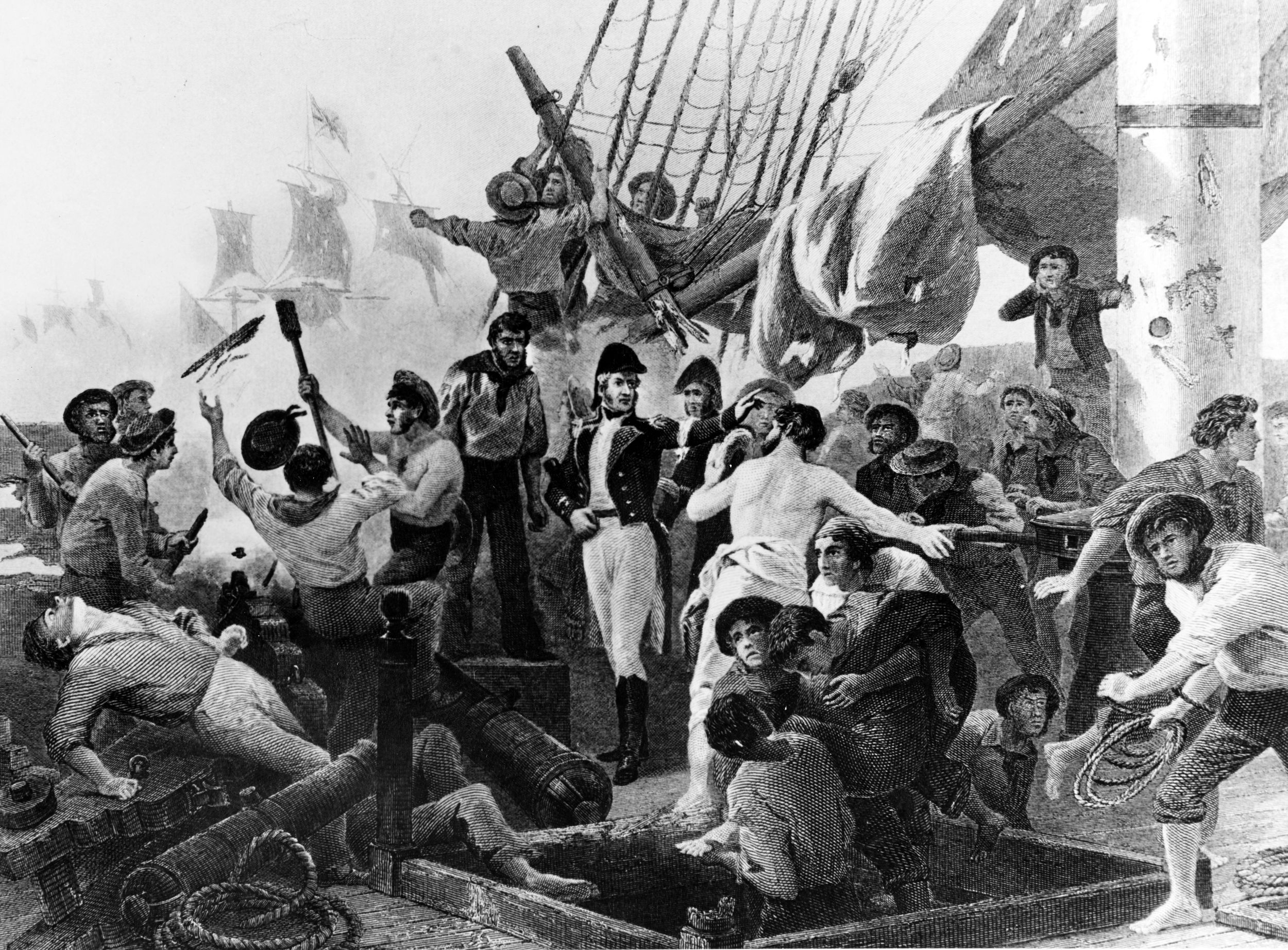
Early in the battle, one of the Confiance’s guns had it’s barrel knocked off its carriage, and the loose gun slammed into Downie’s chest, killing him instantly.
The guns themselves were often as much of a danger to the men operating them as to the men being fired at and as deadly as the flying wooden shards from broken masts and planks.
“When a large naval cannon was fired, the cannonball went flying and the two-thousand-pound [cannon] went rolling backward,” Col. David G. Fitz-Enz wrote in his 2001 book The Final Mission. “Such cannons had no recoil mechanism at the time to absorb the shock: the gun would come careening out of position and was arrested finally by restraining ropes attached to blocks in the deck.”
American writer James Fenimore Cooper in his 1853 book describes how two American officers were killed in the fighting. “Lieutenant [Peter] Gamble,” he wrote, “was on his knees, sighting the bow-gun, when a shot entered the port, split the quoin, drove a portion of it against his breast and laid him dead on the quarter-deck without breaking his skin … [and] Lieutenant Stansbury suddenly disappeared from the bulwarks forward while superintending some duty with the springs of the Ticonderoga. Two days after the action his body rose to the surface of the water, and it was found that it had been cut in two by a round shot.”
Flying shards of wood from broken spars and parts of a ship’s railing and on-deck structures were also a danger. Macdonough himself was injured, Fitz-Enz wrote that “when the first broadside of the Confiance split in two a spanker boom high in the rigging of the Saratoga, the severed piece falling across Macdonough’s shoulder and striking him senseless for several minutes.” Macdonough recovered, however, and was able to return to the fighting.
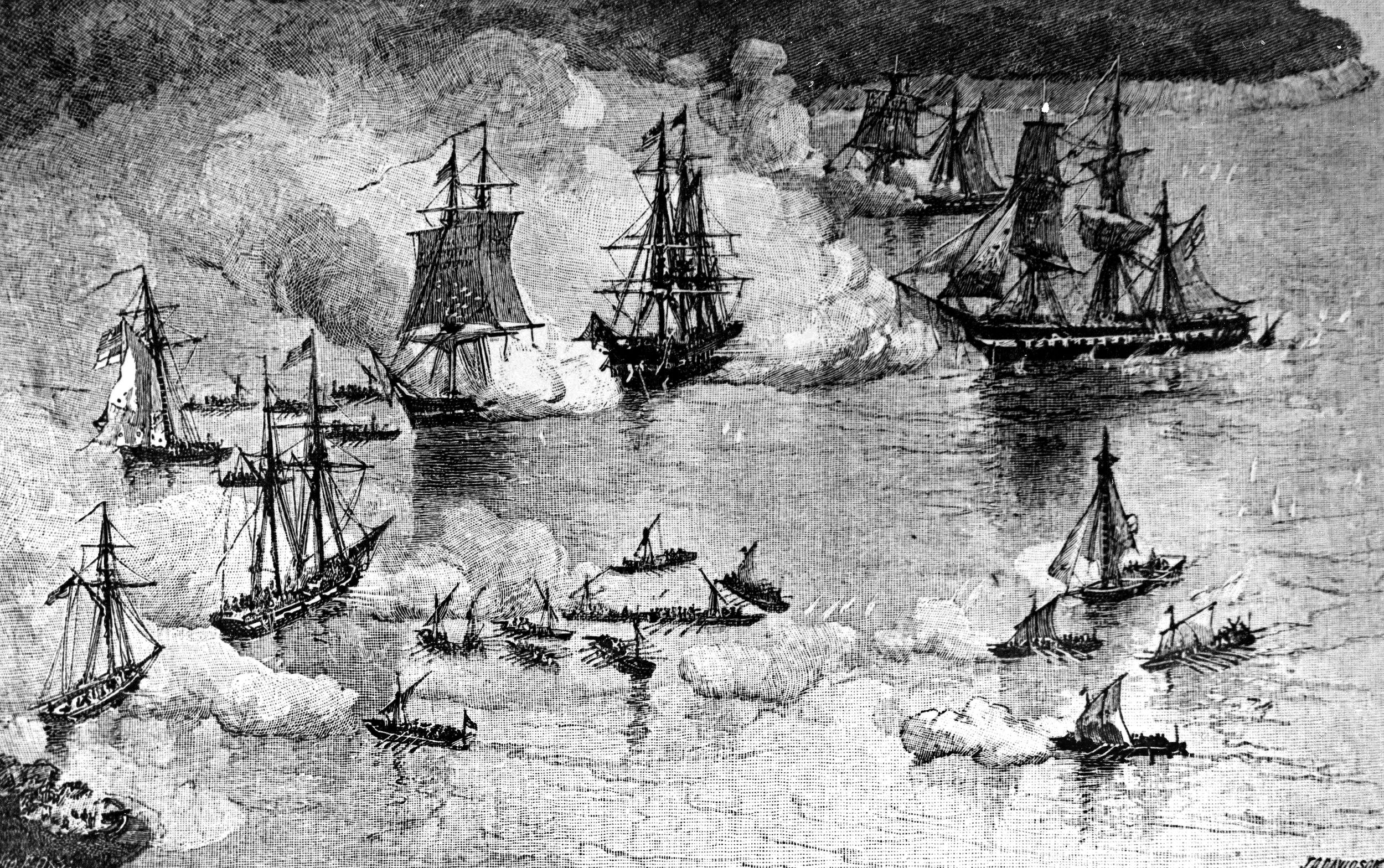
At the foot of the American line, the Preble was damaged by British gunboats and had to cut her anchors and run toward shore, which left the Ticonderoga alone to battle four British gunboats. Repeatedly the gunboats got within an oar’s distance of the Ticonderoga readying themselves to board her only to be repulsed by American grapeshot and musket fire. The Ticonderoga remained in the battle until the end, her guns at times being fired by pistol flashes when the matches did not work. But the gunboats had kept her out of the main battle.
The Confiance and the Saratoga were exchanging broadsides, and at the head of the American line the Eagle was receiving fire from the Linnet as well as some fire from the Confiance, whose shots were flying high over the American decks. But the overall firing was also gradually lessening as guns were disabled by the fighting or by the handling of their inexperienced crews.
At about 10:30 a.m., Lieutenant Robert Henley, commanding the Eagle, cut her cable and allowed his ship to drift south to the rear of Saratoga, which was now receiving fire from the Linnet and the Confiance. There the Eagle joined in firing on the Linnet with its undamaged port-side guns.
Nearly all of the Saratoga’s starboard guns had been knocked out and the ship had been set on fire twice by hot shot from the Confiance. Finally, the naval bolt on the single cannon remaining on the Saratoga’s starboard side broke, and the gun flew off its carriage and down the main hatch. The Confiance still had four functional guns on its port side. At this point, Langguth wrote, “the British seemed to have won, and they waited for Macdonough to surrender.”
But the American commander had one card left to play.
“He used his days before the battle to protect against such a reversal,” Langguth wrote. He had laid out kedge anchors (smaller secondary anchors that are generally easier to use and recover).
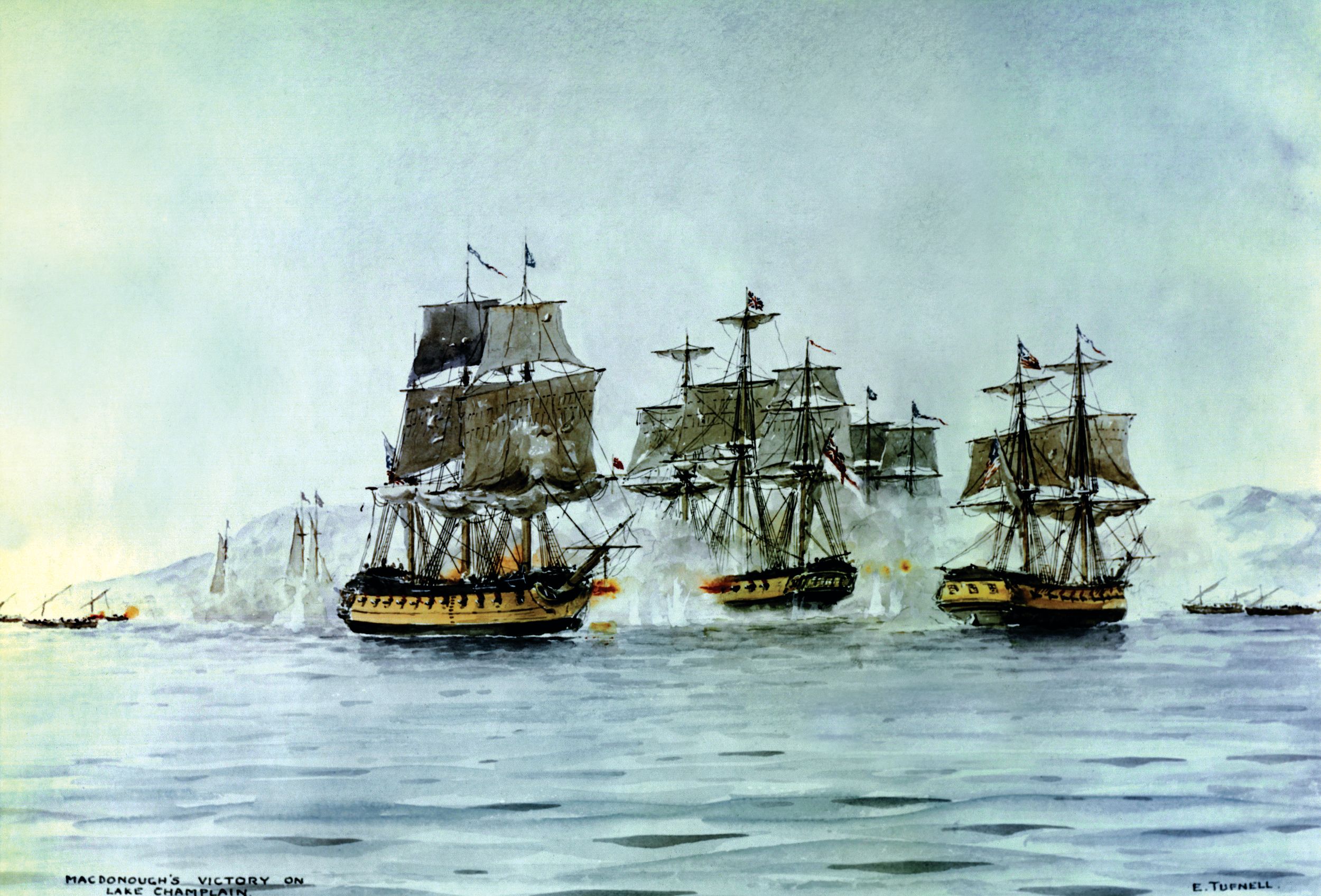
With his starboard guns all but silent, Macdonough let go his stern anchor, passed the cable from one of the ship’s kedge anchors which had been laid off Saratoga’s bow, under the bow and set a crew to hauling it, which caused the Saratoga to turn in a tight circle and bring the Saratoga’s 13 undamaged port guns to bear on Confiance. During the maneuver, the Saratoga’s stern was exposed to raking fire from the Linnet and the crew was ordered forward. Trying the same maneuver but unable to execute it, the Confiance got stuck halfway around, leaving her stern open to the Saratoga’s guns. Helpless, the Confiance surrendered at 11 a.m.
Macdonough then ordered Saratoga crewmen to again haul on the kedge anchor cable and turned his ship on the isolated Linnet. With water rising to as much as a foot below her lower deck and the wounded in danger of drowning, the British brig struck her colors at 11:20 a.m. By then the Ticonderoga was finishing up her engagement with the British gunboats, and those that had not already dropped out of the fighting fled the scene.
None of the large vessels of either side had a mast left that would bear a sail. “After trading volleys for most of the morning,” Langguth wrote, “Macdonough had won the fight in its last thirty minutes.”
During the fighting, the Confiance had taken 105 shots to her hull and the Saratoga 55. The Saratoga was so badly mangled in the fighting that it was two hours before Macdonough could put things enough to rights that he could take control of the Confiance. Macdonough had originally signaled the American gunboats to pursue the fleeing British boats, but then changed his order, bringing them in to assist with the Linnet and Confiance, both of which were close to sinking.
Captain Daniel Pring of the Linnet and other surviving British officers came under guard to the Saratoga and offered their swords to Macdonough who refused them.
“Gentlemen, return your swords to your scabbards, you are worthy of them,” he is reported to have replied. He then fired off a message to William Jones, the American Secretary of the Navy that read: “The Almighty has been pleased to grant us a signal victory on Lake Champlain in the capture of one Frigate, one Brig, and two sloops of war of the enemy.”
The British had lost five officers, including Downie, 49 enlisted men killed and 116 wounded, a casualty rate of 18 percent. The Americans suffered a casualty rate of 13 percent with four officers and 48 enlisted men killed and another 58 wounded. Spectators, including Julius Hubbell, who had viewed the battle from Cumberland Head, were allowed to visit the British ships the next day and later commented on the stacked corpses, the blood, and the near total destruction of the vessels.
Meanwhile, on land, the British and American forces had engaged in an artillery duel until word reached British commander Prevost of the defeat of his naval support in the bay. Realizing there was no longer any reason for his assault and that his planned invasion had been halted, Prevost called off the action and retreated north to Canada. Prevost was later relieved of command in Canada and returned to Britain where feeling his name had been sullied by his removal from office, he requested a court-martial to clear his name. He died in 1816 a week before the court-martial was scheduled to convene. Macomb was promoted to major general and in 1826 became the commanding general of the United States Army. Macdonough was promoted to captain and went on to command the famed USS Constitution before dying of tuberculosis at sea near Gibraltar in 1825.
But the American victory on Plattsburgh Bay had a more profound result.
The British defeat moved England’s Prime Minister, Lord Liverpool, to more seriously consider peace and to ramp up the peace negotiations then underway at Ghent, Belgium. The resulting Treaty of Ghent was signed on December 24, 1814, three months after the battle on Lake Champlain.
The treaty ended the War of 1812 and restored pre-war boundaries without resolving the impressment of American seamen or trade issues that had sparked it three years earlier.
“Nothing was gained and nothing was lost,” Fitz-Enz wrote, “except the lives of soldiers and sailors on both sides.”


Join The Conversation
Comments
View All Comments