By Flint Whitlock
The HMS Queen Elizabeth, the largest passenger liner afloat, took only five days to transport the entire 106th Division from New Jersey to Glasgow, Scotland, making port on November 17, 1944. The troops were then taken by train to Portsmouth, England, and transported across a storm-tossed English Channel to France and up the Seine River.
The young soldiers of the “Golden Lion” Division who had hoped to spend a few days in Paris were disappointed. The division was loaded like cargo into hundreds of unheated trucks and hauled eastward, crossing into Belgium on December 10. The troops did not see Paris.
What they saw instead were miles and miles of a burned and broken landscape that bore grim testimony to the ferocity of the fighting that had taken place for the past six months. The ruins of homes, shops, churches, and factories—the enormous reality of which exceeded a thousandfold what the young soldiers of the 106th had expected—spoke mutely of the desperate battles that had been waged across the European continent during the past six months.
Scattered along the roadsides and in the fields were the twisted and blackened hulks of tanks, trucks, half-tracks, ambulances, artillery pieces, jeeps, aircraft, and military hardware of all kinds. Not all of it, however, was German; plenty of wrecked and bloodstained American vehicles littered the fields, farms, roads, and towns. The men of the 106th collectively gulped and hoped that things were considerably quieter wherever they were going.
The half-frozen Golden Lions finally arrived at the quaint little town of St.-Vith in eastern Belgium on December 11. Named in honor of the martyr St. Vitus, the first settlers had put down roots in the area in AD 863. The town that has found itself in the center of numerous wars over the centuries was once again in the path of great armies at the end of 1944.
At St.-Vith, the Ardennes Forest of Belgium melds with the Schnee Eifel region of Germany, and the two areas are virtually indistinguishable from one another. Broad farmlands and thick groves of trees are spread over a series of rolling hills and deep river valleys, intercut by narrow, winding roads. To call the region “mountainous” would be overstating the case. Steep in places and heavily forested in others, the region’s undulating terrain is perhaps more akin to the gently rolling Appalachians of central Pennsylvania. In January 1944, the Schnee Eifel, a high, pine-covered ridge that runs from the northeast to the southwest, was heavily fortified with bunkers, pillboxes, and antitank obstacles—part of the German Westwall, or Siegfried Line, of defenses.
The broad Allied push had come to a dead stop in autumn along the German-Belgian border at Aachen and the Hürtgen Forest, due to a variety of factors, which included bad weather, heavy casualties, a serious shortage of fuel and ammunition, increased German resistance, and plain exhaustion. On December 7, 1944, Gen. Dwight D. Eisenhower, head of the Supreme Headquarters Allied Expeditionary Force, met with his highest American and British commanders in Maastricht, Belgium, to map out plans for future operations. It was decided that a fresh offensive, in early 1945, must be mounted to keep the German defenders on their heels and prevent any further loss of offensive momentum.
The Allies held a 400-mile front, running from Nijmegen, Holland, to the French-Swiss border at Basel. Occupying the northern front, or left flank of the Allied line, was British Field Marshal Sir Bernard Law Montgomery’s Twenty-first Army Group, while General Omar Bradley’s Twelfth Army Group occupied the area to the south.
Holding the northern half of Bradley’s line was Lt. Gen. William H. Simpson’s U.S. Ninth Army and Lt. Gen. Courtney Hodges’ First Army, the divisions of which had seen months of heavy fighting. On their right flank, from Monschau south, were spread the 99th, the 106th, and the 28th Infantry Divisions. Next to the 28th, which was badly stretched-out, was the exhausted 4th Infantry Division. Below Luxembourg stood Lt. Gen. George S. Patton’s Third Army. At Saarbrücken, the front turned east and was the responsibility of General Alexander Patch’s Seventh Army, which had landed on the French Riviera in August.
It was decided that Montgomery would send his forces in an all-out thrust toward the Rhine north of the Ruhr. Simpson’s Ninth Army would be attached to the British force. Farther south, as part of a one-two punch, Eisenhower would send Patton’s Third Army racing toward Frankfurt-am-Main.
Hodges’ First Army, consisting of the V, VII, and VIII Corps, would also play a major role in the coming fight. The VII Corps, commanded by Maj. Gen. J. Lawton Collins, would spearhead the offensive and head for Cologne. Maj. Gen. Leonard T. Gerow’s V Corps would exploit any VII Corps successes. Chosen to take part in the V Corps offensive, the battle-weary 2nd Infantry Division was pulled out of its positions east of St.-Vith and trucked northward to the vicinity of Dom Butgenbach. Maj. Gen. Troy H. Middleton’s VIII Corps, on First Army’s southern flank, had no immediate role in the upcoming operations, but was told to be ready to follow up Allied gains. December 13 was set as D-day for the start of the operation.
Guarding the supposedly “impenetrable” forest east of St.-Vith in the VIII Corps area were the inexperienced 99th and 106th Infantry Divisions. There they would get a taste for living near the front, hear the distant rumble of artillery fire, and act as reserves.
Although a veteran of World War I, the 106th’s commanding general, 52-year-old Maj. Gen. Alan Jones, had never led a unit of any size in combat, let alone a 14,253-man infantry division. Most of his officers, noncoms, and enlisted men were equally green.
Through no fault of its own, the 106th was about as ill-prepared for combat as any division America ever put into the field. From activation to departure for its port of embarkation, the 106th lost a total of 12,442 of its best-trained men. These were pulled out during training at Camp Atterbury, Indiana, and either sent overseas as replacements or transferred to divisions that had been alerted for overseas movement. Bringing the division back up to full strength was a flood of Army Specialized Training Program students, fresh from their college classes, as well as the rookies from the infantry replacement centers at places such as Camp Wheeler, Georgia, whose military training was minimal at best.
The division had other problems as well. One historian noted, “Unlike Regular Army and National Guard divisions, [the 106th] had no distinctive history or achievements, unit pride, or connection with any particular state or region.”

Once it arrived at the front, the 106th began to acclimate itself to its new positions. While the 2nd Infantry Division, which the 106th replaced, had earlier plotted out preregistered artillery concentrations and established liaison with the 14th Mechanized Cavalry Group to its north, the 106th had yet to adequately carry out either of those two essential tasks. The officers of the 106th may have thought that, as new arrivals at the front, they would be given time to get their feet wet before anyone expected them to engage in any “real” soldiering. They may also not have realized that the division, in its positions in the Schnee Eifel, represented a deep penetration into German territory. It was a situation ripe for disaster.

In the autumn of 1944, Nazi Germany was being crushed from three sides. From the east, the huge Soviet army was slowly pushing back the enemy. From the west and south, American, British, and Free French forces were inexorably forcing the German army into a massive retrograde action. From overhead, daily raids by thousands of Allied aircraft were pounding the Third Reich into shattered, smoldering, unrecognizable rubble.
To save his nation, Adolf Hitler, Germany’s supreme commander, decided to gather as many forces as he could and strike back hard in the west. His hope was to inflict serious casualties, causing public opinion in Britain and America to force Prime Minister Winston Churchill and President Franklin D. Roosevelt to negotiate a peace. Then, perhaps with Britain and America as allies, the Germans could defeat the Soviet army and forestall a takeover of Europe by the Communists.
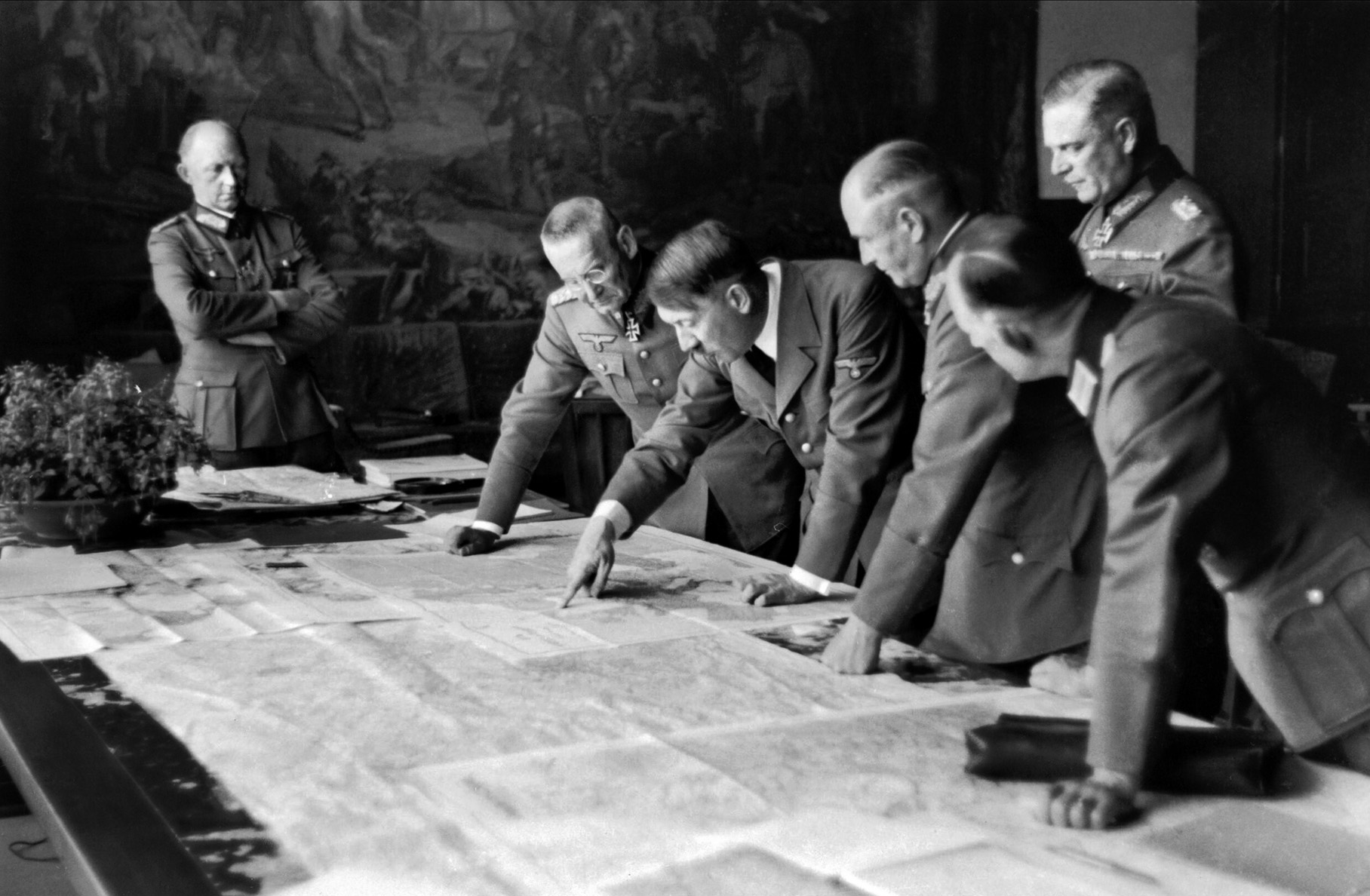
Hitler scanned maps for a suitable place from which to launch his counterassault. Then he saw it, the Ardennes, the same improbable place through which his divisions had begun their surprise invasion of France and Belgium in 1940. Here he envisioned scores of divisions and thousands of panzers and artillery pieces crashing through the “impenetrable” forest and straight into the soft spot of the American front lines—a soft spot currently occupied by the unsuspecting 106th Infantry Division.
While the Allies would later call the operation the “Battle of the Bulge,” Hitler codenamed it Wacht am Rhein (Watch on the Rhine). It was not the Rhine River, however, that Hitler planned to secure. It was instead the vital port at Antwerp, some 75 miles west of Aachen, that he hoped to reach, while simultaneously driving a wedge between American and British forces.
The American high command saw no reason to expect a German counterthrust of any great magnitude in the Ardennes. Intelligence reports indicated no major enemy buildup or unusual “chatter” in communications that might suggest the Germans were about to launch a major attack. Even ULTRA, the system that had broken the German ENIGMA codes, deciphered nothing conclusive. Just as the Allies had hoodwinked the Germans about the Normandy invasion, the Germans had devised a deception plan to convince the Allies that Germany was going to stay on the defensive. They made sure that the Allies received this carefully planted information.
On the night of December 11, 1944, a number of high-ranking German generals were summoned to the Führer’s underground forward headquarters, known as the Adlerhorst, in the resort city of Bad Nauheim. There, Hitler announced that in four days the German army would launch the largest offensive since the invasion of the Soviet Union. He would throw almost everything he had at the Americans. Three armies with 13 infantry and seven panzer divisions, plus an additional five infantry divisions in OKW reserve on alert or en route to the front, totaling some 290,000 men, 2,617 artillery pieces, 1,038 tanks and self-propelled guns, and a handful of aircraft.
Only 80,000 Americans held the 75-mile line between Monschau and Luxembourg City. Hitler believed the 99th and the 106th divisions, occupying the schwerpunkt (point of attack) in front of St.-Vith, were too inexperienced to put up much of a fight.

Stunned, the generals could not believe their ears. Many privately believed that the Führer had long ago lost all touch with reality, and this scheme confirmed their beliefs. They did their best to change Hitler’s mind, pointing out that their formations were much too weak, the Allies were much too strong, and the chances for victory were nonexistent. Hitler had heard this type of defeatist talk from his generals before, however, and he would not be moved. The operation would go ahead as planned, whether they liked it or not.
While the five infantry and four SS (Schutzstaffel) panzer divisions of the Sixth Panzer Army, under SS Obergruppenführer (lieutenant general) Sepp Dietrich, would strike Gerow’s V Corps between Aachen and Monschau, the center thrust would send General der Panzertruppen (general of panzer troops) Hasso von Manteuffel’s Fifth Panzer Army into the 28th, 99th, and 106th divisions. Von Manteuffel’s force consisted of four infantry and three panzer divisions totaling 90,000 men, 396 tanks and assault guns, and 963 artillery pieces. To the south, General der Panzertruppen Erich Brandenberger’s 60,000-man Seventh Army would hit Middleton’s extended VIII Corps line, comprising one regiment each from the 4th and 28th Infantry Divisions, and a Combat Command from the 9th Armored Division, along the Germany-Luxembourg border.
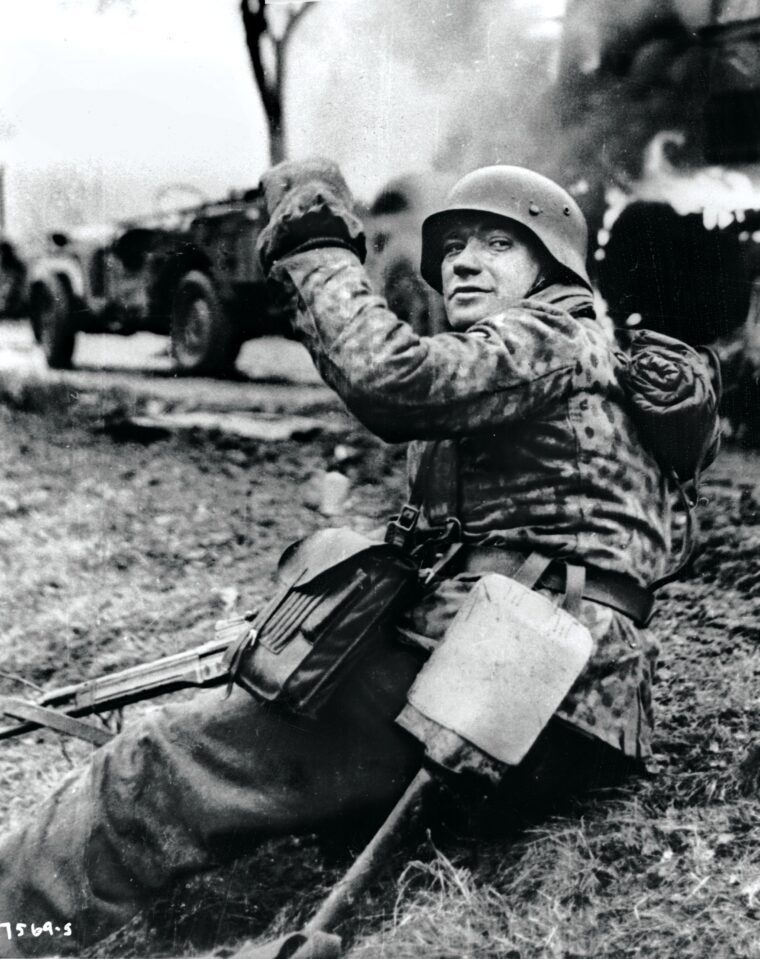
A thousand paratroopers would also drop behind American positions. As an extra surprise, hundreds of English-speaking Germans dressed in American uniforms, driving captured American vehicles, and commanded by SS Obersturmbahnführer (lieutenant colonel) Otto Skorzeny would be employed in “Operation Greif” to sow confusion and disinformation behind the lines as they dashed ahead of the panzers. It seemed that Hitler had thought of everything.
Although German ammunition and fuel stocks were low, and much of the equipment was in poor condition, Hitler gambled that German desperation, surprise, and audacity would be enough to help ensure victory.
On the night of December 15-16, 1944, two regiments of the 106th Infantry Division were thinly spread atop 4.5 miles of a gently sloping ridge in the Schnee Eifel, just inside Germany’s border with Belgium.
The left flank of Colonel George L. Descheneaux, Jr.’s 422nd Infantry Regiment touched the village of Schlausenbach, while the right flank met Col. Charles C. Cavender’s 423rd Regiment near Oberlascheid. The 423rd’s lines then extended southwest to the town of Bleialf. The third regiment, Col. Alexander Reid’s 424th, was located four miles southwest of Bleialf, around Winterspelt. Division headquarters was six miles behind the front line in St.-Vith.
To the 422nd’s and 423rd’s front lay wide farm fields and groves of fir trees. No one expected much action in this sector. Except for the distant and sporadic thud of artillery and occasional patrols by both sides, the situation along the front was about as quiet as war could get. That situation suited many of the new arrivals just fine.
Scanning the far side of the valley with binoculars, officers saw no reason to think that a major attack was imminent. Binoculars, however, could not penetrate the thick woods to see the stores of ammunition and fuel being built up, the hundreds of panzers, half-tracks, and self-propelled artillery pieces lined up track-to-track, the thousands of armed men assembled for the great operation.

Aerial reconnaissance did show heavy concentrations of men and equipment, but this was misinterpreted as enemy units merely passing through the Eifel area on their way to bolster German lines to the north or south. Even General Bradley failed to attach adequate importance to the ominous signs, admitting later, “I had greatly underestimated the enemy’s offensive capabilities.… We could not believe he possessed sufficient resources for a strategic offensive.”
For most of the men of the 106th Division, trying to keep warm in bunkers and foxholes along the Eifel ridge, everything was peaceful. According to 19-year-old Pfc. Peter Iosso, a machine-gunner with Company E, 422nd Regiment, dug in eight miles east of St.-Vith, the loudest thing in his sector was “the snow that fell off the branches of the evergreens.”
Iosso noted that his unit had only been on line for a few days. “We had just arrived there and replaced the 2nd Division. The guys in the 2nd Division told us there wasn’t much going on. We had a machine-gun nest in a pillbox with logs over it—kind of a primitive shelter. We thought we would probably serve a couple of weeks there and then get R and R [rest and recuperation] and have a good time somewhere else, then return to this kind of phony war.”
Robert Kline, a communications sergeant with Company M, 423rd Regiment, was in a log-covered dugout. “The Germans ran patrols up through us about every night. You weren’t supposed to shoot at them, because you’d give away your position. One guy had a dog jump in on him—scared him to death.”
All along the American lines, the night of December 15-16 was pretty much like the previous few nights. There was a little distant gunfire; a lot of hand-rubbing and foot-stomping by sentries trying to keep warm; hours of monitoring the radio net to hear if anything important, or even interesting, was happening; trying to sleep in the wet and cold; and thinking about what tomorrow and the day after would bring. For those who had been “gung-ho” and had enlisted enthusiastically for the cause, their military ardor had waned. War was a cold, dirty business, uncomfortable, and, at times like this, exceedingly boring.
For many married soldiers, that night’s thoughts drifted homeward, picturing what their wives might be doing at that exact moment. Thousands of freezing men in the woods and hills east of St.-Vith thought about home and pondered their future—one that would never come for many of them.
A few miles east of the American lines beneath the towering, frosted pines of the Ardennes, the massive German war machine stirred to life. Soldiers shouldered their rifles and Panzerfausts and climbed aboard their trucks and half-tracks. Panzer commanders gave their men the signal to move out, and the cold night air was suddenly filled with the roar of engines and clouds of choking diesel exhaust. All along the 80-mile front, the snow crunched beneath the tires and tracks of the vehicles as over a quarter-million men headed west, grimly determined to do their holy duty to save the Fatherland or die trying.
In the small hours of December 16, 1944, as the sleepy, unsuspecting American sentries scanned the terrain in front of them, the pre-dawn blackness of the eastern horizon suddenly lit up like an artificial dawn, as though the end of the world were at hand. Thousands of German guns flared as their rounds screamed toward the American lines. Seconds later, the projectiles began splattering on the ground, bursting in the air, and tearing into the trees, hurling hot, jagged fragments into their unsuspecting victims.

Men who had been dozing just moments earlier were now jerked out of their slumber by noise and concussions that none had ever before experienced. Shaking the sleep from their brains and suddenly fueled with adrenaline, soldiers grabbed for their rifles and rushed to their assigned defensive positions. Others, terrified at the bright white-orange flashes and the splintering of tall pines that accompanied the eruptions of thousands of shells, took off running to escape the steel storm.
After a barrage that seemed to last several eternities, the fire lifted. Those soldiers who had survived saw ghostly shapes moving toward them through the trees—whitewashed panzers accompanied by infantry in snow camouflage. While elements of the 18th Volksgrenadier Division kept the men of the 106th occupied to their front, the rest of the enemy division was already slipping around the flanks, between the seam of the 422nd Regiment and the 14th Cavalry Group to the north, and the 423rd and the 424th to the south at Bleialf. The immediate objective of the German units was Schönberg, behind the 106th.
When the first German shells began falling, Peter Iosso dashed back out to his machine-gun post, but a round exploded nearby, knocking him unconscious. When he awoke, he was lying in the snow with a bloody chin and throbbing feet. “Though my stiff legs and frostbitten feet resisted,” he said, “I managed to get back to company HQ. At another time I would probably have been taken to the ‘rear,’ but the Germans had broken through our lines. Somebody bandaged my chin. But the battle began and the aid station was no help to me because they were getting ready to retreat. I was cut off from my company and had to retreat with the company headquarters people.”
Pfc. Joseph Mark, a communications specialist, was at his switchboard in a pillbox that served as headquarters for the 3rd Battalion when the battle erupted. “I was putting through switchboard calls from our artillery observer in the front to our artillery in the back. Our position held initially. We stopped them cold in front of us, but they got around us on both sides.”
Pfc. James V. Smith, an ammunition bearer for a mortar platoon in Company H, 423rd Infantry Regiment, was with his section near Bleialf. “We started having these three-quarter-ton trucks passing us, heading for the rear. We could see all these dead soldiers stacked up in the trucks. That didn’t cheer us up very much.”
Smith’s mortar section began firing toward the enemy. “The first round we fired hit a church steeple in the town and blew the church steeple apart. The next round—we had used a magnesium round—hit very near a tank that was coming around a corner in the town. Our observers said a lot of Germans came out of the tank and several things were on fire there.”
By late morning on the 16th, the 14th Cavalry Group was being pushed back to the Holzheim-Andler line, uncovering the 422nd’s left flank in the process. On the 423rd’s right flank in the village of Bleialf a street battle resembling a Wild West shootout was taking place. The seam between American units was torn. The German breakthrough above and below the 422nd and 423rd Regiments was about to snare the division in a classic double envelopment.
St.-Vith was in a panic. Civilians were attempting to flee while German shells, fired from batteries at Prüm 15 miles away, bombarded the town, and German armored columns were spotted closing in. No one, least of all Jones, seemed to know what was happening to his forward regiments.

At his Paris headquarters, Eisenhower was not panicked or even terribly concerned by the reports coming from the front. To him, the Ardennes counteroffensive signaled that the war was nearly over. He wrote, “We had always been convinced that before the Germans acknowledged final defeat in the West they would attempt one desperate counteroffensive. It seemed likely to Bradley and me that they were now starting this kind of attack.”
The SHAEF brass decided that the 7th Armored Division, part of Hodges’ First Army to the north of the penetration, and the 10th Armored Division, in Patton’s Third Army operating to the south, should be immediately rushed to the area of the breakthrough to pinch off the threat
The situation for the Americans on the front lines, however, was fast becoming untenable. On December 17, the Germans had driven the 14th Cavalry Group back to St.-Vith. Southeast of St.-Vith, the Germans had pushed back the 424th Regiment and taken the town of Winterspelt. A plan was formulated to gather whatever troops could be found in and around St.-Vith and head for Schönberg, thereby opening an escape corridor for what was left of the 422nd and 423rd Regiments.
If Eisenhower was calm and confident, Jones was despondent. Incorrectly informed that Combat Command B (CCB) of the 7th Armored Division, just starting out from Maastricht, Holland, 60 miles to the north, would arrive early on the 17th, Jones hoped that his besieged regiments could hold out that long.
Speeding south from Maastricht several miles in advance of his CCB tanks was Brig. Gen. Bruce C. Clarke. He first reported to VIII Corps headquarters in Bastogne, where General Middleton informed him of the deteriorating situation in the 106th’s sector. The next morning, the forward elements of the 7th Armored reached Poteau, five miles west of St.-Vith. Already there were problems. The SS spearhead had cut the 7th’s route of march and killed Col. Church M. Matthews, the division’s chief of staff.
The situation around St.-Vith quickly came to a head on the 17th. At about 1430 hours that afternoon, with two of his three infantry regiments—about 9,000 men—surrounded and the third fighting for its life, two-star general Jones made the remarkable decision to turn over the defense of the St.-Vith sector to one-star general Clarke. Clarke, however, could do little to change the situation for the better as he was still waiting for his tanks to arrive.
At last, on the evening of the 17th, the first tanks of the 7th Armored clattered down the cobblestone streets of St.-Vith. The next day, CCB linked up with the 9th Armored Division moving up from the south. The two armored units, along with an ad hoc assemblage of infantry, engineer, artillery, and support units, formed a defensive line east of St.-Vith and prepared to hold back the attack.
Following behind the 7th Armored column was Battery B of the 285th Field Artillery Observation Battalion. The small convoy had passed through Malmédy and was a few hundred yards south of Baugnez when it came under fire from SS Obersturmbahnführer Joachim Peiper’s panzers. The lightly armed Americans who survived the initial assault surrendered, but were then lined up in a field and shot. Altogether, 86 GIs were murdered in cold blood by Peiper’s SS battlegroup.

Sergeant Robert Kline, Company M, 423rd Regiment, felt that the situation was going from bad to worse. “The second or third night of the Bulge,” he said, “they sent 12 tank destroyers up but they all got knocked out. In the afternoon, Captain Hardy told us to get into the foxholes that were all around there. The corporal and I crawled into these slit trenches and a German patrol came through there—boy, they’re good; you don’t hardly see ‘em. The corporal was off to my right and one of those ‘potato-masher’ grenades landed about a foot from his head and went off. It made a hole in the ground but it never touched him.
“A little bit later, I heard somebody say, ‘You gotta turn in your gas mask.’ I said the hell with that; I’m not turning in my gas mask. I didn’t know who they were—just a bunch of guys in American uniforms. I found out later that they were Germans in American uniforms.”
Kline’s company commander maintained contact with Lt. Col. Earl Klinck, the battalion commander, while Kline stood guard all night long outside the bunker “with a little carbine and two clips—16 bullets to fight a major battle! I hadn’t had any sleep for about two or three days. Captain Hardy told me that Colonel Klinck said, ‘We’re going to pull out and he wants you to go with him’—which is the dumbest thing we’ve ever done in our life. When you’re dug in, you don’t pull out. Where’re you gonna go? If you’re dug in, make ‘em come get you.” Kline reported to battalion headquarters, where the colonel ordered him to pack up the battalion’s radio and move out.
Kline noted, “About 10 o’clock at night, we stopped in the woods, and Colonel Klinck pulled a ‘klinker.’ He took out his flashlight to look at a map without covering up and all hell broke loose. We started getting bombarded with all these shells. A shell went off to the right of me and it must have been concussion—or else I was so damned tired because I hadn’t slept for three or four days—I didn’t wake up until daylight the next day. There wasn’t one person in sight; everybody went off and left me. Maybe they thought I was dead. There I was by myself, in the daylight.
“I was also supposed to be the reconnaissance sergeant, but I didn’t have a compass or a map—not a damned thing. I had an idea which way everything was going, so I walked and walked, and pretty soon I met the executive officer from our company. He had his head all bandaged up and his eyes were staring. I should have told him to stay with me, ‘cuz he was in shock and was going the wrong direction. He told me that Captain Hardy had been killed.” Shortly thereafter, Kline was wounded in the calf with a wooden bullet and taken prisoner.
At dawn on the 18th, Jones ordered the 422nd and 423rd Regiments to disengage with enemy units to their front and fall back to St.-Vith. To accomplish this mission, the already confused regiments, their communications in tatters, many of their leaders dead, and the weather worsening, would need to make their way through the dense forest, descend a steep hillside, cross a stream, and climb another slope. The wounded would be left behind with medics who volunteered to be taken prisoner.
A few hours later, the regiments received another even more startling order from Jones. Instead of merely withdrawing, they were to go onto the offensive against the enemy that had captured Schönberg! Even for seasoned troops, this would have been a tough assignment. For cold, frightened, inexperienced, and disorganized troops who had lost hundreds of comrades and who had never before been in combat, it was an impossibility. The attack never stood a chance. The men who chose to stand and fight were killed; the others were taken prisoner.
The Germans had managed to encircle the 106th Division and were attacking it from the rear. Further, the tankers who had come to save the two cut-off regiments were themselves now fighting for their lives between St.-Vith and the Schnee Eifel. Forced to pull back, they were unable to rescue Cavender’s and Descheneaux’s men.
Having failed utterly in his first action as a combat commander, the disgraced Maj. Gen. Jones departed his command post in St.-Vith and joined the long procession of men and vehicles heading west toward safety.

Pfc. James V. Smith’s unit, Company H, 423rd Regiment, was still lobbing mortar rounds from a barnyard when German shells began crashing all around. “There were two large oxen there that the farmers used for plowing the fields,” Smith said, “and with all the mortars landing all around us, the oxen began to run everywhere, their bellowing making a terrible noise.”
With the situation worsening, Smith’s unit was ordered to redeploy once more. “All of a sudden, we got pinned down by German mortars again, and we were held in that field for quite a long time. I took cover in a deep tank track in the mud.”
After about two or three hours in that position, the enemy fire let up and Smith’s unit was told to move forward. “We moved up to the edge of the woods and found our company commander; he had been run over by his jeep driver—his right arm and shoulder. He had his .45 out and he was very nervous. He was waving it around with his left hand—we were glad to get away from him. He told us to take a certain road and go into the next town. He had already sent Sergeant Webb, who was the platoon sergeant of one of the machine-gun platoons.”
What the captain didn’t know was that Sergeant Webb was already dead, killed in an ambush. “We went down that same road and ran into the same ambush that Sergeant Webb had run into. They opened up on our line of jeeps with machine guns—I think there were three of us at that time, three jeeps and trailers—just raking the jeeps and trailers. A lot of people got hit.” Faced with annihilation, Smith’s section leader ordered his men to cease firing and surrender.
Pfc. Joseph Mark, Headquarters, 3rd Battalion, had managed to avoid capture for three days and, on December 19, was riding in a jeep in a long line of American vehicles trying to reach St.-Vith. It was pandemonium. “The Germans were laying in some fire on the road,” Mark recalled, “so I jumped out and ran into the woods. The firing was up front so I went the other way. I saw hundreds of Americans giving up in a field. I broke up my rifle and surrendered. I thought that the war was over for me and that the worst was over but I was wrong. The worst was coming.”
On the same day Mark surrendered, Pfc. Jack Crawford, with the 590th Field Artillery Battalion, was also taken prisoner. “It was early in the morning and I had managed to get my breakfast. All of a sudden, we started getting shelled again, and everybody started taking cover in the wooded area there. Finally, the shelling stopped and the fellows started saying, ‘Throw down your weapons; they’ve got us surrounded,’ and the Germans started coming out of the woods. We didn’t even see them coming; they just started coming out of the woods. Some of the guys didn’t even have a chance to get dressed; they got captured without even their boots on. I managed to get my coat and we were led away.”
Pfc. Pete House, also of the 590th FA Battalion, was high-tailing it to the rear, towing a 105mm howitzer behind a weapons carrier. After daylight on the 19th, he said, “We pulled off the road and up a hill to the left and went into firing position. Only had three rounds in the battery. Took tremendous fire from the Germans. … After the shelling lifted, Joe Krause came by and told me we’re going to surrender. [But] we decided not to become prisoners [and] started running through the woods. We came to a clearing where a number of officers were standing around, including our battalion commander. With his permission, about 20 of us attempted to get back to our lines. We ran in a westerly direction for what seemed about an hour until we came over the crest of a hill where we came under direct fire from German anti-aircraft guns in position along a north-south road. Those of us that survived surrendered.
“After capture, we were assembled by the side of the road. While waiting, the Germans prepared their AA weapons for transport. A German officer told one of the Americans to help. The American said it was against the Geneva Convention to help. The German said, ‘Ja, Geneva Convention,’ and shot him.”
After the Germans had collected several hundred Americans, the group started walking eastward. House said, “We had to carry our wounded the best we could until we arrived in Bleialf where we were told to leave them. The road east through the mountains was crowded with German men and equipment moving into battle. What surprised me were the number of horses used to move men and equipment. Their armored infantry were riding bicycles.
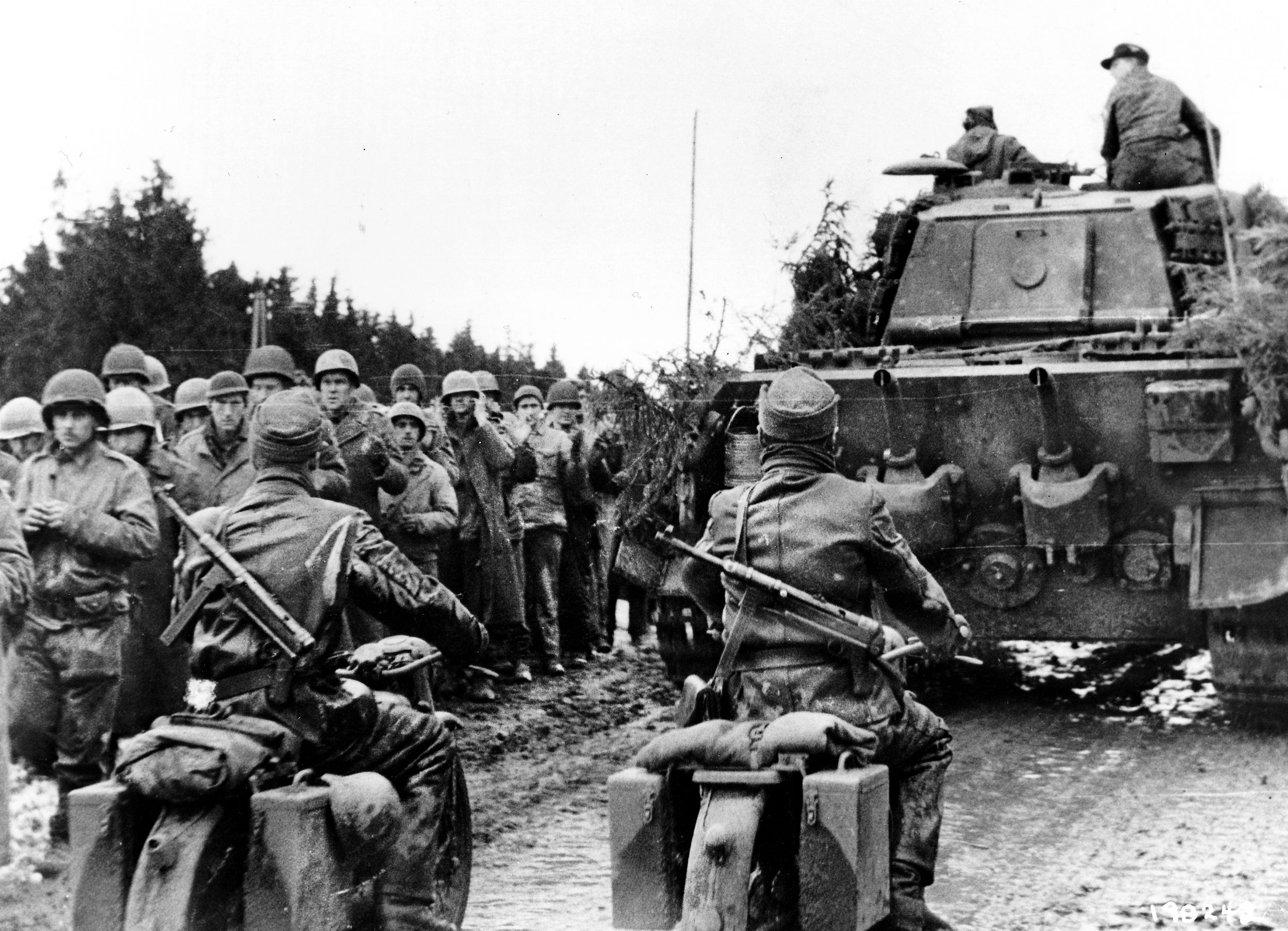
“The roads that day were packed with tanks, artillery, and other gear.… We were under the command of a German warrant officer who was riding in what looked like a Volkswagen. As soon as he could get by the equipment on the road, he would come speeding through our column blowing his horn. Then he would be stopped by more tanks and trucks.
“I was a very tired 20-year-old who finally was too stubborn to move out of his way. This upset him, so he got out of his vehicle, pulled out his pistol, and aimed it at my head. I heard a click. The German in the turret of a tank alongside the road had cocked his machine gun, aimed it at the warrant officer, and yelled something in German. The warrant officer put his pistol back in the holster and got back in his vehicle. This German tank commander who saved my life wore the silver skull [insignia] of the SS.”
At a December 19 meeting in Verdun with Bradley, Devers, and Patton, Eisenhower decreed, “The present situation is to be regarded as one of opportunity for us and not of disaster. There will be only cheerful faces at this conference table.”
Patton, as befitted his brash, aggressive nature, dared the Allies to “have the guts to let the sons of bitches go all the way to Paris. Then we’ll really cut ‘em off and chew ‘em up.”
Ike smiled and replied that the enemy would never be allowed to cross the Meuse. He was true to his word. After shattering the 99th and 106th divisions and roaring through St.-Vith, the German juggernaut rolled eastward, past Stavelot and Malmédy, around Bastogne, and toward the Meuse. It never got there, nor anywhere close to its ultimate objective of Antwerp. The salient that the attack had created now became a spearpoint that was broken into small, ineffective pieces by the hammer blows of the American First and Third Armies.
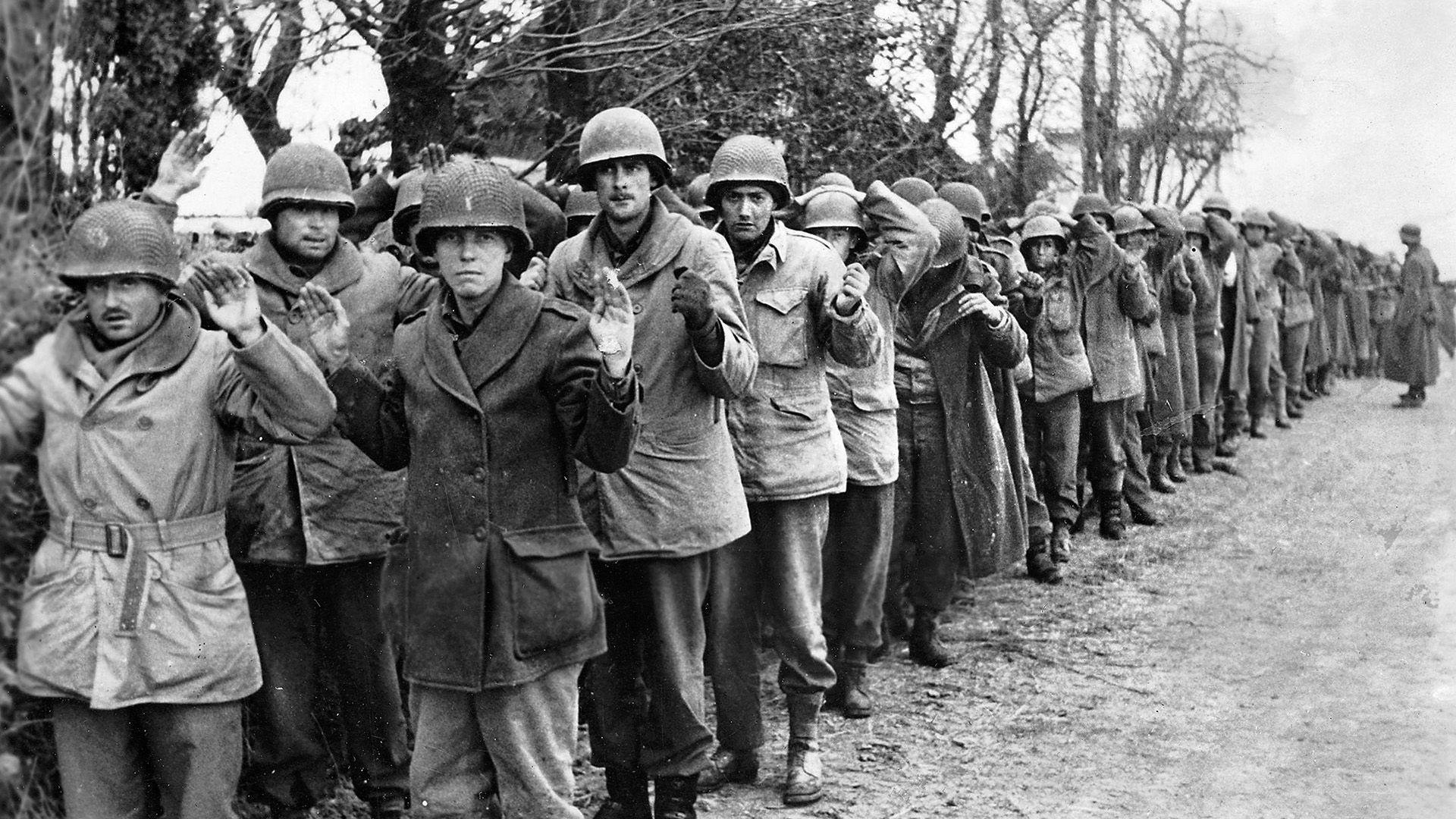
The outcome was little consolation to hundreds of men of the 106th Infantry Division who had been caught in the blast furnace of the violent German assault and lay dead, their corpses frozen in the snow, their blood turned to ice. The thousands who surrendered were marched eastward to the nearest railheads at Prüm and Gerolstein and packed in groups of 65 or 70 into boxcars, with no idea where they were going or what lay ahead.
A medic remembered that the latrine facilities inside the boxcars were “horrendous and appalling: two simple boxes placed somewhere in the middle of the car. It added to the chaos among the men when someone had to defecate. Urination was generally done against the walls or through the cracks in the floorboards. The air was putrid and fecal-smelling and made worse by being confined in a very tight space. The stench was unbelievable.… It led to loud arguments and fighting between the men as to when, where, and how to urinate or defecate.”
Although out of the battle zone, the POWs were not out of danger, as Allied aircraft attacked the trains daily. Once the Yanks arrived at their assigned camps, the nightmare was just beginning. Most of the soldiers were transported to Stalag IX-B at Bad Orb, near Frankfurt, where they were subjected to horrible living conditions, inadequate food and medical attention, and brutal treatment by their guards. Even worse, the Jewish-American soldiers were separated from their comrades at Stalag IX-B and taken farther east to work as slave laborers in tunnels at Berga-an-der-Elster, near Gera. It was a journey from which many would never return.
As Army historian Hugh Cole wrote on the destruction of the 106th Division, “The number of officers and men taken prisoner on the capitulation of the two regiments and their attached troops cannot be accurately ascertained. At least seven thousand were lost here and the figure is probably closer to eight or nine thousand. The amount lost in arms and equipment, of course, was very substantial. The Schnee Eifel battle, therefore, represents the most serious reverse suffered by American arms during the operations of 1944-45 in the European theater.”
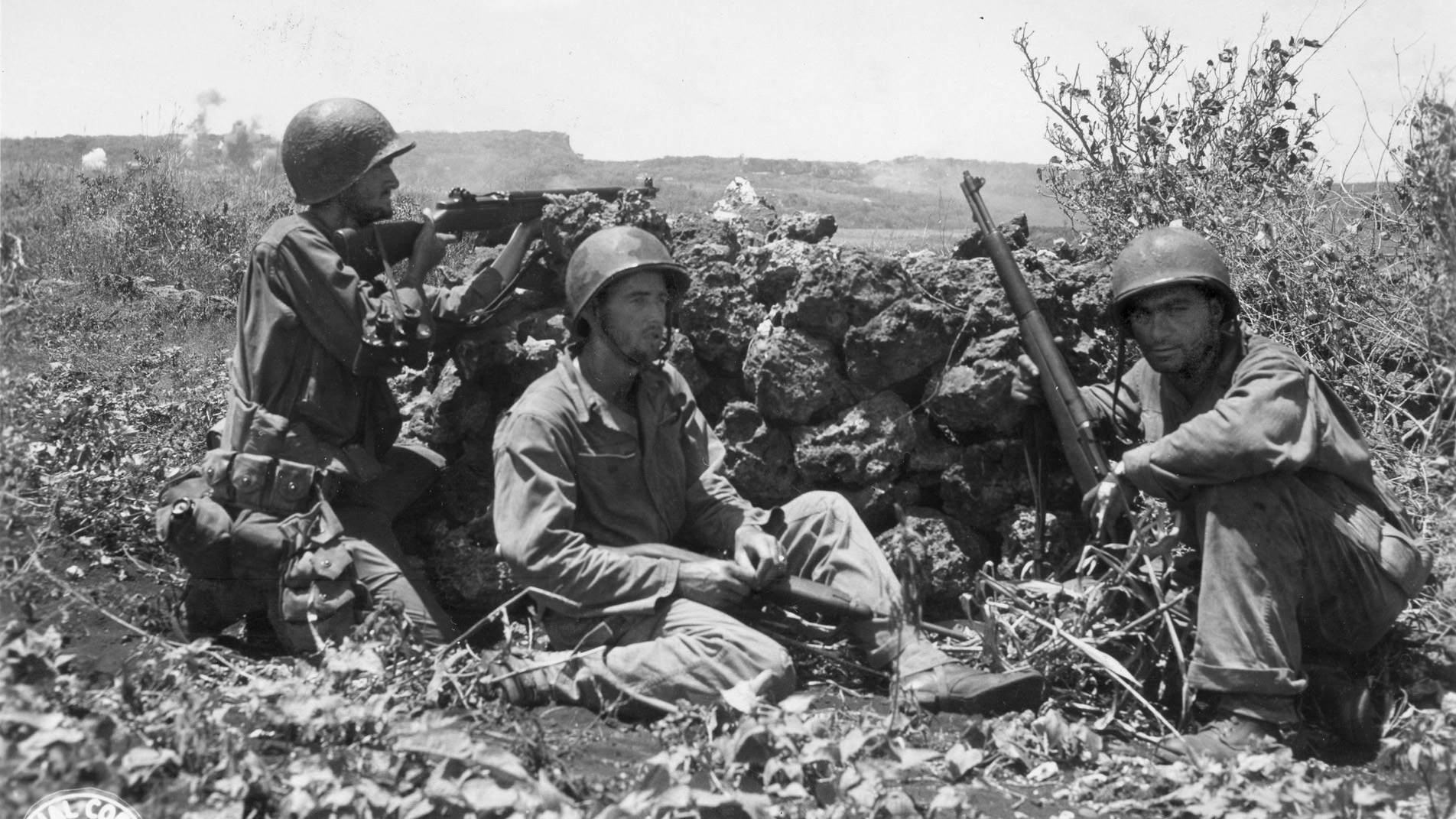
The 106th was a disaster waiting to happen.
The Germans had stopped using their Enigma machines, because they had telephone wires. The Allies were so used to knowing everything in advance they assumed nothing was up. One article on this website indicated Troy Middleton was worried and told Bradley so. He was told, “don’t worry they aren’t coming through here”. Middleton said, “well they have before”. The US Army at that time didn’t have enough infantry divisions to cover their front adequately. The ASTPers were part of the answer, but the poor guys never had a chance.