By John Wukovitz
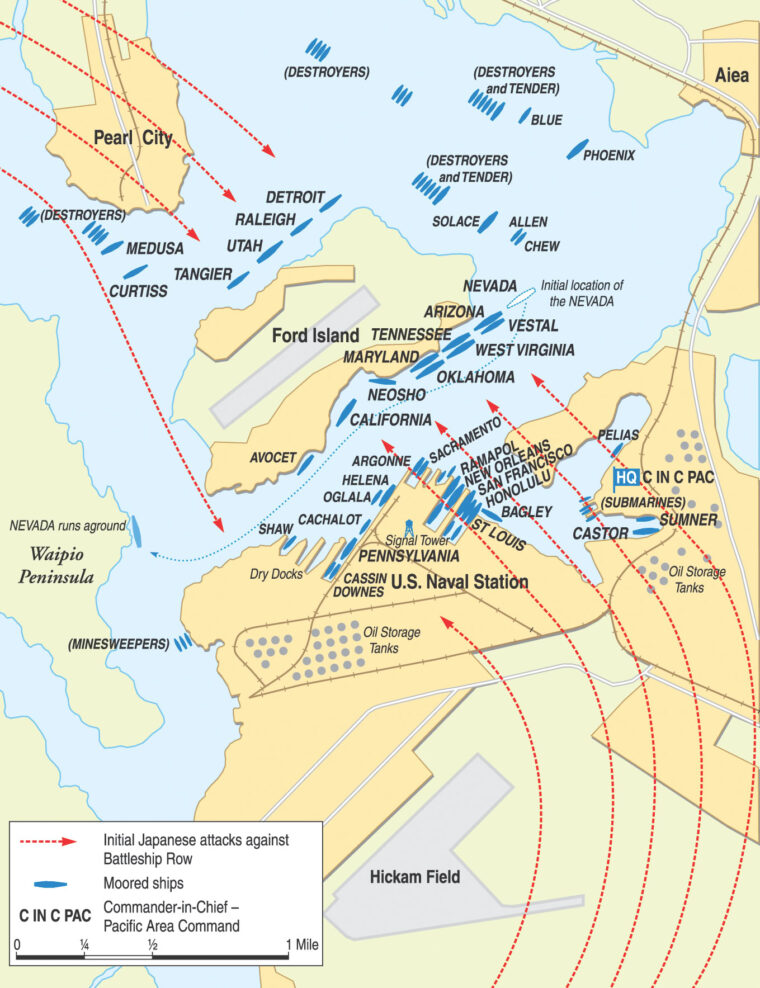
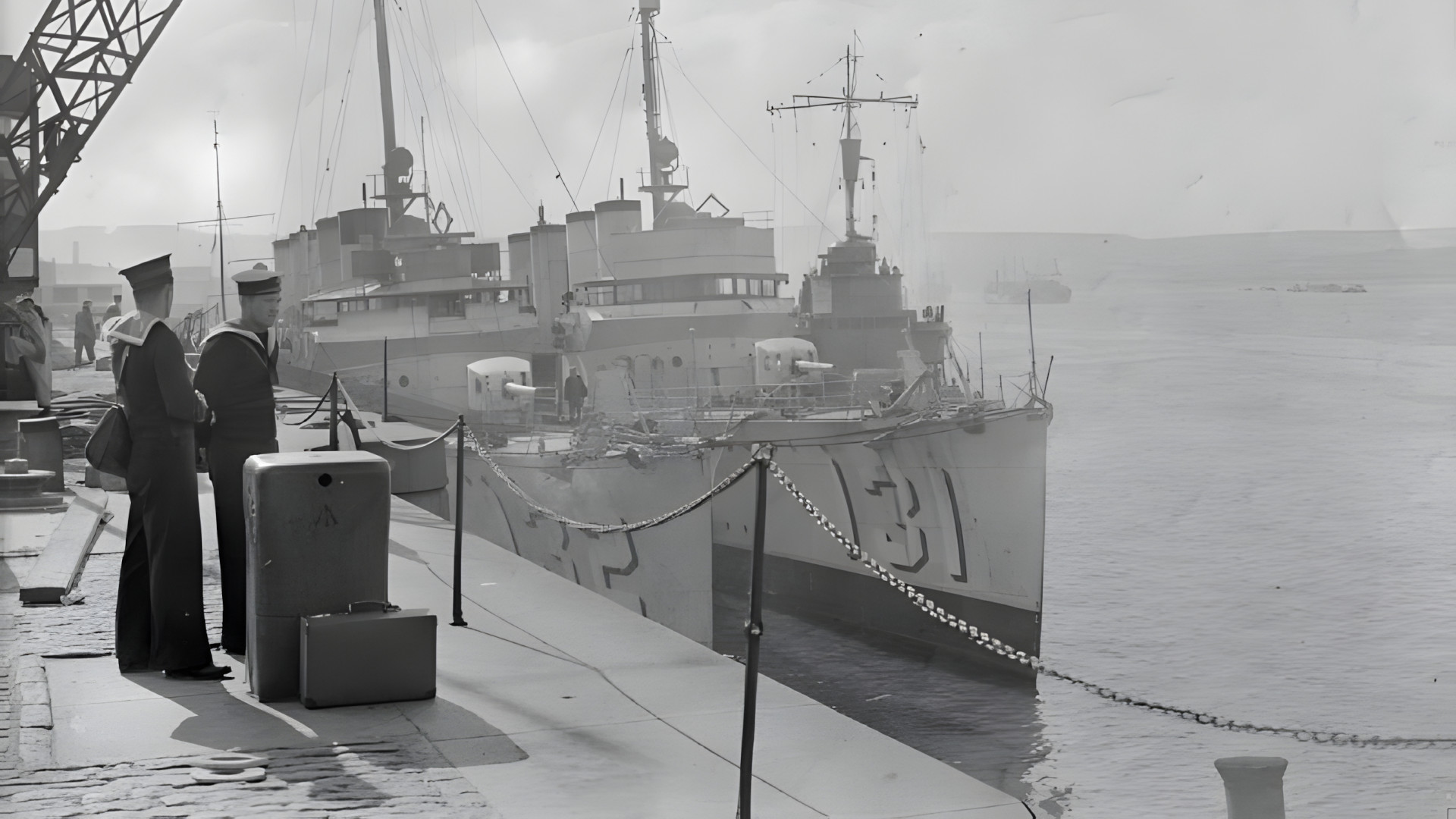
The seaplane tender USS Tangier floated at its moorings that peaceful day at Pearl Harbor. Little disrupted the serenity of the beautiful Sunday morning. An occasional bird flew above as a gentle breeze caressed the ship. Nearby, the battleship Utah and the light cruisers Raleigh and Detroit lined the shore in quiet splendor, while across the way, on the other side of Ford Island, the mighty vessels of Battleship Row rested in splendid majesty. It looked like December 7, 1941, would be another calm weekend in Pearl Harbor.
Lieutenant (j.g.) Richard L. Fruin had just gone out on the deck of the Tangier when he spotted a group of aircraft heading toward Ford Island. That was not unusual for Pearl Harbor, except these aircraft approached from the wrong direction. One week earlier, superiors had chastised a Navy pilot for flying in an unauthorized area, so Fruin assumed that some young aviator was in for a rough meeting with his commander when he landed. That thought was interrupted as the planes passed overhead—not American after all, their red circles clearly visible—dropped a string of bombs on Ford Island as Fruin rushed to his battle station.
The Tangier’s skipper, Commander Clifton A.F. Sprague, bolted from his quarters and dashed to the bridge where he shouted “Quarters! Quarters!” and “Goddamnit, hurry!”into the speaker system.
On the battleship Nevada on the eastern end of Ford Island, the ship’s band had just begun “The Star-Spangled Banner” when the planes swooped down. At first the band members thought it was a drill, but that changed as explosions and bullets filled the air. The band bravely played on through the attack’s opening moments to finish the tune, then raced for their battle stations.
Lieutenant Fruin and the band on the Nevada had just witnessed the opening moments of their nation’s active involvement in World War II. The Japanese, with whom the U.S. had been at political odds for years, mainly over supremacy in the Pacific, had unfurled a surprise aerial assault deep into the heart of American power in the Pacific—directly against its vast naval base at Pearl Harbor on the island of Oahu in Hawaii. Within a few hours, much of America’s military arsenal, and its first line of defense, rested on Pearl Harbor’s bottom. Soon smoke, fire, and death would engulf the ships and sailors and spin the United States into a war that President Roosevelt had been certain would one day occur. The “day of infamy” was about to begin.

Events early in the morning of December 7 indicated that something was brewing. At 6:40 a.m., the destroyer USS Ward spotted the conning tower of a midget submarine headed toward the harbor. The ship opened fire and sank the submarine. “Attacked, fired on, depth-bombed, and sunk, submarine operating in defensive sea area,” the destroyer’s commander radioed headquarters. Unfortunately, Adm. Husband E. Kimmel, the commander-in-chief of the Pacific Fleet, did not receive the news until after Japanese aircraft had already begun their attack.
Less than half an hour later, Private George Elliott picked up a huge flight of incoming aircraft on his radar station near Kahuku Point in northern Oahu. At first he thought his radar equipment was broken, as no flight was expected, but he soon realized it wasn’t. Elliott informed the Army information center of the large group of planes, but was told they were either aircraft flying in from returning American aircraft carriers or an expected group of B-17 bombers from California.
What Elliott saw was the first of two waves of Japanese aircraft to strike Pearl Harbor.
It was a group of 182 aircraft—level bombers, torpedo bombers, dive bombers, and fighters—that had lifted off the Japanese carriers and veered toward their target, led by Imperial Japanese Navy (IJN) Captain Mitsuo Fuchida.
“Just before dawn, all planes on the flight decks of our carriers began launching one by one,” recalled IJN Lt. Cmdr. Sadao Chigusa as he watched from the destroyer Akigumo. “All our crew waved to the planes as they were flying past our upper deck, giving them our prayers.” The aircraft were all assigned targets. Some were to attack the shipping inside Pearl Harbor with special focus on the battleships and aircraft carriers, while others veered toward U.S. airfields at Ewa, Hickam Field, Wheeler Field, and Kaneohe, all within miles of Pearl Harbor. Some 400 aircraft sat on those airfields, parked wingtip to wingtip in an effort to better safeguard them from sabotage.
The planes passed over Oahu’s northern tip, veering right to fly down the island’s west coast before entering their final approach runs to the harbor. The sight that unfolded amazed Fuchida. Instead of antiaircraft fire and intercepting American fighters, they were greeted by a peaceful calm. Ninety-four ships floated leisurely at their moorings, including seven immense battleships along Battleship Row. Lt. Cmdr. Shigeru Itaya, commander of the Japanese fighters, gazed in stunned surprise at the battleships that were “strung out and anchored two ships side by side in an orderly manner.”

“I had seen all German warships assembled in Kiel harbor,” Fuchida said. “I have also seen the French battleships in Brest. And finally, I have seen our own warships assembled for review before the Emperor, but I have never seen ships, even in the deepest peace, anchored at a distance less than 500 to 1,000 yards from each other.” The sight of the monstrous battleships berthed side by side was “hard to comprehend,” Fuchida added.
Not one sign of opposition arose. At 7:49 a.m., Fuchida sent the coded message to headquarters, “Tora, tora, tora,” which meant that complete surprise had been achieved, and ordered his aircraft to the attack.
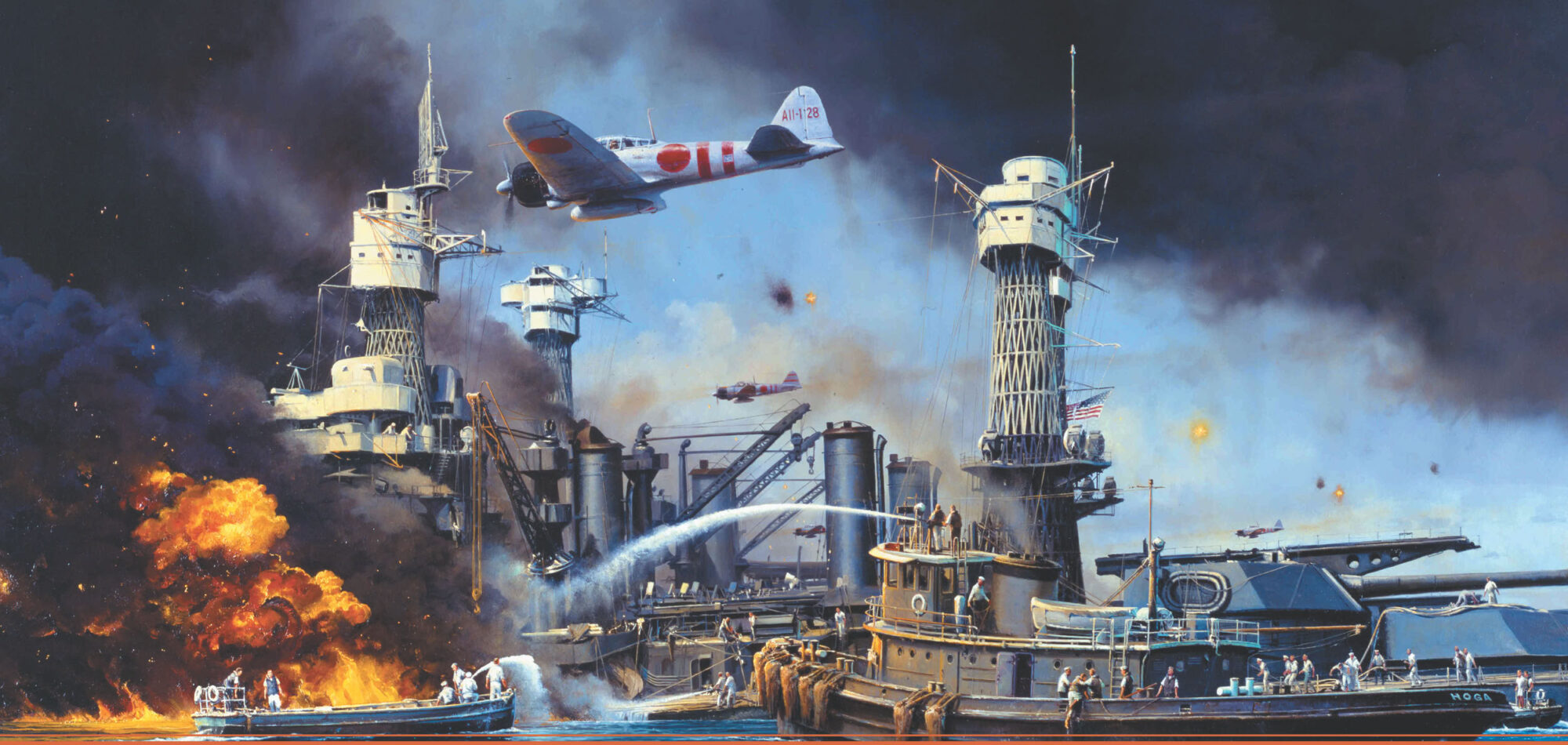
Fuchida’s torpedo planes peeled off, dropping low to skim the water’s surface, as they launched their torpedoes at the stationary ships dead ahead. Each was fitted with specially designed wooden fins to prevent them from plunging into the harbor’s mud and within moments the harbor was transformed into a blazing cauldron as every ship on Battleship Row absorbed hits.
Fuchida had to control his excitement, but the sight of “waterspouts rising alongside the battleships, followed by more and more waterspouts” almost overwhelmed the veteran officer. Here he was, over Oahu, staring at a dream scenario unfolding before his eyes.
At first, American military personnel doubted what they saw. It could only be a drill. Woody Derby was sitting in his bunk in the battleship Nevada when general quarters was sounded. “And you know the thoughts that went through people’s heads. What in the world is going on now? Why are they doing a drill on Sunday morning? And they said it in a different manner. They got a little hot-tempered.”

Hot-tempered could not begin to describe the emotions felt by Roy Vitousek, Jimmy Duncan, and Cornelia Fort. The three civilian pilots had been flying over Oahu when the Japanese aircraft suddenly appeared. They quickly turned their planes into steep dives and headed toward the ground as Japanese bullets filled the air about them. The three safely landed, bewildered over being the initial targets of Japan’s assault.

By then, only moments into the attack, the control tower at Ford Island Naval Air Station transmitted the message that electrified the world. “AIR RAID PEARL HARBOR. THIS IS NOT A DRILL.” Not only did the soldiers and sailors now know that war had arrived, but so did an entire nation.
Battleship Row was soon engulfed in fire and death. On the West Virginia, Ensign Roland Brooks, the officer of the deck, thought the explosions he heard came from an accident on a nearby ship. As a precaution, he ordered rescue parties to prepare to leave. This proved fortunate for his ship, as Brooks’s order sent crew members scurrying to stations before Japanese bombs and torpedoes struck. When six torpedoes ripped into the West Virginia’s port side at 8 a.m., causing an immediate list as tons of water gushed through the ship’s torn side, men were ready to counter the list and prevent the ship from capsizing.
Captain Mervyn S. Bennion ordered Lieutenant C.V. Ricketts below to organize the counter-flooding. Ricketts made his way through smoke-filled passageways, then supervised men as they opened the starboard seacocks and allowed water inside to counterbalance the water gushing in through the torpedo holes. The battleship slowly settled into the harbor’s mud.
The crew of the West Virginia tried to mount a response to the swarms of enemy aircraft. A torpedo explosion hurled Louis Lagesse against the bulkhead and knocked him unconscious. His crew mates nearby thought he was dead and moved him to the starboard side and stacked him up with the dead bodies.
On the battleship Arizona, Norman Lancaster battled back as Japanese aviators took aim with their torpedoes and bombs. “At first the planes would come in and dispose of their bombs and their torpedoes, and then they’d circle and come back and strafe us.” Shipmate Stuart Hedley dove under a gun to avoid the shrapnel and bullets and found a lieutenant already there, firing back with his .45 automatic pistol.
An enormous eruption rocked nearby ships and sent shock waves throughout the harbor as more bombs hit the Arizona. Above, even Fuchida felt the reverberations. “We were about to begin our second bombing run when there was a colossal explosion in Battleship Row. A huge column of dark red smoke rose to 3,300 feet,” recalled the Japanese commander. “The shock wave was felt even in my plane several miles away from the harbor.”

Across the harbor, Mechanic First Class Francis T. Bean witnessed the hit that demolished the Arizona. He watched as “a spurt of flame came out of the guns in No. 2 turret, followed by an explosion of the forward magazines. The foremast leaned forward, and the whole forward part of the ship was enveloped in flame and smoke and continued to burn fiercely.” More than 1,100 men perished in the explosions aboard the Arizona, and the battleship’s sunken hulk rests on the bottom of Pearl Harbor to this day, a memorial to the tremendous loss of life sustained aboard the ship on December 7, 1941.
Aboard the Oklahoma, James Bounds reeled in disbelief at the sight of his ship being hit and others rapidly sinking. “The only thing they taught me going through training was that you could not sink a battleship.” However, three torpedoes slammed into the Oklahoma’s side almost simultaneously, fatally wounding the giant.
Commander Jesse L. Kenworthy, Jr., rushed about the stricken ship, gathering men in an attempt to mount a response to the Japanese. “As I reached the upper deck, I felt a very heavy shock and heard a loud explosion and the ship immediately began to list to port. Oil and water descended on the deck and by the time I had reached the boat deck, the shock of two more explosions on the port side was felt. As I attempted to get to the conning tower over decks slippery with oil and water, I felt the shock of another very heavy explosion on the port side.”
His efforts, however gallant, could not stop the inexorable stream of water from gushing inside. The ship quickly rolled over and trapped 400 men in the holds.
Sailors aboard other vessels or on land stared at the Oklahoma as she turned over and settled to the bottom. The image of the once-mighty battleship, now lying helplessly mangled in the mud, hit with a ferocious impact. “I felt like somebody kicked me in the stomach,” said Ivan Harris. “You don’t kill a battleship. They’re impregnable, tough. But there was one over on its side.”
What Harris could not see was the agony unfolding inside the Oklahoma. Members of the crew, some hopelessly wounded and dying, battled the waters to avoid drowning. Many stuffed clothes and blankets into the ship’s venting system to halt the water’s flow. The struggle seemed hopeless, however, for as soon as they plugged one leak, another gushed open. As the waters rose, the men began to frantically beat on the bulkheads in hopes of drawing help.

Other ships endured similar agonies. The California, the final battleship to be hit, took two torpedoes into her side directly below the bridge. Counter-flooding prevented her from capsizing, but the vessel, like the West Virginia, settled to the harbor’s bottom. The Maryland and the Tennessee survived their hits, but took months to repair before rejoining the fleet. The Nevada got underway and started steaming down the harbor in an attempt to reach the open sea.
“Torpedo planes swooped in from almost over my head and started toward Battleship Row,” recalled Chief Petty Officer Leonard J. Fox of the scene that unfolded as he watched from the light cruiser Helena. “First the Oklahoma … then it was the West Virginia taking blows in her innards…. Now, as I looked on unbelievingly, the California erupted … and now it is the Arizona…. Men were swimming for their lives in the fire-covered waters of Pearl Harbor.”
In the vast confusion, one ship reacted with amazing alacrity and efficiency. Commander Sprague had been a stickler for preparing his men for combat, and when war arrived they responded gallantly. The Tangier’s crew was at battle stations in moments, and the gunners returned fire on the Japanese before any other ship did that morning. “Everyone knew his job and went where he was supposed to,” stated one sailor.
While Sprague’s gun crews filled the sky with antiaircraft fire, three Japanese torpedo planes approached from the north and released their torpedoes at the Utah, moored directly behind the Tangier. Two torpedoes smashed into the aging battleship and created such a ferocious explosion that ladles and other hanging equipment in the Tangier’s galley snapped through the air and cooks were knocked off balance. The badly hammered Utah sank in just eight minutes. Although other Japanese aircraft completed runs against the Raleigh and Detroit, sinking the Raleigh by the stern, the Tangier escaped notice in this initial flurry.
Luck and Sprague’s repeated prewar drills shielded the crew of the Tangier, but the men received sustenance from another source—their commander. He gave few orders, but instead trusted his men to do what they had to do. He quietly watched from the bridge as they executed their duties, confident they would draw inspiration by his absolute faith in their abilities. “Sprague was always cool,” said ship’s radio operator Leonard Barnes. “At Pearl Harbor, he acted like he’d thought everything out. Sprague knew just what to do, like he was born to command during a crisis.”
Sprague remained on the open bridge of his ship rather than seeking the safety of his protected bridge one deck below because he wanted the crew to see that he shared the same dangers as they did. His crew faced death for the first time, and he wanted to remain in plain sight to lend moral support at a time when it was most needed. “All those men on the main deck and above it, at one time or another as they fought,” Ensign John J. Hughes said, “could see Sprague calmly standing there throughout the battle. That impressed us officers and encouraged the men.”

Other components of Fuchida’s first wave struck nearby airfields and storage facilities. Two groups of Japanese dive bombers destroyed three squadrons of flying boats at Kaneohe Bay; the Army lost almost all of its aircraft stored at Hickam Field and other airstrips; only two of the 12 Wildcat fighters stationed at the Marine Corps base at Ewa survived. As these attacks occurred, Japanese fighters demolished barracks and hangars. The American aircraft, aligned wingtip to wingtip, were systematically destroyed by the Japanese. At Ford Island Naval Air Station, only one American aircraft managed to lift off the runway.
This left precious little area in which 12 Boeing B-17 bombers, the ones due in from the mainland that trackers confused for the Japanese, could land. The hearty pilots braved fire from both the Japanese fighters that buzzed by and from nervous American antiaircraft gunners and riflemen on the ground. Despite the hazards, all 12 somehow landed at crater-filled Hickam Field.
In Washington, D.C., initial disbelief turned to anger. When first informed of the attack, Secretary of the Navy Frank Knox said incredulously, “My God! This can’t be true. This must mean the Philippines.” With confirmation arriving and additional reports of damage, however, Knox and Roosevelt turned to the business at hand. Roosevelt ordered his secretary of state, Cordell Hull, to go ahead and see the two visiting Japanese diplomats that had been scheduled to meet with him, but to say nothing of the events at Pearl Harbor.
When Ambassador Kichisaburo Nomura and Envoy Saburo Kurusu walked into Hull’s office, they quickly noticed an icy atmosphere. Hull hardly took the courtesy to look at his guests, pretended to read the message they handed to him (codebreakers had already delivered to him the message’s contents), then said with barely controlled anger, “In all my 50 years of public service, I have never seen such a document that was more crowded with infamous falsehoods and distortions.” Hull quickly dismissed the perplexed diplomats.
Less than one hour after the first wave smashed Pearl Harbor, Yamamoto’s second wave of 80 dive bombers, 54 level bombers, and 36 fighters swooped down to complete the devastation started by the first wave. By now American sailors and soldiers had manned their guns, but few American aircraft were able to join the fray. Most had been destroyed by the first Japanese wave. In some places, sailors grabbed World War I vintage rifles, strung bandoliers of ammunition across their shoulders, and headed out to battle the Japanese. “All ships in the harbor are setting up a terrific antiaircraft barrage,” scribbled Radioman 1st Class R.A. West in notes taken at his station on the bridge of the Tangier. American gunners managed to shoot down six fighters and 14 dive bombers.
The second wave targeted the ships missed in the first assault. A bomb hit the battleship Pennsylvania in drydock, while others demolished the destroyers Cassin and Downes and sliced the bow off the destroyer Shaw. Aboard the Nevada, officers and crew hurriedly prepared to move away from the ship’s berth near the blazing Arizona and down the channel to elude the bombs and torpedoes. Sailors draped their bodies over exposed shells and powder to shield it from the waves of heat that glowed from the Arizona. As they inched carefully down the channel, Japanese pilots took aim and smashed the Nevada with multiple bomb hits and numerous near misses. To prevent the damaged ship from sinking and blocking the harbor entrance, the captain veered the Nevada toward Hospital Point and beached the ship away from the entrance.

Trapped inside the Oklahoma, desperate men continued to beat on the bulkheads as workmen furiously cut through metal to reach them before the air supply expired. “We got to the point where you could hear each other breathing,” said James Bounds. “You didn’t want to talk any more than you had to because that air was getting low. It’s like being in a big, black, damp, dark hole—I guess like somebody in a coffin.”
As the air supply ebbed, the men started to lose hope. Finally, after 36 hours, rescue workers cut through to the bulkhead and pulled Bounds and the other men from their watery tomb. Only 30 of the 400 men were rescued from Oklahoma’s bowels.
Louis Lagesse, who had earlier been placed with the dead, experienced a resurrection. When a man picked him up to carry what he assumed was a dead sailor to a boat for transfer to a burial ceremony, the man noticed one of Lagesse’s eyelashes move slightly. Instead of the burial service, the man transported Lagesse to a hospital ship and treatment.
In rapid succession, five dive bombers took aim at Clifton Sprague’s Tangier. Geysers erupted off the ship’s bow and bomb fragments shattered windows on the protected bridge, but not one bomb touched the seaplane tender. Some of the enemy pilots failed to press their attack vigorously enough and dropped their bombs too early, while Sprague’s gunners blunted the assault by putting up a dense shield of fire that caused Japanese aviators to swerve away. Sprague later claimed that the Japanese pilots, “and some came damn close,” failed to remain long enough on their diving approach because “the volume of our fire was so great they couldn’t complete their dive.”
As the second wave departed, Fuchida circled above and surveyed the damage. He was stunned at the amount of destruction his fliers had inflicted on the enemy. “I counted four battleships definitely sunk and three severely damaged, and extensive damage had also been inflicted upon other types of ships. The seaplane base at Ford Island was all in flames, as were the airfields, especially Wheeler Field.”
In the two waves, the Japanese destroyed 188 aircraft and damaged 159. They sank or damaged 18 ships, including eight battleships, and they killed 2,403 American sailors and soldiers and wounded 1,178. This was accomplished at the cost of 29 Japanese aircraft and pilots lost, as well as one large and five midget submarines destroyed. Hawaii’s defenses were so wide open that one soldier claimed the Japanese could have stormed the islands in canoes.
Smoke billowed 300 feet skyward from the burning Battleship Row as eruptions continued to break the stillness. The bodies of dead and dying sailors floated all around while men in small craft scoured the harbor, stopping to pull sailors from the water. One injured sailor begged his rescuers not to touch him, as the skin hung in ribbons from his arms, but the men defied his wishes in order to save him.
Fortunately for the United States, the Japanese missed some precious commodities. When Fuchida landed, he strongly urged that another strike hit the undamaged American oil and repair facilities, but Admiral Nagumo would have none of it. He believed that the missing American aircraft carriers lurked in the vicinity, and he was not about to tempt fate by lingering too long within range of enemy land-based aircraft. He ordered the force to head back to Japan.
Had Nagumo listened to Fuchida, he could possibly have delivered such a damaging blow that the United States might have needed months to recover. Without fuel or the ability to repair ships, the United States most likely would have pulled its Pacific fleet back to home waters. Caution overruled Fuchida, but a little more daring on Nagumo’s part would have all but completed the job his two waves had started.
Yamamoto had hoped to catch the valuable American aircraft carriers at anchor, but all three had been out on missions. The Saratoga steamed off California, while the Lexington and Enterprise delivered aircraft to Wake Island and Midway. Had the Japanese destroyed even two of these three, they would have solidified their hold in the Pacific to such an extent that Roosevelt might have seriously considered negotiating a truce.
One Allied leader who found optimism in the attack was British Prime Minister Winston Churchill. When he first learned of the assault, like many others, he reacted with stunned surprise. “Mr. President, what’s all this about Japan?” he asked in his first call to the American leader. Roosevelt confirmed that the fighting had begun. “They have attacked Pearl Harbor,” he told Churchill. “We are all in the same boat now.”
Churchill detested the destruction and death wrought by the Japanese, but now, at least, he had the most powerful nation in the world actively on his side. For two years he had battled, at times alone, the mighty legions of Adolf Hitler, but now he could count on America’s people and factories to help him finish the task.

At 8:40 p.m., in Washington, D.C., Cabinet members entered Roosevelt’s study to be briefed about the day’s events. Most had been out of town on business and had been quickly called back to Washington by White House operators, so they knew little of the details. When Labor Secretary Frances Perkins arrived, she noticed that the president’s typical warm greeting had been replaced with a perfunctory hello.
Roosevelt started by labeling the meeting the most serious Cabinet session since Abraham Lincoln assembled his advisers in the dark early days of the Civil War. In a subdued voice Roosevelt explained that the nation had absorbed serious losses and that the Navy had suffered the worst defeat in its history.
“His pride in the Navy was so terrific,” Perkins wrote later, “that he was having actual physical difficulty in getting out the words that put him on record as knowing that the Navy was caught unawares, that bombs dropped on ships that were not in fighting shape and not prepared to move, but were just tied up. I remember that he said twice to [Secretary of the Navy Frank] Knox, ‘Find out, for God’s sake, why those ships were tied up in rows.’”
Perkins later added, “It was obvious to me that Roosevelt was having a dreadful time just accepting the idea that the Navy could be caught unawares.”
People in all corners of the nation wondered what had happened as the day unfolded. Their faith in the ability of their military to keep them out of harm’s way had been badly shaken, so much so that one of the most respected publications in the country, Time magazine, bluntly wrote that “The U.S. Navy was caught with its pants down. Within one tragic hour—before the war had really begun—the U.S. appeared to have suffered greater naval losses than in the whole of World War I.” A nationally syndicated journalist wrote that people believed the United States would not hit the Japanese because they could not hit back.
Fear and uncertainty created fertile ground for rumors that made an already nervous citizenry more susceptible to panic. Reports circulated that a group of Japanese aircraft had flown over San Jose, California. In Hawaii, residents made plans to leave for the mainland because they feared that an inevitable Japanese invasion could not be repelled by the weakened military. Politicians urged the president to consider the West Coast indefensible and to pull back the military to fortified positions in the Rocky Mountains. Roosevelt’s son, Elliott, even called him from Texas to explain that he had heard the Japanese were about to launch an attack from Mexico against Texas or California.

As night fell on Washington, D.C., on December 7, groups of citizens collected outside the White House fence. A hushed crowd silently stared at the presidential mansion, then started singing, “God Bless America.”
After his Cabinet and congressional leaders departed, Roosevelt kept an appointment with renowned newsman Edward R. Murrow, whose radio broadcasts from London had moved the world. The two shared beer and sandwiches while the president discussed the last 24 hours. Finally, he erupted in an angry tone that American aircraft had been destroyed “on the ground, by God, on the ground!”
Roosevelt quickly set aside his anguish. He knew that, as the nation’s leader, he could not ask his people for optimism and calm in dire circumstances if he did not exude those same qualities. Roosevelt’s vigorous leadership abilities shone the next day when he traveled to Capitol Hill and asked Congress for a declaration of war. Congress overwhelmingly passed the resolution.
Eight congressional and military boards concluded that Pacific Fleet Commander Admiral Husband E. Kimmel and Army commandant Lt. Gen. Walter C. Short had been negligent in their duties. The two were quickly relieved of their posts.
Yamamoto had not counted on the impact of the surprise attack on the American people. Debate between isolationists and interventionists disappeared, and men and women rallied to the cry, “Remember Pearl Harbor.” The smoldering wreckage at Pearl Harbor united the nation in a way that could not have been achieved in any other manner.
The United States faced an almost insurmountable task, though. Japan had removed the only instrument that could have stopped her aggression, the United States Navy, and she prepared to deliver more knockout blows to Allied forces throughout the Pacific. The remaining question was whether the United States could hold on long enough for her military and industrial machines to start producing the weapons of war in massive numbers.
In the weeks following Pearl Harbor, the Japanese won a string of military victories. However, Yamamoto’s initial prediction was proven accurate. Almost six months to the day after the attack, the U.S. Navy decisively defeated the Japanese at the Battle of Midway and changed the course of the Pacific War.
Join The Conversation
Comments
View All Comments