By Kevin Seabrooke
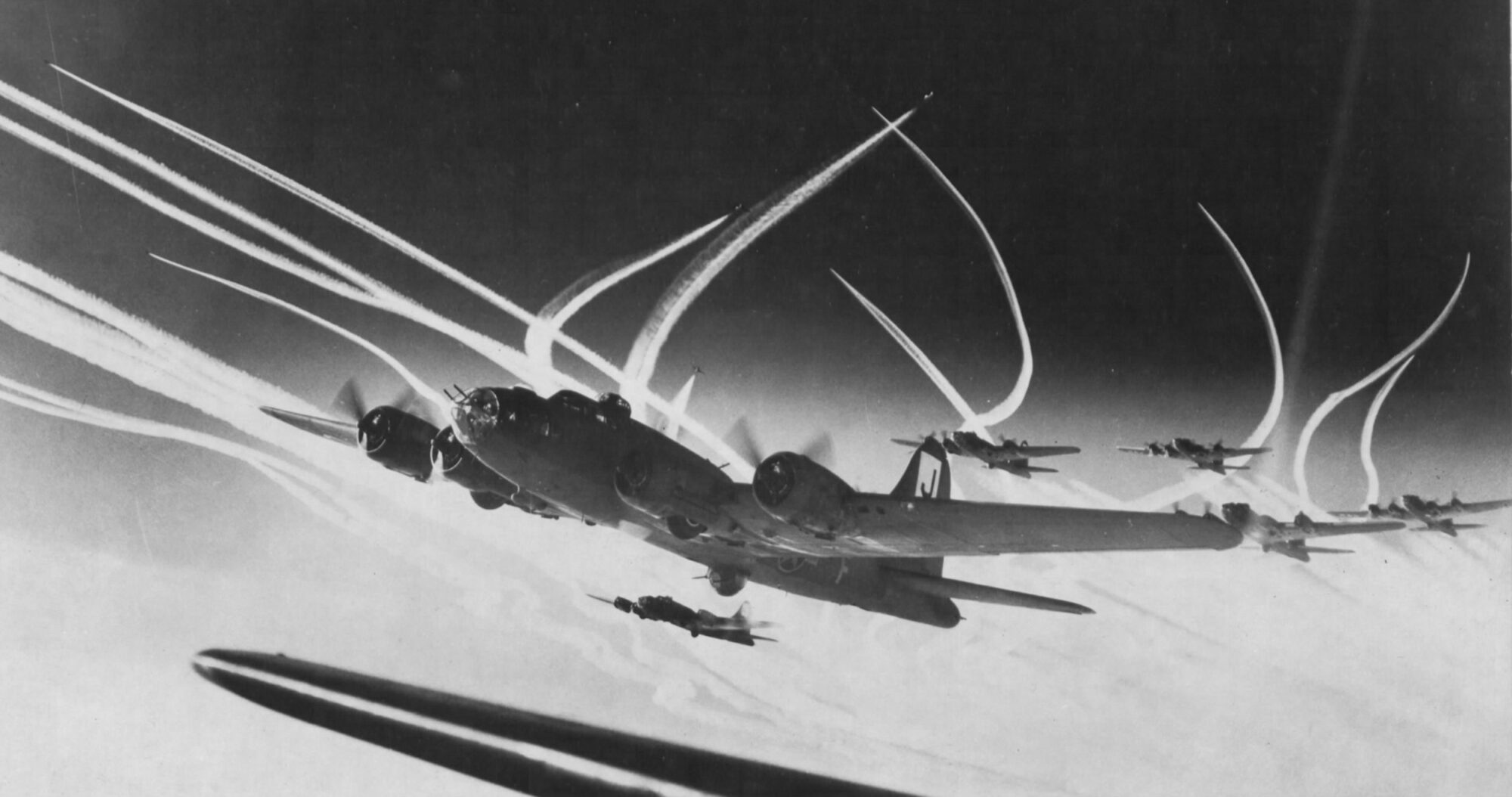
The story of the Luftwaffe’s Reichsverteidigung (Defence of the Reich) is the story of the U.S. Army Air Force (USAAF)—the Mighty Eighth based in England and the 15th Air Force, which included the Tuskegee Airmen, based in Tunisia and Italy.
Early in the war, some Luftwaffe pilots were intimidated by the huge formations of Viermot (four engine)—the Boeing B-17 Flying Fortress and the Consolidated B-24 Liberator. Given no tactical instruction on how to approach, pilots at first had to work out their own method of attack. Some of the more experienced pilots had success with head-on approaches, where there was little protection for the B-17. But this was dangerous and required skill.
Luftwaffe pilot Hans Philipp described the experience as curving in “towards 40 Fortresses and all your past sins flash before your eyes.”
Later, pilots were ordered to attack formations from the rear, giving less experienced pilots more time to line up their targets, though many described this experience as “trying to make love to a porcupine that is on fire.” By this time, anyway, the U.S. had introduced chin turrets on the B-17 to counter frontal attacks.
Promoted by Hitler in 1940 to the ceremonial rank of Reichsmarschall des Grossdeutschen Reiches ( Reich Marshal of the Greater German Reich), Hermann Göring was also the Oberbefehlshaber der Luftwaffe (Supreme Commander of the Air Force). His mercurial temper and failure to recognize realities contributed to Germany’s failure in the Battle of Britain and the Luftwaffe’s inability to protect the Reich from Allied bombing, which in turn led to his falling out of Hitler’s favor.
Hitler and the German high command had a poor opinion of the USAAF in 1942, largely influenced by Göring, who reportedly said that the B-17 was of “miserable fighting quality,” and the only thing that Americans could build properly were “refrigerators.” This despite detailed reports from their military attaché in Washington warning that the U.S. was gearing up to build thousands of quality aircraft.
 As the number of American bombers in the skies over Germany grew from the hundreds in 1943 to the thousands in 1944, some in the high command of the Luftwaffe could see—if not the handwriting on the wall, at least the fact that something would soon be written there.
Forsyth writes that as early as July 1943, Adolf Galland, promoted General der Jagdflieger in command of Germany’s fighter force, advocated that “only by carefully conserving strength and by efficient management of its most precious resources, namely its pilots, could the Luftwaffe hop to cause any damage to the bombers.”
Göring dismissed this idea and “demanded that all available units be thrown against every raid wherever and whenever possible.”
After another American attack in October 1943, Oberleutnant Rudolf Engleder recalls Göring flying into a rage during a meeting shouting, “How is it possible that American bombers can fly over the city in almost parade ground fashion? And further, German fighters were seen at altitude, not attacking!”
Göring then issued orders that there did not exist any “meteorological conditions which will prevent fighters from taking off and engaging in combat,” that any pilot landing “a machine not showing any sign of combat, or without having recorded a victory, will be prosecuted by a court-martial,” and that any pilot running out of ammunition “should ram the enemy bomber.”
Indeed, such a squad would be developed—Sonderkommando Elbe (special command Elbe), whose sole mission took place on April 7, 1945, when 180 Bf 109s downed eight Allied bombers by ramming them in flight. Pilots were expected to escape the plane just before, or after, impact.
Defenders of the Reich: The Luftwaffe’s War against America’s Bombers (Robert Forsyth, Osprey Publishing, New York, NY, 480 pp., glossary, maps, 16-pages b&w photos, Nov. 4, 2025 $40 HC), is a fascinating look at the Allied achievement from the other side—the failures and the fears, the relentless destruction, the egos and the politics, fighting the industrial superiority of the Allies as well as their own sense that they could not ultimately win—whether they could admit it to themselves or not.
Not unlike Union General Ulysses Grant during the Overland Campaign in the Civil War, the Allied bombing campaign of Germany, while still suffering great loss of life and materiel, was ultimately assured of winning a war of attrition.
A noted Luftwaffe historian, Forsyth makes use of both German and Allied archives, as well as interviews with former Jagdwaffe pilots to fill in the other side of the incredible campaign by the Eighth and Fifteenth army air forces to cripple the will and ability of the Third Reich to wage war—and to destroy the Luftwaffe in time to eliminate it as a threat to Operation Overlord in June of 1944.
Join The Conversation
Comments
View All Comments