
By Edward F. Murphy
The terse announcement stunned the tightly packed group of young Marines aboard a troop ship in New York Harbor, November 12, 1918. They looked back and forth at one another, asking the same questions, “What did the gunny say? We are not going to France. The war is over? Did we hear that right?” Then a stern “At ease!” from the gunnery sergeant brought them back to attention. “I repeat,” he said brusquely, “the war in France is over. We will not be sailing for France. Gather up your gear. Everyone will be disembarking shortly. You will be returned to camp for further assignment. That is all. Dismissed.”
Private George B. Turner looked around at the stunned faces of his buddies. All that training. All that effort. All for nothing. It did not seem possible. They had specifically enlisted in the Marine Corps to join the fight “Over There,” in France. They desperately wanted to fight the brutal Huns. They had been training arduously for weeks so they would be prepared for battle. Nineteen-year-old Turner felt cheated. All he wanted to do was fight for his country. He quit Wentworth Military Academy in Lexington, Missouri, four months earlier to enlist in the Marines for the sole purpose of joining the fighting in France. Now he would not be sailing across the Atlantic Ocean. He would not be battling the Hun. Turner could barely conceal his disappointment. What would he do now?
George Benton Turner, born June 27, 1899, in Longview, Texas, grew up in the greater Dallas-Ft. Worth area where his father, Gaines B. Turner, an attorney and two-time state representative, owned a prominent real estate development firm. In 1928 George moved to Los Angeles, California, where he worked as a legal secretary and, later, in the wholesale grocery business.
Although little is known about Turner’s life in pre-World War II Los Angeles, he never lost his patriotic yearning to fight for his country. Denied that opportunity in 1918, Turner viewed the gathering war clouds in the late 1930s as an opportunity to satisfy his long-held wish. He tried several times to reenlist in the Marine Corps, but at 41, his age worked against him. Undeterred, Turner went north to join the fighting as a member of the Canadian Army, but found rejection there as well.
Finally, after the December 7, 1941, Japanese attack on Pearl Harbor, Turner’s goal of fighting for his country was finally realized. He was drafted on October 23, 1942, at the ripe old age of 43.
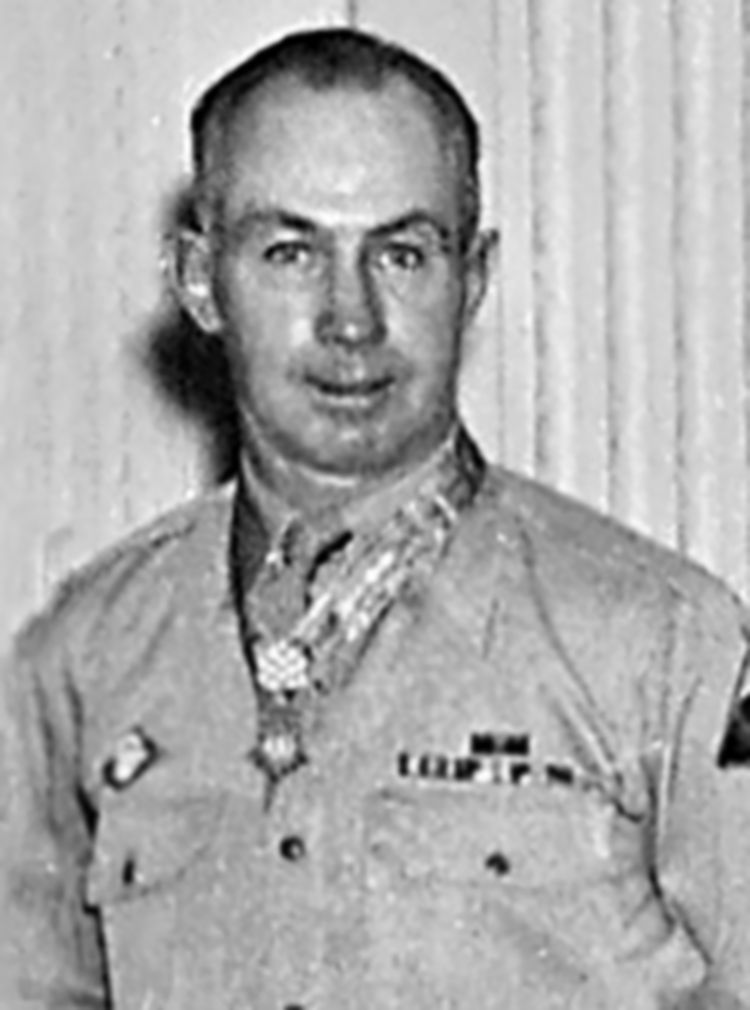
Private Turner joined the fledgling 14th Armored Division’s 499th Armored Field Artillery Battalion at Fort Chafee, Arkansas. His platoon leader, Lt. Curtiss R. Thomas, recalled when Turner arrived.
“Turner was clearly the oldest man in the outfit,” Thomas said, “but he immediately asked, ‘What section will see the most combat action?’ I told him the forward observers. ‘That’s where I want to be,’ Turner announced.” Thomas granted his wish.
Because of his age, education, and work experience, Turner frequently received lectures from his superiors on why he should go to officer candidate school and take a commission. But Turner always declined. He knew an officer’s commission would remove him from the front lines and he remained determined to fight for his country.
After two years of intense training, the 14th Armored Division headed overseas, arriving in Marseilles, France, in October 1944. Two weeks later, the fledgling tankers entered the front lines in the Vosges Mountains in eastern France as part of the Seventh Army. As the division fought its way north and east, Turner found plenty of opportunities to experience combat.
“He always wanted to know where the action was,” remembered his battery commander Lt. Col. Clarence F. Graebner. “He even volunteered to accompany infantry patrols.” In November 1944, just days after entering the combat zone, Turner spent two hours in a church steeple directing his battery’s fire, all while under enemy artillery fire. That display of courage earned him a Bronze Star.
At year’s end, Turner, and the rest of the 14th Armored Division, manned defensive positions east of Bitche, France, just south of the east-west running French and German border. Turner’s Battery C took up positions in the heavily forested hills around the picturesque village of Philippsbourg, France, an important road junction town that also sat astride the area’s main railroad line. It was a relatively quiet area, a welcome respite from the weeks of intense combat they had just experienced. Unfortunately, that respite did not last long.
After the failure of Adolf Hitler’s desperate offensive launched in December 1944 through the Ardennes Forest, the Battle of the Bulge, the Führer ordered another attack farther south. He hoped to not only lure American troops out of Belgium, but also to capture the Alsatian city of Strasbourg, a move that would allow the German troops there to link up with the German forces holding out to the south in Colmar, just west of the Rhine River. The Germans launched Operation Nordwind (North Wind), the Wehrmacht’s last offensive operation in World War II, just before midnight, December 31, 1944.
The sudden attack stunned the defending American forces. Although some more experienced units fought off the Germans, many American divisions were new to combat. One of those rookie units was the 70th Infantry Division, advanced units of which had just arrived in Marseilles on December 15, 1944. The division’s lead elements from the 275th Infantry Regiment had only set up their defensive positions around Philippsbourg to support Battery C on December 28, 1944.

By late morning of January 3, 1945, attacking German units closed on Philippsbourg. With enemy artillery raining down on their positions, the 499th’s armored artillery vehicles received orders to withdraw. But Pfc. Turner ignored the order. He decided to stay put. He was not about to miss another opportunity to fight the Germans at close range. Somehow, in the confusing rearward movement, no one noticed Turner remained in Philippsbourg.
As German armor and infantry entered the town from the north around 1400, Turner spotted members of the 275th’s Company C preparing to pull back. The intrepid forward observer dodged enemy fire to join them. He asked for volunteers to help him fight off the advancing Germans. No one stepped forward. Undaunted, Turner picked up an abandoned rifle and began firing at the Germans. A few minutes later, Company C Browning Automatic Rifleman PFC Donald Docken heard two German Mark IV tanks rumbling down Philippsbourg’s main street. Close behind them tramped some 75 infantrymen. Docken witnessed Turner pull a bazooka from an abandoned half-track and, completely alone, calmly advance to the middle of the narrow cobblestone street. Oblivious to the hot lead zinging past him and ricocheting off nearby buildings and the cobblestones, Turner calmly loaded a rocket into the weapon, aimed, fired, and scored a direct hit on the lead tank. Though that effectively blocked the second tank’s advance, Turner was not satisfied. He reloaded the bazooka, fired again, and knocked a track off the second Mark IV, immobilizing it, too. Docken later said that Turner’s “strategically placed shells stopped the German armor….and drove the infantry back.”
From his nearby command post Second Lieutenant Joseph K. Donahue, a Company C platoon leader, saw Turner next pull a .50-caliber machine gun and several belts of ammunition from the half-track. Donahue watched in awe as Turner fearlessly, “… returned to the scene of his first engagement, went into position in the middle of the street, completely void of cover or concealment, and poured deadly accurate fire into the supporting infantrymen…” The remaining German infantrymen scurried for cover.

Later that afternoon, Company C’s reorganized riflemen launched a local counterattack. Still determined to fight the Germans, Turner eagerly joined them. When two supporting Sherman tanks took hits from a German antitank gun, Turner used his machine gun to cover the crews’ escape. One of the fleeing men shouted to Turner that a wounded driver was still in one of the tanks.
Second Lieutenant Travis Coxe, Company C, remembered how Turner, while under a continuous stream of fire thrown at him by the enemy, raced to the burning tank, mounted the front of it, and reached for the trapped man.” Though the tank’s power traverse mechanism was engaged, causing the turret to revolve, Turner remained resolved to save the injured man. As Coxe watched, “Private Turner managed to grasp the driver and, as he started to pull him out, the tank’s ammunition exploded, killing the driver and throwing Turner backward in a heap.” Amazingly, the uninjured Turner staggered to his feet and moved to cover.
As the intense fighting raged on that afternoon, Turner, despite Lieutenant Donahue’s suggestion, refused to leave his new buddies. When a German patrol approached the destroyed Mark IV tanks around 2000 hours that night, Turner spotted them. According to Donahue, Turner alerted the soldiers around him and directed their rifle fire at the enemy. At least 11 German soldiers dropped, while the others scrambled into a nearby building. The next morning Lieutenant Donahue and Pfc. Docken saw Turner, accompanied by just two other soldiers, assault the building. After a brief, but intense, flurry of gunfire, the trio emerged with four captured enemy soldiers. Docken said that Turner assumed the role of platoon leader for the rest of the day, carrying out several missions throughout the town.
“Turner’s maturity and uncommon bravery led us novice soldiers to assume he was a combat-hardened officer,” Docken said. Inspired by Turner’s intrepid leadership, the men of his ad hoc rifle platoon silenced an enemy machine gun nest and several times patrolled into enemy territory seeking information on the enemy’s positions.

Early the next morning, January 4, Philippsbourg was hit with an intense German artillery barrage. With the shells threatening the 275th’s wounded in an aid station set up in the town’s church, 2nd Lt. Clark M. Richardson, a battalion surgeon, asked a nearby group of soldiers for a volunteer to drive a truckload of wounded soldiers to a rear aid station. “Immediately a man climbed into the truck,” Richardson later said, “and backed it up to the church and helped load four litter cases and eight walking wounded…. Completely ignoring the terrific enemy bombardment, this man once more climbed into the cab and fearlessly drove through the wall of enemy fire, successfully delivering the casualties … to the rear aid station.”
When Richardson later asked who the volunteer driver was, “I learned that the man who so readily volunteered to risk his life in an effort to save his fellow soldiers was not even a member of the 275th Infantry, but George Turner from the 499th Armored Field Artillery.” Turner made repeated trips that day and the next to move more casualties to safety. No one kept a record of how many trips he made, but a lot of 70th Infantry Division soldiers lived because of his selflessness.
By late morning of January 5, the German plan to capture Philippsbourg had been thwarted largely through the gallant conduct of Turner. The enemy forces pulled back into the mountainous terrain north of Philippsbourg. Having thoroughly satisfied his years-long quest to fight for his country, Turner decided it was time to get back to his own outfit.
Colonel Graebner remembered his return. “George was tired, dirty, and very hungry,” Graebner said. “What I especially remember was that his canteen had a bullet hole through it. Apparently, this was the closest the Germans came to hitting him, as there was not a scratch on him!”
Too busy to do much more than welcome Turner back, Graebner put him to work in the fire direction center. Thinking that Turner had been missing due to the frantic withdrawal, Graebner did not question his absence and Turner did not volunteer any information. A few weeks later, though, several officers from the 275th Infantry Regiment visited Graebner. They asked him pointed questions about a soldier who matched Turner’s description. Hesitant to respond, Graebner demanded to know why they were asking about the forward observer. The officers explained the mystery soldier’s heroic actions in Philippsbourg. They wanted to ensure he received some recognition for his gallantry in action.
Turner received that recognition eight months later, on August 23, 1945, when President Harry S. Truman placed the blue ribbon of the Medal of Honor around his neck in a White House ceremony. At age 46, Turner was the oldest enlisted man to receive the Medal of Honor in World War II.
After his discharge, Turner returned to Los Angeles where he and his wife, Lucille, settled in Encino. Because he was an unassuming and reserved man who rarely spoke publicly of his combat experiences, little is known of Turner’s postwar life. He is believed to have worked as an executive for the local Pepsi-Cola bottling company. Turner died of a heart attack on June 29, 1963, a few days after his 64th birthday. He was interred at Arlington National Cemetery. He and his wife Lucille had no children. Her date of death is unknown.
Though he was one of the most outstanding heroes of World War II, Turner’s story has unfortunately faded into the pages of history, remembered by few, and forgotten by most.

Those feats were simply incredible for someone of any age, much less 46. Many thanks to George Turner, and indeed, his story needs more publicity.