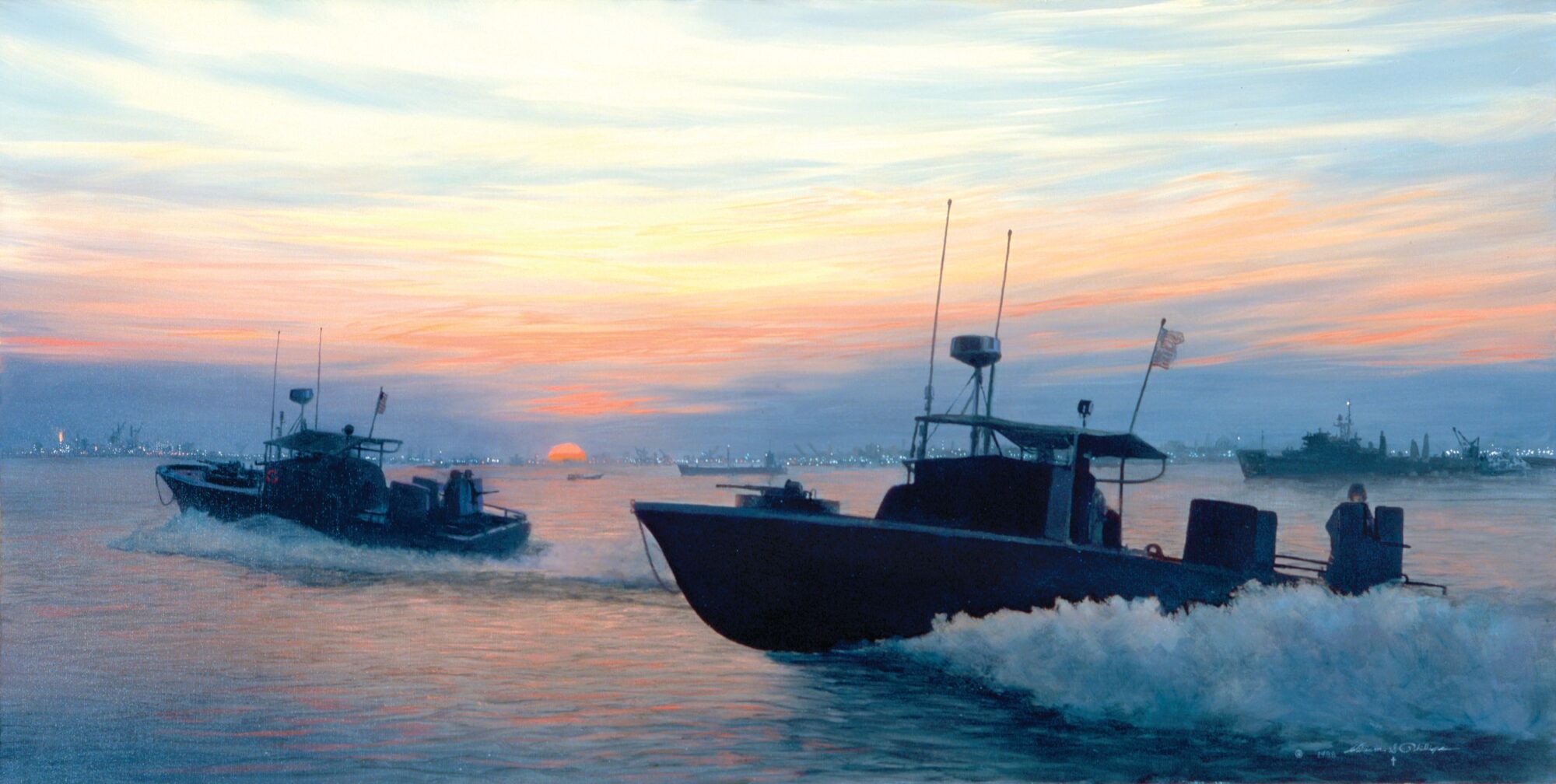
By John E. Spindler
Deep within the guided-missile cruiser U.S.S. Wainwright, Captain James Chandler scanned various screens in the dimly lit climate-controlled combat information center (CIC) absorbing details on the status of the ship’s weapons systems and the activity outside on the sweltering Persian Gulf. Unlike the crew on deck, those on duty here sweated from the rapidly developing situation—an Iranian missile patrol boat, the IRIS Joshan, was closing to within 13 nautical miles of the Surface Action Group Chandler commanded. Already in contact with his superiors, he had pre-approval to sink the Iranian vessel if necessary. Tensions were rising in the CIC because in addition to its 76mm main gun, the Joshan carried the Harpoon missile which could be deployed in an anti-ship role. The Iranian vessel had already ignored three warnings in both Farsi and English. As a precaution Chandler had issued orders for the other two ships in the group to have missiles ready to fire. At 12:15 p.m. on April 18, 1988, the Wainwright sent its fourth and final warning, “Iranian patrol ship, this is a U.S. Navy warship. Stop and abandon ship. I intend to sink you.”
In response, the Joshan locked its fire control radar upon the U.S. cruiser and fired a Harpoon missile. Already prepared for such a contingency, chaff dispensers went into action. Chandler and his crew awaited the outcome as the vessel executed evasive maneuvers. Already having received “Go,” the nearby U.S.S. Simpson launched a RIM-66 Standard Missile, SM-1MR (standard missile, medium range). The Wainwright’s chaff threw off the Harpoon, which missed along the starboard side and disappeared into the sea.

Unfortunately for the Joshan, its chaff dispensers failed as the Simpson’s SM-1 hit its superstructure. Before the first missile hit, the Simpson had already fired a second that exploded almost atop the Iranian patrol ship, most likely ripping through its fire control radar as at 12:17 p.m. it went offline.
In the Wainwright’s CIC, Chandler ordered the launching of another SM-1MR, which also hit the Joshan. Although not in the process of sinking, the enemy ship was observed to be an inferno from bridge to stern when a third SM-1 from the Simpson struck it. The U.S.S. Wainwright and the IRIS Joshan became the first naval surface vessels in history to exchange missiles in hostility. Naval combat had taken a massive step forward into the age of electronics. Despite the historic milestone, the exchange between the U.S. and Iranian warships only constituted a part of the battle known as Operation Praying Mantis.
The largest U.S. Navy battle since World War II took place in the Persian Gulf during the intense and brutal Iran-Iraq War. This region has seen conflict for several millennia for a variety of reasons that included religion, trade, and empire building. The onset of the 20th century brought about yet another cause for nations to fight. In 1908, the Anglo-Iranian Oil Company discovered the first major oil deposits in southwest Iran and 15 years later, a similar discovery of oil deposits occurred in neighboring Iraq. The Persian Gulf suddenly became crucial to the West. By the 1980s, this hot and arid region contained about 80 percent of the world’s proven oil reserves as well as one of its busiest waterways. With their deep draft, oil tankers were forced to stay in specific shipping lanes when navigating the Persian Gulf, passing through the narrow Strait of Hormuz—a natural chokepoint to be blocked in times of war.
After the Vietnam War, the United States developed a policy of strengthening and supporting regional powers but not taking direct responsibility for any region. In the Persian Gulf, the U.S. focused on the Kingdom of Saudi Arabia and Iran as their cornerstones for the region’s security and accomplished this through the export of modern weapons to both nations. The American doctrine went askew when Mohammad Reza Pahlavi, the last Shah of Iran, was overthrown in January 1979. Led by Ayatollah Ruhollah Khomeini, the country became the Islamic Republic of Iran. Saddam Hussein, the despotic leader of Iraq, kept a deep interest in the resulting confusion from the Islamic revolution in his neighbor. Hussein wanted to expand Iraq’s narrow strip of territory along the Persian Gulf coast, the Al-Faw (sometimes spelled Al-Fao) Peninsula. Sensing the disorder in Iran would hamper its ability to respond militarily, Hussein seized the moment, sending in several divisions on September 22, 1980. Less than a month later, Iraq declared the water off Iran a “prohibited war zone” and any vessel inside this zone would be subject to destruction.
By early 1981, an unexpected fanatical defense by the Iranian revolutionary forces had stopped Saddam Hussein’s invasion. In the fall, Iran mounted its first counter-offensive. The drawn-out conflict, which would not end until August 20, 1988, saw the worst aspects of war which included Iran’s “human-wave” tactics and Iraq’s use of chemical warfare against Iran and its own people. Decisions by both governments led to attacks on vessels in the Persian Gulf by the Iraqi Air Force as well as elements of Iranian naval and air forces. Neither side wanted merchant ships to carry goods to their enemy’s ports and had no hesitation using deadly force to support their blockades. The course of the war turned against Iraq in February 1986 after Iran’s successful amphibious operation to occupy the Al-Faw Peninsula.
By this time, the United States had decided to safeguard delivery of oil by permanently deploying five warships to the Persian Gulf. An aircraft carrier stationed outside of the Strait of Hormuz provided crucial air support. From 1983 to 1986, Iranian and Iraqi attacks on merchant vessels and tankers increased each year. With the situation growing worse, Kuwait appealed to the U.S. in December, 1986, with the offer that the nation would allow its tankers to sail under the American flag, thus falling under American military protection. U.S. law forbids U.S. Navy warships to escort civilian ships under a foreign flag.
Tired of waiting for a response from the U.S., the Kuwaiti government contacted the Soviet Union with the same proposal in the spring of 1987. U.S. Secretary of Defense Casper Weinberger, in March, voiced his support of reflagging the vessels and providing an escort through the Persian Gulf. The Soviet Union was Iraq’s main supplier of weapons and Weinberger wanted to prevent any further Soviet influence in a region so crucial to the Western powers. President Ronald Reagan agreed to the Kuwaiti request on March 10 and preparations for Operation Earnest Will, the American protection of Kuwaiti oil tankers, began.
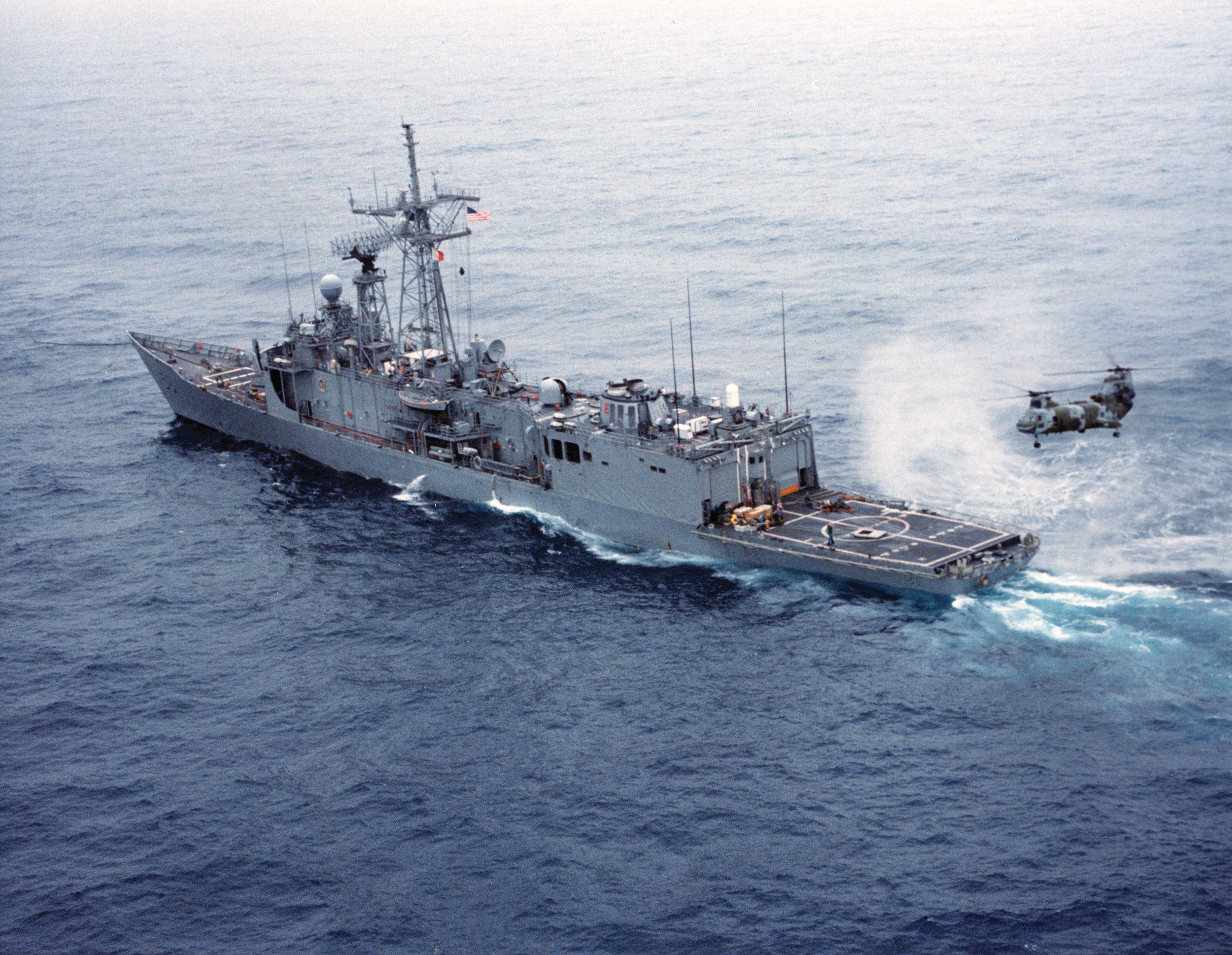
This American campaign would eventually be the largest naval convoy operation since the end of World War II. Two months before the onset, America suffered its first casualties in the Persian Gulf. On May 17, 1987, an Iraqi Air Force Dassault Mirage F1 fighter jet attacked a U.S. Navy warship. The U.S.S. Stark, a guided-missile frigate, was struck by a pair of French-built AM-39 Exocet anti-ship missiles—which had gained notoriety for its success in the 1982 Falklands War. Some 37 American sailors were killed and 21 wounded in the attack, which the Iraqi government claimed was accidental, though this has never been confirmed.
Operation Earnest Will officially started on July 24, 1987, as Kuwaiti oil tankers were reflagged with American flags and most piloted by American captains. The United Nations Security Council Resolution 598, adopted unanimously three days prior, reinforced the protection of “neutral shipping and civil aircraft” in the region. Although the U.S. Navy provided the majority of the escorting warships, Britain’s Royal Navy and the French Navy sent warships into the Gulf to enforce the resolution.
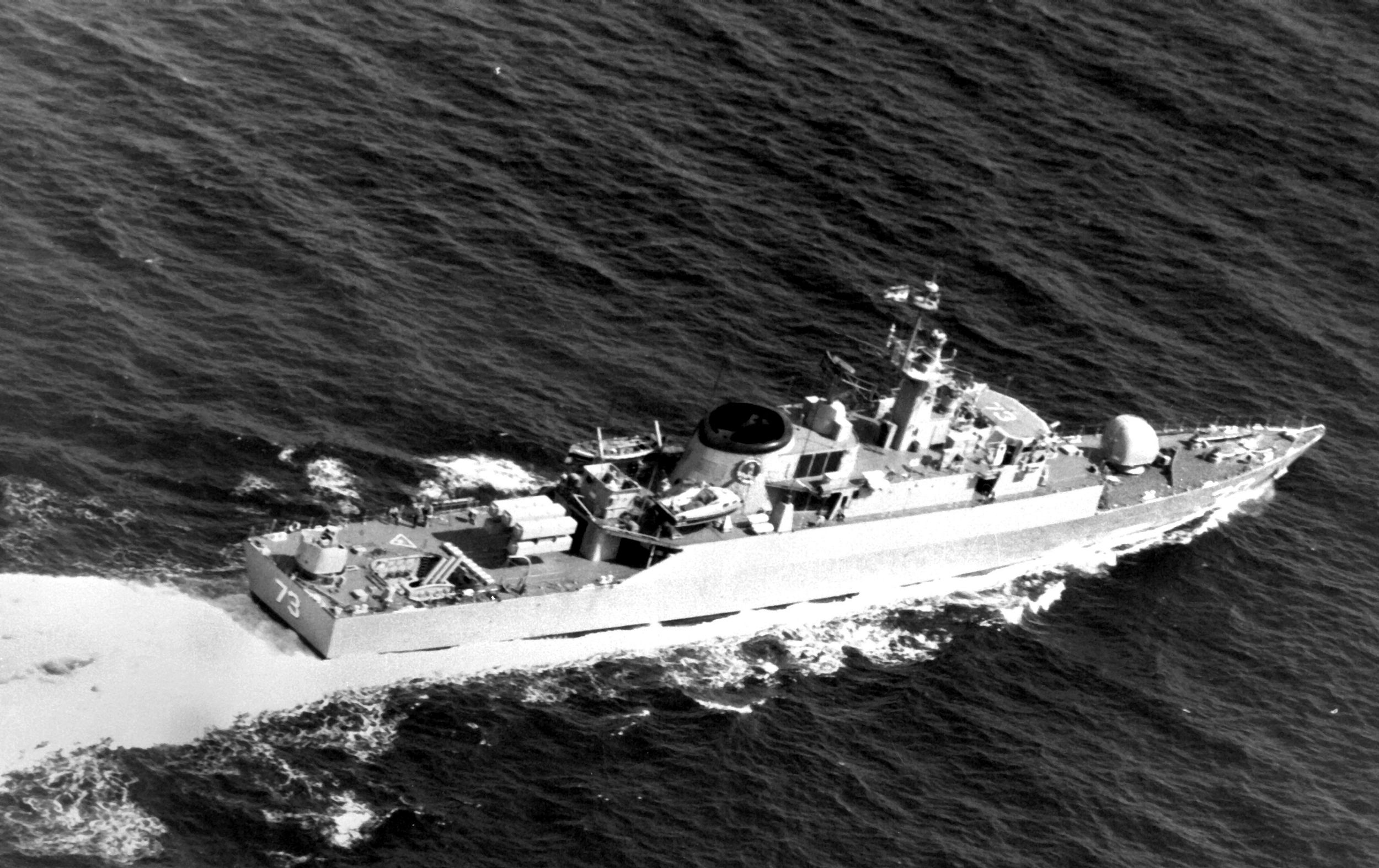
Opposing this enforcement of Resolution 598 and America’s naval presence, Iran fielded a navy composed of warships bought from the West during the Shah’s reign. Although its three destroyers (one ex-Royal Navy and two ex-U.S. Navy) were the Islamic Republic of Iran Navy’s largest ships, a pair of frigates built for the previous regime in the United Kingdom were part of Iran’s response to the American military actions on April 18. The IRIS Sabalan and Sahand were both launched in 1969. In addition to carrying Sea Killer anti-ship missiles, these frigates mounted a 4.5-inch Mark 8 naval gun for its primary weapon. The third major surface vessel seeing combat that day, the IRIS Joshan was a French-built fast attack craft from the 1970s. One of 12 such ships ordered under the Shah’s regime, this Kaman-class ship carried the Harpoon missile as well as a 76 mm Oto-Melara naval gun, which also armed some of the U.S. Navy ships that participated in the April 1988 operation. The captain of the Sabalan earned the moniker “Captain Nasty” for his preference to attack merchant vessels by targeting their bridge and/or crew quarters. Frequently after an attack, “Captain Nasty” radioed the victimized ship saying “Have a nice day.”
Separate from the Islamic Republic of Iran Navy, the Islamic Revolutionary Guard Corps possessed its own naval force. More fanatical, this branch had been designated as a terrorist organization by some nation-states including the U.S. and the Kingdom of Saudi Arabia. Among their ships were Boghammar fast patrol boats. Purchased during the early years of the Iran-Iraq War, the crews of these Swedish-built speedboats swarmed and ruthlessly attacked tankers and other merchant ships with RPG-7 rocket launchers, machine guns, and recoilless rifles.
The same preference for Western armaments extended to Iran’s air force with aircraft purchased from the United States, such as the Grumman F-14A Tomcat interceptor, McDonnell Douglas F-4D Phantom II fighter-bomber/interceptor, and the Northrop F-5 Tiger II fighter. Along with these combat jets, the U.S. completed deals to arm the export aircraft with American-built missiles and bombs. By the time of Operation Praying Mantis, the Islamic Republic of Iran Air Force (IRIAF) had lost a number of aircraft to combat and accidents. Others sat grounded due to a lack of available spare parts, especially in the case of the F-14A Tomcat with Iran being the only operator of the aircraft other than the U.S. Navy.

On the initial escort mission of Operation Earnest Will on July 24, 1987, a reflagged Kuwaiti supertanker, now called the MV Bridgeton hit a contact mine about 18 miles west of Iran’s Farsi Island. Though no definitive proof existed at the time that Iran laid the mine, suspicion overwhelmingly fell upon Tehran as a new consideration for the convoys to contend with had unwelcomingly appeared. During the preparation of Earnest Will, the capabilities of Iran’s air force and both naval services had been taken into consideration. These concerns included Iran’s land-based Silkworm missile batteries. These Chinese-built and supplied anti-ship cruise missiles had already been used against Kuwait from sites on the occupied Al-Faw Peninsula.
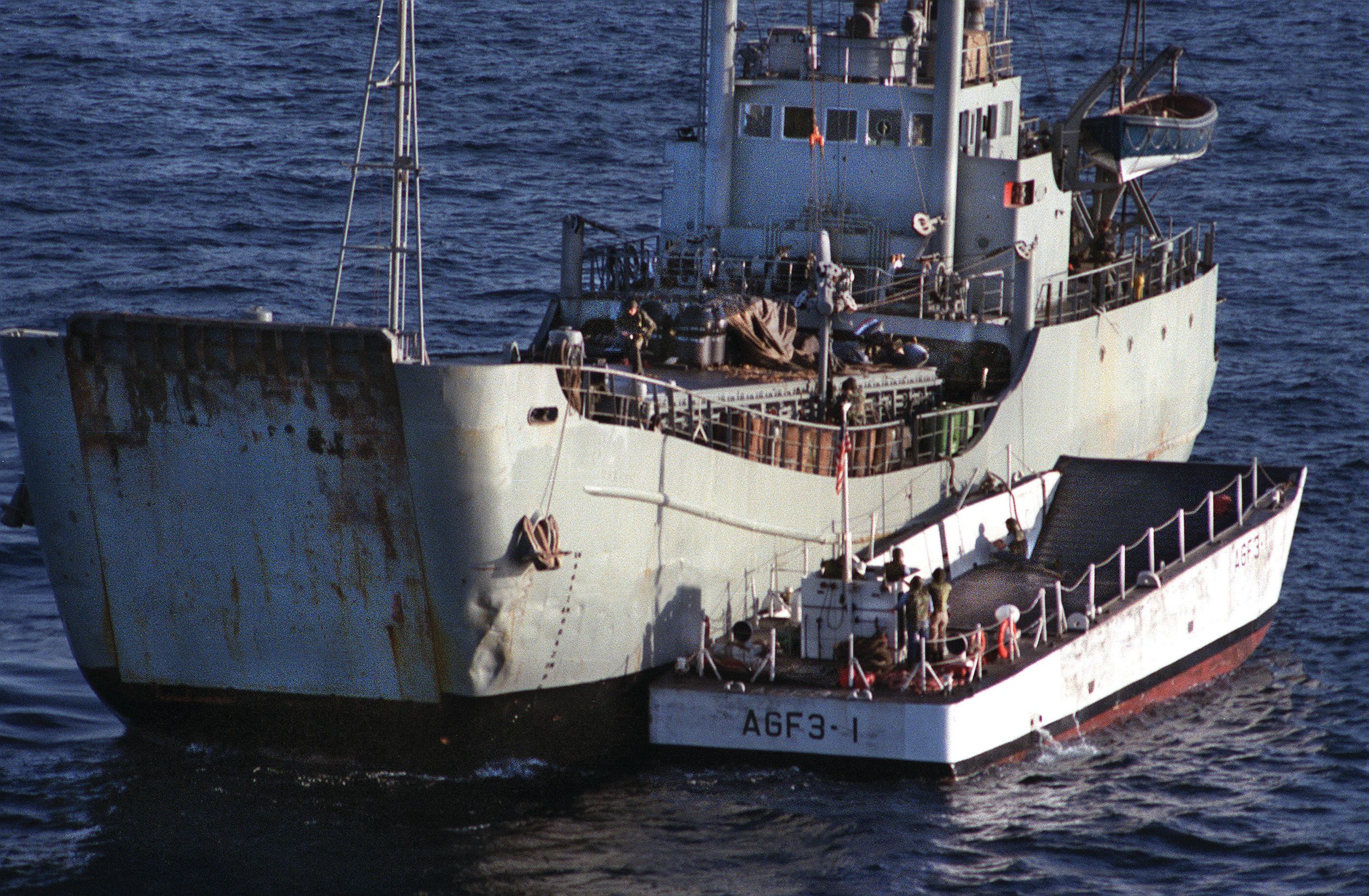
U.S. Army Boeing MH/AH-6 light helicopters fitted to operate at night and informally named “Sea Bats” flew from U.S. Navy ships. On the night of September 21, two months into the escort operation, one of these “Sea Bats” observed the Iran Ajr laying mines. After issuing a warning, the helicopter fired upon the landing craft-turn-minelayer killing some of the crew. A team of Navy SEALs arrived and took control of the Iranian craft, discovering more mines. It would be later confirmed that the mines confiscated on Iran Ajr were from the same production batch as those found near the Bridgeton. An intensive multi-national effort commenced to clear out known minefields and actively deter Iran from laying more mines in the Persian Gulf. For the time being, the escort operation succeeded as whenever an Iranian warship sailed on a potential intercept course, American warships “illuminated them with our fire-control radar” thus sending the Iranian vessel back to safety.
A month later in the early morning of October 16, Iran launched another volley of Silkworms missiles from the Al-Faw towards Kuwait. The reflagged tanker MV Sea Isle City was hit, wounding 18 crew members including its American captain. Debate over responding to the incident among high-level Reagan officials occurred as the empty oil tanker, though under an American flag, was at the time in port and not being escorted. A decision to not eliminate an Iranian warship was adopted. Instead, U.S. forces would target a pair of oil platforms. The destruction of the Resalat and Reshadat platforms was justified as the Iranians, particularly the Navy of the Islamic Revolutionary Guard Corps, used them as bases to launch their Boghammar attacks. Under Operation Nimble Archer, four destroyers, a cruiser, and a frigate destroyed one platform and heavily damaged the second on October 19. A commando team landed on the latter platform, retrieving documents and a teletype printer, before destroying it with demolition charges.
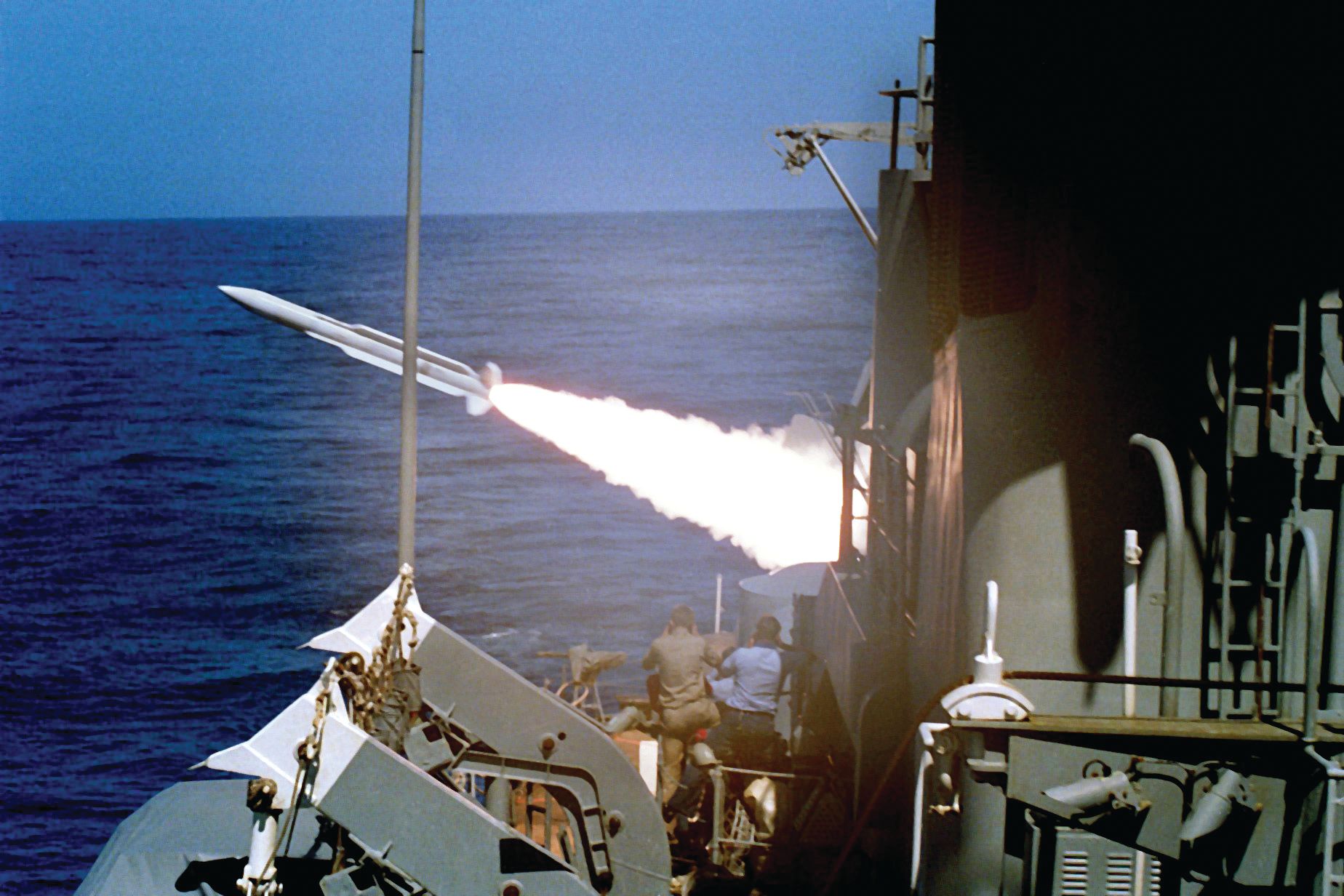
In early 1988, two-star Rear Admiral Anthony Less took over command of the Joint Task Force Middle East. From his flagship, the U.S.S. Coronado, no notable incidents took place under his watch until 4:45 p.m. on April 14, 1988. The guided missile frigate U.S.S. Samuel B. Roberts, a sister ship of the U.S.S. Stark, sailed into a minefield and struck one while trying to maneuver out of it. Using damage control lessons learned from the Stark incident, the crew saved the Samuel B. Roberts by using cables to prevent it from breaking in two. Astoundingly, no fatalities resulted from striking the SADAF-02 Sea Mine, the same type found on the Iran Ajr.
Immediately Admiral Less communicated his retaliation recommendations to his commander, U.S. Central Command’s Marine Gen. George W. Crist, who in turn forwarded it to Adm. William J. Crowe, Chairman of the Joint Chiefs of Staff in Washington. Reagan met with his senior advisors including Secretary of State George Schultz, Secretary of Defense Frank Carlucci, and National Security Advisor Gen. Colin Powell. Less had advocated using aircraft from the U.S.S. Enterprise to strike land-based targets on Iranian soil as well as the sinking of a major Iranian Navy warship, preferably the Sabalan. These proposals received support from Crowe. Schultz took the position that targeting a warship could escalate the conflict and only ensnare America deeper in the region’s turmoil.
After much debate, it was decided to eliminate two of Iran’s important Gas-Oil Separation Platforms (GOSP), the Sassan and the Sirri. Separating natural gas and crude oil from the wellhead fluid, this pair of GOSPs accounted for nearly seven percent of the country’s output. Reagan also gave permission to sink the IRIS Sabalan or an acceptable alternate, if possible. Over the next couple of days, details were finalized for Operation Praying Mantis to begin at 8 a.m. Gulf Time on April 18, 1988.
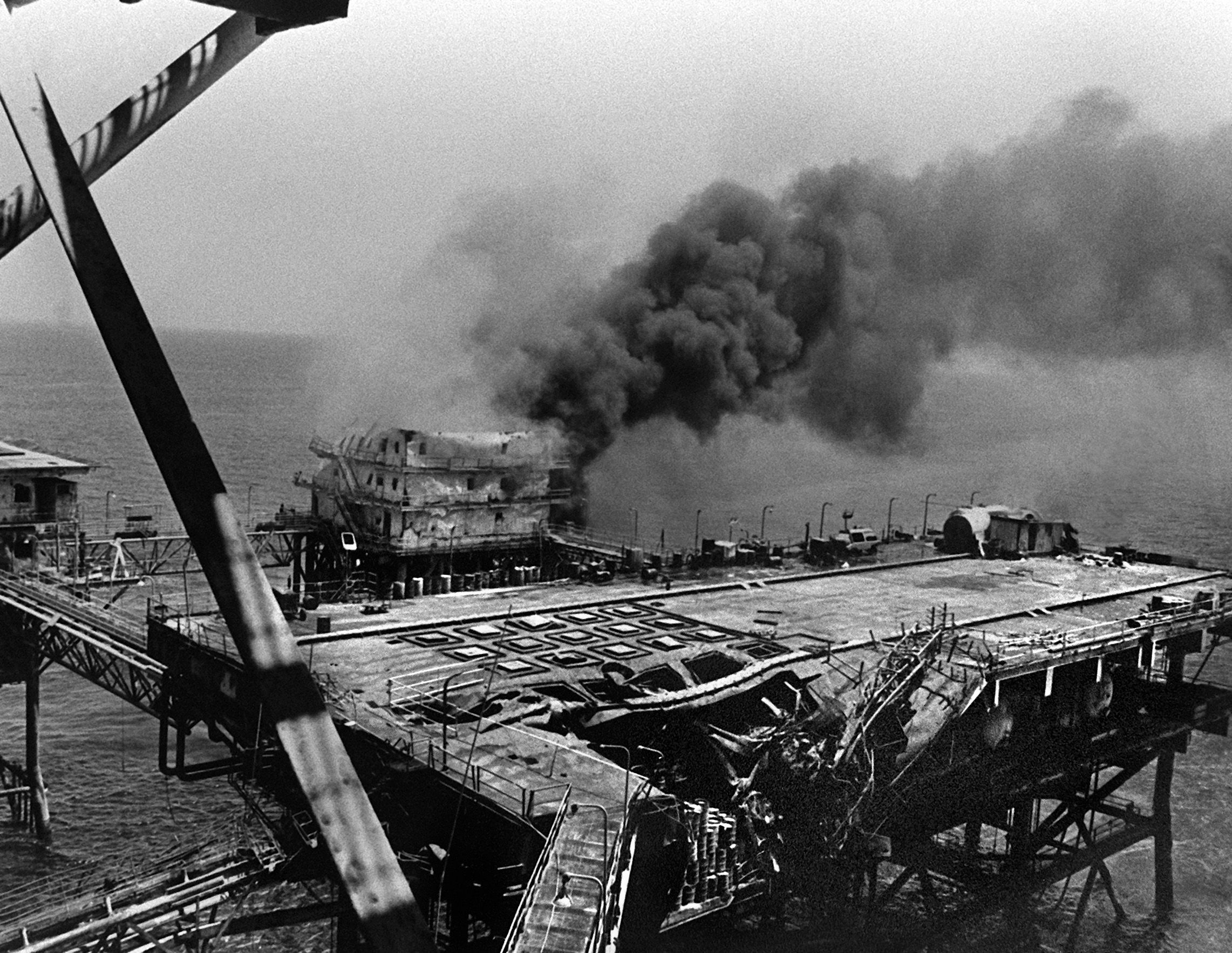
Three Surface Action Groups (SAG) were formed, each assigned a specific part of the mission. Assigned to eliminate the Sassan GOSP, SAG Bravo comprised the guided missile destroyer U.S.S. Lynde McCormick, destroyer U.S.S. Merrill, and the amphibious transport dock U.S.S. Trenton. Leading SAG Bravo from the McCormick, Capt. James B. Perkins had a U.S. Marine squad who would land on the platform. After securing it, they had orders to gather intelligence before setting demolition charges to destroy its production capability. Operation Nimble Archer had proven how difficult it was to destroy a platform by naval fire alone and the Navy wanted to prevent the major ecological disaster of an uncontrollable oil leak. After eliminating the GOSP, they would target another.
Simultaneous with the attack on the Sassan platform, SAG Charlie would take out the Sirri GOSP. Under the command of Chandler aboard the U.S.S. Wainwright, this SAG also contained the guided missile frigate U.S.S Simpson, and the frigate U.S.S. Bagley. A SEAL commando team would board the Sirri, gather intelligence and set the charges to disable it. As with SAG Bravo, U.S. Army helicopters would be in a supporting role for reconnaissance and transport.
The third and final group, SAG Delta, was tasked to search-and-destroy any Iranian warships just inside the Strait of Hormuz. From the Joint Chiefs of Staff to the crews operating in the Persian Gulf, all knew the favored target was the Sabalan, though the sinking of its on-station replacement was acceptable. Assigned to SAG Delta were the guided missile frigate U.S.S. Jack Williams, guided missile destroyer U.S.S. Joseph Strauss, and the destroyer U.S.S. O’Brien. In command of this SAG, Capt. Donald Dyer led from the Jack Williams. A SEAL team would be on standby if the opportunity to board an Iranian ship presented itself.
Support for the operation came from Air Wing 11 stationed aboard the aircraft carrier U.S.S. Enterprise. The combat air patrol (CAP) to interdict any Iranian Air Force sorties was in the form of four Grumman F-14A Tomcats. The American warships received a surface combat air patrol (SUCAP) in the form of two Grumman EA-6B Prowler electronic warfare aircraft and two Grumman A-6E Intruders, whose mission payload included Harpoon missiles, Walleye TV-guided glide bombs, Rockeye cluster bombs, and Skipper II laser-guided missiles. Additional aerial support came from another Intruder and six Vought A-7E Corsair II attack jets, armed similarly to the Intruders. The U.S. Air Force provided Boeing E-3A Sentry for radar surveillance and one of its McDonnell-Douglas KC-10 Extender tankers for aerial refueling. All four branches of the U.S. military would participate in this operation.
At dawn on April 18, the ships moved into position with SAG Delta near the Strait of Hormuz and SAG Charlie steaming to the Sirri platform. Captain Perkins and SAG Bravo headed to the Sassan GOSP. The ships stopped about 4,000 yards from their target, aware the Iranians were alerted to their presence. Intelligence reported Soviet-built ZU-23 anti-aircraft guns had been installed on Sassan, and a helicopter conducted a reconnaissance sortie of the objective with visual confirmation, discovering the ZU-23s to be manned by fanatical members of Islamic Revolutionary Guard Corps. At 7:55 a.m. Perkins broadcasted warnings directed at Sassan GOSP in English, Farsi, and Arabic over both military and civilian frequencies, “Attention Sassan platform. This is a U.S. warship. This is your warning. You have five minutes to clear the platform before we commence firing.”
A large number of platform personnel headed for a tug and workboats, while pleas were sent to SAG Bravo for more time. Seeing the Iranians actively trying to evacuate, the captain allowed them a few more minutes. At 8:04, the Iranians received the notification that time had expired. Both the McCormick and Merrill went to the “Weapons Free” status—OK to fire on the enemy. A Second-class Petty Officer stationed in each of the CICs used a joystick to train their 5-inch guns on the platform. Seconds later a 5-inch air-burst round exploded at the platform’s vacant southern area as a hard warning. The extremists manning one of the ZU-23s fired at the destroyers in a useless gesture as well as directing 23mm rounds at an approaching Bell AH-1 Cobra gunship. The Merrill eliminated the enemy gun emplacement with an air-burst round.
The American ships ceased fire to allow the tug and workboats to vacate the area. Once the Iranians moved out of harm’s way, the Merrill and McCormick resumed firing their 5-inch main armaments, with the former doing a majority of the shooting. Special care was employed to avoid bursting a round near a hydrogen sulfide tank on the northern side of the GOSP. The Marine commando team would have been unable to land on the platform because gas masks were ineffective against the lethal compound.
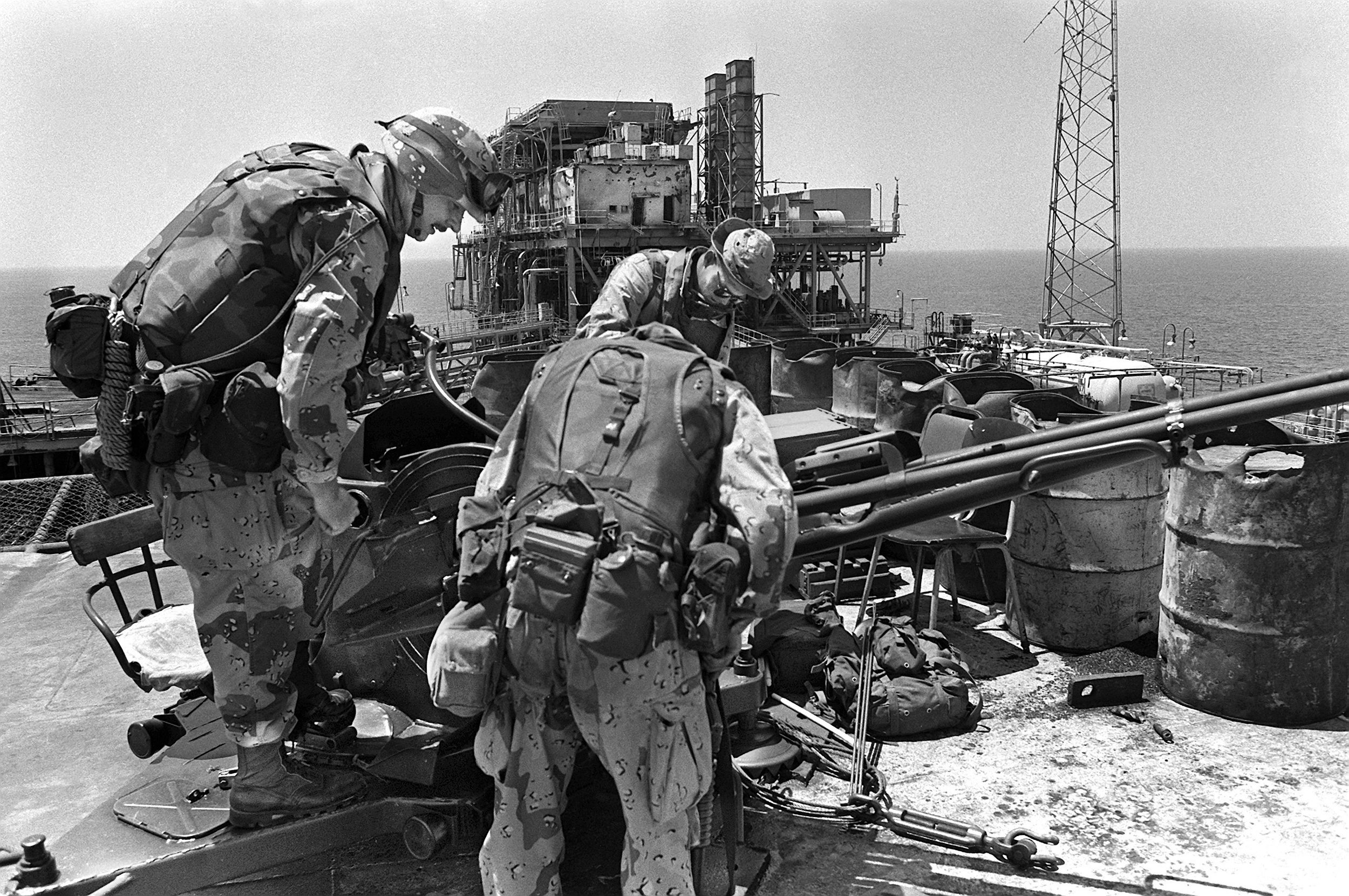
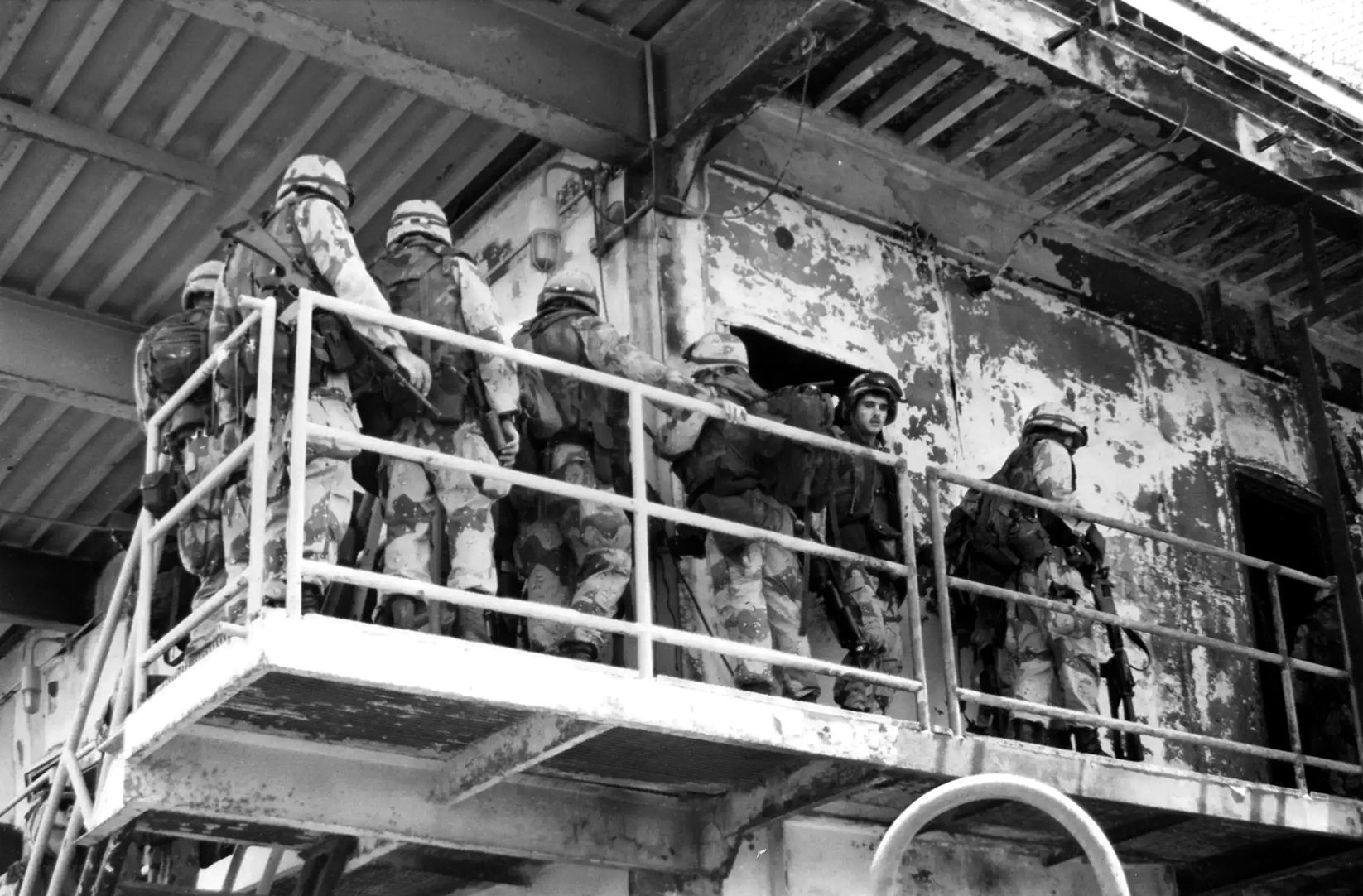
At 9:25 a.m., the Marines landed on the Sassan platform using MP-5s and flashbang grenades to suppress any lingering resistance. The Marines declared the objective secure 40 minutes after arrival. Demolition charges were detonated a little after 1 p.m. and 10 minutes later Cobra gunships leveled any remaining structures with TOW anti-tank missiles. The mission was completed without any oil leaks from the platform. An operation to eliminate another platform was started and then cancelled a couple of hours later when a surface contact was detected. This turned out to be a Soviet destroyer whose captain explained that he wanted to capture the moment for history.
SAG Charlie arrived at the Sirri platform before H-Hour. As at Sassan, the Americans issued a warning at 7:55 a.m. in Farsi and English giving those on the platform five minutes to evacuate. A response of more time was needed as tugs had been called for evacuation. Chandler elected to wait for the tug to load and clear the platform. When the tug and a few other boats were 2,000 yards from Sirri Platform, the Americans fired. From five miles out, the Wainwright and Bagley used their 5-inch main gun, while the Simpson shot 76mm rounds from a closer range. The first salvo saw a total of eight 5-inch rounds–the Bagley fired three before a round jammed in its lower gun carriage temporarily taking the ship out of action–and 29 shells from the Simpson. For defenses, Sirri also had the ZU-23mm anti-aircrafts guns and one of these was taken out by an airburst round in the initial barrage.
One, possibly more, of the surviving ZU-23s returned fire at the American warships plus a handful of Islamic Revolutionary Guards futilely used small arms. Many of the remaining Iranians on the Sirri GOSP decided to abandon the structure after the opening attack with some jumping into the water. The three U.S. ships paused the assault and helicopters bearing the SEAL commando team began their flight to the Sirri. While nearing the platform, at least one of the ZU-23s fired upon the chopper. SAG Charlie retaliated by firing a second salvo to eliminate the threat. An errant round from the Wainwright struck a compressed gas tank, setting off a fire that quickly spread. The blaze consumed an ammunition stockpile setting off secondary explosions. The SEAL-laden helicopters attempted another approach. Not taking any chances, mini-guns were used against any remaining enemies spotted on the platform. The inferno consuming the Sirri proved to be too hot and the boarding mission was cancelled. Instead, the American choppers dropped life rafts to the Iranians treading water. In targeting these platforms, some ranking U.S. officials hoped to lure out the Islamic Republic of Iran Navy.
As the American Marines were planting the demolition charges on the Sassan GOSP, Iran responded. In the Mubarek oil field near Sharjah, a trio of Revolutionary Guard Corps Boghammars attacked the York Marine, an oil storage tanker, hitting the engine room with an anti-tank rocket. After harassing the ship for nearly an hour, the speed boats raced back to port. Late that morning, the Joshan was dispatched to the vicinity of the Sirri platform. Less than an hour after it sailed, Chandler issued the first of the warnings to the Iranian missile patrol ship at noon.
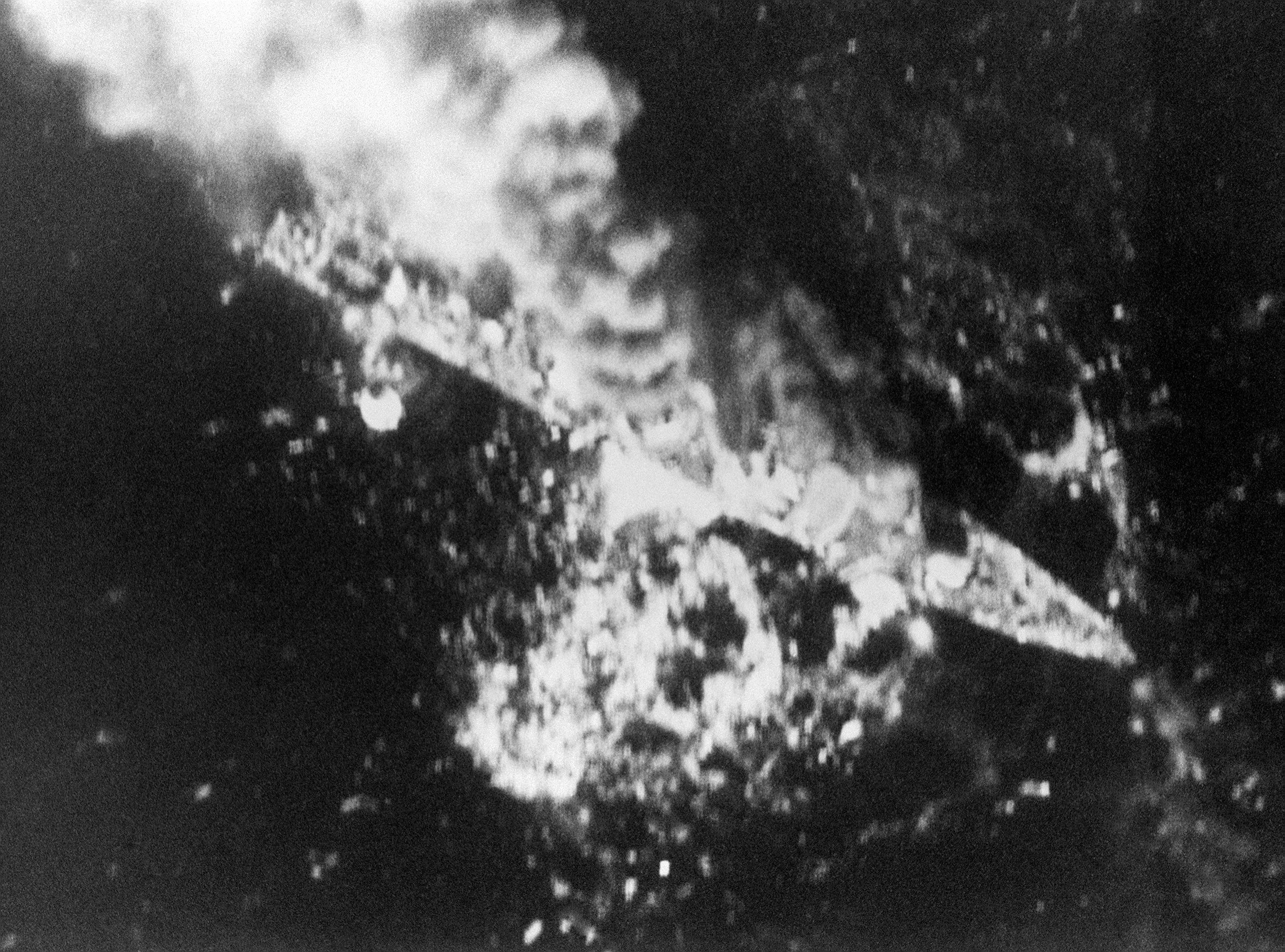
Fifteen minutes later, the surface warships from the U.S. Navy fought their first battle against enemy capital ships since World War II. After firing the Harpoon missile, the Joshan at was hit by two Standard SM-1MRs from the Simpson and an SM-1MR from the Wainwright. A third and final SM-1MR from the Simpson struck the lifeless missile patrol boat. Reports exist that the Bagley missed with a Harpoon.
Less ordered Chandler to finish off the Joshan. The Bagley, Simpson and Wainwright riddled the Iranian ship with dozens of 5-inch and 76mm shells until a massive explosion obliterated its superstructure and it finally sank at 4:21 p.m. Not wanting Tehran to make false claims of Americans shooting Iranian survivors, rescue of the Joshan’s crewmen was left to fishing boats. A trio of IRIAF F-4 Phantoms approached SAG Charlie. Countering, the Wainwright launched a pair of RIM-67 Standard SM2-ER (Standard Missile, Extended Range) anti-aircraft missiles. One missed, but shrapnel from a near hit damaged one of the Phantoms and all of the Iranian aircraft returned to base.
As the Wainwright and Joshan were exchanging missiles, a sortie of seven Boghammars returned to the York Marine. A ship answering their calls for assistance was also attacked. Shortly after that the Panamanian-flagged barge rig Scan Bay was hit by rocket-propelled grenades and machine guns. A pair of A-6E Intruders from Squadron VA-95 and an F-14 Tomcat arrived to witness the latest attack, but at the time Navy pilots were not allowed to intervene for foreign-flagged victims. Contacting their superiors on the Enterprise led to a communication exchange that went straight up the ladder to Reagan. Three minutes after the initial call, the Intruder pilots were informed that the President decided to remove the threat. As the Boghammars were small and highly agile targets, it was with a bit of difficulty the Intruders engaged the speed boats with the Tomcat providing cover. Eventually a Rockeye cluster bomb destroyed one Boghammar, which caused the rest of the Revolutionary Guards Corps-piloted vessels to flee and beach themselves on Abu Musa.
Throughout the morning, the three ships of SAG Delta sat on location, awaiting news that the Sabalan had entered the area. Sailors on the ships were drained from being on General Quarters the entire time in the 100-degree heat. For reasons still unexplained, the Tehran government decided to continue to respond to the Americans with its navy. The Iranians may have believed that the U.S. had finally allied themselves with Iraq. On the day of Operation Praying Mantis, Baghdad launched a major offensive to reclaim the Al-Faw Peninsula. Alerted via radar contact that a Saam-class frigate had departed from Bandar Abbas, SAG Delta had additional aid in the search operation from another A-6E, two F-14s and an EA-6B electronics jammer and communications plane. Due to a close call between Soviet and U.S. ships in the Black Sea in February, Less on the Coronado wanted visual confirmation.
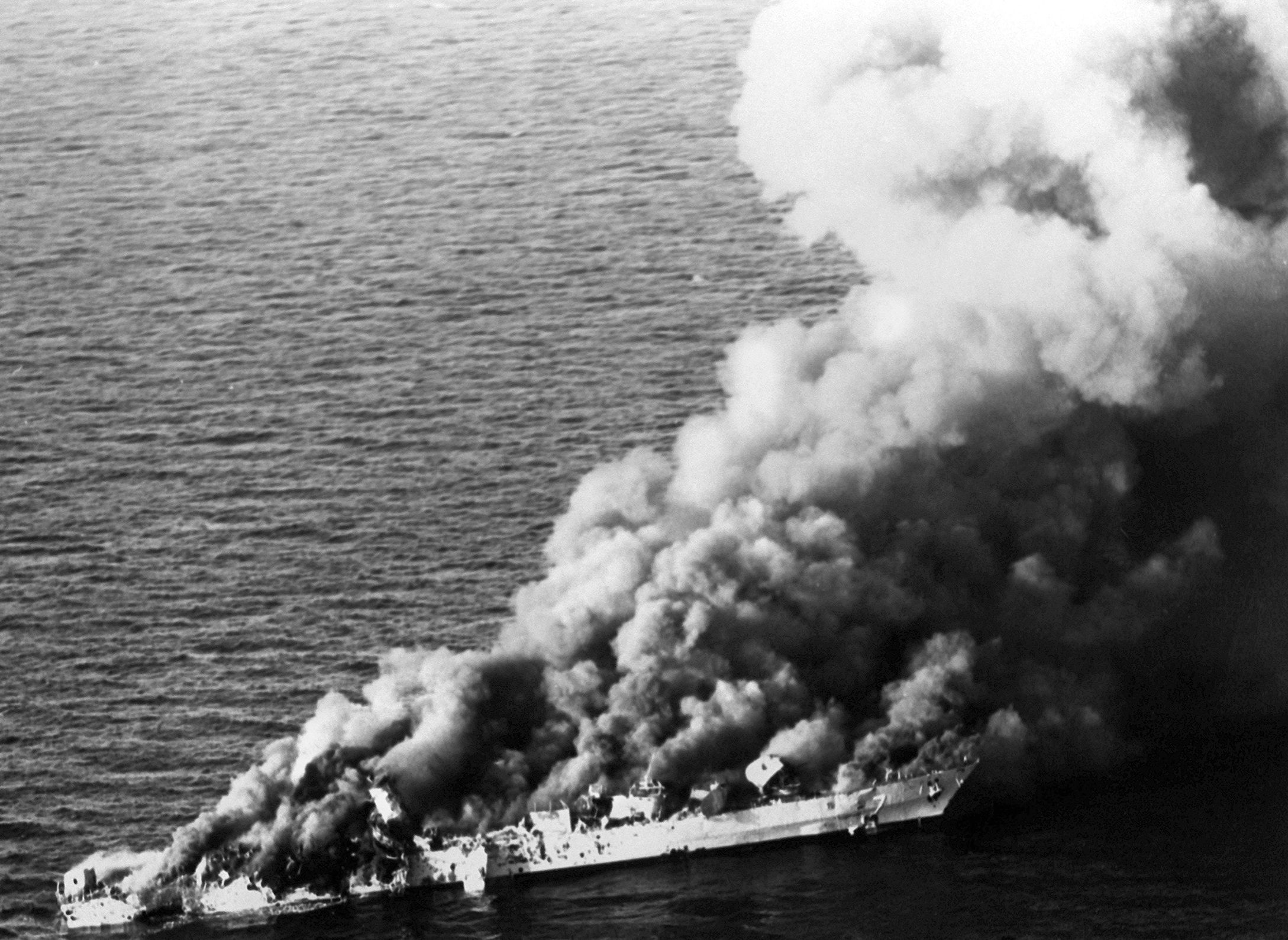
At 2:40 p.m. the Intruder pilot, Commander Arthur “Bud” Langston, identified the ship as the Sahand. During the verification process, the Iranian frigate fired anti-aircraft cannons and launched a couple of surface-to-air missiles (SAM) which Langston defeated by employing counter-measures. The EA-6B Prowler jammed the Sahand’s air search radar and communications. From 12 miles out, Langston launched one of his Harpoon anti-ship missiles, striking the frigate amidship rendering it dead in the water. The commander reported the Sahand appeared to be slowly sinking, but was still able to fight.
In addition to SAG Delta racing to the area, the on-deck strike group of an Intruder and six Corsair IIs was launched from the Enterprise to engage the enemy vessel. As the reinforcements were en route, Langston undertook another attack run, this time his bombardier launched a pair of 1,000-pound Skipper missiles. Though one splashed into the sea, the other slammed into stricken Sahand under its bridge. Both SAG Delta and the strike group arrived in range about the same time. The second A-6E and the U.S.S. Joseph Strauss unknowingly fired Harpoons simultaneously, both hitting the target. Continuing its attack run, the second Intruder fired its two 1,000-lb. laser-guided Skippers with one striking the Sahand’s aft and blowing pieces of the stern into the air.
The A-7Es made their first attack pass, striking the Sahand with a Walleye TV-guided bomb and at least 8 unguided Mk83 1,000-lb. bombs, one of which eliminated the frigate’s Seakiller missile mount. The Corsair II pilots reported flak was still being fired at them. Additional attack runs followed with the ship receiving hits from another Walleye, numerous Mk 83 and cluster bombs, and another laser-guided bomb. Then the burning ship’s magazine exploded and the IRIS Sahand sank with the loss of 45 of its crew and 87 wounded.
As afternoon turned to early evening, the Sabalan sallied forth from its base at 5 p.m. Alerted by an AWACS aircraft, Lt.-Com. Jim Engler flew in the direction of the radar contact in his fully-loaded Intruder. Fifteen minutes later and eight nautical miles from the ship, a FLIR image confirmed the contact was the much-sought IRIS Sabalan. With Less’ visual confirmation order still in place, Engler made a pass to identify the Sabalan and was greeted by a barrage of anti-aircraft fire and flashes signaling the presence of hand-held SAMs. SAG Delta called for the Intruder to stand down as the enemy frigate was theirs to eliminate. Ignoring the request as he had been fired upon, Engler rose to 17,900 feet in preparation for an attack run. Going into a 45-degree dive, the Intruder’s bombardier released a 500-pound laser-guided bomb before leveling out at 12,000 feet. Eighteen inches above the waterline on the Iranian frigate’s starboard side, it penetrated the ship’s hull into the engineering area and exploded, rendering the Sabalan dead in the water with an oil slick spreading around it.

Engler’s A-6E still possessed Harpoon missiles and Rockeye cluster bombs. He radioed in his engagement. Less, who was in communication with General Crist in Tampa, relayed news that a bomb went down Sabalan’s stack and rendered it dead in the water. His choice of words has led to the popular belief that is how the frigate was critically damaged. The news quickly went up the chain of command. Though Less and Dyer favored destroying the ship, Admiral Crowe and Defense Secretary Carlucci felt enough death and damage had already been inflicted. The word was passed down to abort further attacks on the Sabalan, which was later towed back to Bandar Abbas for extensive repairs.
No further action took place that night as reports of Iran firing Silkworms at military and civilian ships proved to be false. Operation Praying Mantis officially ended the next day, April 19. The heavy U.S. response to the near-sinking of the U.S.S. Samuel B. Roberts inflicted significant damage to Iran, especially its navy. The Joshan and frigate Sahand were sunk with a combined loss of 56 men. Though claims of three exist, only one of the Islamic Revolutionary Guard Corps Navy’s Boghammars was destroyed. The frigate IRIS Sabalan was heavily damaged, leading to a long repair time, and an Iranian Air Force F-4 Phantom also took damage. The ships of SAGs Bravo and Charlie destroyed the Sassan and Sirri GOSPs, impacting Tehran’s oil production.
Unfortunately, the American victory was not casualty-free. A Marine AH-1T Cobra gunship from the U.S.S. Trenton went missing. Dive crews, assisted by sonar, later located the wreckage of the helicopter along with the bodies of its two-man crew on the bottom of the Persian Gulf.
Iran went to the International Court of Justice accusing the U.S. of committing crimes during Operation Nimble Archer and Praying Mantis. Among these, Tehran claimed American forces fired upon helpless survivors floating in the Gulf on April 18. The U.S. issued its own counterclaims. On November 6, 2003, the court dismissed the claims by both sides.


Join The Conversation
Comments
View All Comments