By David Alan Johnson
Sometime during the middle of July 1944, a well-meaning war correspondent asked an officer with the Third Marine Division if his men were ready for the landings on Guam. It was meant as a routine question—the invasion was only a few days away, and the reporter just wanted something to put in his daily summary. But the response he received was anything but routine.
“Guam?” the officer shouted in exasperation. “Goddamit, man, these men have had Guam until it’s been coming out of their ears!”
The officer was not exaggerating. For the past several months, the men of the Third Division had listened to lectures, attended briefings, watched films, and looked at maps of the island. Although there is really no such thing as “overtraining” for any amphibious operation, everyone had certainly had their fill of Guam by the time the landing date had arrived.
At least the men could be certain that all the information being drilled into them was factual and up to date. Maps and briefing materials for some previous operations had been woefully inadequate. Planners had to make due with ancient British Admiralty maps and charts that had probably been obsolete 50 years earlier. And the maps were of places that most Americans had never even heard of—islands like Guadalcanal, and Tulagi, and Tarawa. But this was not the case with Guam, far from it.
Until December 1941, Guam had been a possession of the United States for over 40 years, ever since the Spanish-American War of 1898. The US Navy established a naval base near the village of Piti in 1899. Americans had not only heard of the island, but many had relatives who had served there. Guam was probably as well-known as Guantanamo Bay, Cuba. Some of the older Marine officers and non-coms in the landing force had been stationed there before the war.
The old Marine barracks were still there, but had been occupied by Japanese troops for the past two and one-half years. In the 1930s, Guam was a base for the Pan American Clipper service between the United States and the Orient, and was also one of the stations of the pre-war trans-Pacific cable network. Part of this system was still intact, including the link between Guam and Midway. Once in a while, someone on Midway would tap out an obscene message for the Japanese garrison on Guam. A few minutes later, some angry-sounding gibberish would come snapping back through the telegraph line.
Because of the many American connections with Guam, both political and sentimental, retaking Guam was not just another step in the Pacific island-hopping campaign. To the Marines who would be landing on its beaches, Guam was “ours.” The commanding general of the amphibious force, Major General Roy S. Geiger, made this announcement to the invasion force just prior to the landings: “The eyes of the nation watch you as you go into battle to liberate this former American bastion from the enemy.” Guam may not have been the 49th state, but it was the next thing to it. Taking Guam meant taking back a piece of the American homeland.
The plan to occupy the Marianas Islands—Guam, Saipan, and Tinian—began to take shape in March 1944. It was known simply as the “Marianas Operation,” and was given the code name “Forager.” Forager was eventually refined to treat each island as a separate objective with its own code name. The Guam landings were called “Stevedore.” According to plan, Stevedore was tentatively scheduled for June 18, 1944, three days after landings were to take place on Saipan; the invasion day was designated “W-Day.”
Photo reconnaissance flights over Guam began in late April and continued into June. Modern, up-to-date maps were also used for planning purposes. The submarine USS Greenling took photos of the landing beaches and provided information on the tides and the water depth offshore. Every effort was made to give as much information as possible to the units of the landing force during the planning phase of the operation.
When naval intelligence was satisfied that they had found out everything possible about the landing areas, and after the Marines and army troops had made countless practice runs onto beaches similar to those at Guam, a landing date was set. W-Day would be June 18, 1944; H-Hour would be 0530. The word went out, in code, to all commands.
The date turned out to be optimistic, to put it mildly. Landings had taken place on the neighboring island of Saipan on June 15, and Japanese resistance turned out to be a lot more determined than anyone expected. The Guam operation was postponed until Saipan could be secured, which took the better part of a month. On July 9, Admiral Richard K. Turner officially announced that Saipan was in American hands. Operation Stevedore could proceed.

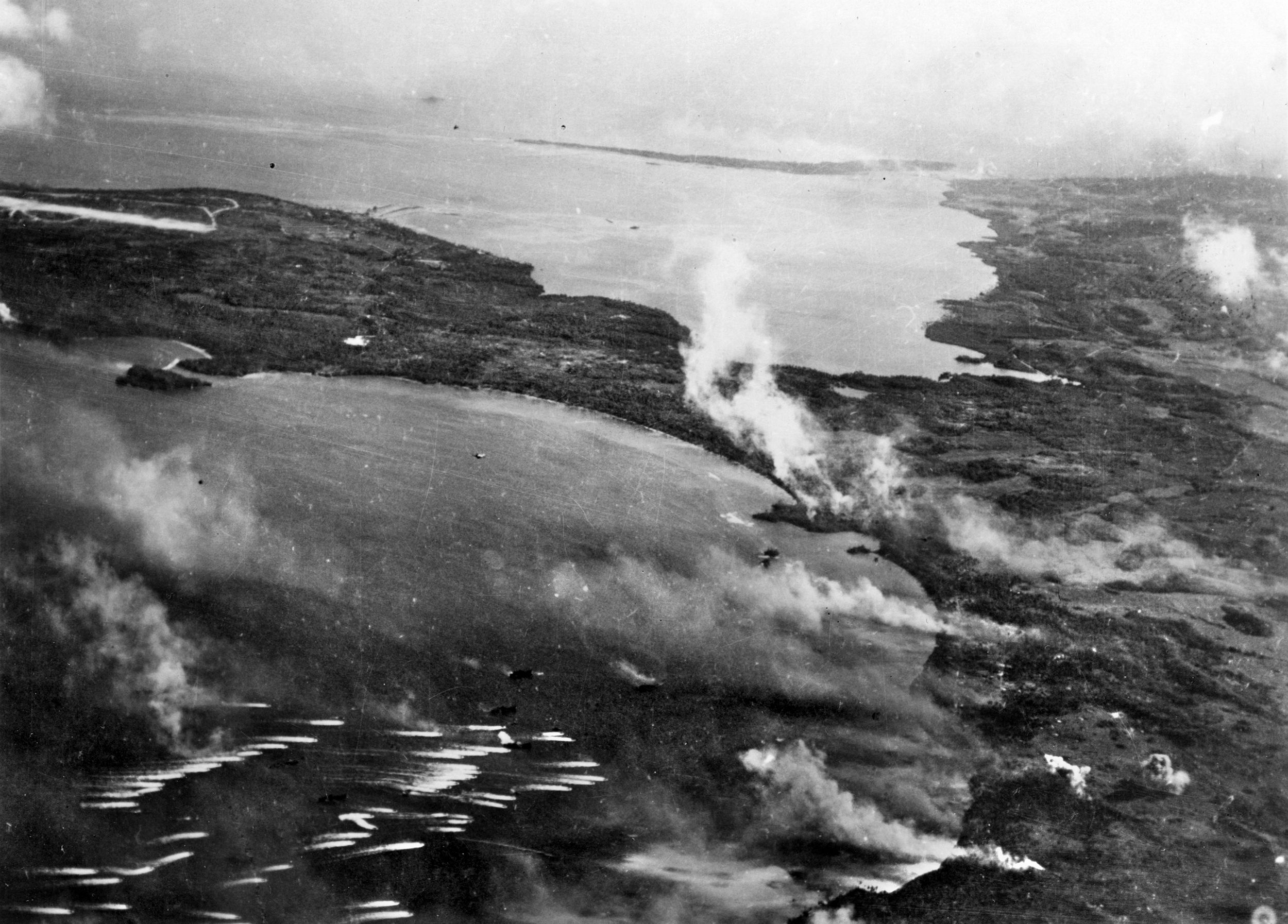
By the time the Guam landings finally began at dawn on July 21, 1944, the island had already undergone 13 days of “softening up” by U.S. warships and carrier-based aircraft. The first day of concentrated bombardment was July 18, when the battleships Pennsylvania, New Mexico, and Idaho, along with the cruiser Honolulu and several destroyers, pounded the landing areas for several hours. Just before W-Day, the battleships Tennessee and California joined the bombardment group and added their substantial firepower to the already considerable barrage. Gunners on board the warships wondered if anyone could still be alive on the island.
The pre-invasion bombardment on July 21 fired on specially selected targets near the western beaches, as well as on objectives further inland. “Fourteen-inch guns belching fire and thunder sent spectacular blossoms of flame spreading on the fields and hillsides inland,” is the way one Marine described it. “It was all very plain to see in the glow of star shells which illuminated the shore, the ships and the troops who lined the rails of the transports and LSTs which brought the US Marines and soldiers ashore.”
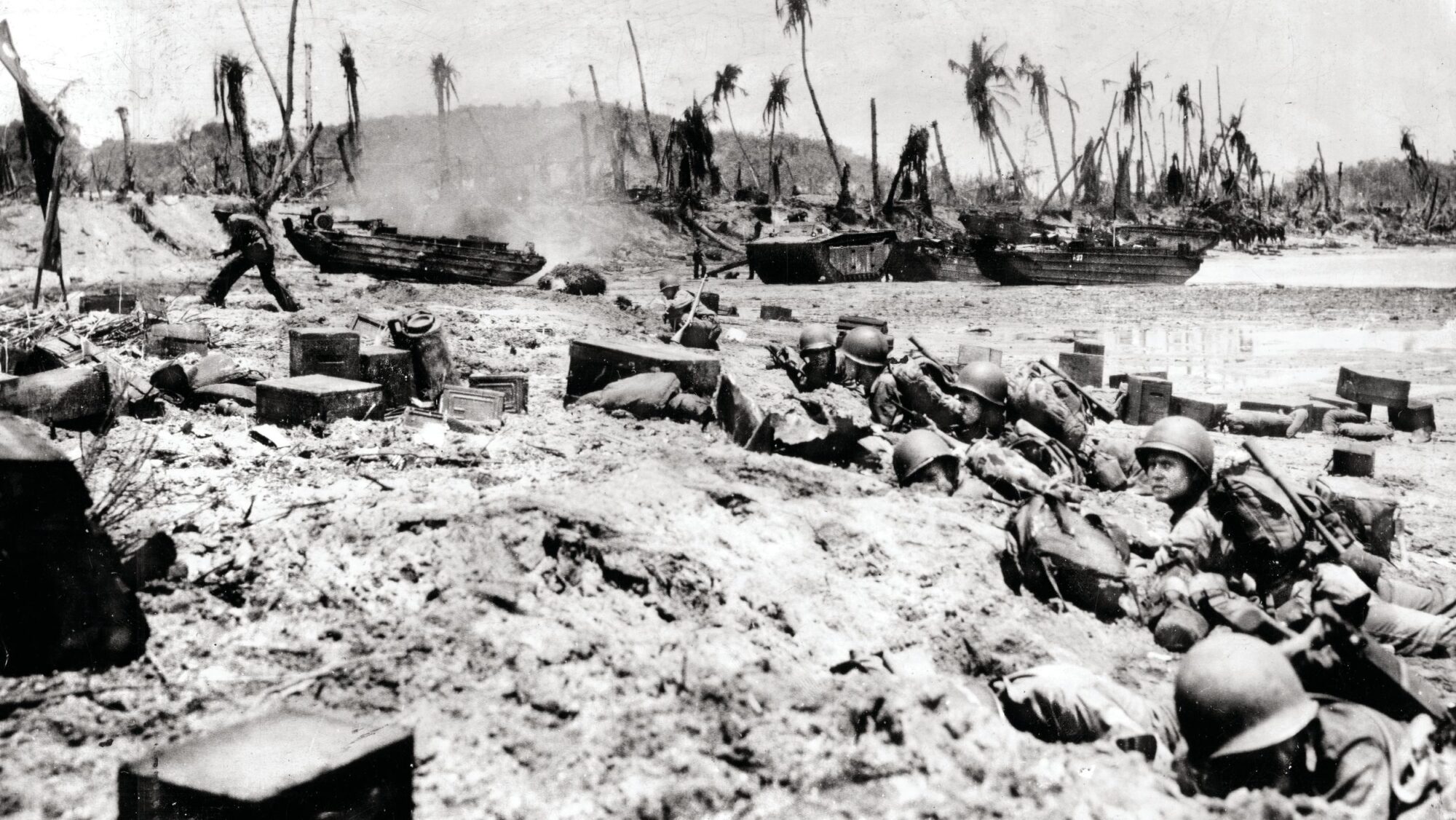
By about 0600, the landing craft had already been launched and began to circle, waiting for the signal to head for the beaches. The men aboard these LVTs (Landing Vehicle, Tracked) and LCVPs (Landing Craft, Vehicle and Personnel) had been awake since 0230, and had had their breakfast and made last minute checks on their equipment several hours earlier. The order to “land the landing force” was not given until just after 0730, when the landing craft finally broke their circle and began moving eastward, toward the shore. A Marine in the bow of an LVT looked toward the beaches and wondered the same thing as the gunners aboard the battleships and cruisers—could anyone still be alive on Guam?
The Third Marine Division came ashore on Asan Beach, on the western side of the island, while the First Marine Provisional Brigade landed at Agat, several miles to the south, and also on the other side of the Orote Peninsula. An Army unit, the 305th Regiment of the 77th Division, also came ashore at Agat. Two other regiments of the 77th Division stayed aboard the transports as a floating reserve.
At 0833, an air observer flying above the island announced, “Troops ashore on all beaches.” This was very good news for General Geiger, but did not have much of an impact on the troops. The men quickly discovered that many Japanese troops were still very much alive on Guam, in spite of the naval bombardment.

The Third Marine Division landed almost literally right on top of the Japanese command post. Lieutenant General Takeshi Takashina, commander of the 29th Japanese Division, had his headquarters on the sandstone cliffs that dominated the landing beaches. General Takashina’s troops began firing at the Marines as they approached the beaches and kept up their mortar and artillery fire after they came ashore. Snipers had a perfect view of the beaches from the high ground, and soldiers rolled grenades right down the cliffs onto the Marine positions.
The Marines’ first objective was to dislodge the Japanese from their stronghold. Gunfire from the warships offshore, joined by a mortar barrage from the newly landed Marines, was supposed to have softened up the Japanese position in advance of the Marine attack. But the enemy very quickly recovered from the shellfire, and just as quickly began firing at the exposed troops as they tried to make their way up the cliff. “Four times they tried to reach the top,” one of the Marines recalled. “Four times they were thrown back … they attacked up a 60-degree slope, protected only by sword grass, and were met by a storm of grenades and heavy rifle, machine gun, and mortar fire.”
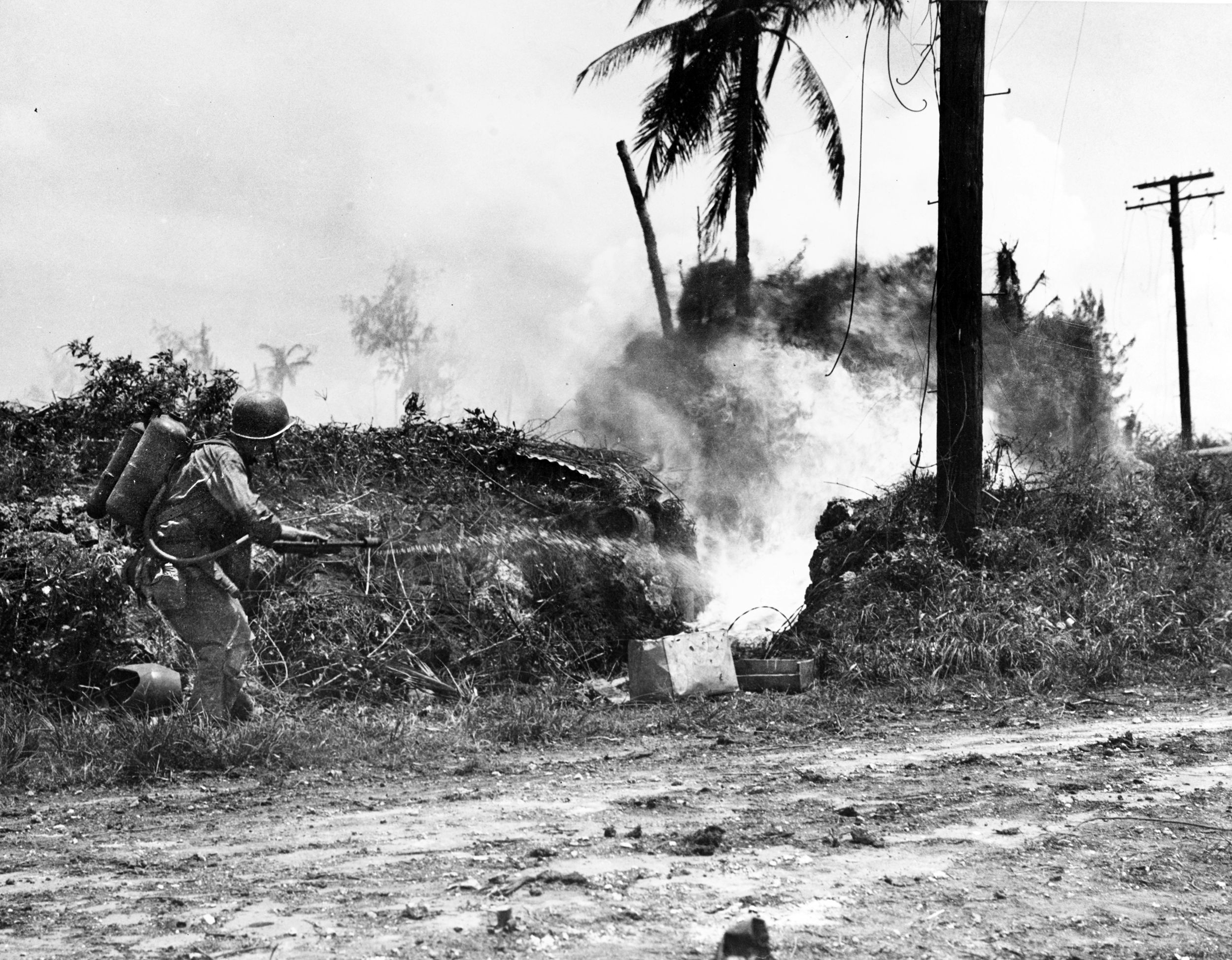
Tanks from the Third Tank Battalion were finally brought up from the beach. Between fire from the tanks and flamethrowers carried by Marine infantrymen, the Japanese position on top of Chonito Cliff was finally overrun—“cleaned out” in the Marines’ vernacular.
On the southern beach, at Agat, the First Provisional Brigade was finding Japanese resistance just as intense. A concrete block house with a four-foot thick roof was the main problem. The pillbox was situated in a perfect position, almost squarely in the middle of the landing beach, and was armed with two 75mm howitzers, one 35mm gun, and several machine guns. It was effectively camouflaged and had not been spotted by photo interpreters, which also meant that it had not been marked as a target either for air bombardment or naval gunfire. Several LVTs had been knocked out by the blockhouse before they could even get close to the beach.
Most of the LVTs managed to get past the gunfire and onto the beach—there were simply too many landing craft for the Japanese gunners. Once they reached the shore, the Marines came across a system of enemy trenches that one of them described as “excellent but unmanned.” The Marines were able to take possession of the deserted trenches without any resistance at all. By 1330, the massive pillbox that had caused so many problems for the landing force had been knocked out—the Marines had worked their way around it and had surprised the defenders by attacking from the rear.
At about the same time, General Lemuel Shepherd, commander of the First Provisional Brigade, established his command post on the beach. General Shepherd and General Allen Turnage, commander of the Third Marine Division, could be satisfied that their respective landings had been a success, and also that their respective units were in better condition than they might have imagined. At the end of the day on July 21, General Shepherd sent this cryptic message to General Geiger: “Our casualties about 350. Enemy unknown. Critical shortages of food and ammunition of all types. Think we can handle it. Will continue as planned tomorrow.”
But the day was not over yet. At about 1730 hours, an estimated 750 men of the Japanese 38th Regiment began what is usually referred to as an “all-out assault” on the Agat beaches. The focal point was Hill 40, a strategically positioned hill overlooking the Marine positions. Both sides recognized the vital importance of Hill 40. The men of the 38th Regiment did their best to take the hill; the Marines of the 4th Regiment managed to hold their position, but just barely.

A major with the 4th Regiment wrote, “K Company with about 200 men fought them all night long from Hill 40 and a small hill to the rear and northeast of Hill 40.” When morning came, “the Marines counterattacked with two squads from L Company …and two tanks. A number of men from Company K died that night, but all 750 Japanese soldiers were killed.”
“If the Japanese had been able to recapture Hill 40,” another officer recalled, “they could have kicked our asses off the Agat beaches.”
At the end of the first day, the Marines were safely ashore but their beaches were still vulnerable. They occupied two shallow, unconnected beachheads, but the enemy controlled the high ground just inland, which meant that they were not only in danger of counterattack, but were also within range of Japanese mortars and artillery. General Shepherd and General Geiger could see how absolutely vital it was to get off the beaches and capture the high ground.
On July 22, the Third Division and the Provisional Brigade began their move to get off the beaches. The most critical area was Bundschu Ridge, named after Captain Geary Bundschu, who had been killed in an attack on that ridge shortly after coming ashore. The drive to capture this ridge, which stretched along the northern third of the Asan beaches, began on the morning of July 22. But the Marines did not reach the crest of the ridge until noon on the following day. They spent the rest of July 23 overrunning any remaining Japanese strongpoints, officially known as “pockets of resistance.”
The Marines resumed their push inland on July 24. The 9th Marine Regiment did their best to link up with the First Provisional Brigade during the morning hours. The 9th Marines already had a measure of success, capturing the Piti Island Naval Base three days before, and were looking forward to joining forces with the First Brigade and consolidating their two landing beaches.
But progress turned out to be a lot slower than anyone had expected. The tropical heat and humidity were the main culprits for the slow advance, along with exhaustion—the steady fighting since the 21st was taking its toll. The Marines did capture a food and ammunition depot that the retreating Japanese had left behind but did not make anything resembling an all-out effort to make contact with the Agat beaches.
The Marines on the Agat beaches were holding their ground. All of their artillery had landed, along with “a steady stream of supplies.” Also, additional units of the 77th Division had been put ashore and were in place all along the beachhead perimeter. Japanese forces in the area had withdrawn to the Orote Peninsula, a long, finger-like spit of land that pointed off to the northwest.
Even though the Japanese on Orote were bottled up and isolated, they still posed a threat—they were lurking behind the American position on the Agat beaches and could cause considerable trouble if they decided to break out of their confinement. General Geiger decided to attack the enemy forces on Orote before they could do any damage. Because the 77th Division was defending the beachhead perimeter, General Geiger could send the entire First Provisional Brigade against the Japanese on the peninsula.
General Shepherd prepared to begin his attack on the morning of July 26. The 22nd Marine Regiment would attack on the right, and the 4th Marines were to attack on the left. Fifteen minutes before the attack, the Army’s 902nd Artillery opened fire on the Japanese defenses and were joined by other Army and Marine artillery units.
But in spite of all the planning and support, the 22nd Marines had a hard time gaining ground because of a mangrove swamp at the base of the peninsula. Their line of advance was rerouted to the Agat-Sumay Road, which was much easier for the Japanese to defend. But the 4th Regiment, moving up the other side of the peninsula, had a much easier time. To keep from bypassing the 22nd, and from opening a gap between the two regiments, the 4th shifted its position to cover part of the line that had originally been assigned to the 22nd.
The fighting did not get any easier for the 22nd Marines the following day. The morning of July 27 began with a steady rain, which filled everyone’s foxhole with water. Later that morning, Japanese artillery fire sent the men scrambling back to their foxholes, “water or not water,” as one sergeant put it. The artillery finally did let up, allowing the Marines to get under way. They did not get far before encountering Japanese infantry units—“The resistance was picking up,” one Marine put it.
It quickly became evident exactly why the resistance was increasing. “The area was full of pillboxes and bunkers,” the same sergeant reported. “It was a yard by yard fight.”
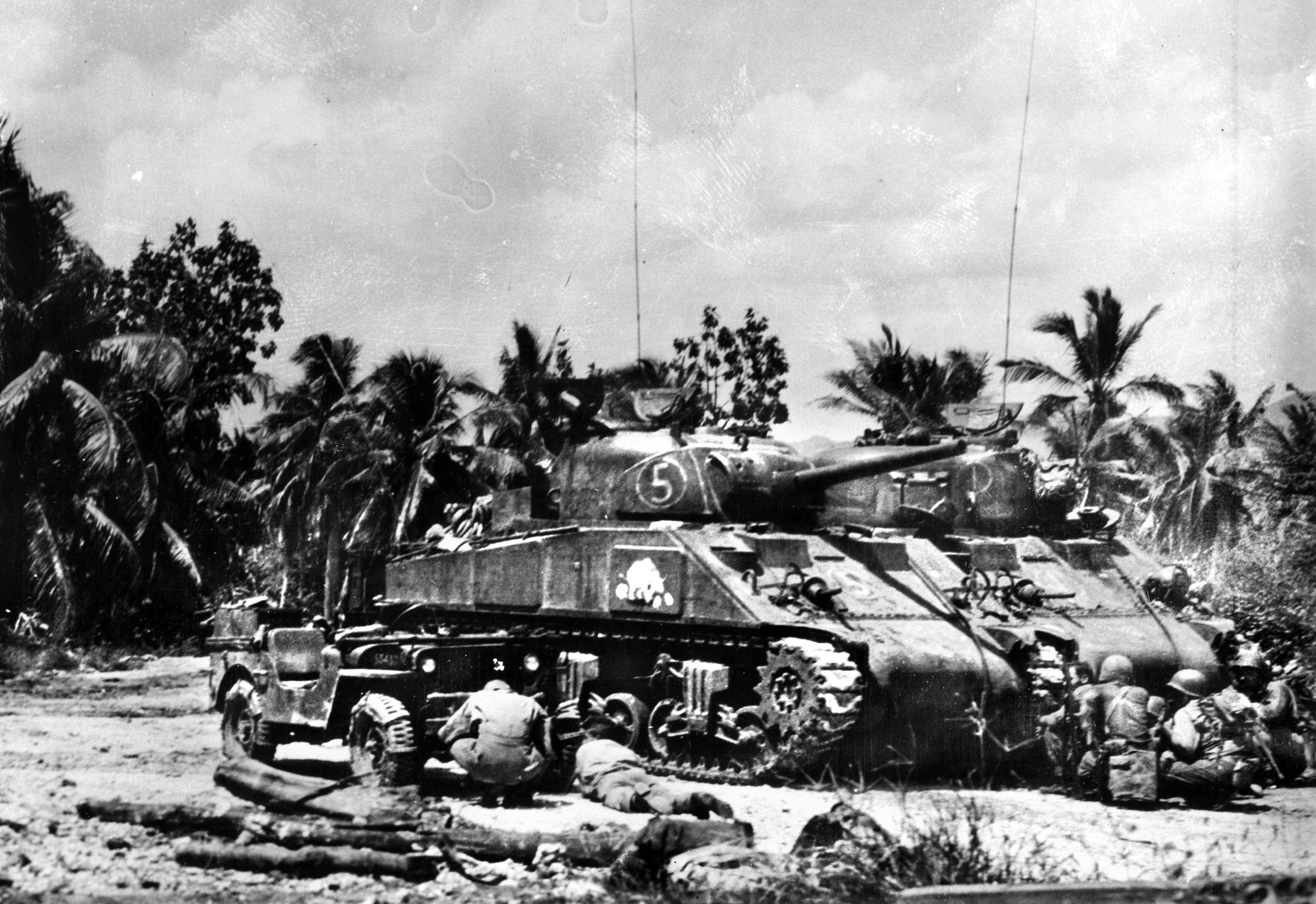
Sometimes Japanese mortar and machine-gun fire forced the Marines either to stop dead in their tracks or to withdraw out of range of the enemy fire. Whenever that happened, Sherman tanks were brought up to neutralize the enemy positions. With their 75mm howitzers and .50-caliber machine guns, they made short work of any pockets of resistance and allowed the stalled advance to start moving forward again.
The infantry was stopped by a line of pillboxes and trenches on July 27, and again a day later. In both instances, Sherman tanks were sent in to support the Marines, and in both instances the infantry and the tanks destroyed and overran the enemy’s emplacements. Surviving Japanese troops withdrew to the vicinity of Orote’s airfield, which was about two-thirds of the way up the peninsula.
General Shepherd decided to push right up the length of Orote on July 29. The old Marine barracks had already been retaken, and it looked as though it would take one more major assault to capture the airfield and secure the entire peninsula. Bombardment by Army and Marine artillery began during the early morning hours of the 29th, along with gunfire from the Navy’s warships just off the coast. After the barrage lifted, the Marines and all available tanks, including several M-10 tank destroyers, began moving forward at about 0800. Resistance was described as “meager.” By the end of the day, the Marines captured the airfield and pushed their way to the lighthouse on Orote Point, at the extreme end of the peninsula.
Japanese troops who survived the fighting committed suicide rather than surrender. Some jumped off the island’s steep cliffs. Others blew themselves up with hand grenades. A Marine private with the 4th Regiment watched some of the suicides from his position. “I could see the Japanese jumping to their deaths,” he said. “I actually felt sorry for them. I knew they had families and sweethearts like anyone else.”
This mindset, that suicide was preferable to capture, came as a jarring shock to the Americans. Japanese soldiers would hold a grenade under their chin and very calmly wait for the explosion. Or they might take 10 minutes to climb to the top of a cliff before jumping to their deaths, as though this was the most normal thing in the world. It was a strange and frightening philosophy for young men from Kansas and Michigan and Alabama, who never dreamed that such a way of thinking even existed.
Not every Japanese soldier was ready to commit suicide, though. As the fighting on Orote began to wind down and it had become evident to both sides that the Japanese were about to lose possession of the peninsula, a small, underfed Japanese private was taken prisoner. A Maine interpreter asked the soldier exactly why he decided to give up.
“My commanding officer told us to fight to the last man,” came the reply.

This seemed more like an evasion than an answer, so the interpreter insisted, “Well?”
“I am the last man.”
The Orote Peninsula was finally secured on July 29. Construction units began filling in the many shell holes that pockmarked the airfield almost as soon as the fighting stopped. Six hours after the first bulldozer clanked onto the field, a U.S. Navy TBF Avenger torpedo bomber made an emergency landing. It would be the first of many hundreds of such landings.
That afternoon, a flag-raising ceremony was held on the grounds of the old Marine barracks. The Stars and Stripes were hoisted at 1530 hours, with “To the Colors” played on a captured Japanese bugle. General Shepherd gave an emotional speech to a gathering of senior officers, which included Admiral Raymond Spruance and General Geiger, as well as to a “hastily cleaned up” honor guard made up of Marines who had been fighting just a short while before.
The general called Guam “hallowed ground,” and went on to say, “You have avenged the loss of our comrades who were overcome by a numerically superior force three days after Pearl Harbor. Under our flag, this island again stands ready to fulfill its destiny as an American fortress in the Pacific.” Marine losses on Orote are given as 115 killed, 728 wounded, and 38 missing. Japanese dead were 1633; total losses 2,500.
While the Provisional Brigade was pushing its way up the Orote Peninsula, the 77th Division was joining forces with the Third Marine Division. Reconnaissance patrols discovered that the remaining Japanese forces had moved away from the landing beaches to the northern part of the island. Natives who lived in the area confirmed that the Japanese had evacuated to the north.
On July 27, Major General Andrew D. Bruce, commanding general of the 77th Division, asked permission to take possession of Mount Tenjo. Mount Tenjo was about two miles inland from the base of the Orote Peninsula, strategic high ground still occupied by Japanese troops. General Geiger immediately gave his permission. By 0830 that day, a company of the 305th Regiment reached the summit of Tenjo. That afternoon, the 307th Regiment made contact with the Third Marine Division, which meant that the two beachheads had merged and the American lines were now continuous. There was no longer a southern landing area and a northern landing area, just one defensive line. Admiral Samuel Eliot Morison remarked, “It only remained to clear the enemy out of the northern half of Guam.”

But clearing the enemy out of the north was not going to be as simple as Admiral Morison made it seem. Japanese troops had established strong rear guards to give their retreating troops time to organize and were digging defensive positions against the advancing enemy. They knew they did not have much hope of driving the Americans off the island but were determined to make them pay for every foot of ground.
The offensive began on July 31, with the Third Marine Division advancing on the left and the 77th Division on the right. The First Provisional Brigade relieved elements of the 77th Division as defenders of the southern part of Guam.
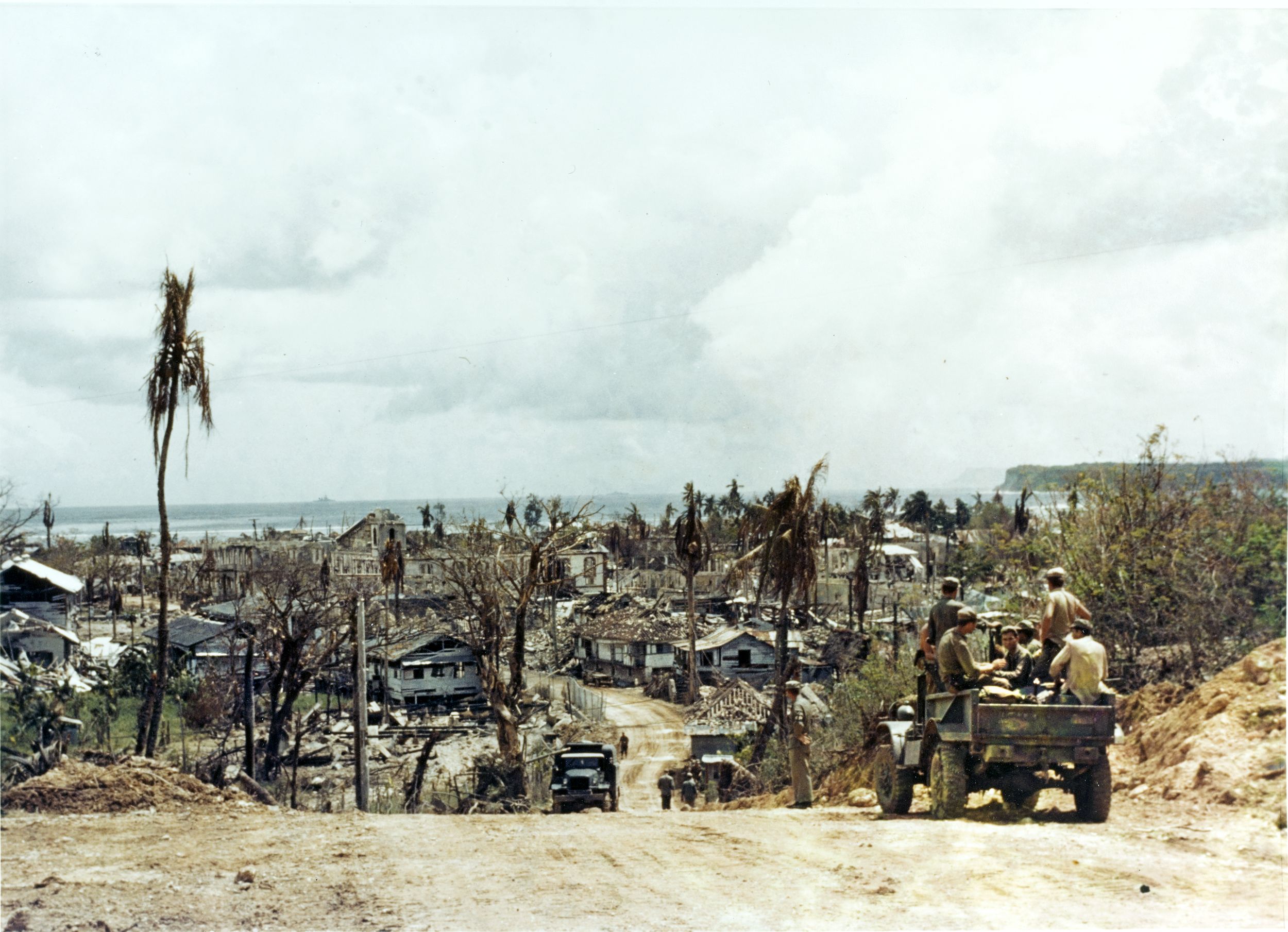
The first objective to be secured was the city of Agana, Guam’s capital, about halfway up the island on the northwestern shore. The Japanese abandoned the town to units of the Third Division. When the Marines entered Agana on the 31st, they discovered that the retreating Japanese had left nothing behind but ruins.
Agana had been Guam’s most heavily populated city before the war; about half of the island’s population lived there. A news reporter wrote this stark description of what was left of the city. “The cathedral and churches were gutted by shells and fires,” he wrote. “It was not wanton destruction, but incidental to the overall necessity of neutralizing Agana, which the Japs had made into one of their chief supply bivouac areas.
“Virtually every building was a shambles, most of them beyond recognition,” the reporter went on. “The coconut trees which once shaded the streets had broken like snapped twigs, withered by fires, while debris littered every foot of the once beautiful Plaza Espana in the city’s heart.”
After searching Agana for Japanese holdouts, the Marines left it behind and began moving north again. They made fairly steady progress throughout the day, until they were slowed down by mines on the morning of August 1. But when bomb disposal experts removed the mines, the northward drive began again. Enemy resistance had been fairly light, to the relief of the advancing Marines, and a lot less of a threat than the mines had been.

The 77th Division had also moved out during the early hours of July 31, and also ran into enemy opposition that was described as “negligible.” By the end of the day, two regiments, the 305th and 307th, rescued about 2,000 Guamanians that had been held in the Japanese detention camp at Asinan. Residents in the area told the Marines that the Japanese had left for the town of Barrigada, several miles up the island.
General Bruce assigned Barrigada to the 307th Regiment, with the 305th moving in the same direction but on the 307th’s right. By dawn on August 2, the two regiments were in position. General Bruce also sent about a dozen tanks on an armed reconnaissance of the town in advance of the infantry. His plan was to bring overwhelming force against the enemy, a combination of rifles and armor. But any thoughts of an easy walk into their objective were quickly laid to rest.
A dug-in Japanese position outside Barrigada effectively stopped the tanks with vicious and well-aimed fire. An infantry attack backed by artillery, which began at about 1330, was also stopped. By the end of the day, the two regiments dug fortifications of their own and waited for the morning to come, hoping that the next day’s fighting would represent a marked improvement over the past 24 hours.
As it turned out, August 3 did bring about a change in fortune—for both sides. An artillery barrage allowed the 307th to advance to the Barrigada well, close by the town itself. Access to the well not only gave the men access to the town, but also ended the scarcity of drinking water that had been a major problem since the landings.
By mid-afternoon, the 307th had advanced to the summit of Mount Barrigada, about a mile beyond the town and one of the highest points on the island. All three objectives connected with Barrigada—the town itself, the well, and the mountain—were now in American hands. Japanese units withdrew further toward the northern end of the island.

A few miles beyond Barrigada, the Third Marine Division, which had been joined by units of the First Provisional Brigade, was battling for possession of the village of Finegayan. During the night of August 2, Marine artillery fired nearly 800 rounds at the Japanese positions around Finegayan. At 0700 on August 3, the 3rd and 9th Regiments began moving forward and promptly ran into what one officer called “the toughest” defenses he had encountered on Guam. Two Japanese medium tanks came out of nowhere, “shot up the area,” and disappeared again. Another group of Japanese tanks was driven off by artillery fire later the same day.
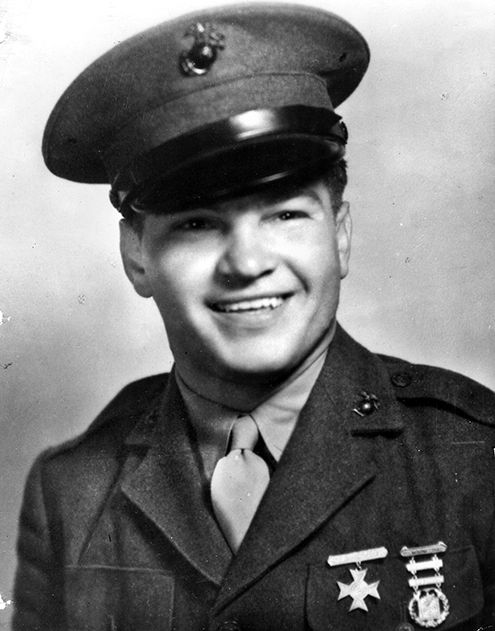
During the fighting around Finegayan, Private First Class Frank P. Witek ran ahead of his unit to take on an eight-man Japanese position that was holding up their advance. He was killed during the course of his one-man attack and was awarded the Medal of Honor posthumously. This was the sort of determination that put Finegayan in American hands by the end of the day on August 4.
By this time, the end of the Guam campaign was in sight. The Third Marine Division, First Provisional Brigade, and 77th Division all began their final advance on that day. At this stage, the jungle terrain and undergrowth, along with the rain, mud, and insects, posed more of a problem than the enemy. American units met with no organized resistance at all on August 5. Whenever pockets of resistance were encountered, they were quickly overwhelmed. The 9th Marine Regiment was held up by enemy riflemen who had hidden themselves in the underbrush, but the Marines fought their way through the Japanese position with the help of several tanks.
The Japanese line of defense had been completely overrun by August 7. During the next three days, all Army and Marine units steadily advanced northward supported by air strikes and artillery fire. A patrol from the First Provisional Brigade actually reached Ritidian Point, the island’s northernmost point, on August 8. But this was only an advance unit and was pulled back from the coast to dig in for the night. Other units in the area also dug themselves defensive positions. The enemy was still active and just might launch some sort of attack during the night.
During their drive up the island, units of the 77th Division discovered the underground headquarters of General Hideyoshi Obata, commander of the 31st Army. The Japanese defenders opened fire with machine guns and rifle fire that drove the surprised Americans back—no one knew that they were attacking General Obata’s headquarters. Instead of trying to drive the Japanese out of their underground caves, the soldiers decided to use explosive charges to seal the enemy troops inside them.
When the caves were opened a few days later, the bodies of over 60 Japanese were found inside. General Obata’s was among them. He had committed ritual suicide on the morning of August 11, after writing a letter in which he apologized for losing Guam. “Our souls will defend the island to the very end,” he wrote. “I pray for the prosperity of the Empire.”
By the time General Obata had committed suicide, General Geiger had already declared that all organized resistance on Guam had ended. The bodies of 10,984 Japanese had been counted up to that time, but there were still several thousand Japanese on the island that were armed and dangerous—between 7,000 and 10,000, depending upon which source is consulted.
Some of these soldiers staged ambushes or fired at the Americans from concealed positions. But with the death of General Obata and his staff, the Japanese no longer had any central command, which meant that none of the attacks were coordinated. Also, Japanese troops were too preoccupied with food—they were too weak from hunger to offer much in the way of resistance. Some managed to make their way into Marine food storage depots at night, where they stole a few days’ rations. Many were too weak even to attempt this and blew themselves up with hand grenades in desperation.
On the same day that General Geiger declared Guam to be secure, August 11, four of the highest ranking American Navy and Marine officers—Admirals Raymond Spruance and Chester Nimitz, along with Marine generals Holland M. Smith and Alexander Vandegrift—arrived on the island for a strategy conference with Geiger. The meeting took place without any incident. This was a stronger endorsement of the island’s security than any statement that General Geiger could possibly have issued.
Since the initial landings on July 21, Marine casualties were reported as 1,190 killed, 377 who died from wounds, and 5,308 wounded. The 77th Division’s casualties were 177 killed and 662 wounded. The Marines developed what has been described as a healthy respect for the soldiers of the 77th Division during the fighting on Guam. A battalion commander with the Third Marines said, “There was no doubt in our minds that the 77th were good people to have alongside in a fight, and as a result we referred to them as the 77th Marine Division.”
Guam became the Navy’s primary base for operations in the central Pacific. Seabees began extending the runways of Guam’s two airfields for the B-29 Superfortress bombers of the 20th Air Force. The big, four-engined bombers would soon begin attacking the Japanese home islands from their Guam base. On August 15, Admiral Nimitz announced that Guam would be his headquarters, which meant the rest of the war would be directed from Guam. Admiral Nimitz’s announcement also meant that new construction and building improvements had to be implemented as soon as possible. Roads were paved, and facilities at Piti Navy Yard were upgraded. Seabees built everything from office blocks and living quarters to tennis courts for the admiral and his staff.
The end of the war was still a year away. The recapture of Guam, and the construction of its airfields, were major contributions to the ending of the war in the late summer of 1945. One Third Division Marine, who had been stationed on Guam as a private in the late 1930s, tried to put the fighting in perspective from the view of the Marines who had fought their way from the landing beaches to Ritidian Point.
“When I heard about losing Guam to the Japs right after Pearl Harbor, it felt like I had lost part of my own country, part of home,” he said. “Recapturing it meant a lot to me, personally I mean. It was like retaking something that belonged to me. It was like going home again.”
David Alan Johnson is a longtime contributor to WWII History and the author of numerous books, the lastest of which is the story of Admiral Wilhelm Canaris, chief of the Abwehr, the Nazi intelligence apparatus.
Join The Conversation
Comments
View All Comments