By Kevin Seabrooke
The apologue of the “boiling frog,” which postulates that an amphibian placed in a pot of tepid water that is gradually heated to the point of boiling won’t notice the increase and jump out. Though considered false by modern scientists, it is useful as a metaphor for humanity’s capacity for self-delusion and selective ignorance.
That such a concept as a “Holocaust denier” could exist in the 21st century is mind boggling and is the reason that such meticulously researched and accessible works as historian Frank McDonough’s The Hitler Years Holocaust 1933-1945, the fourth volume in his “Hitler’s Germany” series, will always be necessary for future generations willing to not look away.
The series includes The Weimar Years: Rise and Fall 1918–1933, detailing pre-Hitler Germany; The Hitler Years, Volume 1: Triumph, 1933–1939, a chronicle of Hitler’s consolidation of power up to the invasion of Poland; The Hitler Years, Volume 2: Disaster, 1940–1945, follows the war, the fall of Germany and the Holocaust.
His clear, concise, factual chronology is unadorned with superlatives—there is no editorial voice nudging the reader as if to say, “look at this, isn’t this horrible?” McDonough lays out for a broad audience a chronicle supported by facts, statistics, testimonies and photographs that moves forward with solemnity, in its own gravitational force.
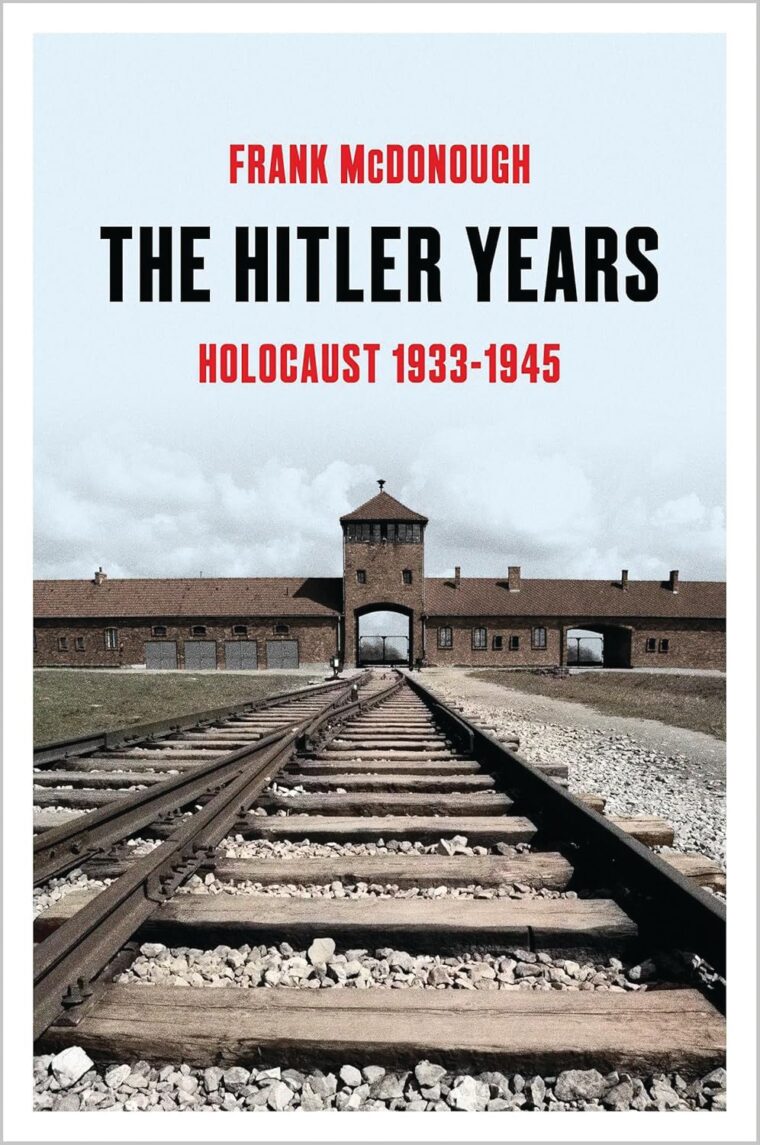 The Hitler Years: Holocaust 1933–1945 (Frank McDonough, Apollo/Bloomsbury Publishing, New York, NY, 416pp., Jan. 27, 2026, $45 HC) moves from the first chapter, “The Persecution Begins’ and marches grimly forward: Jewish life under siege; Road to Nuremberg; Racial defilement, emigration and Aryanisation; Escalating violence against Jews; In the ghetto; Mass murder.
The essential legal and political foundations of Adolf Hitler’s dream of a Third Reich were in place by the end of 1933—including the first concentration camp at Dachau, fully three years before Germany was allowed to host the 1936 Olympic Games for both winter and summer.
After he was appointed Chancellor in January 1933 came the Reichstag Fire Decree in February that suspended essential civil liberties, such as freedom of speech, assembly, and the press, and allowed the regime to imprison political opponents without trial.
The Enabling Act followed in March, granting Hitler the power to legislate without consent of the Reichstag, making him a dictator and effectively ending parliamentary democracy.
Hitler immediately began Gleichschaltung (Coordination), the process of infusing all parts of German society—political parties, trade unions, media, and state governments—with Nazi ideology and subject to its control.
By December 1933, only the Geheime Staatspolizei (Secret State Police) or Gestapo, for short, created that summer, in conjunction with the regular police force, were allowed to commit prisoners into “protective custody”(Schutzhaft).
The main part of the Nazi terror system, the Gestapo only had about 1,000 officers in 1933, though that number would grow to 15,000 by 1939. Ordinary German citizens were its eyes and ears, giving it the fearsome reputation as an “all-powerful thought police.”
McDonough writes that the concentration camps, known as the Konzentrationslager, or “KL,” staffed and run by the SS were the second part of the Nazi terror system.
The “protective custody,” supposedly simultaneously protected the public from those the Gestapo arrested and protected the arrested from the rest of the population. Gestapo founder Hermann Göring, put it more chillingly. Those who had committed treason and who could be proven to have done so, would be turned over to the police. “The others, however, of whom one might expect such acts, but who had not yet committed them, were taken into protective custody, and these were the people who were taken to the concentration camps.”
Only six months later came “The Night of the Long Knives,” June 30-July 2, 1934, in which Hitler, at the urging of Göring and Heinrich Himmler, ordered the killings of officially 85, but possibly many more to eliminate the potential threat of Ernst Röhm and the Nazis paramilitary organization, Sturmabteilung (SA), also known as the “Brownshirts.”

Join The Conversation
Comments
View All Comments