By Kevin Seabrooke
Though now more nuanced, for many years historians have written about the “spirit” that surrounded the buildup to the Great War.
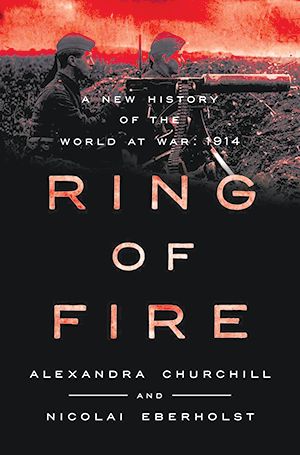 In their new book, historians Alexandra Churchill and Nicolai Eberholst acknowledge that, “a common image of those days in the summer of 1914 is one of enthusiasm, a universal ‘spirit’; people waving flags and rushing forth in their eagerness to fling themselves at the enemy.”
While recognizing that such feeling did exist in some places—cheering, singing crowds in Berlin—the authors, whose stated focus is more on the “how” the war began rather than “why,” mine a rich trove of writings from all walks of life to detail experiences, motivations and reactions to this cataclysmic conflict.
Focused almost exclusively on August 1914, Ring of Fire aims to go beyond troop movements, generals and politicians and, indeed, beyond the confines of Europe and the trenches of France, to probe into a conflict that is much more complex and global in nature than is often portrayed.
Ring of Fire: A New History of the World at War: 1914 (Alexandra Churchill & Nicolai Eberhols, Pegasus Books, New York, NY, 448 pp., maps, Aug. 5, 2025 $35 HC)

Join The Conversation
Comments
View All Comments