By Allyn Vannoy
Mission No. 443, dispatching the 1st, 2nd, and 3rd Air Divisions against Nazi-occupied Europe was launched by the U.S. Eighth Air Force on June 27, 1944. No aircraft were reported as lost.
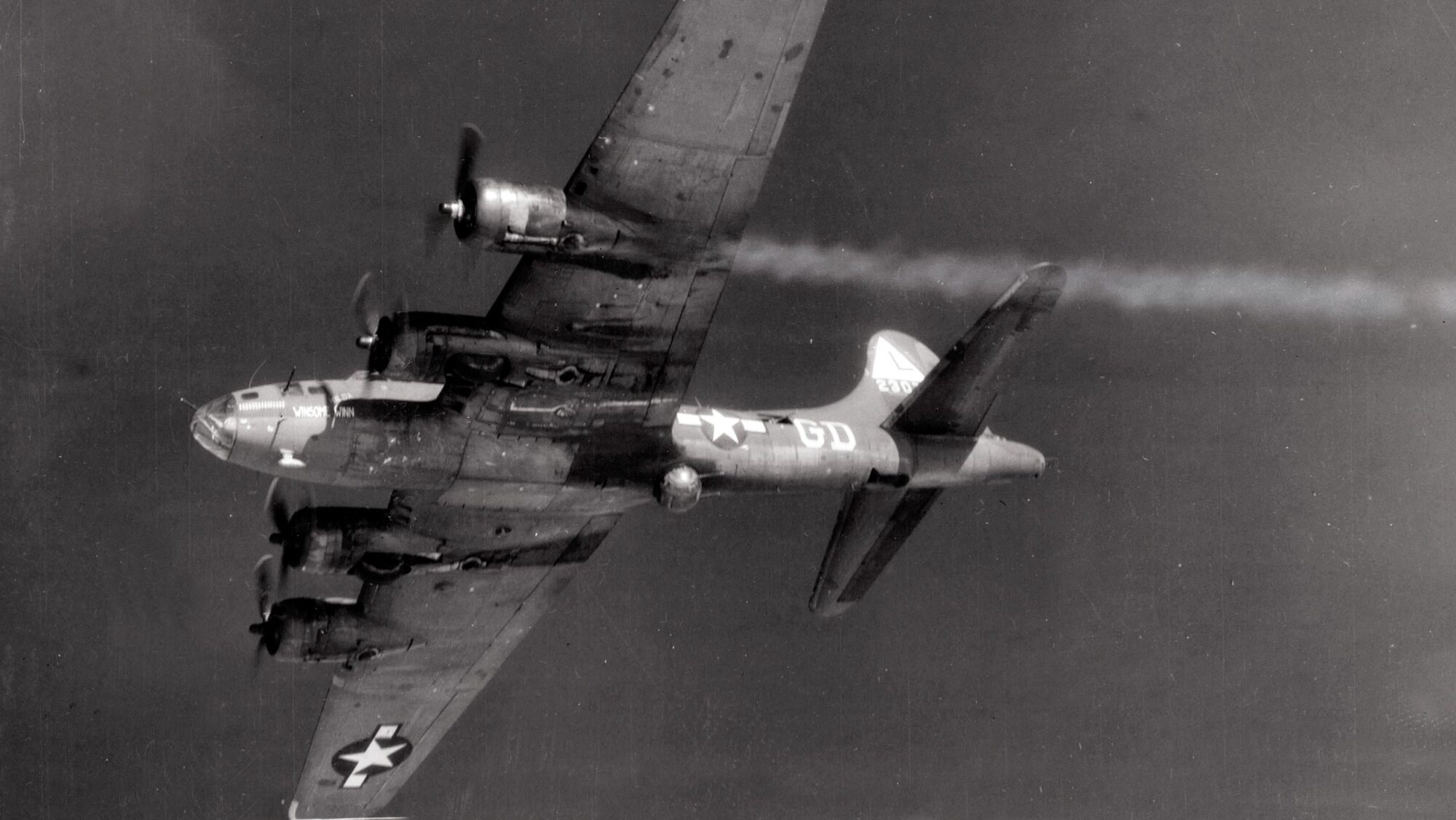
During the mission Brigadier General Arthur W. Vanaman, recently appointed A-2 (Chief of Intelligence) at Eighth Air Force headquarters, flew as an observer with 1st Lt. Clarence Jamison’s crew aboard the 379th Bomb Group’s Boeing B-17 Flying Fortress bomber “Big Barn Smell.” The target was the V-1 weapon storage area at St. Martin l’Hortier, about 28 miles northeast of Rouen, France. After a shell burst near the plane’s No. 4 engine, the flight engineer (top turret gunner) reported a fire.
The pilots saw flames coming from the engine’s oil filter plate on the nacelle and immediately alerted the crew for possible bail out. The burning engine was shut down, but as the flames persisted, intermittently trailing from the wing back to the tailplane, and as an explosion appeared to be imminent, the pilot gave the bail out order. The navigator, bombardier, engineer, co-pilot, and General Vanaman complied, leaving by the nose hatch. Lieutenant Jamison had difficulty engaging the auto-pilot, but before he could leave the cockpit one of the crew members in the rear of the plane reported that the fire had gone out. Seeing this, Jamison countermanded his order and stayed at the controls. After jettisoning the bomb load, Jamison was able to fly the B-17 safely back to base.
Apparently during the fateful mission a fuel line had been severed and escaping gasoline had been ignited by the engine exhaust. There was little damage and the aircraft was scheduled for operations the next day.
After bailing out of the bomber Big Barn Smell, Vanaman’s story would take some unique and interesting turns. General Vanaman spent the rest of the war as a POW. Because of the circumstances of his arrival, his captors were suspicious that he was a deliberate plant by counter-intelligence.
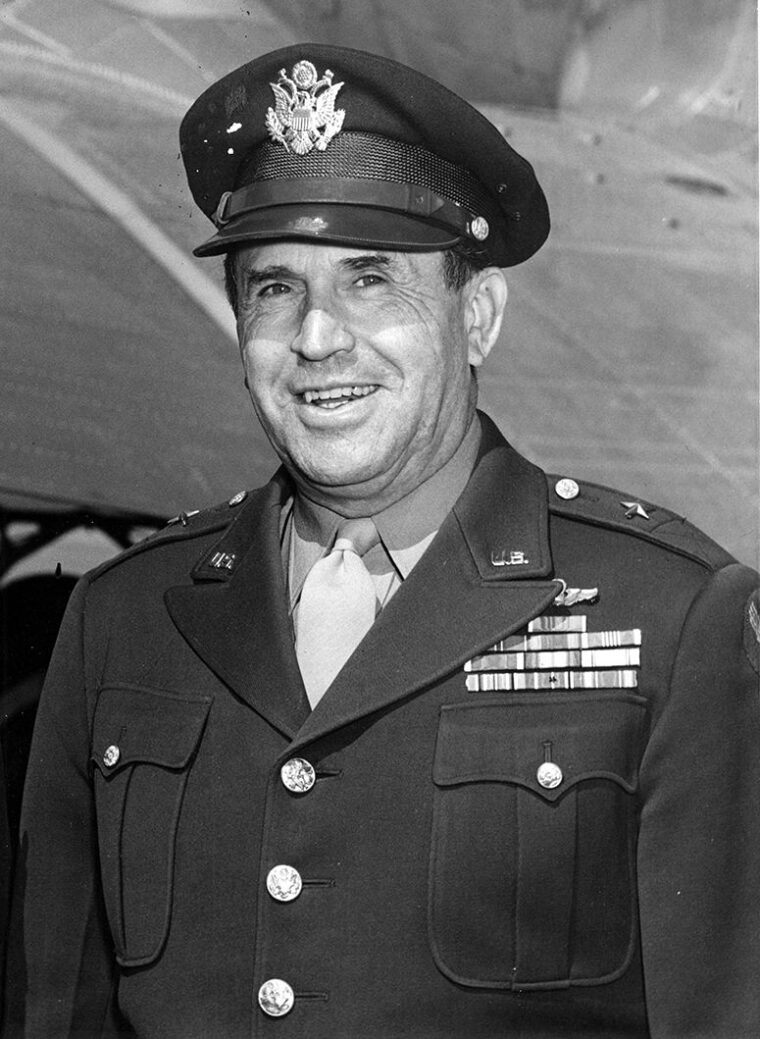
He was born on May 9, 1892, in Millville, New Jersey. He graduated from the Drexel Institute of Technology in 1915 and studied aeronautical engineering at the Massachusetts Institute of Technology. He was commissioned as a 1st lieutenant in the U.S. Army Air Service on July 1, 1920. In 1937, he graduated from the Army War College. Soon after, he was appointed as an air attaché to Berlin. In August 1941, Vanaman returned to the U.S. and was assigned as Secretary of the Air Staff in Washington, D.C.
Landing in the French countryside between Contay and Puisieux on the Somme, the four airmen who parachuted from the stricken B-17 were able to escape, but Vanaman, injured in the jump, was immediately captured. One of the highest-ranking American POWs of World War II, he was taken to Stalag Luft III. In 1945, Nazi officials brought Vanaman and Col. Delmar T. Spivey to Berlin in an attempt to conduct clandestine peace negotiations with the Allies.
The post strike report of the 379th Bomb Group, dated June 28, 1944, indicated that 14 aircraft of the bomb group, part of the 41st Combat Wing, were airborne at 1524 hours, as part of the mission strike force to hit military installations at St. Martin l’Hortier. At 1819 hours, the group crossed the English coast at 26,000 feet, then crossed the French coast at 1839. Bombs were dropped at 1926, on a “target of opportunity,” as the GH equipment (electronic targeting device) of the lead aircraft was jammed. Two runs were made over the primary target in an attempt to bomb visually, but cloud cover prevented this.
Weather over the primary target was reported as “6/10” cloud cover with tops at 15-16,000 feet. The report said that flak was “meager, but accurate,” encountered at 1846 hours.
No aircraft were lost, but five men had indeed bailed out of aircraft number 42-32093 at 1915 hours at 24,000 feet.
Lieutenant Jamison reported, “We were making our first run-on the primary target. Flak started coming up and I heard it hit the ship. A few minutes after we got the flak the formation turned and we followed them. Right after that I heard someone yell over the interphone that the #4 engine was on fire. I was still flying formation. I looked over at #4 and couldn’t see anything wrong with it. The co-pilot kept looking out the right window and then I looked again and could see flame coming out of the oil filter plate on the side of the nacelle so I gave the order to prepare to bale (sic) out. This was at 1915 hours…The co-pilot wasn’t getting ready to bale out so I motioned him out and down. This was one minute after the warning. Then I called over the interphone, ‘Bale out’. I yelled that about three times. Then I started and got caught in the controls and couldn’t get out. Just as I started out I put the ship on AFCE [Automatic Flight Control Equipment]. The elevator control wouldn’t work and was in full nose-high position. The nose of the ship pulled up sharply. I pulled it down again and tried to center the lights on the AFCE but could not do so, so I started out again. Just at this time I heard someone in the waist call over the interphone to say that the fire was out. We were at about 24,000 feet and as the bomb bay doors were still open I dropped the bombs in an open field at this point. I looked out the window and couldn’t see any more fire so I just kept flying the ship. It seemed as though fire was really out as I turned and tried to follow the formation. I was too busy to follow them though as I only had three engines. I just headed straight for the nearest water, cross the Channel, found the base and landed.”
The bombardier of Jamison’s crew was George Rogers. He recalled: “Over the target area, the plane… (was) struck by antiaircraft fire and the number four engine caught on fire. Engine fires in these aircraft were dreaded, because the entire wing of the plane was filled with gasoline tanks, and once they caught fire there was little hope of escape. The engine was shut down, but the fire persisted, so the Pilot (Clarence Jamison) signaled the crew to abandon ship.”
The navigator, then Vanaman, then George (the bombardier) left the plane. George related that he and the general landed together and that there was disagreement as to the next course of action. George thought that the best course of action was to hide and let the advancing Allied troops pass over them. This was a few weeks after the Normandy invasion, but nearly a month before Operation Cobra and the Normandy breakout was launched. The general had other ideas, and so they split up. George was able to evade the enemy, and eventually returned to Allied control.
Radio operator Technical Sergeant Kanpp L. Vallas, remembered, “We were getting near the target when flak hit us. A few minutes later #4 engine caught on fire and the Engineer reported it to the Pilot on the interphone. The Pilot told the crew to prepare to bail out. The next order was the order to bail out which followed just a few moments later. Immediately the Bombardier, Navigator, Co-Pilot, Engineer and the General bailed out. The waist gunner and the Ball Turret man proceeded to the rear exit to bail out. Then the Ball Turret man noticed that the fire was out so we informed the Pilot of this fact. At this time there was [sic] only five men left in the plane. The Ball Turret man crawled back to the tail to administer oxygen to the Tail Gunner. The Pilot immediately started descent. For the next five minutes we all stood ready to bail out because the fire came back once to twice and we didn’t know whether it would continue to burn.”
Tail gunner Staff Sergeant Salvatore Tomaselli recalled, “We were on the bomb run and got hit by flak. Somebody said that there was gas leaking out of #4. I could see it streaming back to the tail. Then someone called ‘fire.’ The pilot told us to prepare to bail out. I took my flak suit off and went back to the tail escape hatch. At this time [I] passed out due to lack of oxygen and didn’t hear a thing until the Ball Turret Gunner came back and woke me up. We were at about 16,000 feet then. After we got down to about 12,000 to 13,000 feet I went up to the nose to see if I could get the bomb bay doors closed. I then went back to the tail to look out for fighters since we were all alone. The pilot took action to avoid being picked up by enemy radar on the way back.
Captain John J. O’Connell, a staff officer of the 379th Bomb Group, officially reported, “Due to the failure of the Gee-H equipment and the fact that there was 9/10’s clouds at the target, the primary target was not bombed. In aircraft number 42-32093, which was flying lead position in our High Squadron, piloted by 1st Lt. Clarence E. Jamison, Brig. Gen. A.W. Vanaman, who is A-2 of the 8th Air Force was riding as observer, in the nose of this plane. During the bomb run on the primary target at about 1900 hours, this aircraft was hit by flak and the #4 engine was set on fire. The pilot reports that the fuel line was broken and that gasoline was streaming… There was [a] large sheet of flame from the trailing edge of the wing back to the tail. The pilot gave the order to bail out at 1915 hours after first giving a preparatory order. Gen. Vanaman, the Co-Pilot, Navigator, Bombardier, and engineer immediately bailed out at 490 North- 010/30’ East from 24,000 feet. As the pilot was preparing to bail out [he] heard one of the crew members call over the interphone that the fire had gone out so he continued operating the plane. About five minutes later the pilot dropped the bombs in an open field. The plane descended to about 15,000 feet. The pilot was able to get it under control and returned to base with the remaining four members of the crew, being the radio operator, ball turret gunner, waist gunner, and the tail gunner.”

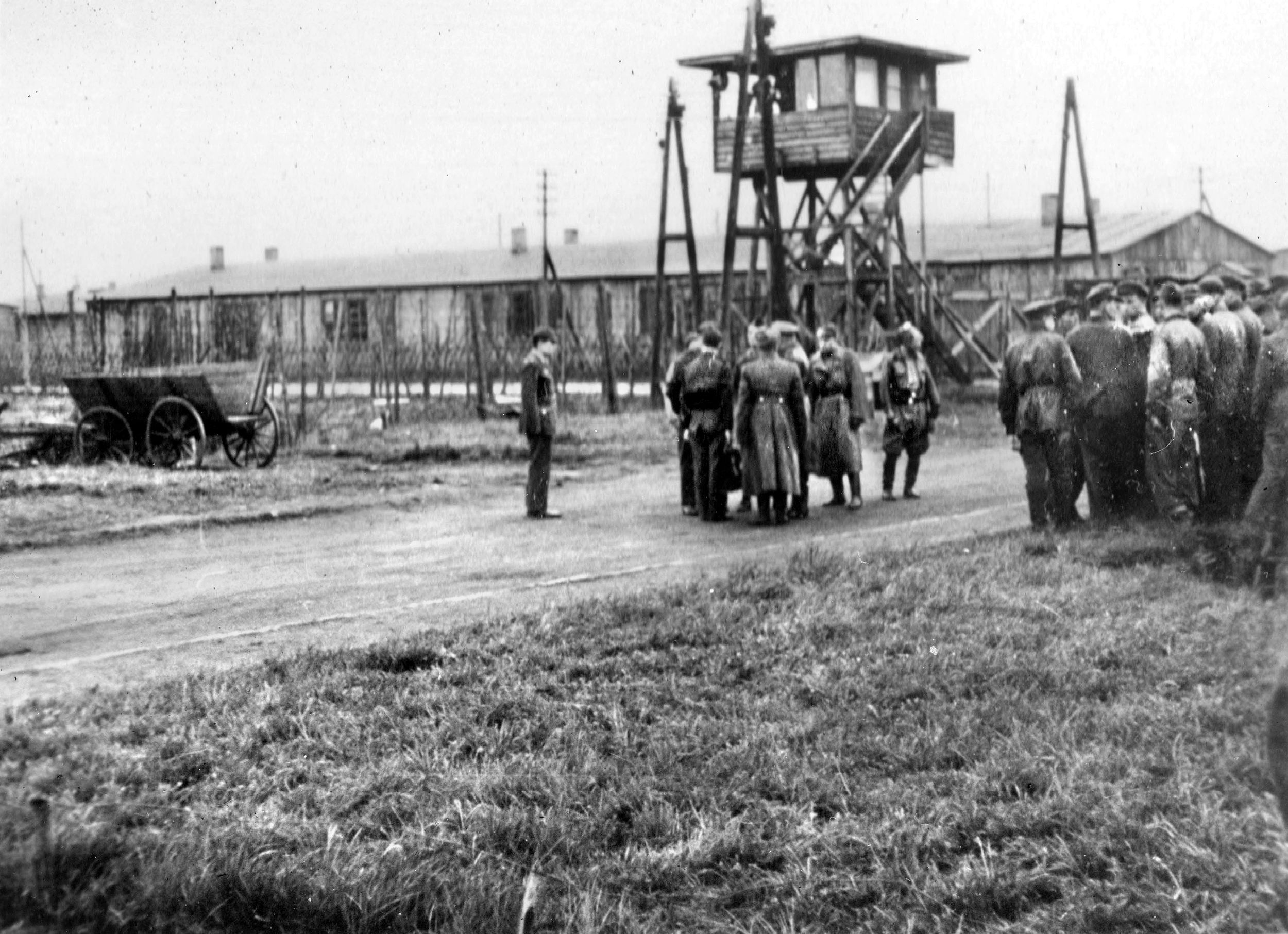
Stalag Luft III was located near the town of Sagan in Lower Silesia, now Żagań, Poland, near the German border. The camp held Western Allied air force personnel and was best known for two escape plots by Allied POWs. One was in 1943, described in the book, The Wooden Horse, by Eric Williams. The March 1944 plot, known as the “Great Escape,” was conceived by Squadron Leader Roger Bushell of the RAF and authorized by Herbert Massey, the senior British officer at Stalag Luft III. Former POW Paul Brickhill would write a book about this attempt that would form the basis of the film The Great Escape (1963).The camp was liberated by Soviet forces in January 1945.
Vanaman succeeded Colonel Spivey as the senior American officer in the camp. Spivey had been captured on August 12, 1943, while flying as an observer with the 92nd Bomb Group. As the USAAF expert on aerial gunnery, Spivey was on the mission to evaluate possible improvements to gun turrets. Spivey had assumed command as senior American officer in the center compound of Stalag Luft III, in August 1943. He created a history of the camp which would serve as the foundation of the book, Stalag Luft III—The Secret Story, a history of the camp, by Col. Arthur A. Durand.

There were many rumors about how Vanaman arrived at the camp. One suggested that he had flown over the area in a bomber and bailed out. At the time there were reports that many American, British, and French generals who were prisoners of the Germans lived in several manor houses or castles—all Allied generals but one, that being Vanaman, who was at Stalag Luft III. Some thought that Vanaman was German, although he was an American citizen. Another theory suggested that as the military attaché to the American ambassador in Berlin before the war, he knew the top members of the German government. Vanaman had indeed served in the Nazi capital city from 1937 to 1941, and was fluent in German. There were also rumors that Vanaman was visited by senior German officials while at Sagan.
Because Vanaman was held at this camp, there were stories of special treatment given the prisoners there and that the quarters, recreation facilities, privileges, and food were of a better standard while representatives of the Red Cross could enter and leave as they pleased. The camp had been in operation since 1942, two years before Vanaman’s arrival.
It was said that the general was constantly negotiating with the camp’s commandant about the slightest thing that he did not consider proper, that the commandant was afraid of Vanaman as the general was apparently well known in Germany. This all led to the belief that Vanaman’s being at the camp was not an accident.
On January 12, 1945, as Russian forces were advancing into Germany, Vanaman was said to have addressed his fellow prisoners, telling them that what he thought was to happen. He announced that the German guards would either evacuate or surrender the camp to the Russians, that orders would be issued to kill the prisoners, or that they would be evacuated on a long march across Germany in an effort to keep them out of the hands of the Russians. The last of these three possibilities turned out to be true as the prisoners were forced to march west under guard in the dead of winter.
Once organized and marched from their camp at Sagan, they reached a temporary refuge in a brick factory near Muskau. Vanaman told his men that he had met with the commandant and a general of the staff of the Luftwaffe and that Hitler had directed the Luftwaffe to march the prisoners to Berlin. There they were to be held in the city as hostages to prevent further bombing from the Allied air forces. Vanaman explained to a Luftwaffe general that such action would be considered direct and willful murder of prisoners of war. He told him that they, the prisoners, had no intention of going to Berlin, and that if anything should happen to them, the general and every general of the Luftwaffe would be held directly responsible.
It was obvious that the war would be over in a short time. Vanaman told his fellow prisoners that in a day or two that he and several other representatives of the prisoners would leave for Spremberg, Germany, and meet with a Luftwaffe general after he had conferred with his superiors. If Vanaman failed to change their minds regarding the order to proceed to Berlin, and with the Russian Army so close, it might mean the need to overpower the guards, then hide out for several days. He indicated that this was to be a last resort and that no man was to desert or make any foolish attempt on their own.
The next day the camp commandant, after attending a high level conference with Luftwaffe officials, informed the prisoners that they would continue to Spremberg the next day, February 4.

Reaching Spremberg in the next evening, the prisoners were fed and placed in barns. Vanaman told the men he was to meet with several Luftwaffe generals at their local headquarters in Spremberg the next day. There was speculation among the prisoners as to what Vanaman might propose to the Germans as to their care and destination. It was believed that he would ask them to allow the prisoners to remain in Spremberg until the Russians arrived and, in return, promised the Germans their lives and certain concessions after the prisoners had been liberated.
On Monday, February 5, the prisoners were marched to the western edge of the city to a large Luftwaffe fighter base, where they were housed in several hangars—facilities that were much better than the barns they had been in. Each hangar had toilets, running water, and plenty of space. The prisoners received word that Vanaman had been engaged in negotiations with several German generals and expected to reach an agreement by the next morning.
The following day, a large crowd of prisoners had gathered outside the main administration building of the base when Vanaman, Spivey, the commandant, and three Luftwaffe generals appeared. Two Luftwaffe chauffeured cars then appeared, and Vanaman, Spivey, the three German generals and their two aides departed, leaving a Captain McGee in charge of the prisoners.
Later that day McGee received a message from Vanaman which he read to his charges: “Gentlemen, I have made an agreement with several high-ranking German generals whereby you will be moved, starting late this evening. Several freight trains will be made available to the Spremberg marshaling yard, and you will be moved by boxcar from Spremberg to the western front. Your new prison camp will be Moosburg (Stalag VII-A), located about halfway between Munich and Nuremberg. You will be out of danger here. Everything cannot be revealed to you at this time. I must go to Berlin with the German generals. I am taking Colonel Spivey with me, and I may not see you again until the end of the war. I have talked to the commandant regarding your treatment, and I am certain that you will be treated well. Good luck to each of you. Until we meet again, remember to keep your faith and trust in God.”
After arriving at Stalag VII-A, on February 18, the prisoners received word that Vanaman, Spivey, and the three German Luftwaffe generals had made it to Berlin. They found the city in ruins as a result of the tremendous bombing. There they gathered papers, money, and belongings and then returned to Spremberg, From there, the group drove to Munich, then on to the Swiss-German border. The border guards did not question the three German generals. It seemed that Vanaman had promised freedom from war crimes trials and a return to civilian life for the generals and guards who did not harm American prisoners of war. Although one would have to question his authority to do so—maybe it was simply based on his personal relationship with the Luftwaffe officers. It was believed that the general was taking the German generals to Supreme Allied Headquarters to report on the location and condition of the prisoners, their needs, and plans to evacuate them safely.
After surviving his harrowing mission and capture, Vanaman had done his utmost to care for the prisoners entrusted to his command, and his efforts were noted. During May-June 1945, he served as Deputy Chief of Staff for Prisoner of War Affairs in France. He remained with the Air Force until retiring in 1954 with the rank of major general. During his career he was awarded the Distinguished Service Medal, the Bronze Star, and the Belgian Croix de Guerre with Palm. He died in 1987 at the age of 95.
Author Allyn Vannoy has written extensively on a variety of topics related to World War II. He resides in Hillsboro, Oregon.
Quite a story! Knew the basics, the additional info is most welcome. Thanks!