By Kevin Seabrooke
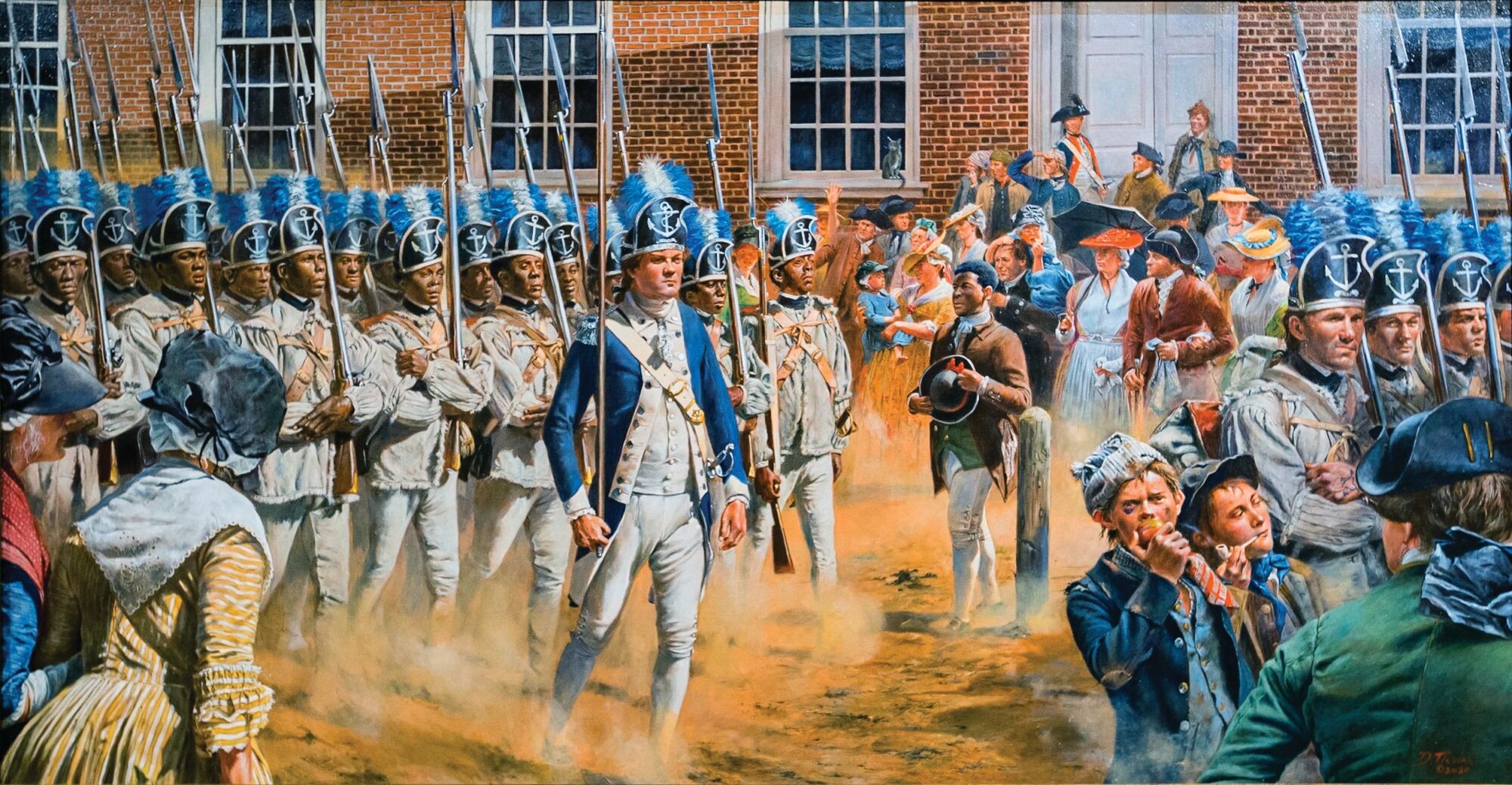
When the first shots of the Revolutionary War were fired at Lexington Green on the morning of April 19, 1775, Black men had already been serving in colonial militias for some time, particularly in New England. Some even had previous military experience from the French and Indian War. Their participation during these opening moments helped sustain the Patriot cause at a time when the Continental Army did not yet even exist.
And while “Indians and Negroes” were not technically permitted to train as soldiers in the militia, they were expected to be armed and “turn out” in an emergency. There is documentation that Prince Estabrook, an enslaved man serving in the Lexington militia under the command of Col. John Parker was on the green that morning and was hit by a musket ball in the left shoulder. He recovered and would serve several tours until the end of the war.
Historians have documented at least 35 men of color in integrated units there, or at Concord Bridge later that day, most in local militia, though the number could be higher. Of those, 11 were officially in some of the so-called minute companies that began forming and training twice a week in October 1774, at the suggestion of the Massachusetts Provincial Congress
Free and enslaved African Americans would play a crucial, yet often overlooked, role in shaping both the conflict and its meaning—are all men “created equal” or not?—from the earliest moments of resistance. Their contributions were not limited to physical labor or support roles; many fought directly in combat, demonstrated exceptional bravery, and influenced military outcomes. A recent analysis regarding the number of African Americans in the colonies in 1775 estimates there were 450,000 enslaved persons, and roughly 50,000 free. Some 4,000 Black men, free and enslaved, would serve as soldiers in the Continental Army over the course of the war, with estimates of participation in all services, including sailors, ranging from 5,000-8,000. This is not an insignificant number for a force that never at one time numbered more than about 20,000 troops.
About 10 percent of the sailors serving in the Continental Navy were free or enslaved Black men serving on ships that were, by maritime tradition, unsegregated. The Royal Navy had an estimated 15,000-20,000 Black sailors serving aboard their ships. This number would grow as Britain tried to lure enslaved men from the Colonies with promises of freedom, with disastrous results in some cases, as they were sold back into slavery.
The history of the American Colonies and the War for Independence, like all history, is rife with apocryphal stories. A single person, with a name, who committed a singular act, is easier to remember than a large group who did many things in many places over an extended period of time. Over decades real events, impressions, and beliefs are combined and repeated until they’re distilled into symbols, a shorthand to represent a group, an event, or an era. In the minds of many, for example, the Patriots were all white men like George Washington, who is himself a symbol and the subject of many apocryphal stories.
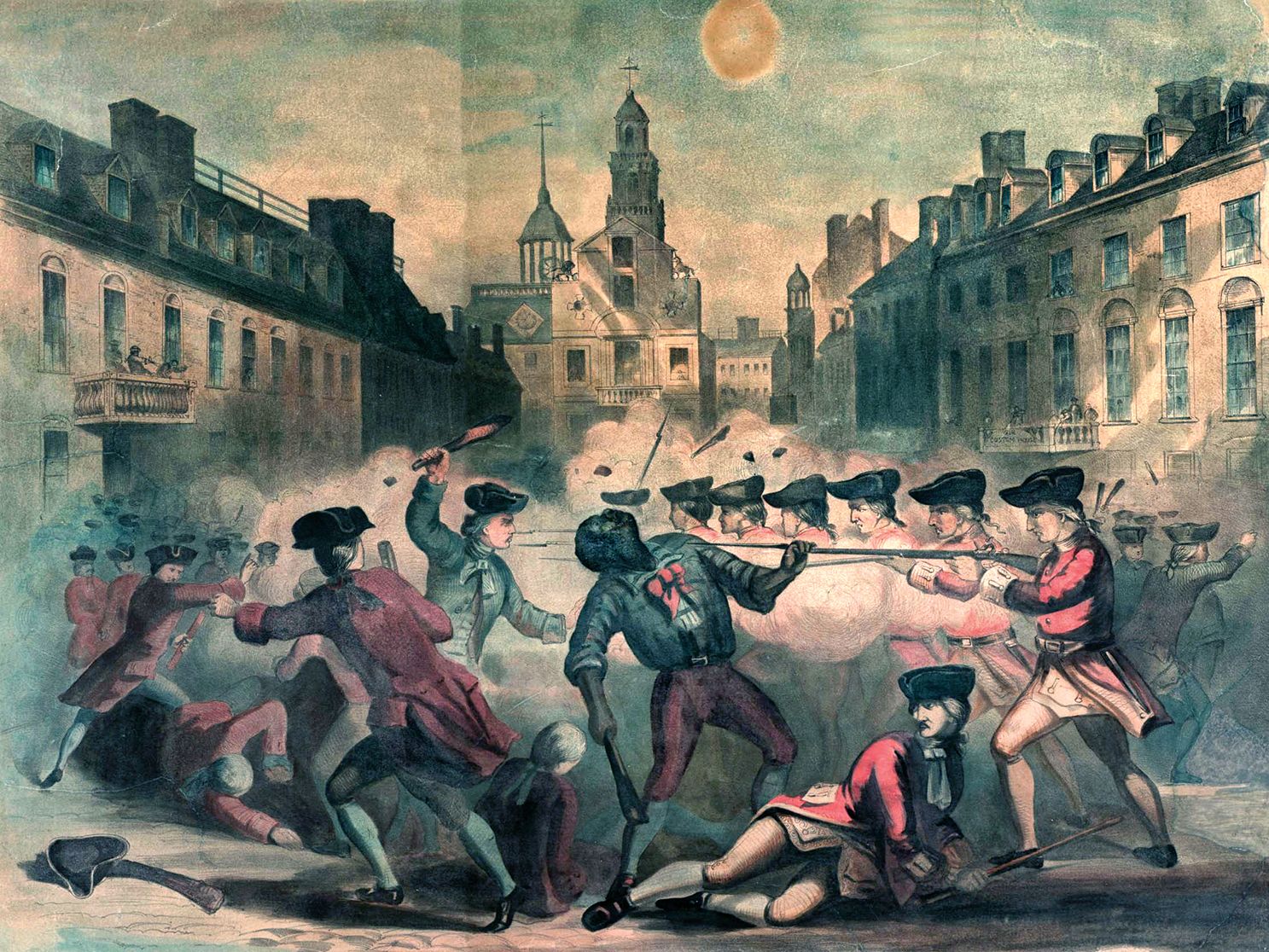
One of the most powerful early symbols of Black participation in the American Revolution was Crispus Attucks, a man of African and Native American descent who was shot and killed by British soldiers during the “Boston Massacre” of March 5, 1770. He is often referred to as the first death in the Revolution, though 11-year-old Christopher Seider (possibly Snider) died two weeks earlier when customs agent and British informer Ebenezer Richardson fired into a crowd protesting outside his house.
Attucks’ death became a rallying point for colonial resistance to British authority, and Patriot leaders frequently invoked his sacrifice in propaganda against British tyranny. His role demonstrated that African Americans were not passive observers but active participants in the resistance movement, willing to place themselves at risk in pursuit of political change.
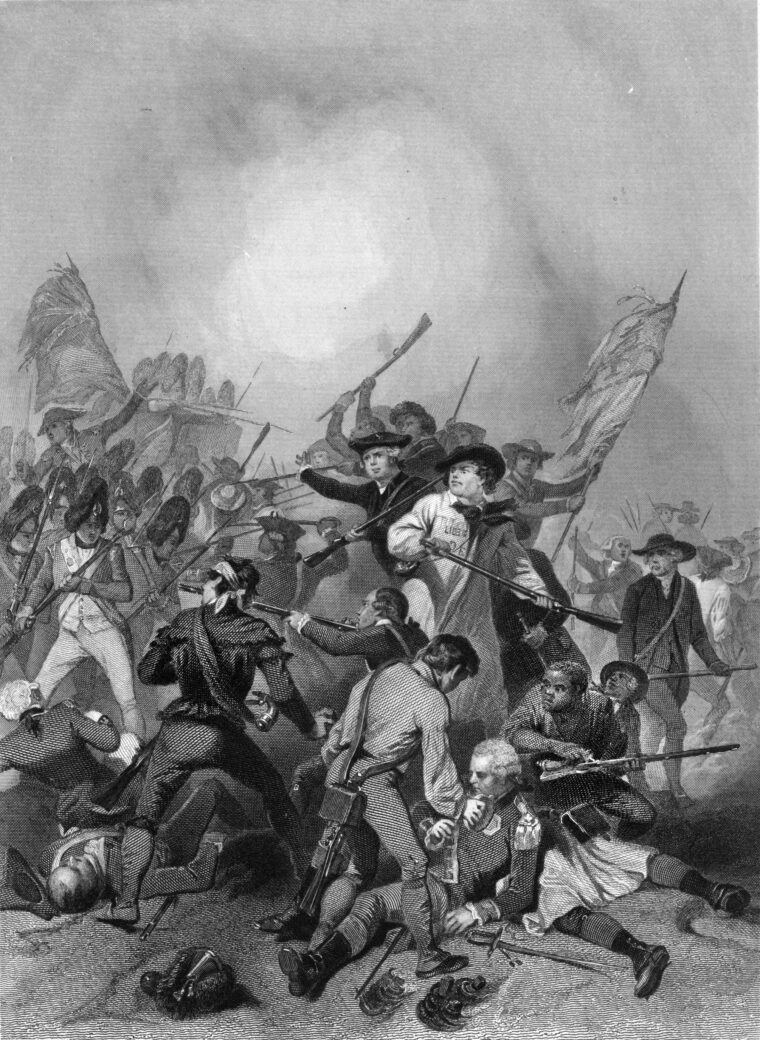
After the events of April 19, the Battle of Bunker Hill in June 1775 marked one of the first major tests of the Patriot forces and stands as a defining moment for Black soldiers in the early war. Among those who famously fought there were Peter Salem and Salem Poor, two Black soldiers whose bravery became widely recognized.
Peter Salem was born enslaved in Massachusetts but was freed by his enslaver specifically so that he could enlist in the Patriot militia. At Bunker Hill, Salem fought against British regulars advancing up Breed’s Hill. According to several accounts, he fired the shot that killed Major John Pitcairn, a British officer who had played a key role in the opening clashes at Lexington. While historians debate the exact details, contemporary recognition of Salem’s bravery was significant. His service challenged deeply entrenched racial assumptions and demonstrated that Black soldiers could perform with distinction in direct combat against elite British forces.
Salem Poor’s experience further reinforces the importance of Black soldiers at Bunker Hill. Poor was a free Black man from Massachusetts who enlisted in the militia and distinguished himself during the battle through extraordinary courage.
That either Salem or Poor, the two are often confused to this day, shot Pitcairn remains a persistent story is most likely due to the fact that it makes a more satisfying narrative. The idea that Pitcairn, despite conflicting claims in the historic record, had ordered his men to fire at the militia on Lexington Green remains an equally persistent story.
Witnesses at Lexington swear a British officer said something along the lines of, “Lay down your arms, ye villains, and disperse!” That there’s no evidence it was Pitcairn who said it did not matter—in the minds of New Englanders, he was a villain. Humans gravitate toward stories that reinforce their beliefs, be they entertaining, morally instructive, or both. They want stories with clear meaning, where villains get their just deserts.
Peter Salem’s role in Pitcairn’s death was all but cemented by the 18th century version of a “viral meme”—the 1786 painting, The Battle of Bunker’s Hill, by American artist and veteran John Trumbull that included a Black soldier many believed to be Salem.
By the end of the 19th century, as a result of the painting and the efforts of abolitionists in the ante-bellum northern states, the idea that a Black man named Peter Salem (or sometimes Salem Poor) had killed Pitcairn had become an iconic moment in the history of Bunker Hill.
Lieutenant Colonel James Abercrombie, who was wounded at Bunker Hill and died a week later was also said to be shot by Salem or Poor, though some contemporaneous accounts and many historians argue that Abercrombie was probably hit by what would be called “friendly fire” today.
The presence of Salem and Poor at Bunker Hill highlights the military necessity of Black soldiers during the war’s opening phase. The Continental Army faced chronic shortages in manpower, weapons, and training. Allowing Black men to enlist—especially free Black men—helped stabilize the Patriot forces at a critical moment. Early victories and strong performances, even in tactical defeats like Bunker Hill, boosted colonial morale and demonstrated that British forces were not invincible. Black soldiers were essential in this effort.
Just two weeks after Bunker Hill, General Washington arrived in Cambridge, Massachusetts, to take command of the new Continental Army, formed from the militia units around Boston.
By July 9, Washington’s adjutant, Horatio Gates, had issued instructions to army recruiters not to “enlist any deserter from the ministerial Army [British], nor an Stroller, Negro or Vagabond.” But many Black Patriots were already serving and had been in battle. Some had been killed or wounded and at least one (Caesar Augustus) taken prisoner.
John Adams, hearing reports that youths, old men and Black soldiers not fit for service were being paid, wrote to several generals about the matter. Gen. John Thomas’ replied that, “We have some negroes; but I look on them, in general equally serviceable with the other men for fatigue; and, in action, many of them have proved themselves brave.”
Fourteen white officers signed a petition to the Massachusetts legislature praising the bravery of Salem Poor and requesting official recognition. They described him as a “brave and gallant soldier” whose actions merited reward. This rare and formal acknowledgment illustrates how undeniable Black contributions could overcome, at least temporarily, racial prejudice and force white leaders to confront the reality of Black military competence. Unfortunately, the petition did not detail Poor’s actions. Though his bravery was not in question, it is possible the petition was part of an effort to help sway the question of Black enlistment in the new Continental Army.
John Greenwood, a young, white soldier in this new army, was impressed when he saw wounded men at Bunker Hill leaving the fight for medical treatment. Greenwood recalled seeing “a negro man. Wounded in the back of the neck… blood running down his back. I asked if it hurt him much… he said no, that he was only going [for treatment}, and meant to return.”
Black Continental troops also drew the attention of foreign observers, including Lt. Comte Jean-Francois-Louis de Clermont-Crevecoeur, a French Artillery officer who observed a formation of Continentals assembled for review in July 1781. He wrote, “the men were without uniforms… most of them barefoot. There were many Negroes, mulattoes, etc.”
Later the same month, Baron Ludwig von Closen, aide-de-camp to French commanding General Comte de Rochambeau wrote, “It is incredible that soldiers composed of men of every age, even children of fifteen, of whites and black, unpaid and rather poorly fed, can march so fast, and withstand fire so steadfastly.”
Washington, a slaveholder, had been opposed to Black enlistment, but by the end of 1775, he had been convinced by officers in Massachusetts and by the fact that they were already serving. His final order of the year was to allow it. He wrote to Continental Congress President John Hancock to say that, to keep the Free Black soldiers from enlisting with the British, he had “given license for their being enlisted. If this is disapproved by Congress, I will put a stop to it.”
By 1777, Connecticut was recruiting both free and enslaved Black men to fill military quotas, with many securing manumission and pensions after the war. At least 820 Black soldiers and sailors served in the colony’s integrated regiments.

In February 1780, Rhode Island created companies of black soldiers within otherwise white Continental regiments. These companies were commanded by white officers and NCOs, although there were several black privates promoted to NCO rank. Some observers were critical of these black units while others insisted they performed as well as their white counterparts.
In August 1778 a return was made by the main Continental Army serving with Washington at White Plains, New York, to determine the number of African American soldiers present. Of some 21,000 total soldiers, 755 were identified as black.
In the brigades containing African Americans, they made up 5-8 percent of the enlisted soldiers. Most of these units were fully integrated, apparently with little or no serious problems. As the Continental Army struggled to enlist new recruits over the next several years, the percentage of Black soldiers likely increased.
In October 1783, the fighting effectively over, Virginia passed a law to guarantee the emancipation of slaves who had served in its military. These were men whose enslavers had them enlist as freemen to act as substitutes for others. With their return from the fighting, some owners attempted to return the former soldiers to slavery. The law stipulated that “they should enjoy the blessings of freedom as a reward for their toils and labors,” and to be “fully and completely emancipated, and shall be held and deemed free in as full and ample a manner.”
Once the Continental Army was formed, the southern colonies began contributing men and South Carolina and Georgia were particularly opposed to the idea of Black soldiers. In September, South Carolina’s Edward Rutledge introduced a resolution, which was voted down, to expel all Black Patriots from the Continental Army—regardless of status or service.
It’s interesting to note that in the early 1700s, fearing an invasion by the French or Spanish, several colonies passed laws allowing the arming of all men, regardless of color. In 1703, the South Carolina General Assembly passed a law authorising the arming of enslaved men, promising them that if they “in actuall invasion, kill or take one or more of our enemies, and the same shall prove by any white person to be done by him, shall, for his reward, at the charge of the publick, have and enjoy his freedom for such his takeing or killing as aforesaid.”

Things were different by the time of the Siege of Charleston in 1780. In addition to Redcoats already in the area under Lt. Col. Mark Prevost, Patriot Gen. Benjamin Lincoln knew Henry Clinton and the British fleet were on their way with some 13,500 troops. Though badly outnumbered, Lincoln’s request to the South Carolina government for 1,500 enslaved men to be armed was refused. The British took Charleston in about six weeks, capturing 5,000 men, 300 cannons, 6,000 muskets and stores of gunpowder in the biggest single loss of the war for the Americans.
The early participation of Black soldiers also forced Patriot leaders to confront the ideological contradictions of the Revolution. The war was justified through language emphasizing liberty, natural rights, and resistance to tyranny—ideas that resonated deeply with African Americans. Enslaved and free Black men alike recognized that these principles applied as much to them as to white colonists. By fighting for independence, Black soldiers asserted their own claims to freedom and equality, exposing the hypocrisy of a revolutionary movement that demanded liberty while upholding slavery.
The British recognized this contradiction and sought to exploit the schism. In November 1775, Lord Dunmore, the royal governor of Virginia, had issued a proclamation offering freedom to enslaved people who escaped their Patriot enslavers and joined British forces.
In a letter to London, Dunmore wrote, “I am now endeavouring to raise two Regiments, one of White People (Called the Queens own Loyal Virginia Regiment) the other of Negroes (Called Lord Dunmores Ethiopian Regiment).
It’s estimated as many as 2,000 responded to the call—enough to form the all-Black “Ethiopian Regiment” of 300 able-bodied men. Dunmore made no provision to care for those freedom seekers not fit for the regiment and many were dead from starvation or disease within a few months. The unit was disbanded in August 1776, when Dunmore fled to England. Some members of the regiment went with him, while others sailed with the British to New York and others to St. Augustine. It’s estimated that after the war, some 100 or more people associated with the Ethiopian Regiment evacuated to Nova Scotia in 1783.
Dunmore’s Proclamation demonstrated that African Americans were a decisive strategic factor in the war. Their choices had the power to influence military outcomes and political calculations on both sides.
With the war going badly for the Crown, Gen. Sir Henry Clinton issued the Philipsburg Proclamation on June 30, 1779, which unlike Dunmore’s did not require military service. It applied to all colonies and also promised freedom for women and children who could reach British lines. Wildly successful, it hampered the economy of the southern colonies, with some 5,000 refugees just from Georgia making it to freedom. Unfortunately for some, they were forced back into bondage as a condition of Cornwallis’ surrender at Yorktown in October 1781.
Clinton himself would form an all-Black Loyalist unit overseen by white officers called the “Black Pioneers.” Not initially armed, they performed non-combatant labor under dangerous conditions.
The 1783 Treaty of Paris called for all former enslaved people to be returned to bondage, but British commanders refused, relocating about 3,000 of them to Nova Scotia. In 1792, some 1,200 of these Black Loyalists would join the British-led migration to found the colony of Freetown in Sierra Leone.
The service of Black soldiers in the Patriot cause laid the foundation for future debates over citizenship and rights in the new nation. Veterans could point to their sacrifices as evidence that they deserved the liberties promised by the Revolution. While some Black soldiers were likely denied pensions, land, or equal treatment after the war, their service influenced gradual emancipation efforts in northern states.
Importantly, Black soldiers were not a monolithic group. Their motivations varied widely depending on whether they were free or enslaved, their geographic location, and their personal circumstances. Some fought to defend their communities, others to secure freedom, and still others to claim a place within the emerging American nation. The contribution of Black soldiers to the Patriot cause challenged the notions of race and citizenship, exposing the moral contradictions of a revolution founded on liberty yet constrained by slavery.
Despite this, their contributions go largely unrecognized in the public consciousness. It was not until 1986 that President Ronal Reagan signed the Black Revolutionary War Patriots Act, authorizing a memorial on the National Mall. Disputes over the design and fundraising efforts delayed the effort and the memorial’s foundation was dissolved in 2005. Multiple efforts to establish a National Liberty Memorial were finally passed and signed by President Obama in 2014, but this foundation’s approval expired in 2021. In 2023, Congress granted an extension to 2027.
Join The Conversation
Comments
View All Comments