By John Wukovits
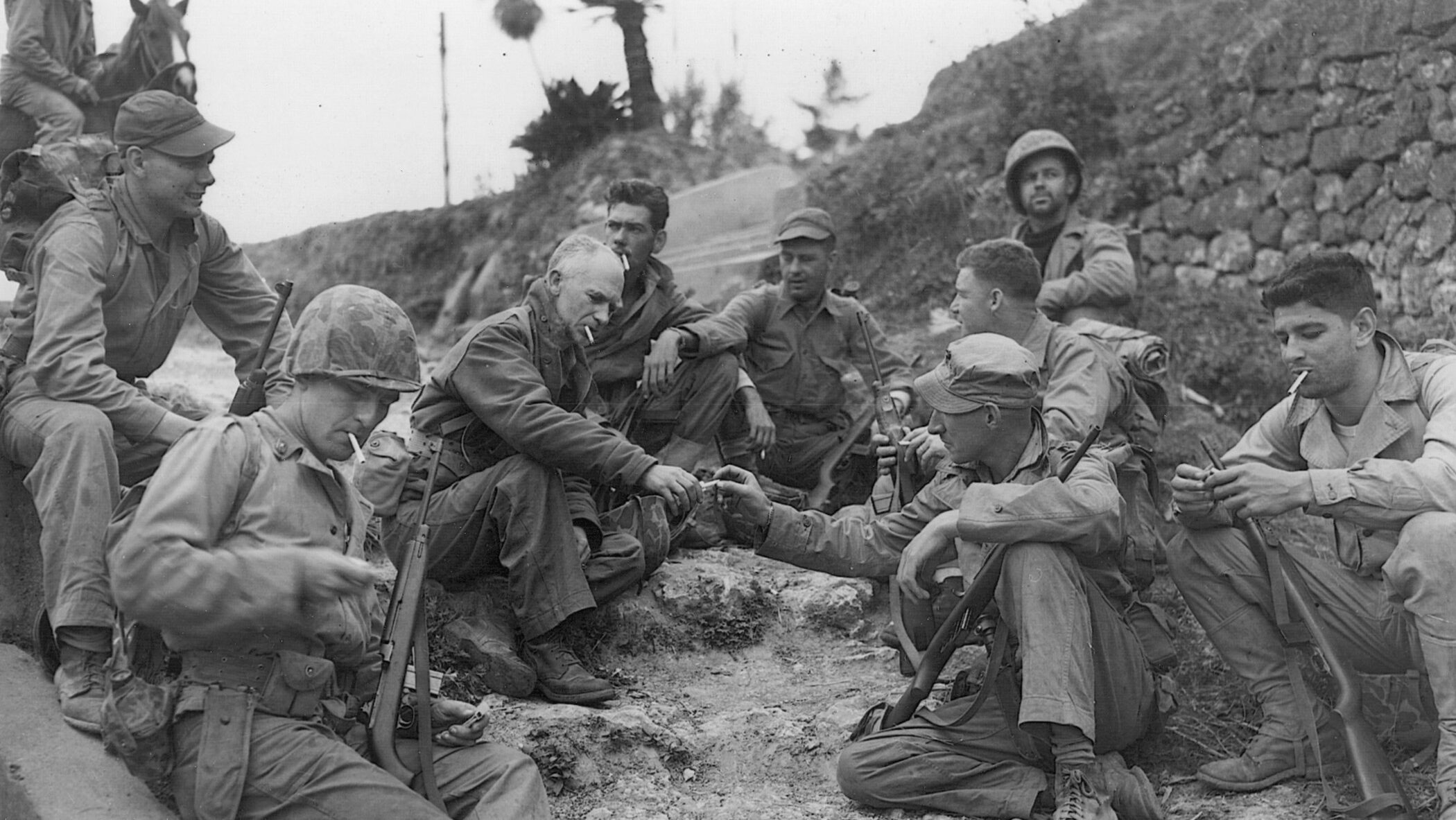
Edward T. Higgins had witnessed few spectacles to match the one that unfolded all about him in the waters surrounding Okinawa, an island 400 miles southwest of the Japanese Home Island of Kyushu. Part of a relatively new and obscure unit called “frogmen,” Higgins and his cohorts were to destroy any underwater obstacles that might impede the army and navy invasion forces when they crashed ashore two days later on April 1, 1945. They found an impressive and deadly array of underwater mines attached to a series of telephone poles that were connected with barbed wire.
As he advanced, sometimes under the waves and other times along the surface, Higgins had trouble focusing on his work, for a frightening cascade of sounds erupted from battleships, cruisers, and destroyers as they softened the invasion beaches in preparation for the landings.
“Over our heads the fire support drummed a thunderous tattoo,” Higgins later recalled. “The little LCI [G’s] lay close behind us, their 20 and 40 mm quads and .50 machine guns pumping in perfect rhythm as they fired scant feet above our heads at the beach. Behind them the destroyers worked back and forth across their grid patterns, slamming three and five inch shells in arithmetical patterns into the jungle above the shore line. Beyond the destroyers were the cruisers and battlewagons salvoing their six, eight, and 16-inch guns in great bursts of fire that made their land targets jump and shiver, erupting in clouds of dust and debris.”
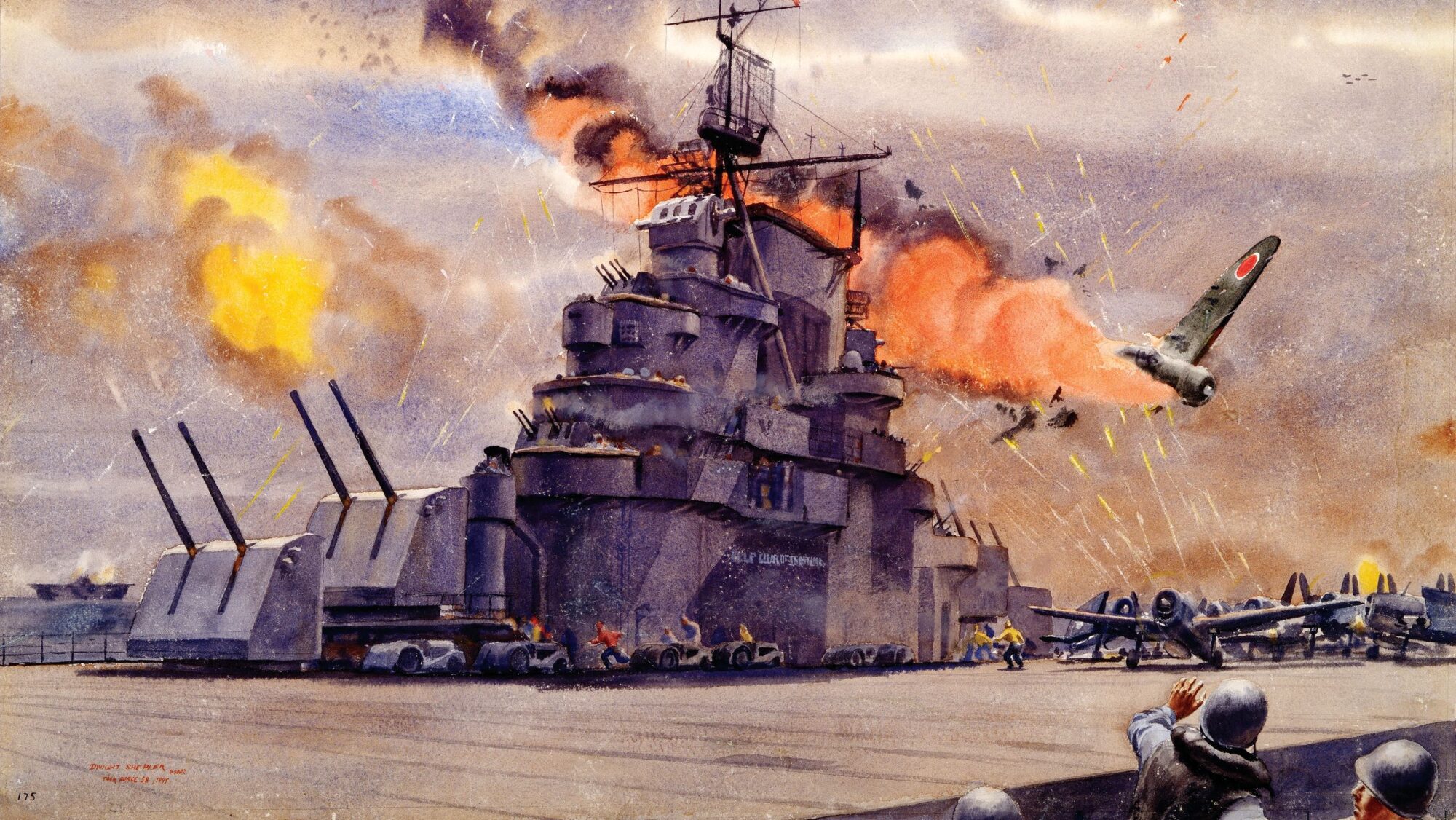
Higgins and the surface vessels provided foreshadowing of what would unfold at Okinawa. The three-month campaign to wrest the island from the Japanese saw some of the fiercest land action in the Pacific, including ferocious hand-to-hand combat to seize hills and traverse ridges. But another deadly drama played out on the sea, one so unnerving that Marines and Army infantry, normally envious of those serving aboard surface ships, almost felt sympathy for their Navy brethren. Prying Japanese soldiers out of trenches, bunkers and caves was hard enough, but at least soldiers on the ground didn’t have to face Japan’s newest weapon—the dreaded kamikaze.
The United States had gathered an immense force to take Okinawa. More than 1,200 ships, including 18 battleships, 200 destroyers, and over 40 aircraft carriers escorted and transported the assault troops. So great was the armada that forces had to assemble at most every major U.S. port in the Pacific, including locations in the Marianas, the Philippines, the Solomons, Hawaii, and the West Coast. Under the command of Vice Adm. Raymond A. Spruance, the hero of Midway, and Vice Adm. Richmond Kelly Turner, the naval units rivaled those employed in the massive European D-day operation staged at Normandy.
The campaign for Okinawa was the most recent in a long string of operations that shoved the Japanese out of the island bastions they had held since early 1942. Beginning in the Solomons, U.S. land and sea forces gradually leaped westward and northward in a simultaneous advance along two Pacific paths, gobbling up island groups in the process—the Gilberts, the Marshalls, the Marianas, New Guinea, the Philippines, and Iwo Jima. Next was Okinawa, practically on the doorstep of Japan. Once successful, the Americans intended to use its airfields to house bombers to attack Japan, and Okinawa would become a major staging area for the massive numbers of men, ships, and supplies required for a land invasion of the Japanese islands.

Imperial Japan had other ideas. The Home Islands had never before been invaded; Japanese honor stood on the line. Just as strong as the U.S. desire to take Okinawa was the Japanese intent to prevent its loss. Should the island fall, there was little to stop the Americans from continuing on to Kyushu or Honshu.
A desperate Imperial General Headquarters realized the enemy would come for Okinawa, but they lacked the necessary resources to stop them. Serious shortages existed in every area, including ships, oil, bombs, and bullets. Japanese factories, once humming with activity, now labored under devastating American bombing raids that seriously reduced their outflow. Placed in a precarious situation, the Japanese hoarded their precious remaining aircraft and turned to the one commodity they possessed in abundance—volunteers willing to die for their country and their Emperor by piloting aircraft into enemy ships. One aircraft, one ship. This was a simple equation that, if successful, might reverse fortune for the reeling Japanese.
Led by the commander of the First Naval Air Fleet, Vice Admiral Takajiro Onishi, called the “Father of the Kamikaze,” kamikazes first appeared in the October 1944 Battle of Leyte Gulf. The name, Japanese for “Divine Wind,” referred to a 13th-century typhoon that smashed a Chinese invasion fleet as it approached Japan.
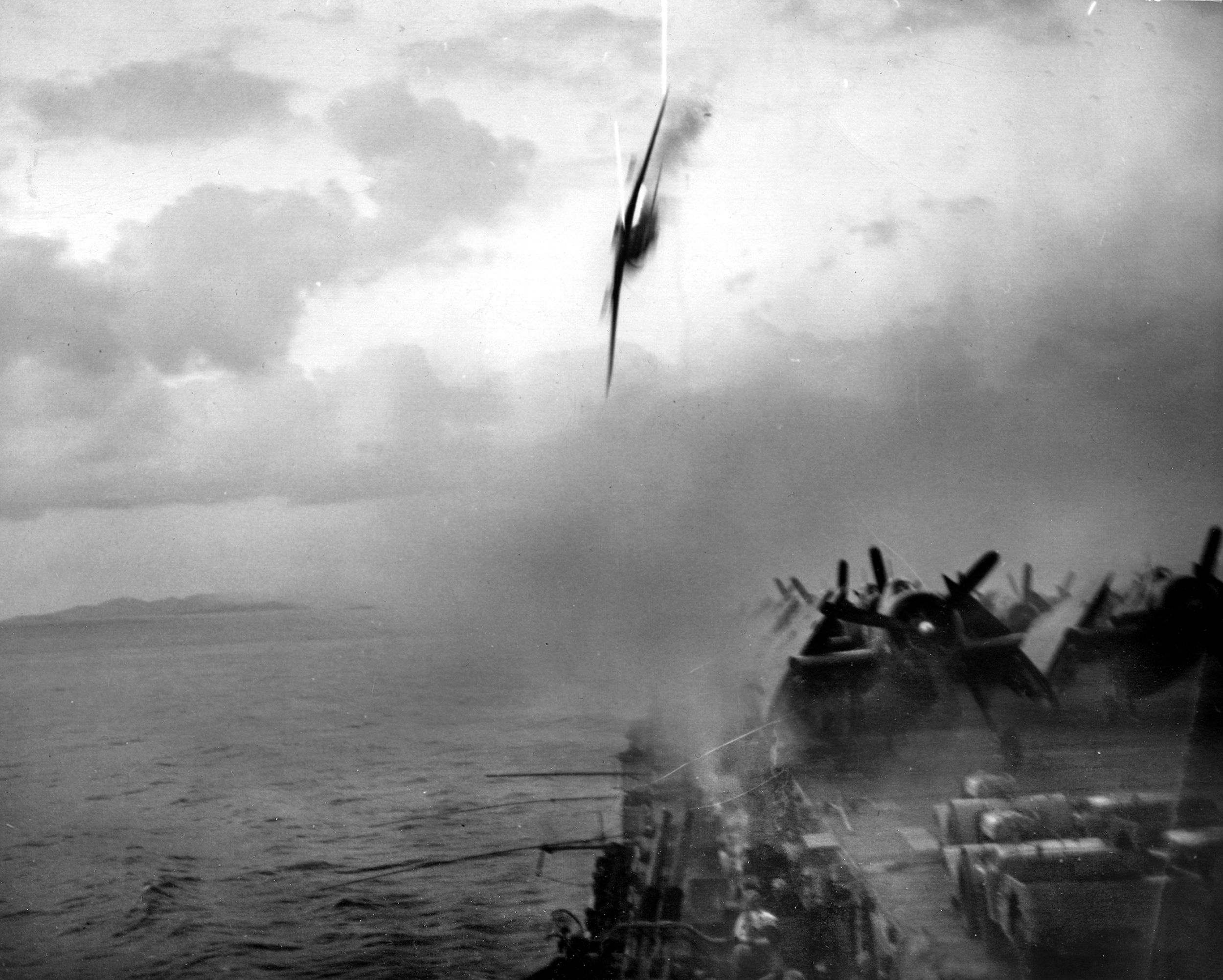
The sight of a man willingly flying his aircraft into a ship and offering with it his own life terrorized American sailors, who could not comprehend the tactic. American soldiers and sailors sacrificed their lives for their fellow fighting men. Numerous accounts exist of one soldier falling on a hand grenade to save others, or of units attacking against overwhelming odds, but kamikazes differed. One was the act of an individual, whereas the kamikaze existed as part of a massive organized assault. It made sense to the Japanese, who were desperate to prevent the invasion of their homeland, but it only made the Americans wonder about the sanity of their opponents. “Few missiles or weapons have ever spread such flaming terror, such torturing burns, such searing death, as did the kamikaze in his self-destroying onslaughts,” wrote historian Samuel Eliot Morison of the fear that gripped American sailors when kamikazes appeared.
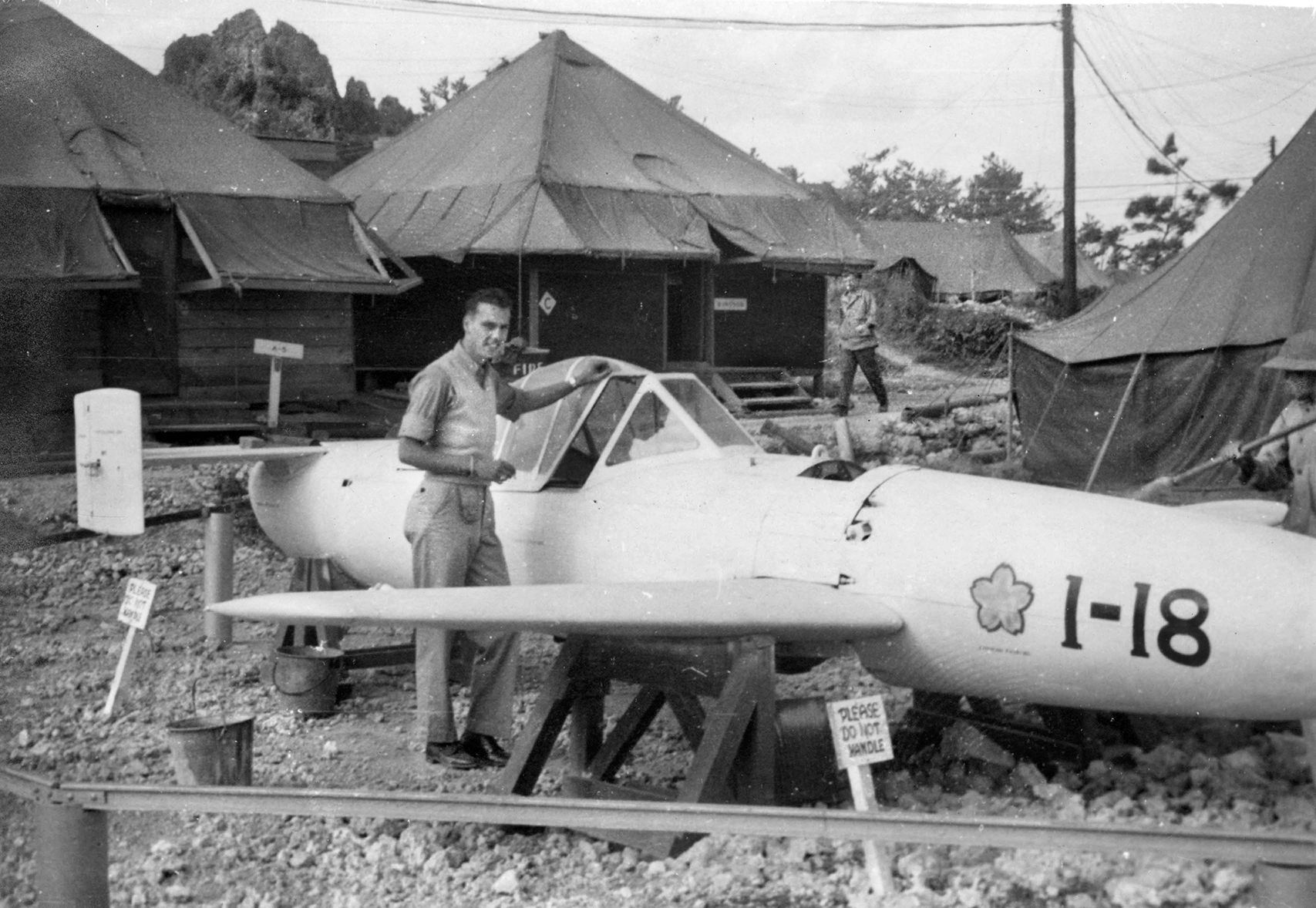
The plan, named Ten Go (Heavenly Operation), earmarked a series of huge air raids, called kikusui (floating chrysanthemums), to assault enemy ships off Okinawa. Japan intended to collect 4,500 aircraft as well as a handful of smaller, piloted, rocket-propelled buzz bombs called Ohkas (“cherry blossoms”). that would be carried to the battle scene on a bomber’s underbelly. Once launched, a suicide pilot steered his missile at the nearest target.
Except for the newest aircraft and most experienced pilots, which would be kept in the homeland to defend Japan’s shores, every available aircraft—seaplanes, older fighters, training planes, and scout planes—was sent to Vice Admiral Matome Ugaki’s Fifth Air Fleet for use off Okinawa. Despite being given little training in flying, men willing to gain honor by yielding their lives quickly filled the kamikaze corps.
Japanese soldiers fighting on Okinawa planned to slow the American advance on land with a series of rigorous defenses stretched out along Okinawa’s numerous ridges and cave systems. As long as they stalled the American drive on land, American ships had to remain in the waters offshore to lend air support and bring in additional supplies, thereby offering tempting targets for kamikaze attacks.
Lieutenant General Mitsuru Ushijima, commander of the Japanese defenders at Okinawa, exhorted his men to a spirited defense by heralding the feats of their brethren in the skies. “The brave, ruddy-faced warriors with white silken scarves tied about their heads, at peace in their favorite planes, would dash spiritedly out to the attack.” Ushijima counted on the kamikazes to so seriously impede American naval support for the forces ashore that he would be able to defeat the American Marines and Army infantry.
Even though much of the combat at Okinawa occurred on land, a successful land defense for the Japanese relied largely on what unfolded at sea. American ships and sailors would pay a heavy price as a result.
On March 26, six days before the April 1 landing on Okinawa proper, elements of the 77th Infantry Division landed at Kerama Retto, a string of 10 rocky islands 18 miles west of Okinawa, to secure an advanced naval base. The Japanese defenders were quickly brushed aside, but the Americans unearthed a surprise when they discovered a base for 350 suicide boats, camouflaged and hidden in caves. The plywood craft, about 18 feet long and five feet wide, each carried two 250-pound depth charges. A Japanese volunteer would steer the craft at one of the numerous naval targets floating in the waters near Okinawa. Fortunately for the Americans, the 77th Infantry Division eliminated this threat, but the discovery made some wonder what other surprises Japan had prepared. They could never guess what was about to occur.
From the beginning, different factors hampered the United States in dealing with the kamikaze threat. Unlike earlier assaults, where American air power helped neutralize Japanese air opposition, Okinawa’s location made it almost impossible to eliminate that danger. While resting outside the range of American air bases, it stood within easy striking range of Japanese bases in Japan and Formosa.
Normally, American carrier aircraft would be employed in such a circumstance, but crafty camouflage and widespread dispersal made it difficult to locate the airfields. Even if American aircraft knew the whereabouts, Japan built so many different airstrips that the fighters and bombers could not hope to eliminate them all. Placed in such a quandary, the U.S. Navy had no alternative but to remain off Okinawa to provide air support for the troops ashore, an alarming prospect to Admiral Chester W. Nimitz, commander-in-chief of the Pacific Fleet, and Admiral Spruance, who knew their ships, tied so closely to land operations, would be sitting ducks for enemy aerial assaults. They could do little but hope that Japanese airfields already on Okinawa would be speedily seized and readied for use, thus freeing the navy to depart.
To counter any threat from the air, Admiral Turner ringed Okinawa with picket ships. Prowling the waters at the 16 most likely routes leading to the island, the destroyers’ main duty was to pick up incoming enemy aircraft on their radar, then dash a quick alert to the carriers and battleships steaming closer to shore. Some scoured the sea 75 miles away from Okinawa, while others watched the approaches from closer in. These destroyers, while standing guard at the most exposed locations, lacked enough antiaircraft guns to fend off large attacks. Should the enemy send great numbers of aircraft, the destroyers could be gravely imperiled.
Not only did the Japanese dispatch large groups of aircraft, but they did so repeatedly, hammering American vessels on a regular basis. Between April 1 and June 22, kamikazes struck on numerous occasions. While some operations consisted of 20 or fewer aircraft, the Japanese mounted 10 major offensives in which aircraft numbering anywhere from 50 to 300 pounced on American ships. In all, 1,900 kamikaze aircraft attacked off Okinawa. While some broke through the destroyer picket line and charged the larger ships, the American destroyers on the picket line bore the brunt of the attacks.
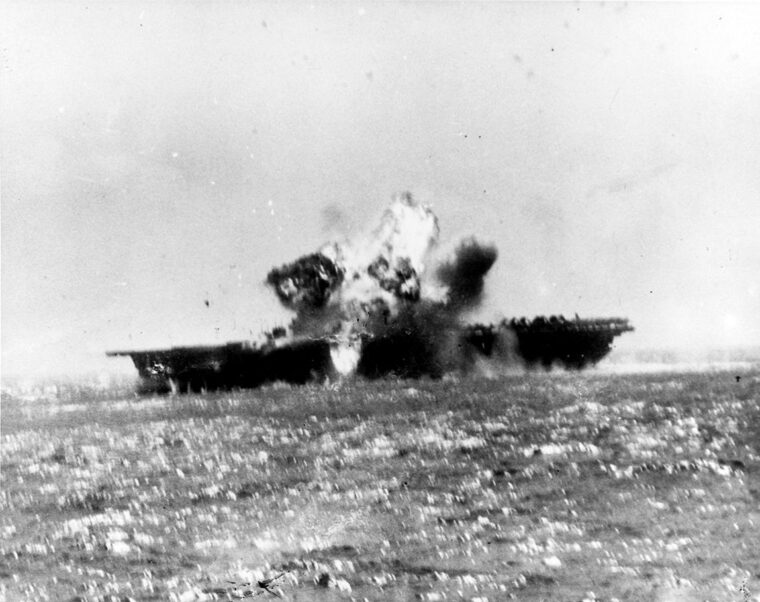
A hint of impending danger loomed on March 31, when a kamikaze struck Admiral Spruance’s flagship, the cruiser Indianapolis, and forced the ship to nearby Kerama Retto for repairs. The main drama unfolded in earnest, however, on April 6-7, when 700 aircraft, half escort and half kamikaze airplanes, struck the American fleet in Kikusui No. 1. The volunteer kamikaze pilots had been instructed to search for enemy carriers and battleships, but in the frenzy of battle, the inexperienced pilots often pounced on whatever target first appeared—the picket destroyers.
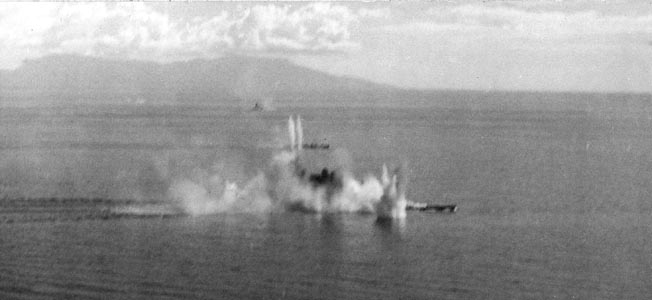
The tale of destroyers Bush, Colhoun, and Cassin Young typified the day’s action. The three vessels steamed along a 60-mile arc northeast of Okinawa at stations No. 1, No. 2, and No. 3, the most likely path for Japanese planes to approach out of Kyushu. At 2 pm on April 6, a group of about 40 aircraft approached at altitudes ranging from 500 to 20,000 feet. Some planes broke away from their formation to attack the Bush. The ship’s antiaircraft gunners splashed two and drove off two other aircraft, but a fifth plane crashed into Bush’s forward engine room, killing most of the men stationed there.
Dead in the water, the Bush issued a distress call that Colhoun answered. At 4:35, as she inched near the stricken destroyer, 12 kamikazes appeared. One plane struck the Colhoun’s main deck and killed the crews of two 40 mm guns plus everyone in the after foreroom. Less than 30 minutes later, another kamikaze crashed into Colhoun’s forward fireroom, ripping a huge hole below the destroyer’s waterline.
The Japanese now swarmed on the two American ships, both dead in the water and easy marks for destruction. Two smashed into the Colhoun and a third struck the Bush with such force that the ship almost split in half, causing crew members to scramble for their lives. By 6 pm each ship had absorbed a fourth kamikaze hit that proved to be fatal. At 6:30, an ocean swell toppled the Bush, which quickly sank. Cassin Young, now in the area to lend support and retrieve survivors, hurriedly picked up sailors, but many drowned, either from exhaustion or from their wounds. After switching to the Cassin Young, the Colhoun’s commander ordered the remaining destroyer to sink the battered Colhoun, damaged beyond repair. The two destroyers, the first such ships to sink off Okinawa due to kamikazes, lost 129 men killed and another 53 wounded. The frightening ordeal was simply a taste of what was to unfold.
The results from Kikusui No. 1 had an already uneasy Admiral Spruance fretting more about his ships off Okinawa. The campaign ashore had lasted only six days, and in one furious aerial attack the Japanese sank six ships, three destroyers, one LST, and two ammunition ships, damaged 10 others, and killed 367 men. Even though American antiaircraft guns and fighter pilots knocked down more than 350 intruders, 33 kamikazes sneaked through the defensive web to smash into vessels.
As if that were not enough, three days later the first Japanese suicide boat struck the destroyer Charles J. Badger. Although no one was injured, sailors had to keep alert to attacks from both sea and air.
Off Okinawa, even advance warning could do little to aid the ships. When a Japanese prisoner boasted of a second massive kamikaze raid to occur on April 11, the navy canceled support missions over land to focus on shielding their ships. No matter how protective the air umbrella might be, and no matter how many Japanese aircraft might be splashed, little could be done to ward off large numbers of suicide pilots determined to crash into a target.
Four hundred aircraft, again half escort and half kamikaze, struck on April 11-12 in Kikusui No. 2. This time, the Japanese damaged a handful of large ships, including the aircraft carriers Enterprise and Essex and the battleship Tennessee, killing more than 60. When the action settled, another ship had been lost and 18 damaged.
This second onslaught added one more peril that played with sailors’ emotions and fueled their fears. On April 12, as the destroyer Mannert L. Abele stood at her station, the initial ohka (also called baka) bomb seen in the campaign struck. The ohka bomb was a piloted missile that whistled through the air at speeds approaching 600 miles per hour. Carried first to the scene on a bomber’s underbelly, when released the ohka so quickly raced toward its target that defenders had almost no time to react.
This first ohka ripped into the Mannert L. Abele and ignited explosives stored in the destroyer’s bowels, tearing the ship in two. Within five minutes both halves disappeared, leaving stunned survivors struggling in the water. A third of the 345 men died or suffered wounds. “The small size and tremendous speed of baka made it the worst threat to our ships that had yet appeared, almost equivalent to the guided missiles that the Germans were shooting at London,” wrote Samuel Eliot Morison, on hand to observe the campaign.
Four days later, the third kikusui again inflicted horrible punishment on the picket destroyers, and one carrier, one hospital ship, and two transports also suffered damage. Swarms of kamikazes attacked the destroyer Pringle, on guard at Station No. 26, which was 75 miles northwest of Okinawa in company with USS Hobson.
One Zero crashed near the forward stack, aft of the bridge and chart house. Sonarman 1st Class Jack Gebhardt, who witnessed the plane pass barely 15 feet above him before it crashed, recalled the ordeal. “The Japanese came in waves and sent everything at us. All attacks were now kamikazes and every type of aircraft was used, some barely able to fly. What a waste of human life as we shot them down. The air raids were endless and our nerves became frayed and stomachs churned at the thought of being killed in a horrible blast or gasoline fire. This was absolute total unforgiving war and everyone was scared! The only way to stop a kamikaze plane was to kill the pilot before he crashed into you. There was no surrender, no mercy given or expected. You had to kill to live!”
They killed some, but this Zero made it through to demolish part of Gebhardt’s ship. As he later wrote, Gebhardt scrambled to find safety. “When the two 500 lb. bombs on the plane exploded it seemed like the world ended as the Chart House rumbled and years of dust crashed down from the overheads. I sensed the Pringle was severely damaged and tried to get off the Bridge through the Starboard door, but the door was jammed and access ladder was blown away. I managed to bend the door from the top and slide out onto the open bridge area. I looked toward the stem and the ship was a burning hulk with men stumbling dazed and bleeding from the flying debris, smoke and flames. I looked forward and saw men going over the side. Just then someone yelled “ABANDON SHIP” and I saw a 40-mm [antiaircraft] ammo [ammunition] magazine under the bridge on fire so I went to the Starboard side of the bridge and worked my way down to the main deck. The Bridge Splash Shield was blown away so I climbed down to the gun deck where I took off my shoes and hat and laid them neatly against the bulkhead as if I was coming back!”
Gebhardt leaped into the water and swam as hard as he could to place distance between himself and the sinking destroyer. “I don’t know how far I swam, but it seemed like several hundred yards before stopping to look back and see the Pringle engulfed in flames, broken in half sinking amidships. The bow and stern were pointed sharply upward and I heard screams as she slipped under the water and disappeared. It all happened in less than five minutes after the Japanese plane hit and Pringle disappeared.
“When the ship sank I rolled onto my back and floated high in case a depth charge went off, but there was no explosion, only the cries of wounded men and the continuing battle. I watched helplessly as the Pringle sank and could do nothing to save her. The Japanese planes circled overhead like a swarm of angry hornets to make sure Pringle was dead…. I watched the Hobson put up an intense blanket of antiaircraft fire as the Japanese tried to strafe us in the water. They drove the Jap planes off and fired several 20-mm [antiaircraft] rounds into the water to chase off any sharks. When the attack finally ended the landing craft moved in and picked us up. I had been in the water about 7-8 hours after the Pringle sank and the water was rough most of the time. To keep up my spirits and stay alert, I prayed, sang and did anything to survive.”

A landing craft eventually rescued Gebhardt, who enjoyed a large helping of whiskey from a bottle the crew handed him. “My hands shook as I drank and thought of my shipmates, sharks, fire and terror of the last few hours,” he recalled. “The sight of Pringle going under was still vivid in my mind.”
As gripping as Gebhardt’s ordeal was, nothing matched the agony endured by the Laffey, stationed at the same spot where the Bush and Colhoun had earlier been sunk. While one group of kamikazes targeted the Pringle, another focused on the hapless Laffey, a destroyer that had participated in the Normandy landings in Europe on June 6, 1944. At one time, Laffey’s radar plotted 50 enemy aircraft whistling toward the ship. Her guns splashed some, but others coursed through the curtain of fire. When one hit amidships and started a huge fire, other kamikazes swerved away from their targets to strike the wounded destroyer. In quick succession, two more smashed into the deckhouse, and bombs jammed the rudder and knocked out power to many of the antiaircraft guns. As the ship helplessly steamed in circles, another kamikaze struck the mast.
One sailor had both legs ripped off by a bomb explosion, but he continued to fire his 20mm gun until the final plane disappeared. “Please, please get me out of here,” he begged, moments before he died.
For almost an hour and a half, one kamikaze attacked Laffey every four minutes. She shot down nine, but suffered an astounding eight kamikaze and four bomb hits. The ship continued to fight, carried along in part by the indomitable spirit of her skipper, Commander Frederick J. Becton, who defiantly shouted, “I’ll never abandon ship as long as a gun will fire.”
He carried out his promise. In the early afternoon other ships arrived to tow her to Okinawa’s west coast, where she was patched up enough to head on to Guam under her own steam.
The Navy could ill afford to lose more ships, as the exhausting work off Okinawa required more than defense against kamikazes. As if that ordeal were not hard enough, sailors also had to lend fire support to the Marines and Army infantry ashore. Practically every day, ships hammered enemy land targets in attempts to soften the way for the men fighting and dying on Okinawa. A grateful Maj. Gen. P.A. Del Valle, commander of the 1st Marine Division, dispatched a message of thanks to the gunners aboard the battleship Colorado. “Your superb shooting has been a constant inspiration to our troops. Every Jap captured reveals the awe and fear with which all Japs regard your gunfire.”
At night, rather than rest, ships’ crews had to be alert in case the Marines or Army units requested star shells to illuminate the areas immediately to their front. Again, infantry units welcomed the assistance provided by their naval compatriots. “Time and again,” wrote Army historians, “naval night illumination caught Japanese troops forming or advancing for counterattacks and infiltration, and made it possible for the automatic weapons and mortars of the infantry to turn back such groups.”
Sailors off Okinawa’s coast were delighted they could assist the troops ashore, but the seemingly endless duties wore them down. Providing fire support by day and star shells at night would tax anyone, but these sailors also had the heavier burden of not knowing when the next kamikaze attack would appear. They arrived off Okinawa hopeful of a relatively easy campaign, for they assumed the Japanese Navy had been mortally wounded in earlier Pacific battles, but instead they faced what became one of the war’s most frightening weapons. Nerves frayed and anger mounted as the days unwound.
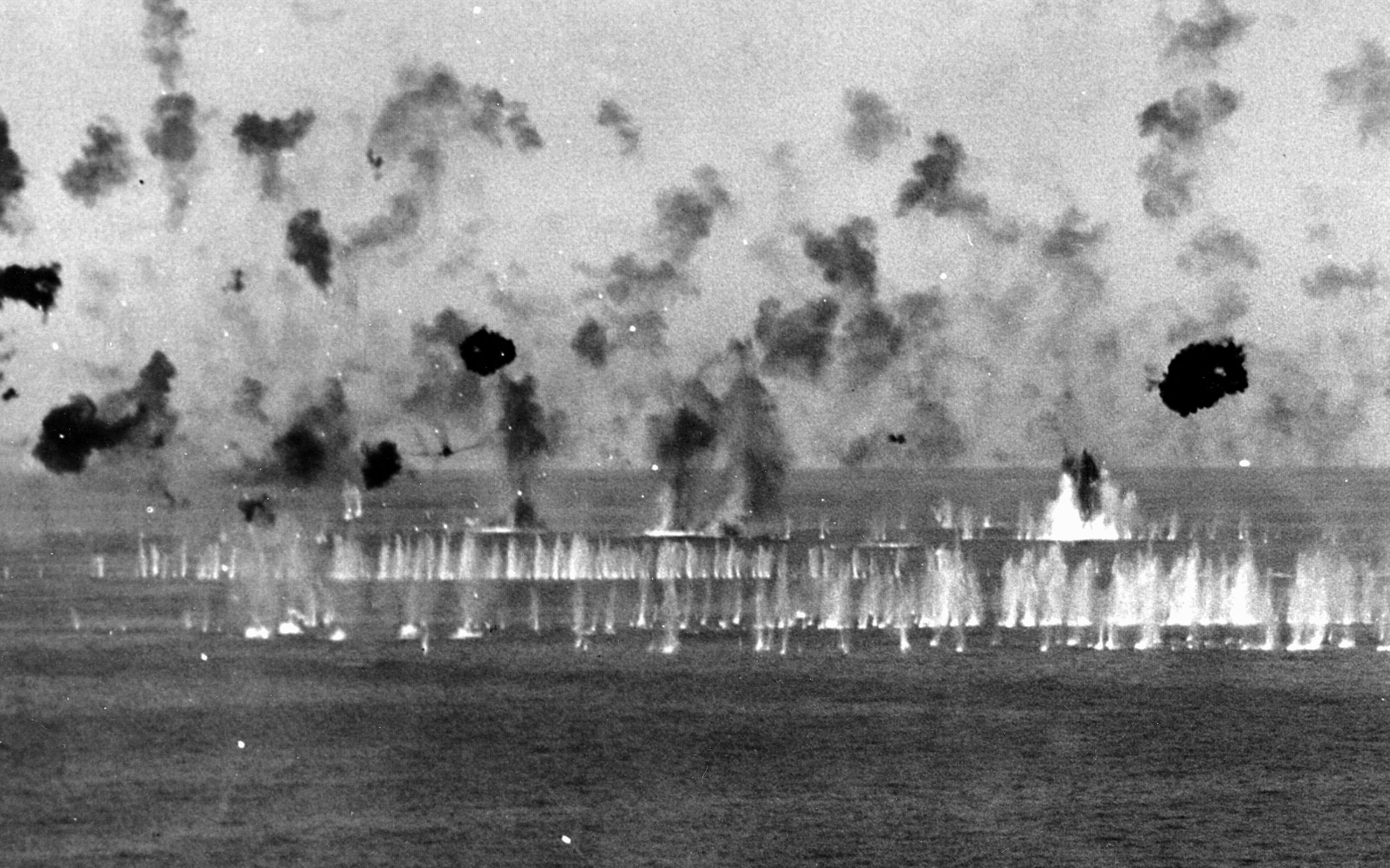
“We’d get warnings of about half an hour before they appeared,” explained Fred Poppe of life aboard one of the ships, “and the waiting was scary too, the knowing what was coming when those pilots’ one wish in the world was to kill you.”
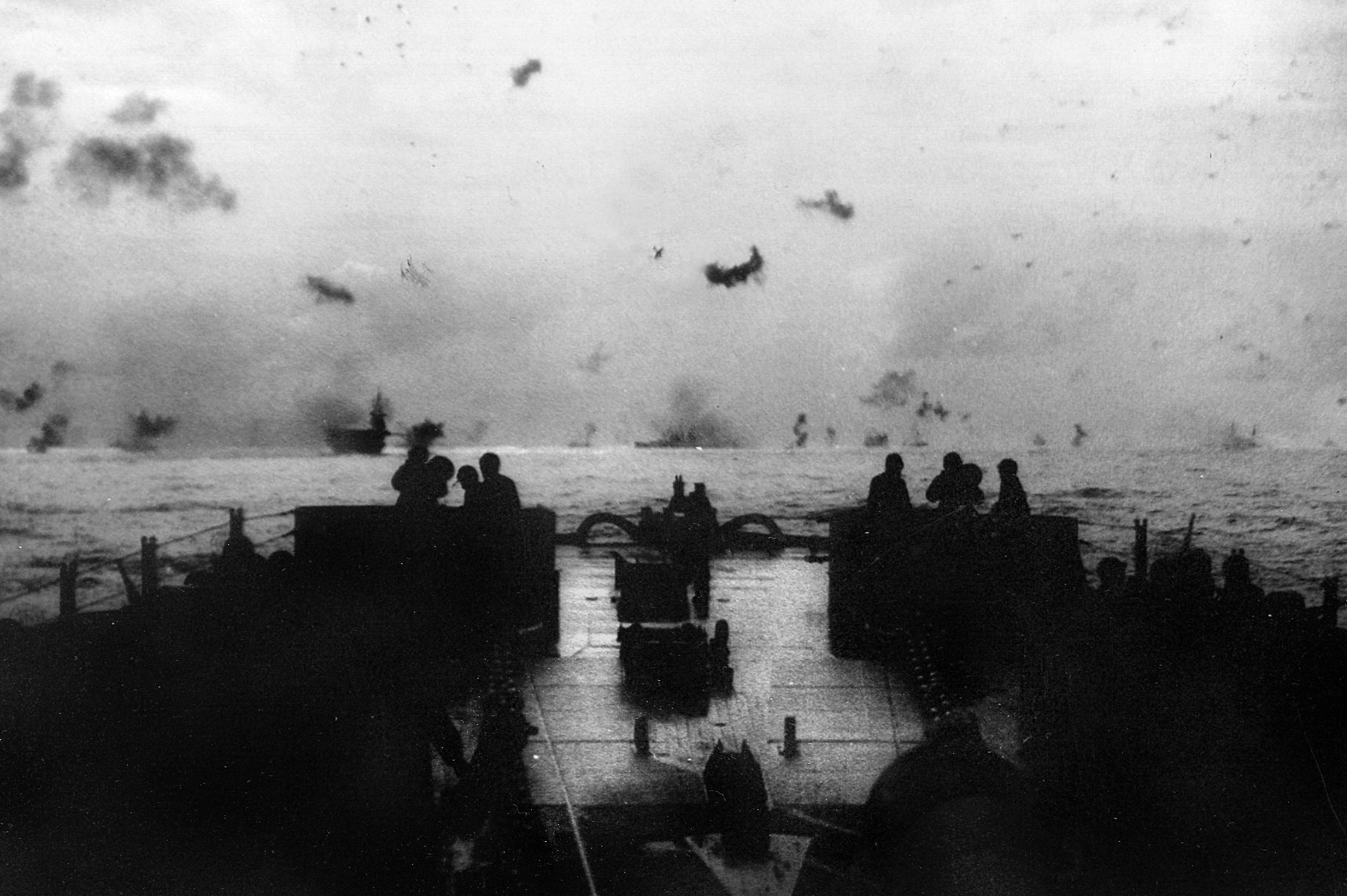
“During the day, the ships threw up so much ack-ack that daylight almost disappeared in a million black puffs,” stated Dick Whitaker, who watched from shore. “During night attacks, the concentration of fire made a kind of twilight—incredible. A sea almost solid with tracers and gun flashes. So much fire would have seemed truly impossible if you didn’t see it.”
Each day, laboring under the incredible strain of possible kamikaze attacks, American sailors became wearier. Some approached the point of nervous exhaustion and wondered how a human could so readily terminate his life in such a manner. Captain Charles R. Brown, chief of staff of one of the task groups, wrote, “I doubt if there is anyone who can depict with complete clarity our mixed emotions as we watched a man about to die, a man determined to die in order that he might destroy us in the process.” He added he felt “a strange mixture of respect and pity—respect for any person who offers the supreme sacrifice to the things he stands for, and pity for the utter frustration which was epitomized by the suicidal act.”
Macabre humor even appeared. After the crew of a picket destroyer battled off one particularly trying kamikaze attack, the sailors mounted a huge arrow-shaped sign pointing to their rear. The sign carried the words, “Carriers this way.”
Admirals Spruance and Turner became so concerned with the sluggish progress of the troops ashore, which required the ships to remain off Okinawa even longer, that they began to prod their cohorts. Spruance, upset with the Army’s slower manner of combat compared to the Marines’ faster, more direct approach, wrote another officer, “I doubt if the Army’s slow, methodical method of fighting really saves any lives in the long run. It merely spreads the casualties over a longer period. The longer period greatly increases the naval casualties when Jap air attacks on ships is a continuing factor.”
Spruance had a point, but he also overlooked the fact that the men ashore, including the Marines, faced some of the most intricate defense systems erected in the Pacific. Admiral Turner even implored the Army commander to implement an amphibious operation behind the Japanese flank to speed up the campaign, but he failed to convince his Army brethren.
The cost to the navy for the lengthy Okinawa campaign was visibly evident at Kerama Retto. Sonarman 1st Class Gebhardt called it “a graveyard of shot up ‘tin cans’ from the picket stations around Okinawa. Some had the stacks shot off, sinking by the stem [bow], beached to avoid sinking or burned black with bomb holes. They were kept afloat by constantly running bilge pumps. Some of the ships were so badly damaged we wondered how anyone survived.”
Admiral Spruance sent a handful of messages to Admiral Nimitz imploring a speedy conclusion to the fighting so he could remove his beleaguered ships. The navy requested that the army divert Boeing B-29 Superfortress bombers from their raids against Japanese cities to air bases in Kyushu, but the Army balked. When Admiral Ernest J. King, the chief of Naval Operations, hinted in Washington, D.C., that if the Army Air Forces was not willing to help, he might have to halt supplying the Army air bases housing the B-29s in the Marianas, the Army Air Forces grudgingly lent assistance.
Even that did not suffice. Spruance wrote Nimitz, “The skill and effectiveness of the enemy suicide air attacks and the rate of loss and damage to ships are such that all available means should be employed to prevent further attacks.” On April 23, Nimitz arrived in Okinawa to nudge his land commander into more aggressive action. When the army commander replied that the navy knew little about land fighting, Nimitz shot back, “Yes, but ground though it may be, I’m losing a ship and a half a day. So if this line isn’t moving in five days, we’ll get someone here to move it so we can all get out from under these stupid air attacks.”
As the calendar stretched into May, the fighting and dying continued, both on land and at sea. While Marines stormed Sugar Loaf Hill and other Japanese bastions and army forces assaulted entrenched enemy troops along Okinawa’s numerous ridges, the navy continued to bleed. Nimitz asked Admiral Forrest Sherman if he thought the Japanese would switch targets and give the picket destroyers respite, but Sherman answered in the negative. “You could get a man down quicker by hitting him on the same tooth than by punching him all over.”
Nimitz thought for a moment, then replied that American productivity back home would be the difference. “Anyway we can produce new destroyers faster than they can build planes.”
In addition to the U.S. Navy, a force of British carriers and destroyers fought off Okinawa. Their carriers, however, did not worry about kamikazes as much as their ally because of the sturdiness of their steel decks. American ship planners preferred the lighter wooden decks over the steel decks, whose added weight affected the ship’s stability and reduced the number of planes that could be carried. However, British carriers stood up to kamikazes much better than the American carriers. When hitting an American carrier, the kamikaze usually punctured through to decks below and caused severe damage. Against a British carrier, as Samuel Eliot Morison stated, “A kamikaze hitting a steel flight deck crumpled up like a scrambled egg and did comparatively little damage.”
One American officer observing aboard a British carrier could hardly believe the differing results of kamikaze strikes. “When a kamikaze hits a U.S. carrier, it’s six months’ repair at Pearl. In a Limey carrier it’s a case of ‘Sweepers, man your brooms.’”
Kikusui No. 6 on May 11 illustrated the point when kamikazes battered the aircraft carrier Bunker Hill. Seaman 2nd Class William Rowe, a 22-year-old from the small Michigan town of Painesdale, joined the navy because he believed he would enjoy a better life than those fighting in foxholes. “As long as the ship was not shot out from under you, I figured it would be okay.”
His duty off Okinawa forced him to take back those words. “We were living 24 hours a day on a floating target,” he later recalled. “This thought was always present, but especially so at Okinawa where Japan used the kamikaze. We constantly thought of being an open target. You never knew when you would be under attack and if you would be alive tomorrow. It was like living on a large bull’s-eye.”
May 11 tossed worse events his way. The Bunker Hill, recently resupplied with two million gallons of fuel and oil, was steaming offshore when kamikazes punctured through the afterdeck. Raging fires quickly consumed 30 aircraft standing on the flight deck, leaving nothing but heaps of ashes behind shattered steel propellers. Below, a group of pilots in a ready room suffocated as they attempted to flee through a passageway.
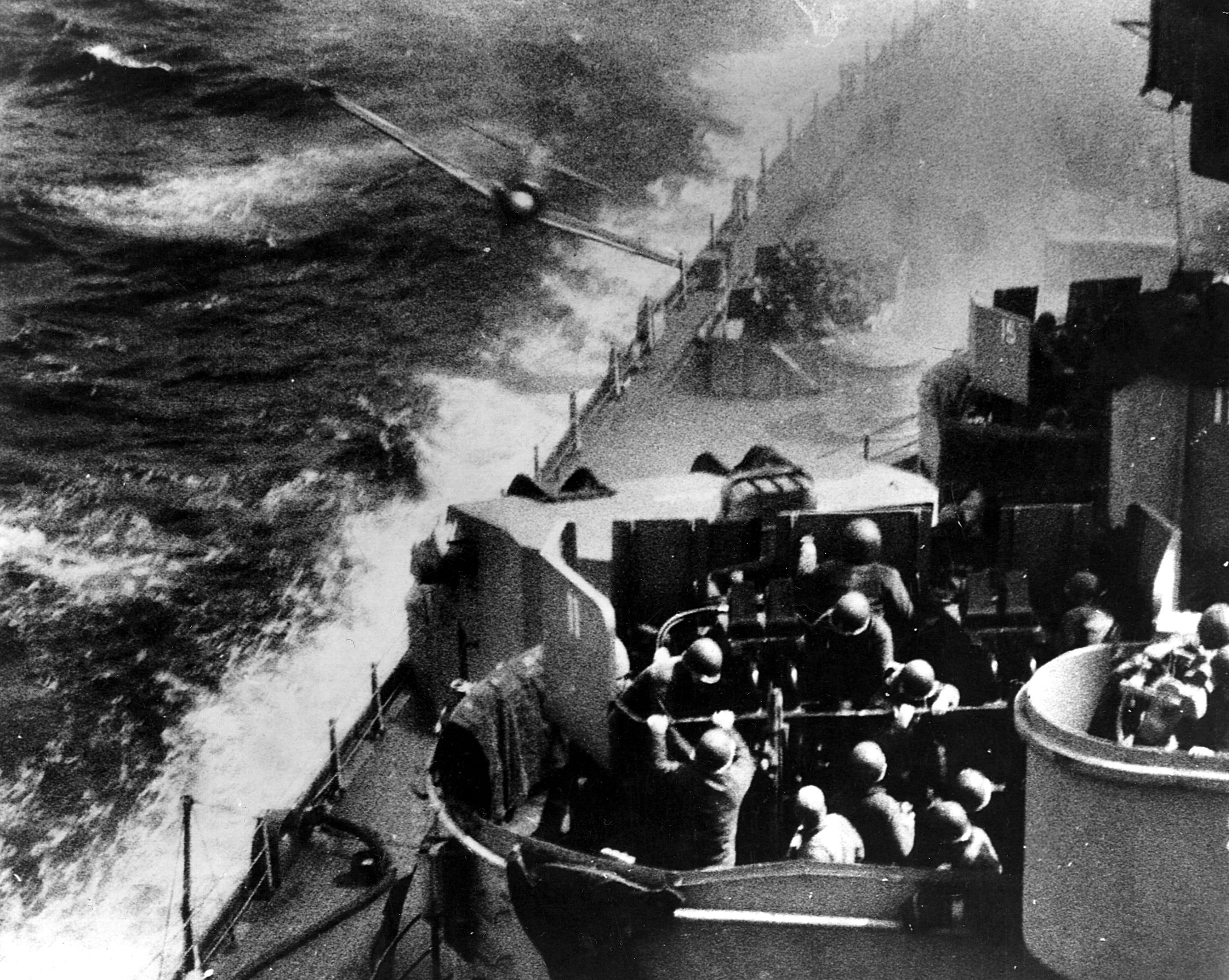
Rowe watched one kamikaze zoom directly over him before it crashed into the deck. “It’s terrifying to see a kamikaze coming down. They keep boring in on you on a sharp angle, and it’s either him or you. I saw tracers from our guns going right into the plane and yet it would not blow up. I kept wondering how in the world it stayed up. I was far from calm, yelling to the gunners to ‘Hit it! Hit it!’”
Immediately after the hits, Captain George Seitz, the ship’s commander, swung her broadside to the wind so the smoke and flames would be carried away from the carrier. He then ordered a 70-degree turn, which propelled thousands of gallons of aviation fuel overboard and reduced the threat of worse fires.
Fires raged out of control in Rowe’s area. When an officer ordered everyone to jump overboard, Rowe plunged to the ocean 80 feet below, then spent two hours in the water before being rescued. When he returned to the carrier the next day, he saw a battered and bruised ship, but one that somehow remained afloat. His next sight, though, stopped him in his tracks. Seventy-three bodies of fellow crewmen had been neatly lined up along the deck, and for the rest of the day Rowe and others gently placed them in canvas bags for burial at sea.
The carrier made it to Ulithi under her own steam, but Rowe’s ship was out for the remainder of the war. A British carrier would have been quickly patched up and put back on the line.
By the end of May, when Admiral William F. Halsey’s Fifth Fleet relieved Admiral Spruance, kamikaze attacks had slowed, both in numbers, and intensity. Kikusui No. 8, lasting from May 27-29, and containing more than 100 aircraft, was the final attack. From then on, kamikaze strikes became more haphazard. Attrition of the Japanese and American numerical superiority in ships, planes, and weaponry doomed the kamikaze campaign to failure from the start.
The Army and Marine land forces finally overwhelmed Ushijima’s rigorous defenses the next month. By the time Okinawa was declared secured on June 22, the casualty count made the battle the bloodiest of the Pacific. On land, more than 130,000 Japanese soldiers died, another 75,000 Okinawan civilians perished, and 39,000 Americans were killed or wounded. At sea, 1,465 kamikazes sacrificed their lives and in the process sank 34 ships, destroyed 763 carrier aircraft, and killed or wounded 10,000 sailors, a higher cost than any previous Pacific naval campaign.
The fighting at Okinawa convinced American military planners that the next operation, the campaign to invade the Japanese Home Islands, would exact a frightening toll. The Joint Chiefs of Staff urged President Harry S Truman, who had succeeded Franklin Roosevelt, to adhere to the unconditional surrender policy adopted by President Roosevelt.
The strife off Okinawa’s shores offered sailors moments of sheer terror interspersed with noble bravery. Winston Churchill, an orator and writer accustomed to memorializing great military moments in history, so recognized the U.S. Navy in a June 22 letter to President Truman. “The strength of willpower, devotion and technical resources applied by the United States to this task, joined with the death struggle of the enemy, places this battle among the most intense and famous of military history. We make our salute to all your troops and their commanders engaged.”
Join The Conversation
Comments
View All Comments