By Al Hemingway
A full moon in a cloudless sky shone over Germany’s Ruhr Valley on the night of May 16, 1943, meaning that all Royal Air Force (RAF) bombing missions over Nazi Germany had been canceled. The risk of enemy antiaircraft fire in such bright conditions meant that the crews had a night off to enjoy a movie, visit friends and family, or hoist a few beers in a local pub.
However, for the Squadron 617 “Dambusters” these weather conditions were ideal for a bombing run. They were a special unit whose task was to destroy the Möhne, Eder, and Sorpe dams located in the Ruhr Valley, the industrial heart of Germany. Eliminating these targets would deprive the enemy of much of the power needed to keep its factories and munitions plants producing war material—shortening the war and bringing the Nazis to their knees.
“Operation Chastise” faced doubts from the outset and would have to overcome enormous hurdles to succeed. Attacking huge dams was not an easy undertaking, but there were people within the military and the government that believed it could be done.
Once such individual was Dr. Barnes Neville Wallis, assistant chief designer at Vickers-Armstrong’s Aviation Section. Though the idea of destroying the dams had originally been proposed by the Air Ministry and Bomber Command, it was Wallis who resurrected the concept and sought to solve the technical barriers associated with the operation.

To begin with, just locating the dams posed enormous difficulties. Even during daylight, 40 percent of navigators “could not find a nominated British City.” From a medium bombing altitude it is hard to distinguish any structure—“a pin head in a field,” according to the Dambusters official website.
Even if the bombers were able to find their target, the next obstacle to overcome was exponentially larger: how to hit the dam and destroy it. Throughout the war, no more than 10 percent of aircraft reached their destination in the Ruhr Valley and only a third of these unleashed their ordnance within five miles radius of a target. For Chastise, the bombing runs would have to be far more accurate to have a chance of eliminating the dams.
Another major roadblock was that the bomb needed to do the job did not exist. At the start of the war in 1939, the RAF only had 500-pound bombs in its arsenal. Razing a structure like one of the German dams would require more than 5,000 of them, dropped with pinpoint accuracy. Wallis knew a larger bomb was needed if the mission was to be a success.
Developing a bomb that could do the job brought its own stumbling block—the RAF did not have a bomber large enough to fly there, drop the bombs, and make it back to England.
Wallis moved forward, working on all of these problems at once. After much deliberation, six of the twenty dams in the Ruhr Valley were chosen for destruction . Of those, the Möhne, Eder, and Sorpe dams would be the primary objectives. The Möhne and Sorpe dams alone held three-quarters of all the water available to produce hydroelectricity in the Ruhr Valley. Destroying all three would “bring the whole industrial valley to a standstill, causing massive damage to the steel industry, devastating production of tanks, aircraft, guns and locomotives which were all vital to Germany’s war effort,” according to the official Dambuster history.
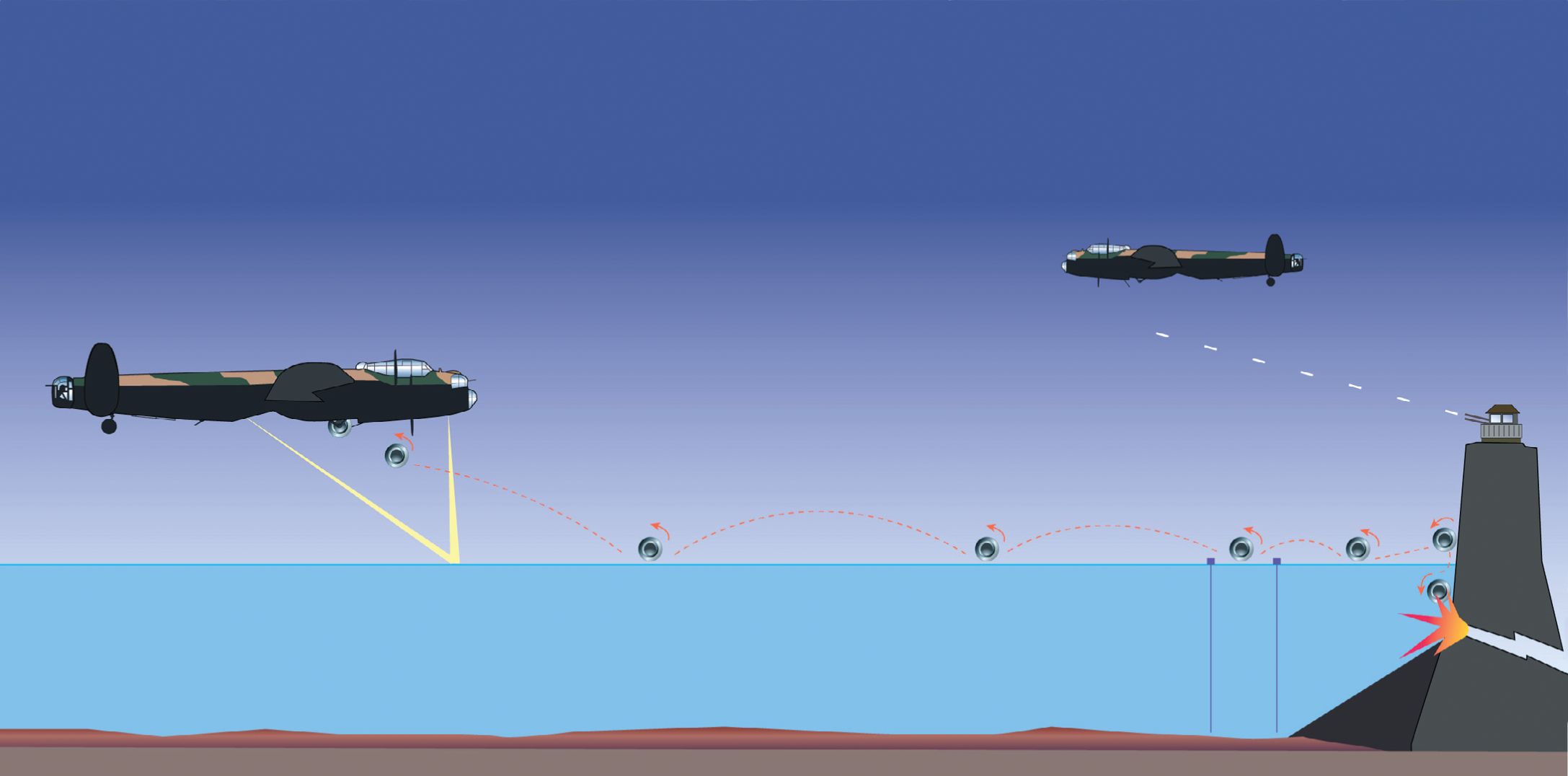
The majority of the German dams were gravity dams—a wall of concrete with a wide base, held in place by its own massive weight. To destroy these dams, a bomb would need to be detonated near the bottom where the explosion would seriously deteriorate it, causing the wall to crumble and allowing the water to gush out into the basin.
But the Sorpe was an earth dam and would require different bombing methods to breach it. The projectile had to be dropped at the top of the structure where the blast would cause the structure to buckle, collapsing the bank on the outer, dry side. With the loss of support, the concrete wall at the dam’s inner core would fall under its own weight.
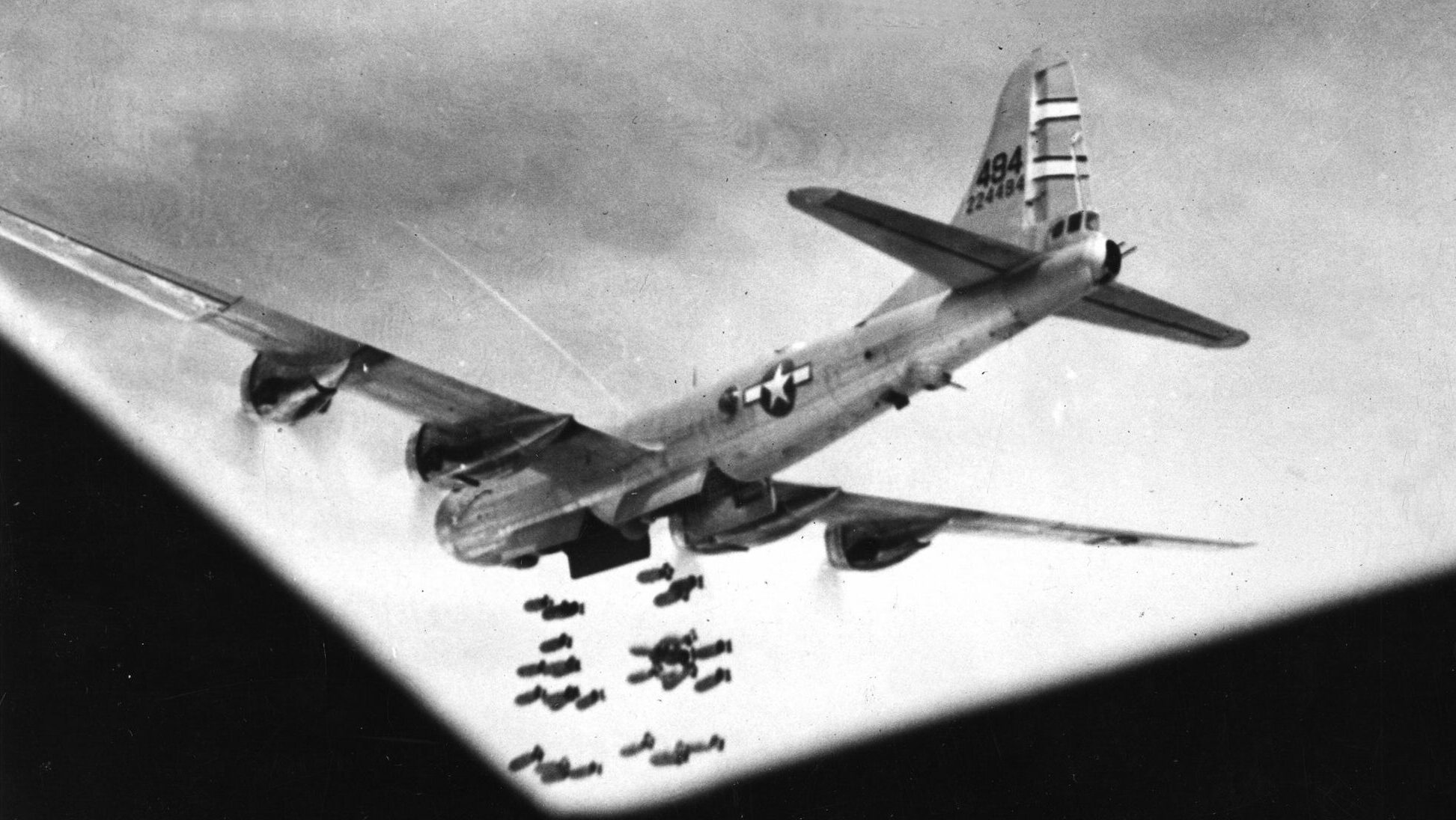
The team of engineers working on Operation Chastise had to constantly adapt, coming up with new strategies as problems arose. After much testing, it was decided that a 7,500-lbs. bomb, when dropped from a low altitude, could skip across the water like a stone and make a breach in the walls of the dam. The new weapon was designated as “Upkeep.”
Production began on the Avro Lancaster B Mk IIIs in April 1943. The new bomber was equipped with four Merlin engines and a bomb bay that could house an 8,000-lb. load—large enough for the new bouncing bomb. Avro Chief Designer Roy Chadwick adapted the Lancaster to carry Upkeep. Much of the armor and the dorsal gun turret was removed to save weight. Upkeep’s size and shape meant that the bomb doors had to be removed so it could hang partly out of the open bay. These modified aircraft were designated Lancaster B Mark III Special (Type 464 Provisioning).
As Wallis and Chadwick were fine-tuning their respective projects, the RAF organized and began training a squadron to carry out this dangerous assignment. There was a sense of urgency because the mission had to be carried out when water levels of the dams were at their maximum height in mid-May. If they missed this window, the project would have to be postponed until the following year. That meant they only had three months of preparation for the pilots and crews.
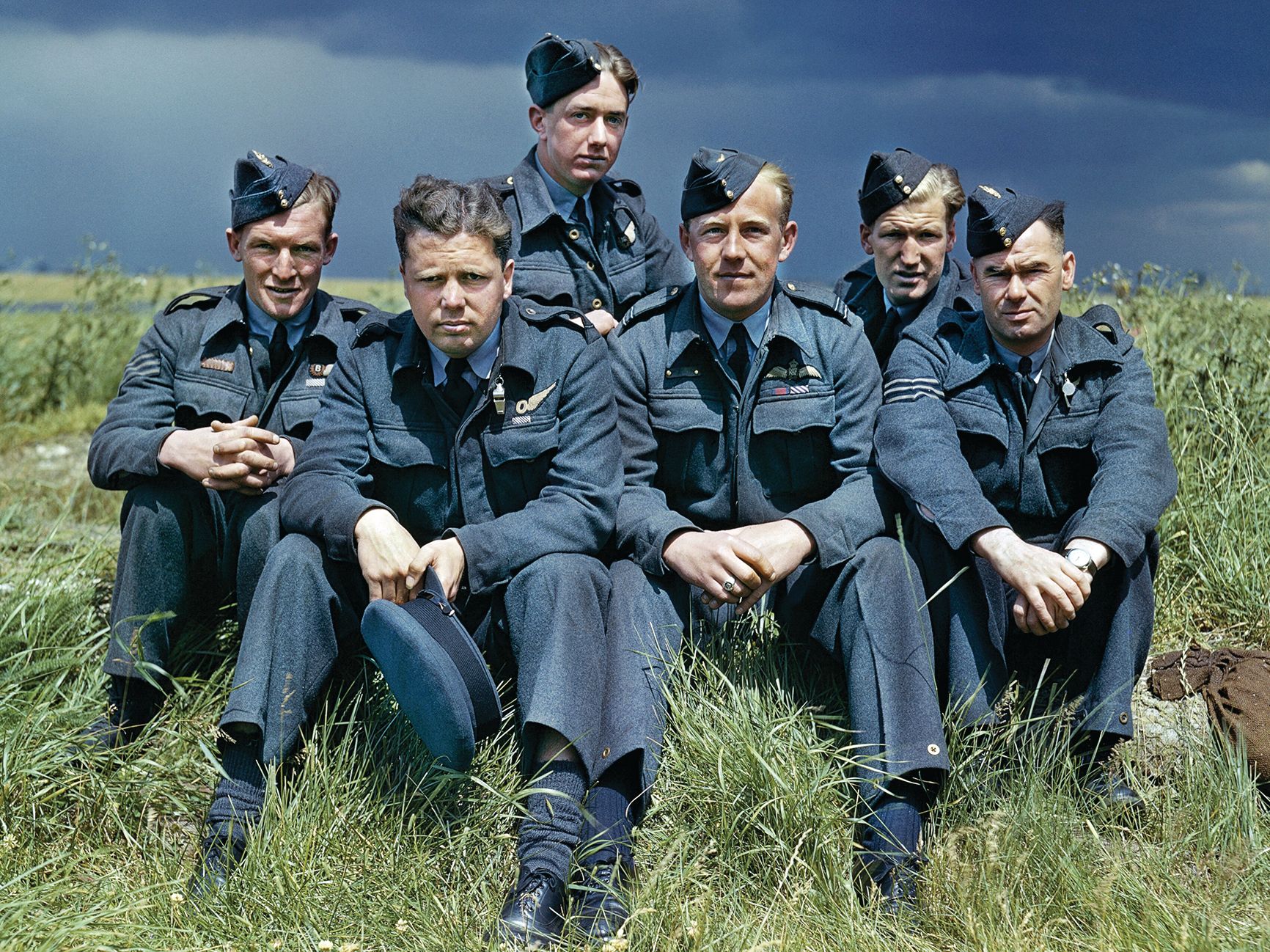
A special man was needed to lead such a squadron, and Wing Commander Guy Penrose Gibson was selected due to his “formidable operational record … leadership skills and strict discipline.” On his first bombing raid in July 1940, he earned the Distinguished Flying Cross (DFC). He then volunteered to be a fighter pilot and was credited with four kills before being decorated with another DFC and promoted back to Bomber Command. The 25-year-old pilot was given the authority to select his own people, although he still had no idea what the mission or target would be. The squadron, originally given the code name Squadron X, would later be renamed Squadron 617. The unit adopted the motto “Après moi, le déluge,”(After Me, the Flood) attributed to French King Louis XV as an expression of indifference to events after one’s death. The name certainly fit.
On March 21, 1943, Gibson assembled his crews for their first briefing at Scampton, Lincolnshire, an RAF bomber base 150 miles north of London. Although he had scant information himself, Gibson spoke to his men about the upcoming operation—that there would be a raid on Germany and they would have to learn how to fly at very low altitudes. Gibson tried to quash the rumors that were circulating about the mission because he believed that in order for them to succeed, “security is the greatest factor.”

Several days later when Gibson met with Wallis, who could not inform the wing commander of any specifics of the plan, he impressed upon him the importance of low-altitude flying. Gibson was told his men had to attack their objectives at 240 mph at a height of 150 feet in moonlit darkness. If they did not do this, the mission would fail.
Training commenced immediately. Blue film was put over the windows of the aircraft while the crew members donned yellow-tinted goggles to get them accustomed to night flying. Maps were made and placed on rollers to make reading them easier.
Flying low over water would be a thornier issue. In late March, Gibson flew a test flight over the Derwent reservoir at an altitude of 150 feet. All went smoothly in the light of day. At dusk, however, “he could not distinguish the horizon from the water surface and nearly flew into the lake.”

The solution to this problem was found at the Royal Aircraft Establishment, which had tried to equip Hudson bombers with spotlights situated under the plane so they could bomb German U-boats at night. The idea had been scrapped because of rough ocean waves, but over relatively smooth lake water, it had possibilities.
Two lamps were positioned on the Lancaster, one by the bomb bay and the other at the nose. The lights were oriented so that the beams would intersect on the surface of the water when the bomber was 150 feet above it. The navigator would direct the pilot downward until the beams converged.
When they saw the lights on their planes, the crews were stunned. Not only would they be flying at an extremely low altitude, they were also going to be lit up, exposing themselves to antiaircraft fire. This enraged Bomber Command leader Air Marshal Sir Arthur Harris who said, “I will not have aircraft flying about with spotlights on in defended areas.” Despite his objections, this was the only solution to the problem, and the lamps remained on the Lancasters.
Meanwhile, Wallis, Vickers’ chief test pilot Mutt Summers, and Avro’s chief test pilot Sam Brown were also busy. They had been experimenting with dropping the bouncing bomb from the required 150 feet. The results were not promising.
Wallis soon discovered that the weapon’s wooden casing was being demolished when it hit the water. Despite improvements to the outer layer, the bomb continued to break apart on impact. It was eventually concluded that the only answer was for the aircraft to fly even lower.

Wallis told Gibson his crews would have to fly over the water and attack their targets at an altitude of only 60 feet. The stunned officer took a deep breath and answered that they would. Later Gibson would comment, “If 150 feet was too low, 60 feet was very low. At that height you would only have to hiccough and you would be in the drink.”
The final obstacle to be worked out was the distance from which the projectile would have to be dropped to breach the dam. There could be no miscalculations. The bomb had to hit the dam in the right spot.
A “bomb aimer” developed by the Royal Aircraft Establishment would produce the desired results. The bombardier would use an eyepiece at the base of a hand-held Y-shaped wooden sighting device. When the two nails on the arms lined up with the towers on the dam, this would designate the correct range for releasing the bomb—about 400-425 yards from the target.
Less than a week before the raid, Gibson’s men began training in dropping the actual bombs at Parkstone shore, utilizing the crude bombsights. The bouncing bombs were not filled with explosives, but they gave the crews a feel for releasing the projectiles. Everyone was astonished as they watched the drums skipping over the water until they stopped at the beach.
While training, several of the bombers were trapped and damaged in a large volume of water when they released their Upkeeps too low. As a result, one of the Lancasters could not be repaired in time and the unit was minus one plane. Then, one of the crews developed intense airsickness as a result of the low flying. From 20 planes to fly, with one in reserve, the mission was down to a total of 19 aircraft.

Amazingly, in only two months, the operation was on schedule. The bomb was ready, the Avro Lancasters had been fitted with a release mechanism for Upkeep, and Gibson’s crews were perfecting their night- and low-altitude flying plus dropping the bouncing projectiles at their targets.
On May 15, 1943, Gibson was summoned to speak with Wallis. This was the first time he had learned about their targets. In a magazine article, author Daniel Wyatt wrote, “The dimensions of the dams astonished Gibson. The Gothic-styled Möhne Dam was 2,500 feet long, 130 feet high, topped by a 25-foot-wide roadway, and had a concrete and masonry base 112 feet thick. It held back a lake 12 miles long that contained 140 million tons of water. A short distance south of the Möhne Dam was the much smaller Sorpe Dam. Together they controlled 75 percent of the total water available in the Ruhr Valley. Fifty miles to the east was the Eder, the big brother of the three, with a water capacity of 200 million tons.” The Möhne, Eder, and Sorpe dams were the main objectives of the raid. The alternative targets were the Lister, Ennepe, and Diemel Dams.
Gibson absorbed all this information and realized the importance of this mission. He immediately sat down with his two flight commanders, Henry Melvin Young and Henry Eric Maudslay; his deputy leader, Flight Lt. John Vere Hopgood; and bomb aimer Flight Lt. Robert Claude Hay to inform them of the plan.
In the early evening hours of May 16, 1943, the men of Squadron 617 gathered for their final briefing. Tensions were high. They were finally being told the details of their mission. Gibson outlined the specifics of the attack, call signs, routes, code words, and the like. Wallis described Upkeep to the men—how the concept came about and its progress over the years. He also impressed upon them the magnitude of the raid and how it might help in shortening the war if successful.
Gibson had the Lancasters taking off in three waves. Nine bombers designated AJ-G “George (Gibson’s plane),” AJ-M “Mother,” AJ-P “Popsie,” AJ-A “Apple,” AJ-J “Johnny,” AJ-Z “Zebra,” AJ-L “Leather,” AJ-B “Baker,” and AJ-N “Nut” were in the first group.

The second group had five bombers given the names AJ-Q “Queenie,” AJ-E “Easy,” AJ-W “Willie,” AJ-K “King,” and AJ-H “Harry.” This sortie would leave Scampton Airfield before the first group because of its more northerly route. The bombers would fly over the Dutch island of Vlieland and then down the Zuider Zee to link up with Gibson’s formation, which had flown a southern path toward Germany.
Lastly, the third wave also had five Lancasters. These were dubbed AJ-C “Charlie,” AJ-S “Sugar,” AJ-F “Freddie,” AJ-O “Orange,” and AJ-Y “York.” They would depart last and be behind Gibson’s group, acting as a mobile reserve and striking at any of the primary or secondary targets that had not been destroyed. If the other two waves were successful in breaching all their objectives, then the last wave would return to Scampton.
Everyone was told not to veer from their designated routes. These courses had been established to evade Nazi antiaircraft batteries, enemy night-fighter bases, areas along the coast of Holland and along the approach to the target, which were known to be areas of intense antiaircraft fire. The crews were told not to return home with an unexploded bomb because landing might prove difficult. All unused Upkeeps were to be dropped over enemy territory.
Just prior to departure, AJ-Q developed a coolant leak in its starboard engine. American-born Flight Lt. Joseph McCarthy and his crew changed to AJ-T “Tommy,” a spare bomber that had just flown hours earlier. “Tommy” had no spotlights or VHF radio, but it was too late to modify it now. McCarthy and his men would have to make do with what they had. As a result, “Tommy” left Scampton a half-hour later than expected.
As the first group flew over the North Sea, Gibson, Hopgood, and Flight Lt. Harold Martin’s bombers experienced gusty winds and strayed off course. The three planes flew into Holland in the wrong area and were met with a volley from German guns. As “George” headed toward the Ruhr, the sky was suddenly criss-crossed with searchlights. The forward gunners immediately fired at the lights below, hitting one of them. The others switched their attention to Martin’s Lancaster, “Popsie.” The gunners in Martin’s bomber opened up as well. Hopgood’s “Mother” was not so fortunate as the aircraft was struck in one of its wings.

Flying along, sometimes at an altitude of 40 feet, the trio evaded power lines, structures, and trees as they neared their objective. “Johnny,” “Apple,” and “Leather” were closely trailing when they, too, were hit by flak. Except for minor hits they made it through safely.
Pilot Officer Leslie Gordon Knight in “Nut,” Flight Lt. William Astell flying “Baker,” and Squadron Leader Henry Eric Maudslay piloting “Zebra” had an uneventful journey until they reached the Rhine. That’s when Astell’s “Baker” plummeted to the ground.
“There are conflicting stories as to why Astell crashed,” according to the mission’s official historical website. “Bob Kellow, Knight’s wireless operator, said later that AJ-B was trailing behind when it was caught in a crossfire of light flak.” German eyewitnesses, however, dispute this story. They said that the bomber hit power lines and went down. As the Lancaster crashed, the Upkeep exploded, leaving no survivors.
“Baker” was the fifth bomber to either crash or return for various reasons. The majority of them were from the second group. As “Zebra” and “Nut” approached the Möhne, Gibson, Maltby, and Hopgood had started their bombing runs.
As Gibson made a practice run over the target area he noticed an antitorpedo net stretched across the bottom of the dam. There were no searchlights. The enemy apparently felt no one could destroy the dam. “George” was met with some gunfire from the dozen or so antiaircraft batteries that lined the towers and walls of the Möhne dam.

the RAF Dambusters raid tore a roughly 250-foot-square hole in the structure.
“Well, boys, I suppose we’d better start the ball rolling,” Gibson remarked as he went in for his attempt on the dam.
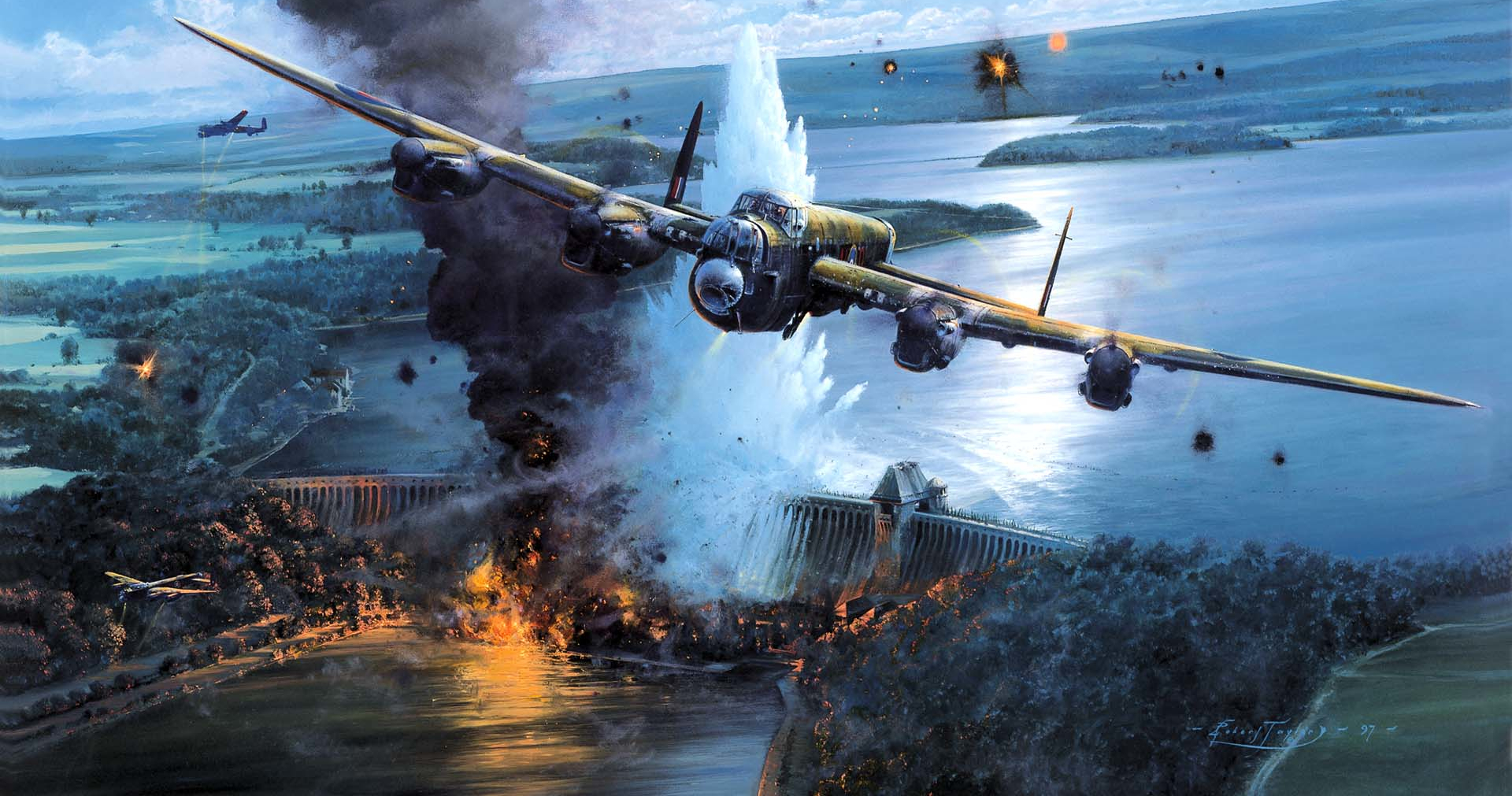
As he lowered his Lancaster to the required 60 feet, he turned on his lamps under the belly of the plane. As the bomb rotated toward the tail of the plane at 500 rpm, navigator Torgor Harlo Taerum kept in constant communication with Gibson as he neared the water. At 28 minutes past midnight, bomb aimer Frederick “Spam” Spafford let loose the first Upkeep. The bomb did as it was supposed to; it bounced along the lake hitting the structure at water level and exploded, causing a tremendous geyser of water to be emitted skyward. The liquid temporarily blocked the view. But as it dissipated, the Möhne Dam still stood.
Hopgood was next. Unfortunately, by this time “Mother” had been hit and was suffering extensive damage as flak had struck her port engine and starboard wing. As Hopgood tried desperately to keep his aircraft steady, his bomb aimer, James W. Fraser, sent their Upkeep crashing into a power plant on the other side of the structure. Fraser, thought to be wounded, had let loose the projectile too late. “Mother” tried to reach a higher altitude, but the plane exploded in a brilliant flash. Miraculously, the rear gunner, Anthony Burcher, managed to escape by opening his parachute inside the aircraft and allowing it to launch him from the bomber. Fraser escaped the plane in the same manner. Unfortunately, both individuals were captured soon after hitting the ground.
Gibson ordered “Popsie,” flown by Harold Martin, to make a run at the Möhne. He flew ahead of Martin’s Lancaster as a decoy, drawing enemy fire from him as the second bomber made its way toward its target. Again, Upkeep was sent crashing into the lake. This time, it detonated 50 yards from the dam causing no damage.
Now it was Henry “Dinghy” Young’s turn in “Apple.” Martin and Gibson tried to draw the Germans’ attention away from Young’s Lancaster as he made his turn to strike at the dam. The bouncing device was released perfectly by Vincent MacCausland, and it skipped over the water and hit the structure causing no visible damage. However, the initial assessment by the airmen was wrong. “Apple” had indeed caused a breach in the Möhne Dam.

Flight Lieutenant David Maltby dropped his Lancaster down to 60 feet as bomb aimer John Fort let loose another Upkeep. As AJ-J “Johnny” gained altitude to make its escape after dropping the bomb, the crewmen observed the Möhne Dam crumbling in a spectacular fashion.
In his autobiography, Enemy Coast Ahead, Gibson wrote: “The whole valley was beginning to fill with fog from the steam of the gushing water, and down in the foggy valley we saw cars speeding along the roads in front of this great wave of water, which was chasing them and going faster than they could ever hope to go. … The floods raced on, carrying everything with them as they went—viaducts, railways, bridges and everything that stood in their path. Three miles beyond the dam the remains of Hoppy’s aircraft was still burning gently, a dull red glow on the ground. Hoppy had been avenged.”
Excitement erupted back at headquarters in Grantham when the signal was sent by Flight Lt. Robert Hutchinson, Gibson’s wireless operator, that the dam had been destroyed. Harris offered Wallis his hand and congratulated him saying, “I didn’t believe a word you said when you came to see me, but now you could sell me a pink elephant.”
But the congratulatory remarks were short lived—there were still targets to be eliminated. Gibson sent Maltby’s “Johnny” and Martin’s “Popsie” back to Scampton. “Leather,” “Zebra,” and “Nut,” along with Gibson’s “George,” made their way to their next objective: the Eder Dam.
One thing in their favor at the next objective was that the Germans had no antiaircraft batteries set up to defend it. There was, however, a reason for this. Shielding the Eder Dam were cliffs, some reaching 1,000 feet in height, which would make their runs at the structure extremely difficult. The bombers would be forced to drop down and make an abrupt turn to the left, proceed over a small piece of land, then reach the required 60-foot altitude to release their bombs.

“Leather” was the first to attempt it. After three failures, Gibson instructed Flight Lt. David Shannon, flying “Leather,” to back off while he sent in Henry Maudslay in “Zebra.” Unfortunately, after several runs, “Zebra” experienced similar difficulties. Gibson radioed Shannon to go in one more time. They all watched as a huge geyser of water shot up in the air when “Leather” released her bomb, but when it subsided the Eder Dam still stood.
When Maudslay returned to make another run, bomb aimer Michael Fuller released the Upkeep too late. It struck the wall and detonated in a magnificent blast that lit up the entire valley. Unfortunately, the explosion damaged “Zebra.” Gibson reached Maudslay by wireless, inquiring if he was all right, but the only words he heard from “Zebra” were, “I think so.” That was the last radio communication anyone had with him. Maudslay’s Lancaster was lost.
Gibson had one bomb left, and it was aboard “Nut.” He told Leslie Knight to make a practice run and try his luck on the dam. As Knight approached the structure at 60 feet above the water, his bomb aimer, Edward Johnson, set the Upkeep in motion. The canister skipped across the water into the dam near its center, then sank to explode near its base using a hydrostatic fuse, breaching the wall. As with the Möhne Dam, the sight of the nearly two million gallons of water gushing from the opening was impressive. Word was relayed back to headquarters that the Eder had been destroyed.
While the first group was busy destroying the pair of dams, the second wave, which had left Scampton separately because of its lengthy northern course, was trying to reach its target, the Sorpe Dam.
Regrettably, the crews ran into trouble. Flight Lt. Robert Barlow and his crew in AJ-E “Easy” assumed command when McCarthy’s plane “Queenie” developed a leak and the crew was in the process of preparing “Tommy,” the only reserve Lancaster the squadron possessed, for takeoff.

Barlow lifted off at about 9:30 p.m. and disappeared. Reports say he and the crew perished in a crash near Haldren, Germany. Although the Lancaster hit the ground hard, the bomb it was carrying was not damaged. It was unearthed by the enemy and spirited away to be studied by top German scientists.
Likewise, Flight Lieutenant Vernon Byers and his men in “King” were sent spiraling downward as a result of enemy gunfire near Texel, off the Dutch coast. Again, no one escaped the crash. Two of the five Lancasters were gone.
AJ-W “Willie” was not having much success either. As the bomber flew over Vlieland, an island near Texel, the aircraft came under intense fire from German batteries below. The flak caused extensive damage to the ship’s communication and electrical systems. Realizing he could not complete the mission, Flight Lt. John Munro decided to return to Scampton.
Just past Vlieland around 11 p.m., Flight Lt. Geoffrey Rice in “Harry,” was flying low to avoid the heavy flak when he accidentally struck the water. The Upkeep was torn from the plane’s underbelly and the Lancaster began taking on water through the open bomb bay. As Rice got the nose up in his fight to stay aloft, the aircraft’s tail hit the sea and the tail wheel smashed a hole in the fuselage. Rice was able to climb to a safe altitude with the water draining out of the tail and turn back for England.
That left only one aircraft from the second wave—McCarthy’s “Tommy.” As he headed for the Ruhr Valley, McCarthy flew low as flak exploded all around him. He managed to reach the Sorpe Dam just after midnight. The only earthen dam on the target list, it had to be struck parallel in its midsection on the upstream side. After three dummy runs, McCarthy discharged the bomb, but it failed to destroy the dam. McCarthy made it back to Scampton.

Arriving just after 3 a.m., “Freddie” was the only plane from the third group to strike the Sorpe Dam. Flight Sgt. Kenneth Brown tried to destroy the imposing structure but had difficulty as well. In his article “The Ruhr Dam Raids,” author Daniel Wyatt details what happened: “Brown tried eight times. Each time, his Canadian bomb aimer Sgt. Steve Oancia, could not judge his target in the mist with the wall and hills fast approaching. On the ninth attempt, Oancia dropped a bundle of incendiaries in the trees near the approach to the dam. The next time Brown came around, Oancia saw the fire despite the mist, and he knew precisely where to drop the bomb. He let go and Brown thundered over the hills. The crew watched as a circular shock wave of air surrounded a towering blast of water. But when everything settled, the Sorpe Dam remained unscathed.”
Disappointed, “Freddie” was forced to return to base. AJ-C “Charlie” tried to attack one of the secondary targets, the Lister Dam. The plane was hit by flak and crashed near Hamm, Germany. Rear gunner Sergeant Frank Tess, the sole survivor, was taken prisoner.
On the return flight, “Apple” reached the Dutch coast and was flying at a high altitude when it was peppered by flak and crashed into the North Sea. Henry “Dinghy” Young and his entire crew were lost.
Flight Sergeant William Townsend and his crew in “Orange” reached the Ennepe Dam just after 3:30 a.m. They released the Upkeep but it did not destroy the dam. His Lancaster was the only one to successfully reach and attempt to destroy one of the alternative targets. He was the last to return to Scampton, setting down about 6:15 a.m.
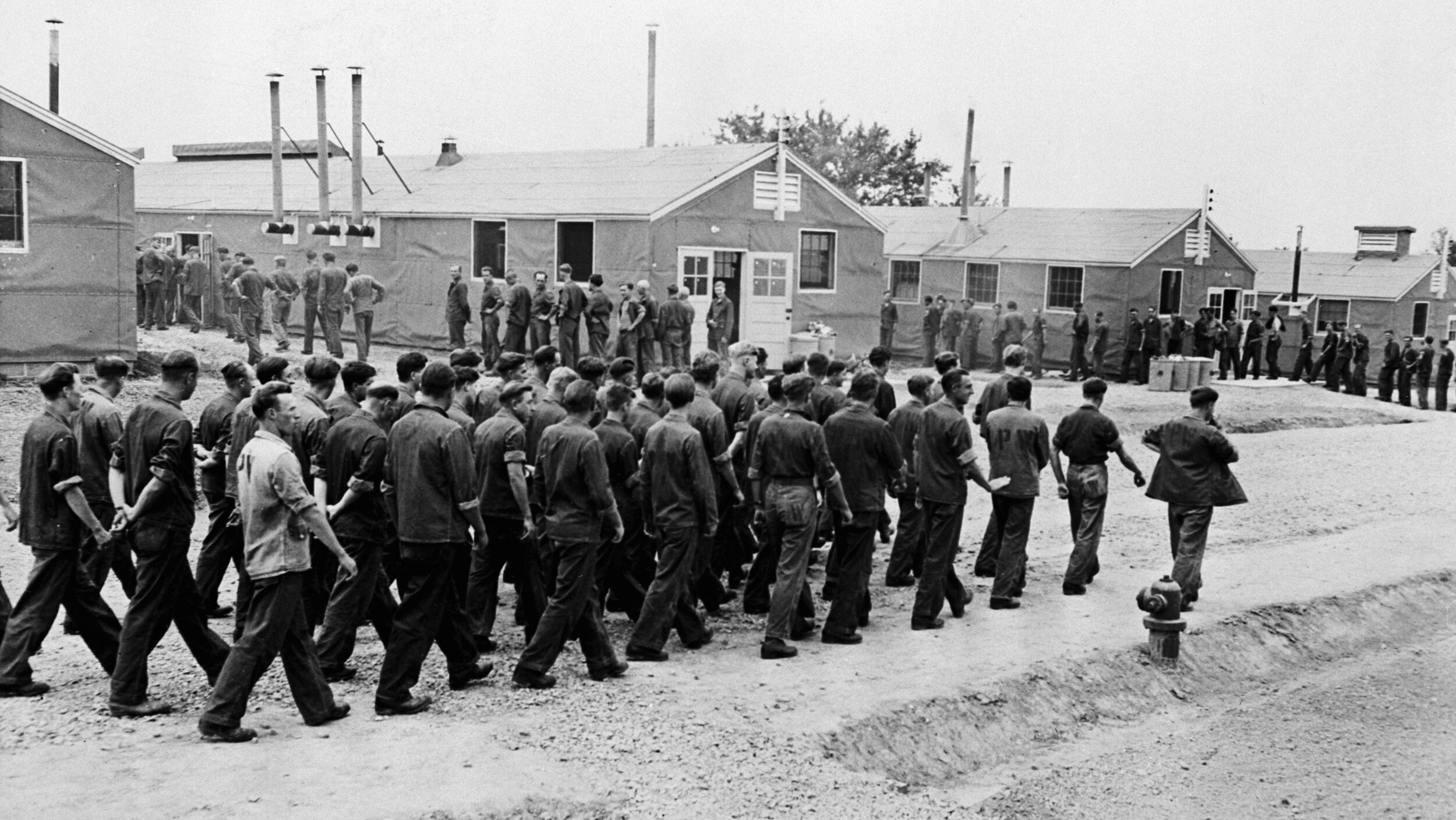
With two of the dams destroyed, the raid was deemed a success. Photographs later revealed the devastating destruction to the region. The lakebeds at the Eder and Möhne dams were now dry. Towns, roads, canals, power plants, and railroads 50 miles downstream had been washed away. Due to the loss of power, many of the German manufacturing plants lay idle. Farms lost thousands of head of livestock as well. Nearly 1,300 people died as a result of the water that gushed from the dams. Unfortunately, almost half of the casualties were from a Russian POW camp situated by the Eder.

Despite the destruction of the two structures and the loss of life and property, the Germans rebounded quickly. Although production was crippled, it did not suffer as greatly as anticipated. Had the Sorpe Dam been breached, the Germans would have been dealt a severe setback. Albert Speer, Reich Minister of Armaments, later commented, “Ruhr production would have suffered the heaviest possible blow.”
One important result of the raid was the reassignment of 20,000 workers who were involved with the construction of the Atlantic Wall. They were quickly dispatched to the Ruhr Valley to repair the Möhne and Eder dams before winter arrived.
The bravery of Gibson and his men cannot be understated. They performed magnificently under very difficult conditions. Squadron 617, however, did not get away lightly in the raid. Fifty-six men did not return from the mission. Three survived their crashes and became POWs. Of the 19 Lancasters that departed Scampton, only 11 made it back safely.
Many of the returning crew members were awarded Distinguished Service Orders and Distinguished Flying Crosses, some posthumously. Guy Gibson was presented with a Victoria Cross, England’s highest decoration. His citation read in part: “Wing Commander Gibson personally made the initial attack on the Möhne Dam. Descending to within a few feet of the water, he delivered his attack with great accuracy. He then circled very low for thirty minutes, drawing enemy fire and permitting as free a run as possible to the following aircraft. He repeated these tactics in the attack on the Eder Dam. Throughout his operational career, prolonged exceptionally at his own request, he has shown leadership, determination and valour of the highest order.” Sadly, Gibson was killed when his de Havilland Mosquito crashed in Holland while on a bombing mission in September 1944.
Through their dedication and unrelenting devotion to duty, Squadron 617 did the impossible. They were soon dubbed the “Dambusters” by the media. Their popularity increased over the years with books and a movie made about their exploits. Their heroic achievements will always be remembered by a grateful nation. To them, men like Gibson, Young, Mauldslay, Hopgood, and the rest of the Dambusters will remain immortal.


Join The Conversation
Comments
View All Comments