Dr. Roxanne Farwick Owens
Women’s contributions on the World War II home front are commonly portrayed in two ways: planting victory gardens, knitting blankets and rolling bandages—or working in a factory welding as “Rosie the Riveter.” Both images are accurate and important. By 1945, 65 percent of the aircraft industry employees were women, up from 1 percent before Pearl Harbor. In a time of war all those tasks were crucial to sustaining life at home and supporting soldiers abroad.
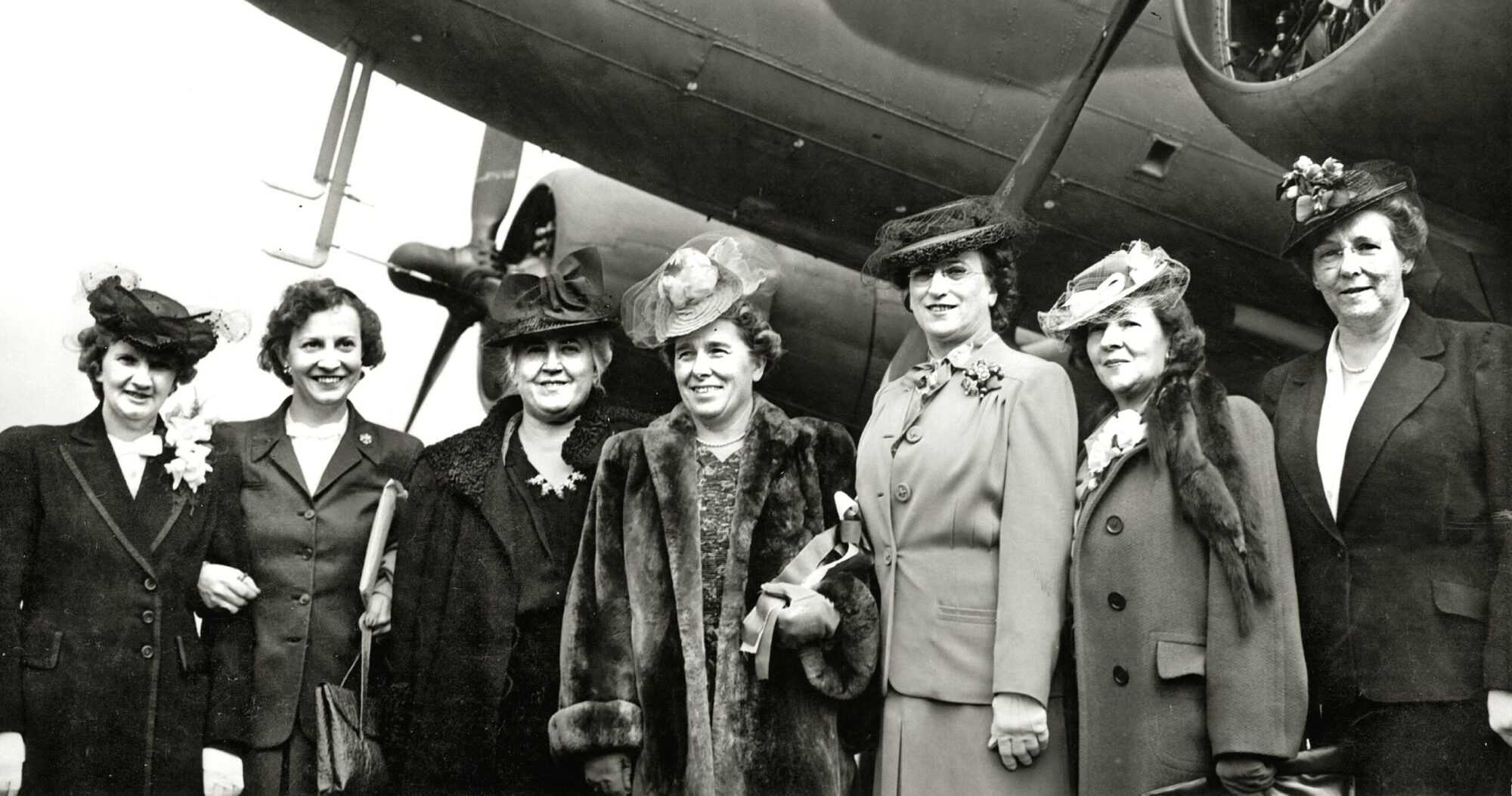
Between 1942 and 1945, one group of women—the Women’s International Bowling Congress (WIBC)—found a third way to benefit the war effort by creating a nationwide fundraising drive combining patriotism and a love for bowling. Their grassroots campaign involved nickel and dime tournaments, basket raffles, “Swat the Dictator” nights, ham prizes, and the sale of “warchids” and “warsages.” They raised $350,000, about $6.5 million in 2026. The WIBC collected enough through their “Wings of Mercy” campaign to buy a mobile ground ambulance, a Havoc A-20 bomber, and three air evacuation planes. The three air ambulances are credited with saving tens of thousands of lives, particularly in the China-Burma-India Theater. Despite the tremendous effort by so many women and the popularity of the sport, this story has remained largely unknown.
Dennis Sweeney, a St. Louis reporter and bowling alley manager, pitched the idea of a women’s bowling organization in 1907, believing that “bowling will never become a major sport until it is accepted by women.” Sweeney wrote many articles on women’s bowling, highlighting the numerous physical and emotional benefits. As a businessman, he no doubt knew he could double his business by bringing in female leagues to his alleys. Though not yet a formal organization in 1916, the group that became the Women’s International Bowling Congress (WIBC) held its first unofficial tournament in St. Louis with about 40 entrants.
Jeannette Knepprath from Milwaukee was a pivotal leader in the early days of the WIBC, serving first as president of the Wisconsin Women’s Bowling Association in 1923; she was quickly elected as president of the WIBC in 1924, a post she held until 1960. She oversaw major initiatives during her tenure, including the establishment of the WIBC War Committee and the Wings of Mercy Campaign.
Knepprath asked Violet Jean McClatchey of South Orange, New Jersey, to chair a WIBC War Committee in 1942. The group was tasked with finding a way for the organization’s 183,737 members (in over 5,300 leagues) to contribute to the war effort. This increased to 200,610 members by the end of the 1943 season. By March of 1944, women bowlers in 6,000 leagues in 34 states had contributed to the campaign.
The War Committee’s first campaign was “Our Answer to Bombs: A Bomber. Buy A Bomber for Uncle Sam.” The Woman Bowler, a monthly magazine founded in Chicago in 1936 by Earle Ward and John Hemmer, provided monthly updates of league fundraising activities. This created a healthy competition across the states and allowed the local organizations to share ideas: “That a bowler’s heart is bigger than her average is evidenced by the exciting reports received daily…. Bowling establishments are teeming with activity. Novelty tournaments, parties, raffles, etc. are in full swing now.”
With so many women working in factories, many bowling alleys stayed open all hours to accommodate shift workers and their leagues. This helped with the fundraising efforts. The Woman Bowler reported each state’s contribution to the fund: “The Polish Falcons of Erie, Pennsylvania, contributed 100% of our quota…Wichita Falls: A true spirit of patriotism was revealed when these girls remitted a check for their quota…Memphis, Tennessee. Praise the Lord, we women bowlers of the country have a chance to pass the ammunition.”
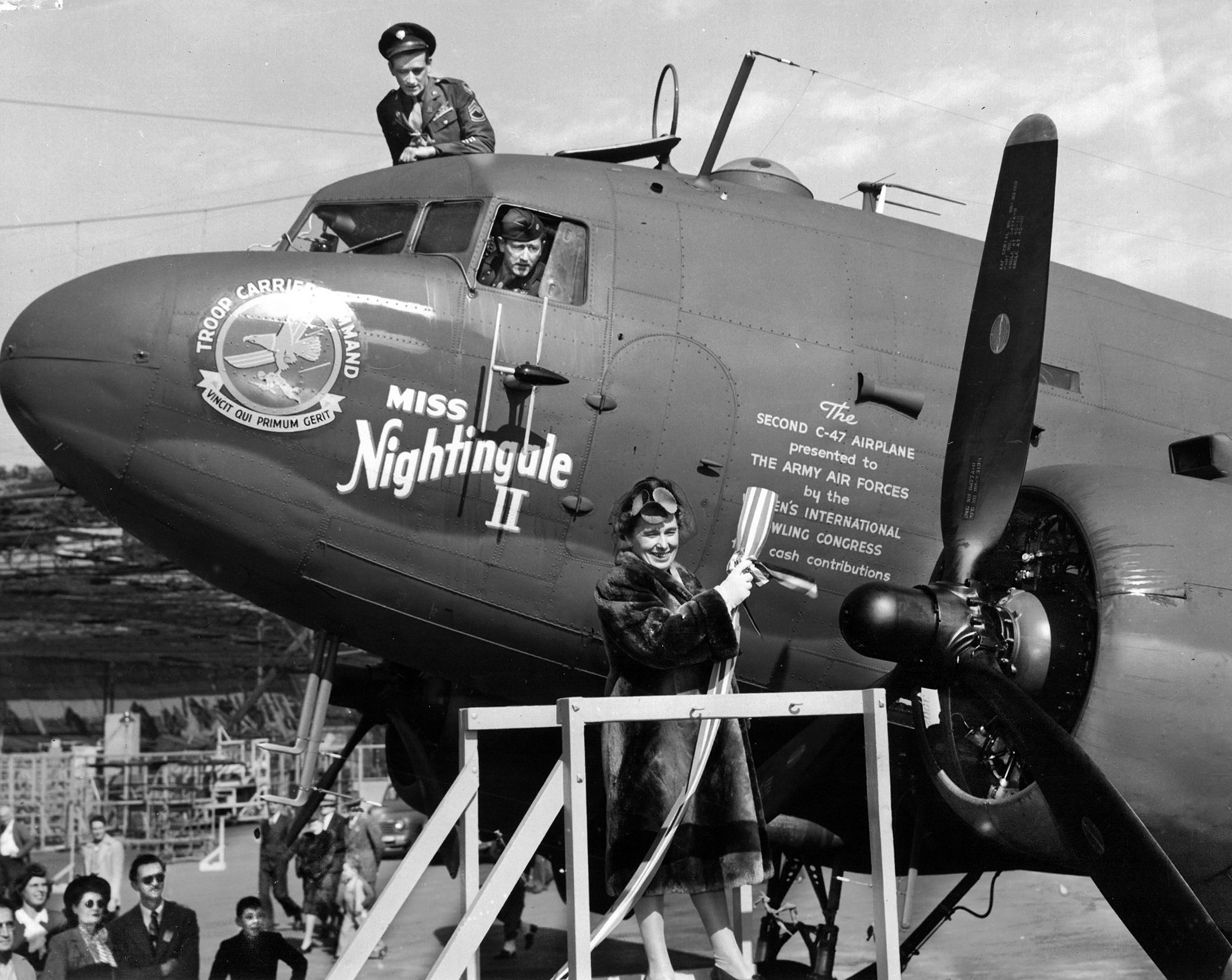
On March 28, 1943, members of the WIBC were present in Kansas City, Missouri, to christen a Douglas Havoc A-20 plane as Miss W.I.B.C. War Committee Chair Violet McClatchey presented a plaque to Major Stanford Chester inscribed with “Our Answer to Bombs—This Bomber.” She asked that the plaque be installed in the cockpit of the plane and noted the prayers of all the women were carried with it. President Knepprath said, “The WIBC has always stood for good sportsmanship, courage, and progress… We have confidence in you and our prayers go with you to strike the winning blow for the continuance of Democracy.”
WIBC secretary Emma Phaler of Columbus, Ohio, and other members listened as Brigadier General Ray Harris explained the type of fire power carried by the plane, and highlighted that the plane was designed for low-level attack work and was affectionately known as a “grass cutter.” He introduced pilot Capt. William J. Chum and Gunner Sergeant William B. Morehead who then gave an impressive flight demonstration before the Miss W.I.B.C. flew away to the strains of “God Bless America.”
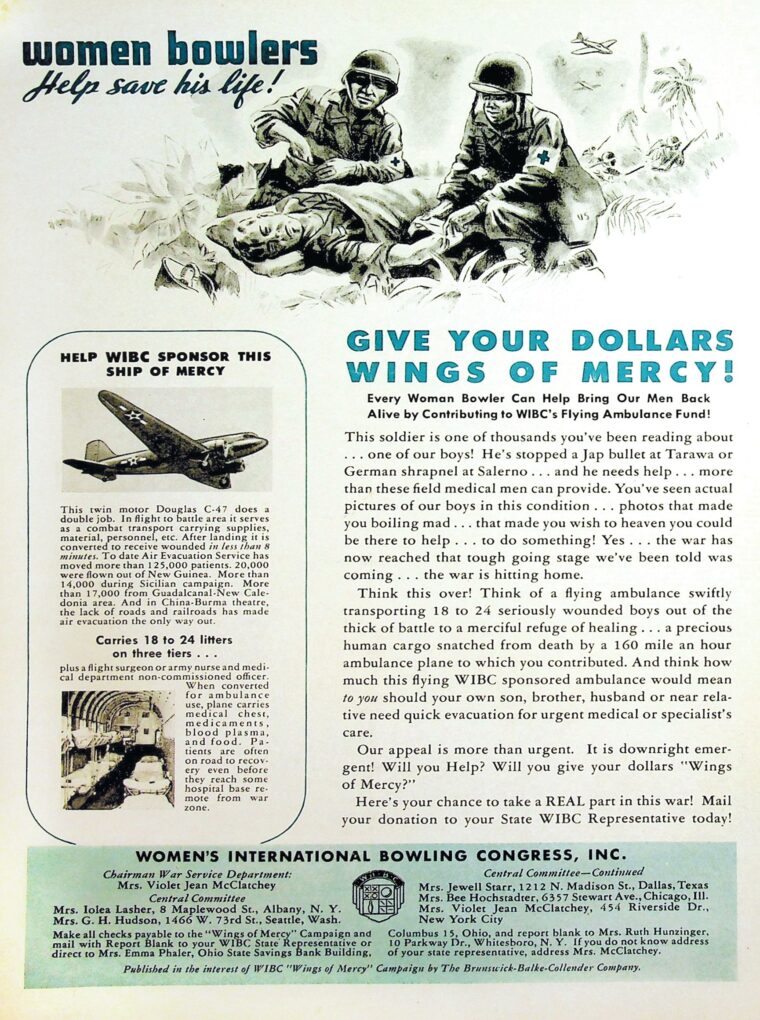
For their next endeavor, the delegates of the WIBC voted to raise money for a ground ambulance and an air evacuation ambulance plane, rather than a bomber. They decided it was a better match with their mission to fund vehicles for healing, rather than for destruction. The slogan of the second campaign was “Give Your Dollars Wings That Fly: We Shall Scale New Heights.” They continued to hold special tournaments, collecting pennies and nickels for bowling pins left standing, raffling gift baskets, and selling war bonds. They also held specific matches in which bowling pins with pictures of Hitler, Mussolini, and Hirohito were hit for extra fees. Celebrity appearances generated positive morale on the home front. Corporate sponsors such as Pabst Blue Ribbon held a competition among its female league employees with the incentive of Groucho Marx presenting the prize.
The Woman Bowler continued to report the fundraising contributions of each state. The editors and writers, now predominately women, also provided articles on other ways women supported the war effort. The Syracuse Women’s Bowling League was mentioned in several issues for their prowess with their knitting needles:
“It is not an uncommon sight to see many of them knitting between bowling frames, making socks … or eight-inch squares which are turned over to Mrs. Irene Huntley, chairlady of the program, to be sewn into badly needed afghans and donated to the Red Cross.”
By April 1943, the Syracuse women had finished 10 afghans, numerous socks,
and multiple sweaters, prompting the editor to comment, “Syracuse, New York, women bowlers are as handy with their
knitting needles as they are with crashing the maple.”
By August 1943, the WIBC had funds to buy a mobile ambulance for the US Army. During the ceremony at Hendricks Field in Syracuse, New York, Violet McClatchey noted that with the WIBC now 200,000 bowlers strong, their goal was attainable.

Colonel Probst acknowledged not only the women of the WIBC, but also the Women’s Army Corps (WACs), the Navy’s Women Accepted for Voluntary Emergency Services (WAVES) and the Women’s Coast Guard Reserve (SPARS) along with other women contributing through service roles.
The contributions of each city league continued to appear in The Woman Bowler; the Roll of Honor list—for any WIBC member who donated a day’s pay or more than $5—was added in October 1943. Bowlers also held parties at skating rinks and passed the hat at movie theatres to reach non-bowlers. Local leagues sponsored dances cleverly titled “Bowling Balls.” WIBC Secretary Phaler welcomed back the Honolulu women’s league, which had not been able to fully participate in the fundraising efforts due to post-Pearl Harbor restrictions such as the blackout and curfew rules.
While the selling of war bonds was a common government fundraiser at the time, the WIBC War Services Committee promoted the purchase of the popular “Warsages” and “Warchids”—corsages made of war stamps. Initially sold between Thanksgiving and Christmas they were sold as completed pieces or as kits with instructions for all holidays. They were popular replacements for jewelry, especially after actresses and USO entertainers began wearing them.
The Cedar Rapids League netted $163.73 for the ambulance plane fund from its Ten Strike Tournament, while the Mishawaka League raised $250 over their $1,000 goal from their efforts with another novelty tournament. Unfortunately, not all events were a striking success. The Sooner Gals of Oklahoma City held a tournament with a ham as the prize. Someone stole the ham before it could be presented to the winner, resulting in a loss of profits. The Gals referred to him as “the meanest man in Oklahoma City.”
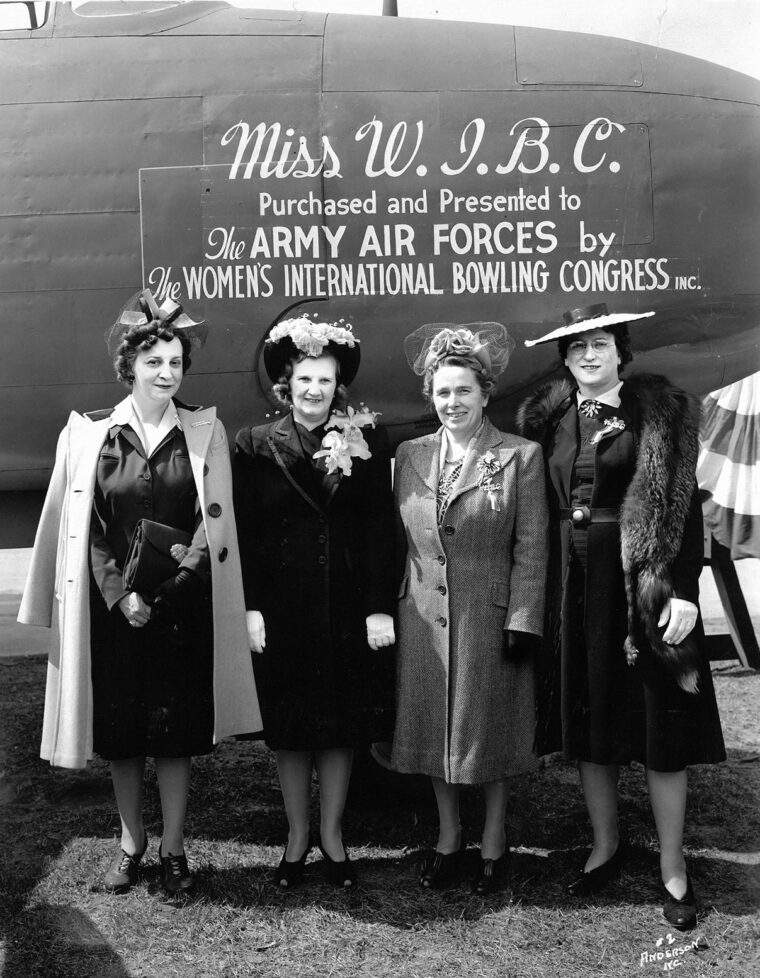
Baton twirlers and tap dancers added to the celebratory atmosphere when the WIBC officers presented the first air ambulance, Miss Nightingale, to military officials in a ceremony at the New York City LaGuardia Field in April of 1944. Miss Nightingale was a Douglas C-47 air evacuation plane capable of conducting glider pickups. These “mercy” planes, as they came to be known, were especially important in places like the China-Burma-India Theater because the lack of roads made mobile rescue difficult. By August 1, 1944, Miss Nightingale had completed 16 successful missions in the South Pacific. In the next two months, Miss Nightingale made 28 more flights, predominantly to evacuate the wounded and to deliver 14,000 pounds of medical supplies. Following D-Day, the plane helped with European air evacuations in the fall and winter of 1944. It was in 20 hours of battle and was grounded for four days due to damage.
The WIBC officers presented Nightingale II on January 28, 1945, at Clover Field in Santa Monica, California. The plane cost $80,000 ($1.5 million in 2026) and was dedicated in memory of Ruth Gardiner, the first flight nurse to die in service during the war. Deputy Air Surgeon Brigadier General Charles Glenn accepted the plane for the Ninth Troop Carrier Command in England.
“In making the contribution of $80,000 for an air evacuation plane, you have purchased flying beds for hundreds of casualties,” Glenn explained, “You could do the sick and wounded no greater service if you gave him a magic carpet.”
The first flight of Miss Nightingale II carried 5,000 pounds of medical supplies, five medical technicians, three flight nurses, and a four-member crew to a base in Burma. Within hours, the plane had transported hundreds of wounded soldiers over terrain impassible to ground transportation. Coincidentally, when Capt. Harley Loveless learned that the WIBC had purchased mercy planes in his squadron, he wrote to his mother, sister, and wife who were avid bowlers, asking if they helped “buy the airplane that the Woman’s International Bowling Congress donated to the Army Air Forces?
If you did, your son has been flying a plane you helped to buy, as we have it in our squadron. It is really a honey of an airplane, and I enjoy flying it a lot.”
The Sports Parade Radio Show interviewed Loveless and his family while he was home on furlough. During the interview, his mother explained that thousands of women were involved in the Wings of Mercy campaign knowing some of their own would one day benefit from their efforts. She was proud to have been a part of the campaign and even more proud to know her son was a pilot who aided in the rescue of hundreds of soldiers.
The 210,000 women of the WIBC continued raising funds to purchase a third air ambulance. Miss Nightingale III was dedicated on July 8, 1945, at the Detroit Municipal Airport in honor of 1st Lt. Aleda Lutz, who had 727 flying hours and 197 missions to her credit—the highest of any flight nurse at the time. She evacuated at least 3,500 wounded soldiers. She was also a WIBC gold star member. She died when her plane crashed into a mountain during a storm while evacuating soldiers from Southern France. Her brother and sister attended the dedication ceremony. Lutz was awarded the Distinguished Flying Cross posthumously.
At the ceremony, WIBC president Knepprath presented the dedication plaque that would be placed in the cockpit to Colonel Juanita Redmond, chief of nurses of the Army Air Corps. Major General Grant explained that the Ninth Troop Carrier Command along with Miss Nightingale and Miss Nightingale II had evacuated more than one million wounded soldiers between Pearl Harbor and V-E Day, and more than 300,000 wounded soldiers between D-Day and V-E Day. Because Miss Nightingale III was ready to be deployed for immediate action after the ceremony, it was not open for public inspection and did not conduct a maneuver demonstration. A similar substitute plane conducted the traditional demonstration for the thousands of attendees.
In addition to purchasing vehicles, the WIBC worked with bowling vendors to send equipment to military barracks and stations in the US and overseas during the war years. Bowling was known as good exercise and a morale booster. Bowling provided opportunities for teamwork and wholesome
relaxation for the service men and women. A Brunswick-Balke-Collender Company ad in The Woman Bowler quoted several officers who expressed their appreciation for the equipment: “The alleys are unquestionably a splendid morale building factor.” “After visiting our alleys one can appreciate what a great morale-booster they are.” “Of all our recreational facilities, bowling is easily the most popular.”
The achievement of raising $351,543.25 for the purchase of a Havoc A-20 Bomber, a mobile field ambulance, and three Douglas C-47 air evacuation ambulances was lauded by military agencies as an unparalleled success. The WIBC leaders noted they now would turn their attention to collaborating with the Bowlers Victory Legion—later named the Bowlers to Victory Link (BVL)—and the American Red Cross to assist the returning war wounded. The new campaign slogan of the War Committee was “Sunny Hours to G.I. Jane and G.I. Joe who have given up much to bring about world peace.” The women bowlers focused their fund-raising efforts on providing recreational and therapeutic equipment for military centers around the country. They took a special interest in adaptive equipment for disabled and blind bowlers during the next several decades. This collaboration between the WIBC and BVL proved quite successful and raised more than $60 million by 2012.
Throughout World War II, women performed many important services on the home front. They organized blood and scrap metal drives, planted victory gardens and worked in factories. These were widely known. They also served in non-combat military roles on the home front and overseas—and their stories are still being discovered today.
The important work during World War II of the members of the Women’s International Bowling Congress—which began as an organization for women to spend a night socializing with friends while exercising their bodies, minds, and competitive spirits—eventually led to an initiative that involved 200,000 women bowlers and saved the lives of tens of thousands of American military personnel.

Join The Conversation
Comments
View All Comments