By William R. Hogan
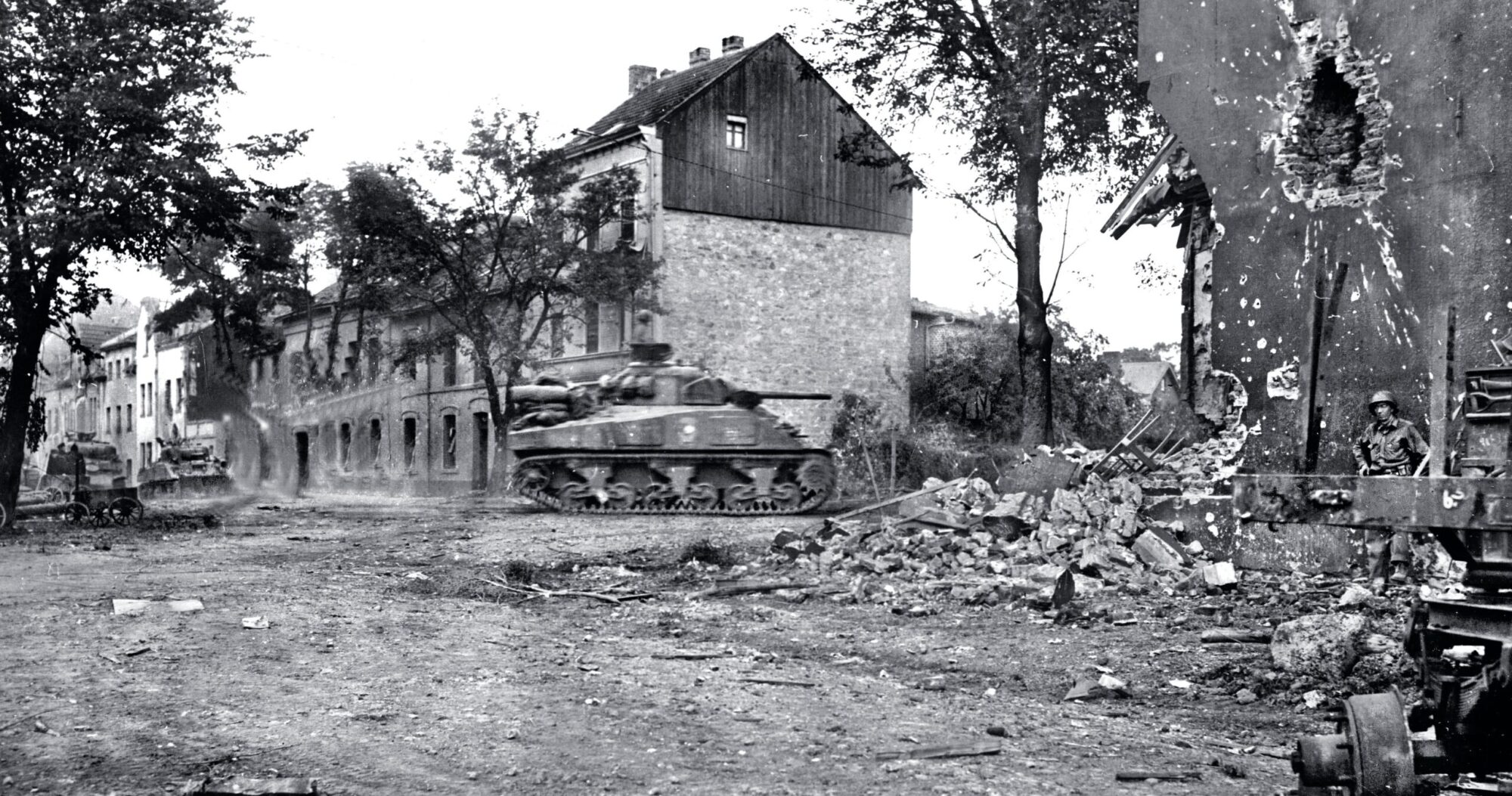
On September 11, 1944, the U.S. First Army began its attack into Germany at the Belgium/Luxembourg border, its vaunted VII Corps in the lead. The fortifications of the Siegfried Line, or West Wall, were thinly manned as most of the enemy troops that should have been inside pillboxes and gun positions were lying dead or imprisoned in and around Mons—courtesy of the hammer and anvil of the 3rd Armored Division (AD) nicknamed “Spearhead” and the 1st ID, known as the “Big Red One.” Spearhead entered Germany on September 12, just a day after a patrol from the 5th Armored Division had done so at St. Vith/Sûre.
Standing at the doorstep of the Third Reich, these two divisions would be put to the test again as they approaching the Roer Valley. As the breakthrough and exploitation force of the VII Corps, 3rd AD would, befitting its nickname, spearhead the attacks through Germany with the objective of enveloping the enemy’s industrial heartland, effectively putting its armies out of action and freeing up the road to Berlin.
Back at “Omaha Forward,” the 3rd AD forward command post on September 17, the division commander, Maj. Gen. Maurice Rose, cut an imposing figure in his cavalry jodhpurs, highly polished riding boots and impeccable “Ike” jacket bearing a row of WWI and WWII awards for valor. He wanted to get on to Aachen, then capture a bridge over the Rhine at Cologne. But now those objectives would have to wait and Rose was fuming. Reports had come in earlier in the day that infantrymen of his own 36th Armored Infantry Regiment had been sharply rebuffed near a small mining town called Diepenlinchen.
In a manner similar to the way the Allies would be taken by surprise three months later during the Ardennes counteroffensive, elements of the 9th Panzer plus the entire 12th Volksgrenadier Division succeeded in deploying to the battle line, during a bout of severe weather, arriving fresh and unmolested by U.S. airpower. They massed, and on the 16th unleashed a powerful counterattack from Werth and Gressenic to the northeast, led by 15 Mark V Panther tanks with infantry and artillery support including the division’s 150-millimeter guns.
The attack’s objective was to retake and occupy the Siegfried Line between Stolberg and Zweifall. It caught D and E Companies of the 36th Armored Infantry Regiment in the open, the fierce assault pushing back Spearhead’s right flank 1,000 yards. The U.S. infantry, made up mostly of recent replacements, lost their officers to tank fire and with no friendly armor nearby, dropped their M1 Garand rifles and sprinted back toward friendly lines. Thirty who did not run, or not fast enough, were missing, either cut off or taken prisoner. Rose wanted the lost ground, the prisoners and the rifles recovered at all costs.
He assigned the job to one of his most successful and maverick task force commanders, 28-year-old Lt. Col. Samuel “Sam” Hogan. For the attack, Rose bolstered Hogan’s tanks with a battalion of infantry from the Big Red One, the 1st Infantry Division.
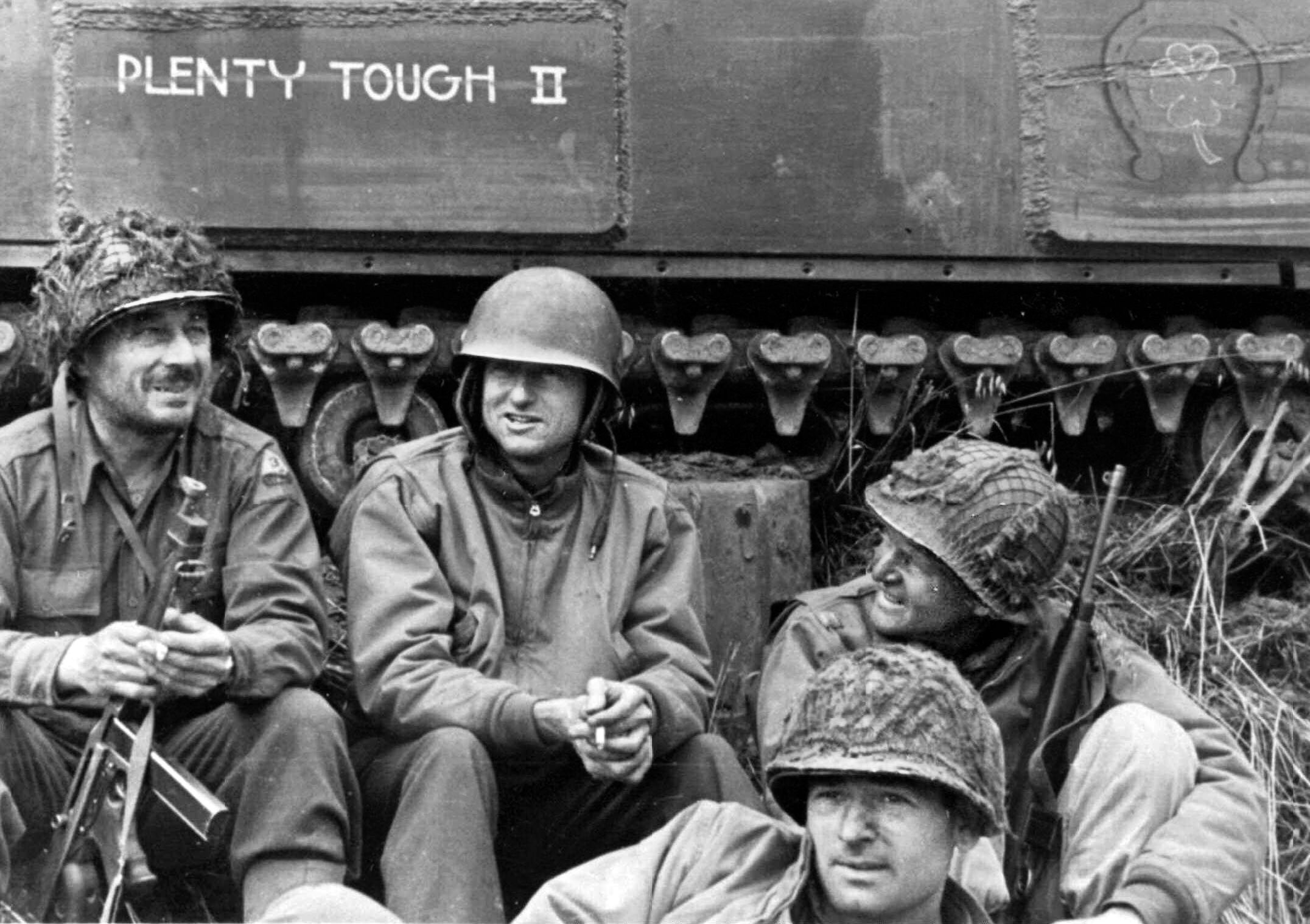
The infantrymen of the 1st Battalion of the 26th Regiment “Blue Spaders,” so named for the wide blue spear on their regimental crest, had already teamed up with Task Force Hogan during operations around Mons, Belgium and the pursuit east as they liberated the southeastern part of the country clear to the Ardennes, and the start of the Siegfried Line.
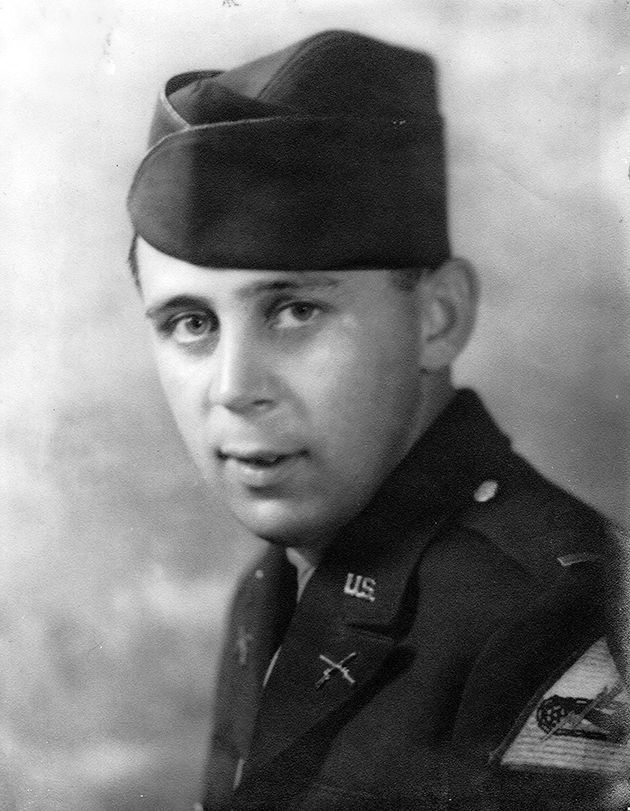
Their officer-in-charge was Maj. Francis W. Adams. Tall, athletic with a strong jaw, high cheek bones and steel-blue eyes, Adams embodied the fighting spirit of the 1st Infantry Division. The tough Major with the Arkansas drawl was already a holder of the Silver Star for actions in the Tunisian campaign, where he single-handedly navigated a path through a minefield after his vehicle was disabled by a hidden tank killer. On June 6, 1944, he celebrated both his 29th birthday and his wedding anniversary storming ashore on Omaha Beach. At home waiting for news, his wife Jeannie was probably not as thrilled for that anniversary.
The tankers of Task Force Hogan were glad to work once again with this top-notch unit for they were a tough and experienced infantry battalion.
Along with Adams’s infantry, Hogan counted on 105-mm self-propelled artillery from the 54th Armored Field Artillery Battalion in direct support. The 155-mm M12 Gun Motor Carriages of the 991st Field Artillery Battalion were used for direct fire into German pillboxes in the initial assault.
During the morning of September 18, Task Force Hogan moved to an assembly area 1,800 meters southwest of the objective and got to planning the attack.
This portion of the Roer, with Stolberg and its surrounding villages, had been a mining area since Roman times. The enemy held high ground at Hill 283, centered around the two hamlets of Weissenberg and Diepenlinchen. The two consisted of manufactured housing interspersed with solid, brick-and-mortar factory buildings. In front of Diepenlinchen was a zinc processing plant crowned with a 40-foot smokestack.
Beyond the mining camp was a clearing a half-mile long and about two football fields wide. The clearing stopped at an enormous pile of mining byproduct, or slag. The pile was 200 yards wide and 40 feet high dominating the view of both towns. A detailed look at the map showed that the area to the right was swampy so a flanking movement with tanks was out of the question.
Intelligence on the enemy ahead of them was lacking. The surprise appearance in the battle area of the 10,000-strong 12th Volksgrenadier Division meant that the Americans did not have detailed knowledge that they faced, at a minimum, an entrenched enemy grenadier regiment, the 89th, supported by artillery and a company of Panther tanks.
Hogan directed his Company H Shermans, led by Lieutenant Jake Sitzes, of Sikeston, Missouri, to envelop on the left while Company B of Adams’s 1/26 Infantry maneuvered through the woods along the approaches to the town to flank any German infantry waiting in ambush. Company A would move behind B and then secure the left flank once they emerged out of the woods.
G Company tanks, led by Indiana native Captain Carl Cramer, would feint to the right to cover the approaches to the high ground. Once at the edge of town, the tanks and infantry of C Company would form up together to clear it then move on to the high ground and slag pile.
Hogan’s command was working like a well-oiled machine after surviving the hellacious fighting of the Normandy hedgerow country, then helping close the Falaise Pocket, pursuing the German 7th Army into Belgium, to close yet another pocket full of enemy prisoners of war at Mons. Now the beautiful countryside of the Ardennes in Fall had given way to the bleak industrial landscapes of the German borderland. The battles of Aachen and the Hürtgen Forest lay ahead and Task Force Hogan’s two Sherman tank companies were understrength but well-led.
G Company’s Captain Carl Cramer was a tough-talking former NCO with a penchant for climbing onto his subordinates’ Shermans then banging on the turret until a tank commander came out to get some good old “coaching and mentoring.”
Lieutenant Jake Sitzes, leading H Company, was just as energetic, having been promoted after the heavy casualties in the Norman bocage left Task Force Hogan with few experienced company-level officers. His men loved him and as Hogan would say in his Texas drawl: Jake’s men “would follow him barefoot into a prickly pear patch if he said it needed to be done.”
Shortly after 2 p.m., H Company crossed the line of departure with Sitzes in the lead tank. The infantry moved through the woods as the Shermans fired high-explosive shells at anything behind the slag pile or in the factory buildings. The ground sloped up initially and the little mining town came into view. Artillery and mortar support helped keep German heads down but the advance was slow as each building had to be cleared by the infantry.
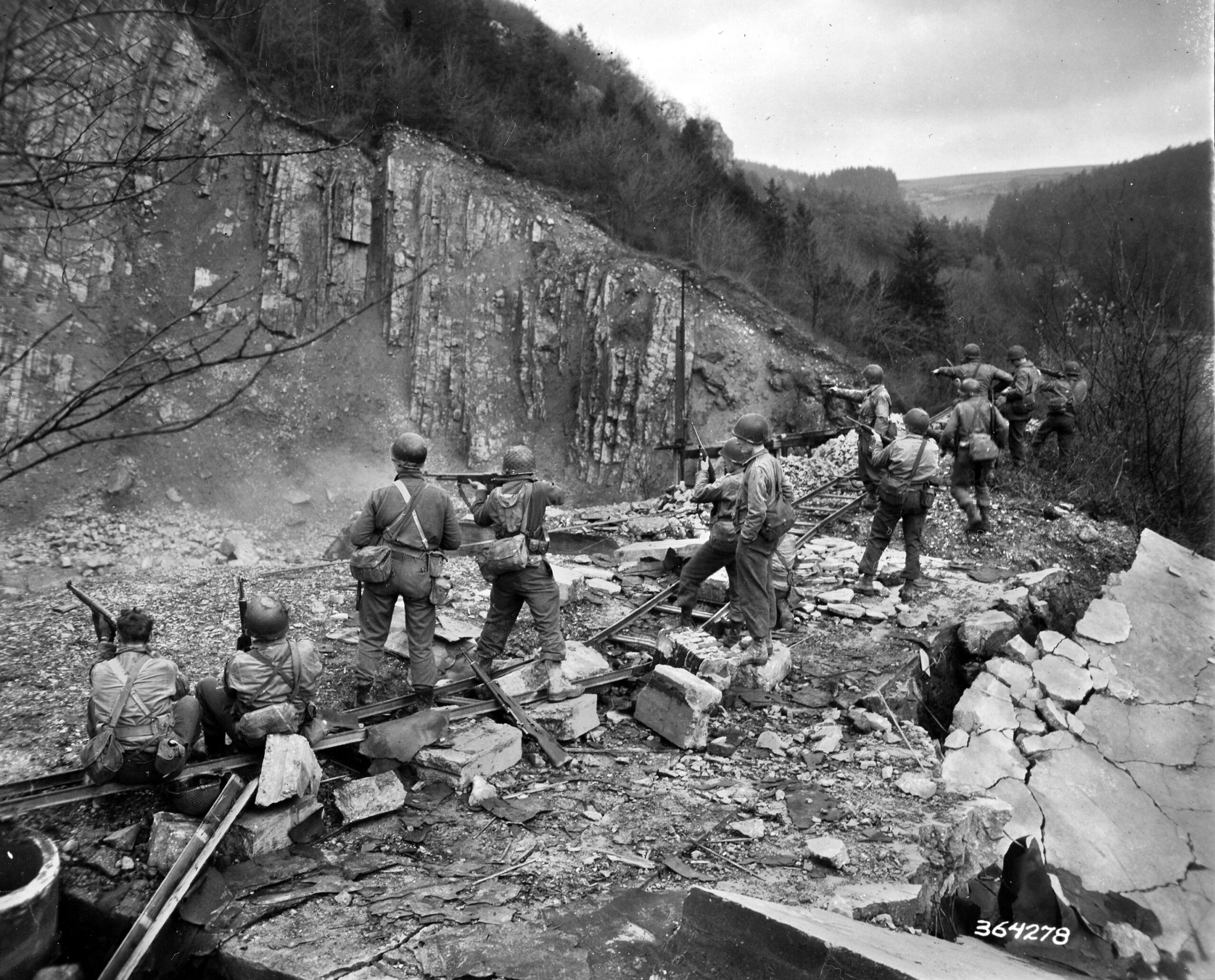
A Sherman would fire into a building, the infantrymen storming in to clear it, then on to the next one. After 10 minutes of movement German artillery and mortars began falling around the tanks as airbursts hit the treetops on their left, raining leaves, branches and razor-sharp metal shards on the ground below. The infantrymen of Big Red One moved forward in short rushes from cover to cover in between the barrages. Tankers buttoned up and tried not to run over any friendlies.
Despite the heavy enemy artillery and machine gun fire, the task force cleared the miners’ housing complex after an hour of hard combat. Yet, they were only halfway through the town. They did find the missing soldiers from the 36th Armored Infantry Regiment—they were given ammunition and organized to support the attack.
The processing plant was next. They cleared the big building with difficulty, as it was full of nooks and crannies around heavy machinery and stacks of material. The Shermans emerged from the town and quickly assumed a wedge formation pointing at the slag pile in an inverted V.
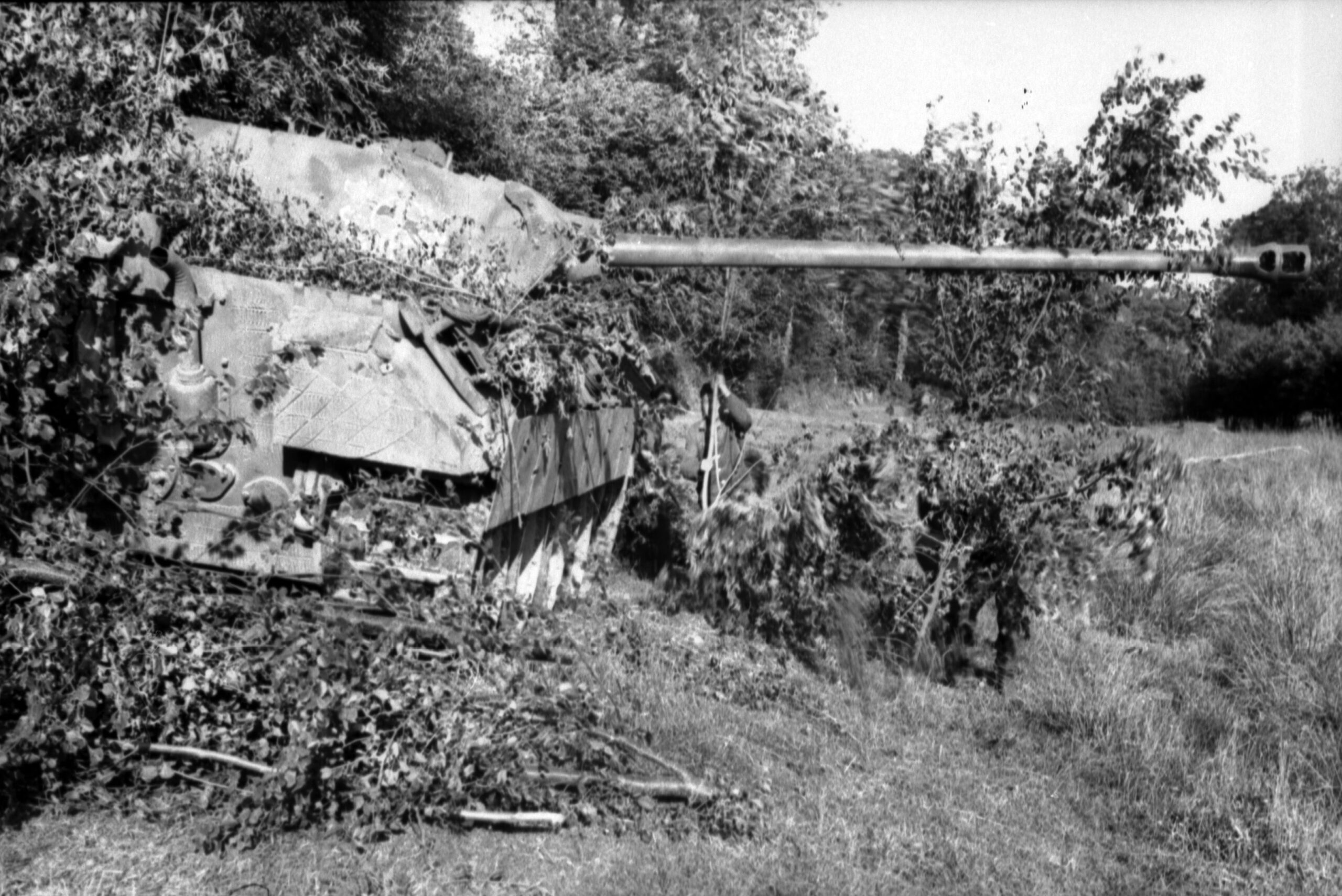
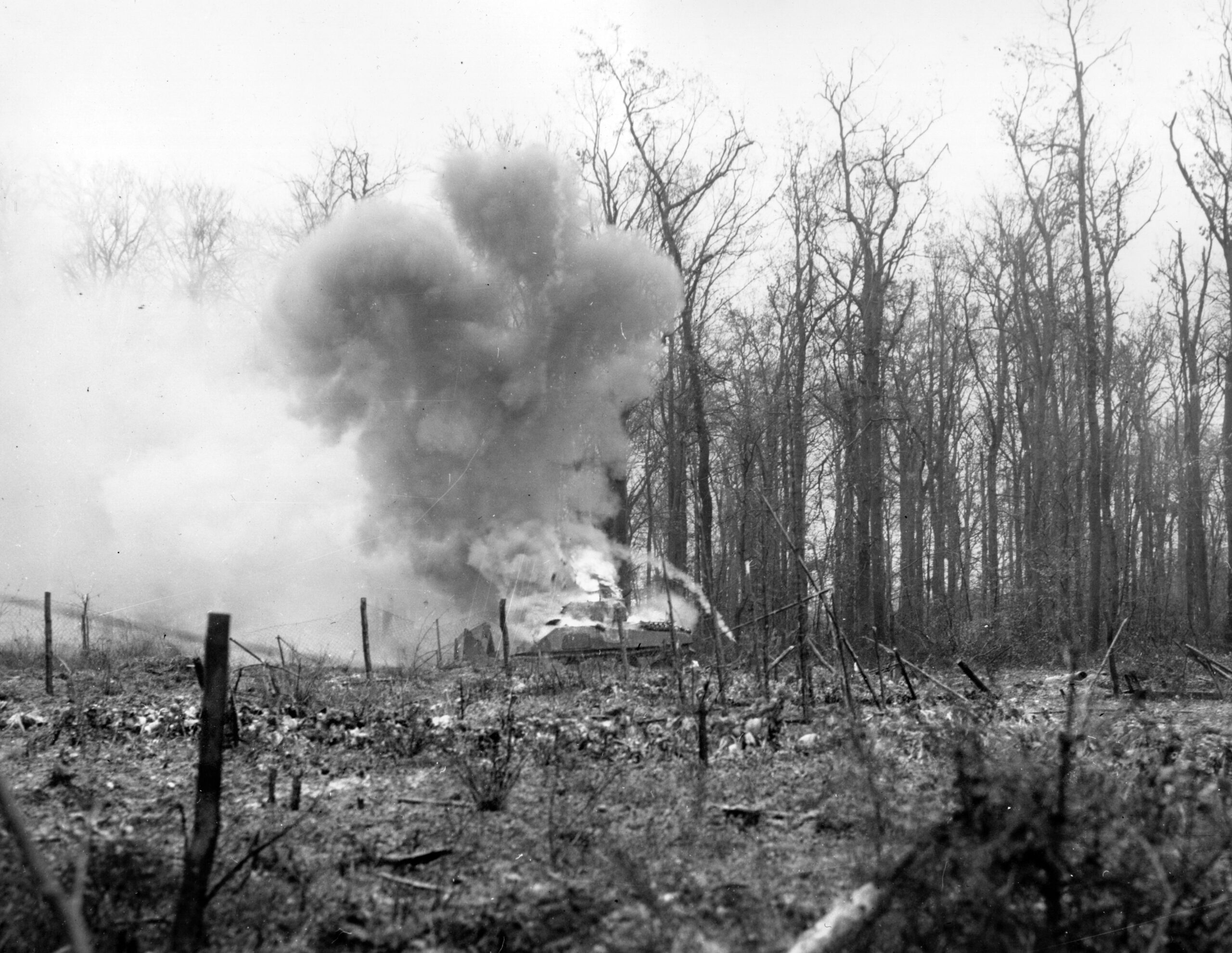
Just 25 yards short of the debris pile, a heavily camouflaged German Panther tank rocked back, a muzzle flash and green tracer shot out from its position in the woods to the Americans’ right. The armor-piercing round slammed into the side of the command tank with a sound like that of a sledgehammer against a grounded cathedral bell.
Shaking off the concussion, Sitzes calmly ordered “Bail out” to his crew as the vehicle lurched and began to fill with smoke. The Germans were using flashless powder; nobody observed where the fire was coming from. But a volley of H Company main gun fire, as well as immediate artillery suppression silenced the Panther.
Watching from his own command tank at the edge of the clearing, Hogan ordered H Company to fall back to the town, as the tanks awaiting the infantry had become sitting ducks for more hidden tanks or marauding enemy armed with Panzerfaust antitank rockets. Better to call in air support and an artillery barrage on the hidden German positions.
The tank crews backed up to the line held by Adams’s infantry where the sloping terrain hid them from the German positions. The crew of the stricken tank made it back to report that Sitzes was missing. They were sure he had bailed out right behind them, after making sure nobody was left behind. The word was that he had been slightly wounded and was being treated by an adjoining unit.
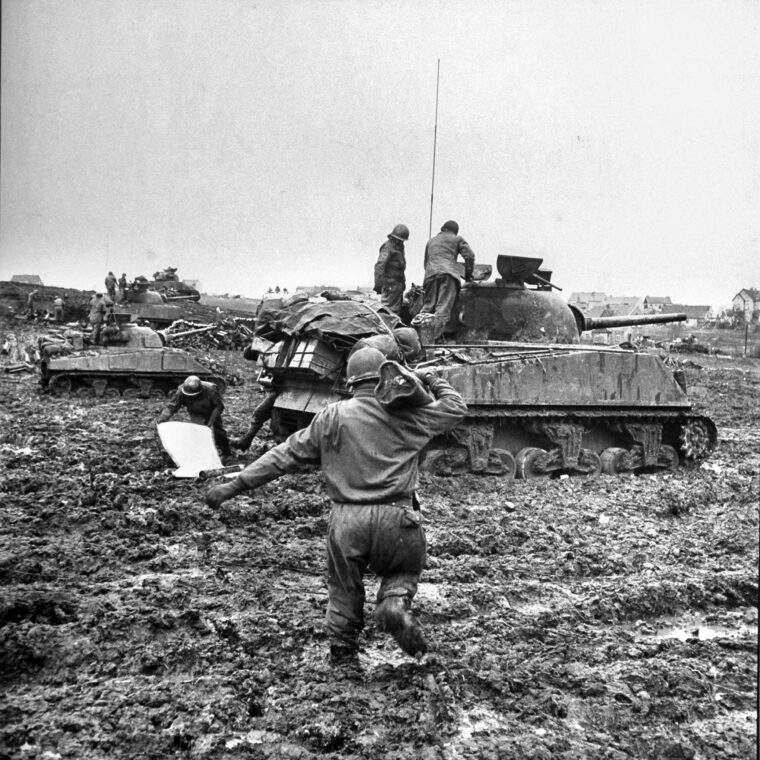
For now, the Task Force needed to focus on taking out the enemy artillery several kilometers behind the slag pile to allow the tank-infantry teams to resume the attack. To that effect, the 105-mm howitzers attached to Task Force Hogan plotted counter-battery missions and began dueling with the German artillery. Everyone took cover where they could, though the piles of sand did not afford good protection and ended up burying a soldier if a round hit nearby.
The enemy counterattacked from the woods near Weissenberg as dusk settled over the battle area. Seeking to turn the flank of A Company, 1/26th Infantry, German grenadiers poured out from the opposing buildings and behind the slag pile. Adams, recognizing the danger, immediately ordered his ammunition platoon and engineer attachments to reinforce the infantry. H Company tanks poured coaxial and main gun fire at the enemy assembly area.
The attack was beaten back and the day ended in stalemate. The tired combatants facing each other across the small clearing and pile of slag settled in for a fitful night with little rest.
Under full darkness, the artillery ceased firing. Captain John Barclay led a patrol to within 25 yards of German lines to look for Sitzes. First Sergeant Ernest Filyaw, Sitzes’s senior non-commissioned officer, was one of the volunteers on the patrol. They returned safely before midnight but there was no sign of Sitzes.
The next day, September 19, the artillery duel continued. When ammunition ran short, General Rose intervened with the VII Corps to send trucks on an overnight run from Paris with the much-needed 105-mm rounds.
Task Force Hogan was down to seven of 15 Sherman tanks from H Company and 5 of 15 medium tanks from G Company. Two platoons of M3 Stuart light tanks provided flank security. Third Platoon had been detached to guard Omaha Forward, the Division Command Post.
The infantry were hit even harder. Adams reported that his 1/26 Infantry would soon be ineffective after taking eight killed in action and fifty wounded. Most of his men showed symptoms of “combat fatigue,” what is now known as Post-Traumatic Stress Disorder (PTSD), and he was at about 60 percent strength.
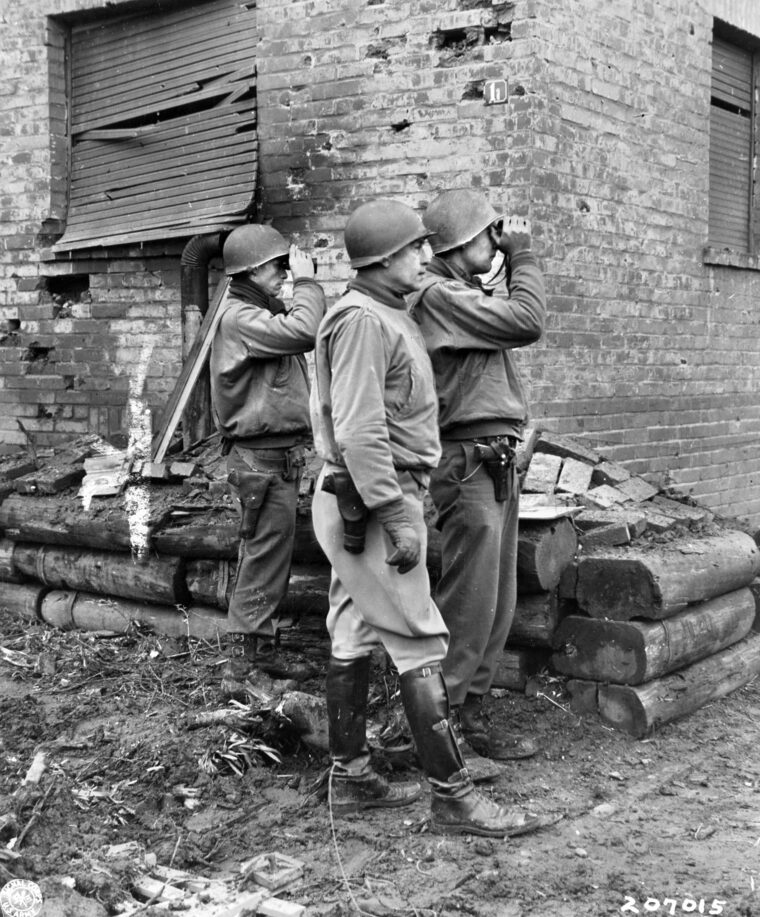
Brigadier General Truman Boudinot, second in command to Rose, ordered a late afternoon, coordinated attack with neighboring Task Force Lovelady on the left while Task Force Hogan attacked down the center plus a flanking attack on the slag pile with tanks and infantry as the right “prong” of the fork. Hogan protested, having seen with his own eyes on a reconnaissance the previous day that the ground to the southeast of the slag pile was boggy, making it a tank trap. General Boudinot nevertheless ordered the attack to proceed as planned. Other Spearhead units were also attacking and holding ground along this “Stolberg Corridor” in the VII Corps area.
The attack was set to jump off after a 10-minute preparatory barrage by the entire VII Corps artillery along with smoke to conceal the American advance. Before the Task Force set off, German fighter-bombers appeared overhead and tankers and infantrymen gazed wide-eyed at a Hollywood-style dogfight as American P-47s pounced on them.
The U.S. Army Air Forces (USAAF) came out on top but not before losing one of the P-47s. To Hogan, the pilot appeared to have been severely wounded or possibly blinded as he flew his stricken craft in several flat, low triangles over both U.S. and German lines. Suddenly, while maintaining the 1,000-foot altitude, the P-47 nosed down straight into the ground crashing in a fireball to the dismay of the on-looking U.S. infantrymen and tankers.
Soon after, the artillery preparation began. It did not go well. Rounds fell short, and fires needed to be lifted to avoid friendly casualties. Right on time, however, H Company launched the attack toward Weissenberg in the center. Four G Company Shermans and the remnants of C Company, 1/26 Infantry advanced toward the slag pile from the right through woods and swamp.
As the Americans emerged from the town and into the clearing, German artillery fell again with deadly, accurate volleys.
To Colonel Hogan, moving astride the road junction between his three maneuver units, it was the most German artillery he had ever seen. Artillery and mortars of every caliber plus at least one 20mm automatic antiaircraft cannon rained on the advancing Task Force Hogan. Nebelwerfers, six-barreled rocket launchers nicknamed “screaming meemies” by the GIs, also rained down with a high-pitched screech as each 70-pound warhead descended to earth to explode in a concussive blast. This attack was clearly the main effort of the enemy LXXXI Corps.
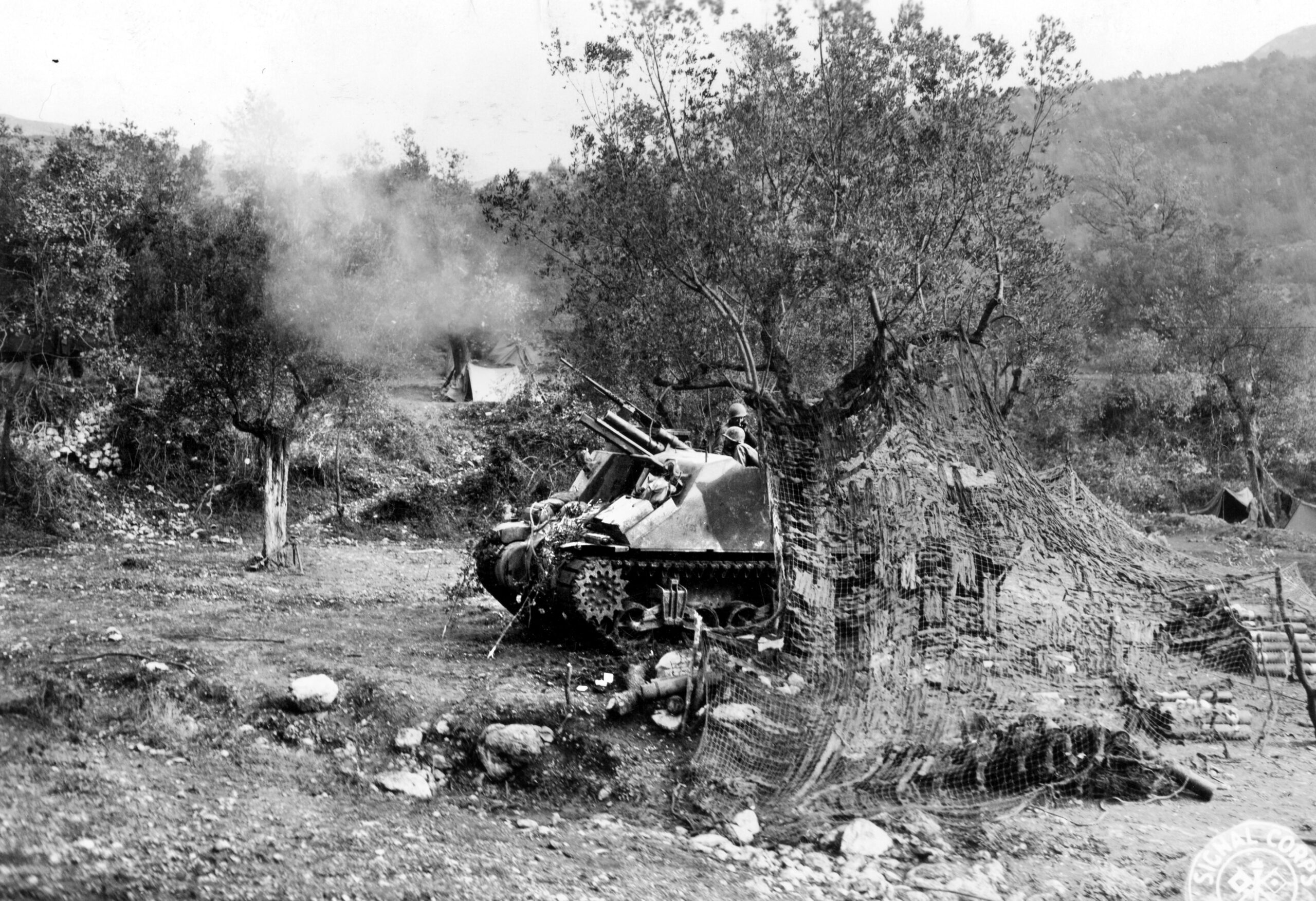
Artillery liaisons in the American tanks furiously radioed back for counter-battery and suppressive fire missions. These were ineffective in suppressing their German rivals, as the supporting U.S. self-propelled M7 “Priest” howitzers sank into the mud, losing their ability to deliver accurate fire with every recoil of their 105-mm cannon. Some of the U.S. airbursts exploded dangerously close to the Blue Spader soldiers.
The outspoken Hogan needed to be talked down by his loyal orderly, Staff Sergeant Phil D’Orio, from going off on General Boudinot, to whom Hogan had advised against a frontal daytime assault with tanks across swampy terrain. Holding his anger, he halted the artillery fire so that the guns could register and observers could keep up with the movement.
H Company made good progress across the clearing until they reached the woods outside of their objective, Weissenberg, where well-concealed antitank guns and at least one Panther tank knocked out two tanks, and a third by a Panzerfaust fired from the woods. Hogan ordered H Company to pull back as G Company, on the right side, was bogging down in mud, as predicted by Hogan’s earlier reconnaissance.
Task Force Hogan regrouped in the early evening. German prisoners said that a counterattack was planned for September 20 at dawn. According to the POWs, H Company’s artillery preparation for Sitzes’s attack had disrupted a counterattack by 200 German infantrymen.
Hogan looked at a map and decided if they could not flank this strongpoint, they would storm it in a night attack—foiling an enemy counterattack and negating their artillery.
He conferred with his assembled commanders: Adams; his S-3 Operations Officer Captain Armand Levasseur; G Company’s Carl Cramer; and John Barclay of H Company. They needed a night surprise attack, just as the Germans had tried the night before. Adams and Levasseur proposed a bayonet charge, surprising the exhausted enemy in their foxholes. Even further, they suggested skipping the artillery preparation entirely. Hogan greenlit the plan and around midnight radioed division artillery to cancel the morning preparatory fires.
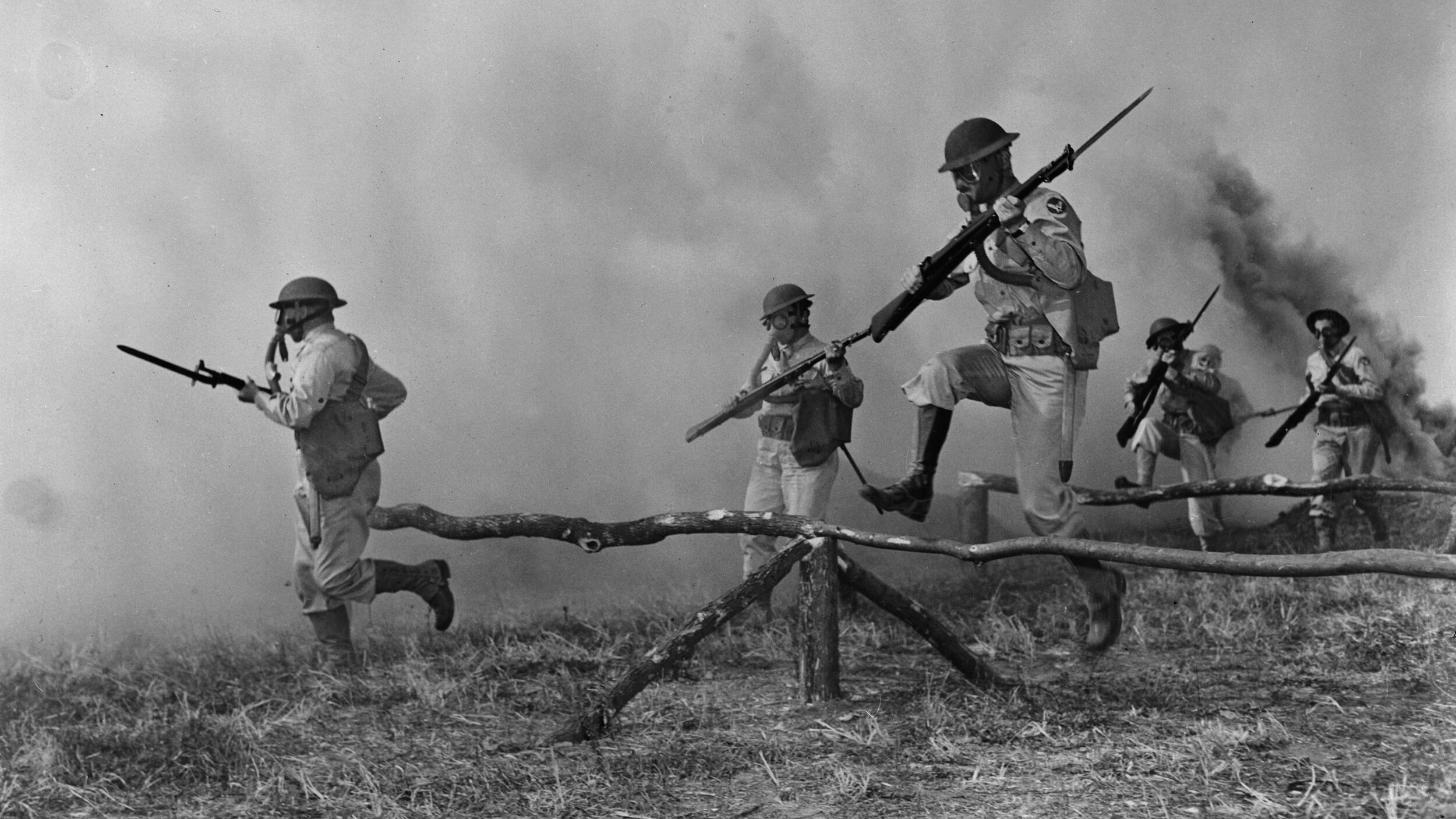
The light blue glow of the coming day was still at least an hour away when Adams and his Blue Spaders jumped out of their positions at 6:30 a.m. with bayonets fixed on their M1 Garands. They rushed forward, moving quickly among small piles of ore and bomb craters.
The Shermans stayed back, their crews ready to fire up their engines and move forward. Ahead, the infantry sprinted through a wood line and into the open clearing, past the silent ghost of the mining camp then up a gentle slope to the entrenched enemy.
Two German guards were quietly bayoneted, and Adams waved them forward, with all breaking into a sprint. As their main line crested the slope, they saw the surprise was total. Bayonets thrust and slashed in bloody mayhem. Exhausted enemy soldiers were startled awake and quickly dispatched. After three minutes of savagery the enemy line went quiet as the sound of Hogan’s approaching tank engines drowned out the din of hand-to-hand combat.
Roaring forward, the Shermans scanned for the muzzle flashes of hidden enemy armor. A Panther behind a smokestack was taken out from 300 yards, but no other enemy armor showed.
Back on the German line, Adams’s men cleared their objective. A total of 33 enemy soldiers were caught soundly sleeping, and those not killed by airbursts and bayonets, were taken prisoner. Adams radioed back that the high ground was secure. Hogan, positioned at the edge of the clearing with his tanks surging on both slopes and anticipating a counterattack, radioed them to roll forward past the objective.
As they moved forward, Hogan dismounted to survey the position. The fog was lifting but the air still remained cool, with grey mists hovering over upturned dirt, brush and bomb craters. Hogan saw Sitzes’s immobilized tank in a dark silhouette 30 feet away. He walked to it, .45 caliber pistol at the ready. It was an eerie dawn suddenly quiet after the short, sharp action.
As Hogan walked toward Sitzes’s stricken tank, he could hear the faint commands of Adams’s infantry as they consolidated on the objective: searching for surviving Germans, checking for wounded and loading fresh ammunition clips.
The fog was lifting and Hogan kept walking toward the empty tank. In a 500-pound bomb crater, about 10 feet from the tank, a dark object drew his eye, stark against the grayish-brown dirt of the crater. He crept closer, swallowing hard with the initial, almost sub-conscious knowledge of what lay ahead. Sitzes lay on the crater’s back slope, facing the slag pile. In the early light, Hogan could see his youthful, calm face—with a round hole in his forehead.
Equipment and corpses lay scattered across the ground. The artillery damage reminded Hogan of pictures and descriptions of the bomb-cratered “lunar landscapes” of World War I.
Hogan saw the body of a German soldier nearly cut in half by a 105-mm direct hit and couldn’t help but hope that it was the remains of the sniper that got Sitzes.
With the high ground taken by Task Force Hogan and the 1st Battalion, 89th Grenadier Regiment down to 100 effectives (from 500), the enemy had no choice but to fall back. Blocked from reaching their objective of recapturing the Siegfried Line between Stolberg and Zweifall, the 12th Volksgrenadier reoriented on protecting Stolberg.
American task forces had little time to rest or process the battle’s hard losses. After Diepenlinchen, Task Force Hogan kept moving forward with Task Forces Lovelady and Mills. A daring armored charge captured Stolberg on the evening of the 20th. The impenetrable Hürtgen Forest loomed ahead.
After Stolberg, Task Force Hogan, attached to 1st Infantry Division, would help capture the first major German city to fall to the Allies, the old imperial capital of Aachen.
Adams’s 26th Infantry Regiment would receive the Presidential Unit Citation for their gallantry fighting in and around Stolberg from September 13–22, 1944. Sadly, Adams would be killed in action during the Battle for Aachen at the head of his Blue Spaders.
For both 1st Infantry and 3rd Armored Divisions, the battles for the Siegfried Line and the gateway to the Ruhr were a baptism of fire on the enemy’s home soil where they had to quickly learn the complexity of urban warfare. More savage battles lay ahead, including a return trip to the Ardennes, where Task Force Hogan would be ordered back to Belgium from advanced positions in Germany, right into the path of the greatest battle ever fought by the U.S. Army—the Battle of the Bulge.
Hogan, a fourth-generation combat veteran and historian of World War II armor, served in Bosnia, Haiti, Afghanistan, and as an exchange officer on the French Army Staff in his 22-year career. His award-winning book, Task Force Hogan, is based on the experience of his father, Col. Samuel M. Hogan.
Join The Conversation
Comments
View All Comments