By Eric Niderost
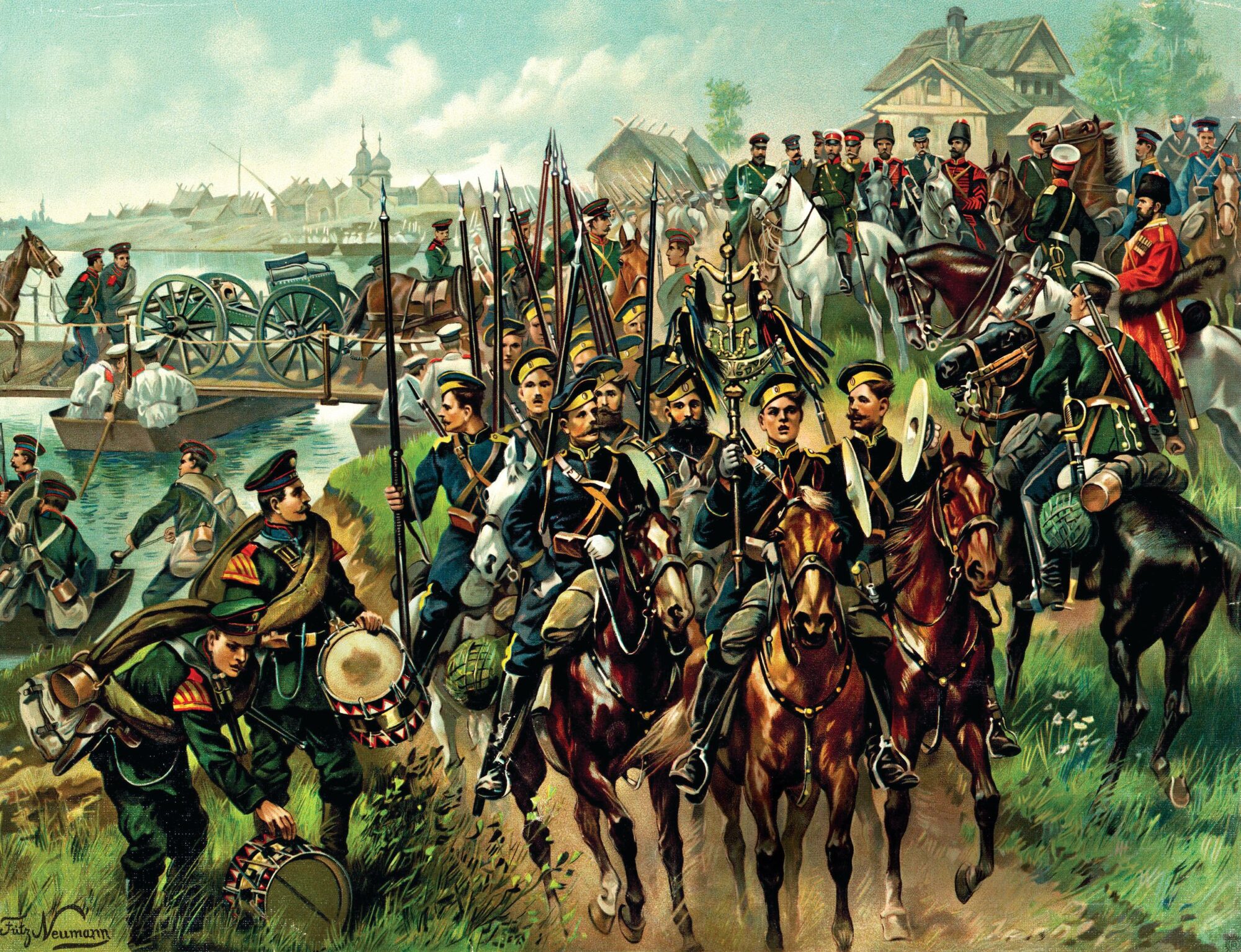
Four Russian soldiers, a lieutenant colonel and another officer, with an NCO and bugler, strode briskly down Jaroslaw Road just north of the defensive perimeter of Fortress Przemyśl. Even though it was October 2, 1914—the Great War pitting England, France, and Russia against Germany, Austria-Hungary, and Turkey had started a few months earlier—there was no sense of danger, because the men approached the enemy lines under the protection of a flag of truce.
Located in the foothills of the Carpathian Mountains, Przemyśl was a road and rail transportation hub and a key crossing point over the broad San River.It was designed to block, or at least seriously impede, an invader’s push west and south. The fortress blocked the Lupkow and Dukla Passes through the towering mountains, and the main rail line to Vienna linked Przemyśl to the Hapsburg capital.
If the fortress fell, those road and rail links would be in Russian hands, making it easier to logistically support an ongoing Czarist offensive. Once through the Carpathian Mountain passes, the Imperial Russian army would debouch into the Hungarian plain, potentially taking Budapest and even Vienna in the process. Austria-Hungary would be knocked out of the war.
These were all attractive scenarios to the Russians, but Przemyśl had to be taken first. It was a bone in the throat of the Russian “bear,” an obstruction the Czarist forces nevertheless felt would be easy to swallow. There had been some preliminary fighting outside the fortress, and the Russians were not impressed with the quality of the troops facing them.
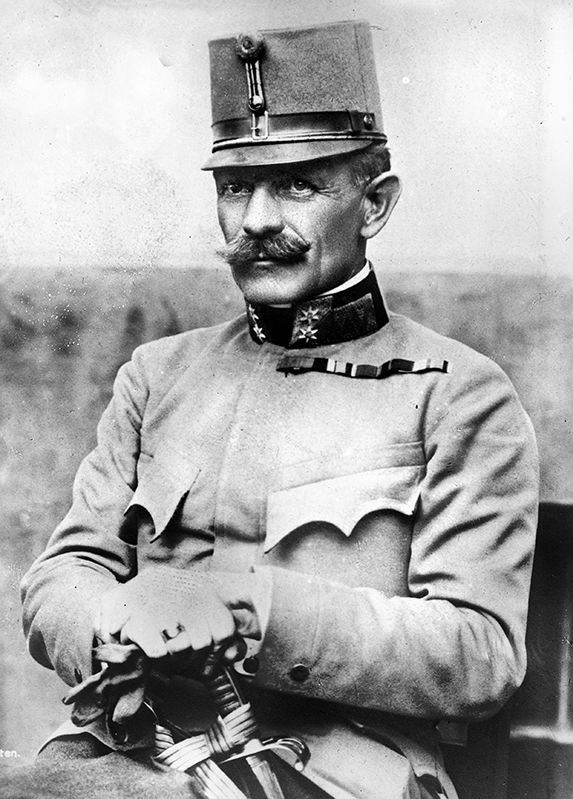
The commander of Fort XI, one of the points on the defensive perimeter, telegraphed Fortress Command in Przemyśl for instructions on what to do.The Russian colonel had a message for Przemyśl commander Lt. Gen. Hermann Kusmanek von Burgneustädten from Gen. Radko Dimitriev. Orders were given that the Russian envoy would be driven to Fortress Command and allowed to deliver his message, but he would have to be blindfolded for the journey. The others in his party would be sent back to Russian lines.
The messenger had to cool his heels for three hours before being led to fortress headquarters, a not-so-subtle way of showing the Russian they were not cowed by his presence or his message. Once at Fortress Command he was made to wait in an anteroom while Kusmanck read the note. The missive called for immediate surrender “to avoid needless bloodshed.”General Kusmanck and his officers laughed scornfully when they read the message, making sure the merriment was loud enough for the Russian envoy to hear in the other room.
The reply was short, sweet, and to the point. “I find it beneath my dignity,” Kusmanck declared, “to grant a substantive answer to your insulting suggestion.” Reading between the lines, it was a message that even the most obtuse Russian would not fail to understand: “If you want Przemyśl, come and take it.”
Fortress Przemyśl’s transition from peacetime border fort to wartime bastion began almost as soon as hostilities were formally declared. General Rusmanek was energetic and experienced, aware of Przemyśl’s strengths as well as its weaknesses. As summer turned to fall, some 27,000 military laborers, 2,200 specialist technical troops, and 300 officers worked tirelessly to prepare the fortress for the ordeal that was sure to come. Ammunition was stockpiled. Barracks, stables, and field kitchens were built to accommodate an expanded garrison. When the siege began, Przemyśl had something like 130,000 troops, up from a peacetime complement of around 85,000 men.
The Przemyśl garrison was a microcosm of the sprawling, polyglot Hapsburg empire itself. Its defenders included Austrian Germans, Hungarians, Romanians, Serbs, Slovaks, Czechs, Italians, Poles, and Ruthenians (Ukrainians). Austria was a “dual monarchy,” with the aging but revered Franz Joseph as Emperor of Austria and King of Hungary. There was the Imperial and Royal Common Army, shared by both partner countries, but also two organizations—originally meant as reserve bodies—the Imperial Austrian Landwehr and the Royal Hungarian Honved, which translates to “defender of the homeland.”

Przemyśl’s garrison were mainly Landsturm (territorial) brigades from Austria, northern Hungary, and the city’s “home” province of Galicia. By definition, Landsturm units were composed of reservists aged 37-42. Some of them seem to have been even older physically than their numerical age, and many were out of shape, described at one point as “well past their prime fatties.”
Landsturm officers were rudely plucked from their civilian life and placed in command of largely peasant soldiers. Before the war they had been academics, businessmen, or minor civil servants with reserve commissions, men with families and personal concerns rooted in civilian life. They had no interest in military glory or public fame.
It’s a source of wonder that the Austro-Hungarian army could function in peacetime—in war, their cohesion is something of a modern miracle. One of the garrison units at Przemyśl was the 3rd Battalion, Landsturm Infantry Regiment No. 18. With one or two exceptions, the officers spoke German or Czech, while the peasant rank and file’s mother tongue was mainly Polish or Ukrainian. In theory the language of command and military communication was German, but many common soldiers never even learned the basics.
Second Lieutenant Bruno Prochaska admitted his soldiers were “good natured, willing and brave but slow, clumsy and untaught.” Army rules stated that, while German was essential, if another language dominated at least one fifth of a regiment, the officer had to learn that language. Still, it was tough, especially if you didn’t have an “ear” for languages.
Prochaska recalled that “none” of his common soldiers knew German, and “only the noncommissioned officer has mastered a little Austrian military German.” If there was a problem, and the NCO wasn’t available, the officer might fall back on his “few nuggets of Polish” out of sheer desperation. Even that might fail, with the exasperated officer trying to understand the soldier’s explanations in his “Złoczów farmer’s (Polish) dialect.”
Though the main forts had mostly been constructed in the 1880s, and few had been modernized or upgraded, Przemyśl still was an impressive fortress. After three decades of construction the fortress boasted of a chain of seventeen main forts with eighteen subsidiaries. If it was held by a determined garrison, it would be a very tough nut to crack. Added to this was a factor that was to prove decisive—the Russians would feel the pressure of time.
Czarist forces initially had the upper hand, but the situation was fluid and could rapidly change. The longer Przemyśl held out, the longer the Austro-Hungarian field army had time to recover, reorganize, and start their own offensive. A message delivered by airplane to Commander Kusmanek told him to hold at all costs. It was an order he intended to follow.
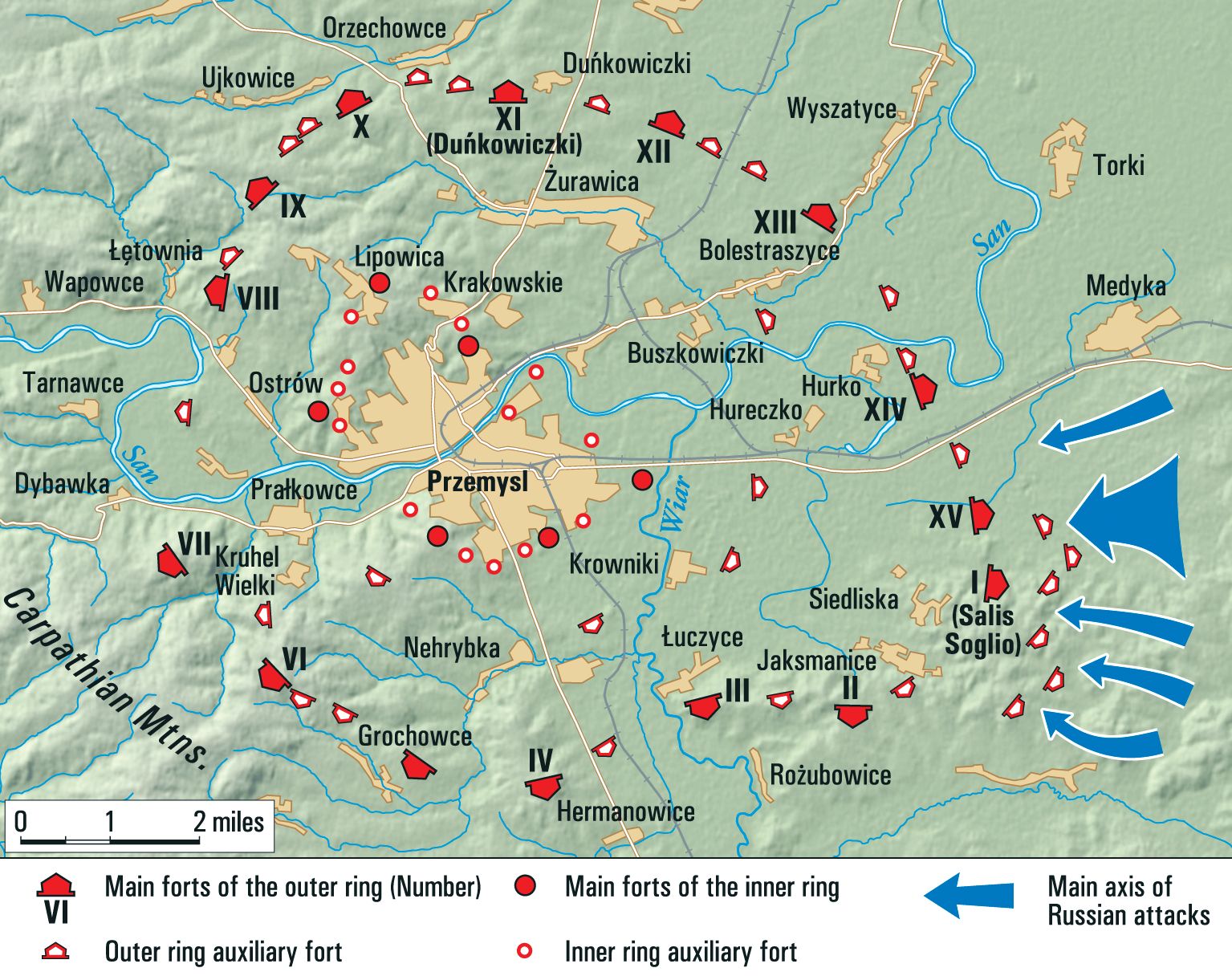
Fortress Przemyśl had a layered defense consisting of three rings radiating out from the city’s core. First was an inner core that had a scattering of strong points and batteries. Outside of this was a second line of artillery batteries. Third was the impressive outer ring—a strong belt of forts 30 miles in circumference. Though the average distance from the outer ring to the city center was about four miles, it stretched to seven miles in the southeast.
In the weeks before the Russians arrived, military laborers strengthened the outer ring of Przemyśl by stringing thick belts of barbed wire in front of the forts, amounting to some 620,000 miles of prickly barrier. Mines were also laid, and additional artillery posts established. Trenches were also hastily dug between forts, to be manned by infantry, lest the Russians try to infiltrate those places as the Germans in Liege had done not long before.
On September 12, 1914, the Austrian field army withdrew from Przemyśl, eventually relocating 110 miles to the west. On September 16, his 54th birthday, Kusmanek received a message informing him he was on his own, and reminding him that his duty was to “hold at all costs.” He pressed on, supervising preparations for the siege that was bound to come.
The Russians arrived in early October. General Alexi Brusilov’s orders did not include the taking of Przemyśl; Stavka, the Russian high command, wanted it to be screened and bypassed, at least for the moment. Brusilov, more competent and thoughtful than most senior Czarist generals at the time, disagreed. He recognized that taking Przemyśl might give the Russian army access to vital rail lines and open up the Carpathian Mountain passes to Hungary and beyond.
Not taking the fort was also a violation of the most basic of military precepts—never leave a major enemy army to your rear. Those 130,000 men could do all sorts of mischief, and even act in concert with the Austro-Hungarian field army. Brusilov decided that Przemyśl had to be taken, by assault if necessary. At his disposal were the Russian Third and Eighth Armies as well as a weak force that currently surrounded Przemyśl. Brusilov strengthened that blockading army considerably by adding heavy artillery. The task of capturing the fortress was assigned to Gen. Dmitry Sheherbachev, a man whose reputation was tough and uncompromising.
There would be diversionary attacks elsewhere, but the main Russian effort would be at Fort I “Salis-Soglio” along the southwestern corner of the perimeter near Siedliska. Fort I itself was an outmoded 1880s affair, but in front of it there was a semicircle of six smaller forward forts. Four of them had been built at the turn of the century, which meant they were fairly modern in design.
But there were compensations for the attackers: hills in front of the forts could be used by artillery spotters, a rail line was nearby for supply logistics, and gullies and ruined villages would provide good cover for advancing infantry. The Russians would storm Przemyśl simultaneously on three sides. In the north, a diversionary attack of 168 guns and 43 infantry battalions would go forward to distract the defenders from the real effort. In the south, 7 rifle battalions and 24 guns would support the main southwest effort and guard its flanks.
The Russians attacked in the early morning hours of October 5. Though there were no breakthroughs, progress was made and fortress outer positions taken in several spots. Inside the Przemyśl forts and support trenches the heavy fighting, loud artillery exchanges, and the overall climate of fear began to take a toll on some of the middle-aged reservists. A Polish officer, his coat ripped by shell fragments, eyes wild from shock, shivered and declared hell could not be worse. Many other defenders had a similar reaction.
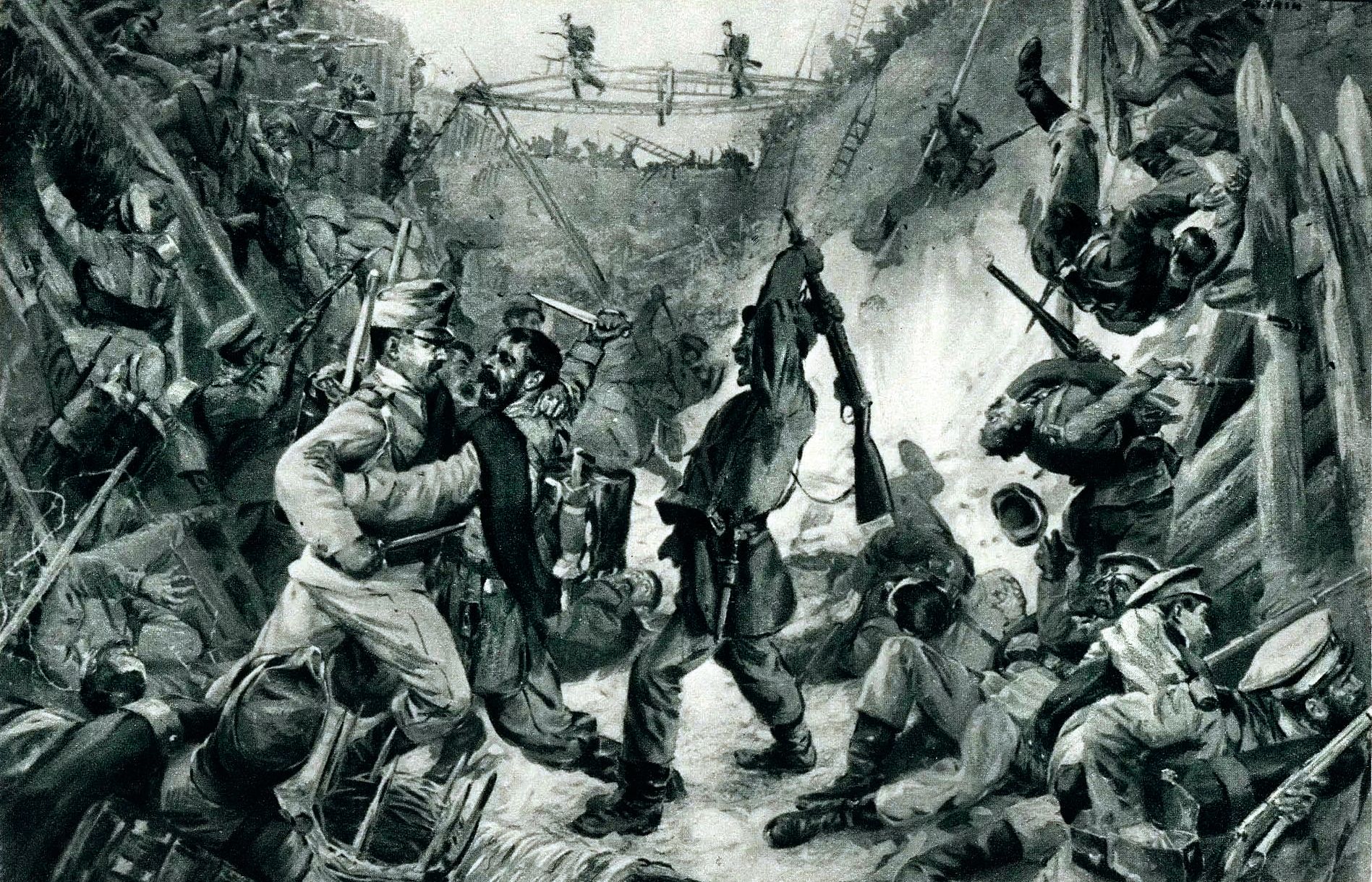
The following day was one of artillery bombardment, designed to soften up the southwest corner of the fortress for the main assault with bayonets. In the eighteenth century, Field Marshal Alexander Suvorov had coined the expression, “the bullet is a fool, the bayonet is a fine fellow,” and it had become an article of faith for Czarist forces.
Lieutenant Bruno Prochaska of the Landsturm Infantry Regiment No 18 and his men enjoyed the relative protection of being in Fort I during artillery barrages, but even there, the atmosphere was tense and frightening.They could hear the distant sounds of the Russian guns, and then “the (shell) thuds like a colossal battering ram furiously against the earth covering of the old fort…the building shudders and resounds down to its foundations…dust and gasses from the explosion (make) the air heavy and suffocating.”
The Russian 19th Division and the 69th Reserve Division would lead the assault on the southwestern forts. Each attacking regiment was given scaling ladders, steel cables, portable bridges, and wire cutters. A regiment would also get 32 hand grenades, an amount that was ludicrously few, but standard early in the war. At least four of the smaller forward forts were up to date, featuring steel observation cupolas, steel gun turrets, a deep ditch and plenty of infantry support. These would be tough “nuts” to crack, but Russian morale was still high.
The Russian storming of southeastern Fort I-1 was the climax of what was later called the First Siege of Przemyśl, an epic that showcased the various aspects of the human condition: courage and cowardice, strength and weakness, efficiency and incompetence. After the siege, Lt. Janko Svrljinka was lionized by the Imperial and Royal press as the hero of the defense—his exploits heavily fictionalized. He was chosen perhaps because he was the only professional officer present.
Hungarian Landsturm Second Lieutenant Dr Istvan Bielek, a 39-year-old lawyer, was the real hero. He had taken over commander of I/1 two weeks earlier, bringing with him elements of his own 2nd Company, Hungarian Landsturm Infantry Regiment No. 11. The regiment was a mixed group that included Hungarians, Ruthenes (Ukrainians), Jews, and a few Slovaks.
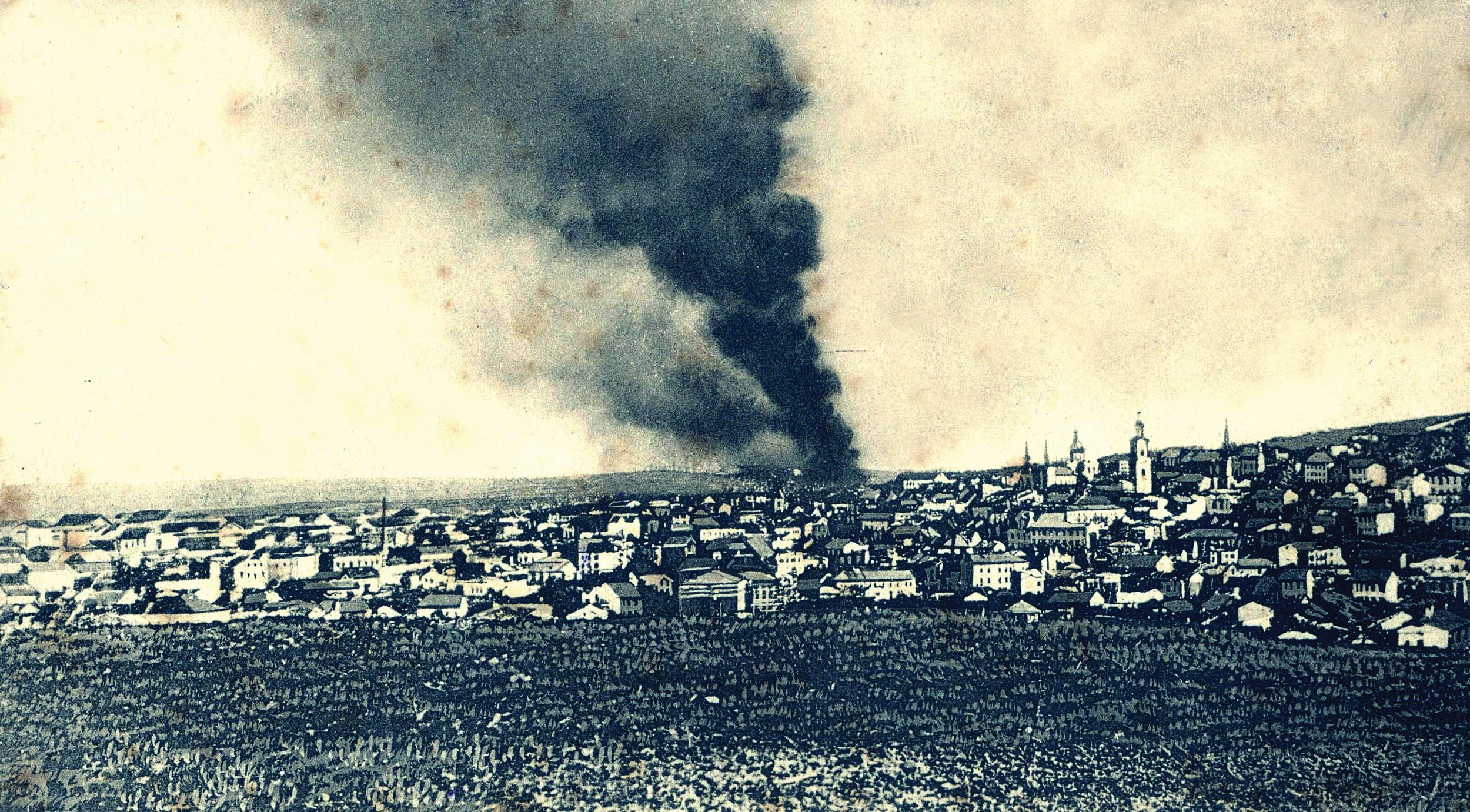
At about 3 a.m. on October 7, something alarmed the sentries at Fort I/1. According to one story, a soldier in an advance listening post fired a warning shot before the advancing Russians crept into his position and cut his throat. Bielek rushed up to the wall and immediately ordered flares to be fired. The flickering lights revealed that the leading edge of the Russian assault wave was already at the bottom of the fort’s glacis.
Realizing that surprise was lost, the Russians turned on large searchlights, simultaneously illuminating the fort and blinding its defenders. Then the Czarist artillery began pummeling Fort I/1. Though rendered half blind by the lights and half deaf from the exploding shells, the I/1 garrison admirably kept their heads and opened up with sustained rifle fire.
But the fort’s artillery was strangely silent, even after Bielek sent request after request for support fire. Ironically, it was Svrljuga the “hero” who was in command of the guns, and he was having a nervous breakdown! Though never officially acknowledged, rumors circulated that Svrljuga had lost his nerve, constantly crossing himself as he repeatedly moaned “Oh, my God, Oh, my God.”
Bielek didn’t have time to figure out why the artillery wasn’t firing as the Russians came closer and closer. He prepared for the worst by ordering heavy beams and sandbags be readied to block the fort’s main entrance. For the next two long and bloody hours the fighting was fierce, with the garrison contesting every foot of ground as the Russians advanced.
Some 2,000 men of the Russian Crimean Infantry Regiment No 73 were in the forefront, so close to the fort that Ukrainians in the garrison could understand their talk between the bursts of gunfire. By about 5 a.m. the Russians managed to throw a bridge over the fort ditch and break through the right shoulder. Just then, with the bridge crowded with Czarist troops pouring across, Ensign Hans Seiler fired one of the turret guns. Probably disgusted by Svrljuga’s apparent cowardice, Seiler took action without orders. His timing was perfect, as the turret guns sprayed the Russians with lethal doses of canister even as they crossed the bridge and climbed up the fort wall.

Seiler’s blasts dislodged the assault bridge, killing even more Russians. Other Russians were still alive amidst the carnage, trying to climb the 10-foot walls of the ditch when the machine guns in the fort carponier (outwork) sprang to malevolent life, mowing down scores of green-clad men.
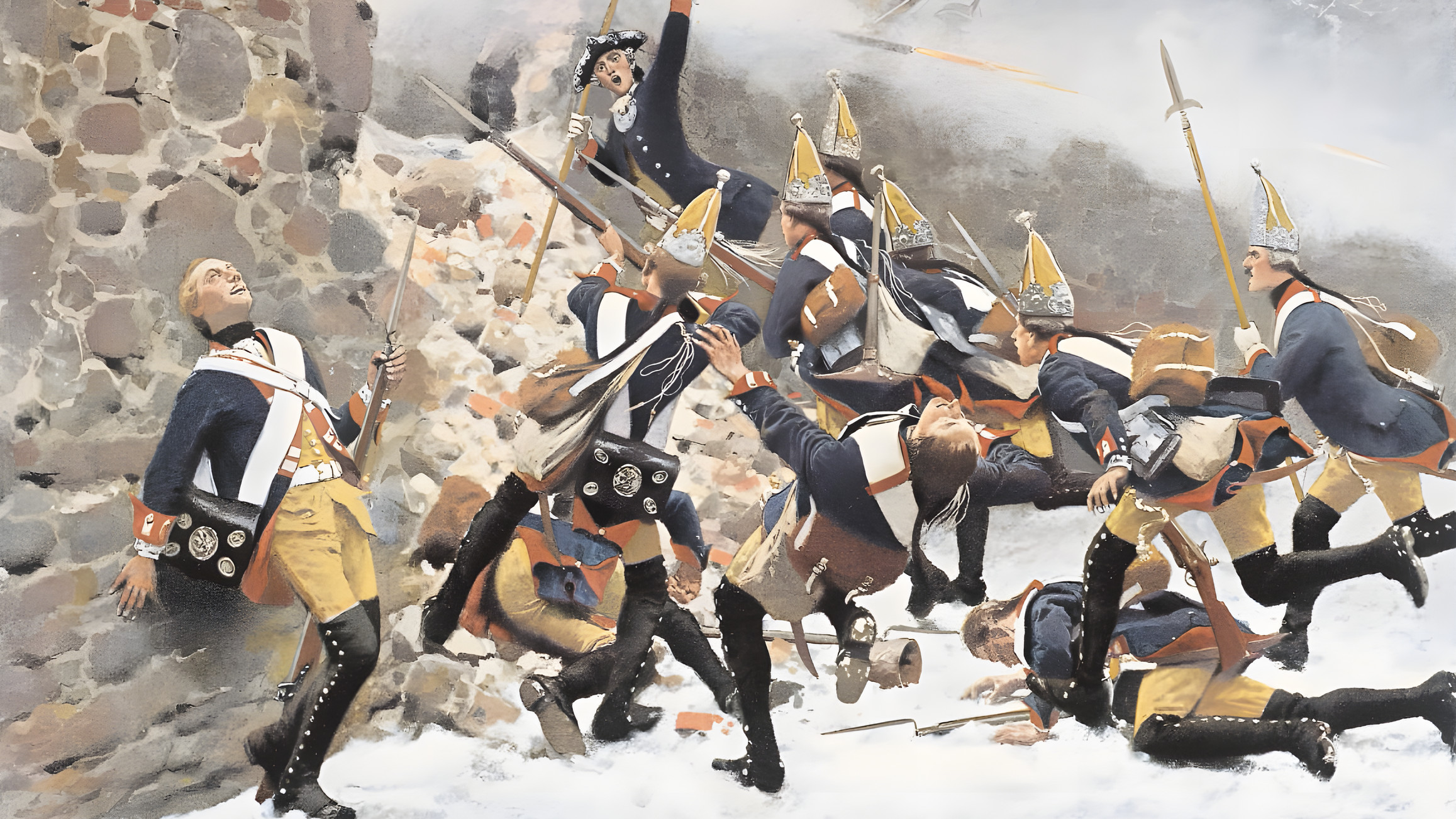
This action bought time, but 250 men of the Crimean Regiment had made it over and were scaling the fort proper. Bielek had only about 40 men left defending the wall. The Russians had climbed over the parapet and there was some hand to hand fighting. There was nothing left to do but for Bielek and the survivors to fall back into the interior of the fort.
There was an anxious moment when it was discovered that the heavy entrance door had already been shut and bolted. Pounding at the door and shouting finally got through to the soldiers on the other side, and the commander and his surviving men were let in. Bielek and his men were now essentially entombed within their own fort.
The Russians were on the roof, and had taken possession of most of the fort. Bielek could not call for help, because the bombardment had cut all the phone lines. The dim light and stuffy, fortress rooms were made even more terrifying by the screams of the wounded outside and strange noises echoing through the corridors—it was the enemy trying to shoot through ventilation shafts, or drop objects down fort chimneys.
The Czarist troops grew increasingly frustrated. The guncotton they had brought along to stuff down chimneys was wet and failed to explode. Russians interrogated garrison wounded, trying to find out where all the entrances were in the fort, but the injured prisoners told them nothing. Casting around for a solution, they focused on the fort’s rear main entrance and rooftop iron door. The invaders might have succeeded, but were kept at bay by a few soldiers firing from nearby loopholes. One soldier, a roofer from Vienna named Franz Suchy, kept watch at the main door and later claimed to have shot 40 Russians.
About 7:30 a.m. help arrived in the form of the fortress reserves, Hungarian Hovid troops considered the best of the garrison.They made short work of the Russians who now found themselves trapped and unable to escape. They were cut down or made prisoner. Fort I/1 was saved, and with it Fortress Przemyśl. Two days later the Russians were forced to retreat and the siege was broken. The Hapsburg field army soon launched an offensive, pushing Czarist forces further back.

The whole Austro-Hungarian empire rejoiced at the news that the Russian bear was not invincible, and the once feared Czarist juggernaut could be stopped by a few determined men. Przemyśl also rejoiced, but the respite only lasted a month, and was followed by a long second siege that started in November, 1914. It was an ordeal that would test the physical and mental endurance of both civilians and soldiers.
Once again the Austo-Hungarian field army fell back, and Przemyśl was under siege. Having been stopped in October, the Russians were not eager to repeat the experience.There would be no further bravado, nor wasteful frontal assaults or attempts at storming the fortress perimeter. “General Famine” would be in charge of the operation to starve Przemyśl into submission.
Just before the second siege began on November 10, there had been some evacuations of noncombatants, but 30,000 civilians, including children, remained in the city. The garrison now numbered 130,000, along with 21,000 horses that might become a food source if regular supplies ran low.
Good morale was essential, so every effort was made to make life as routine and normal as possible. Theaters were open, and since laughter is a great psychological medicine the playbill usually included slapstick comedy. Przemyśl’s movie house, The Olympia, was crowded with people seeking a couple of hour’s relief from their stressful lives. Drama, comedy, or even fantasies like A Thousand and One Nights proved very popular.
The schools were reopened in January, 1915, a move that was welcomed by students and teachers alike. Children craved normality, and drew comfort from a sense of routine they knew before the war. Classes were conducted as usual, even if a teacher’s voice might have to compete with the distant boom of artillery fire and chatter of machine guns.
At least in the early weeks, citizens strolled the lovely landscaped park not far from the old City castle, or had a drink at the Grand Café Stieber, located on the ground floor of the magnificent Hotel Royal. The café was not too far from Fortress Command, and so there was always a hope one might pick up some good news.

As a garrison town, Przemyśl was no stranger to romance even before the war. Soldiers often courted and sometimes married local women. But during the siege the dynamics changed, and often not in a woman’s favor. Some genuine romances blossomed, but as the weeks went by and real starvation threatened, desperate females became girlfriends/mistresses of soldiers, particularly officers, who had food.
Some of these women achieved an almost legendary status, such as Ella and Hella, nicknamed the “flyer princesses” because they associated with the fortress pilots. Both were beautiful, vivacious, well dressed, and had pleasant voices. An evening with one of them was enough to make a man forget the miseries of war.
A kind of mystique surrounded them, partly because they were unattainable by ordinary soldiers. Rumors persisted they might be Russian spies. After Przemyśl fell, Hella was seen at a café being very friendly with a Russian officer. Was she a spy? An eastern “Mata Hari”? Or simply a woman trying to survive by adapting to new circumstances?
It was also in January that the grim reality finally began to register with Przemyśl’s beleaguered inhabitants. That’s when the horses, the last ditch source of food, began to be slaughtered in great numbers. Flour was made in part from horse bones and dried horse flesh, and horse liver Pâté was spread over it. Horse intestines made good sausage casings, and of course the sausages themselves were stuffed with horse meat, chiefly offal. For cooking oil, horse fat served well enough.
Przemyśl wasn’t entirely cut off from the outside world. They did have radio communication, an airfield, and air squadron Flik 11. The squadron had Albatros and Avitik two-seater biplanes, canvas-covered contraptions that were primitive, but serviceable by 1914-15 standards. Remarkably, Fortress Command set up a regular airmail service with these planes. Soldiers could contact their families via special post cards, made of thinner, lighter paper to save weight. Understandably the cards were censored; only greetings and comments about the sender’s health were allowed.
Aircraft of another kind showed up on the morning of December 1, 1914. It was a Russian plane, and crowds of Przemyśl citizens thronged the streets to view the entertaining spectacle. The fortress guns opened up, and dirty white blossoms of smoke appeared near the plane as the shells burst. The crowds laughed and made jokes about how scared that Russian pilot must be, when suddenly small dark objects were thrown out of the aircraft.
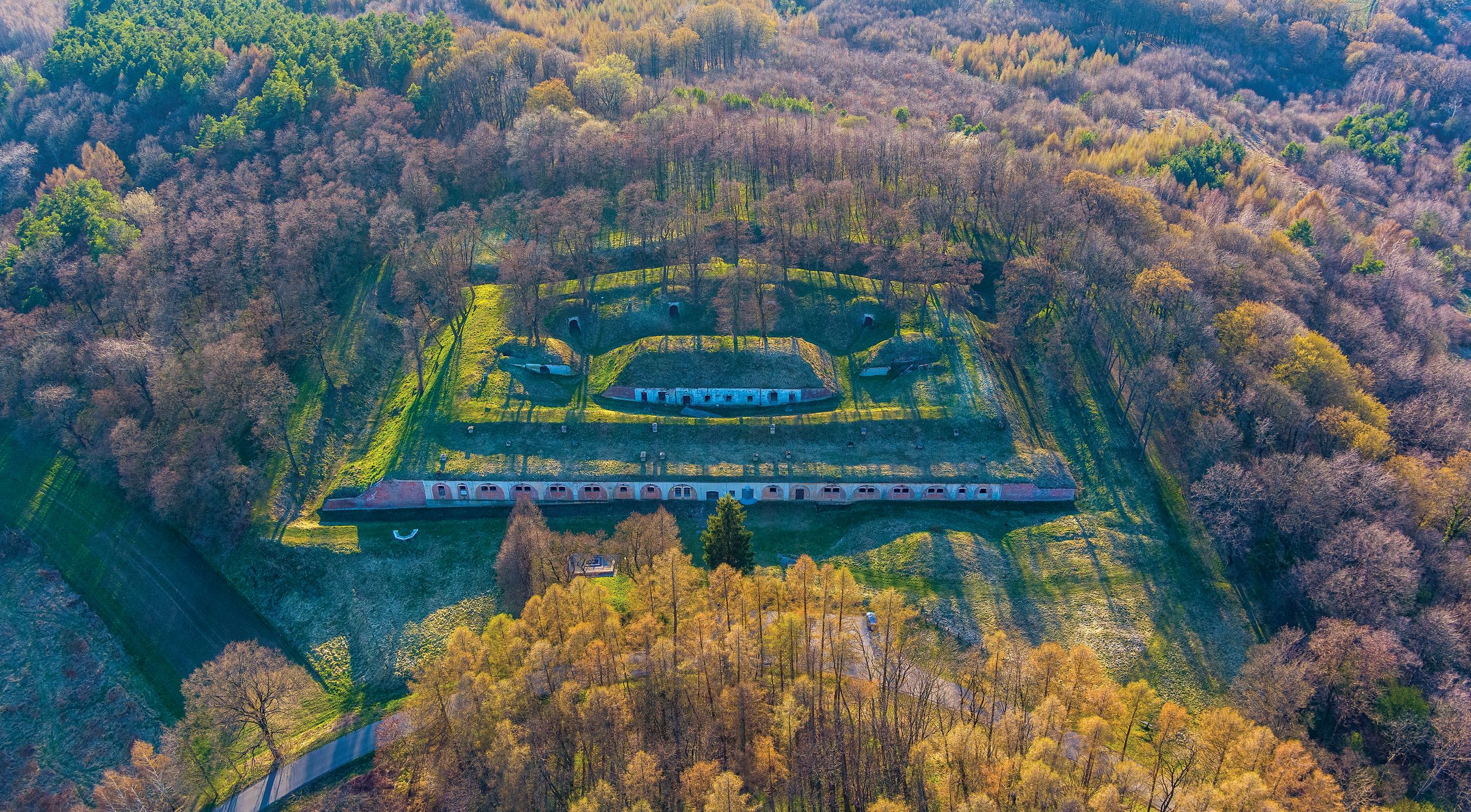
Speculation about what was falling from the plane ended when the objects hit the ground and exploded with loud detonations. Voices shouted, “bombs! Bombs! The Russians are throwing bombs!” and the panicking crowd ran for cover. It was the first of many bombing raids on Przemyśl; throughout the siege the Russian air corps dropped no less than 275 bombs. This was one of the earliest bombing raids experienced by a civilian population.
Winter was particularly hard on everyone bottled up in Przemyśl. One observer recalled that the soldiers in forward positions were like a “procession of ghosts. The soldiers creep forward, pale, like shadows, buckled like old men.” Ragged, apathetic and hollow eyed, the garrison troops reminded observers of Napoleon’s Grand Army during the retreat from Moscow. Sickness also decimated the garrison ranks; by March 1, 1915, some 15,000 men, or 1 in 8 garrison soldiers, were hospitalized.
A half-hearted effort to break out was tried, but it ended in bloody failure. About 40,000 garrison troops were assigned the task to, at least in theory, break through Russian lines and reach the Austro-Hungarian field army some 56 miles away. Kusmanek was no fool—given the condition of the men, success was a near impossibility. Nevertheless, an attempted breakout might disrupt the Russian front infrastructure like the railroads, capture food stockpiles, and satisfy the army’s diminishing sense of honor.
Lieutenant Jan Vit spoke for many when he wrote, “Everyone from the highest commander to the ordinary soldier knew very well that our starved and physically exhausted men and emaciated horses were incapable of undergoing a single day’s march, not to speak of several days of battle.”
The March 19 breakout “offensive” was a debacle of the greatest magnitude. Of the 40,000 poor wretches that bravely went forward. Some 10,000 were killed, wounded, or captured.The survivors wearily made their way back to the fortress.
When the food was gone, so was hope. An officer in the 23rd Honvid Infantry Division wrote, “I have been walking like a drunk…or to speak precisely, a man condemned to death. I find no delight in anything. There is nowhere to hide—the end is coming.”
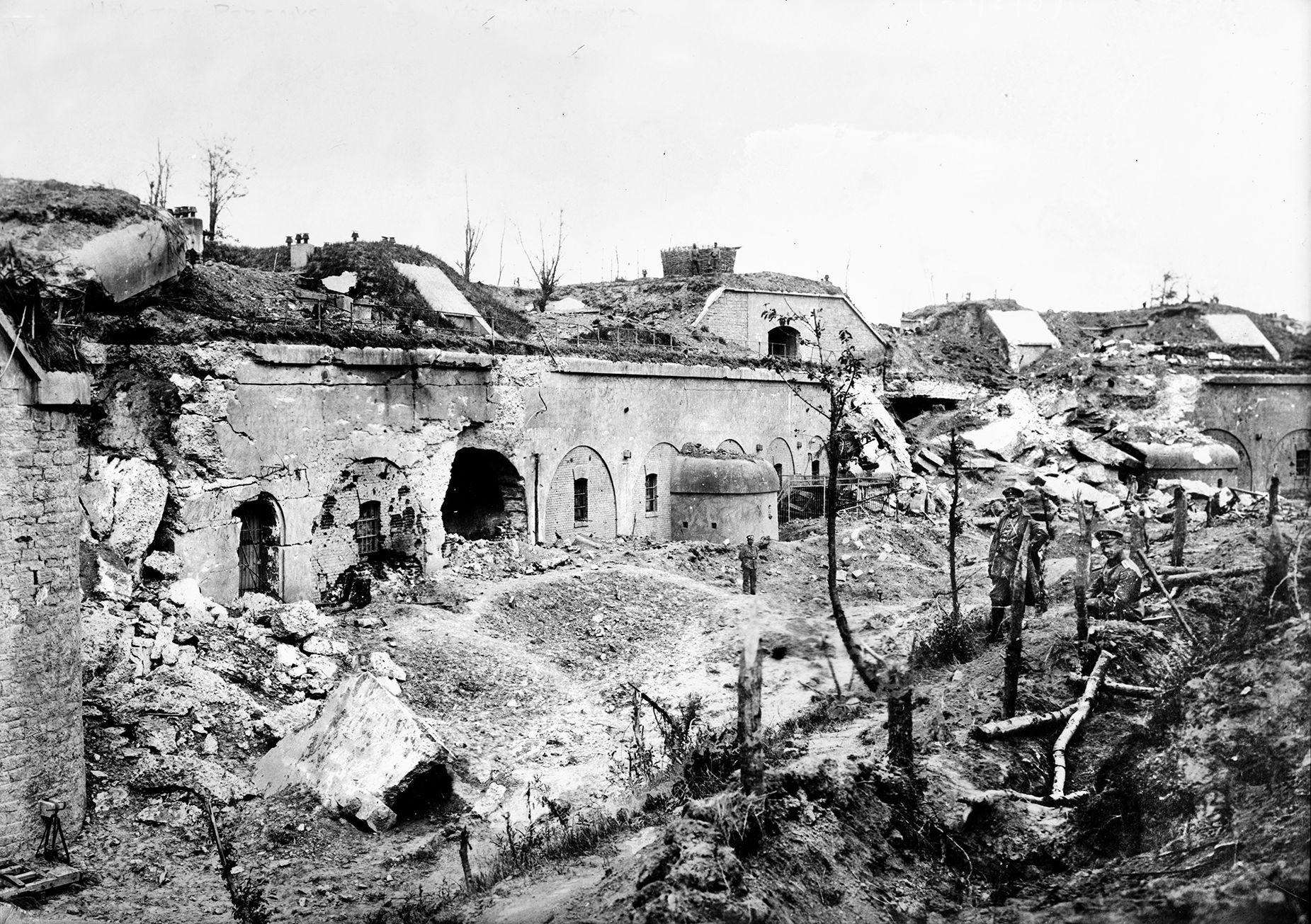
Before Przemyśl was surrendered, anything of value would need to be destroyed. There would be nothing left for the Russians to use for their own war effort. At 6 a.m., March 22, 1915, all the major forts were blown up, a spectacular pyrotechnic display that would forever linger in the minds of those who witnessed it. The first one to go was Fort XI, “Dunkowicski.” First, a huge explosion that shot fingers of flame and coils of smoke into the sky, accompanied by a terrifying roar that could be heard throughout the city. Moments later another fort blew up, then another, and another, until what once was a defensive perimeter was transformed into a ring of flame and smoke that circled Przemyśl like a crown of apocalyptic destruction.
To some it seemed like Przemyśl was surrounded by a chain of erupting volcanoes, and from the air the spectacle was even more awe inspiring. Pilot Rudolf Stanger was one of the last of the garrison to escape before its surrender. After he took off, the sight he beheld from above inspired an almost poetic description. It was “horrible, and yet of incomparable beauty, eternally sad yet of such sublime greatness that the destruction of Pompeii and Herculaneum could not have offered a sight more awesome.”
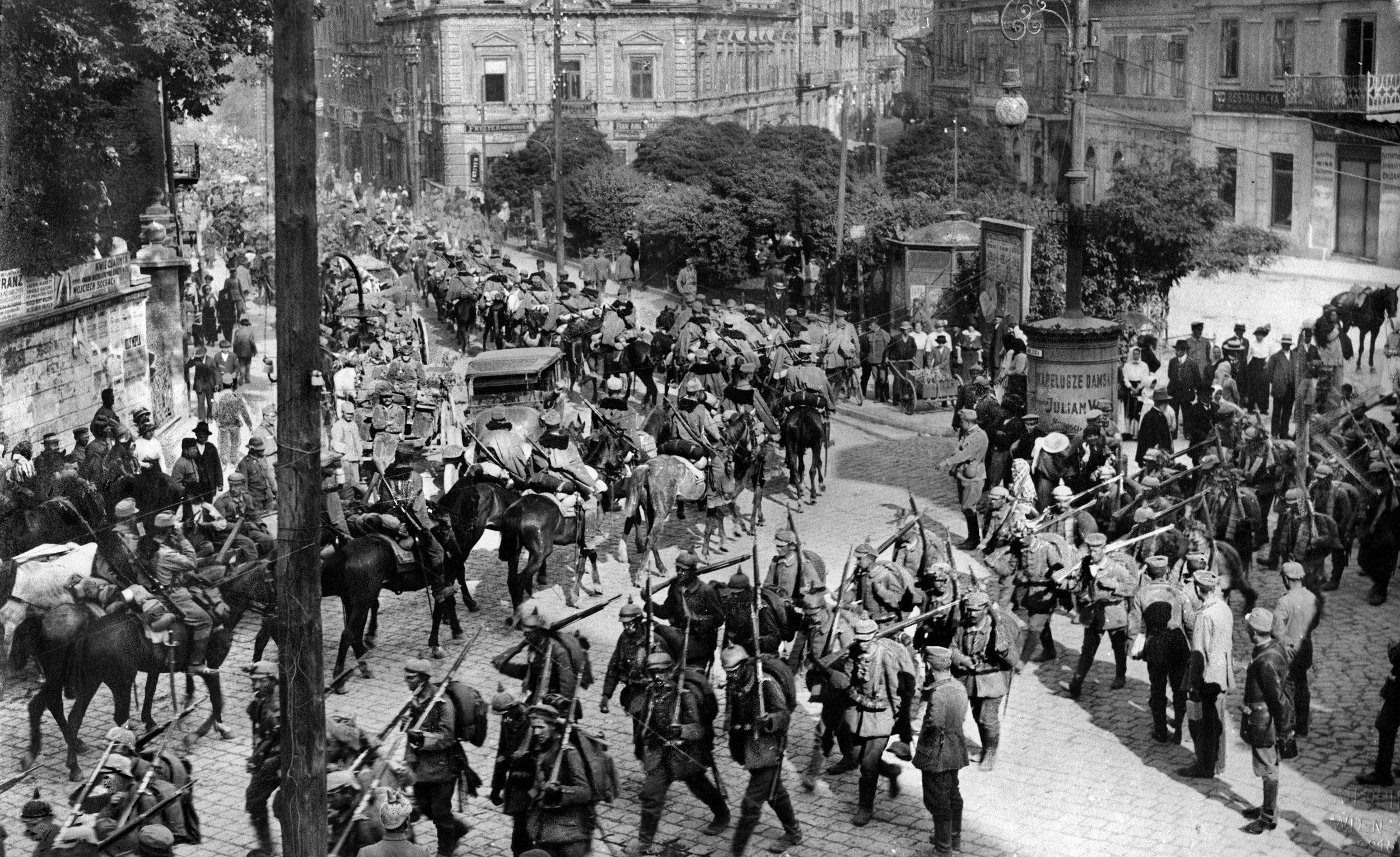
Fortress Przemyśl formally surrendered, and the garrison marched off into captivity. Mounted Cossacks now trotted through its streets, and a jubilant Russian officer declared “Przemyśl belongs to us now forever.” A casual statement, but in retrospect an ominous one for the people of Przemyśl and Galicia. Most Russians, even Czar Nicholas himself, embraced the idea of a “great Russia”that insisted much of Slavic Eastern Europe had somehow historically been Russian territory in the distant past.
The Ukrainians were considered Russian, albeit “little Russians,” and not permitted to have any sense of separate ethnic, cultural or even linguistic identity. Ukrainian newspapers were shut down, and the Russian language replaced Ukrainian in
schools. It was part of the overall Russification program, and even the clocks were set to St. Petersburg time. History often repeats itself, and the Russian policies of 1915 are not too different from the ones that Vladimir Putin has been following in the 21st century.
The worst treatment was meted out to Galicia’s Jewish population, and the jews of Przemyśl also suffered. Antisemitism was endemic in Russia, and periodic pogrom persecutions of Jewish communities occurred on a regular basis. Crude and derogatory names for the Jews were common; even the Czar was antisemitic, casually using ethnic slurs in his private correspondence.
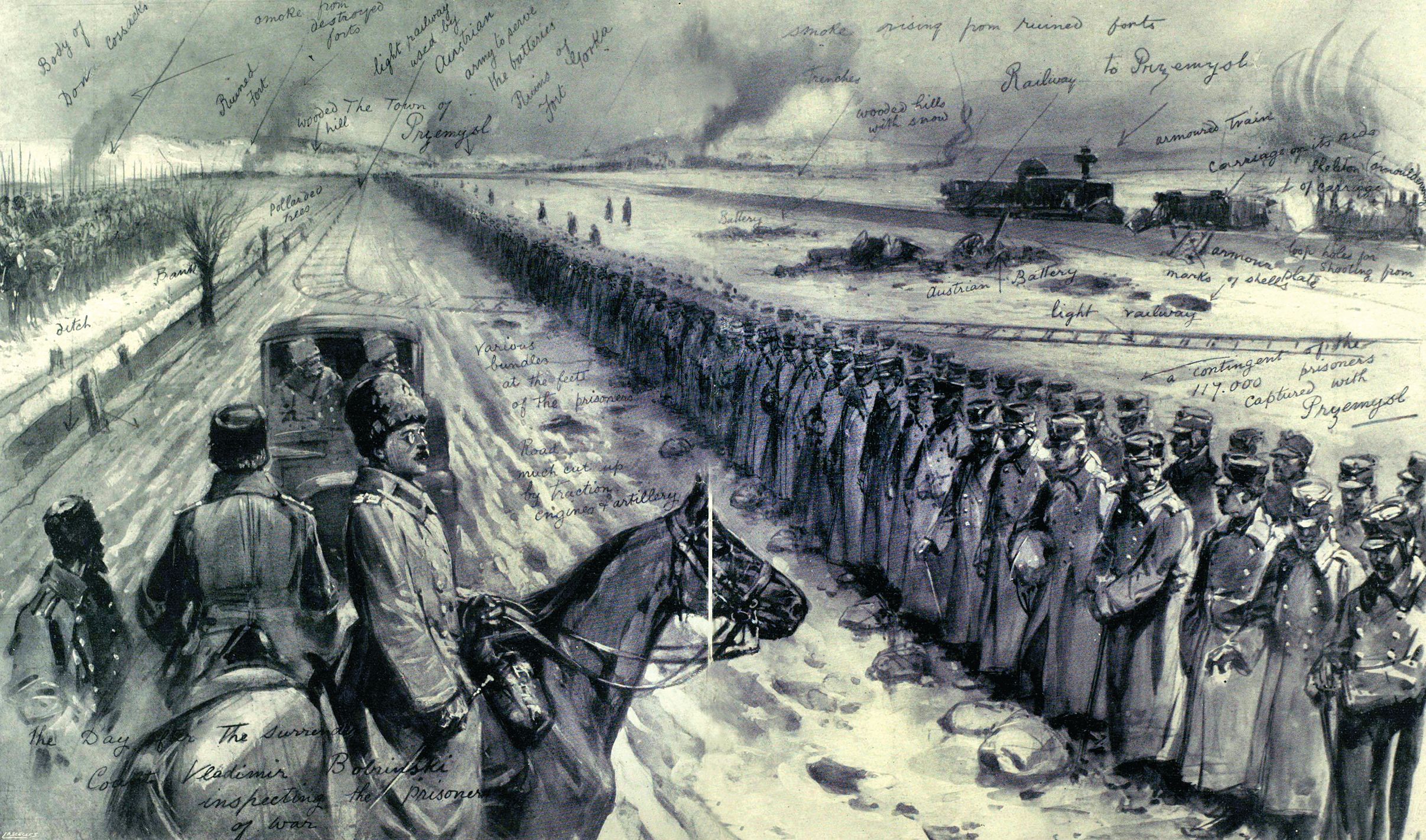
As part of their ethnic cleansing/Russification program, no less than 17,000 Jews from Przemyśl and the surrounding district were rounded up and deported to locations deep in Russia. Russification also meant that anyone—Austrian, Polish, Slovakian, Hungarian—who was a community leader, or a potential community leader, was arrested and/or deported, lest opposition coalesce around them.
But the Russian occupation of Przemyśl was brief. On June 3, 1915, formidable German troops expelled the Russians, who would not return, at least until the end of World War II. The saga of Fortress Przemyśl was over, at least for the moment. The fortress city had endured the longest siege in World War I, five grueling months from November, 1914 to March 1915.
Thomas Carlisle once wrote “It is singular how long the rotten will hold together.” Austria-Hungary was indeed rotten, a patchwork quilt of territories filled with diverse nationalities, religions, ethnic and cultural identities. Yet against all reason it largely held together in the years just before the war. And in retrospect, given the horrors of the Nazis and Communism that was soon to come, relatively successful.
The second half of Carlisle’s quote is seldom included. He says that the rotten will hold together, provided “you do not handle it roughly.” This underscores the miracle of the Austro-Hungarian empire. It was “handled roughly,” very roughly, for four brutal years, always teetering on collapse, yet still maintained a cohesion that was nothing short of miraculous.
The siege of Przemyśl also illustrates that the human factor, which is sometimes overlooked, is of supreme importance in war. The troops that held Fortress Przemyśl were middle aged, out of shape, and were a motley collection of different languages and nationalities. They had little in common, though some had a genuine affection and reverence for the old Hapsburg Emperor Franz Joseph. Armed with obsolescent weapons, manning forts that were mostly out of date, poorly prepared and in some cases poorly led, these men rose to the occasion and performed much better than expected.
Though little known in western histories the siege profoundly altered the whole course of the war. If Przemyśl had fallen in 1914, the Russian “steamroller” would have pressed on into Hungary and may ultimately have captured Vienna. The Hapsburg empire might well have collapsed before its German ally could rescue it. Allied victory might have been achieved in 1915, saving millions of lives in the process.

Join The Conversation
Comments
View All Comments