By William R. Hogan
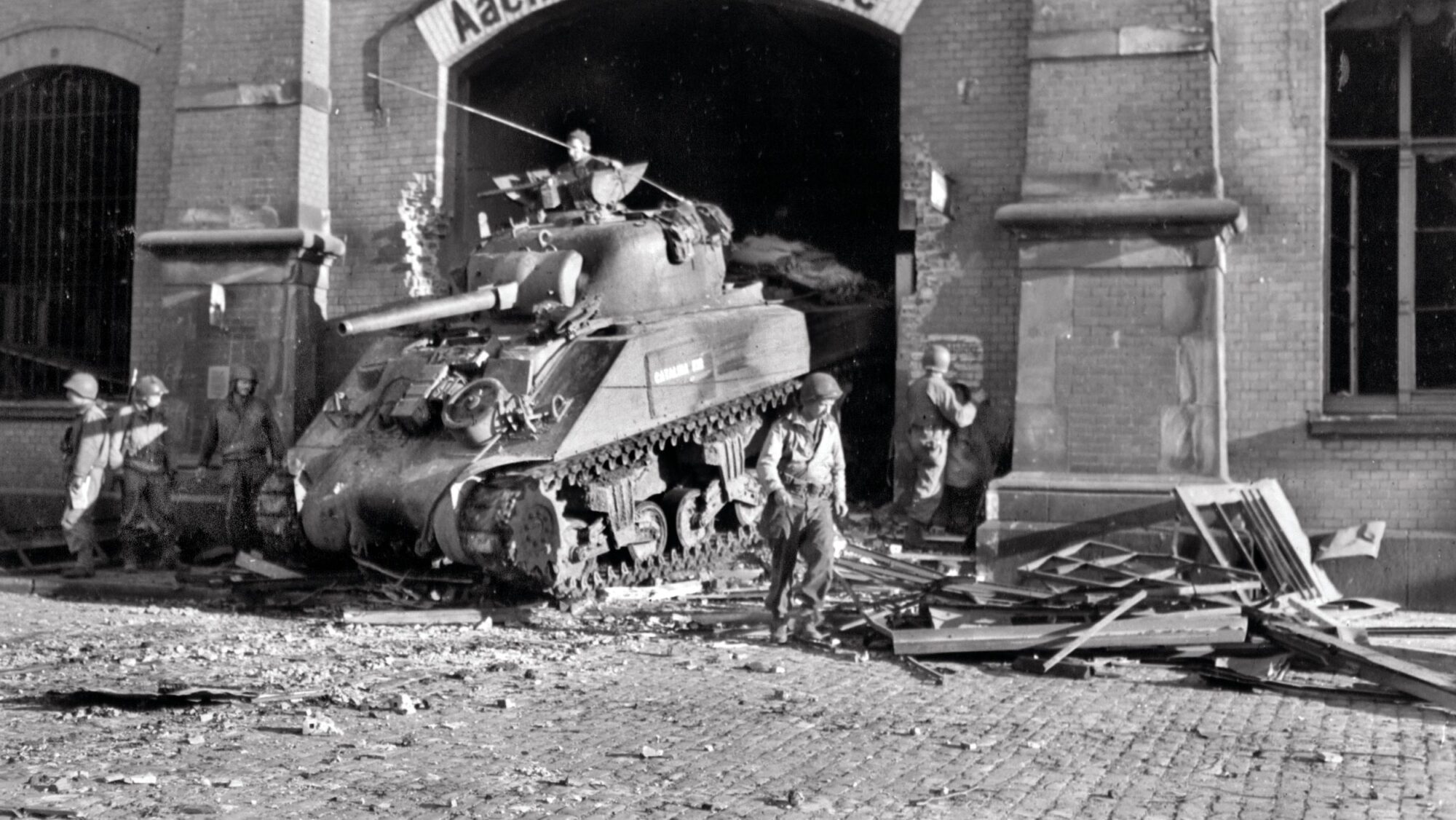
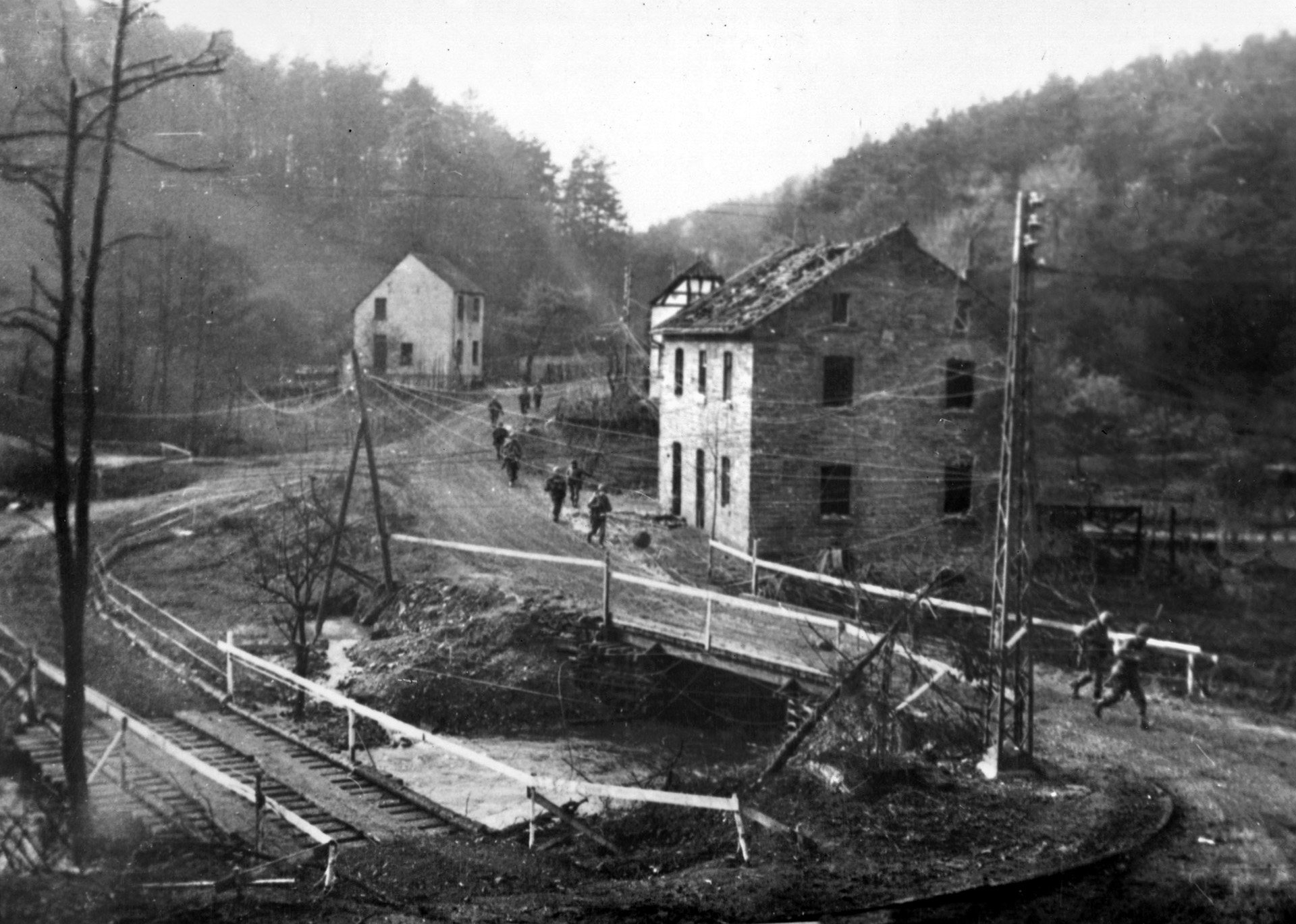
Task force commander Lieutenant Colonel Samuel Hogan, eager to get any advantage over the entrenched enemy of the 12th Infantry Division, requested a section of M2 flamethrowers from the 23rd Engineer Battalion. The six soldiers, each armed with a flamethrower and heavy fuel canister strapped to their back, divided up among the infantry squads. The “reconnaissance in force” resumed by nightfall along suburban streets south of the German city of Aachen lit up by tank cannon muzzle flashes and the orange glow of burning napalm inside cellars. The flamethrowers’ tactical and psychological impact helped the Americans advance from east to west toward the center of the industrial town of Stolberg and the main intersection of town, where they would halt and wait for other units to come on line.
After landing at Omaha Beach on June 23, 1944, Hogan and his 3rd Battalion (33rd Armored Regiment) had fought in the hedgerows, at Mortain, at Mons and the closing of the Falaise Pocket. Once again in an urban environment, his task force faced German tank-killer teams armed with the Panzerfaust anti-tank rockets, covered by machine gunners, that knocked out lead tanks and sent the accompanying infantry scrambling for cover in doorways and drainage ditches. Tanks returned cannon and machine-gun fire at the buildings on either side. Grunts and Landsers spent the day in house-to-house fighting with advances measured in meters. The work was exhausting especially for the flamethrower crews, who kept up with the advance while carrying a 68-pound container of napalm strapped to their back. Lieutenant R. Eells of the 23rd Engineers reported that night that it was the first organized use of flamethrowers in urban combat operations in the European theater to “encourage” an enemy to abandon fortified positions.
This was the first phase of the operation to capture the German city of Aachen and the Americans were getting a taste of how hard urban combat in Germany was going to be—the city and its surrounding area had been incorporated into the Siegfried Line (West Wall), Hitler’s formidable defense of his western border.
The battle for Aachen in September/October 1944 became one of the U.S. Army’s largest, and toughest, urban battles of World War II. It was the Army’s initial exposure to large-scale combat operations in a city and would play an important part in the development of effective “Military Operations on Urbanized Terrain” (MOUT) for the service going forward.

The experience at Aachen would be studied for decades and become the basis for an emphasis on combined arms for MOUT operations, as previous military doctrine had discouraged the use of armor in urban areas where defenders enjoy almost all of the advantages as each building offers multiple opportunities for cover and concealment, forcing attackers to treat each one as a bunker that must be neutralized before they can advance. Streets can be used to force attackers into ambushes. Mobility and fields of fire are restricted. Armored vehicles are virtually blind and easily attacked at close quarters. It became necessary for infantry and armor to work together, each compensating for the other’s weaknesses, and forcing them to improvise combat tactics in a complex and confined environment.
Valuable lessons can still be drawn today from the battle for Aachen, where an American force, untrained in urban combat, whose higher numbers were negated by the terrain and the enemy’s fanatical use of a new generation of portable anti-tank rockets, fought and won. Agile and adaptable mission command, ingenious employment of heavy artillery and flamethrowers, engineer mobility assets, and old-fashioned aggressiveness along with close-quarter fighting won the day.
Though it had been incorporated into the Siegfried Line near Germany’s border with Belgium and Holland, Aachen (pop.165,00), had little strategic value. After fighting their way northward into Belgium from the beaches of Normandy by early September, the Allies were much more interested in crossing the Rhine River to target the coal and steel plants of the Ruhr Valley. Supreme Headquarters Allied Expeditionary Force (SHAEF) commander Gen. Dwight David Eisenhower had not expected the Allies to reach this position until May 1945—the rapid advance had surrounded five German divisions before they could take positions on the defensive line. On September 5, 1944, Eisenhower ordered that “We should advance rapidly on the Rhine by pushing through the Aachen gap in the north and the Metz gap in the south” toward the Third Reich’s industrial heartland. Initially, the plan was to surround, then bypass, Aachen on the way to this objective in order to avoid the costly street fighting inherent in urban combat.
The best argument for capturing the first large city on German soil was symbolic—the city loomed large in the psyche of the Nazi Party. The Frankish king Charlemagne had been born in Aachen in 742 CE and it had been the capital of his Holy Roman Empire, or the “First Reich,” as Adolf Hitler called it. Otto von Bismarck’s unification of Germany was the Second Reich, and Hitler styled his regime as the Third Reich. Its loss would be a blow to the Nazi cultural center of gravity and chip away at the government’s credibility in the eyes of its people.
For General Omar Bradley, commander of the 12th Army Group, the largest body of U.S. soldiers ever to serve under a single commander (four field armies, over 39 infantry and airborne divisions, and 15 armored divisions) the capture of Aachen would validate his strategy of attacking through Belgium to secure the road network and the crucial Rhine crossing into Germany—the terrain beyond the “Aachen Gap” was flat and suitable for motorized forces.

Bradley designated Major General Charles H. Corlett, commander of XIX Corps, and Maj. Gen. J. Lawton Collins of VII Corps, to spearhead the attack. The plan was for them to encircle the city, which was protected by the West Wall’s Schill and Scharnhorst lines.
Corlett’s XIX Corps—the 29th and 30th Infantry Divisions and the 2nd Armored Division—would break through into Germany from Holland north of the city and drive south to Bardenberg and Würselen. Acting as the advance element of Collins’s VII Corps, the 1st Infantry Division reached the western outskirts of Aachen on September 10 and began a series of reconnaissance patrols around the southern edge of the city. The rest of VII Corps would then push to the east below Aachen near Stolberg and hold in place, until time to push north and rendezvous with XIX Corps.
Knowing the importance of the city as a symbol, the Allies expected a hard fight—which they eventually got—but didn’t realize how lightly defended Aachen was in the first half of September. Indeed, most of the city’s population had left after Hitler ordered all civilians to evacuate. By the time Maj. Gen. Gerhard Graf von Schwerin, commander of the 116th Panzer Division, arrived on September 12 to take over the defense of Aachen he found only 7,000 civilians cowering in the city. Von Schwerin’s division, gutted in the summer by the 30th Infantry Division at Mortain, consisted of 1,600 men, three tanks, a few assault guns and two Luftwaffe fortress battalions. Including a random mix of other units, he initially had only 6,500 men to defend the city.
Assessing the situation, von Schwerin saw that his most reasonable move was to surrender and wrote a letter addressed to the Americans to that effect on September 13. Unfortunately for von Schwerin, that was the same day that Hitler ordered him to counterattack and the letter was never delivered. Instead, it found its way to the Führer, who had von Schwerin arrested by the Gestapo (reprimanded, he would serve on the Italian front).
His replacement was Colonel (Oberst) Gerhard Wilck, commander of the 246th Volksgrenadier Division—many of whom had received fewer than 10 days of infantry training. Hitler also brought Field Marshal Gerd von Rundstedt out of retirement to help organize the defense in the west and began transferring as many units as possible from the Eastern Front to the Aachen Gap—which he ordered to be defended at all costs.
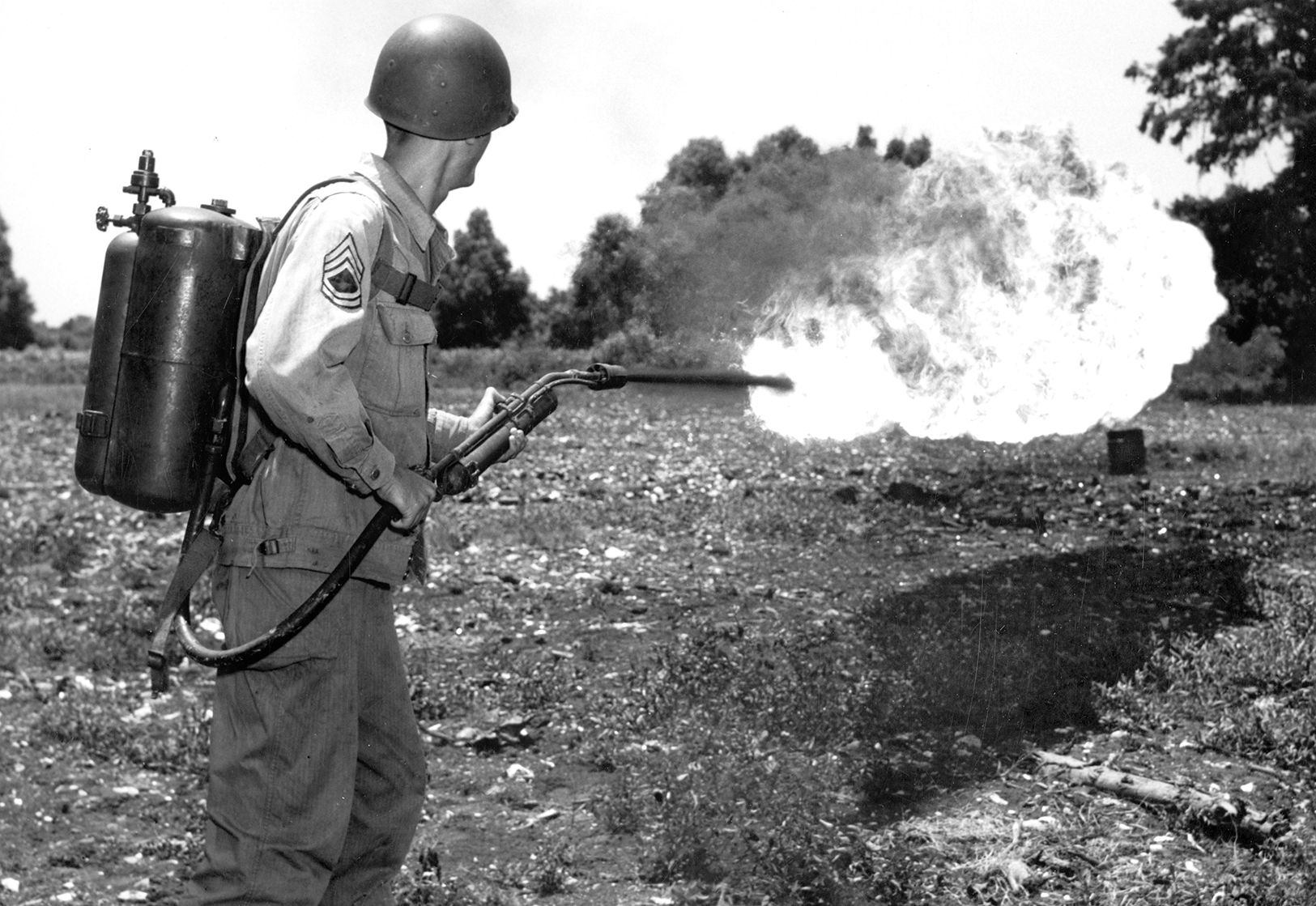
On September 10, the Big Red One (1st Infantry Division), including TF Hogan, penetrated the south side of Aachen, at first finding the lines of bunkers and obstacles to be largely deserted. They continued east, with increasing opposition until they reached Stolberg, occupying an arc around the southern perimeter of the city. By September 21, 1944, Task Force Hogan’s advance up to the main intersection helped secure central Stolberg for the 3rd Armored Division. Pockets of German resistance continued to the north, so Hogan enlisted the help of Stolberg’s Nazi Mayor, who surrendered rather than face Lieutenant Eells’ flamethrowers. Hogan did not trust the doctor, putting him to good use at the head of the column, sitting on the hood of a jeep. This way he was “motivated” to help identify mines and possible ambush sites set up to slow the Americans.
After missing the opportunity to quickly seize Aachen, or have it surrendered to them, the Allies now faced a problem of their own making. As they had pushed toward the Rhine River, the Germans had been falling back in village after village across France, leading to the idea that a bold move into Germany could have the war “over by Christmas.” Bradley surely thought that his plan to take Aachen and seize the Ruhr Valley was that bold move. Eisenhower himself favored an approach on multiple fronts, but overstretched supply lines and logistical issues wouldn’t allow it.

By mid-September the optimism to end the war quickly had reached a fever pitch, especially in the eyes of British Field Marshal Bernard Montgomery, who called for “one powerful full-blooded thrust across the Rhine and into the heart of Germany backed by the whole of the resources of the Allied Armies.”
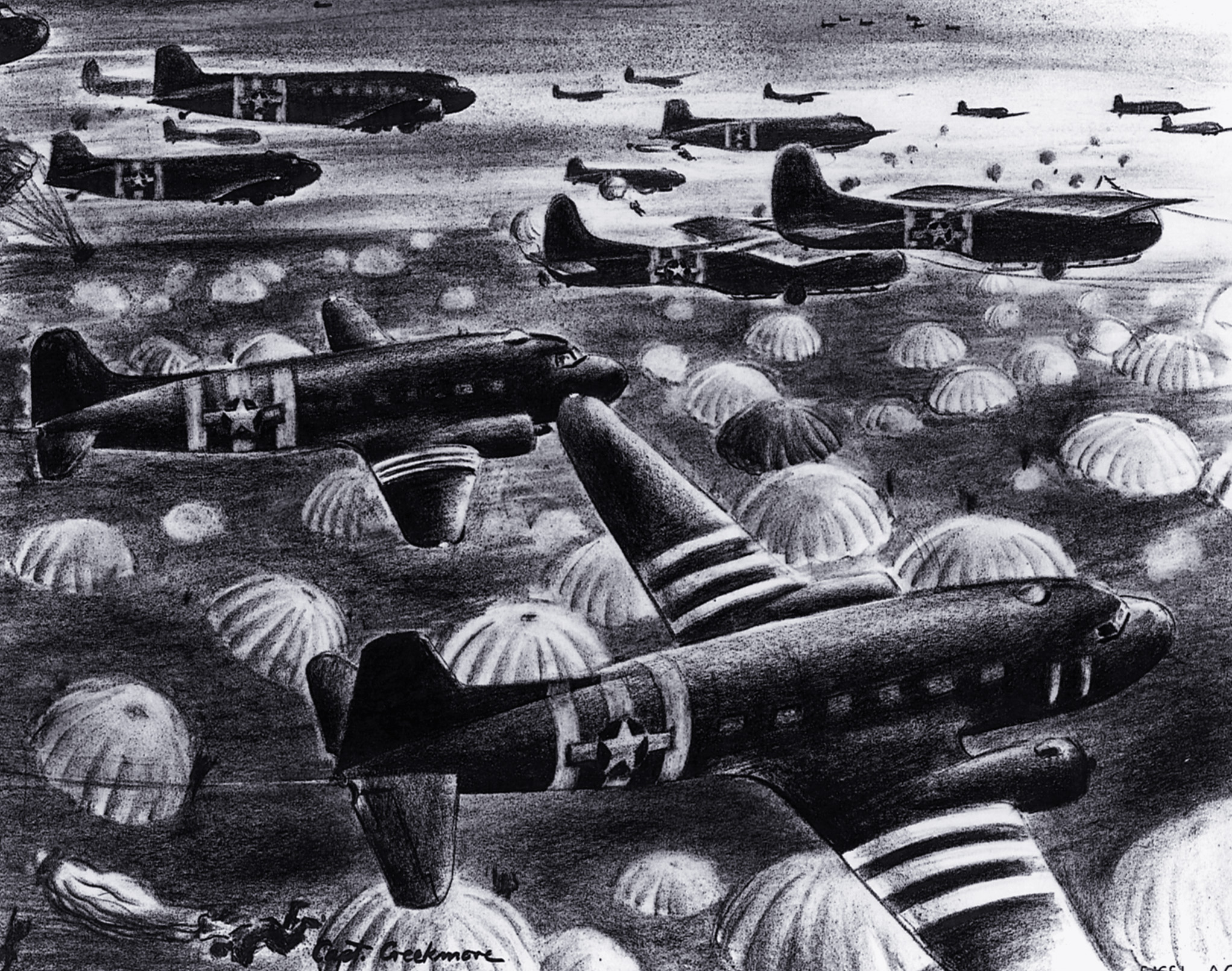
On September 17th, 1944, after only about a week’s preparation, the Allies launched Montgomery’s Operation Market-Garden.
After eight days, the ambitious but ill-conceived operation failed in its objectives for a variety of reasons. In doing so, as many as 17,000 men were killed, wounded, and captured and 88 tanks destroyed.
The shortages began to be felt more acutely around Aachen as the 3rd Armored Division reported on September 18 that it had only 75 operational medium tanks out of its authorized 232. On September 22, just as it seemed the 12th Army Group was poised to break through into Germany, Bradley called a halt to the operation due to critical shortages of artillery shells, fuel and other supplies. Cloudy and overcast conditions due to record rainfalls in Central Europe in the fall and winter of 1944 also meant they would lose their close air tactical support. It also limited the delivery of supplies by air. The Allied supply lines extended all the way back to Normandy and with many secondary roads washed out, vital resupply convoys carrying the large quantity of artillery shells, hand grenades, and small arms ammunition could only reach Aachen by a few hard surface roads.
An uneasy stalemate descended on the area, but the capture of central Stolberg helped VII Corps isolate Aachen, control the city’s water supply, and trap German forces in the Hürtgen Forest where the 9th Infantry Division had began its advance on September 19 and was soon followed by the 4th, 8th, 28th, and 1st Infantry Divisions, plus the 2nd Ranger Battalion and a combat command of the 5th Armored Division. The Battle of Hürtgen Forest would involve more than 200,000 men and last until February 10, 1945.
By the end of September, supplies of ammo and fuel began to reach the Aachen front with sufficient quantity and regularity that the planned pincer attack was ordered to resume. After a four-day bombardment of an 11-mile sector to the north between Geilenkirchen and Aachen, XIX Corps’ 30th Infantry Division (under Maj. Gen. Leland S. Hobbs) and the 2nd Armored Division (under Maj. Gen. Ernest Harmon) were set to launch on their mission to cross the Wurm River and West Wall on October 1, but heavy downpours delayed them 24 hours.
This advance was immediately met with fierce German resistance, requiring the extensive use of flamethrowers and explosives to clear deeply entrenched pillboxes. Progress was agonizingly slow and costly; one company lost 87 troops in just an hour, and another suffered 93 casualties out of 120 from a single German artillery strike. The fighting quickly devolved into brutal house-to-house engagements and hand grenade duels, particularly in areas like Palenberg. The arduous task of forcing a crossing of the Wurm and establishing a bridgehead alone cost the 30th Infantry Division approximately 300 dead and wounded.
As previously planned, the 16th Infantry Regiment would secure the eastern flank while the 18th ID moved northward to the east of the city to link up with the 30th Infantry Division near Würselen. The task of capturing Aachen itself would fall to the 26th Infantry Regiment, supported by Task Force Hogan’s armor. They launched from the south on October 8, aiming to capture key high ground positions such as Verlautenheide and Crucifix Hill. These initial advances, though costly, set the stage for the eventual encirclement of the city. The German high command’s demand to “hold to the last man,” coupled with Aachen’s immense symbolic importance, fostered a desperate, almost fanatical resistance. For the Allies, the refusal to surrender meant that even after encirclement and heavy bombardment, the fight would remain a brutal, house-to-house grind, testing the endurance and morale of their own troops.
The brunt of this fighting was borne by combined arms teams, typically built around an infantry company, supported by bazooka teams, flamethrowers, and tanks or tank destroyers. The 26th IR, for instance, effectively integrated close air support, indirect and direct artillery fire, and TF Hogan’s armor (M4 Shermans, M10 tank destroyers) with infantry and engineers, pushing these diverse weapon systems down to the company level. This provided commanders with the flexibility to counter unique German defensive positions while minimizing casualties. Filled with hard targets by design and improvisation, an urban environment requires an enormous amount of ammunition. As an example, Army records show that at Aachen the 2nd Battalion alone fired 5,000 mortar rounds, threw 4,300 grenades and torched 50 gallons of flamethrower fuel. They also fired 40,000 .30-caliber machine-gun rounds and 27,000 other small arms rounds. One of the key components of success for an attacking army is to keep moving stockpiles of ammo and supplies as far forward as possible at every opportunity.
Surrounded by woods and hilly terrain, the “Sentinel of the Rhine” lay in a plain that started at the foothills of the Ardennes Forest and swept east toward the city of Cologne with its bridge over the mighty river. High ground encircled the city, and the Lousberg Heights looked down upon the center of town, an ideal observation post from which to call artillery. Reinforced concrete pillboxes, camouflaged and with interlocking fields of fire, covered approaches and key intersections. An above ground railway line looped around the inner city, the equivalent of a medieval wall to thwart invaders. Antitank obstacles, mines and booby traps rounded out the defenses.

The 1st Infantry Division with Task Force Hogan attached received the mission to capture downtown Aachen. Maj. Gen. Clarence Huebner, the division commander, split his 26th Infantry Regiment along two axes of advance, attaching his 1st Battalion, under the command of Major Francis W. Adams, to Task Force Hogan. Their orders were to move under cover of darkness into the outskirts of Aachen to a factory district from which they would jump off at noon on October 19. Objectives “Red” and “Blue,” the heights and road junction beyond, controlled access to the old city center and the Aachen-Laurensberg highway, along which German counterattacks were expected.
Defending Fortress Aachen were 6,500 men assembled under Oberst (Colonel) Gerhard Wilck from his own 246th Volksgrenadier Infantry Division. Northeast of Aachen, elements of the 1st SS Panzer Corps augmented by Tiger tanks of the veteran 506th Heavy Tank Battalion readied themselves to counterattack against any U.S. gains.
By October 10, with the city more than halfway encircled, the 1st U.S. Army Commander had a message delivered into the city under a white flag offering the German Garrison Commander the opportunity to surrender. After no reply within the specified 24 hours, the formal assault on Aachen began with artillery shelling and bombing runs from the Army Air Corps. The city would be reduced to rubble with 80 percent of its buildings damaged or destroyed.
The final attack began amid a gray industrial landscape that matched the low gunmetal clouds dropping a cold drizzle that turned roads to muck. Artillery preparations and aerial bombing reduced some parts of the city to rubble with German infantry inside cellars, along rooftops, and in every nook and cranny of collapsed masonry.
The tank-infantry teams advanced, each M4 Sherman supported by a platoon of infantry; the Shermans would “light up” up a building, driving the German defenders into the cellars and basements. There was no knocking on front doors, just blowing holes into side walls with satchel charges or tank fire so the infantry could come in where least expected while staying clear of enemy kill zones. The infantry then moved up and down stairs, using grenades or flamethrowers to kill anyone not surrendering. The infantry squad leader would yell or signal “Cleared!” and the tank would shift fire to the next building. Radio or voice commands, wired field telephone, and runners provided the redundant communication between tanks, infantry, and their higher command. This slow and deliberate sledgehammer approach combined firepower and aggressive movement, minimizing friendly and civilian casualties.
Once in the city center, lead American elements drew up toward the Lousberg Heights. Immediately below lay a park carved into a spur. Several large buildings edged around Farwick Park. The Kurhaus served as a German tactical command post, and the Quellendorf Hotel was a battalion headquarters. The area had changed hands three days prior when the Germans launched a counterattack, which recaptured the Kurhaus from the hard-fighting troops of 3rd Battalion, 26th Infantry. Now, reinforced with Hogan’s tanks, it was time for the Americans to capture these objectives for good.

At first light on October 19, the Americans charged up the hill to their northwest. Mud slowed the tanks’ advance, but they succeeded in isolating the Germans’ fortified positions at the Quellendorf and then engaged enemy infantry entrenched on the slope of the Lousberg. Sniper fire, incoming mortar rounds, and the chatter of heavy machine guns greeted the oncoming Americans. Several bunkers and Germans occupying the steeple of the Salvatorberg Church on the forward slope of the heights required elimination before the advance resumed.
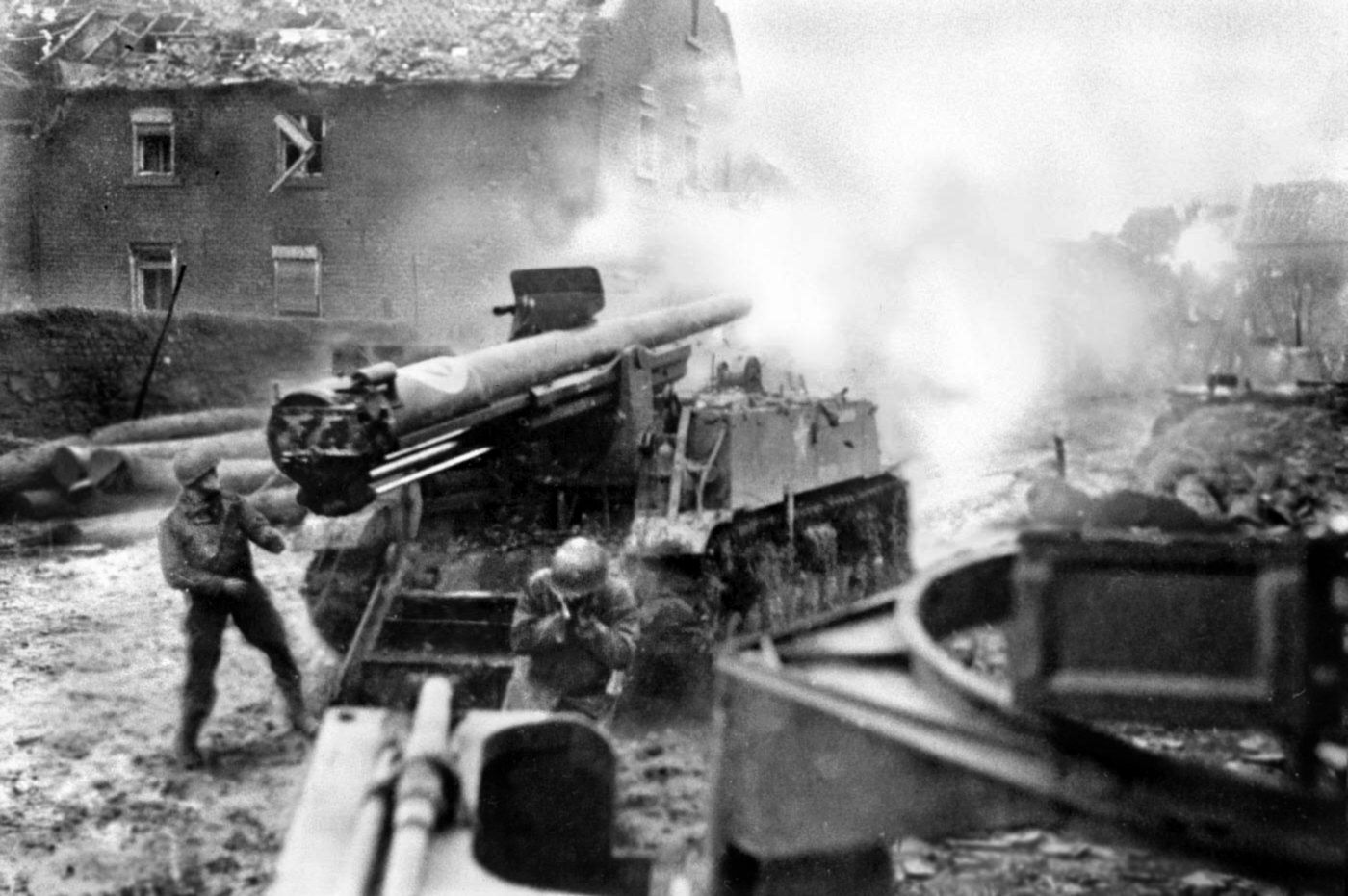
When enemy bunkers supported one another, the technique was to bring up a “Long Tom,” a towed 155mm howitzer, and blast away. The concussion was sufficient to bring down walls already weakened by bombardment. A hit by its 90-pound round against a bunker resulted in massive headaches and bleeding from eyes, nose, and ears for the German defenders, who quickly thereafter surrendered. For the smaller bunkers, infantry identified the vision slits and attacked their enemy’s blind flanks with grenades, stopping only to blow up obstacles and for the engineers to clear mines. This method of overcoming hardened urban defenses became known as the “Knock ‘em all down” approach, coined by Lt. Col. Derrill Daniel of the 2nd Battalion, 26th Infantry Regiment.
Forward observers riding on Shermans called in suppressive fire and the steeple on the Salvatorberg exploded in a gray cloud of debris as the first 76mm tank rounds and artillery in direct fire mode reduced the German observation post to a mound of dusty rubble.
To the right of the tanks, the 3rd battalion, 26th Infantry, Lieutenant Colonel J.T. Corley, commanding, infiltrated L Company into the Quellendorf Hotel tennis courts at first light and began clearing the outer buildings. Corley’s own “Long Tom” moved onto a tennis court and began firing on the Quellendorf and the Kurhaus. The rounds poked gaping holes in the façade of the elegant hotel and suppressed the antiaircraft cannon the enemy had assembled piece by piece in the upper floors. The battle increased in tempo as the ripping of machine-gun rounds and the lung-vibrating detonation of tank and artillery fire continued.
Task Force Hogan’s two understrength tank companies pressed on in enveloping wings, their movement commanded and controlled by Hogan’s command Sherman situated toward the rear of the center area of advance. Behind the tank columns, the accompanying infantry heard heavy fighting as Corley’s troops exchanged grenades with the Germans inside the hotel lobby and German infantry holed up in the Quellendorf basement fought tenaciously.
Sherman engines roared as the American tank-infantry teams struggled up the northeastern slope past the smoking ruins of the Salvatorberg church to their left. The top of Lousberg Hill, Objective Red, lay another 200 yards up. The Americans surged over and around the hill, pausing only to mop up a squad of German infantry. Consolidating his command on the hilltop, Hogan called a halt in order to evacuate 15 infantrymen wounded on the move through the town and onto the heights. Two armored half track ambulances moved forward, and medics got to work patching up the wounded troops.

The columns resumed the advance onto the reverse slope of Lousberg and headed downhill with the sinking sun. The final objective, a manor house 200 yards away, Objective Blue, severed the Aachen-Laurensberg highway. Task Force Hogan set up a hasty roadblock to await German counterattacks.
After the day’s loss of ground, Wilck moved his headquarters to a hardened air raid bunker on the Lousberg Strasse. He issued a communique exhorting the remaining German defenders to fight to the death and not yield any ground. Task Force Hogan’s tanks stayed on guard all night with artillery prepared to fire toward the approaches of the Aachen-Laurensberg highway. Unbeknownst to the Americans, the 1st SS Panzer Corps was directed to give up relief of the Aachen garrison.
Dawn gave the Big Red One’s infantry another push into the German garrison’s final redoubt. Lieutenant Colonel Corley called up his 155mm Long Tom and began pounding the air raid bunker. At 10:26 a.m., Wilck disobeyed his own orders to save his eardrums and surrendered. It was October 21, 1944. Brig. Gen. George Taylor, assistant division commander for the Big Red One, accepted the surrender and the ceremonial handing over of Wilck’s sidearm.
The juxtaposition of the overwhelming Allied numerical superiority (100,000 soldiers) against the significantly smaller German defending force (13,000 soldiers and 5,000 Volkssturm) with roughly equivalent casualty figures (approximately 5,000 for each side) vividly illustrates the brutal nature of urban warfare. Despite being heavily outnumbered, the German defenders inflicted comparable losses, highlighting the “meat grinder” aspect of the battle. The high number of German prisoners (5,600) relative to their initial strength indicates that while they fought tenaciously, the eventual encirclement and systematic clearing of the city led to mass surrenders once resistance became futile.
On October 22, Task Force Hogan, released from attachment to the 1st Infantry Division, headed back to Stolberg and into reserve to rest and prepare for whatever came next. Beyond Aachen was Cologne, then the industrial heartland of the Ruhr, and the advance toward Berlin. However, Hitler had one last ace up his sleeve on the other side of the Ardennes Forest, and the Battle of the Bulge was only weeks away.
William R. Hogan is a fourth-generation U.S. Army officer who has served across the world from Bosnia to Haiti and Afghanistan. He is the youngest son of Colonel (Ret.) Samuel M. Hogan and the author of Task Force Hogan: The World War II Tank Battalion that Spearheaded the Liberation of Europe.
Join The Conversation
Comments
View All Comments