By Darren Neely
Hundreds of American professional baseball players gave pause to their promising careers to step up to the plate for their country during World War II.
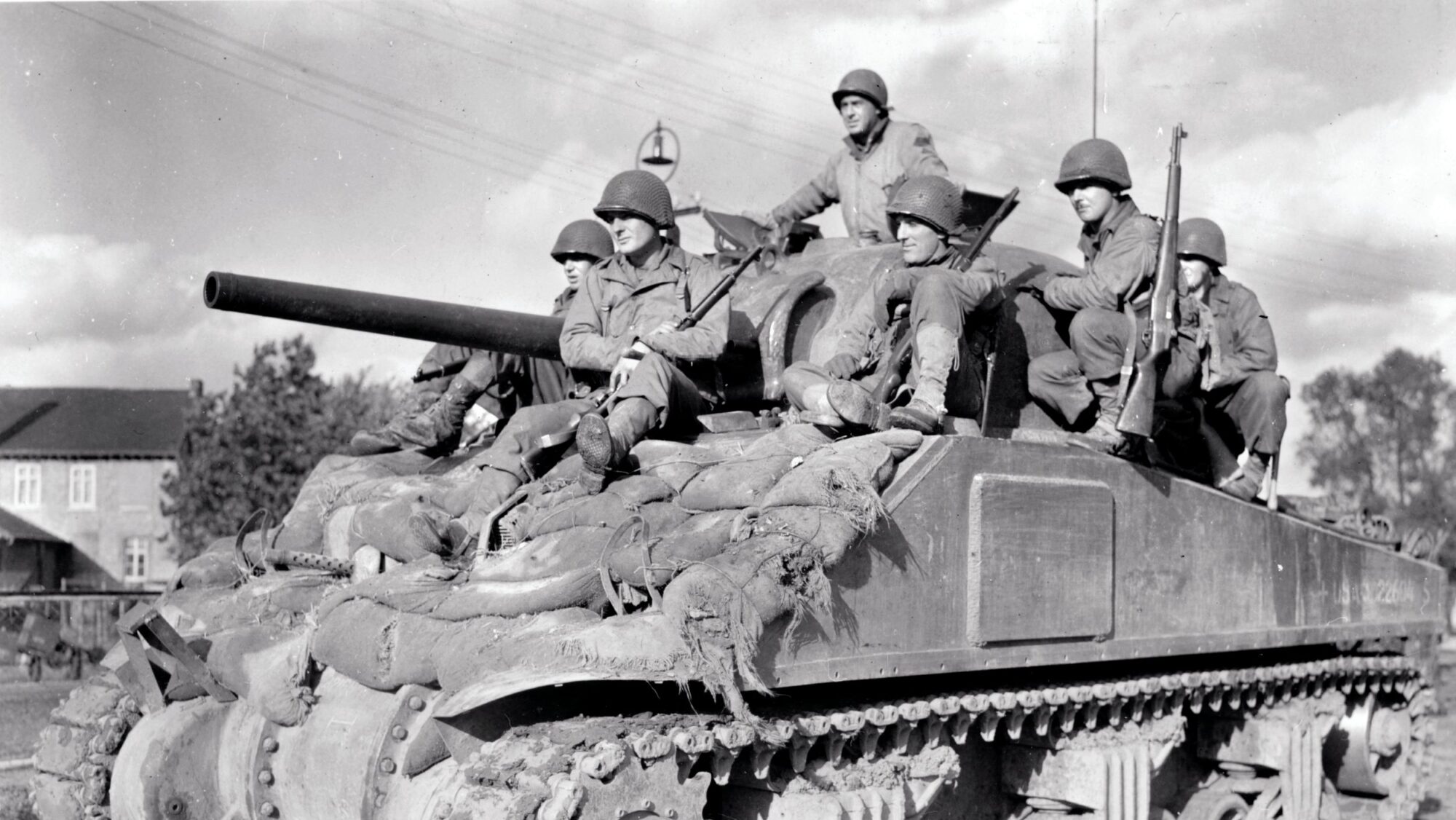
Whether they made the ultimate sacrifice or received career-ending wounds, many of those men would never step up to the plate again. George Tweedy Stallings Jr., son of the famous baseball manager, was one of them. He had embarked on a promising baseball career before serving his country in a tank unit of the 3rd Armored Division (Spearhead) in the war. In the European Theater of Operations (ETO) during World War II, the 3rd Armored Division was one of, if not the finest, fighting units of the U.S. Army.
The 3rd Armored fought in almost every major engagement in the ETO—except the Normandy invasion. But they were constantly at the forefront of the advance of the Allied armies as they made their way from France to the Elbe River in Germany in 1945. Stallings was wounded several times during and received some of the highest military awards for his meritorious service.

Stallings Jr. was born on February 4, 1918, in Haddock, Georgia, roughly halfway between Macon and the old state capital of Milledgeville. Before he became famous as the manager of the “Miracle Boston Braves”—5th place in 1913 to World Series winners in 1914—the elder Stallings had been a pro baseball player in the 1890s. He had a 34-year career as a manager, including 13 in the majors. His son grew up around baseball. The Braves, and later the minor league Rochester Tribe, came down to Haddock for the spring training on his father’s peach farm.
The athletic 6’3” younger Stallings played first base for the University of Georgia and signed with the Chattanooga Lookouts of the Class A1 Southern Association after graduating in 1939. After only four games with the Lookouts, he was optioned to the Class B South Atlantic League’s Spartanburg Spartans, where he batted .211 in 43 games. He would play in 28 games in the Class B Southeastern League, batting .244 for the Selma Cloverleafs.
Stallings, who had served in the Reserve Officers’ Training Corps (ROTC) at UGA, entered active military service as a 2nd Lieutenant on February 4, 1941, joining the 3rd Armored Division when it officially formed that year. At Camp Polk, Louisiana, in 1942, 2nd Lieutenant Stallings was placed in command of Company D, 33rd Armored Regiment, which he held until September 1944. The division then went to California’s Mojave Desert for training and on to Camp Pickett, Virginia, in October 1942. The division was stationed at Indiantown Gap, Pennsylvania, in January 1943, where Stallings, now a captain, was placed in charge of the baseball program because of his playing background.
In September 1943, Stallings arrived in England with D Company, 33rd Armored Regiment, 3rd Armored Division. Company D was part of the 2nd Battalion, 33rd Armored Regiment under the command of Lt. Col. William Lovelady, whose name a subsequent task force would bear later in the war. In England the unit would continue to master its craft through constant field training, combined tank and infantry exercises on the firing range, and the maintenance and upkeep of their vehicles in preparation for the invasion of Nazi-occupied France.
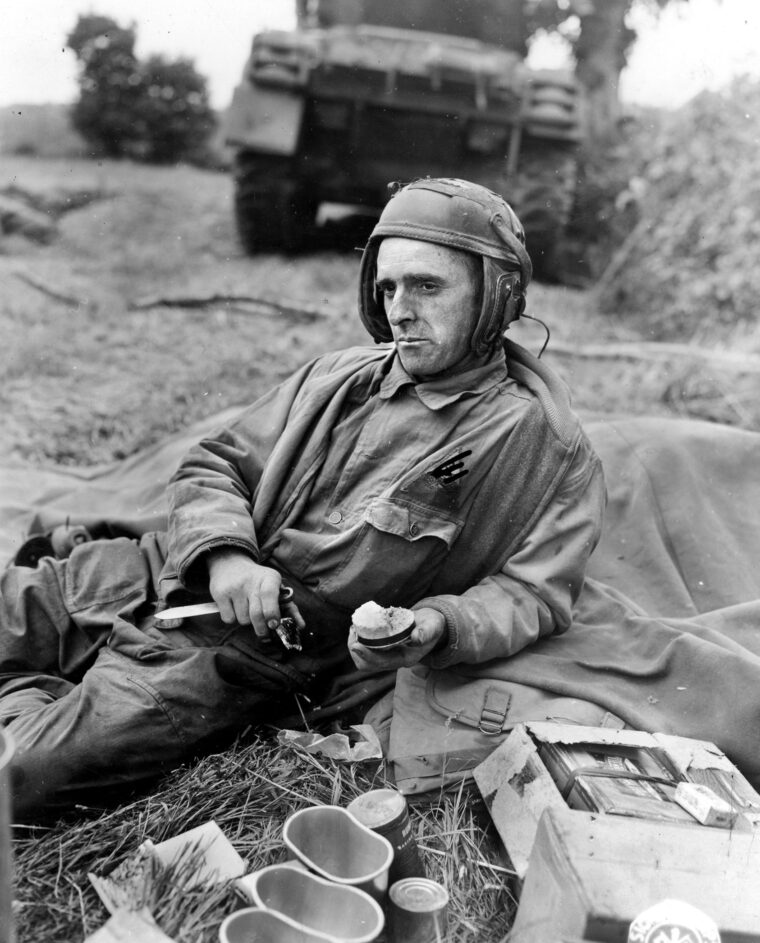
The 3rd Armored Division was ready and eager to join the fight in Europe after the Normandy invasion of June 6, 1944. On June 22, Stallings and Company D departed Portland Naval base, Dorset, aboard LCTs for Omaha Beach and anchored until low tide to disembark vehicles around 2205 hours on June 23. The 2nd Battalion, 33rd Armored Regiment was made up of two companies of M4 Sherman medium tanks (D and E) one light tank company of M5A1 Stuart light tanks (B) in addition to battalion headquarters and support units for a total task force strength of 27 officers and 517 enlisted men.
On July 7, the 2nd Battalion was given orders as part of the 33rd Armored Regiment, Combat Command B to cross the Vire River at Ariel and pass through the 30th Infantry Division bridgehead to seize ground near St Gilles. Intelligence reports showed that German forces in the area consisted of a battlegroup from the 275th Infantry Division along with elements of the 2nd SS Panzer and Panzer Lehr Divisions.
Launching their attack on July 8, Company D met a German tank thrust of the 2nd SS Panzer Division near Saint Fromond. In this initial action Stallings showed his unit the type of leader he was, and he received the Distinguished Service Cross (DSC) for his actions on July 8-11, 1944. The citation reads in part: “Major Stallings’ tank company was spearheading a drive upon a major objective near Les Hauts Vents in Normandy. Time after time, in the confusion of the intense fighting and under heavy enemy fire, he left his tank to make a personal reconnaissance on foot to employ his tanks more effectively. On July 8 near St. Fromond because of his superior knowledge of the situation and skillful direction of his tanks, Major Stallings succeeded in destroying five Mark IV tanks and reducing a pillbox, thereby permitting his task force to continue its advance.”
Further, the forward observer from the accompanying 391st Armored Field Artillery Battalion was wounded on July 10. Stallings unhesitatingly assumed his place and succeeded in directing intense artillery fire which destroyed another tank and two antitank guns and inflicted heavy losses upon enemy infantrymen. But Stallings wasn’t finished with his heroics.
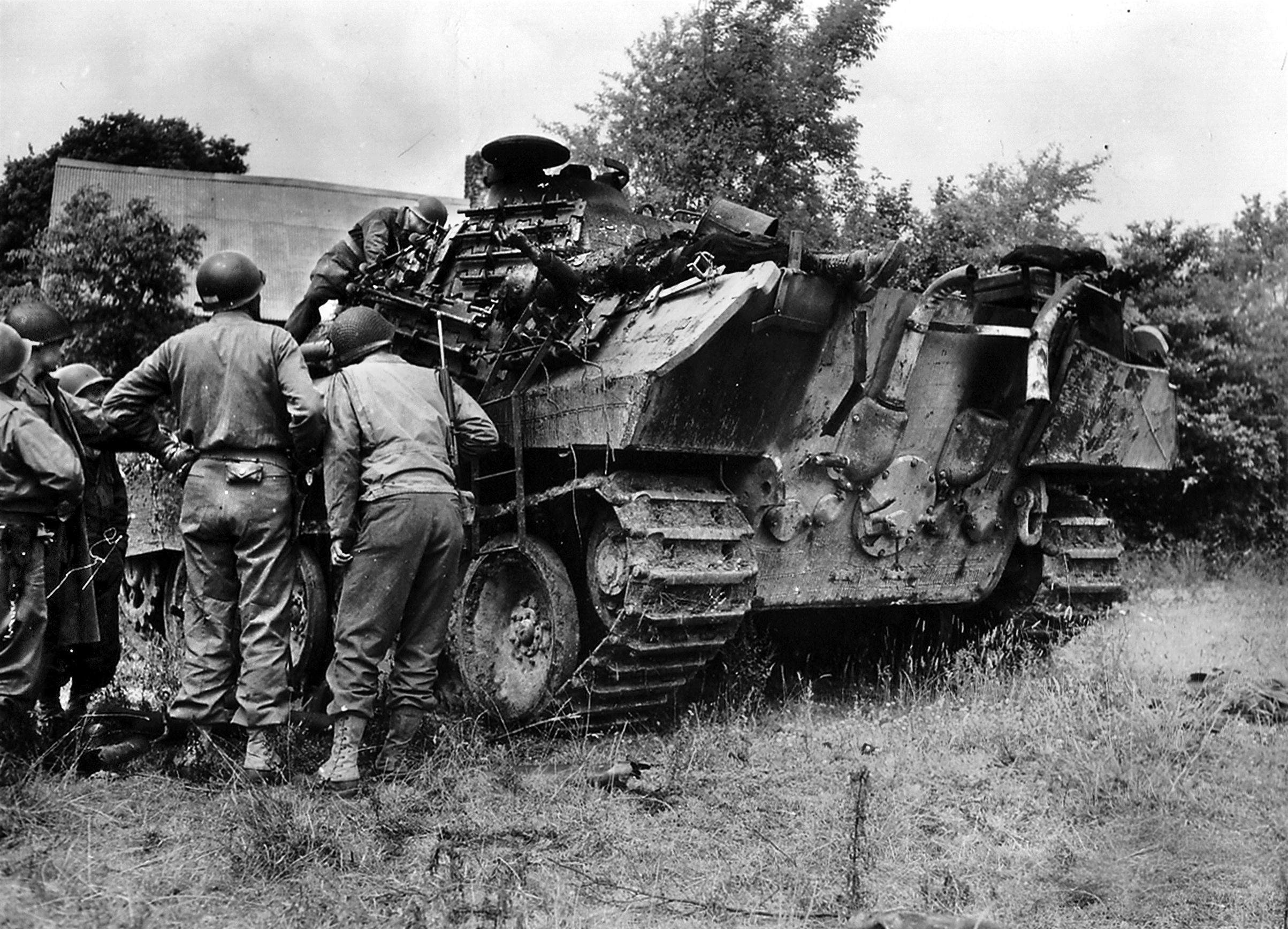
During the night of July 11, while he and his tank were returning to the front lines, they were attacked by a German tank hunting party supported by a halftrack with a mounted flamethrower. Stallings and his crew were forced to abandon their tank as it and part of the crew were on fire. Sgt. Charles Lewis and Technician 4th Grade Mac Humphrey were killed. Stallings jumped from the tank, rolled on the ground, put out flames, and then played dead for about an hour before he escaped to friendly lines. Two other crewmen, Technician 4th Grade Wiliam MacLain and Corp. Herbert Miracle, also made their way to friendly forces. Stallings earned his first of three Purple Hearts for his wounds.
The eulogy for Stallings written in 1970 after he died summarized these actions best. “This was the first of a long series of examples of his leadership, devotion to duty, courage, and cool-headedness. Rightfully he was awarded the DSC for his bold action. The night was dark as his tank returned alone towards the front lines following an officers meeting. Without warning a mass of fire belched down the hatch and all its occupants scrambled out looking like human torches. The acrid fumes of asphalt filled the air and they realized that they had been attacked by flame throwers. Stallings threshed the flames from his burning clothes and body ending up head downwards in a deep wet ditch. Guttural voices of the German tank hunting patrol warned him to simulate death. Not daring to move, scarcely breathing and with the pain of second degree burns on his forehead and arms, he lay motionless. The intruders gathered around talking and examining their prize. After approaching Stallings and deciding he must be dead, their voices eventually dissolved in the chill night air. The captain alternately ran, crawled, and walked back to the vicinity of the command post. He arrived at dawn, covered with black asphalt spots in his hair, face and uniform. He refused to be evacuated even though his eyes burned like fire. He remained on duty and retained his suggestion of cool dignity which was to hold the respect and admiration of all who fought with him during the bitter months which followed.”
On July 14, Ted Malone, a famous reporter for NBC Westinghouse, came upon the men of Task Force Lovelady. Malone noted that Stallings recounted his story to him with calm and a sense of ease that would typify his leadership. Malone noted, “It all sounded so easy there the other afternoon as Captain Stallings perfectly okay now sat peeling an orange and telling what happened. It was just a job. He had done his like the rest of the fellows did theirs.” It was this type of action by Stallings that quickly endeared him to his men. Tanker Louis Baczewski noted, “Men held the highest regard for officers like Stallings, he led from the front, faced the same dangers as their men, day in and day out. He weighed his decisions on the real costs in lives as he was always with his men and trying to survive the same elements.”
An unfortunate event on August 17 changed the course of Stallings’ future with Task Force Lovelady. Maj. John Crosby, the executive officer for the 2nd Battalion, 33rd Armored Regiment/Task Force Lovelady was killed with a platoon leader from Company E near Fromental while performing a reconnaissance mission. In just a few weeks Stallings was moved from his company command to serve as the executive officer for the 2nd battalion. However, before moving to the battalion, Stallings earned yet another distinguished award.
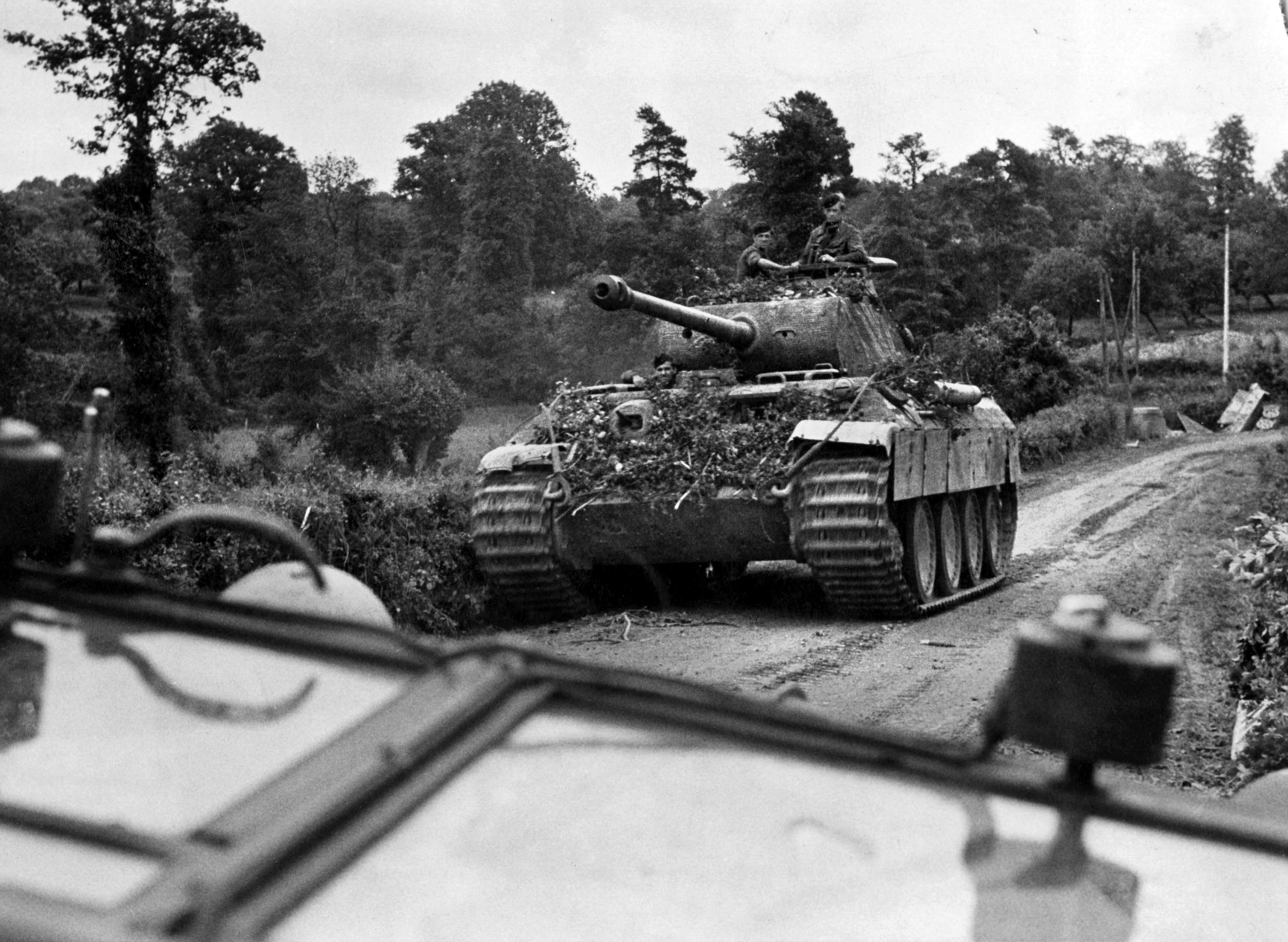
For his actions around Le Fresnay, France, Stallings was awarded the French Croix de Guerre. On August 18, Task Force Lovelady had the mission of securing the surrounding high ground. Shortly after jumping off, the attack bogged down within sight of the objective due to heavy enemy opposition consisting of tanks, machine-gun nests and snipers. The terrain was difficult for tanks, and the route to the objective was analyzed. Stallings, still commanding Company D, went forward on foot, contacted the leading elements of infantry and tanks, and formulated a plan of attack. He then personally led the attack on foot in the face of enemy fire until the objective was taken. A number of tanks became mired down in the boggy terrain, and when the objective was reached Stallings only had one tank left along with roughly two platoons of infantry. His personal bravery and fearless leadership were an inspiration not only to the men of his command but also the supporting infantry. At least seven German tanks were knocked out by his company from August 16-18.
Stallings officially became the executive officer of the 2nd Battalion (Task Force Lovelady) on September 6, 1944. Even in this role, Stallings still took care of his men from Company D and led them from the front. Sergeant Cady from his old company got in trouble with a new platoon leader in the fall of 1944, and Stallings had to intervene. He admitted to Cady, “The new officers didn’t know anything but you can’t talk to them like that.”
Task Force Lovelady and Stallings’ previous company faced tough action once they crossed the German border near Roetgen after speeding through France and Belgium amid the closing of the Falaise Gap. Once they crossed the Siegfried Line on September 11, they faced stubborn and prepared Germans entrenched and defending their homeland from bunkers, well positioned antitank guns emplacements, and artillery positions. They became the first Allied unit to capture a German town two days later at Roetgen. For the rest of September, American advances were measured in yards versus the miles they had covered in the late summer as they raced across France into Belgium. The two-week period until they were pulled off the line at the end of the month saw extremely high losses in tanks and men, especially the valuable veteran tank commanders and platoon leaders that had formed the cadre of the tank companies.
The U.S. First Army—including the men of Task Force Lovelady—launched an offensive on November 16, 1944, to take the towns of Werth, Hastenrath, and Scherpenseel east of Aachen, Germany. A stubborn German defense and extensive minefields caused horrific losses in tanks for both Task Force Lovelady and Task Force Welborn, its sister unit on its left. Stallings escaped unscathed, but the tank companies lost 26 tanks out of 48 that started the operation. The men of the task force tried to rest for the next four weeks and prepare for the holidays, but Hitler’s winter Ardennes offensive rudely changed their plans.
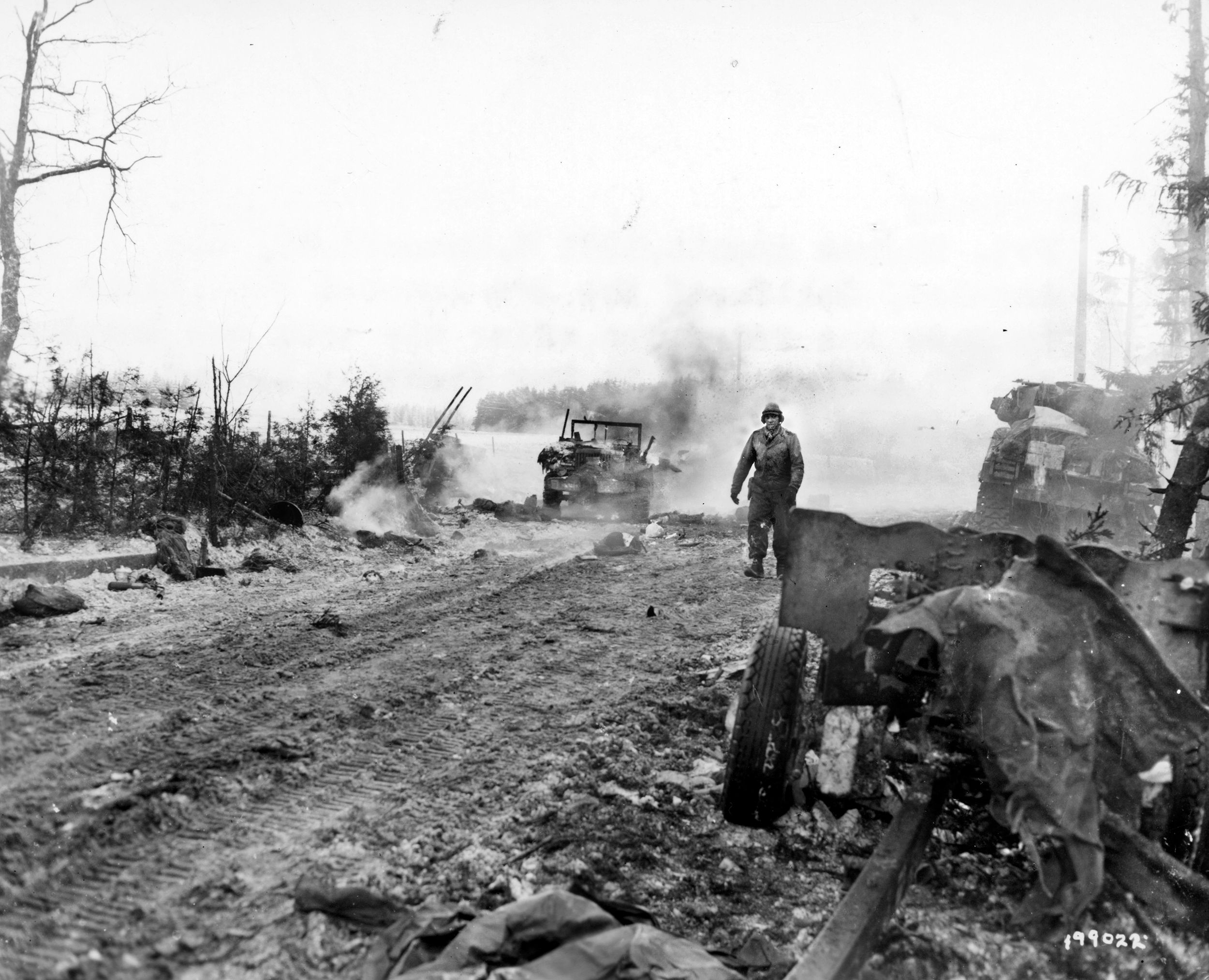
In response to the German attack in the Ardennes, the 3rd Armored Division was alerted to move to the forest and blunt the attack and then prepare for a counterattack to push the Germans back. On December 19, Task Force Lovelady left Eschweiller and went to an assembly area just outside Spa, which had been the headquarters of the First Army. Task Force Lovelady was ordered to clear the highway between La Gleize and Stavelot. On December 20, they jumped off and passed through the 30th Division with the objective of capturing Stavelot to the south. When they had advanced about half a mile, the leading vehicles met a column of German artillery along the road. It was the tail end of a unit of the 1st SS Panzer Division. The Germans did not fire a single shot at the Americans, and the task force was able to capture a couple of artillery pieces and some vehicles.
The task force started out again for Trois-Ponts, where they turned at the town to make their way to Stavelot, but about a mile after passing Trois-Ponts they encountered a German column crossing the river in front of them. The Germans had six or eight tanks and antitank guns guarding the bridge. The first and last tanks in the American column from Company E were knocked out, trapping the others. After the smoke cleared, four M4 tanks were knocked out. The Company E commander, Lt. Albert Hope, was killed and two other lieutenants were wounded.
Lieutenant Colonel Lovelady then ordered the task force to retire to Trois-Ponts and set up roadblocks from there up past the town of Petit-Coo. The task force was then split with Company E, which had been leading, was pulled out with elements of Company E of the 36th Armored Infantry, to man the roadblocks with Stallings in command. Meanwhile, D company and other task force units would attempt to make their way east toward Stavelot. Task Force Lovelady’s job was now to cut the Stavelot-Stoumont road, forming the left side of a vise to squeeze Kampfgruppe Peiper which had been cut off in La Gleize. In addition, the light tanks of Company B and the aid station were placed at Petit-Coo. Radio communications were located at the Grand Coo railway station to relay messages to Stallings since the hills were blocking radio transmissions between him and Lovelady.
On December 21, Stallings’ old Company D made its way toward Stavelot with attached infantry from the 30th Division along with elements of the 391st Armored Field Artillery. The force could only get as far as the small village of Parfondruy before it was quickly discovered that elements of the 1st SS Panzer Division’s Kampfgruppe Knittel had recently passed through the town, executing over 20 Belgian civilians in cold blood, then burning several barns where the civilians had been forced to gather. [The exact number of civilians executed by Peiper’s troops in Parfondruy, and other nearby areas, is unknown.]
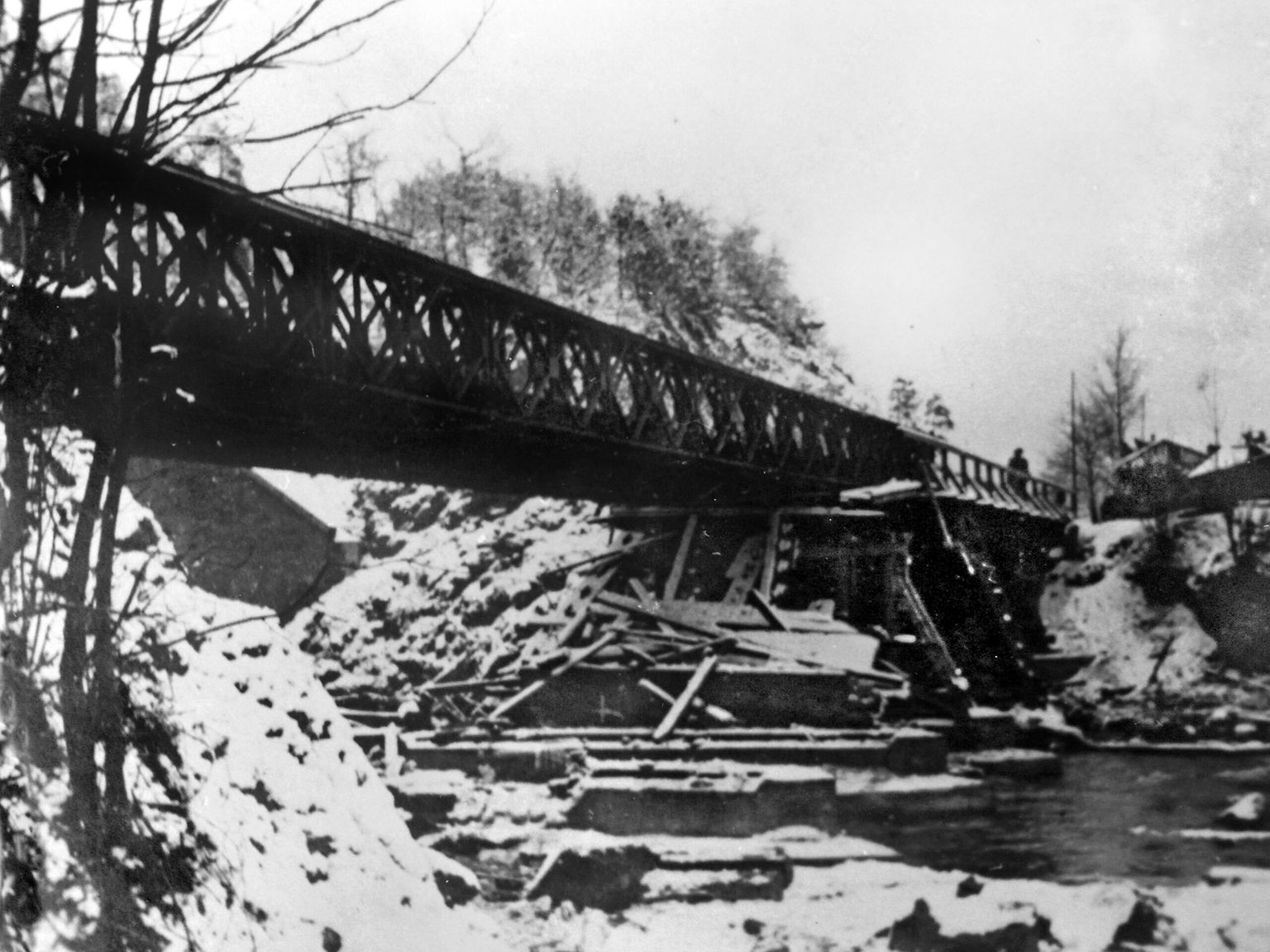
The Germans were desperate to break through the vise that Task Force Lovelady held north of the Ambleve River, keeping them from reaching Kampfgruppe Peiper at La Gleize where Task Forces Jordan and McGeorge of the 1st Battalion, 33rd Armored Regiment were battling Peiper. The Germans cut the road linking to Company D and the units under Stallings’ command on December 22. Elements of the 1st SS Panzer had crossed the Ambleve River on a footbridge, bypassed Stallings’ tanks and attacked the American troops at Petit Coo. The two battle groups of Lovelady were completely cut off, and only the river prevented them from being surrounded. By utilizing every bit of their own firepower along with the close artillery support offered by an 82nd Airborne unit, the main fighting elements of the task force held their ground.
With a unit of the 30th Infantry joining the light tanks and what few medium tanks were available, TF Lovelady was able to retake Petit Coo, establish contact with the battle groups, and send the remnants of the Germans back over the hills and across the Spa River on December 23. Stallings reported that they had a good time fighting the counterattack and felt that they could kill more Germans when they were attacked on three sides than when they could fire in only one direction. Stallings and TF Lovelady would pull out of that area and move to Melreux and Ny where they established defensive positions, celebrated Christmas, and prepared for the American counterattack that would come after New Year’s Day.
At the onset of the planned 3rd Armored Division counterattack on January 3, 1945, TF Lovelady was equipped with 27 medium tanks and 12 light tanks. A battalion from the 330th Infantry Regiment, 83rd Infantry Division was attached for infantry support. Lieutenant Colonel Lovelady was relegated to Combat Command B headquarters with pneumonia, leaving Stallings in command of the task force. Malempré was their first objective and, as there were no real roads in this area, the tanks were forced to maneuver through fire break trails. The task force would be facing elements of the 2nd SS Panzer Division and the 12th Volksgrenadier Division.
After reaching Malempré the night of January 3, the task force continued in the harsh conditions the next day. The advance out of Malempré was uphill, and the enemy had excellent observation of the American tanks as they attacked uphill on slippery ground. The task force quickly lost a tank in a minefield and then another to an anti-tank gun.

In an interview at the 112th General Hospital later in the month, Stallings noted that the route was so slippery and the tanks were having such great difficulty that he sent the infantry to flank the road and eliminate the opposition. They cleared the minefield at night to a width of 30 feet, and it was the thickest minefield he had yet seen. It took them a day and a half to get across that point of resistance.
The next objective was the town of Fraiture. Due to the icy road conditions, the tankers put “grousers” (steel track extenders added for better traction) and waited for the 391st Armored Field Artillery’s targeted artillery barrage on the village. After an hour with no artillery, Stallings called the tanks and said they couldn’t wait any longer and to advance. It was then that the shells began falling—1,000 yards short of their target. Frantic radio calls to the 391st to cease the fire prevented a disaster. The task force had good observation, so they decided to use the artillery and make a dash for the town. They did so, and not a shot was fired while they occupied the town. There were only about 25 houses, but they captured more than 400 prisoners who were packed in like sausages. The tankers also captured a battery of 75mm artillery, 4 120mm mortars, and 4 assault guns and killed 57 Germans.
As the task force settled in on January 6, they were joined by the NBC correspondent Gordon Fraser, whose typed draft for his radio show painted a very dramatic and “you are there” account of Stallings and his command post during these days. Riding in a medical halftrack before the break of dawn, he went to the most forward positions to talk with the men who were killing Germans and to watch the evacuation of wounded from the places where they first fell.
A supply sergeant had just come back from the front with Stallings at Fraiture and noted that the tankers needed supplies but the only way to get there was by halftrack, so Fraser joined him on the next trip and they stopped at the task force aid station. While there, a call came over the radio that a tank and tank destroyer had been knocked out and the medics were called for aid. Fraser joined them. The driver of the medical halftrack arrived and said things were getting pretty hot up at the front as Stallings and the task force were beginning to move toward Regne on January 7. Fraser overheard the Combat Command B commander, General Boudinot, tell Stallings on the radio, “You have to take the high ground tonight!”

As Fraser arrived at the task force command post, he wasn’t surprised to find that Stallings was at the front with his troops and he had just missed the officer by five minutes. Stallings called on the radio to the CP and said, “I’m going to send little babies, others are not in good shape.” It was explained that four medium tanks had just been knocked out and Stallings was calling for the light tanks. Lieutenant Columella, the reconnaissance leader for the task force, arrived at the command post followed by a Sergeant Policy who now had three halftracks full of supplies for the tanks. He lamented that the roads were covered with mines everywhere, but luckily the engineers had built log roads to bypass the mined areas. A tank driver let Fraser know that it would take about 45 minutes to drive a couple of miles to where Stallings was currently leading the tanks into battle. Fraser made his way back to the task force aid station and when he got there he was surprised to be asked if he had Stallings with him because he had been hurt. Minutes later a jeep driven by Lieutenant Columella showed up with Stallings slumped over the seat badly wounded.
Stallings recalled the instant he was wounded near Regne on January 7 and earned his first oak leaf cluster to the Purple Heart. In a hospital interview, Stallings recalled that, “at 10 o’clock we arrived in Regne and established communications with the other task force coming up. I was standing beside my jeep, talking with the commander of the other task force by radio, when a sniper picked me off from a house. A bullet went through my chest and came out my back. It knocked me down but I was not unconscious. It was a very strange feeling when I found that I was breathing through a hole in my back rather than through my nose or mouth. I was very scared and did not take part in any activity. I was given attention very quickly as my medics were nearby. Then I was put on a jeep in a litter and taken to the rear. Due to the poor condition of the trail over which we had advanced, it was several hours before I reached the aid station, but I was more scared than uncomfortable on the way. When I reached the aid station, I was given a drug to induce sleep and I remember nothing further.”
Stallings’ Distinguished Service Cross had been formally approved on January 2, 1945, and on the morning of January 7, General Boudinot had radioed him a congratulatory message, noting a ceremony would be held once things cooled down. The serious wound would force Stallings to wait until April 30 to receive the medal from VII Corps commander Lt. Gen. J. Lawton Collins. However, true to his fighting spirit and wanting to be there for his men, Stallings would return to the division and not take advantage of lighter duty offered because of his wounding.
Stallings was no longer with TF Lovelady, but on April 6 took command of the 1st Battalion, 33rd Armored Regiment of TF Welborn. He wasn’t far away from his old unit for these last few weeks of the war. On April 11, while Lovelady attacked the southern half of Nordhausen concentration camp, Stallings and his force attacked to the north against minimal opposition, and the area was secured. Stallings and his men were appalled at the camp and the condition of the Jewish prisoners they found in the Nordhausen area. On April 20, after receiving minor wounds to his face and thigh from an artillery shell, Stallings would receive his second oak leaf cluster to his Purple Heart, ending his tally for the war at a Distinguished Service Cross, Croix de Guerre, and three Purple Hearts.

In the late summer of 1945, Stallings was promoted to lieutenant colonel and became executive officer of Combat Command B. In just a year, Stallings had gone from a tank company commander to the second in command of an entire combat command. The wounds he suffered would prevent him playing professional baseball ever again, but his legacy was not to be made on the baseball diamond. Rather, it was gained on the battlefields of Europe.
Lieutenant Colonel Stallings returned home to Haddock in late September 1945, and married Evelyn Juhan Neel, a captain in the Women’s Army Auxiliary Corps (WAAC) who had earned a Bronze Star in April 1946. They had two daughters and a son. In keeping with the military tradition of his father, George Stallings III served as a helicopter door gunner in Vietnam and was awarded the Distinguished Flying Cross. “It’s another war and another part of the world, and another George T. Stallings has been decorated for heroism above the call of duty,” a local newspaper noted.
After the war, Stallings served in the Army Reserve in Macon, reaching the rank of colonel by his retirement in 1969. He died from congenital heart failure in 1970. Shortly after his passing his wife received a letter from one of his former sergeants, Frank Spinali, who said, “George and I were in many battles, and I mean real tough ones, but George made me feel like we were strolling through a nice quiet park on a Sunday afternoon. He was one great guy and a great commander.”
Colonel Dorrance Roysdon, commander of Combat Command B when Stallings was nominated for the Distinguished Service Cross, wrote at the time of Stalling’s passing, “He was one of the finest men I have ever known. He was the best and most reliable company commander that served in my command during the war. When the going was tough, I knew that George could be depended on to do a superb job.”
Darren Neely is a military historian and author of The Forgotten Archives: The Lost Signal Corps Photos series, Photo Studies of Operation Nordwind, Battle of the Bulge Weapons, and The Pictorial History of the 3rd Armored Division. He is currently working on a complete history of Task Force Lovelady of the 3rd Armored Division in World War II. He is employed by the federal government and resides in Annapolis, Maryland.
Join The Conversation
Comments
View All Comments