By Michael A. Flexsenhar III
Second Lieutenant Erving L. Peterson led a seven-man reconnaissance patrol along the coastal road out ahead of the 158th Infantry’s main column. It was early in the afternoon of January 12, 1945, a warm, clear day with a fresh breeze blowing from the north. The waters of Lingayen Gulf were calm as the surf gently lapped the nearby shore.
The patrol travelled light: weapons, maps, water, and demolition charges. How long their mission would take, they didn’t know. How many enemy were in the area, they weren’t sure. They were told to follow the road, keep moving north, until they met their objective—a Japanese ammunition dump which they were also to destroy, if possible.
The patrol passed barrios, small clusters of bamboo shacks, which were indistinguishable on their maps. To the right of the road fields, interrupted by an occasional copse, stretched across the landscape until they reached a series of razorback ridges that rolled up into the hills and on to hazy mountain tops from where the Japanese fired artillery and mortars onto the 158 Infantry.
The patrol soon spotted a more substantial settlement at about 1500 and Peterson halted the patrol. The village seemed to be deserted. Train tracks ran up to a large brick building with Romanesque arches, clearly a rail station. Beside the station the patrol could make out the ordnance lined and piled in a substantial ammunition dump. They counted 13 Japanese soldiers guarding the ammo dump. Outnumbered, two to one, Peterson had a decision to make.

Japanese artillery and mortar fire northeast of Lingayen Gulf on the Philippine Island of Luzon had slowed the progress of the U.S. 6th Army for days. Gen. Douglas MacArthur, Commander-in-Chief (CINC) of the Southwest Pacific Command, was growing impatient with 6th Army commander Gen. Walter Krueger. MacArthurwanted speed. The 6th Army’s amphibious landings at Lingayen Gulf on January 9 had been unopposed. The U.S. 6th Army, made up of I Corps, commanded by Maj. Gen. Innis Swift, and XIV Corps, commanded by Lt. Gen. Oscar Griswold, had landed four total divisions, established beach heads, and quickly fanned out. Manilla, the capital of the Philippines, was only 120 miles away on the flat coastal plain and MacArthur wanted it liberated as quickly as possible. The outcome of the campaign, not to mention the lives of Filipinos, depended on it. After his humiliating nocturnal exodus from Corregidor in April 1942, after years of struggle and thousands of miles of fighting, redemption was now nearly in MacArthur’s grasp. What was the holdup?
The plan for the invasion of Luzon, code named MIKE I, was for Swift’s I Corp to hold the left flank and allow Griswold’s XIV Corps to sprint to Manilla. But by January 11, only the far left of 6th Army’s front, I Corps, had encountered significant Japanese resistance. Harassing artillery from positions along the Damortis-Rosario road was the problem. The I Corps was “having a tough time with shelling,” Griswold wrote in his diary. Cautious and plodding, Krueger feared a Japanese counterattack was brewing to his northeast. Swift’s I Corps, Krueger reasoned, was holding a tenuous left flank that protected the entire Lingayen beachhead. Krueger wouldn’t risk overextending his forces. The enemy in the northeast had to be addressed first and MacArthur begrudgingly relented.
To plug gaps in I Corps’ expanding front and ensure his far left flank was covered, Krueger decided to commit his reserves. On the morning of January 11, 1945, he sent ashore the 158th Regimental Combat Team (RCT).
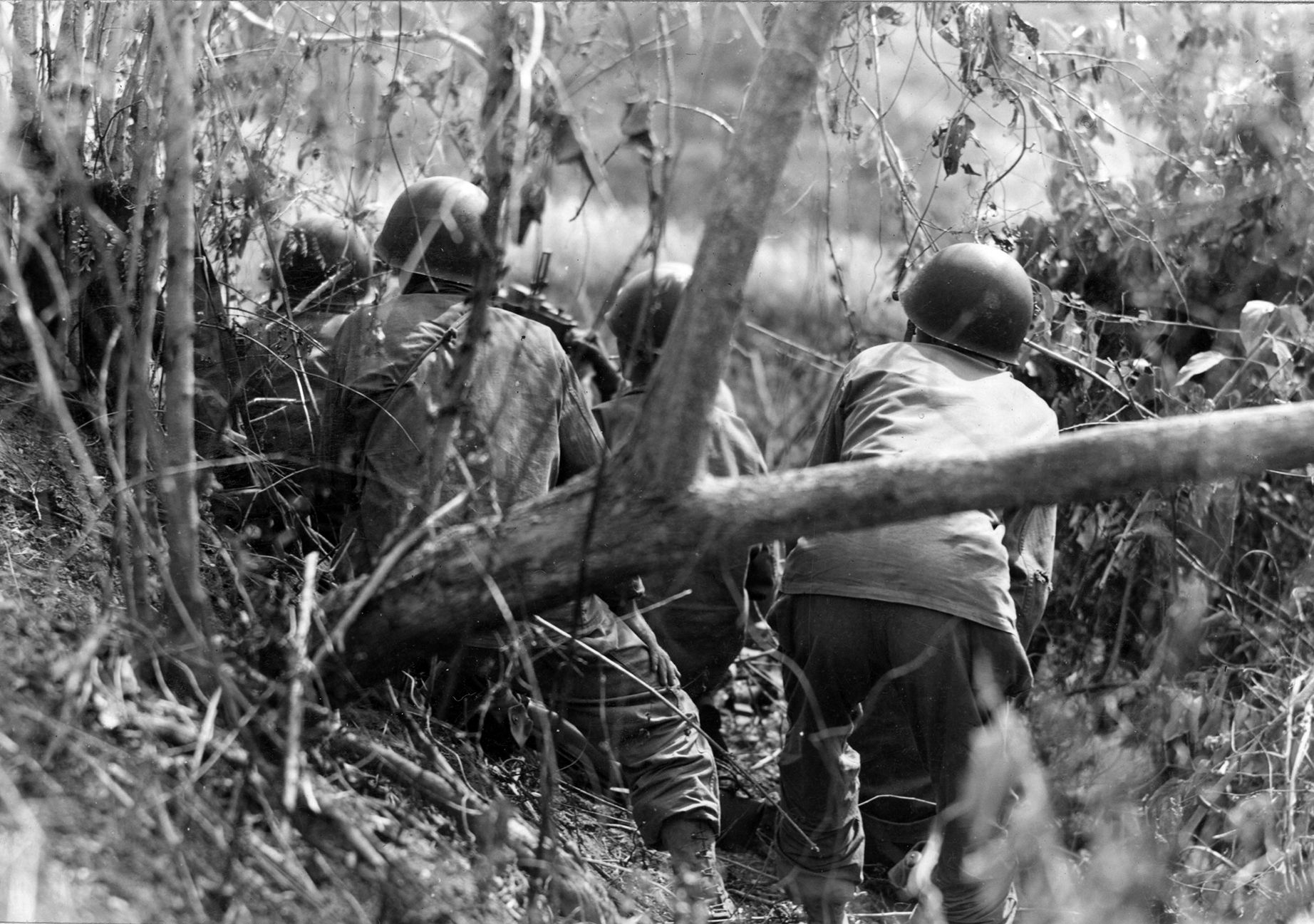
The 158th RCT was commanded by the former Acting Secretary of War and America-first isolationist, Brig. Gen. Hanford MacNider. The 158th RCT comprised three battalions of the 158th Infantry, totaling a few thousand men, plus the 147th Field Artillery Battalion, medical corps and auxiliaries. All together the RCT made up an independent “baby division” of about 4,500 men. Peterson’s infantry unit, the 158th, was a motley crew of men from 39 different states, including Native Americans and Mexican Americans. They were known as “Bushmasters” after a deadly pit viper of Panama’s jungles where the original outfit had trained in 1942. Machete-wielding, Judo practicing, close-quarters aficionados, the Bushmasters were Uncle Sam’s jungle warriors.
The 158th RCT’s strategic objective was to clear the Damortis-Rosario road leading East from Damortis to the junction of highways 3 and 11. Meeting this objective would provide I Corps with easy access to the Japanese summer capital of Baguio, where Japanese Gen. Tomoyuki Yamashita, commander of Japanese forces in the Philippines, had established his headquarters. Meeting the objective would also overcome the threat of Japanese counterattack and finally allow XIV Corps to turn south and speed towards Manilla. But first the 158 Infantry had to move North and hold the extreme left flank of the U.S. 6th Army.
Peterson formed up with 2nd Battalion, 158th Infantry on White Beach I at 0945 on January 11. At 1100, 2nd Battalion pushed north to protect the coast road leading north from Lingayen Gulf to Damortis. The Filipinos, who had endured unspeakable horrors at the hands of the Japanese, came out like supplicants paying homage to saints. Filipino men in broad-brimmed buri hats and Filipina women in free-flowing white dresses lined the roads and cheered as their saviors marched by. By 1300, the 158th had made it to Rabon and relieved 1st Battalion, 172 Infantry, of the 43rd Division. The 158th then continued north thousands of yards farther than their A-day schedule.
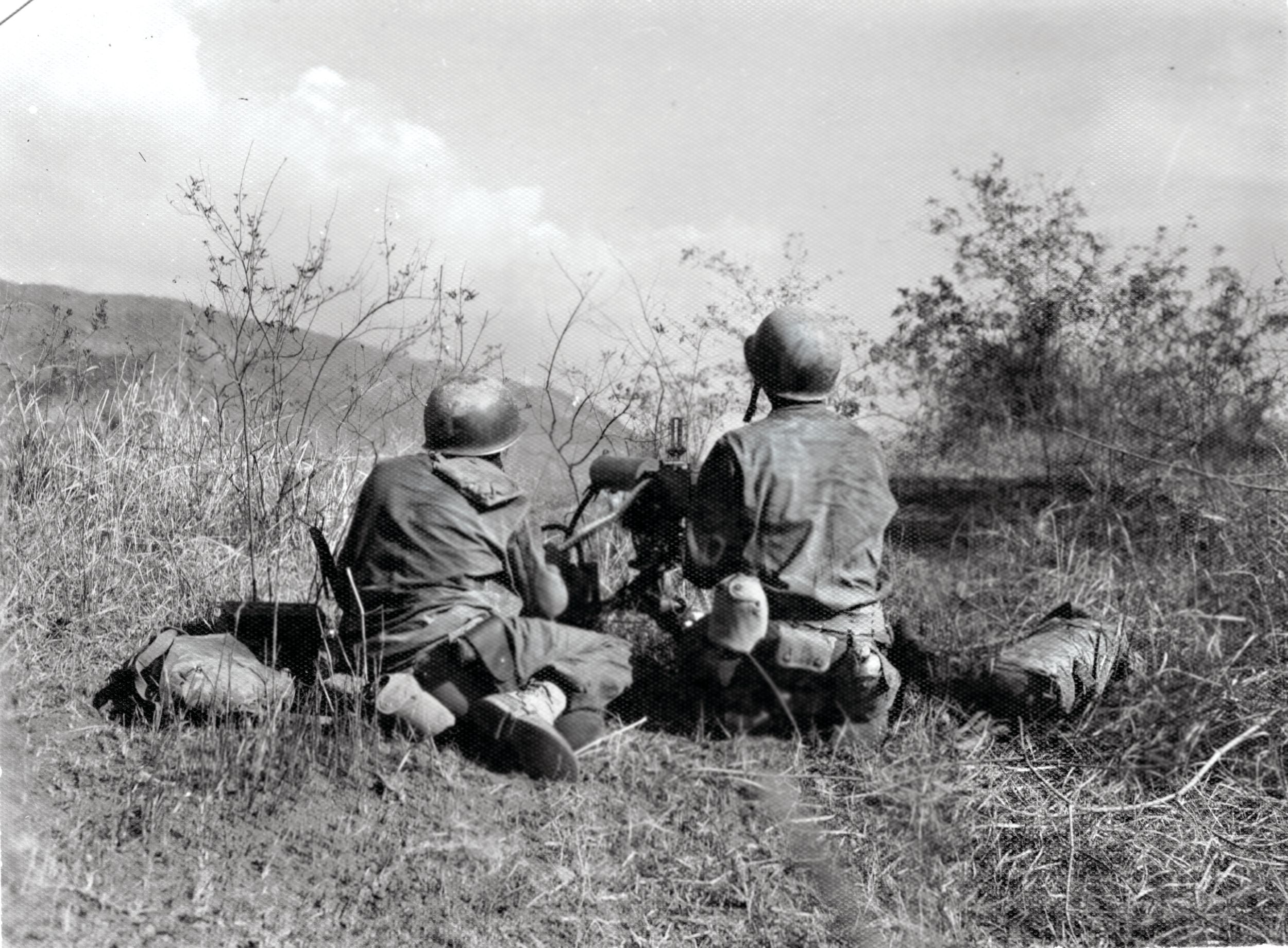
Soon, however, they were met with heavy artillery fire, light machine gun, and small arms fire from the front and from the ridges to the East. “All afternoon Jap artillery and mortar fire was landing on the crest of the hills across the road about 700 yards away,” wrote Maj. William Garlic of the Third Surgical Hospital attached to the 158. The 158th Infantry took up positions astride the road: 2nd Battalion was in the van, 3rd Battalion outposted on the right flank, and 1st Battalion assembled just south. Heavy artillery continued falling. By 1400 the 147 Field Artillery was in position between the 3rd and 1st Battalion and was registering their fire by 1700. But progress had stopped. The 158 was pinned. They began digging in for what would be a long night.
At the RCT command post north of Rabon, the curtain of Japanese shellfire drew closer and closer, encircling the post and hitting men in neighboring foxholes, wrote American Legion correspondent Boyd Stutler. At dusk on January 11, casualties started arriving at the Third Surgical unit with shell fragment wounds. “There was enough to keep us busy most of the night,” Garlic wrote. It was “one of the most harrowing nights I have ever spent on the battle lines,” Stutler said.
While American casualties were still light, resistance was stiffening. And few experiences felt more helpless for the infantryman than artillery raining down from the heavens, each shell screaming and each soldier hoping it wasn’t meant for him. The guns of the attached 147th Artillery Battalion responded in kind, but had little direct effect except to make noise. On January 12, MacNider summed up the situation in a letter to his wife: “Didn’t get much sleep.”
Intelligence reports started to filter in. A big Japanese ammunition dump was in the 158’s sector, a dump that supplied the menacing enemy artillery. It was a tempting target. But if the dump was where intelligence said it ought to be—somewhere near the Damortis-Rosario road—it would be a difficult target to hit with American artillery or aerial bombing. An infantry unit would need to foot patrol into Damortis in order to confirm, and if possible, destroy the dump. Peterson, a quiet and unassuming 23-year-old from Fergus Falls, Minnesota, volunteered to lead the patrol.

By 1010, advanced elements of the 158th Infantry pressed forward once more with Peterson in the lead. MacNider himself started out with Peterson’s patrol—“a grand bunch of kids,” he called them. MacNider and Peterson chatted. It turns out, they’d met before.
Peterson was a newcomer to the Bushmasters but an old-timer in the Southwest Pacific. The day after the Japanese had bombed Pearl Harbor in December 1941, Peterson enlisted in the U.S. Army. He then spent most of the war fighting the Japanese in the steamy jungles of New Guinea as a platoon sergeant with the 32d Division, which at that time was under the direction of MacNider. Peterson had earned a reputation as aggressive, resourceful, and absolutely fearless in the face of danger. So impressed by his performance in combat were his superiors that they removed him from the ranks and sent him to Officer Candidate School in Australia. There he married an Australian girl who later gave birth to a son. In September 1944, he was commissioned as a second lieutenant and sent to the reconstituted 158th RCT as a platoon commander in 2nd Battalion, Company G, 158th Infantry.

“The general will not remember me,” Peterson said upon reporting to MacNider’s 158 RCT for assignment, “but I remember him well. The last time I saw the general was at the crossing of the Wanigela River just before Buna when he stopped and talked to me. I was an enlisted man then, and I am glad to be back under your command.”
Now on the morning of January 12, MacNider was reunited with Peterson, this time following his patrol. MacNider relayed to his wife the happy reunion. “The Lieutenant [Peterson] in charge of its scouts,” MacNider wrote, “had been a buck private in our outfit during the Buna campaign so we had a good time talking that over. Like old soldiers of another war.” Soon Peterson would get a chance to prove his mettle once more, this time as a front line officer in the gritty 158.
By early afternoon, Peterson’s patrol had left their commander in the rear and come upon the rail station and ammunition dump. Weighing the odds of seven Americans against 13 Japanese, Peterson talked with his men and quickly formed a plan—they would attack.

Peterson and his men crept towards the station, getting into position. At a prearranged signal, they launched a surprise assault. Firing from the hip, Peterson led the way. The shots echoed violently off the station’s brick walls in the sharp and intimate firefight. The Bushmaster’s speed and aggression overwhelmed the Japanese, who were all killed. The patrol, having suffered no casualties, searched the area. They captured 4 light artillery pieces, a .50 caliber machine gun, and 5 50 mm mortars.
Next the engineers went to work. They placed the demolition charges around the ordnance and set the timed fuses. They were about a mile down the road when the charges detonated. The explosion was so violent that it split the sky wide open. The ground shuddered under their feet. Dirt and debris started dropping down around their heads. Peterson’s advanced patrol had destroyed 150 tons of enemy ammunition.
Damortis was secured by late afternoon.
But blowing up a single ammunition dump didn’t stop the Japanese shelling. Now the real fighting would begin. The 158th RCT would turn East towards its main objective: clearing the Damortis-Rosario road. The campaign would be costly. To get to Baguio, the Bushmasters would have to traverse miles of lush valleys and narrow mountain passes along a route where the Japanese had years to prepare defenses. Entrenched in the hills above the road—in meticulously crafted tunnels and pillboxes—they unleashed defilading artillery, mortar, and machine gun fire down onto the 158. “Moving directly up that highway through the valley was an invitation to be killed,” wrote Capt. Harold Braun, Company B, 1st Battalion, 158th Infantry. With his Bushmaster buddies, Peterson’s G Company would have to clear the defenses above the road–one bloody hill at a time.
Three days after taking Damortis, on January 15, MacNider was ranging along the front monitoring the progress of his “baby division.” When he returned to the 158 RCT Headquarters, he received news that MacArthur was on the road up to meet him. It was the CINC’s first visit to the front. MacArthur pulled up in his jeep, climbed out covered in dust, taking it all in. MacNider showed the CINC and his retinue around and MacArthur was pleased. MacNider’s outfit was in some of the hottest fighting in the Philippines and was taking it to the enemy. The CINC had also heard about the kid from Minnesota. The initiative, the decisiveness, the speed—it was the kind of stuff that MacArthur was looking for. The CINC asked for the Peterson kid. MacNider sent word to pull him off a nearby hill.

At the Regimental Headquarters, MacNider, Swift, and Maj. Gen. Leonard F. Wing, commander of the 43rd Division were awaiting Peterson, along with MacArthur himself. All that brass must have made quite an impression on the small-town kid. The CINC approached Peterson and awarded him the Distinguished Service Cross. The Fergus Falls boy with the fetching smile was awarded the second highest honor in the U.S. military, behind only the Congressional Medal of Honor. Then MacArthur hopped back into his jeep and zipped off in a cloud of dust and Peterson returned to his unit to fight on.
Two weeks later, the 158th Infantry was engaged in heavy fighting along the Damortis-Rosario road north of Cataguintingan, in an area that became known as “Two Gun Valley.” On February 1, a patrol encountered a well-organized enemy position containing mortars and machine guns. Peterson’s G Company was dispatched to eliminate the pocket. Moving up the thick grassy slopes, by dint of will and persistent lead, they established contact, then set up a perimeter for the night.
Around midnight, the men were battered by the muzzle blast of a huge artillery piece located immediately in front of them. With ears ringing from the concussive blasts, the men could hear the jabbering of the Japanese gun crew as they loaded and fired the enormous 30 cm howitzer: the barrel and breech were 16 feet, with a bore diameter of 12 inches, and it was capable of hurling a 1,300-pound shell more than 9 miles. The gun rolled on heavy tracked wheels and railroad ties. After it was fired, the crew ran the gun back underneath a sawali shack with matted bamboo walls and covered the opening with camouflage netting, grasses, and bushes.
The Japanese got off 10 rounds before the 81 mm mortars attached to G Company succeeded in silencing the mammoth field piece. The battle was short, vicious, and one-sided. G Company killed 164 Japanese. Tanks were called for and at 0830 on February 2, 1st Battalion followed the tanks in. They crushed the last enemy defenses and took a second 30 cm howitzer. The two largest Japanese guns on Luzon were now the property of the Bushmasters. For capturing the gun, G Company was awarded the Philippine Presidential Unit Citation; the entire 158th Infantry would later receive the award for their part in liberating the Philippines.
That same day in early February 1945, amid nearly continuous combat with the Japanese, Peterson was severely wounded. The details are unknown, but he was evacuated to a field hospital where he languished for a few days. Peterson, who would never meet his son, died from his wounds on February 5. His body was returned to the U.S. in 1947 and he was buried in the Fort Snelling National Cemetery.

Great story. Sorry Lieutenant Peterson didn’t make it.
Thank you. Yes, that was an amazing generation of Americans. So many lives cut short.