By John Wukovits
Twenty-one-year-old Elizabeth Teass walked into the Western Union office in the small town of Bedford, Virginia, early on the morning of July 17, 1944, fully expecting a normal day as the teletype operator. After all, what more could Bedford expect than a telegram from an out-of-town relative announcing he or she would soon visit, or a request for help from a family member in another part of the country? Of course, with the war in the Pacific and in Italy raging, she had come to expect periodic notices from the government informing a local family that their son or father or husband was either missing in action or killed, but these were the exception.
Teass settled into her chair, turned on the machine, and awaited any overnight telegrams that might have accumulated for the Bedford area in the main office. The first words rushing from the teletype wrenched Teass out of her complacency as an outpouring of messages littered her desk. “The Secretary of War desires me to express his deep regret,” read the opening words, and suddenly Teass’s stomach knotted as she waited to see which Bedford family’s day would be touched with sorrow.
To her amazement, before the ticker ceased, news of the deaths of nine Bedford boys, young men that everyone in town knew, lay on her desk. With a heavy heart, Teass set about informing Bedford’s mothers and fathers that the grieving process for Bedford’s sons was about to begin.
Barely more than 3,200 people inhabited Bedford in 1944, but the town would soon earn the distinction of sacrificing what some historians claim is a higher per capita loss of young men than any other town in the United States in the June 6, 1944, D-day invasion. Of Bedford’s 35 soldiers that headed toward Omaha Beach’s deadly sands, 19 died in the first 15 minutes and two more died later in the day. Historians from Cornelius Ryan to Stephen Ambrose have recorded the town’s casualties, while author Alex Kershaw devoted an entire book, The Bedford Boys, to the story.
When these interviews were conducted only two Bedford survivors remained in the quiet community, whose peacefulness is sometimes disturbed by visitors who travel to see the National D-day Memorial, appropriately constructed at the site of a town that gave so much in World War II. Ray Nance prefered anonymity by then, explaining that he had said all he could about the men with whom he entered battle and whose bodies remained on Normandy’s beaches. His friend, 84-year-old Roy Stevens, continued to share his story, a tale fraught with emotion, love, and duty. In two interviews conducted in December 2003 and February 2004, Stevens talked about his town, his family, his fellow soldiers, and a legacy that is always with him.
Born August 12, 1919, in Bedford, a tiny community 25 miles east of Roanoke, Roy Stevens quickly became accustomed to life with crowds. He and his twin brother, Ray, were but two of the family’s 14 children, and while times became rough in the Great Depression of the 1930s, Stevens never considered his family poor.
“The Depression had an effect on our family,” said Stevens, the son of a sharecropper, “but we were young and didn’t realize what was going on. I got to the seventh grade in school and then had to drop out to help out on the farm.”
Stevens loved life in small-town Bedford, a Norman Rockwellesque community where everyone knew everyone else. “You could not get in trouble without everybody else knowing about it. I went to a one-room schoolhouse, but you didn’t think about all the different age groups together in one room. We used to go to the picture show for 10 cents, but the thing about it was, it was hard to get that 10 cents. We’d play baseball. Bedford was a good town in which to grow up.” He and Ray especially loved participating in activities together.
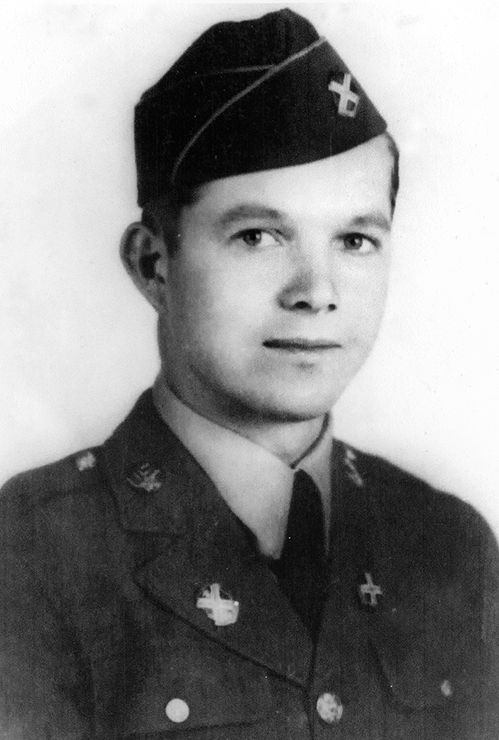
As the 1930s unfolded and Stevens grew to manhood, like many other boys from Bedford he turned to the military as a potential means of improving his situation. The 18-year-old and his twin brother signed on in 1938. “I joined the National Guard, in part, for money,” explains Stevens, “but mainly because I liked the uniforms.” Stevens felt confident that once he was back in Bedford wearing the shiny military uniform, the town’s girls would swoon for him. Unfortunately, “I didn’t have much luck impressing the girls.”
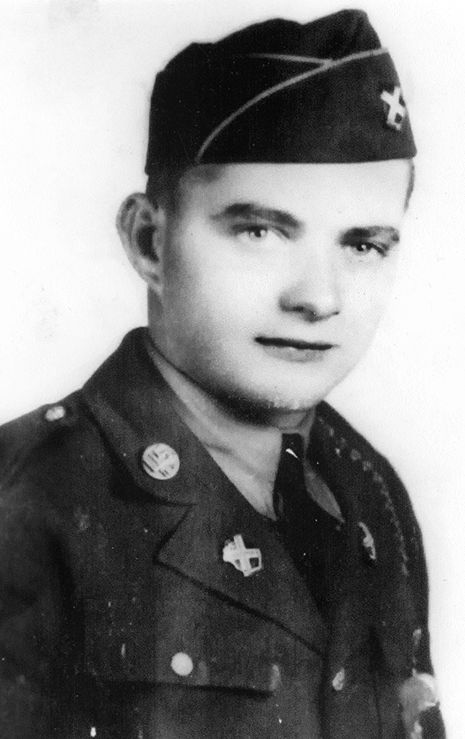
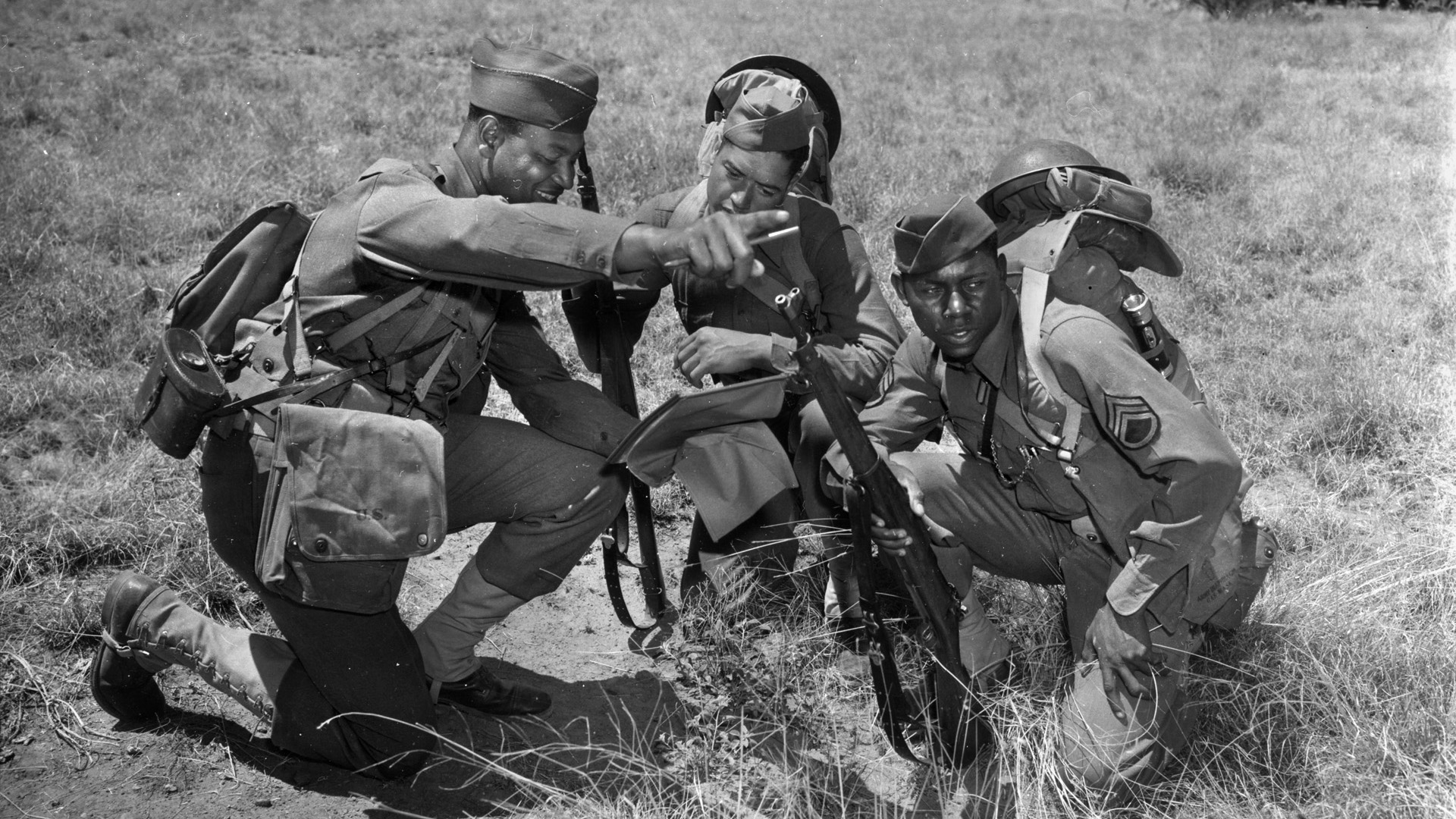
Brother Ray and many of the other young Bedford men joined Roy to form what eventually became the nucleus of Company A, 116th Infantry Regiment, 29th Division, U.S. Army. The Army kept the men from Bedford together in the same unit because they believed that the presence of familiar faces would make them better soldiers and less likely to drop out of training.
While many men found the rigorous training and discipline of the military hard to take, Stevens adapted easily. “The military didn’t surprise me too much because we had to be disciplined with our large family. I liked being in the National Guard. If I hadn’t joined, I probably would have been in the war later anyway.
“A lot of our buddies went in with us. The way it happened, one guy joined, then the others started joining, too. We liked the training. Sometimes we got disgusted with it and wanted to go home, but we were right proud to be in that outfit. We were proud of our company, which had other men than just Bedford men.”
Some of those other men came from northern cities like Philadelphia and New York, and the two groups gently teased each other about their roots. “Some guys gave us a hard time because there were so many Bedford boys in the unit. We also fought the Civil War a lot with some of the Northern guys, but it was all in fun. They called us the Bedford Rebs.”
At first, rattlings from Adolf Hitler in Europe and the Japanese in the Pacific, who threatened war to gain their objectives, hardly intruded. Stevens and his mates pocketed the extra money and enjoyed swaggering about town in their National Guard uniforms; to them, war was nothing but a distant concern, nothing to occupy more than a fleeting thought. But soon, events across the oceans disrupted their tranquil existence.
President Franklin D. Roosevelt recognized the dangers far before much of his nation. Although the prevailing attitude of isolationism prevented him from taking every step he wished, Roosevelt diverted whatever efforts he could into strengthening an alarmingly weak military. One October 1940 move affected Stevens and his Bedford pals when their National Guard unit was mobilized into the U.S. Army, supposedly for only one year. Stevens and the others thus packed their belongings and headed to training camp, now part of the full-time Army rather than part-time National Guardsmen.
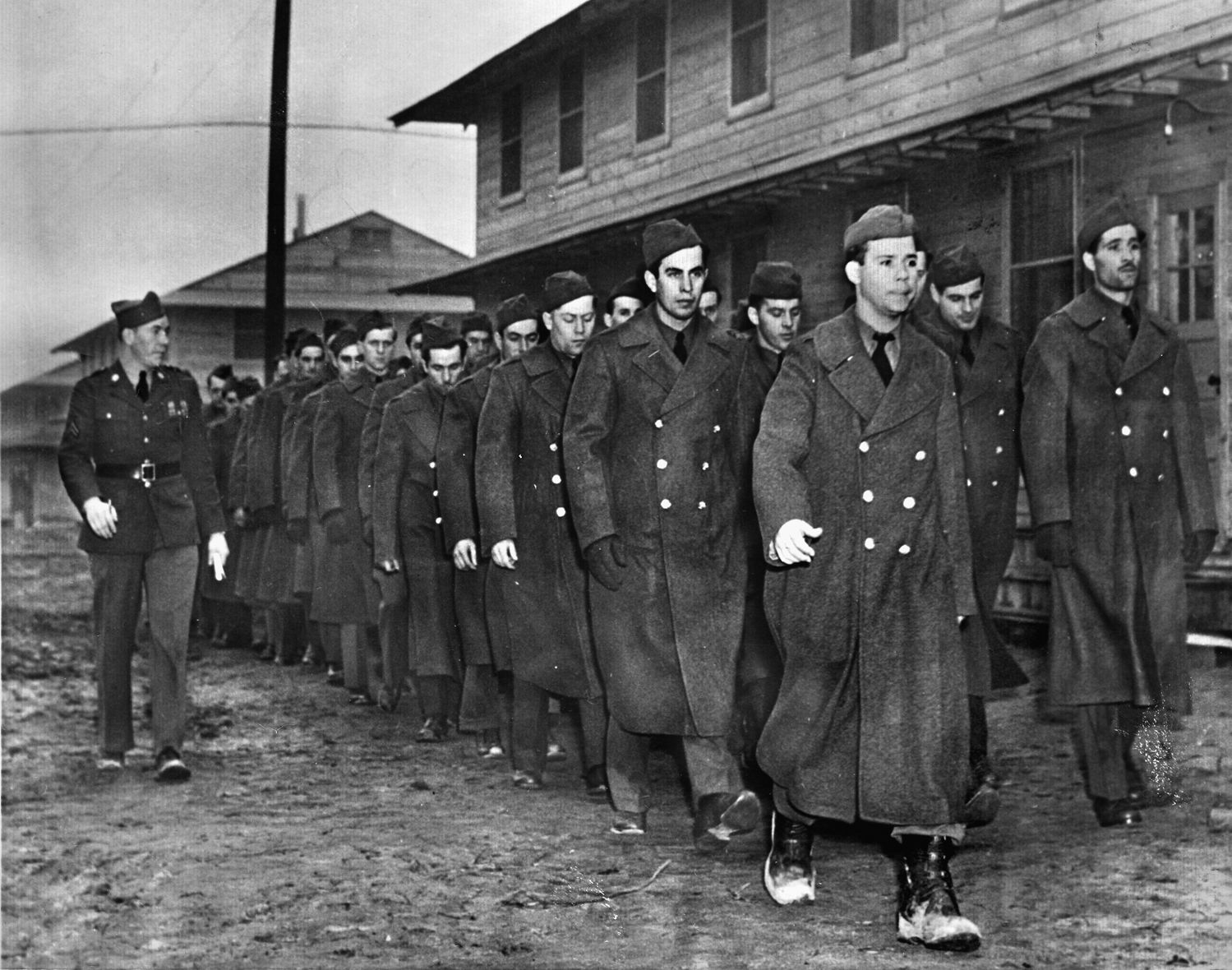
Like his friends, Stevens still rarely thought about the possibility of being in a war. He trained harder, and weekend passes were a luxury, but mostly he drilled, participated in field maneuvers, then headed to a local bar whenever possible. He even wondered why, later in 1941, the government extended their stint in the Army. Like many others, he was eager to return home.

On December 7, 1941, Stevens headed to a local theater near their North Carolina camp. “I was in a little town. We were watching a Gene Autry movie, I think, when they flashed on the screen that Pearl Harbor had been bombed. I didn’t know where Pearl Harbor was. We left and went back to the base. We all got to talking, and we took the Japs that night! We knew we would take these guys with no problem.”
“Most of us were glad to be in the war. We looked forward to it because we had trained so much and so hard. We wanted to get this over with and get back home. You had the ignorance of war,” Stevens said of the naïve, yet typical, attitude that most soldiers adopted on December 7.
That December day changed Stevens’ life. From then on, a rapid string of events yanked him out of a world of shiny uniforms and starry-eyed girls and into a dangerous realm that ended on European battlefields.
The first event involved his training. Instead of the more leisurely pace, the men now embarked on a 24-hour, seven-days-a-week schedule. Officers barked orders more loudly, and men marched more crisply, for to do otherwise might one day mean injury or death. Stevens endured the rigors along with everyone else and was nagged by his twin brother’s statement that he, Ray, would not live to see the war’s ending. “I don’t know why he had that feeling,” says Stevens. “It didn’t dawn on me until later. I never thought about death much.”
This hectic pace continued unabated until September 1942, when Stevens and Company A boarded the liner Queen Mary for shipment across the Atlantic to England. There they would form part of the advance team and commence training for the long-awaited invasion of Hitler’s Europe.
Formerly one of the world’s classiest luxury liners, the Queen Mary now served as a troop transport, one that would take Stevens outside the United States for the first time in his life.
On September 26, 1942, Stevens lined up with his company on the docks of New York City to board the liner. The small-town boy was impressed with what he witnessed, especially when he steamed past the ultimate national symbol representing the ideals for which the United States stands.

“Sailing by the Statue of Liberty was an experience. This was the first time I had seen it. The ship left New York City, and it was still an adventure to us. We were young, and we wanted to see what England and Ireland looked like.”
The voyage to England went smoothly for much of the way across. Stevens spent most of his time lying in his bunk next to Ray, watching the seemingly hundreds of card games, or attending the mandatory lectures warning the Americans of what to expect in England and how they should treat the British civilians. “There were plenty of poker games going around. I didn’t have many duties. My bunk was even with the water line so I could look out the porthole and see the water. It was a decent spot, not too hot. We had to get used to that British food! Cabbage, potatoes, things like that, but they did the best they could.”
However, the trip contained reminders that they were far from being on a luxury cruise. “The ship zig-zagged because of U-boats,” Stevens recalled, referring to the constant threat from U-boats.
As they neared the coast of Britain an incident occurred that brought the realities of war closer to Stevens. The ship entered the Irish Sea on October 1, where a group of destroyers and the British cruiser Curacoa joined to escort the Queen Mary through the submarine-infested waters to Scotland. On October 2 Stevens was standing below decks when he felt a tremendous shudder, as if an immense object had rammed the ship.
“I went up on deck to see what happened, and this ship was sinking.” Stevens looked on in horror as the Curacoa, which had accidentally steamed too close to the Queen Mary, was sliced in half by the leviathan and quickly sank. “We started throwing life preservers off the Queen Mary,” but there was little they could do to assist the men already in the water.
“Seeing the ship cut in half and those men drowning, that was the first act of war I had seen,” Stevens said. “Some of the adventure was gone.” Of the cruiser’s 439 men, 338 perished in this accident.

The Queen Mary made it safely to port, despite the hole from the collision. Stevens, however, had been changed. Before stepping onto British soil, he had witnessed some of the casualties of a conflict that would soon engulf him.
From October 1942 until June 1944, Stevens engaged in a constant string of drills and maneuvers designed to prepare Company A and the other units for the Allies’ re-entry onto the European continent, the monumental cross-Channel invasion against Hitler’s formidable military. No one knew exactly when it would occur, of course, but little other reason existed for the rapidly growing American presence in the British Isles. The hectic pace of training the men had begun in the United States accelerated once they arrived in England.
“We’d go on long hikes. It was kind of rough training, and that’s why we lost so many people. They couldn’t take the training and transferred out. We always seemed to be wet, and it was always cool over there. We didn’t know for sure what we were training for, but you heard rumors.”
For the next 20 months the men trained seven days a week. Once a month they received 48-hour passes, which most used to head to London. Stevens briefly dated a British girl. He recalls, “We got along with the British people. I have good memories of England.” The Southern-born Stevens remembers one thing he did not appreciate. “The English called all of us Americans ‘Yanks.’ I didn’t go for that! That was almost an insult!”
Inevitably, Company A grew weary of the monotonous schedule. It seemed they would waste the entire war training, when what they really yearned for was a shot at the action.
Stevens noticed a change in the training in March 1944, when the men of Company A were grouped into six boat teams of 30 men apiece. To develop cohesiveness, the 30 men lived together, ate together, and slept together, and the training focused on the singular responsibility each man bore once he stepped into battle. Each boat team had two officers, along with mortar men, machine gunners, demolition men, riflemen, and Bangalore torpedo men. Instead of training only on land, the men now embarked on the boats and practiced beach assaults, especially at a location known as Slapton Sands.
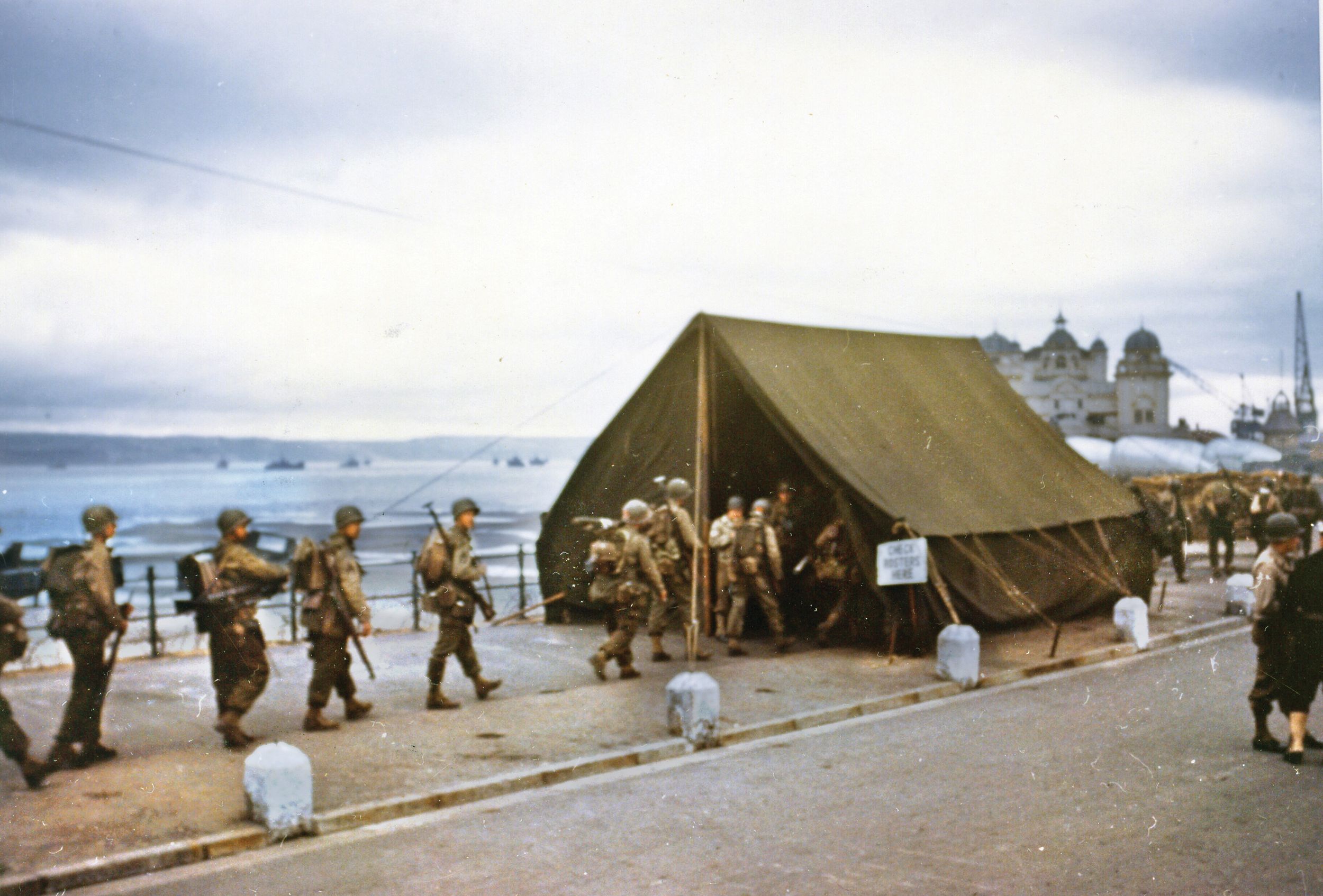
“The thought that we were going to attack a beach frightened us,” says Stevens, who as a technical sergeant was second in command of Boat No. 5. “You thought about it, you really did. I was certain I was going to make it for some reason. The training was getting more serious now. It was a grind. I know of two guys who were killed during training, one was blown up and the other shot. That affected us. Some of the guys, including me, got homesick, but there was a lot of water between us and home.”
Stevens said the men in Company A wanted to be the first unit onto whatever beach they had to assault. Benefiting from the ignorance that shields all first-timers to combat, Stevens and the other Bedford soldiers believed it would be an honor recognizing their efficiency during their training overseas, and they celebrated when superiors designated them to be in the first wave in the coming assault. “We were right proud to be in that outfit and chosen to go in first on D-day,” recalled Stevens. They would soon learn that for most, those long months in England would quickly end on a beach called Omaha.
One week before D-day, Stevens and other NCOs and officers gathered in a building for a briefing. For the first time, he glimpsed Company A’s objective, for spread out on a table was a sand drawing of the coast of France, including Omaha Beach. Stevens learned that Company A was to slosh ashore against the western edge of Omaha Beach, one of five beaches assigned to the vast Allied invasion forces, and seize a ravine cut through the cliffs that led to the village of Vierville-sur-Mer.
Stevens left the briefing, informed the men of Boat No. 5, then started preparations for heading to France. One thing did give him pause and underscored the seriousness of his undertaking. “It was weird when I signed up for the $10,000 life insurance policy. I named my mother as beneficiary, and it made us think a bit.”
Stevens boarded a troop transport with the other men in early June, realizing that this time fighting waited at the other end. The thought did not yet bother the men, who had tired of their long routine. “We had trained so much, we’d been training and training, that we hoped this was the real thing, so we could go over, get it over with, get home, and start our business again. Everyone was anxious to get going. You get to a point where you just want to get into it. I told the men they had been doing a nice job, and said, ‘Now, let’s go in and get it over with.’’’
Stevens felt so confident the landing would unfold smoothly that he rejected a final handshake from his twin brother, Ray. His brother still maintained that he would not make it out alive, and he told Roy to take care of the family farm when he returned to Bedford, but just before they stepped aboard their respective ships, Roy declined to shake Ray’s hand. “I said that we would shake hands on shore, when we got to Vierville. I wish now I had shaken his hand.”
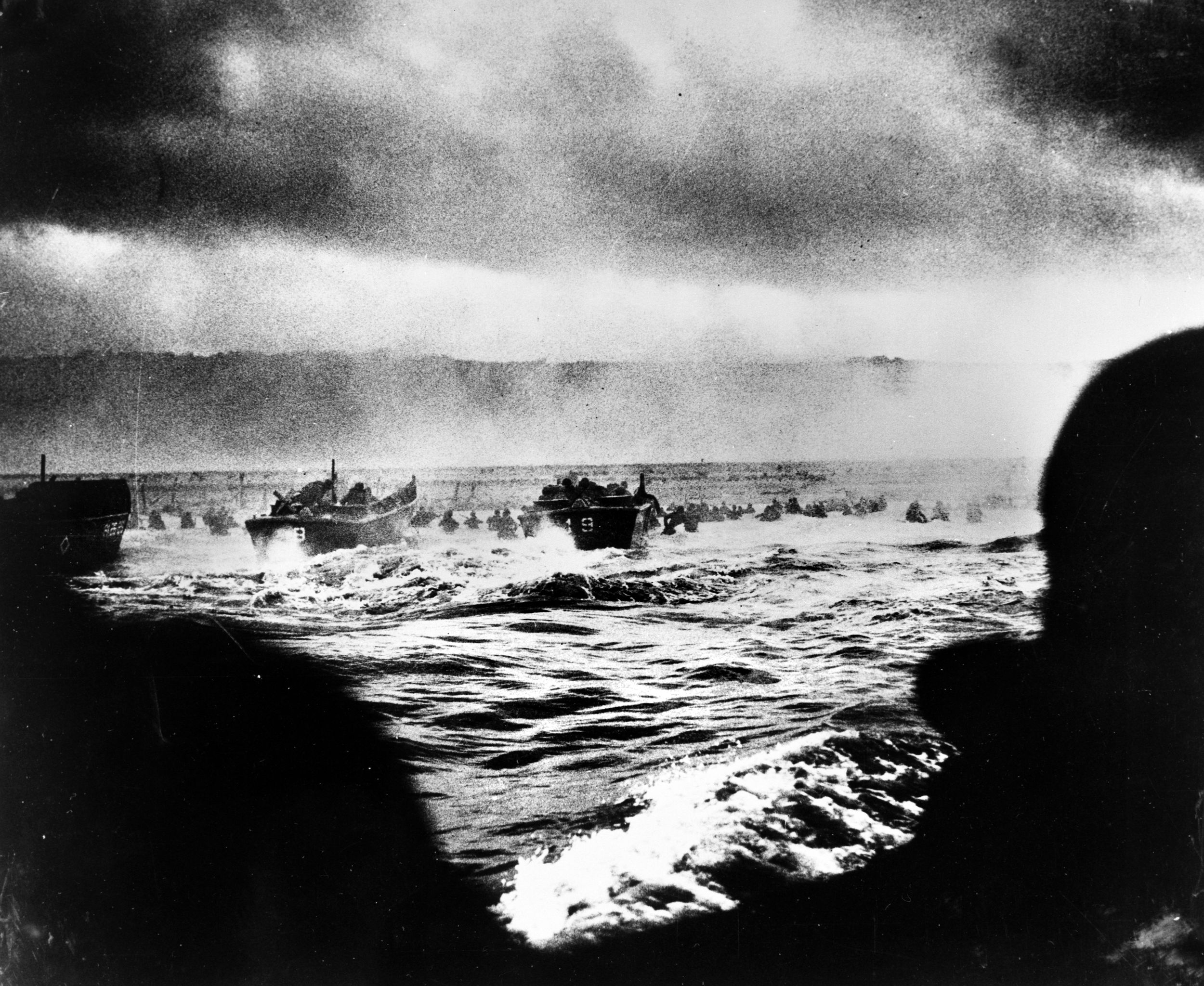
Rough weather delayed the crossing for a few days, during which the men remained aboard their ships, but soon the invasion armada headed out of British ports and started its inexorable way across the English Channel. With each mile that brought them closer to the French coast, the men thought more and more about what awaited them.
“On the ship, we didn’t expect to get much fire from the Germans. We knew something was going to happen once we landed, but we didn’t know what. We thought we would take our objective easily. We thought the beach would have been bombarded hard.”
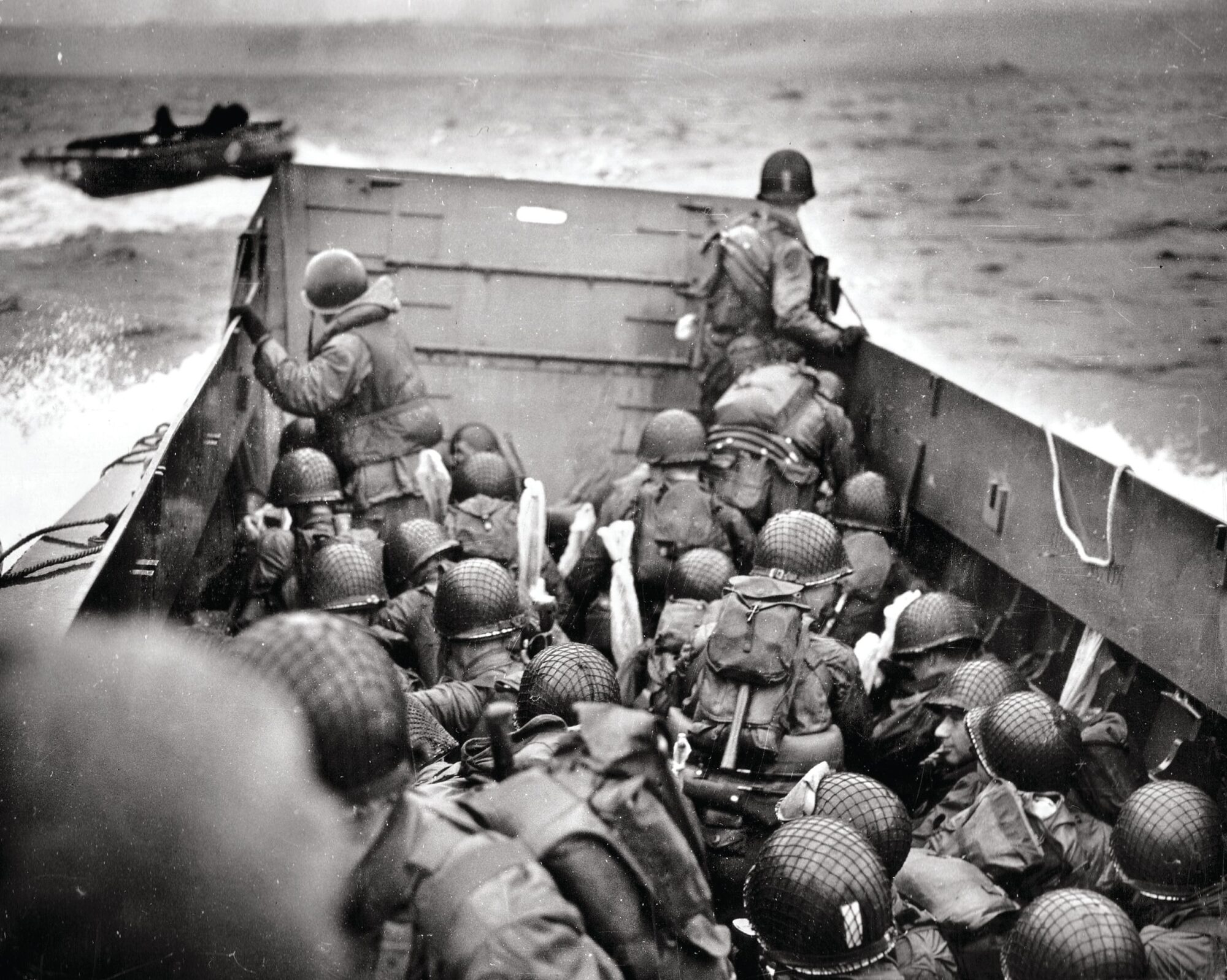
Heavy winds and rain churned the English Channel and made the men feel as if they sat on a roller coaster. Most men became seasick, and everyone shivered from the cold and mist. The miserable conditions did not help maintain the positive attitude most had when they first stepped aboard.
“Some of the men looked frightened,” Stevens remembered. “They had this look on their faces, like danger was approaching. I felt the same way, that this was something I had never done before. I had never been in battle. Everyone was afraid. Roosevelt said you have ‘nothing to fear but fear itself,’ but I don’t know about that!”
At 4 a.m. on June 6, when the troop transport bearing Stevens and the 30 men of Boat No. 5 drew within 12 miles of the French coast, the laborious transfer into the smaller landing boats began. For most men, that meant carefully stepping down ropes into landing craft bobbing and weaving in the heavy seas, but Stevens enjoyed a better fate. “We were pretty lucky. We didn’t have to scale down the ropes, which was rough! Cables lifted our boat and put it directly into the water. Our craft then turned away and headed out.”
The boat was to take Stevens’ group to shore 12 miles distant, but because the craft took a diagonal course it had to travel 20 miles. The seas that felt rough aboard the transport magnified once the men stood in the smaller landing craft. “It was bumpy, rough,” recalled Stevens. Once more, he saw a look of fear blanket the faces of many. “Riding into the beach, some of the boys just knew they weren’t going to make it. You could see it in their faces. I never had any doubt, that’s how stupid I was, but I never thought that I would never make it out alive.”

As Boat No. 5 neared Omaha Beach, American battleships opened a pre-invasion bombardment that draped the boat in noise. Stevens could recall nothing as loud as what he heard that morning, and like most of the men steadily advancing toward the Normandy invasion sites, he believed that little would remain of the German defenses after such a bombardment.
Stevens never had a chance to find out. When his boat closed to 500 yards from shore, it smacked into one of the thousands of underwater obstacles sprinkled along Normandy’s coastline to prevent enemy craft from reaching the beach. He and his group spent 20 minutes trying to bail out water that gushed through a gaping hole in the boat’s bottom, but their efforts failed.
“My boat hit one of those obstacles, but there was no explosion because it didn’t have a mine attached. We didn’t have to jump out of the boat. It just sank from underneath us. I could hear the German gunfire, and I could see what I thought were flamethrowers going off onshore, but there was too much going on for me to notice much. We lost one boy, and I’ve often wondered what happened to him.”
Stevens now found himself struggling against another threat—his own gear dragging him under in seas that alone posed a large enough danger. He battled to remove his assault jacket, shoes, and other pieces of equipment that endangered his life, and nearly lost his struggle. “I fought to stay afloat, but I almost gave up; it was so hard because of all the gear. I couldn’t swim, and my whole life came before me. The first thing I thought of was my home, then Mother and Dad, then some of the things I did in life. I thought it was curtains. Finally, I grabbed hold of a bangalore that had a Mae West on it and that kept me up. I was in the water for almost two-and-a-half hours.”
While Stevens battled weariness and the elements 500 yards from shore, the boats carrying the other Bedford men headed into what became a debacle. Instead of beaches that had been softened from naval and air bombardment and bombings, the men at Omaha Beach stepped directly into a slaughter. A cloud cover forced Air Corps bombers to drop bombs farther inland than intended, lest they drop short and decimate their own forces. As a result, most of the German targets remained untouched. Then, rockets from ships offshore intended to create craters on the beach in which the invading troops could seek shelter, mostly fell short and splashed harmlessly into the water. Finally, instead of facing raw troops, Company A ran straight into the crack German 352nd Division, a veteran unit that had only recently been transferred to the beach.
As a result, the men from Bedford landed on a beach with no cover, against fortifications manned by skilled troops that had hardly been touched by the pre-invasion bombardment. The results were predictably lethal. Of the 170 men from Company A who hit the beach at 6:30, 91 died and another 64 were wounded. Nineteen Bedford soldiers died in the first 15 minutes. One boat disintegrated from a direct hit, which killed all 32 occupants.

Lieutenant Ray Nance scrambled ashore, advanced a few yards, then looked around to see how many men had followed him onto the beach. To his horror, he spotted no one else on the beach near him. When he turned back toward the water, he understood why. So many floating bodies clogged the landing area that they bumped into each other.
Stevens had little idea that, while he strove to stay above water, his brother and friends, as well as hundreds of other Americans, had already died on Omaha. “You could hear the planes going overhead and see some of what was going on,” explained Stevens, “but I was too busy trying to live to worry about what was happening ashore. I didn’t know how bad it was until later.”
For Stevens, later meant June 11. For now, though, he had to worry about survival. Fortunately, a small boat carrying rockets stopped, helped Stevens and the other men into the craft, took off their jackets, and took the men back to ships that returned them to England. “I didn’t have my rifle or any other gear, and that’s why they returned me to England. I stayed there four days, then headed back to France on June 11. I was anxious to get back and rejoin my men.”
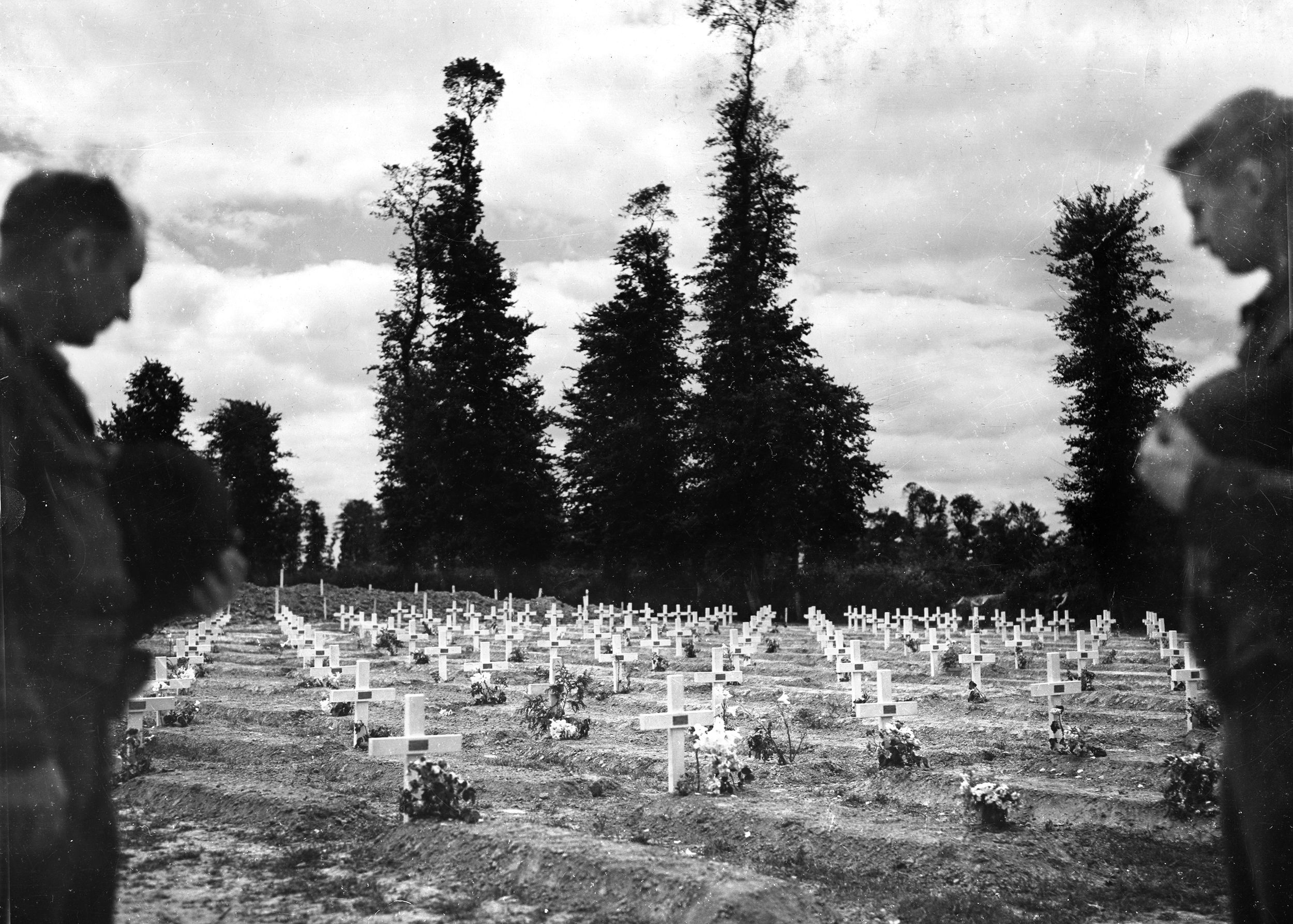
Stevens was also eager to learn what happened to his brother. When he returned to Omaha Beach, he headed over to a makeshift cemetery that graves registration personnel had started just off the beaches and quickly found an answer that, for a time, he tried to reject.
“I went to a cemetery, and that’s where I found Ray’s grave. His was the first one I came to. There was a little white cross covered with dirt, and when I moved the dirt I saw Ray’s dogtag on it. They were still burying men there. Then I walked around to look for other guys, and I started finding all the other Bedford men. I didn’t know how bad it was for them until I returned to the beach, walked to the high ground, and turned back to see what those guys had to land against. The Germans were really set for us. I don’t know how any boat got in. Those boys didn’t even have a chance. They just riddled them.”
Stevens could hardly believe what he discovered. There, in a rough French cemetery, lay many of the friends with whom he had grown up in Bedford, and one man who was as much a part of him as his left or right arm. For a time, Stevens refused to accept that his brother had died and told himself that graves registration had made a mistake, that all he had to do was reach the front and he would find his brother. He also tried to ignore the feelings of guilt he felt over not shaking his brother’s hand on D-day morning.
Stevens entered the fighting that same day, all the time believing that he would yet meet his brother. Until that day, he vowed to exact revenge on the enemy for the harm they had inflicted on Bedford. “I wanted to get back at the Germans for my brother and the other guys. I wanted to kill one German for each guy [from Bedford]. Most of the times I’d go out on my own looking for Germans. It was silly, but I had to. I would expose myself to draw fire, and then go after wherever the fire came from.”
Stevens’s superior officer, Colonel Charles Canham, finally put a stop to Stevens’s recklessness by telling the grieving soldier that it would take everyone’s effort to win the war, not just his, and that he was to cease the almost suicidal actions.
Stevens hardly had to worry about trying to get killed, for the fighting in which he engaged was some of the roughest. He entered the hedgerow country, fields boxed in by high, thick rows of bushes that concealed enemy positions. “All the hedgerows were booby-trapped, and we were so green and didn’t know our way around them. I was in a lot of skirmishes. One time we went over the hedgerow to bring back a prisoner for information, and when we got over, these Germans came in behind us and set up their guns.”
A furious firefight ensued. Rifles answered machine gun blasts and grenades illuminated the night. One man near Stevens fell from a bullet, his eyeball lying on his cheek.
Stevens learned that men responded to the fighting in different ways. He used it to cleanse the anger building inside, while others attempted to avoid fighting altogether. Stevens empathizes with those individuals. “One time five guys shot themselves in the foot, and Colonel Canham asked me if I thought they did it on purpose. I’m pretty sure he would have had them shot right there, so I lied and said no. He probably knew I was lying, but I wanted to save their lives. The body can only take so much. There was another soldier, a kid, who one day went back, dug a hole, and shot himself.”
On June 30, as Stevens climbed a hedgerow, a Bouncing Betty land mine ended his fighting. The man directly in front of him tripped the wire, took the full blast, and died instantly, while Stevens went down with neck and shoulder wounds. Blood gushed from the upper part of his body and Stevens kept spitting blood, but he had enough strength to stumble to an aid station, where they cleaned out his wounds and sent him back to a field hospital.

“They put me in a place with boys who were really hurt, who were much worse than me and were going to die. I thought, ‘This is no place for me!’ so I grabbed a nurse and, even though I couldn’t talk very well, told her to move me.”
The nurse checked Stevens’ wounds, then arranged for him to be operated on. The doctor removed most of the shrapnel, although some still remains in Stevens’ neck, then sent him back to England for rehabilitation. After three months of recovery, Stevens returned to the Continent, where he again visited his brother’s grave, hoping that by then the Army would have corrected its mistake and he would learn that Ray was fighting somewhere along the front. When he saw his brother’s grave, though, still in the same cemetery, his hopes plunged.
Stevens was too badly injured to rejoin the fighting, but he reported to a camp in France where he trained other men headed for battle. During this time, though Stevens wrote home, he refrained from telling his mother what happened to Ray. “I didn’t know how to deal with that. I still kept telling myself that maybe he was in a hospital somewhere. My mother got a telegram sometime in August about what had happened. Even after I got home after the war, I wondered if maybe Ray would be in a hospital in West Virginia or something.”
While most men raucously celebrated the war’s end, Stevens, though pleased, dreaded returning to Bedford, where he would have to face his mother and talk about Ray. His fears quickly dissipated. “She just looked at me and said, ‘At least one of you got back.’”
Stevens settled in, met a girl named Helen at the county fair, and married in 1946. The couple recently celebrated their 58th wedding anniversary, surrounded with the love that children, grandchildren, and great grandchildren bring.
On June 6, 2001, President George W. Bush visited Bedford to dedicate the National D-day Memorial, a beautiful sculpture honoring the men lost on D-day. He referred to Bedford’s uniqueness in warfare and hoped that Americans tookthe time to visit.
Despite the joy he feels from family, Stevens never forgets about the war. His injuries bother him at times, especially when the weather sours, but a sense of loss hovers over the Bedford survivor. “I dream about Ray a lot. The others that got killed on D-day, I dream about them a lot, too. Returning to Normandy for the 50th anniversary of the battle was quite an emotional thing. I’m glad I went back.”
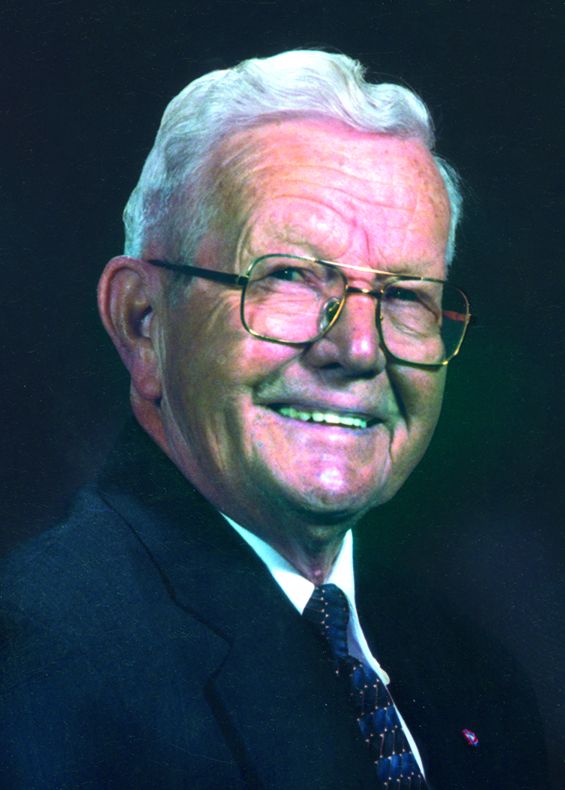
Roy O. Stevens died on January 1, 2007, at the age of 87. The last of the Bedford Boys, Elisha “Ray” Nance, died at the age of 94 on April 19, 2009.
John Wukovits is the author of Lost at Sea: Eddie Rickenbacker’s Twenty-Four Days Adrift on the Pacific—A World War II Tale of Courage and Faith. His previous books include Pacific Alamo, the story of the heroic defense of Wake Island and Devotion To Duty, a biography of Admiral Clifton A.F. Sprague, hero of the Battle of Leyte Gulf.

Thanks for this article. It leaves me in awe of the men who fought on d-day and really all of our great veterans in all of the wars we fought in.
We need to hear more stories from our heroes before there are none left. I thank you for sharing so many of their stories. I never got the chance to hear my father’s story because he refused to talk about it.
I was playing in the yard when my mom excitedly called me in. I was seven. She had just gotten off the phone with Daddy, commanding officer of a medical unit at Camp Barkeley, near Abilene, Texas, preparing to ship out overseas. He said there was a big invasion in France, and that the war might be over by Christmas…
If you haven’t visited the National Normandy D-Day Memorial at Bedford Va it is worth your trip! God bless all those men who invaded and participated in all aspects of WWII to defeat Hitler!