By Alan Rems
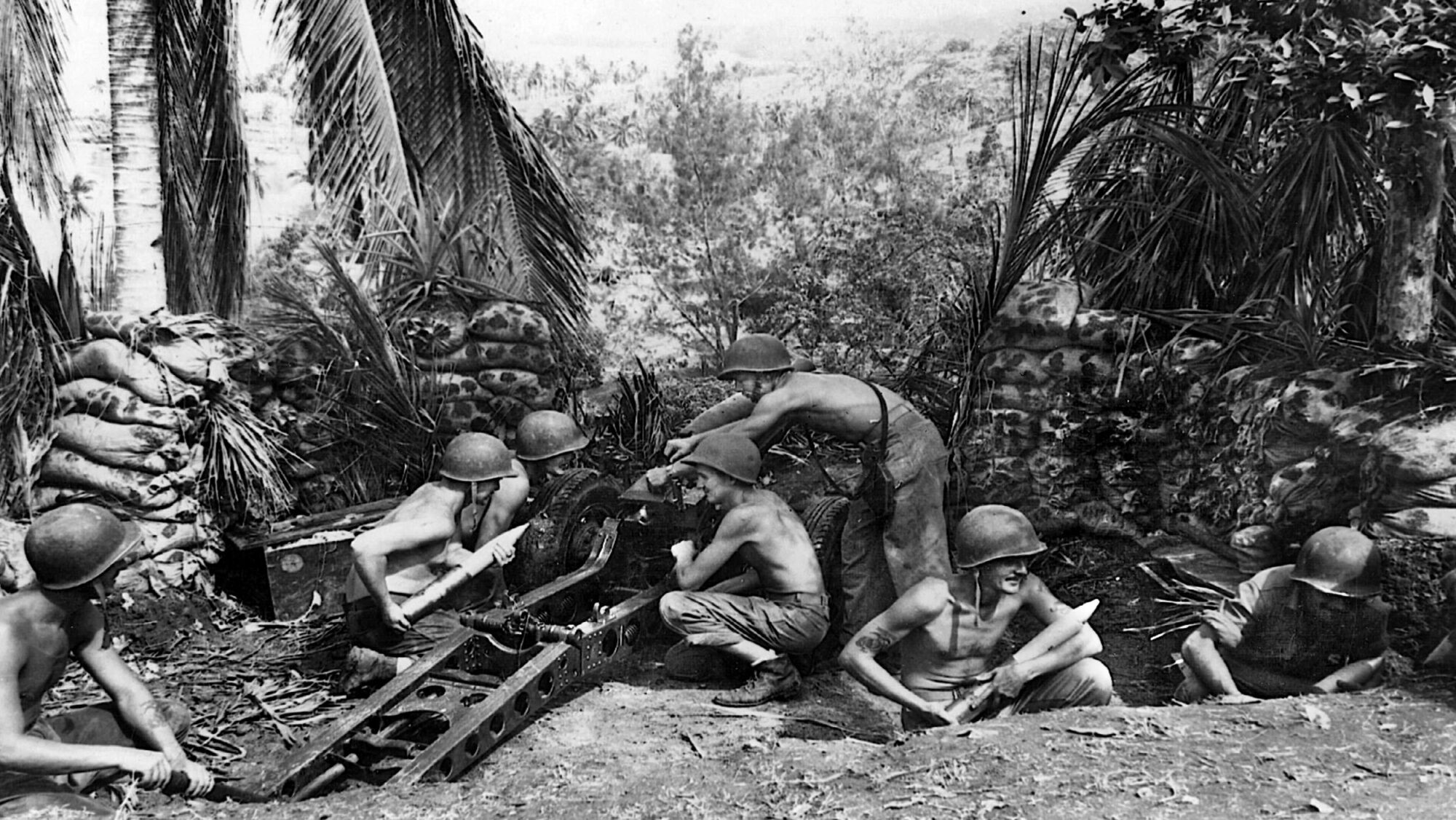
Undertaken in haste and with slim resources, the Guadalcanal Campaign (Operation Watchtower) was America’s first offensive of World War II and it presented a unique set of challenges. Among the Marine commanders who passed that test on Guadalcanal, an enduring bond was formed—one that would help propel some of them, who became known as the “Guadalcanal Mafia,” to the highest echelons of the Marine Corps.
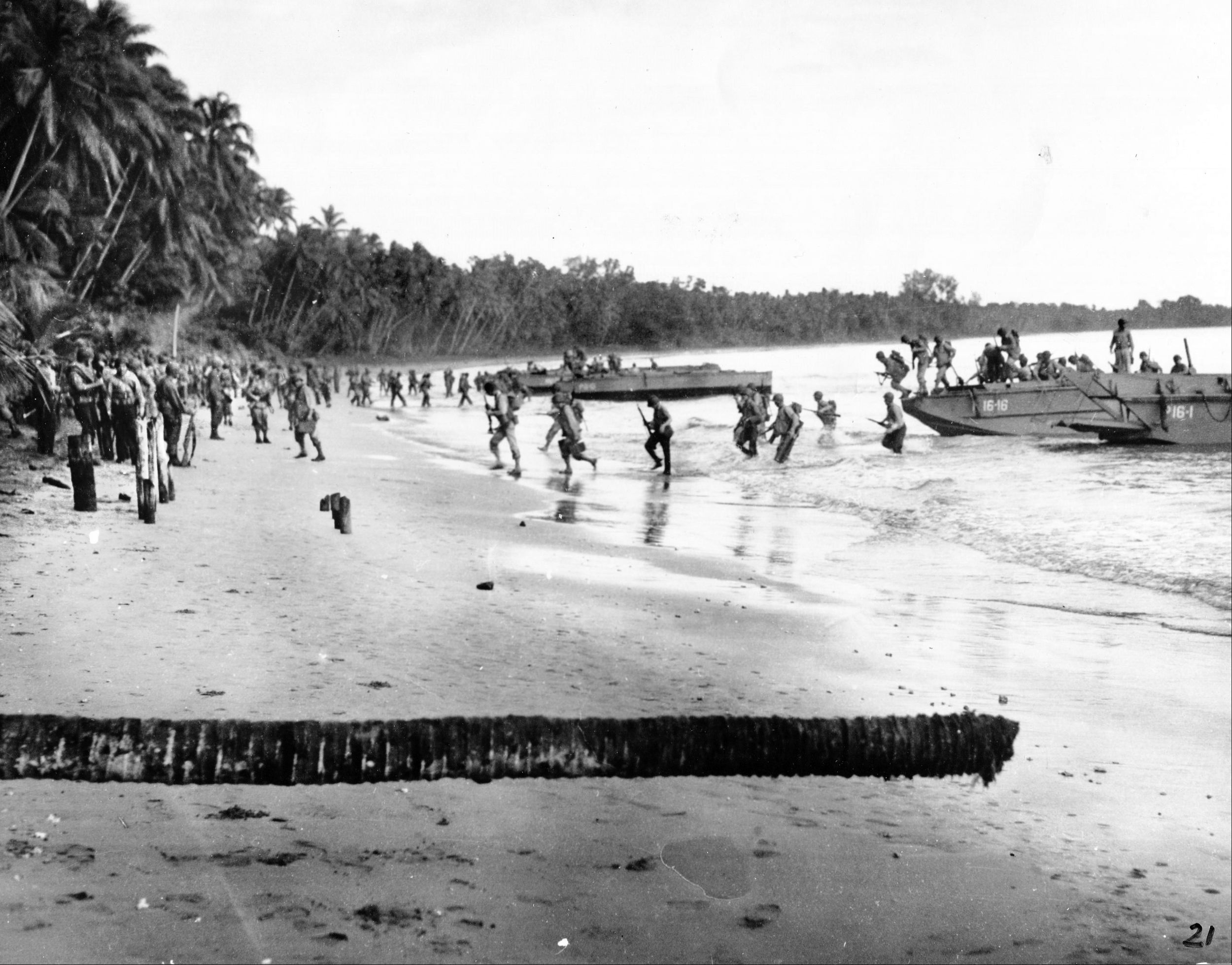
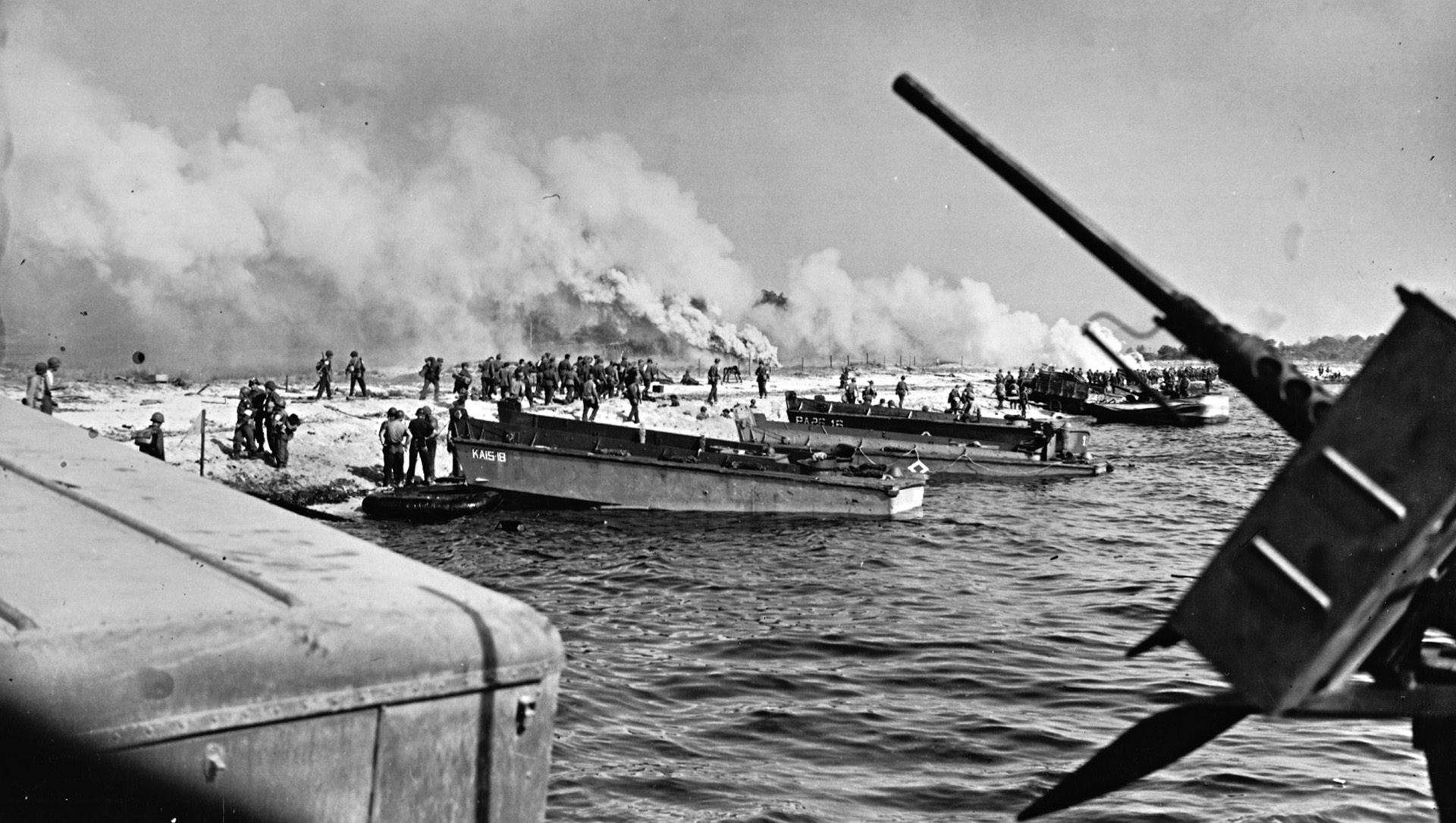
Two regiments of the First Marine Division commanded by Major General Alexander A. Vandegrift hit the beaches of Guadalcanal on August 7, 1942. Landing that day were the 1st Marines under Col. Clifton B. Cates and the 5th Marines under Col. LeRoy P. Hunt. Both regimental commanders had compiled distinguished combat records and were highly decorated in World War I.
Of the staff officers on Guadalcanal, the most important would be the head of division operations, Col. Gerald C. Thomas, who had risen from an enlisted leatherneck in World War I to earn a Silver Star and a battlefield commission. Thomas’ energetic and outspoken deputy, Lt. Col. Merrill B. Twining, was another who emerged on Guadalcanal.

When Vandegrift assumed command of the division, he attempted to energize the weakly led 5th Marines by installing Hunt as regimental commander. A charismatic figure known and admired throughout the Marine Corps, Hunt was also Vandegrift’s good friend. To fill the slot vacated by Hunt, Col. William C. James was appointed chief of staff. Neither move would prove successful.
Difficulties with Hunt’s regiment quickly surfaced. To secure the beachhead, it was essential that the 5th Marines promptly advance to anchor the western flank at the Tenaru River. Vandegrift wrote in his war memoirs that, “after going ashore, I found the 1st Battalion, 5th Marines, moving as if it were about to encounter the entire imperial army. I gave the battalion commander [Lt. Col. William E. Maxwell] hell. In Hunt’s command post I asked him to go down there personally and get the troops moving.”
Part of the problem was that many experienced division officers had left—some to form raider and parachute units and others were sent with the 7th Marines to defend Samoa. According to Twining, except for the 2nd Battalion, “we never could get the 5th Marines off in time. To my mind this outfit never functioned adequately.” What particularly irked him was that the problem was not handled by Hunt before the regiment went overseas. Regarding the outset of the campaign, Twining observed that “I don’t know what we would have done if we had run into serious resistance on Guadalcanal.”
Weeks later, Vandegrift ordered Hunt to conduct a reconnaissance in force. Landing from boats beyond the perimeter, Maxwell’s battalion was to sweep the coast and return before nightfall. After a late start and with little accomplished, Maxwell radioed in the early afternoon for boats to retrieve the battalion. Infuriated, Vandegrift turned on Hunt, who relieved Maxwell by radio and went forward to lead the battalion himself.
Twining observed, “[Hunt] could not enforce his will and get anything out of Maxwell. He was never able to get any satisfaction out of the other battalion commanders either.” But, “Vandegrift was a very indulgent man. He didn’t want to lower the boom on Hunt, but he did eventually. He had to, to protect himself.”
Meanwhile, Marine raiders and parachutists had captured Tulagi and nearby islets and were brought to Guadalcanal to bolster the defense. Placed in command of the composite battalion was Col. Merritt A. “Red Mike” Edson, who had shown great courage and initiative in heavy fighting on Tulagi. Edson and Thomas formed an enduring professional and personal relationship.
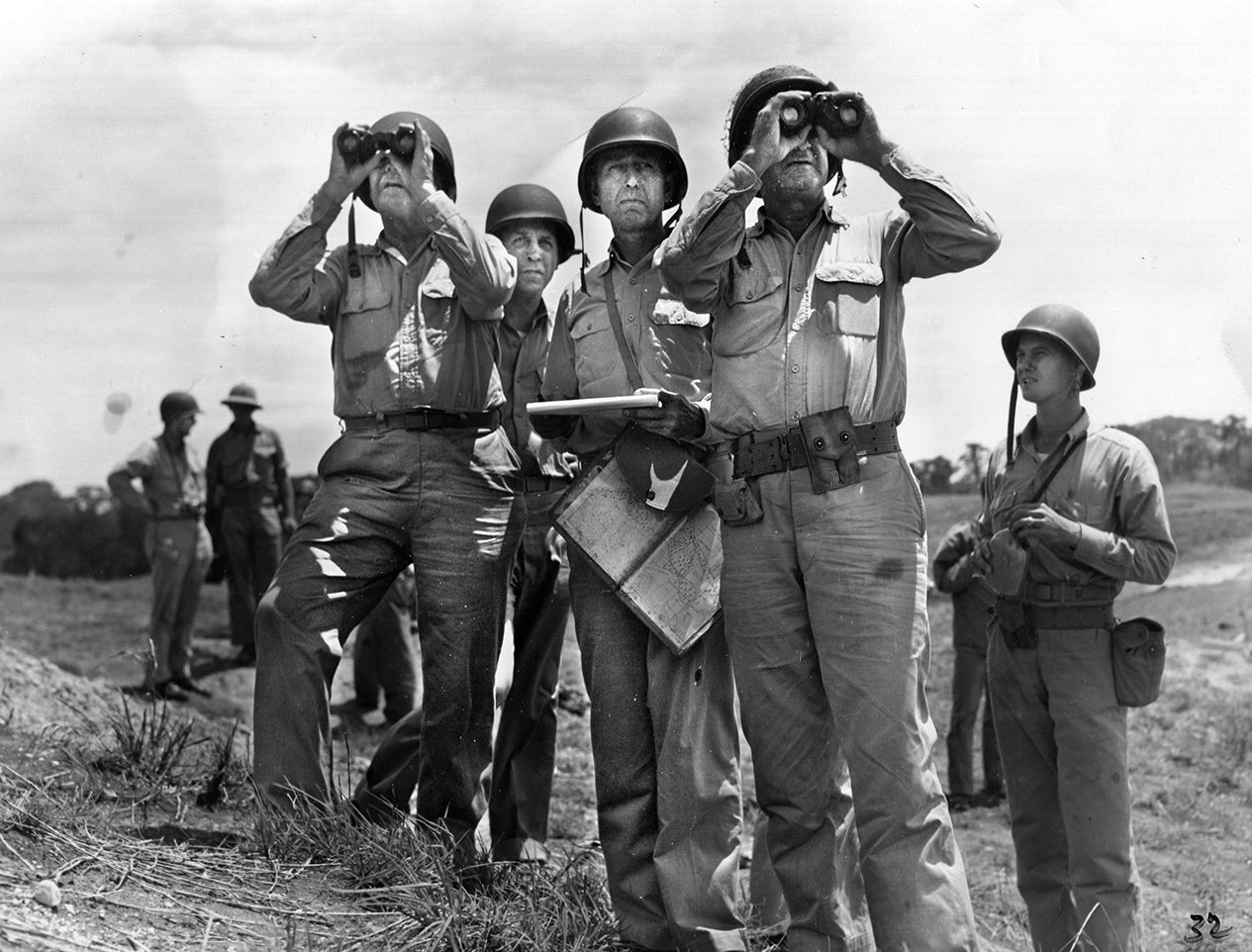
As evidence mounted that the Japanese were planning a major attack, it was uncertain where the blow would fall. Thomas and Edson surveyed the position and convinced Vandegrift to place Edson’s troops on a feature later known as Bloody Ridge or Edson’s Ridge. When the Japanese struck, Edson conducted an epic defense that earned him the Medal of Honor and wide renown.
Though he was unhappy that certain officers were not measuring up, Vandegrift left them in place because he disliked confrontation. Fortunately, Marine commandant Lt. Gen. Thomas Holcomb asked for the release of excess senior officers to form new units—offering Vandegrift a golden opportunity to clean house with minimal pain.
“I’ve got to relieve the commander of the 5th Marines. He’s not producing,” Vandegrift told Thomas, who immediately proposed that Edson take over Hunt’s regiment. Chief of Staff William James was also released. Having by necessity already assumed many responsibilities normally performed by a division chief of staff, Thomas was the logical replacement for James. That situation was sensitive, as Thomas and James were close friends married to first cousins. In his war memoirs, Vandegrift wrote out Hunt and James so deftly that a casual reader would not have noticed their disappearance.
Suppressing his true opinions, Vandegrift praised both officers he was sending home, recommending that they be promoted to brigadier general. Edson’s biographer criticized how officers with such “spotty records would make the grade, to the detriment of men such as Thomas and Edson, who assumed increased authority but found little room for advancement in rank.” Hunt deeply resented Thomas’ part in his removal, creating, according to Twining, “an enmity that lasted a lifetime.”
Having acquitted himself very ably as Thomas’ assistant, Twining took over the operations section and planned many subsequent operations. Command had finally fallen into the shape Vandegrift wanted and needed.
Though the rank and file of the 1st Marines had, for the most part, less experience and training than the 5th Marines, Cates’ regiment was led by first-rate battalion commanders and generally performed well. But even Cates earned criticism from Twining. The 1st Marines barely advanced a mile groping for their Mount Austin target on invasion day, believing it was much closer than it actually was. In the process, Cates lost touch with his battalions, which he tried to conceal from Twining’s watchful eye. Recalling how he had once treated someone who would one day be his superior as Marine commandant, Twining reflected, “Nobody but me would bring that thing up. I should have kept my mouth shut.”
Regarding Edson’s transfer to the 5th Marines, his biographer observed that “many raiders were glad to see him go, because they believed they could not survive many more fights like the ones of the past few weeks. … Sometimes, Edson’s desire to fight seemed to border on callous disregard for the lives of his men.” Though he found that the 5th Marines improved under Edson, Twining still complained, “Edson was egotistical. The very fact that he took over this poor beat-up outfit immediately made it the finest regiment in the Marine Corps. But it couldn’t happen overnight. He didn’t have any [good] battalion commanders. He put the wrong people in.”

For his part, Edson found fault with Twining. Without Thomas’ concurrence, Twining convinced Vandegrift to undertake an
offensive known as Second Matanikau, which Edson was assigned to lead. That operation, described as “a poorly supported, ill-organized force of unrelated battalions attempt[ing] a river crossing in the teeth of strong Japanese defenses,” resulted in substantial losses without gain—the greatest Marine defeat suffered at Guadalcanal. The fiasco soured Edson’s relations with Twining.
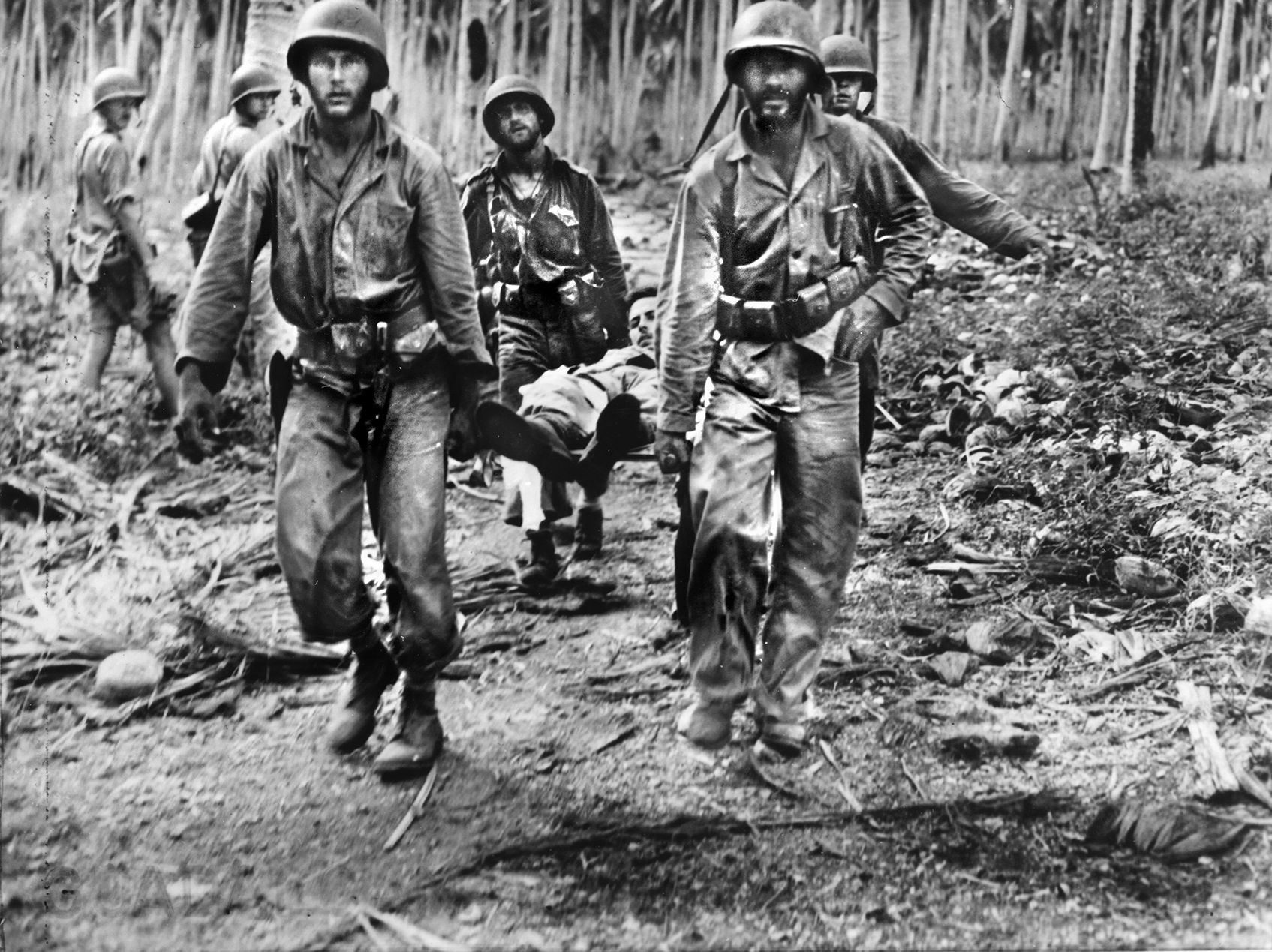
Summing up the epic campaign, Thomas modestly observed, “We went to Guadalcanal for the sole purpose of capturing and defending an airfield. That was our simple mission and we continued on it for four months.” In the view of Thomas’ biographer, Vandegrift and Thomas “stood out … as the architects of victory.”
Recognizing his “quiet resolve, dogged determination, and stubborn persistence,” Vandegrift succeeded Holcomb as Marine Corps commandant in January 1944. Having become indispensable to Vandegrift, Thomas accompanied him to Washington as Director of Plans and Policies, essentially, chief of staff at Marine headquarters.
After Guadalcanal, Cates headed the Marine Corps schools, followed by command of the newly formed 4th Marine Division at Tinian, considered by many as the war’s model amphibious operation. Afterwards, Cates led the division during the bloody fighting on Iwo Jima.
During 1943, Edson moved to the Second Marine Division. Gaining a brigadier general’s star, he served as division chief of staff at Tarawa and afterwards as assistant division commander. Edson’s great hope was to succeed Maj. Gen. Julian Smith as division commander. However, when Smith moved on, that position went to Maj. Gen. Thomas E. “Terrible Tommy” Watson, who came with “a well-deserved reputation of being the hardest officer in the Corps to work under or with.”
Stifled by a commander who seldom listened to him, and able to play only a secondary role during the Marianas fighting, Edson accepted an offer from Lt. Gen. Holland M. Smith to join him as chief of staff of the newly formed Fleet Marine Force Pacific (FMFPAC). Equivalent to an Army headquarters, FMFPAC exercised administrative command over all six Marine divisions, with the potential to eventually function as headquarters for a Marine field army. That attractive possibility ended when Adm. Chester W. Nimitz, strongly influenced by the inter-service row created after Holland Smith removed the Army commander on Saipan, chose the Tenth Army to lead the invasion of Okinawa.
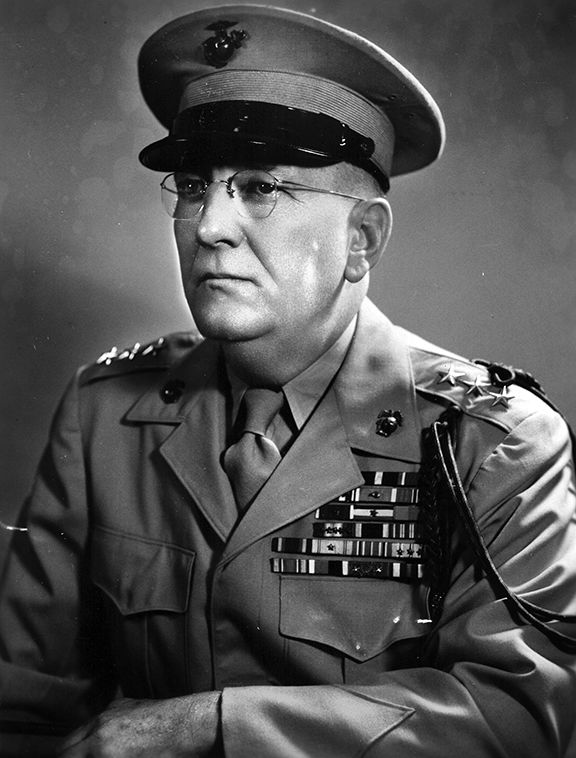
Unable to get into the forefront of the battle, Edson was positioned to gain a full appreciation of problems throughout the Pacific and propose solutions to Thomas, his powerful friend in Washington. According to Edson’s biographer, “the Thomas-Edison duo…wielded enormous influence on the organizational, logistical, and administrative direction of the Corps for the rest of the war. …Thomas did his best to shape headquarters policy to meet the needs that Edson identified in the field. Red Mike, in his turn, saw to it that Thomas’s directives and ideas did not drift off course in the long passage from Washington to the far reaches of the Pacific.”
When Edson departed the Second Marine Division, he was replaced as assistant division commander by Hunt, a close friend of Watson. Hunt’s nearest opportunity to command on a battlefield after Guadalcanal would be leading a feint at Okinawa during which the marines never left their landing craft. At war’s end, Hunt gained a second star when he assumed command of the division for occupation duty in Japan.
Watson left the Second Marine division to become the Marine Corps’ director of personnel. From that perch, he conducted open warfare with Thomas, who unsuccessfully endeavored to implement a general staff arrangement at Marine Corps headquarters. That dispute was exacerbated by Watson’s animosity toward Thomas for the treatment of his friend Hunt on Guadalcanal.
After logistics emerged as one of Thomas’ greatest problems, he turned to Edson who had gained in-depth knowledge at FMFPAC. In June 1945, Edson took over Service Command, the top Marine logistics post in the Pacific. Though the position was challenging, Edson complained, “I little expected three years ago that I would probably finish the war pushing bullets up to the boys.” Japan surrendered two months later, ending his hopes for a combat command and near-term promotion in a military organization that would inevitably downsize.
Despite his frustrations, at least life at Pearl Harbor was pleasant for Edson. A spirited man trapped in a loveless marriage, he enjoyed living far from home with ready access to female company. That compensation disappeared in December 1945 when Edson was ordered to report for duty to Nimitz in Washington at the office of the Chief of Naval Operations.
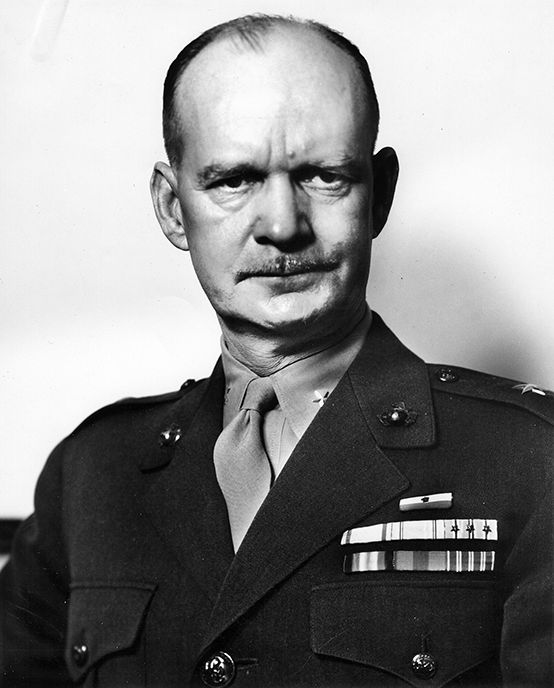
The new billet involved coordination with the Navy to safeguard Marine Corps interests while unification of the armed forces was considered. Edson was particularly valuable there, as “he possessed the seniority, intellect, and presence to represent the Corps in the public arena, and his wartime reputation could be expected to carry considerable weight with Congress and the voters.”
At the center of power, Vandegrift, Thomas, Edson, and Twining were dubbed the “Guadalcanal Mafia.” Thomas headed the effort to combat threats to the Corps posed by unification, ably supported by Twining billeted nearby in Quantico at the Marine Corps schools.
It seemed clear that the surest means of protecting Marine Corps prerogatives would be to have the functions reserved to the Corps written into the unification law. As matters reached a showdown in Congress, Vandegrift succumbed to pressure from the administration to settle for a relatively weak guarantee, but the others persisted in seeking something stronger.
According to Thomas’ biographer, he “believed Vandegrift had lost his moral courage to see the battle for legislative protection to its conclusion.” Now finding his trusted advisor inconvenient, Vandegrift assigned Thomas to command a brigade in China. Edson, unhappy over his assignments and doubtful of advancement prospects in the peacetime Corps, resigned his commission. Before departing, the esteemed war hero delivered a stirring oration warning Congress about the dangers of military centralization. The end result was victory for the Marines in having their role in national defense firmly embodied in the National Security Act of 1947.
After returning from China, Thomas’ bid for a second star was rejected by a board that included his two great foes, Watson and Hunt. Seething over this “injustice and insult” and considering resignation, Thomas vented to Edson, “They do not pay off on a scale of values in D.C. today that you or I understand.” However, with the outbreak of the Korean War and expansion of the Corps, Thomas gained promotion to major general and command of the First Marine Division. That command lasted only months, as Thomas was then promoted to lieutenant general and appointed assistant commandant under a new marine commandant, Gen. Lemuel C. Shepherd Jr. The general staff organization, which was then adopted at Marine Corps headquarters, represented a triumph for Thomas who had urged for that arrangement since his first days in Washington.

After retirement, Edson found many outlets for his energies, including loud and persistent denunciation of attempts to give increased power to the Secretary of Defense and the Joint Chiefs of Staff at the expense of the Marines. When the Korean War broke out, Edson sought a return to service in a combat command, but was rejected. Though seemingly reconciled to life outside the Corps, and having adopted a settled domestic life, Edson remained profoundly unhappy until he died by suicide in 1955.
Whether Edson might have realized his fullest potential as a battlefield commander is uncertain. Certainly, his considerable intelligence and battlefield knowledge would have been valuable assets. However, the seeming disdain for death that concerned his raiders might have easily led him astray, as happened with fellow legend Colonel Louis “Chesty” Puller at Peleliu.
After post-war commands at Washington and Quantico, Cates succeeded Vandegrift as Marine Corps commandant in 1948. Facing a continued battle to preserve the Corps’ position without the strong forces mustered during the unification fight, Cates, in Thomas’ opinion, “had perhaps the roughest time of any Commandant of the Marine Corps”
During these years, Twining emerged as a leading thinker in the Corps, including promotion of helicopters for assault operations in the atomic age. In the late 1950s, Twining provided much needed support for commandant Gen. Randolph M. Pate, a Guadalcanal veteran considered by a leading study “the most controversial commandant of the century.” Particularly noteworthy, after Pate’s initial missteps, was Twining’s devising of an effective response to the Ribbon Creek tragedy. Though widely expected to succeed Pate as commandant, Twining was passed over because many worried that power would pass to his clique, jocularly labeled the “Twining Task Force.”
Writing about the Marine Corps during its perilous post-war years, historians Millett and Shulimson observed, “Thomas, Edson, Twining, and their handful of assistants carried the future of the Corps on their shoulders.” They deserve to be better remembered and hailed as Marines who demonstrated their dedication and abilities as effectively off the battlefield as on the testing ground of Guadalcanal.
A very interesting story. Those internal politics were bloody; they always are.