
By Robert F. Dorr
To American infantryman Rocky Moretto, war on the European continent in the winter of 1944-1945 was mostly about never getting enough sleep, warmth, respite, or relief.
“They told us it was the coldest winter in a hundred years,” Moretto remembered, reiterating a legend that was widely heard among GIs during the Battle of the Bulge. “It was cold, it was snowing, we were moving constantly, and we never seemed to get a break.” When it was over, Moretto was one of only two soldiers in his rifle company who were not killed or wounded during the 11 months between Omaha Beach and VE-Day.
Moretto was a rifleman in Company C, 1st Battalion, 26th Infantry Regiment, 1st Infantry Division, the “Big Red One.”
An official Army history of the division says that beginning on December 16, 1945, some 24 German divisions, 10 of them armored, launched a massive counterattack in the Ardennes sector and that the Big Red One held the critical shoulder of the “Bulge” at Bullingen, Belgium, “destroying hundreds of German tanks in the process.” From Moretto’s perspective, the scale of the fighting was smaller and more personal.

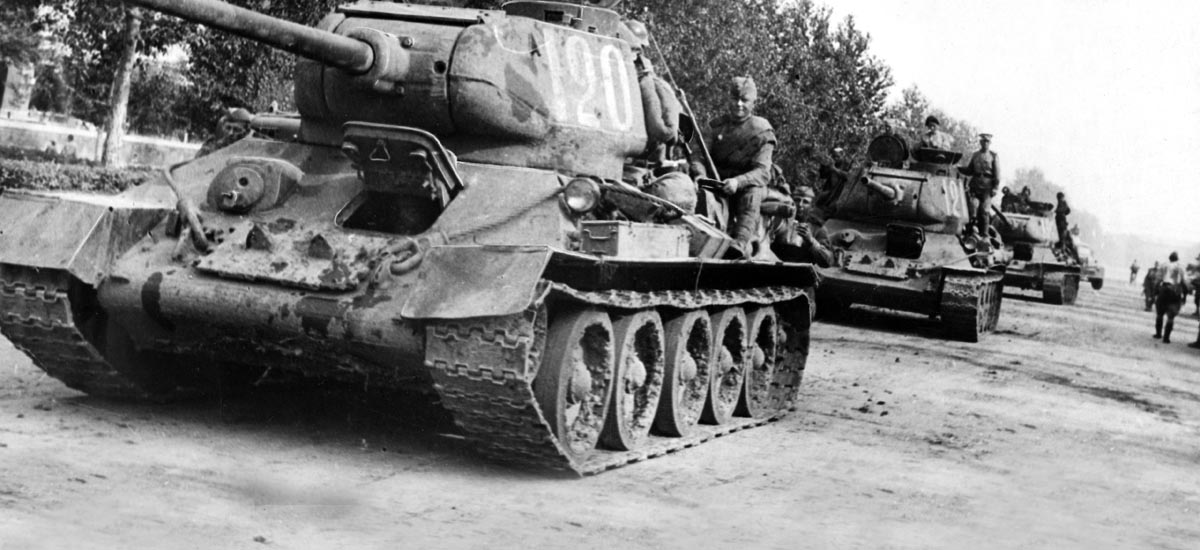
“The battle began for me with German tanks emerging from snow and fog,” Moretto said. “There would have to be something wrong with you if you weren’t frightened. That first morning when all those German tanks came over the rise with machine guns firing, they ran right over our outpost, and broke through our line, but our artillery slaughtered the infantry who were accompanying them. The German infantry never did break through our lines, but two tanks did.”
Amid heavy fighting, Moretto and his fellow riflemen heard many rumors—Germans were infiltrating U.S. lines wearing American uniforms (true); Germans were dropping tanks by parachute behind the lines (not true). Already a seasoned veteran when the fight began, Moretto got caught up in a battle he probably never could have imagined when growing up.
Born in 1924 in New York City, Moretto grew up in Hell’s Kitchen and was active in sports, including baseball and boxing.
“Soon after Pearl Harbor, which happened when I was age 17, they lowered the draft age,” Moretto said. “I was in the first group of 18-year-olds to be drafted, on February 12, 1943. The induction center was Fort Dix, New Jersey. I went to Camp Wheeler, Georgia, for 13 weeks basic training.”
After basic, the Army wanted Moretto to become a noncommissioned officer and kept him at Wheeler for further training. But the sergeant’s stripes were not to come immediately.

“I screwed up,” Moretto said. “We were on guard duty one night, and I tossed a firecracker under one of the sentry’s beds while he was sleeping.
“So they shipped me out of NCO School. I went from there to Camp Swift, Texas, and joined the 97th Infantry Division. I stayed with them a few months, and then they decided to thin out their ranks for reasons unknown to me. A group of us was shipped east to Fort Meade, Maryland. But that didn’t turn out to be our port of embarkation. We were given clothing and equipment and sent to Massachusetts. We were just replacement troops, not in a specific unit. We were in Massachusetts 10 days or two weeks and were shipped by train to Canada. There, we boarded the Mauritania, a former ocean liner that was now a troop ship, and sailed for Liverpool. There were 10 or 12 thousand troops on that ship.”
Moretto arrived in Liverpool during the first week of November 1943. He was taken to a replacement depot and then sent to Swanage, England, to join the 1st Infantry Division as a replacement. “They had just gotten back from the campaign in Sicily where they had made the invasion there,” Moretto said. “They had invaded North Africa before that. They came to England to prepare for D-day. It was widely known that we were preparing for an invasion of Europe, but no one knew where the invasion would take place. I made private first class a week or two before the invasion.”
Moretto landed on Omaha Beach on June 6, 1944, in the second wave. “If you’ve ever been on Omaha Beach, there’s a plaque to mark where we landed. We had to go up an incline and take some high ground while under fire. You can’t believe how chaotic everything was.
“We lost track of the time. My impression was, we landed in the afternoon some time. Even aboard the landing boat itself, there was pandemonium: the pilot kept running into prefabricated obstacles and sand bars, saying, ‘I’m going to get you in as close as I can.’ We were having a difficult time getting in and German artillery was falling on us. The pilot said, ‘I’m sorry, fellas, I’ve got to drop you off.’

“He dropped the ramp. Some of us were in very deep water with all our equipment. The currents were swift. And the German artillery had zeroed in on us. When we finally made it on land, there were at least a dozen guys hit by artillery. Somebody was yelling in the loudest voice I’ve ever heard: ‘Get off this beach!’ We were through a minefield. There were four of us trying to get uphill. Three of us made it and one was blown up by a mine.”
Moretto credited his survival in the early fighting to the fact that he was part of the Big Red One, a “battle-seasoned unit”that was well-trained and disciplined.
“We fought without stopping, with very little sleep, until around June 13,” Moretto recalled. “Then, we finally stopped at Caumont and got some rest. We were sticking out like a sore thumb: the British on our left flank were having difficulty keeping up with us. Their objective was to take Caen, and they were having a difficult time. The unit on our right was lagging, too, so we were kind of exposed. So we were stalled there until maybe mid-July. The 5th U.S. Division relieved us and that’s when we got a respite—but not for long.”
Moretto and his fellow soldiers were designated to make the breakthrough at St. Lo on July 25, 1944. “That’s when we broke out of Normandy,” he said. “We helped close the Falaise Gap in early August. In late August, the campaign in Normandy came to a close. We had a couple of days’ rest and then fought on through northern France and to the Belgian border. We had a very big fight in the Mons area where we ran into a very large German contingent who were trying to get back to command the Siegfried Line. We had a heck of a fight. We were badly, badly outnumbered. But we were lucky. We were in the right place at the right time. We killed a lot of Germans and captured thousands.”
Having frequent, close-quarters contact with the enemy affected soldiers in different ways. In Moretto’s case, surviving each new firefight gave him a deceptive sense of security. “Guys were getting killed within arm’s length, and I was not being touched,” he remembered. “For a time, I started thinking that I could do no wrong.”

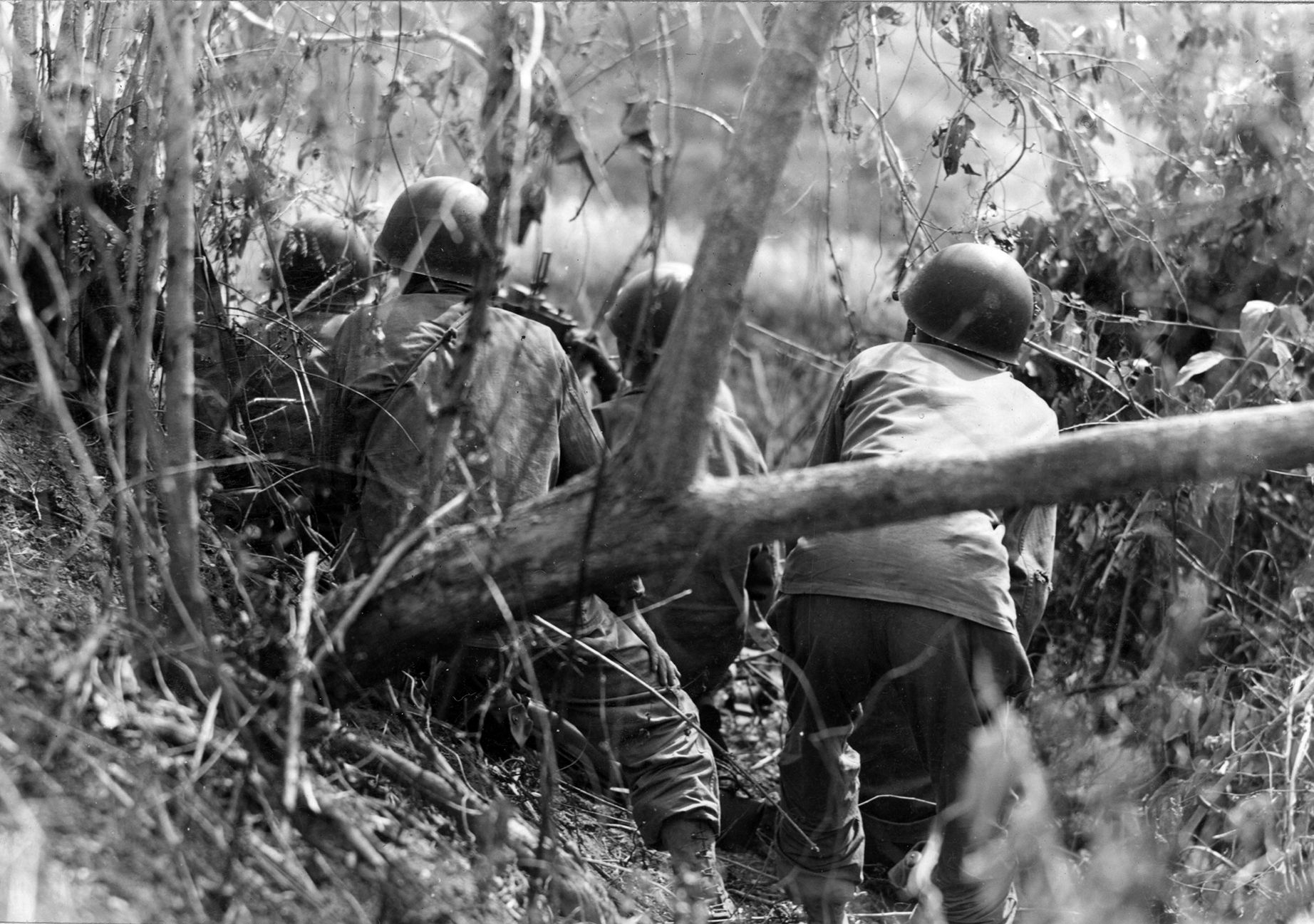
Company C was in heavy fighting in the Hürtgen Forest as summer became autumn, then winter. Moretto and his buddies were slogging through cold, wet weather with snow on the ground and fog frequently in the air.
The abrupt, front-wide counterattack by German armies on December 16, 1944, surprised Allied commanders in the Ardennes, a forested plateau in northern France that had been the scene of earlier fighting in both world wars. At various points along the front, German troops and tanks broke through American defenses. As viewed on the map, the assault created a “bulge” which, if it grew large enough, might divide the Allied armies and enable the Germans to drive for, and recapture, the major supply port of Antwerp in Belgium.
The Battle of the Bulge was the largest battle ever fought by the U.S. Army. “It was a massive attack and it was a kind of last gasp for Adolf Hitler,” according to military historian Thomas D. Jones. “The Germans opened the assault along a 50-mile front, initially with 21 infantry and armored divisions.” One German unit used captured U.S. tanks and vehicles to confuse the American defenders. Along the front, German saboteurs appeared in American uniforms, many of them speaking English and spreading inaccurate information.
The battle swept across parts of Germany, Belgium, and Luxembourg in addition to France—all in the midst of a temporary warming that produced heavy fog without providing much relief from the bitter cold.
“Of the 600,000 GIs involved,” wrote historian Stephen E. Ambrose, “almost 20,000 were killed, another 20,000 were captured, and 40,000 were wounded.” In one incident, wrote Ambrose, “7,500 men surrendered, the largest mass surrender in the war against Germany.”

Company C was transferred to a different battalion, the 2nd, just in time for the Bulge. At Dom Bütgenbach, Belgium, Moretto and his buddies came under attack from German troops and tanks.
Moretto’s battalion, commanded by Lt. Col. Derrill M. Daniel, drew the task of relieving engineers who were defending Bullingen by holding the line at Dom Bütgenbach. Not far from Moretto, the 33rd Field Artillery Battalion dug in with 105mm howitzers. As the Germans came at Moretto and his buddies late in the day on December 17, their assault began a battle in which artillery would play a key role. Most of the casualties on both sides would be claimed by howitzer and mortar shells.
Still, Moretto has vivid memories of constantly using his M-1 Garand rifle during three days of fighting between December 17 and 19. At one juncture, he sighted on a pair of German soldiers charging up a snow-covered rise about 40 feet away and pumped bullets into them. “It’s very rare when you get a clean shot at an enemy soldier with your rifle. You’re usually not closing with the enemy. The longer you go, the more you start to lose the feeling that you can do no wrong. That didn’t happen to me until after the Bulge, in April or May. Psychologically, you’re always afraid, but the longer you stay at it, the less sharp you feel. Everybody knew that you were there for the duration plus maybe six months beyond. Everybody talked about the ‘million-dollar wound,’ which was the only way to get home.”
Between point-blank fire fights, Moretto and his fellow infantrymen found themselves caught up in fierce artillery barrages. Moretto’s best friend, Sergeant Bob Wright, was killed by an exploding German artillery shell only feet in front of Moretto’s foxhole.
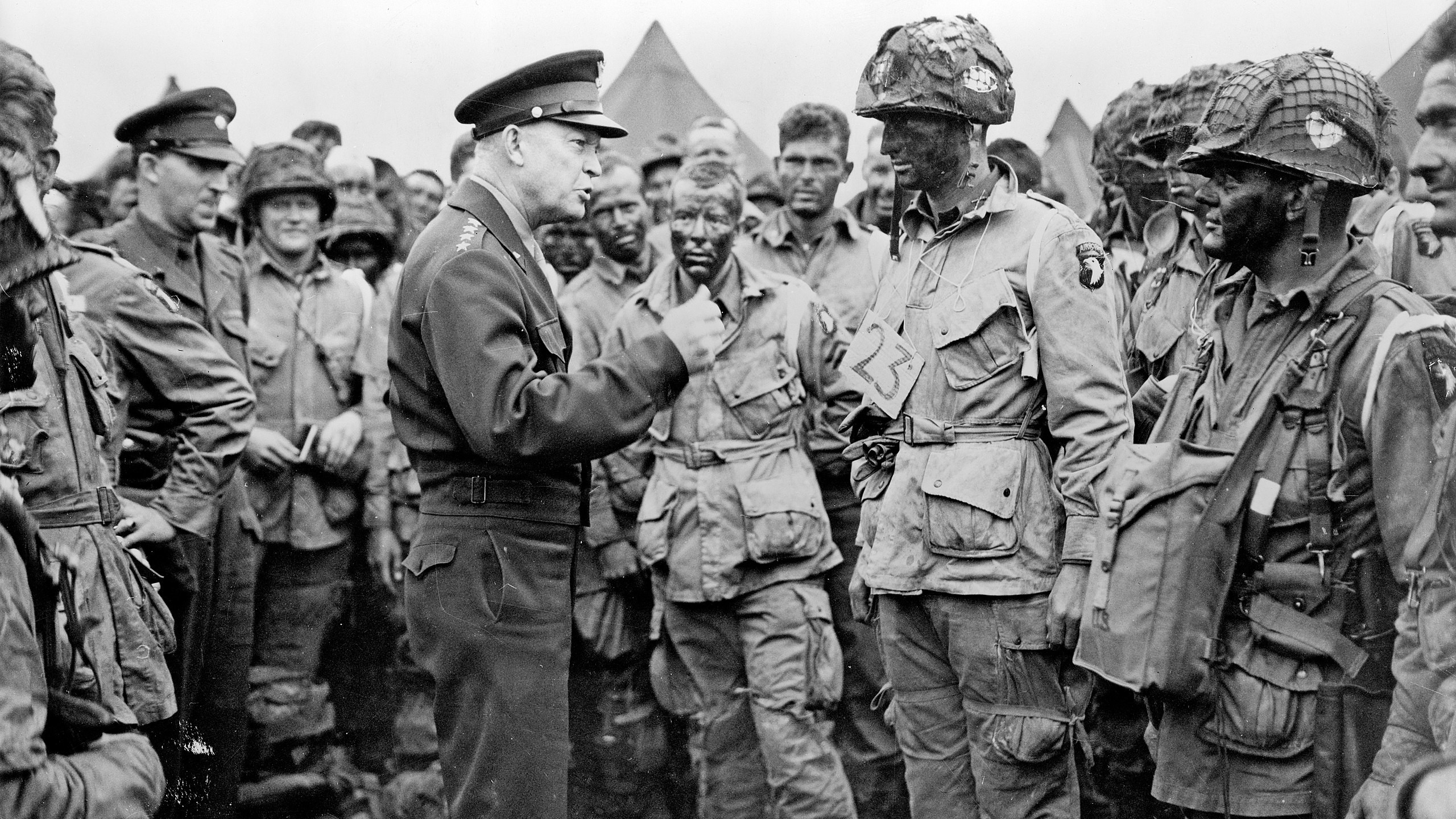
While U.S. soldiers fought in snow, fog, and muck, Supreme Allied Commander Gen. Dwight D. Eisenhower ordered in reinforcements and struggled to settle disputes among his subordinates. By December 19, American troops were surrounded at the crossroads village of Bastogne, Belgium, but when faced with a German demand for surrender, Brig. Gen. Anthony C. McAuliffe delivered the memorable reply, “Nuts!”
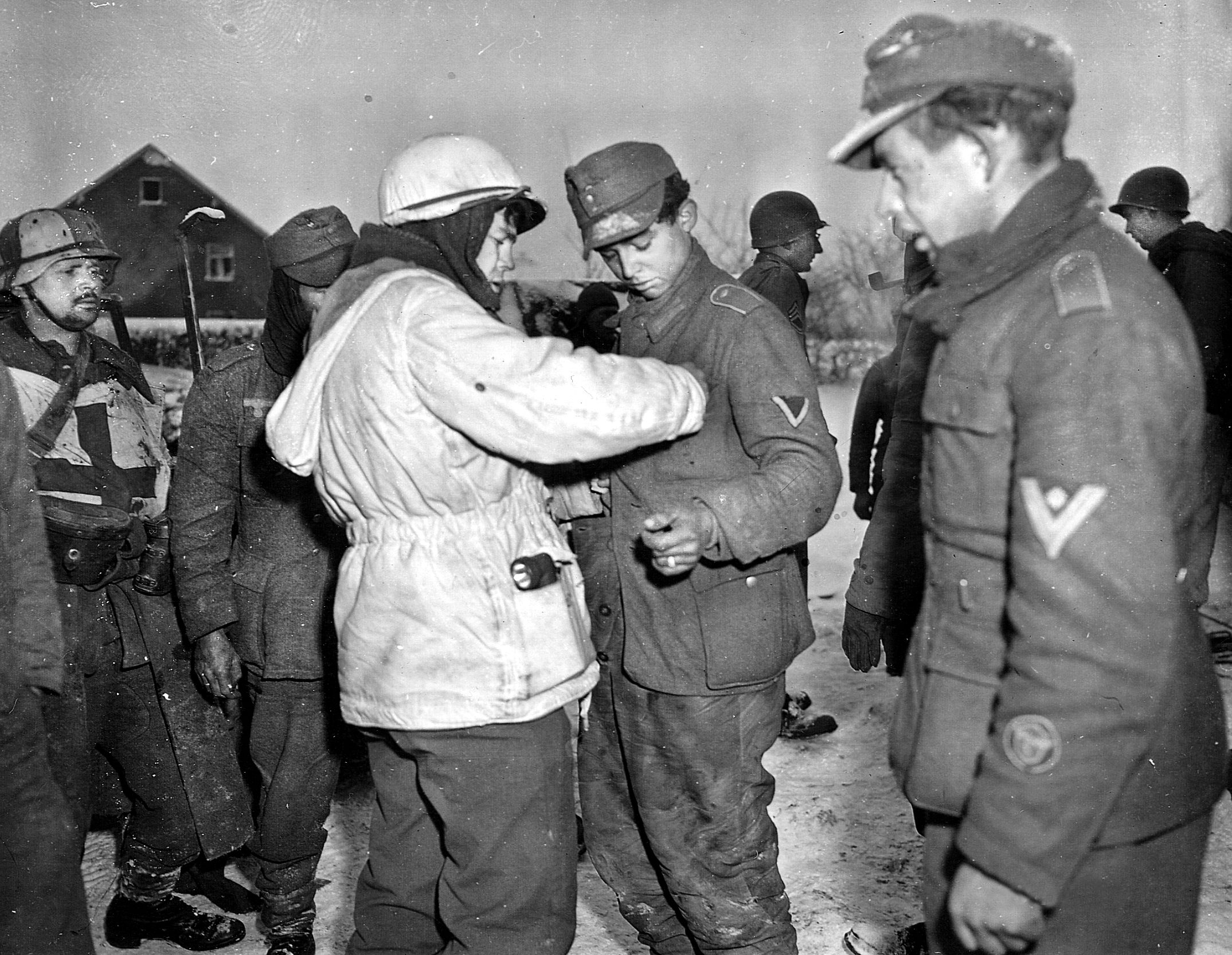
Although Moretto’s outfit stood its ground, the Germans appeared to be winning elsewhere on the front and on the verge of a breakthrough. “The rumors were flying everywhere,” Moretto recalled. “Everything changed on Christmas Day when improving weather and clearing skies enabled Allied planes to attack German troops and to parachute supplies to our troops.”
Britain’s Field Marshal Bernard Montgomery, who was nominally Eisenhower’s subordinate but feuded constantly with him, announced the end of the Battle of the Bulge in a January 7, 1945, press conference. “We Americans didn’t like that one bit,” recalled Moretto. “U.S. soldiers had carried out the bulk of the fighting.”
The German offensive in the Ardennes ended up being a significant American victory. Some 30,000 Germans were killed, 40,000 were wounded, and 30,000 became prisoners of war. Today, some view the Battle of the Bulge as prolonging the war in Europe unnecessarily. Others see the battle as signaling the end of Hitler’s Third Reich, which came in May 1945. To Rocky Moretto, it was the beginning of the end. “When the war concluded, Private Bennie Zuskin and I were the only two in my company who went through the whole thing without being killed, captured, or wounded.”
Moretto returned home after the war, worked for the Pennsylvania Railroad Company for 40 years, and was active with the American Legion and VFW. He passed away on August 26th, 2018 at the age of 94.
Robert F. Dorr was an Air Force veteran, a retired U.S. diplomat, and author of the book Air Force One, a look at presidential aircraft and air travel.
my father was in the 101st Airbourne and was wounded in the battle of the bulge while making a combat jump was wounded by a German sniper i am trying to track the name of the pow hospital where he may have been taken apears he escape from the pow camp with the help of the French underground