By Bradley P. Tolppanen
During the Second World War the Western Desert campaign was a graveyard for the reputations of British generals—all at the hands of the Desert Fox, Gen. Erwin Rommel. The first of these officers to face Rommel in the desert was Lt.-Gen. Philip Neame, who had been awarded a Victoria Cross during the Great War. After the war, he rose to the rank of general—along the way winning a gold medal at the 1924 Olympics and surviving a tiger attack while hunting in India. But by 1941, Neame’s extraordinary run of luck and success ran out. Just days after taking command of an understrength and disorganized British corps-level formation, he took the field against Rommel and the German Afrika Korps, both freshly arrived on the continent. The fight did not go well for Neame and the British.
Neame was born on December 12, 1888, and went to the Royal Military Academy, Woolwich from which he passed out sixth and was commissioned to the Royal Engineers in 1908. Described as “short, slim, wiry, and always superlatively fit,” Neame was thought to be “utterly fearless, a man of strong character, with tremendous drive and determination.”
Stationed in Gibraltar at the outbreak of WWI, Neame returned to England and was then sent to France with the 15th Field Company, Royal Engineers, in November 1914. About a month after arriving at the front, having already seen service in the First Battle of Ypres, Neame’s section was ordered to move forward on December 19, 1914 to repair and consolidate a section of enemy trenches near Neuve Chapelle that had been captured as part of an attack the previous day by the 8th Division. On reaching the part of the trenches being held by the 2nd West Yorkshires, Neame heard the sound of heavy fighting including the explosions of hand grenades—then called “bombs”—as the Germans counterattacked. The British had already lost several hundred yards of freshly gained trench and were being driven back. As the situation seemed quite serious, Neame left his sappers to work on the British trenches that then constituted the old front line and went forward by crawling along a ditch to get into the captured German trenches.
Once safely in the trench he spoke to the infantry officer in command who, amid the heavy incoming machine gun fire and hand grenades, told him that their bombers were nearly all dead or wounded and that their hand grenades would not go off. Neame told him he would see what he could do. The trench was densely packed with British infantrymen and more were coming back. Neame had to squeeze past them as he went forward. Reaching the most advanced part of the line he learned from three West Yorks holding the position that their supply of jam tin bombs were not working as their fuses were damp and could not be lit. Just then a fusillade of German grenades coming from two directions exploded forcing them to give ground. Neame knew that the British grenades could still be used and shouted for all the available bombs to be sent up to him. Acting quickly, he used a knife to cut the bomb fuse much shorter than usual and then lit it with a match. He stood up on the fire-step exposing his head and shoulders above the trench, took a quick look, and threw the first grenade. It exploded with a destructive roar. Neame ducked down and prepared another bomb. As he stood up to throw it a rifle bullet cracked past his head and a machine gun opened up. From then on every time he stood up to throw a grenade, rifles and a machine gun fired at him. Somehow the Germans missed each time. Enemy grenades kept coming over and caused heavy losses. Neame recalled that the trench about him was “a dreadful sight, men lying with bodies broken and maimed” and that he never “saw anything worse in the succeeding years of warfare.”

Guarded by an escort of two or three West Yorks with fixed bayonets in case the enemy tried to rush them, Neame kept up his one-man barrage and managed to halt the German advance. He replied with a grenade every time the Germans threw one. His bombs had an effect. The German volley of grenades slowed and then stopped entirely.
While Neame held off the enemy, the West Yorks received the order to fall back. After 20 more minutes, during which time he periodically hurled a grenade to keep the Germans back, he received a message that the infantry were all safely withdrawn. By then Neame had only seven or eight bombs left and was thus released from his task “just in time.” Accompanied by his West Yorks escort, Neame was the last to fall back from the position. After aiding some of the wounded and helping blunt a further German follow-up, he then rejoined his engineer section after a stiff morning’s work. On July 19, 1915, Neame was decorated with the Victoria Cross for his actions by King George V at Windsor Castle.
During the remaining years of the war, Neame was in the thick of the fighting, serving with the engineers at the front while holding appointments at the brigade, division, corps, and army headquarters levels. He was mentioned in dispatches five times, awarded the Distinguished Service Order, and awarded two brevet ranks, that of major and lieutenant-colonel. He also received the French Legion of Honour and War Crosses of France and Belgium.
By the Armistice in 1918, Neame was a rising star in the army. Immediately after the war he went to the Staff College as an instructor when it first reopened in 1919, this despite never having attended as a student. In the four years at Camberley, Neame counted John Dill and J.F.C. Fuller among his fellow instructors and Alan Brooke, Lord Gort, and Jumbo Wilson as students. In 1923 he published a book based on his staff college lectures, German Strategy in the Great War.
After the staff college, Neame went to Aldershot as a brigade major. He found the appointment “intolerable” and asked to go to India. He was transferred to the Bengal Sappers and Miners and arrived in India in 1925. He largely remained in the country for the next 12 years, including service on the North West Frontier and on a political-military mission to Tibet.

Neame was an excellent athlete and avid outdoorsman. He played polo, hockey for the Royal Engineers and army, rode point to point, and was an accomplished skier and mountaineer. When posted to India he tried hawking and pig-sticking. A great rifle and revolver shot, Neame was a member of the Army Rifle XX and Army Revolver VIII for several years. He competed at Bisley before and after the Great War, with his best showings being in 1910, 1925, and 1929 when he had time for adequate practice.
The peak of his sporting career was the 1924 Olympics in Paris. As a member of the British team he won a gold medal in the sporting rifle event. The team edged out Norway by a single point. Neame remains the only person to have won an Olympic Gold Medal and the Victoria Cross. Neame continued to participate in competitive shooting events into the 1950s.
Neame was an avid sportsman and big game hunter. He hunted in various parts of Britain as well as the Pyrenees, Spain, Sardinia, and Poland. In India, Neame shot tigers and panthers, and made expeditions to Kashmir, the Himalayas, and Tibet. He always emerged unscathed from these hunting trips and dangerous mountaineering expeditions—until 1934, when he was charged and mauled by a tiger while hunting in an inaccessible country in north India. The tiger had a reputation among the locals as a man-killer. Neame managed to kill the animal but was left badly injured, bleeding profusely from his arm and chest.
The mauling by the tiger cost Neame four months in hospital and a further six on medical leave. At one point the doctors thought they might have to amputate his injured arm, but in typical fashion he made a full recovery and later married one of the nurses who had attended him in hospital. They had four children.
In 1938 he returned to England and took up the appointment as Commandant of the Royal Military Academy, Woolwich. The Academy closed on the outbreak of the war and he went to France, serving as a deputy chief of the general staff with the British Expeditionary Force during the Phony War phase. In early 1940 he was sent to the Middle East to command the 4th Indian Division before being appointed General Officer Commanding, Palestine and Transjordan.

In a reshuffling of commanders in March 1941, Neame was suddenly ordered to take over as GOC, Cyrenaica Command. His appointment was made without the entire confidence of the theatre commander, Archibald Wavell.
“I did not know [Neame] well,” Wavell later claimed, but guessed that as a former instructor at the staff college and author of a book on strategy Neame was a “skillful and educated soldier” while his VC was a “guarantee of his fighting qualities.”

The Cyrenaica front against the Axis in eastern Libya was considered temporarily dormant. In Operation Compass, which had ended only a couple weeks earlier, Gen. Richard O’Connor had destroyed the Italian 10th Army and advanced across Cyrenaica. The opportunity to push on into Tripolitania was passed up as the British went on the defensive in Libya and, instead, dispatched an expeditionary force to Greece. While the British turned to Greece, Germans began landing at Tripoli under Rommel.
In Neame’s first days in command he visited all of his troops, including the forward area. It was a discouraging situation. With the transfer of British ground and air forces to Greece, his command was grossly inadequate. It consisted of only two understrength divisions, the Australian 9th and the 2nd Armoured. His army, which largely had not had training in desert warfare, was lacking in both men, tanks, and other equipment. Being deficient in motor transport and signaling equipment, the army was not fully mobile. Neame later noted that it lacked everything that made “a modern army.”
Against this, intelligence was being received that large enemy forces were assembling on the desert front and more troops were moving up from Tripoli. Based on these reports, Neame expected an imminent attack.

“The Germans had not come to Libya for nothing,” he thought and that they “would not long rest content with a defensive role.” Wavell did not share Neame’s fear of an early resumption of fighting in the desert. He disregarded Neame’s pleas for reinforcements, though with three simultaneous campaigns in Greece, North Africa, and East Africa, he had none available anyway.
Instead, Wavell ordered Neame to maintain a static defence on his front and, only if pressed, make a fighting withdrawal back to Benghazi or, if necessary, further east. The theater commander was convinced that a German attack could not be expected until early May at the earliest as it would take weeks to build up a resupply system from Tripoli to the front line in Cyrenaica. Wavell had not counted on Rommel.
On March 31, 1941, Rommel attacked. The weak forces under Neame were quickly thrown into confusion and started to crumble in the face of the onslaught. There was fierce fighting but the British started to withdraw. Three days into the offensive, Wavell flew to Neame’s headquarters. The theatre commander was unhappy with what he found. Although overly optimistic about what could be done, Wavell deemed, perhaps correctly, that Neame had lost his grip on the battle and made no effort to regain it by personally going forward. Wavell ordered Gen. O’Connor to come up from Cairo. O’Connor was not pleased at the prospect of taking over a battle that was already lost. Arriving on April 3rd, O’Connor convinced Wavell not to sack Neame. Instead, O’Connor stayed on at Neame’s headquarters as an adviser. It was a bad decision. Wavell should have backed Neame or sacked him.
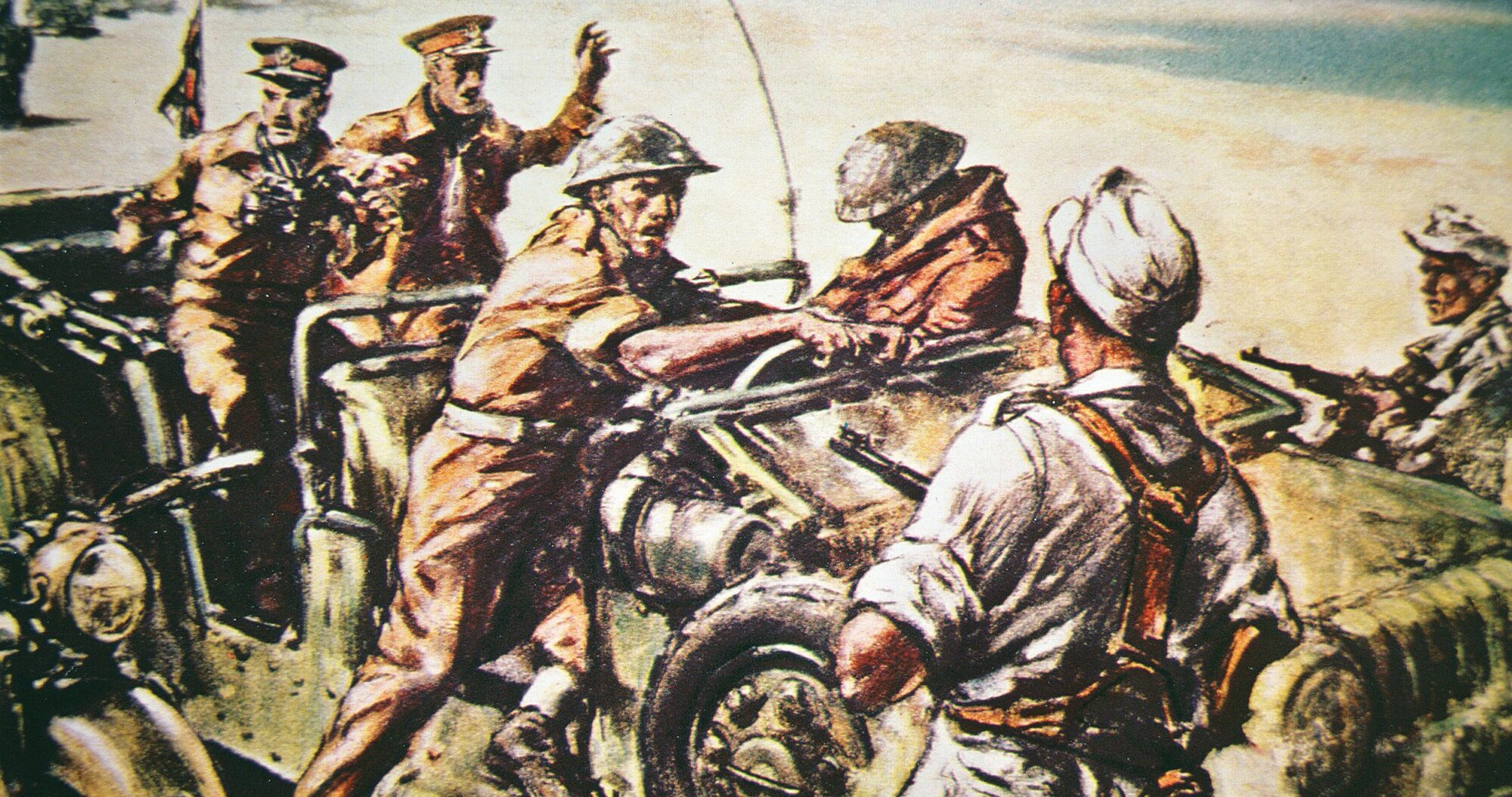
With O’Connor looking over Neame’s shoulder and Wavell interfering in his tactical dispositions, the confused fighting continued as orders and counter-orders were issued. On the night of April 6, with the British in retreat, Neame and O’Connor and their immediate staff set out by car to retire eastward. With Neame alternating at the wheel with his tired driver, they turned off the main road to Derna on to a cross-country track. Amid the dust and moonlight, they became lost in the desert. As they drove, O’Connor protested they were going too far to the north and on the wrong track. Eventually they stopped and took their bearings. Neame still thought they were all right. They resumed driving. With the two generals now asleep in the back seat of the Lincoln Zephyr staff car, they stumbled into a German patrol and were captured. The advance elements of the 3rd German Reconnaissance Battalion that grabbed Neame and O’Connor were 50 miles ahead of the last known enemy positions.
On April 7th the generals were reported missing. In their absence, the battle continued and in 12 days Rommel “swept the British forces out of Cyrenaica in a whirlwind campaign.” Neame later took consolation that his army managed to retreat eastward evading capture and that Tobruk, which had been garrisoned with sufficient forces on his orders, was held.

After their capture, Neame and the others were held in the bare desert for 48 hours surrounded by German guards. Both Neame and O’Connor removed their rank badges and hoped to slip away into the desert during the night. An opportunity did not present itself and both generals eventually provided their names and ranks. They were handed over to the Italians to be flown to Italy. They thought again of escape, of overpowering the Italians and seizing control of the plane mid-air, but the plot fizzled out.
In the first six months Neame, O’Connor, and other senior British generals and air marshals were held at the Villa Orsini on Sicily before being moved to a restored medieval castle, the Castello di Vincigliata, near Florence. The prisoners numbered about 25 and included the legendary British general Sir Adrian Carton de Wiart. As senior officer in the camp, Neame was responsible for the welfare and morale of the other prisoners.
While others used the long hours of imprisonment to sketch, garden, keep lizards, or learn Italian, Neame used his time to write a draft of his memoirs, embroider, and engage in epic backgammon duels with Carton de Wiart. More importantly, Neame and other prisoners plotted escape. Once while a search of their quarters by the Italians was underway, Neame was told that incriminating notes and plans for an escape had been left about and could be easily found. He at once bluffed his way past a guard, ran up the stairs, found the documents, and crawled out to the top of the battlements where he hid the papers under a loose tile.
A plan to escape by tunnel succeeded. Work began on the tunnel in September 1942 with Neame using his knowledge as a sapper to design and direct its construction. He worked out its dimensions, slope, and length. The tunnel was finished at the end of March 1943. On the night of March 29, Neame and his aide went into the tunnel and cut away the final nine inches of earth to the surface. It was never planned that he would be one of the prisoners to go out through the tunnel. The six selected to escape went out via the tunnel and got away from the camp. Two made it to Switzerland.
On September 7, 1943, the Italian Armistice went into effect. The Italians bundled away their VIP prisoners just as the Germans arrived and released them, telling them to board the first train at the station. Over the next four months, Neame and O’Connor hid out and scrambled over rough country by foot and bicycle to avoid recapture by the Germans. Courageous Italians hid them in monasteries, a chapel, farmhouses, isolated mountain hamlets, and homes. Neame gave these Italians the lion’s share of the credit for the British party being able to elude the Germans.

The escapees made contact with General Harold Alexander, British army group commander, by means of a courier who crossed the front lines. A plan was made to take them out by submarine and they made a three-day trek across the mountains down to the coast. The submarine, however, did not appear. They continued southward, avoiding the Germans, and hiding out in Italian homes.
A new plan was hatched that Neame and O’Connor would escape to the Allied lines aboard an Italian boat. Contact was made with the captain of a fishing trawler docked in Cattolica, which was under German occupation. Money changed hands and the captain agreed to take them south.
After dark in mid-December 1943, the British slipped past the Germans on bicycles and went aboard the boat. They immediately went below into the hold. It was blowing hard with heavy rain as the fishing boat sailed. After a day’s sailing the boat turned south around midnight. Neame and the others were then allowed on deck and as dawn broke were thrilled to see Allied squadrons overhead. When the boat put in at Allied-held Termoli, Neame and O’Connor along with the others aboard the trawler were arrested as they stepped ashore, but they quickly explained they were escaped prisoners of war.
After cleaning up, the generals were immediately taken to Bari to meet with Alexander and theatre commander Dwight Eisenhower, before being flown to Tunis. Prime Minister Winston Churchill was in the city recuperating from an illness and on learning of the generals’ escape invited them to his villa. Neame and O’Connor were interviewed by Churchill on his sick-bed and they told him of their adventures. He was very interested. In turn, he gave them a thorough update on the war that left them “spellbound.” Neame was flown back to Britain, arriving on December 25, 1943.
On returning to England, Neame was frustrated to find that no further army commands or appointments were available for him. His army career was over. In 1945 Neame was appointed Lieutenant-Governor and Commander-in-Chief of Guernsey. He published his autobiography, Playing with Strife, the following year. He had written most of the manuscript while a prisoner of war and hid it in a tomb in a monastery during the escape across Italy. It was later retrieved by a British intelligence officer and returned to him.
After an extraordinary life of danger and adventure—surviving two wars, a tiger attack, Rommel, and a prison camp—Neame died at home on April 28, 1978, at the age of 89.
Join The Conversation
Comments
View All Comments