By Christopher Miskimon
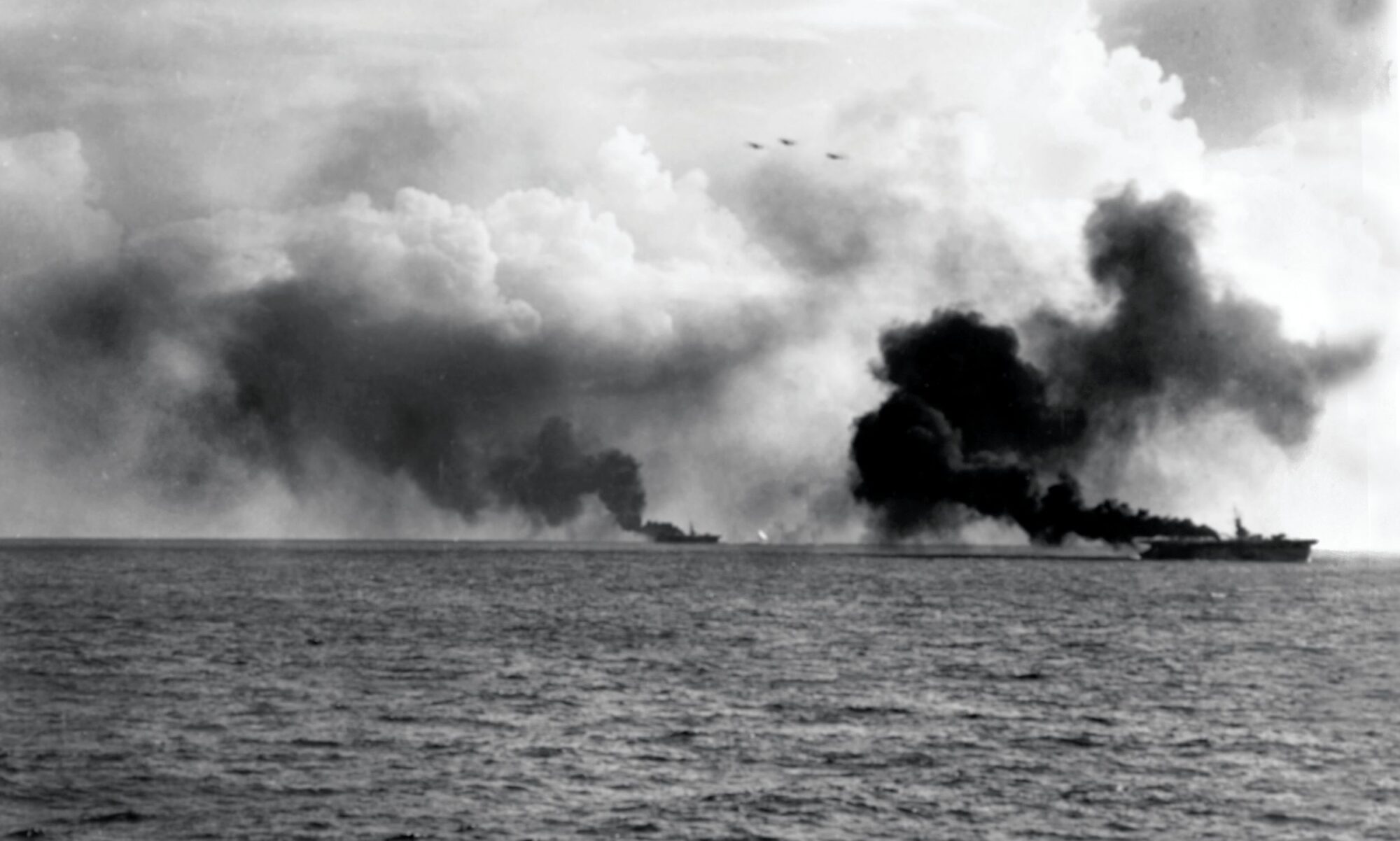
History often remarks on the attack on the Japanese battleship Yamato, but her sister ship, the Musashi, suffered a similar fate at the Battle of Leyte Gulf. A massive American air attack struck the ship and its task force on October 24, 1944, two hours after being spotted by reconnaissance planes from the carrier USS Intrepid. The task force was transiting the Sibuyan Sea on its way to Leyte Gulf to attack the American landing forces.
Whatever targets the American pilots were assigned, Musashi drew most of their attention. The ship’s size made it a magnet for attack, the first one from Helldiver dive bombers from Intrepid. One bomb struck the No.1 turret, doing little damage due to its armor. Other near misses put holes in the hull and caused flooding, particularly in the bow. Next, Avenger torpedo bombers began their runs as Hellcat fighters strafed the decks to suppress the antiaircraft gun crews.
After the torpedo attack, more dive bombers went in. Musashi appeared like a wounded animal, obviously damaged and vulnerable as she was down at the bow. One bomb caused extensive damage to one of the engine rooms, slowing the ship further. The dive bombers scored more near misses, but most importantly they were well coordinated with the torpedo bombers this time. Three of eight torpedoes struck Musashi, causing a list which was mostly corrected by counterflooding. At this point the ship was in no danger of sinking despite the damage.
The following attack did more harm. More bomb hits did only moderate damage, with one bomb hitting the bow and causing more flooding. The four additional torpedo hits proved far more serious, putting Musashi in real danger. Such damage would have sunk other ships, but Musashi was tough, and its crew performed excellent damage control. However, the previous efforts had used up its reserve buoyancy.
 Most of the American planes made their next attack on other ships, but a group from Enterprise selected Musashi and her escorts, now separate from the rest of the Japanese force. By now the battleship was down to twelve knots, only a quarter of her antiaircraft guns were still operational and the ship could barely maneuver. A few planes from other carriers joined the attack. Japanese sources record ten more bomb hits and more torpedo hits. By late afternoon the ship was circling slowly, not answering her helm. Two hours later, soon after the executive officer gave the order to abandon ship, Musashi began a slow roll to port. At 7:35 p.m., the ship sank beneath the waves, taking over 1,000 crew with her. The Japanese picked up 1,376 survivors. They went to the Philippines, where they later took part in the Battle of Manila.
The sinking of Musashi was just one part of the Battle of Leyte Gulf, the largest naval battle in history. This battle spelled the end of the Japanese Navy as an effective fighting force. Leyte Gulf: A New History of the World’s Largest Sea Battle (Mark Stille, Osprey Books, Oxford UK, 2025, 320 pp., maps, photographs, Bibliography, index, $23, SC) tells the story of this battle in great detail.
The author is an established expert on naval warfare in World War, and particularly the War in the Pacific. This latest volume continues his series of excellent studies with a look at the last critical naval battle of the war. It is well-written and results from the usual attention to detail and thorough research. His evaluations of the various phases of the battle make sense and he deftly puts to rest misconceptions about the battle and the performance of Halsey and Kurita. The book’s conclusions are logically derived and backed by reasonable evidence.

Join The Conversation
Comments
View All Comments