By Joshua Shepherd
Convinced that a major fight was in the offing, 33-year-old Colonel John T. Wilder clambered up the branches of a nearby tree as the sun dipped below the horizon. As the unassuming Indianan surveyed the cornfields and woodlots of north Georgia in the fading light, the men of his mounted cavalry brigade filed into position on the bottom ground flankingWest Chickamauga Creek. Uniquely armed with Spencer repeating rifles, his brigade was routinely given the toughest of assignments in the Federal Army of the Cumberland.
From his perch, Wilder saw a large cloud of dust reflecting the sun’s final rays about two miles away. It was September 17, 1863, and after two and a half months of chasing demoralized Rebel troops, it looked as if Federal luck had finally run out. Shinnying down the tree, Wilder calmly informed the knot of onlooking officers that the dust cloud was “the advance of Bragg’s army.”
The Confederacy’s vaunted Army of Tennessee was about to turn the tables on its Yankee pursuers, provoking the bloodiest battle of the Civil War’s western theater.
Wilder’s brigade garnered a reputation as one of the most legendary fighting outfits of the Civil War largely due to Wilder’s audacious and innovative leadership. He was the quintessential self-made man of America’s industrial era. Initially apprenticing at an iron foundry, the ambitious Wilder eventually mastered both engineering and hydraulics and found financial success by establishing his own foundry in Greensburg, Indiana.
He served a stint in the artillery at the outbreak of the Civil War before securing commission as colonel of the 17th Indiana Infantry. Widely regarded as a highly intelligent officer and charismatic leader, Wilder experienced varied fortunes in his new role. In 1862 he was initially successful in repulsing Confederate attacks on Munfordville, Kentucky, but was eventually forced to surrender and spent two months as a POW.
By the early months of 1863 Wilder was paroled and back in command of a brigade attached to the Army of the Cumberland, then operating in Middle Tennessee. Composed of Indiana and Illinois troops, Wilder’s brigade was assigned routine duties that included the pursuit of Rebel cavalry detachments. Invariably, such assignments proved fruitless as enemy horsemen easily outpaced Wilder’s footsoldiers.
The futile pursuit of Confederate cavalry caused Wilder, always an innovative thinker, to consider other options. His conclusion, seemingly obvious in hindsight, was nonetheless revolutionary at the time—his brigade would ride, not as cavalry, but as mounted infantry.
Wilder considered his solution to be the best of both worlds for his men, offering the mobility and reach of the cavalry with the firepower of line infantry. When he approached Maj. Gen. William Rosecrans for permission to implement the plan, he responded with enthusiasm. Wilder’s brigade took final shape with the 17th and 72nd Indiana as well as the 92nd, 98th, and 123rd Illinois. The brigade also possessed its own organic artillery outfit, the 18th Independent Battery Indiana Light Artillery. The battery was commanded by the diminutive but talented Capt. Eli Lilly, an unassuming druggist turned soldier.
By nature dismissive of army red tape, Wilder secured mounts for his men by dispatching foraging parties across a wide swath of Middle Tennessee. Wilder’s men scoured the countryside, seizing horses and mules from terrified farm families. Horses were taken from barns and pastures, and, in one notable instance, from the home of a family who unsuccessfully attempted to hide a horse in their front parlor.

As soon as it was mounted, Wilder’s brigade was put to use in the field, pursuing parties of Confederate cavalry that hovered around Rosecrans’ flanks and threatened the army’s supply lines. Wilder’s outfit quickly became a favored strike force for Rosecrans, who valued the hard-hitting mobility that Wilder’s mounted infantry could afford.
Wilder was unexpectedly presented with a new opportunity in the spring of 1863. Christopher Spencer, an up-and-coming Connecticut arms inventor, appeared in Murfreesboro in March to make a sales pitch to the top brass of the Army of the Cumberland. Always intrigued by innovation, Wilder attended the demonstration.
For its time, the Spencer rifle was a revolutionary development in military small arms. It was a breech-loading, .52-caliber repeater that could hold up to seven rounds in a tubular magazine that fitted into the stock. The rifle utilized self-contained metal cartridges which fed into the chamber simply by operating the trigger guard, which served as a loading lever. An infantryman could fire seven shots in as many seconds. In a war dominated by single-shot muzzleloaders, the Spencer was revolutionary.
Although Rosecrans showed little more than a passing curiosity in the Spencer, Wilder was fascinated and quickly determined to arm his entire brigade with the rifle. Fully aware, however, that an ossified army bureaucracy would likely fail to take any action, the colonel initially resorted to old-fashioned Hoosier ingenuity, asking the men to pay for the weapons out of their own pay. Ultimately, such a move wasn’t necessary, and the War Department supplied Spencers for Wilder’s five regiments.
Despite regular scrapes with isolated enemy detachments, Wilder’s men had yet to face the test of a stand-up fight with Confederate troops. But that would change as Rosecrans made plans for the campaign season of 1863.

Rosecrans’ ultimate goal was Bragg’s primary base of supplies, the vital Confederate rail hub of Chattanooga, Tennessee. But of immediate concern to Rosecrans was Gen. Braxton Bragg’s Army of Tennessee, positioned on good ground on the Duck River about 25 miles from Murfreesboro. While feinting at Bragg’s left, Rosecrans hoped to seize a vital pass at Hoover’s Gap, a move which could dislodge the Confederates. The crucial task of taking the gap was assigned to Wilder’s mounted brigade.
Before daybreak on June 24, Wilder led a charge into the mouth of the gap, where they quickly scattered a small outpost of Confederate cavalry. Recognizing that the pass was inexplicably unguarded, Wilder decided to occupy the gap before enemy troops could retake the position.
The brigade held the gap against repeated counterattacks, and when word of the heavy musketry made its way to the rear, Wilder’s immediate superior was alarmed. Maj. Gen. Joseph Reynolds, concerned that the overextended mounted infantry would be overrun, sent orders for Wilder to disengage. The colonel would have none of it. Convinced that he could indeed hold the priceless real estate of Hoover’s Gap, the fiery Wilder brushed off the order, kept fighting, and held the position.
Although Wilder initially feared a reprimand for the incident, Rosecrans was delighted by the Hoosier’s risky initiative. The bold move had spared the infantry a tough fight for Hoover’s Gap, and, it was thought, saved 2,000 lives. In the wake of the fighting an ebullient Rosecrans gave Wilder’s men a well-earned nom-de-guerre: the Lightning Brigade.
With Federal troops pouring through Hoover’s Gap and his supply lines gravely threatened, Bragg was forced to abandon the region and fall back to Chattanooga. Without so much as a major battle, Rosecrans had succeeded in prying Bragg out of Middle Tennessee. It had been a remarkable whirlwind campaign of successful maneuver, but it failed to impress Washington authorities.

Insistent on the outright destruction of the Army of Tennessee, the Lincoln Administration hectored Rosecrans to maintain momentum and press home an attack on Chattanooga. The embattled Rosecrans developed an ambitious plan. Rather than directly assault the bastion of Chattanooga, Rosecrans launched a feint north of the city while the bulk of his army moved well to the south over backroads that crossed Lookout Mountain. With luck, the immense flanking column would then drive east, cutting off the Confederates in Chattanooga.
To pull it off, Wilder’s Lightning Brigade was given a crucial assignment meant to occupy Bragg’s attention. On August 21, the lead elements of the Lightning Brigade abruptly appeared on the north bank of the Tennessee River, just opposite downtown Chattanooga. The van of Wilder’s column shot up a startled enemy ferry boat, while terrified parishioners poured out of Chattanooga’s churches. Captain Lilly unlimbered his guns and shelled the city, exchanging fire with enemy guns on the south bank.
The brigade would occupy the position for more than a week as Wilder put his men to work noisily pounding on wooden barrels and sawing planks to give the impression that his brigade was building boats in preparation for a river crossing.
Bragg took the bait and concentrated his army in that direction. On the vital mountain passes south of the city, only a thin screen of cavalry was in position to stop a potential Federal thrust.
Southwest of Chattanooga, all was proceeding according to Rosecrans’ plan. Federal troops were able to cross the Tennessee River virtually unmolested on the morning of August 29. The blue columns then pushed eastward over the rugged barriers of Sand and Lookout Mountains to the delight of Rosecrans. But when Bragg finally realized the threat to his lines of communication, he abandoned Chattanooga and fell back into north Georgia.

Meanwhile, the Army of the Cumberland inched its way forward in a wide arc south of the city, pushing east across the mountains in its search for the Army of Tennessee. Wilder’s brigade crossed the Tennessee River on September 10, then made a forced ride toward Ringgold, Georgia. The following morning they tangled with Rebel cavalry just north of the town, but easily turned back two enemy counterattacks. The following day, Wilder’s men pushed southeast toward Tunnel Hill and once again skirmished with enemy cavalry. Wilder then received orders to disengage and head southwest for LaFayette, Georgia.
The brigade would have little respite during the following day. By the afternoon of September 12, his exhausted troopers cantered into Leet’s Tanyard southwest of Ringgold, where the Federal column abruptly encountered Confederate cavalry just a hundred yards ahead. Both sides dashed for cover and Wilder scrambled to dismount his men and form up in line of battle.
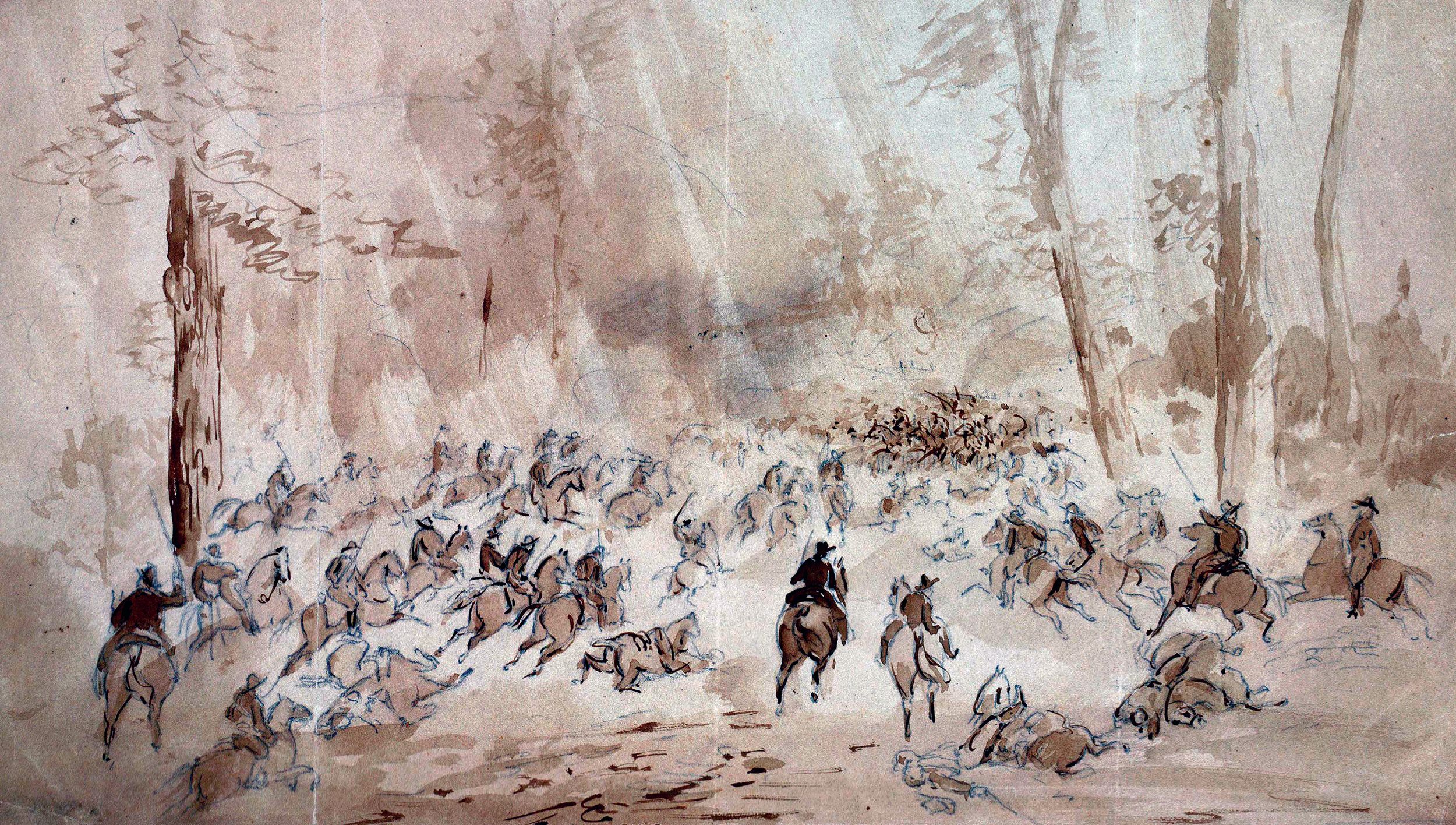
Brig. Gen. John Pegram’s Confederate cavalry division had spent the night around Leet’s Tanyard, and they sprang into action at the sight of approaching Yankee horsemen, driving hard against the 17th and 72nd Indiana that formed Wilder’s main line. Overwhelmingly outnumbered, Wilder tried to pin down the advancing Confederates by ordering Col. Abram Miller to mount up four companies of the 72nd and circle around the enemy’s right flank.
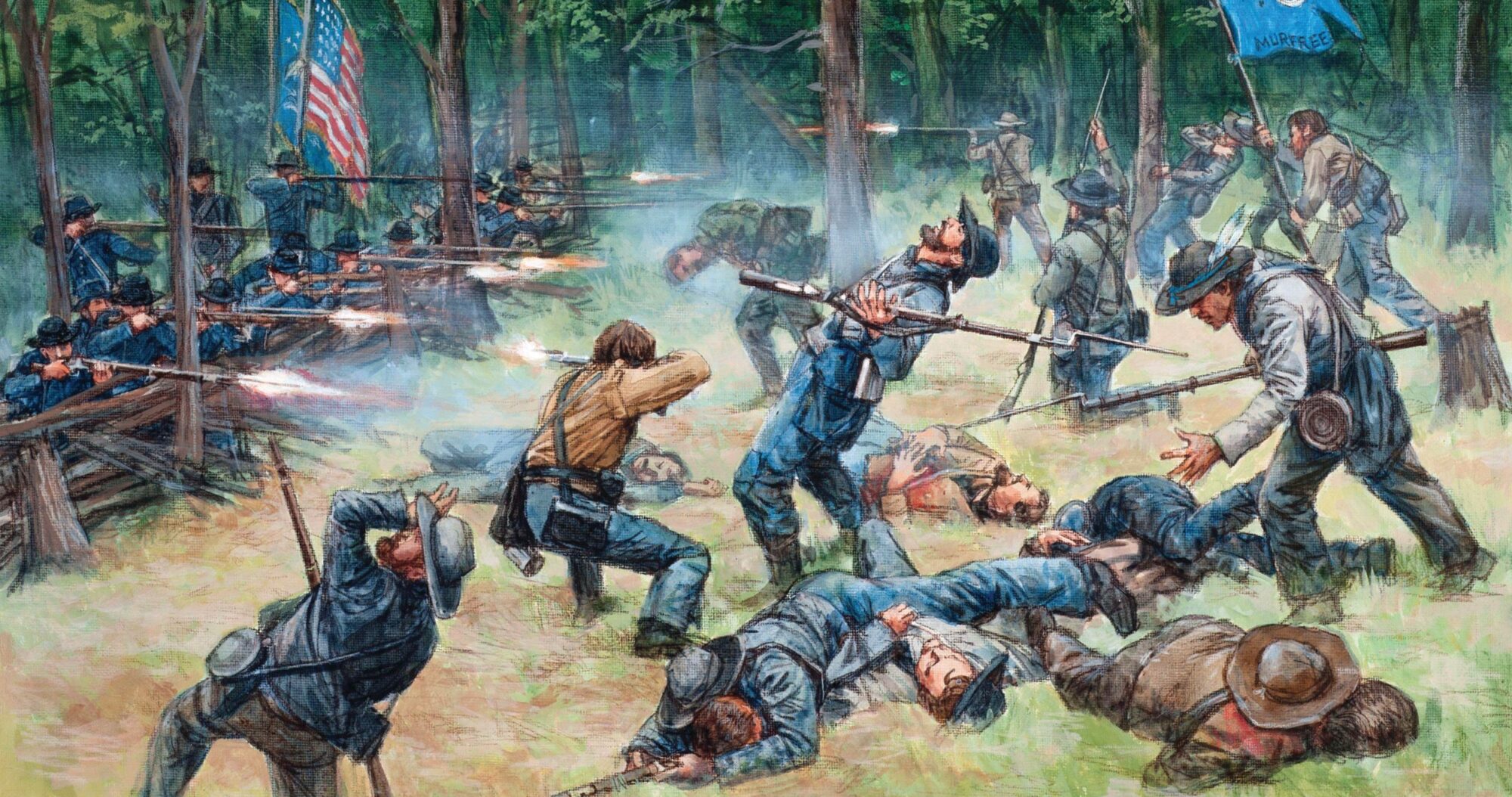
Groping their way through thick timber, Miller’s column blundered into Confederate skirmishers, then watched in horror as a fresh Rebel battle line appeared directly to their front. Miller’s badly outnumbered troopers dismounted atop high ground and opened fire with their Spencers.
Fire swept across the ridge as the dismounted Confederate cavalry attempted to overlap Miller’s flanks. The unrelenting fire from the Spencer rifles began to turn the tide in favor of Wilder’s troops. Pegram’s veterans gave a good accounting of themselves, unleashing several volleys as they attempted to outflank and overrun Miller’s beleaguered troops.

But the Lightning Brigade’s superior firepower was simply too much. After two hours of tough fighting, the Lightning Brigade kept a tenacious hold on the ground. Pegram was forced to pull back, gathering up 50 dead and wounded; Wilder lost 20 men.
But Wilder’s troubles were far from over as the Yankee troopers could still see massive columns of Confederate troops, “as thick as thieves,” thought one soldier, little more than a half mile away. That night, Wilder spurred his brigade west but it soon became apparent that they were boxed in. Confederate campfires were plainly visible, effectively blocking the brigade’s escape route. Wilder’s scouts, however, found a local farmer who showed them a little-used country lane that was clear of enemy troops.
Peering apprehensively through the darkness, expecting to be discovered at every moment, the brigade succeeded in slipping between enemy camps undetected. By the early morning hours of September 13, Wilder’s men, safely outside the Confederate cordon, breathed a sigh of relief.
Wilder remained concerned that, far from being on their heels, Confederate forces were preparing for a fight. His men had captured enemy correspondence indicating that the Army of Tennessee was being heavily reinforced by Confederate troops from Mississippi and Virginia.
Rosecrans was initially hesitant to believe Wilder’s reports. But after examining the captured documents, he moved swiftly to begin pulling his scattered commands together, concentrating around Lee and Gordon’s Mill along the LaFayette Road, a primary thoroughfare that ran back to Chattanooga.

Despite exercising caution, Rosecrans and the bulk of his senior command stubbornly believed that Bragg was in full retreat and unlikely to seek battle. But far off of Rosecrans’ left flank, Col. Robert Minty, a capable cavalry brigade commander, likewise reported troubling developments in his front. From his position guarding Reed’s Bridge over West Chickamauga Creek, Minty’s troopers were encountering a growing Confederate presence.
As a precaution, Rosecrans ordered the Lightning Brigade to plug a yawning gap between Minty’s Brigade and the Army of the Cumberland’s left flank. Wilder took up a strong position overlooking Alexander’s Bridge, one of the few wooden spans over West Chickamauga Creek. By the evening of September 17, Wilder had most of his brigade, minus the 92nd Illinois, on good ground covering the bridge.
The creek, which meandered through boggy bottom ground, was only 100 feet wide, but its steep banks were impassable to infantry columns. Wilder ordered most of his men into position at the crest of a slight ridge overlooking the river; the position was bolstered by the guns of Lilly’s Battery, which had a clear field of fire toward the bridge. Wilder sent forward several companies from the 17th and 72nd Indiana to serve as skirmishers in the bottom ground. As his men settled in for the night, Wilder remained convinced that the Confederates intended to give battle.
In fact, Bragg had been gathering the Army of Tennessee for several days and was moving quickly to strike. While the bulk of the Federal army was concentrated near Lee and Gordon’s Mills, Bragg meant to throw the full weight of his army several miles to the north in a massive turning movement against Rosecrans’ left.
While Lt. Gen. Leonidas Polk’s corps tied down Federal forces at Lee and Gordon’s Mill, Maj. Gen. Simon Bolivar Buckner’s corps would cross the West Chickamauga at Thedford’s Ford. Maj. Gen. William H.T. Walker’s Reserve Corps would make a crossing at Alexander’s Bridge, while a provisional division under the command of Brig. Gen. Bushrod Johnson would attack at Reed’s Bridge.

The ominous intelligence that Wilder had reported in the aftermath of the Leet’s Tanyard fight was all too accurate. Bragg’s army was indeed beginning to swell with reinforcements hastily rushed to Georgia by rail. Three brigades had already arrived from Mississippi and had been assigned to Bushrod Johnson. A fourth outfit, the famed Texas Brigade, had likewise been assigned to Johnson. And more troops were on the way. Bragg was hourly expecting the arrival of two more crack divisions from Lt. Gen. James Longstreet’s I Corps, on loan from Robert E. Lee’s Army of Northern Virginia.
On September 18, things remained quiet for much of the morning, and Company A of the 72nd Indiana was ordered to the far side of the creek. The men performed picket duty but also engaged in a bit of foraging. But at 10 a.m., bedlam erupted. The Hoosiers were startled by Confederate cavalry, who immediately charged for the bridge in an attempt to grab a few prisoners. Terrified Yankees jumped into the creek to escape the trap, while their comrades on the other side opened fire, driving off the enemy cavalry.
The mounting contact with the enemy increasingly indicated that the Confederates were preparing for a major attack. At 11 a.m., Colonel Minty, guarding Reed’s Bridge to the north, sent Wilder a desperate plea for reinforcements. Although Minty was fighting a stubborn delaying action, his brigade was hard pressed by Rebel troops.
Loath to weaken his own command but eager to assist Minty, Wilder ordered half his available manpower—the 123rd Illinois, seven companies of the 72nd Indiana, and a section of Lilly’s Battery—to Minty’s support. Wilder was left with fewer than 1,000 effectives to defend Alexander’s Bridge. In preparation for the attack that was clearly coming, he ordered the planks to be removed from the bridge; troopers used the lumber to create a crude breastwork across the road.
By 1 p.m., a Confederate line of battle emerged into the fields opposite Alexander’s Bridge. It was a veteran Mississippi brigade under the command of Brig. Gen. Edward Walthall; As he and his men waited for the Rebels, Sgt. James Barnes couldn’t help but admire their tight discipline. “They came up in splendid style,” he wrote, “even and steady, bayonets fixed and gleaming in the sun.”

The martial spectacle was short-lived. As soon as the Mississippians came into view, Lilly’s Battery opened up, sending a deadly salvo of percussion shells and canister screaming toward the Confederates. At 350 yards, the cannoneers could hardly miss. Two batteries of Confederate artillery emerged from the woodline and unlimbered in an attempt to silence Lilly’s guns.
In the midst of the artillery duel, Walthall’s Mississippians closed up ranks and pressed forward. As they neared the bridge, the Confederates on the left of Walthall’s line were targeted by the 17th Indiana; shaken by the intense rifle fire, the Confederates went to ground in the cornfield and attempted to return fire. In the ranks of the 34th Mississippi, the fire from the Spencers proved devastating; in a brief but intense firefight, the regiment lost nine men killed and twenty-five wounded.
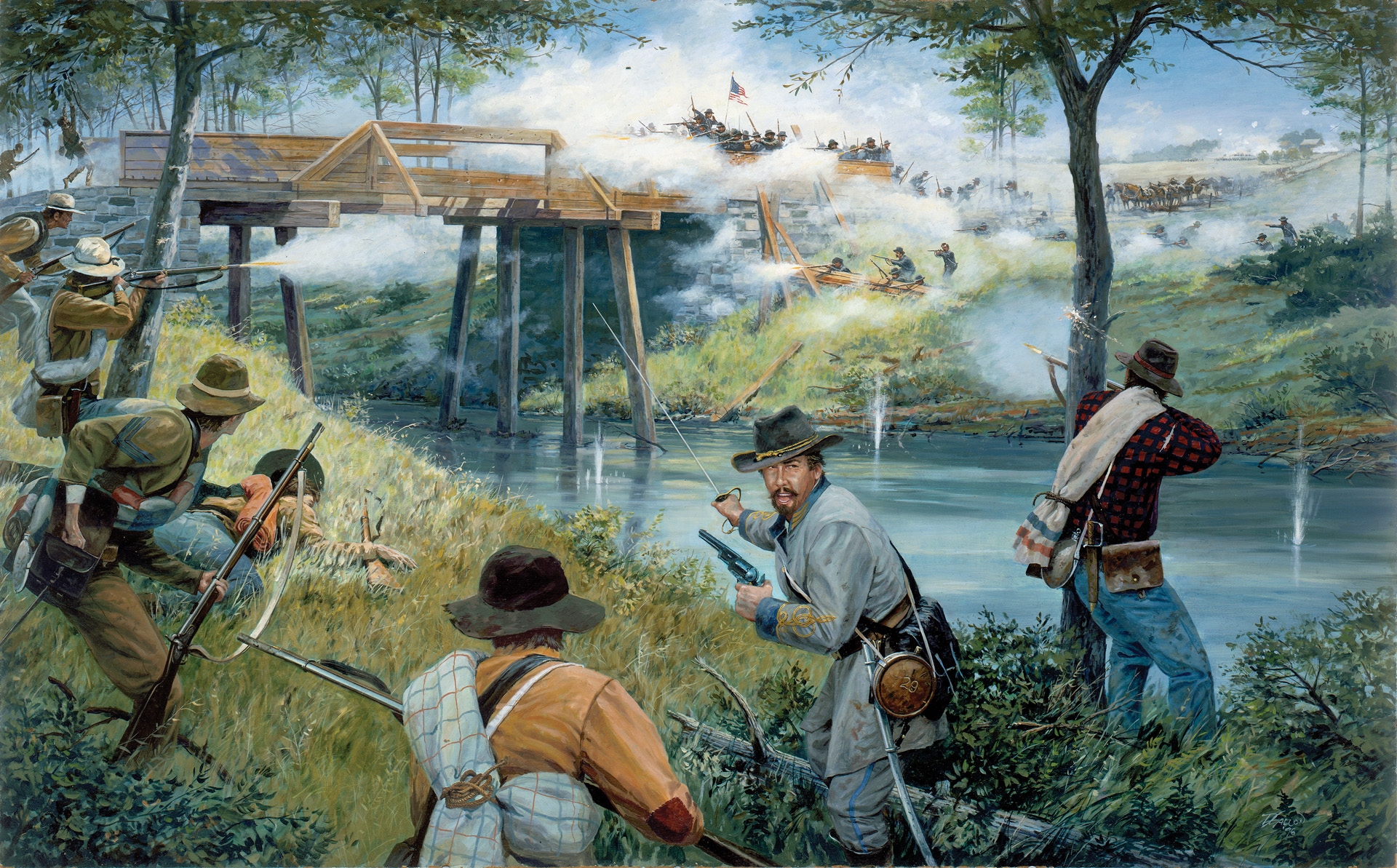
Pushing forward astride the road, the 29th Mississippi hit a brick wall. The men from Company A, 72ndth Indiana, concealed behind their improvised breastwork, nervously waited for the Rebels to come within range—close enough to see their “eyes bat,” according to Barnes. As the Confederates neared the opposite end of the bridge, Wilder’s men opened fire, crumbling the front rank. Their momentum stalled, the Mississippians fell back. Private George Bailey, 17, recalled that the Rebels “dropt like hogs.”
The Mississippians rallied for a second push, and spread out in a hopeless attempt to flank the Hoosiers behind the barricade. As the Confederates pushed ahead, Company A chewed up the center of the Mississippians’ line. The roar of gunpowder filled the valley as both sides stubbornly fought for control of the vital crossing. A few diehards from the 29th Mississippi made it close to the bridge to see that the planks were gone.
When informed the bridge was worthless, Confederate corps commander Gen. Walker ordered Walthall to disengage and cross West Chickamauga Creek a mile north at Byram’s Ford (also known as Lambert’s Ford). The Lightning Brigade’s stubborn defense of Alexander’s Bridge had cost the Confederates heavy casualties, and precious time.

Though Wilder’s brigade had turned back repeated attacks, their position was untenable as the Confederates crossing downstream threatened their left flank. Wilder gave the order to evacuate, with most of the brigade heading west, but Company A, fighting from behind their breastwork, was nearly captured en-masse.
Swift moving Rebel infantry unexpectedly approaching from downstream fired through the underbrush, felling A company’s horses and mules; only a single mount survived the gunfire, forcing the Hoosiers to dash pell-mell for the rear in small groups. Remarkably, only a single man was wounded during the chaotic retreat, with just a few casualties overall. In the field behind them lay 105 dead and wounded Confederates.
Wilder regrouped his brigade on the sprawling Viniard family farm, continuing to skirmish with the Confederates, who were clearly present in force and probing Union positions in anticipation of a major attack. By 7 p.m., three Confederate brigades were dangerously threatening Wilder’s understrength command.
Confronted with the reality that a reinforced Confederate army was preparing to launch a major turning movement the following morning, Rosecrans took action. To protect his flank and blunt the attack, Rosecrans ordered the entire army to shift north and take up new positions roughly parallelling the LaFayette Road.
While fresh Federal infantry began taking up position on Viniard’s farm, Wilder’s exhausted troopers, finally reunited with the reinforcements that had been lent to Minty, fell back to the edge of a cornfield west of the LaFayette Road.

There, along a belt of timber crowning a subtle ridge, Wilder deployed his brigade in a very strong supporting position. The brigade’s right was anchored by the 72nd Indiana. To their left was positioned the 123rd Illinois, four guns from Lilly’s battery, and the 17th Indiana. Wilder’s left was held by the 98th Illinois, and bolstered by two of Lilly’s guns. Anticipating a tough fight on the morrow, the men threw together an improvised breastwork of fence rails and tree limbs.
The morning began quietly enough for the Lightning Brigade, but off to the northeast, a storm was about to descend on the Army of the Cumberland. Rosecrans had succeeded in shifting Maj. Gen. George Thomas’ XIV Corps north to protect his line of communication with Chattanooga, but had little time to prepare for the expected attack.
The following morning, Thomas received erroneous intelligence that only a single Confederate brigade had crossed the West Chickamauga. Consequently, he only dispatched a division under Brig. Gen. John Brannan to clear out the Rebels. Brannan was soon beset by veteran Confederate infantry as Bragg poured reinforcements into the battle.
Over the subsequent hours, the fighting intensified and moved south as fresh troops were inevitably drawn into the vortex of the fighting. In the isolated farm fields and dense thickets west of West Chickamauga Creek, the battle degenerated to a confused slugfest into which individual brigades were thrown piecemeal.
To the common soldiers of the Lightning Brigade, the ominous roar of battle portended a coming trial of their own. Bugler Henry Campbell described a “low, distinct rumbling, gradually approaching, like a distant hail storm.” Veterans recalled that the men grew quiet under the pressure of waiting. By the afternoon, events would, indeed, rapidly overtake Wilder and his men.

In the hope of striking the Confederate left, Rosecrans ordered two brigades to cross the Viniard farm and head for the sound of battle. Brig. Gen. William Carlin led his brigade, bolstered by the 2nd Minnesota Battery, into open farm ground east of the LaFayette Road. On his left, Col. Hans Heg led his men at the double-quick into thick woods.
Heg and Carlin slammed into a crack division of Rebel troops under the command of Maj. Gen. John Bell Hood. Most of Hood’s men were seasoned veterans of the war in Virginia, and coolly poured musketry fire into Heg’s ranks. In the East Viniard Field, Carlin was caught in a maelstrom. Trapped in the open as their ranks were swept by musketry and artillery, Carlin’s troops broke for the rear.
As they did so, the guns of the 2nd Minnesota Battery were left without infantry support. Wilder ordered the 72nd Indiana and 123rd Illinois to mount an attack to rescue the guns. Coming on at the run, Wilder’s men formed up near the LaFayette Road and opened fire, badly chewing up the left flank of the famed Texas Brigade, under Brig. Gen. James Robertson.
But as Heg’s brigade likewise began to give way, the Confederate brigade of Brig, Gen. Evander McNair surged across the grounds of the Brock farm just north of West Viniard Field. Wilder kept a cool head. He ordered the 72nd Indiana and 123rd Illinois to disengage from the Texas Brigade and fall back to his main line. With his own position secured for the moment, Wilder ordered his 98th Illinois and 17th Indiana, along with two of Lilly’s guns, to turn and fire into McNair’s dangerously exposed left flank.
With a clear field of fire, Lilly’s guns played havoc in McNair’s ranks, and the unrelenting fire from the brigade’s Spencers ripped apart McNair’s leftmost regiment, the 25th Arkansas. Caught in the open and with no visible support, McNair ordered his battered brigade to fall back.
Despite McNair’s defeat, the Federal defense of the LaFayette Road was falling apart. With Carlin’s men in full flight, Heg’s shattered brigade streamed back across the road. Terrified soldiers sought refuge in a shallow ditch behind the Viniard homestead. Desperately trying to rally his men, Heg was shot in the abdomen and slumped in his saddle while his troops fled for the safety of the trees sheltering the Lightning Brigade.

Federal defenses collapsed under the overwhelming pressure of the Rebel attack. Panicked Federals discarded weapons and knapsacks as they ran blindly across the field and through Wilder’s ranks. Corp. William Records of the 72nd Indiana recalled that the demoralized soldiers “ran over us like sheep.”
As the exultant Texas Brigade swarmed over the field, they were greeted with a punishing fire from Wilder’s men on the low ridge. Expecting the Yankee gunfire to slacken after the opening volley, the Confederates were shocked and frustrated when it kept coming. Wilder’s position, paired with overwhelming firepower, completely stalled the Confederate pursuit. Robertson had little choice but to pull back his brigade.
When he did so, however, he dressed his ranks for a renewed push and sought support from the Georgia brigade of Brig. Gen. Henry “Rock” Benning. Together, the two brigades surged across the LaFayette Road determined to finally sweep Wilder off the ridge. Sgt. Benjamin Magee couldn’t help but admire the sight of the veteran Confederates as they came into action, “with lines well dressed, coming on at the double quick, as steady in motion as a piece of machinery.”
Within moments, the grand spectacle degenerated to horrific carnage. Loaded with double and triple-shotted canister, Lilly’s guns tore enormous swaths through the crisp Confederate ranks. As men fell everywhere, the Rebels somehow closed up ranks and pressed forward.
But their predicament only grew worse as they came within range of Wilder’s infantry and their repeating Spencers. The Yankees fired and reloaded at a frantic pace from ammunition piled in front of them. Badly mauled, the terrified Confederates dove into a drainage ditch behind the farm, where they were trapped.
Even Benning joined his men in the ditch, crouching with common soldiers as a storm of Yankee fire screamed overhead. The Confederates returned fire as best they could, but Wilder was determined to afford the Rebels no toehold and ordered Lilly into action. Near the left of Wilder’s line, a shallow gully angled southeast into the ditch, and the artillerymen muscled two of their guns into position at the head of the depression.

From there, they could target a 100-yard-long section of the ditch. Lilly’s storm of canister tore through the ditch, churning up men and earth. Even Wilder was stunned at the carnage. “It seemed a pity,” he recalled, “to kill men so.” Leaving piles of the dead and dying, the Confederates fell back, once again running a gauntlet of gunfire as they made for cover east of the LaFayette Road.
As the sun fell, the tactical situation remained largely unchanged despite hours of wholesale bloodletting. The confused tangle of forest had impeded coordination for both armies. Exhausted by nearly two days of incessant fighting, Wilder’s brigade was ordered to fall back several hundred yards to the rear.
During the day’s fighting, Bragg had temporarily broken through the Federal center at the Brotherton farm. But, despite coming within a hairsbreadth of turning Rosecrans’ right, the Confederates had been stopped cold by Wilder’s brigade. Bragg issued orders for a renewed assault in the morning. Starting from the right and proceeding en echelon to the left, Bragg intended to finally break the Federal hold on the LaFayette Road and cut off Rosecrans from Chattanooga.
Unfortunately for Bragg, the attack didn’t proceed as planned—Polk launched his wing against the Federal left four hours behind schedule. His troops were bloodily repulsed by a formidable salient that Thomas had established east of the LaFayette Road.
Off Thomas’ left, the Confederate division of Maj. Gen. John Breckinridge succeeded in working its way around Thomas’ flank. There, Breckinridge turned two of his brigades south and gravely threatened to roll up the Army of the Cumberland. Only a timely counterattack by Col. Ferdinand Van Derveer’s brigade turned Breckinridge back and stabilized the flank.
In the center, the fog of war would prove disastrous to the Federals as Rosecrans—believing that a gap in his lines had been created in sending reinforcements to Thomas—ordered Brig. Gen. Thomas Wood to shift his division to the left. Though there was no gap, Wood followed orders and pulled his division out of line at the Brotherton farm at 11 a.m., leaving a 600-yard chasm in the Federal center.

The timing was disastrous. Just as Wood pulled out, Longstreet launched three massed divisions directly across the Brotherton farm and through the breach after overrunning token Union resistance. In less than 30 harrowing minutes, the Federal center fell apart. With momentum in their favor, Longstreet’s troops crushed Federal reinforcements, then fanned out to the west and north.
Major General Thomas Hindman’s Confederate division, veering west from the breakthrough, attacked a low ridgeline occupied by two brigades belonging to Maj. Gen. Phil Sheridan’s division. After a brief but furious fight, the Union troops were driven off. Sure of success following the defeat of Sheridan, Brig. Gen. Arthur Manigault pushed his Alabama and South Carolina brigade up the wooded heights of Glenn Hill, occupied by the 39th Indiana.
While the Hoosiers were desperately fighting for control of the ridge, Wilder’s brigade, hastily ordered into action, crashed unexpectedly into Manigault’s left flank. The Confederates were scorched in front and flank with devastating fire from the Spencers. It was a hideously one-sided fight, and Manigault ordered a hasty retreat.
Reconnoitering ahead with Col. Smith Atkins of the 92nd Illinois, Wilder mounted a low hill for a clear view of the action. In the distance, he saw lines of Confederate troops wheeling to the north, clearly circling behind the Union army and dangerously poised to strike Thomas’ battle line on the north end of the battlefield. He immediately decided to risk an attack on Longstreet’s wing with his lone brigade, relying on the Spencer rifle to chew up the Confederate rear. With luck, he hoped to fight through to Thomas’ lines.
Eager to carry out the daring assault, the men of the Lightning Brigade began forming up for action. As they did so, Wilder was approached by a lone civilian, who was clearly rattled. It was Assistant Secretary of War Charles Dana, who had been an observer at Rosecrans’ headquarters. Convinced that the battle was hopelessly lost, a wild-eyed Dana ordered Wilder to withdraw his brigade from action and provide Dana a personal escort back to the safety of Chattanooga.
Wilder was dumbfounded. Anxious to carry out his proposed attack but clearly apprehensive of crossing an assistant secretary of war, Wilder relented. The colonel reluctantly ordered his brigade to fall back. In the most unexpected turn of events, the battle was over for the men of the Lightning Brigade. For his part, Atkins was disgusted by the politician’s interference. “Wilder was daring and desperate,” he would later write, “Dana, a coward and an imbecile.”
To the north, desperate fighting continued. With the army’s center in shambles, Thomas scrambled to rally every available unit, and succeeded in patching together a hodge-podge of regiments and brigades atop the commanding high ground of Snodgrass Hill and Horseshoe Ridge. Repeated Confederate assaults wore both sides to a frazzle, but Thomas’ stubborn stand bought precious time for the Army of the Cumberland to escape the Confederate juggernaut. By 5 p.m., Thomas’ ragged troops began executing an orderly withdrawal back toward Chattanooga.
All in all, the two days’ fighting had been a near-disaster. Although Rosecrans narrowly succeeded in extricating his army from Bragg’s trap, the bloody battle delayed the Federal push into the deep south and resulted in a two-month-long siege of Union forces in Chattanooga.
The horrific struggle at Chickamauga likewise constituted the bloodiest battle of the Civil War’s western theater. Both armies had been decimated by the fighting. Rosecrans lost 1,600 men killed, with another 14,500 wounded, captured, and missing. Bragg lost 2,300 men killed, 16,100 wounded, captured, and missing.
Equipped with state-of-the-art firepower, Wilder’s men had inflicted far more punishment than they had received. Henry Campbell of Lilly’s Battery recalled being sickened by the carnage that he witnessed at the Viniard farm. The ditch in which the Rebels sought shelter, he wrote, was full of “killed and wounded.” Some of the Rebels “were shot all over, some with their legs shot off, and some shot in the face, some shot in the head…the Rebs lost a great many more men than we lost for we mowed them down like mowing grass.”
In three days of hard fighting, Wilder’s Lightning Brigade had demonstrated the immense tactical advantage of repeating rifles. At Alexander’s Bridge, West Viniard Field, and Glenn Hill, Wilder’s troopers had repeatedly bested superior numbers and staved off disaster. Although the single shot rifle musket would remain the standard small arm of the Civil War, an increasing number of Federal units would be armed with repeaters.
Major James Connolly expressed the men’s admiration for the rifle that brought them through the crucible of combat at Chickamauga. “We think our Spencers saved us,” he wrote, “and our men adore them as the heathen do their idols.”

Interesting story. Very interesting to learn Eli Lilly was an actual person and war hero. Just a shame all Union soldiers weren’t issued repeating rifles. Thanks!
It was President Lincoln that pushed the use of technology, to include repeating rifles. He tried one of the early models himself in the rear of the White House. It was most of the senior military establishment that was mentally stuck in Mexican War days.