By David Lippman
The message was sent to a staff officer for Brig. Gen. Paul Robinett to read, and it made very little sense. “Move your command, that is, the walking boys, pop guns, Baker’s outfit and the outfit which is the reverse of Baker’s outfit and the big fellow to M, which is due north of where you are, as soon as possible. Have your boss report to the French gentleman whose name begins with J at a place which begins with D which is five grid squares to the left of M.”
Robinett commented that the message took him as long to decipher it as it would any Germans monitoring the radio transmission to do so, as well. But the baffling order was typical of the communications, both radio and verbal, of U.S. II Corps commander Maj. Gen. Lloyd R. Fredendall, a beady-eyed Anglophobe who was a stickler for regulations and wore his overseas cap at a rakish angle. Fredendall had other deficiencies…he was harsh on his subordinates, hurled obscenities in all directions, criticized his superiors, and ignored complaints to remove anti-Semitic Vichy French officials from important positions.
Once deciphered, Robinett understood that his mission was to take his force, Combat Command B of the 1st Armored Division, north to connect with General Alphonse Juin’s French forces at Djérissa in Tunisia to counterattack against German forces on January 21, 1943. The counterattack went in. It made progress against stiff German resistance but ultimately failed.
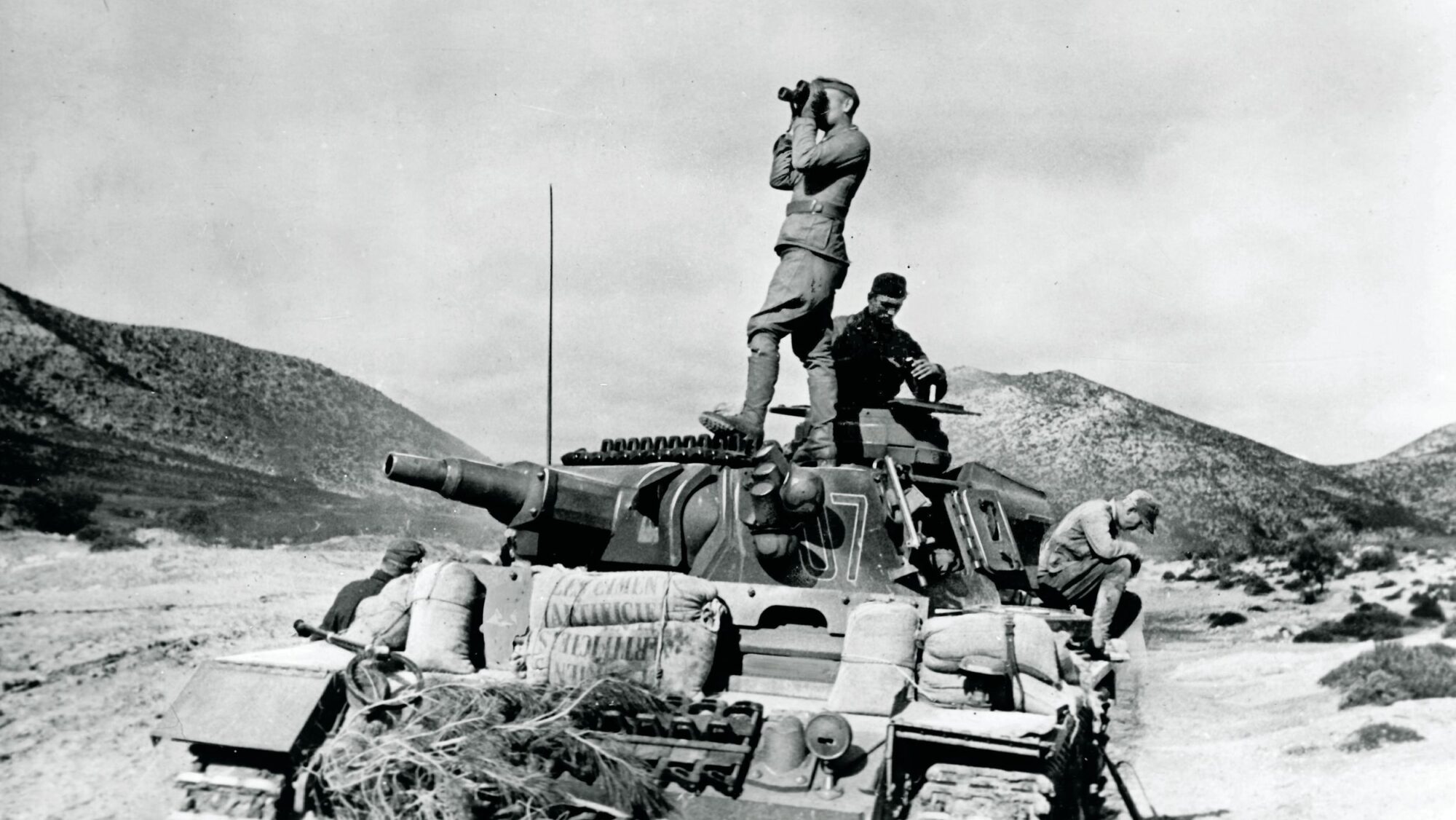
It was a typical outcome for the U.S. II Corps in its fighting against the German Fifth Panzer Army in Tunisia so far. Ever since the Allies had invaded French North Africa in November 1942, their advance to Tunisia had been marked by sluggish movement caused by bad weather and worse logistic problems.
Meanwhile, the Axis had reacted to the invasion with alacrity, shipping elements of two panzer divisions, paratroops, and Italian divisions to Tunisia to successfully stop the advance. By January 1943, the Allies were on the defensive on the “Eastern Dorsale,” a line of hilly terrain with passes that choked advances.
To make matters more difficult for the Allies, leadership was weak. Fredendall was digging a massive bunker-like underground headquarters at Tebessa, 80 miles from the battlefield, officially named “Speedy Valley,” but called by wags, “Lloyd’s Very Last Resort.” From there, he tried to micro-manage an entire corps. Vast numbers of U.S. Army engineers worked on the bunkers, doing so by night to irritate Fredendall, instead of digging fortifications at the front. The American forces were extremely inexperienced. They did not make use of high ground, concentrating their forces in passes instead. The 1st Armored Division was the only one of the 20 such outfits the U.S. Army fielded that did not get desert training. Logically, 1st Armored was the only such division that fought in the desert. Because of shortages, it did so with radios provided by the Connecticut State Police.
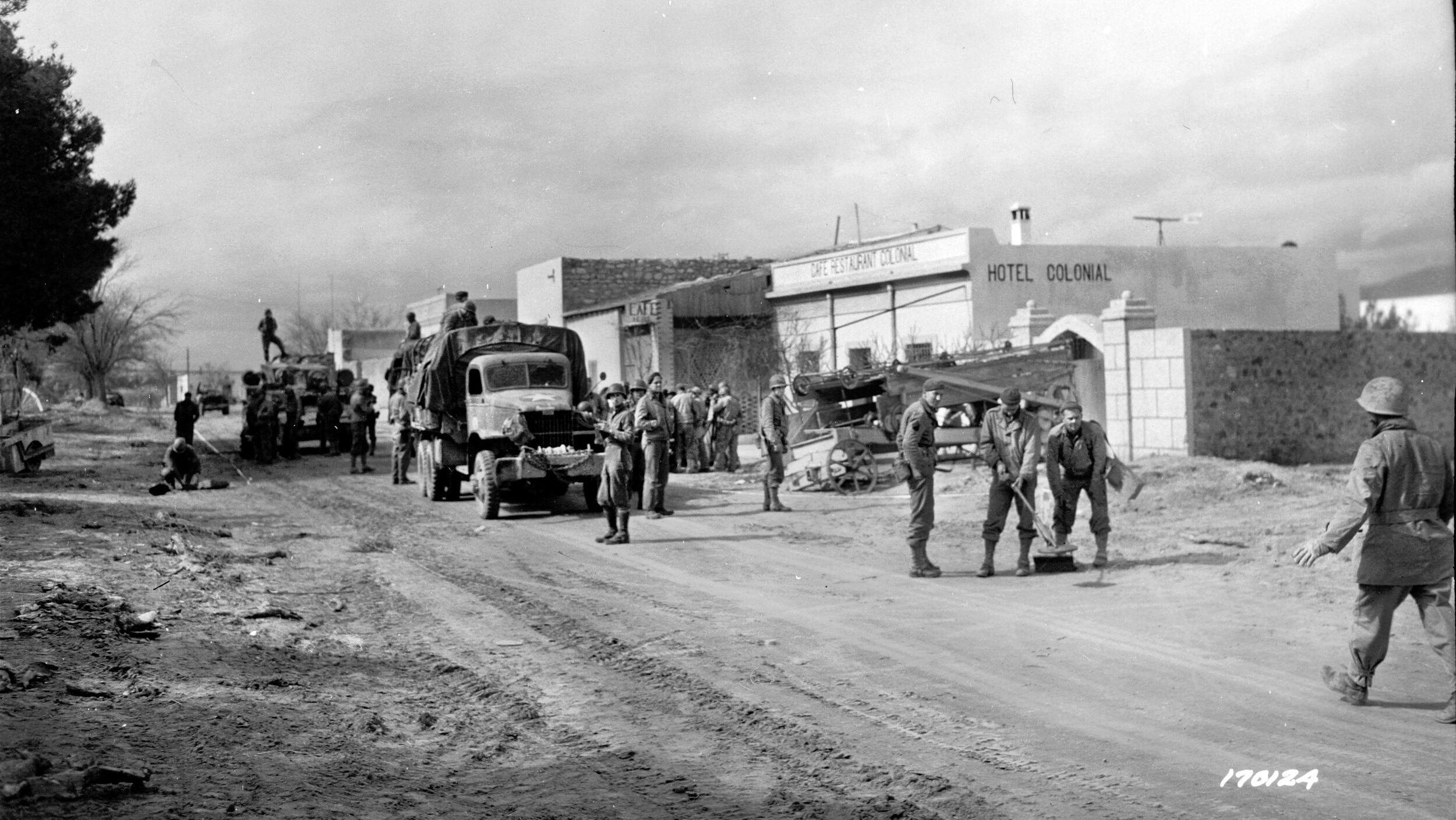
Fredendall’s boss was the commander of the British 1st Army, Lieutenant General Kenneth Anderson, a Scot who defined the term “dour” with his unsmiling face and laconic speech. His codename was “Sunray.” To add to the difficulties, the French forces, former Vichy troops with considerable animosity toward their former British allies, would not work with them. In addition, while the French force included such legendary elements as the Foreign Legion, it had been under equipped for years and still was.
The British 1st Army was divided into three groups, British forces in the north, French in the center, U.S. II Corps in the south.
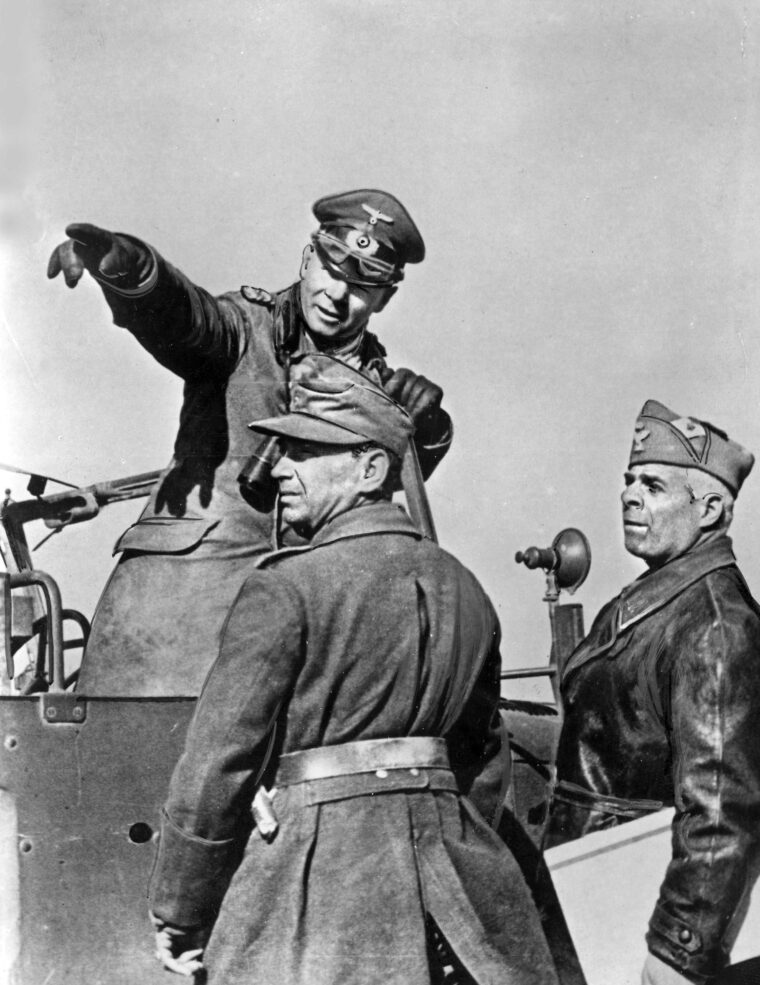
The Germans were determined to redeem the situation. Field Marshal Erwin Rommel’s Panzer Army Africa was retreating from El Alamein, slowly but steadily pursued across Libya to the Tunisian border. There Rommel placed his men in the pre-war French Mareth Line, designed to prevent an Italian attack into Tunisia.
The Axis plan was a double pincer by Colonel General Jurgen von Arnim’s Fifth Panzer Army to the north through the Faid Pass and a second pincer by Rommel himself through El Guettar. The two pincers would meet at Kasserine, drive north through Tebessa, into Algeria, and cut off the Allied forces from their supply bases.
The two German generals were a study in contrasts. Rommel was a legend, burnished by the Nazi propaganda machine. Arnim was an aristocratic staff officer who eschewed publicity. Their big boss was Luftwaffe Field Marshal Albert “Smiling Al” Kesselring, who told his generals: “After Stalingrad, our nation is badly in need of a triumph.”
The only problem for the Germans was Rommel himself—exhausted by three years of hard desert campaigning, he needed to go home. Arnim, regarding Rommel as a rival, was eager to see the “Desert Fox” off to Germany and command the entire assault.
On the Allied side, the top man, Lieutenant General Dwight D. Eisenhower, was rewarded for leading the invasion of North Africa, gaining his fourth star on February 11. He then set off for a tour of II Corps’ positions. Thanks to the legendary Ultra decoding of German communications, the British were reading German messages from Berlin to Tunisia. The only problem was—the British were making the wrong assessments. Brigadier Eric Mockler-Ferryman, Ike’s intelligence chief, told his boss that the Axis would attack in the north, with a feint to the south.
Eisenhower checked on II Corps anyway and disliked what he found. Fredendall’s bunkers…tank units scattered in “penny packets”…complacent officers who had not bothered to place landmines, saying they had two days before the expected attack and would start doing so on the morrow.
“Well, maybe you don’t know it,” Ike retorted, “but we’ve found in this war that once the Nazis have taken a position, they organize it for defense within two hours! This includes the scattering of many personnel mines along the front…get your minefields out first thing in the morning!” Before leaving, Eisenhower decorated Combat Command A Lieutenant Colonel Thomas D. Drake with a Distinguished Service Cross. After Ike left, Drake asked his boss, CCA commander Brigadier General Raymond E. McQuillin, “What will we do if the enemy attacks the pass from the east?”
Knowing that Ike might re-enter the command post at any moment, McQuillin answered, “Now, don’t bring that up!”

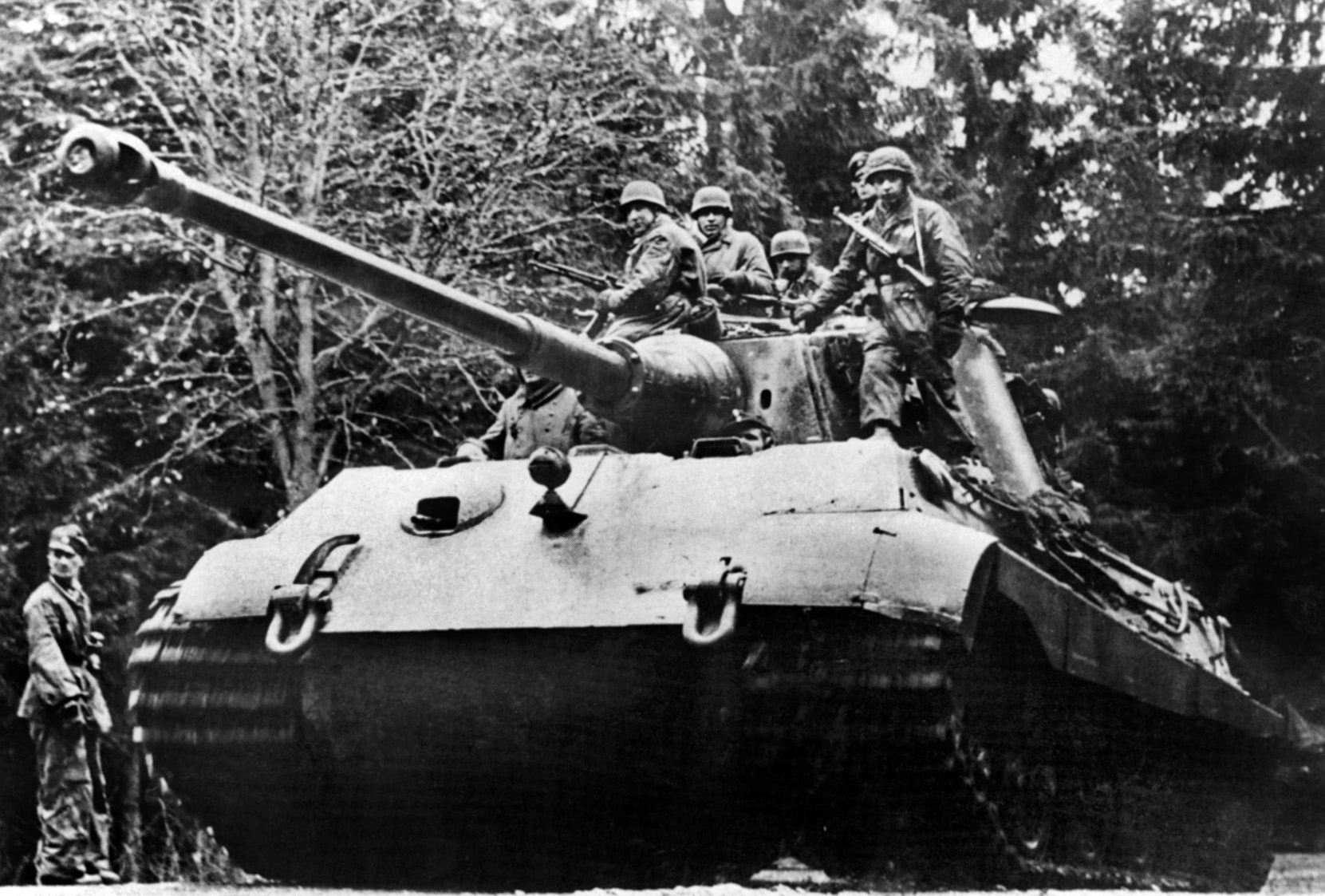
The next morning was Saturday, February 14, St. Valentine’s Day. All night, a fierce wind blew in from the Sahara. But just before dawn, the wind was replaced by two battalions of Rommel’s 10th Panzer Division, headed for the Faid Pass, led by the slow but powerful Tiger tanks of the 501st Heavy Panzer Battalion. The Tiger tanks packed 88mm guns and massive armor, but their hand-driven turret traverses made them vulnerable to mass flank attacks.
But this morning, they slammed into dug-in infantry of the 1st Armored Division facing them for the first time. The scared GIs fired back, but could not damage the incoming panzers. Colonel John Waters, commanding Combat Command A’s 1st Battalion, defending this sector, sent forward 15 M-3 Stuart tanks to stop the advance. The American tanks were armed with 37mm guns—electrically traversed but unable to punch holes in German armor except at point-blank range. In short order, the American tanks were knocked out of action. With typical color, Fredendall said, “The only way to hurt a kraut with the 37 is to try to catch him and give him an enema with it.”
Waters found himself surrounded by more than 60 advancing German vehicles. He phoned CCA’s command post, told them his position, and said, “Don’t worry about me. We’ll be all right. You get on with the war.” He was soon captured. John Waters’ father-in-law was Major General George S. Patton, Jr. Two years later, Patton would mount a raid on a German POW camp to free Waters. The raid would be a disaster.
The Americans tried again with Lieutenant Colonel Louis V. Hightower’s 2nd Battalion, 1st Armored Regiment’s M4 Sherman tanks, which packed 75mm guns, rolling into their first battle. The Americans soon found themselves outgunned. Worse, a single German shell hitting a Sherman’s rear sprocket would immobilize the tank and set it ablaze. Angry American tankers called the Sherman the “Ronson” after the cigarette lighter. Hightower fought on—but his men didn’t. Hightower’s tank “Texas” was among the casualties. Hit by a shell, it burst into flames. The colonel and his four men sprinted west.

More than 100 GIs from a reconnaissance company abandoned their vehicles and helmets and went in the bag. Others ran to the rear, yelling, “The Krauts! The Krauts are coming!” Officers whipped out their pistols to stop them, but it was futile. Drake called McQuillin and told his boss, “Your men are running away.”
“You don’t know what you’re talking about,” McQuillin snapped. “They’re only shifting positions.”
“Shifting positions, hell!” Drake shouted. “I know panic when I see it!”
“You are the man on the spot,” McQuillin said. “Take command and stop it.” Drake tried and found his men surrounded. He scribbled out a message begging for help on three sheets of British toilet paper and sent a dispatch rider in a jeep to take it to McQuillin.
Chaos reigned throughout the American lines. A captain drove into CCA’s supply area and told the men, “Take off! You are on your own!” They hurried to obey but found that lint from camouflage nets had jammed their fuel filters. A major gunned down the fuel dump with machine-gun bullets, setting the gasoline ablaze, infuriating tankers who needed the gas for their vehicles.
The German attack caught the 2nd Battalion of the 17th Field Artillery unawares and destroyed it. Rommel’s men marooned 2,000 GIs on two hills—Djebels Lessouda and Ksaira, annihilated a tank battalion, captured Sidi bou Zid, and destroyed 44 American tanks, 50 halftracks, 26 artillery pieces, and at least 22 trucks. The double envelopment took only 12 hours. It was the worst defeat the Americans would suffer in the entire European theater during the war.
Ike wasted no time. He drove straight down to Speedy Valley and met with Fredendall and Anderson. Neither seemed panicked. But of five battalions commanded by CCA, two were surrounded and three were about to be obliterated. Worse, neither Anderson nor Fredendall had a grip on the situation. Anderson was convinced the Germans would attack in the north. Fredendall was not concentrating his tanks for a counterattack. The only decision made was to refuse the right flank and give up the airfields at Fériana and Thélepte, and the town of Gafsa. That in turn led Madame LaZonga to beg American tankers to allow her and the six women of her bordello to ride out on the back of an M-3 Stuart tank.

Next day, Fredendall ordered a counterattack from Sbeitla. It failed to regain Sidi bou Zid. Once again, the Americans lost a tank battalion. Out of 58 tanks that clanked into battle, only four returned. In two days Ward had lost 98 tanks, 57 halftracks, and 29 artillery pieces. A GI wandered through the battlefield. “The night had a dead silence except for a few howling dogs,” he said later.
Ward, however, reported: “We might have walloped them or they might have walloped us.”
The besieged American battalions suffered on their hills. Drake’s men were hungry and thirsty. As February 16 dawned, Drake told the regimental bandleader to form firing squads to keep the lines intact. Drake radioed for help, but McQuillin told him none was forthcoming. That evening, Drake’s men wrecked their equipment, left their wounded and the chaplain behind, and struggled off in small groups to return to American lines in the dark. Dawn found them in the open, scattered across five miles of desert west of Sidi bou Zid. They met up with a column of troops on a road. Drake’s men thought that rescue was at hand until the trucks disgorged heavily armed men in gray. The Americans tried to fight back, but it was futile as 800 defenders of Garet Hadid and 600 from Garet Hadid went in the bag. A few hundred GIs, surviving on stolen eggs and fried cactus, reached American lines. The 168th Infantry Regiment had been decimated.
The low performance of America’s leading elements in North Africa astonished the Germans and left them puzzled about their next move. Arnim and Rommel were anything but a unified command, and it was up to Kesselring to make the critical decision here. Incredibly, the Germans would waste two days bickering over what to do.
Finally, Rommel settled the matter. “I had never gambled,” he wrote later, “never had to fear losing everything. But in the position as it was now, a rather greater risk had to be taken.” He would hurl his weaker force, the 10th Panzer Division, northeast to Kasserine, while the 21st Panzer Division took over at Sidi bou Zid and drove west to the same place, hitting the Americans from front and behind.
Arnim disagreed, saying in a phone call to Rommel and radio messages to Kesselring: “The terrain would be against us.” Beyond Kasserine lay Tebessa and its mountainous terrain. Arnim wanted to attack on a more northern route.
The British Ultra interception team at Bletchley Park intercepted and decoded all these messages, including one from Rommel on February 17 saying that he could hardly attack Tebessa with the 52 German and 17 Italian tanks under his command. Once again, Bletchley got its facts wrong. Berlin and Rome approved Rommel’s request to have two panzer divisions attack Kasserine.

The 21st Panzer Division moved on Sbeitla on February 17, forcing the American 77th Evacuation Hospital to load 600 seriously wounded men in trucks. Office of Special Services Captain Carleton Coon was asked to hurl Molotov Cocktails at advancing German tanks. He refused, saying, “It was not OSS work.” Instead, they planted explosives that looked like mule defecation.
American panic continued as the II Corps pulled out of Sbeitla. Terrified drivers tore through narrow streets. Vehicles on Route 13 drove three abreast. Officers waved their arms, imploring men to stand and fight. Some troops just fired wildly in the air or in all directions.
American top leadership was even less impressive. Neither Fredendall nor Ward left their command posts, although Fredendall ordered more destruction—blasting a 1st Armored ammunition dump. Instead, Ward phoned Fredendall to say that he was afraid he could not hold. Fredendall called Eisenhower’s headquarters in Algiers to say that he was afraid “We have lost 1st Armored Division.”
Fredendall promptly abandoned Speedy Valley, moving back to a schoolhouse at El Kouif. That ended the tunneling project for all time.
The same day, Ward and Robinett awaited an attack from the east, but none came. It was the Germans’ turn to show lethargy. Kesselring met with Adolf Hitler in East Prussia. Arnim hunted wild geese. Rommel ate couscous. In the words of a GI sergeant, Ward “stood on the skyline smoking a cigar, very calm, which was good on the nerves of a number of very jittery people, including me.”
The attack resumed before noon with panzers advancing down Highway 13 and striking Robinett’s CCB from the right, forcing his tank destroyers—halftracks mounting 75mm guns—back. Robinett sent his M-3 Lee tanks of the 2nd/13th Armored Regiment forward, under Major Henry Gardiner. Ten feet tall, the tanks’ 75mm guns were in belly sponsons with limited traverse. They burrowed into a wadi and faced 35 attacking panzers. “Boys, let them have it!” Gardiner yelled, and the tanks opened up, hitting 15 panzers and destroying five. The volley “stopped the attack cold,” Gardiner said later.
The Germans tried again, swinging around the American right five miles south of Sbeitla. Gardiner warned Robinett that his tanks would soon be in serious trouble, and Ward authorized a withdrawal. Gardiner lost nine tanks, including his own—he had to flee west on foot.

That evening, German and Italian troops entered Sbeitla, finding everything destroyed but Roman ruins and massive fires from burning American supply dumps. Again the GIs had been hammered, but one American on the scene had a positive view, legendary war correspondent Ernie Pyle, who wrote of the U.S. soldiery: “You need feel no shame nor concern about their ability…There is nothing wrong with the common American soldier. His fighting spirit is good. His morale is okay. The deeper he gets into a fight, the more of a fighting man he becomes.”
Now the Germans menaced the Grand Dorsale and its most important gap, Kasserine Pass, 25 miles west of Sbeitla, just past a village that bore the same name. The pass is barely a mile wide where it is most constricted at 2,000 feet over sea level and is the natural invasion route from Tunisia into Algeria since time immemorial.
However, it was not impregnable, and Fredendall knew it. While 1st Armored reassembled in the uplands south of Tebessa to protect the supply dumps, the rest of II Corps was scattered. Fredendall begged his superiors for more infantry and artillery. Ike was shipping 800 soldiers daily from Casablanca in Morocco, but few would reach the front until the end of February. He also asked for 120 Sherman tanks, but was only offered 52—Ike was starting to worry that Fredendall’s poor leadership would cost the other 200 being held in reserve. Fredendall also asked for 60,000 mines and 5,000 booby traps, but nobody knew when they would arrive.
The initial defense of Kasserine fell on the 19th Combat Engineer Regiment, which had been building roads and Speedy Valley’s tunnels. The men had failed to complete rifle training before being shipped overseas.
At 9 p.m. on February 17, the 19th Engineers dug in on the floor of the pass, nobody seeming to realize that the adjoining hills had to be garrisoned as well.
For once, Fredendall took a realistic approach—he ordered a battalion of Major General Terry de la Mesa Allen’s 1st Infantry Division’s 26th Infantry Regiment, under Colonel Alexander Stark, to reinforce the engineers. Fredendall told Stark to “pull a Stonewall Jackson. Take over up there.”
It took Stark 12 hours to move his men through the darkness, but he got there, buttressed by some French 75mm artillery pieces. The Americans dumped fresh anti-tank mines on the road but lacked picks and shovels to bury them properly.
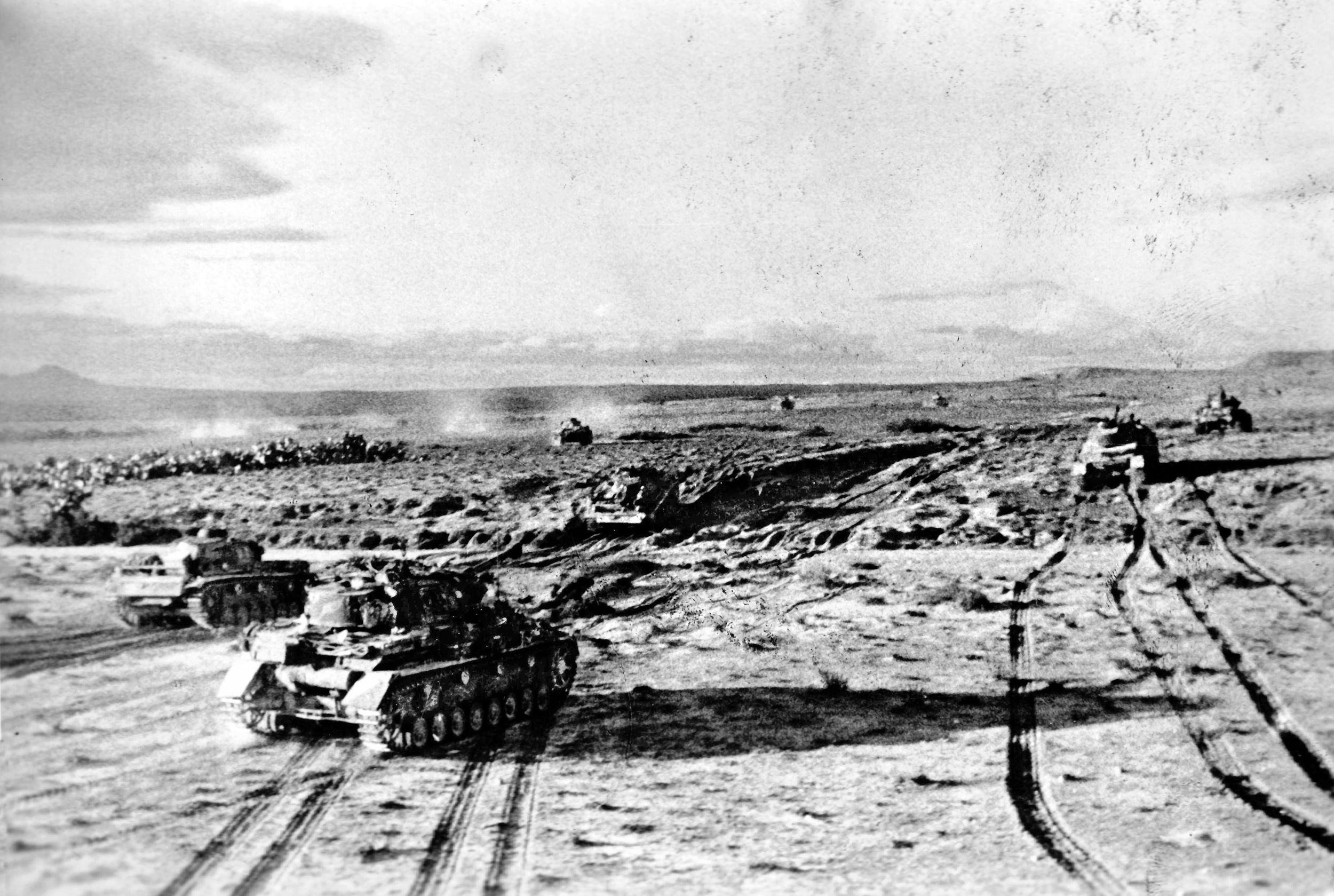
It took Rommel’s advancing panzers a day to reach Kasserine Pass. At 4:50 a.m. on February 19, he ordered a three-prong thrust: the Afrika Korps would attack Kasserine Pass, the 21st Panzers would head north to take Le Kef, and the 10th Panzers would be the reserve at Sbeitla, ready to attack in whichever direction offered the best opening.
At dawn, the Germans attacked the pass. The French 75s, despite their age, were as useful as in the Great War, repulsing the attack. The Germans brought up their artillery to support the next assault, and by 10 a.m. Nazi shells were detonating in Stark’s command post. German troops attacked on Stark’s flanks, with machine gunners trading bursts of fire in the Tunisian winter cold. The badly-laid mines accounted for five panzers.
In the early afternoon, Stark received reinforcements: three companies of the 9th Infantry Division’s 39th Infantry Regiment and the regimental band, along with a tank platoon. Later British Brigadier Charles A.L. Dunphie, a future general and knight, turned up. He commanded the 26th Armoured Brigade, which Anderson had dispatched to stop the drive on Thala. Dunphie arrived in his staff car and had to avoid bullets from German infiltrators.
The two allies did not get along—Dunphie was unimpressed by Stark’s vague idea of where his own troops were and said he had “completely lost control of events…I thought the old boy—gallant but quite out of his depth.” Stark was harder on the Briton, calling him “that blockhead.”
Nonetheless, Anderson finally took charge. In addition to sending the 26th Armoured’s tanks to Thala, he sent the 1st Guards Brigade to Sbiba to halt the 21st Panzer Division and issued a statement telling the entire 1st Army that “there will be no withdrawal from positions now held.”
As the sun set at Kasserine, armored attacks were replaced with heavy German artillery fire, including Nebelwerfers—six-barreled rocket launchers known as “Screaming Meemies” by GIs for their sound. They frightened some Americans into fleeing their posts. Some were captured by MPs, others by Germans, while more fell into the hands of Arab brigands, who seized their rifles and gear. The GIs stayed in their foxholes as they had been trained, but German infantry jumped off the passing panzers and bayoneted the Americans.
February 20 dawned foggy, and Rommel was displeased by the situation. The 10th Panzer’s attacks had been sluggish. General Karl von Bülowius, head of the Afrika Korps, told Rommel at 10:30 a.m. that the Americans were crumbling but still holding. Rommel retorted that unless the Americans were defeated this day the whole attack would fail. Allied reinforcements would prevent him from exploiting any holes in the line. Just as importantly, he needed to capture the American supplies of fuel, ammunition, rations, and weapons at Tebessa to keep his offensive moving.

Rommel berated Bülowius for not moving briskly and 10th Panzer’s commander, Major General Fritz von Broich, for not leading from the front, and ordered the advance resumed.
The American line crumbled definitively at 11:22 a.m. when the Germans hit the 19th Engineers. Their commander, Colonel A.T.W. Moore, told his superiors that his men could not hold any more. “Forget about our equipment and just save your life,” a major told his men as they fled.
Colonel Theodore C. Conway, sent by Ike to assess the situation, seeing GIs fleeing to the rear, wished he had a horse and sword, so he could emulate George Washington whacking his fleeing continentals with the sword’s flat to turn them around in the 1776 battle of New York. Unfortunately, Conway lacked both and also had to flee.
Stark held on until 5 p.m.. Then grenades detonated in his command post, and he ordered a withdrawal, heading overland to Thala. Italian tanks from the Centauro Armored Division clattered five miles up Highway 13 toward Tebessa without seeing a single GI—only burning wreckage.
The Americans had lost more than 500 dead infantrymen in the engagement.
At 3:35 a.m. on Sunday, February 21, Fredendall warned that Kasserine Pass was lost. Demolition crews laid slabs of guncotton through the vast dumps at Tebessa and waited for orders to blast the stores to prevent Rommel from seizing them. The supply depot was defended by two machine guns and a 37mm cannon. Some 400,000 gallons of fuel were evacuated, but more than a million meals of rations were left behind. Cooks ran through coops, slaughtering rabbits and chickens to deny them to the Germans.
At El Kouif, Fredendall kept despondency away with slugs of bourbon. An officer saw the general sitting on the headquarters steps, “head in hand and giving every evidence of being both bewildered and defeated.” Whistling tunelessly at a map, Fredendall said to an aide, “If I were back home, I’d go out and paint the garage doors. There’s a lot of pleasure in painting a garage door.”

Anderson’s headquarters was little better. “Everything was confusion there,” an American liaison officer reported. He saw a British officer slap a hysterical comrade across the face and shout, “Get a hold of yourself.” Another British officer called the entire situation, “The most perfect example of order, counter-order, and disorder that has happened in my experience.”
Fredendall did find time to whine and complain. He referred to his adversary as “Professor Rommel.” He begged for more troops. He told Eisenhower that Ward should be relieved. Ward called Fredendall a “spherical SOB, and a two-faced one, at that.”
On Saturday morning, Fredendall moved to a mansion owned by a Vichy mining executive, where he dined on beef and ice cream, and bypassed Ward, ordering Robinett to take over Stark’s force and counterattack with CCB. Then Fredendall changed his mind and ordered him to defend the approaches to Tebessa. “There is no use, Robbie, they have broken through and you can’t stop them. If you get away with this one, Robbie, I will make you a field marshal,” Fredendall said.
Robinett was to coordinate his defenses with Dunphie’s tanks, even though they lacked compatible radios. The overall commander was Terry Allen, who said, “Well, boys, this is our sector and we will fight in place.” Robinett had eight battalions, including Senegalese riflemen, 11 artillery batteries, and about 700 stragglers formed into an ad hoc group.
Now the strain of the battle was wearing down Rommel’s forces. He hurled what he could at Thala on the morning of February 21 at 11:25. The attack was delayed by fog. From his command post, Robinett could see 20 miles to Kasserine Pass across a foggy plain, dotted with pear orchards and cactus farms. Robinett saw that was the obvious approach route. “It was simply written on the ground.”
Sure enough, Bülowius’s tanks attacked Robinett’s position at 2 p.m. with 40 panzers followed by Italian elite Bersaglieri infantry in trucks and wearing helmets with plumes. This time the Americans had the advantage, shelling the attackers heavily, forcing the Axis troops to disperse for cover. Bülowius lacked the guns to shoot back. The Germans lost 10 tanks, the Americans one. Bülowius tried to make a flanking attack on the left, but darkness and heavy rain helped stop that—his tanks quickly bogged down in the mud.
On the 22nd, Bülowius made one more try at dawn in the fog, and this time managed to take Hill 812 along with five American howitzers and three smaller guns. But at 9 a.m. the fog lifted, and the GIs were able to stiffen their line. American artillery blasted the Germans atop the hill and the advancing tanks on the valley floor. “An artilleryman’s dream,” said Brig. Gen. Clifton Andrus, 1st Infantry Division’s artillery chief. “The valley floor was covered with targets of every description, from tanks and 88 batteries to infantry and trucks.”
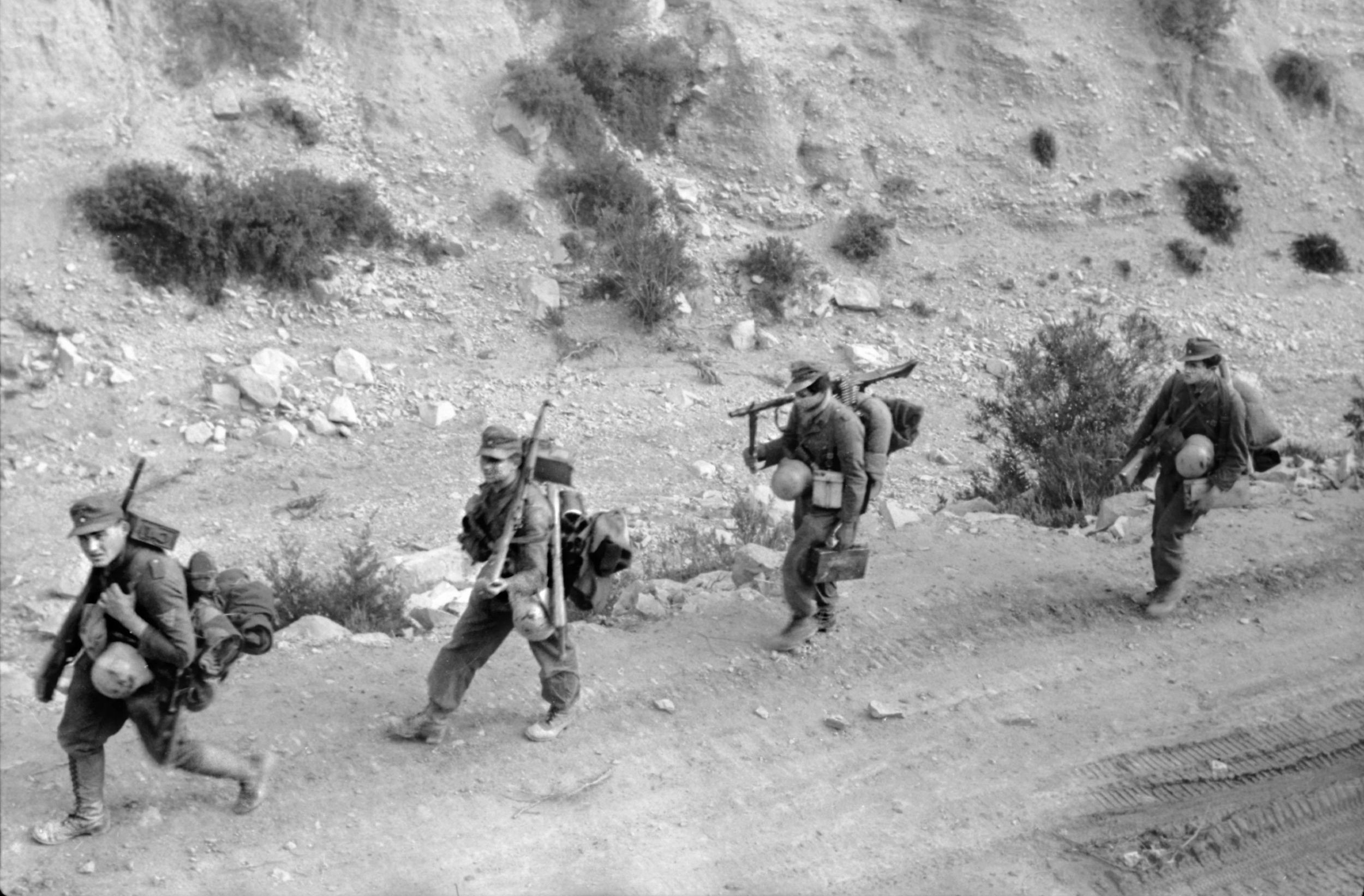
By 2 p.m., the Afrika Korps soldiers were in milling retreat, leaving dead men behind and POWs for GIs to collect. One filled a helmet with aluminum stars—the rank insignia of an Italian private. He told Robinett he had captured a horde of Italian generals. Robinett took two of the stars for himself, for when he got his promotion to general.
Meanwhile, the battle raged elsewhere. On Highway 17, Rommel joined his attacking troops on the 21st, in a uniform covered with mud. He immediately had to hit the dirt when American shellfire started roaring in.
While Rommel’s Afrika Korps veterans were highly skilled at the freewheeling slugfests of Libya’s empty deserts, Tunisia was a new battlefield to them with its passes and hills. The Germans could not push back Dunphie’s tanks, and Brigadier Cameron Nicholson’s 1st Guards Brigade. Rommel complained that his men “did not seem to realize that they were in a race with the Allied reserves.”
The British had their own problems. It took six hours for Nicholson’s men to reach their positions at Thala, only getting there at 3:15 a.m. on Sunday. Dunphie’s 50 tanks were mostly obsolete Valentines, no match for Rommel’s Panzer Mark IIIs, Mark IVs, and Tigers.
The 2nd/5th Leicesters had just arrived from England and “had no conception of what was coming to them,” Nicholson later wrote. “I found it difficult to get a sense of urgency into them.” British officers yelled at fleeing Americans to turn around and fight. They yelled back, “He’s coming! He’s right behind us!” Nobody needed to ask who “he” was.
Nicholson ordered Dunphie to keep Rommel away from Thala until 6 p.m. Dunphie did his best, standing “erect in his scout car, calmly conducting the battle over the wireless,” losing 15 tanks before retreating. With Rommel in direct command, the Germans surged forward until 6:30 p.m., when darkness and rain covered the battlefield.
Dunphie fell back on Thala, defended by a French battalion quartered in the local brothel. The Allies seemed to be at their last extremity. Juin warned that if Rommel broke through, all of North Africa was doomed.

The Leicesters were digging in and doing a poor job of it—Nicholson berated them for their half-dug foxholes and unlaid minefields, when they saw a Valentine tank clanking up to them. If it had arrived in better light, the Tommies would have seen it was named “Apple Sammy.” The Germans had captured the tank at Tebourba. It was the Trojan Horse leading a Nazi column. “Keep away from my bloody trench,” a Leicester yelled, “You’re knocking it in.”
German troops leaped off the Valentine, followed by more German tanks. They chopped up the Leicesters’ positions and vehicles, forcing 300 survivors to surrender.
About 2,000 yards to the north, Dunphie’s remaining tanks were sheltered in a grassy hollow when German tracers and flares shot up over their heads. “Six German tanks were right upon us, greenish-yellow flame flickering from their machine gun muzzles,” a British tanker said.
“Lay roughly on the tanks!” yelled a British troop commander, and a three-hour close-range tank brawl ensued. Determined Leicesters whipped out Mark 74 “Sticky Bomb” grenades with glue tops and slammed them against panzer hulls. Dunphie was down to 21 tanks when Rommel’s panzers withdrew. Dunphie ordered every man into the line—even cooks and drivers, awaiting another night attack. However, Rommel was down to 50 tanks, 2,500 infantry, and 30 guns.
At dawn on the 22nd, Dunphie got major help: Brigadier General Stafford Irwin, commander of 9th Infantry Division’s artillery, arrived with 48 guns, having completed a 735-mile, four-day motor march across Tunisia’s miserable roads. A West Point 1915 classmate of Ike’s, Irwin was a highly competent officer who was a skilled watercolorist and poet. He emplaced his guns on a three-mile arc. Both sides’ lines were 1,000 yards apart, and Irwin opened fire, raining shells down. Broich phoned Rommel, who had returned to Kasserine, to ask if he should attack further or give up the offensive.
Rommel was forced to agree to a withdrawal. Despite inflicting massive casualties on the Allied forces and seizing vast stocks, his army was down to four days’ rations, lacked ammunition, and had only enough fuel to travel 200 miles. Rommel lashed out at Arnim and the Luftwaffe for failing to support his attacks, but then said, more coolly, “It appears futile to continue the attack in view of the constant reinforcing of the hostile forces, the unfavorable weather, which renders the terrain impassable off the hard roads, and because of the increasing problems caused by the mountain terrain, which is so unsuited to the employment of armored units. All this adds to the low strength of our organization.”
Kesselring authorized a withdrawal, and Rommel began doing so on the 23rd, with the Americans and British following only hesitantly. Fredendall said the Germans had “one more shot in his locker.”

The Kasserine battle cost the Germans about 2,000 men, the Allies about 10,000. Of that, 6,500 GIs were dead. The II Corps lost 183 tanks, 194 halftracks, 208 artillery pieces, 512 trucks and jeeps, and vast amounts of fuel, ammunition, and supplies. The Stuart tanks with their 37mm guns could not cope with Rommel’s panzers and neither could the halftrack mounted 75mm tank destroyers. Allied intelligence was abysmal—Ike fired Mockler-Ferryman and replaced him with British Major General Sir Kenneth Strong, who performed ably in the role for the rest of the war. Stark and McQuillin were axed, too. Robinett observed that Tunisia was “a professional graveyard, particularly for those in the upper middle part of the chain of command.”
As the Germans withdrew, Eisenhower sent Major General Ernest Harmon, one of his sharpest officers, to assess the II Corps’ leadership situation and assume command of the corps or 1st Armored.
“Make up your mind, Ike, I can’t do both,” Harmon said. Eisenhower said he didn’t know for sure himself. Then Ike laced Harmon’s boots. At 3 a.m., on Tuesday, February 23, Harmon arrived at El Kouif, finding Fredendall drunk and ready to turn the battle over to him.
“He’s no damned good,” Harmon told Ike on February 28, describing Fredendall as a “physical and moral coward.”
Ike did not yet have the ability to harshly fire incompetents. He gave Fredendall a third star, command of a training army in Tennessee, and sent him home to a hero’s welcome. In actuality, Fredendall would do little more than give away brides to officers at wedding ceremonies.
However, military historians were brutal on Fredendall. Carlo D’Este described Fredendall as “one of the most inept senior officers to hold a high command during World War II.” Combat veteran and historian Charles B. MacDonald called Fredendall a “man of bombast and bravado in speech and manner (who) failed to live up to the image he tried to create.”
However, these assessments had no impact on Fredendall when he left El Kouif and the war for all time at 3:30 a.m. on March 7. After distributing his liquor cache to the staff, he left in a civilian Buick, stopping for a picnic lunch en route.
“Glory be,” Ward wrote. But the best comment on Fredendall came from Ike’s Chief of Staff, General Walter Bedell Smith: “He was a good colonel before the war.”
Author and historian David Lippman has written on a variety of subjects for WWII History. He resides in New Jersey.
Check this out.
https://en.wikipedia.org/wiki/Lloyd_Fredendall
Fredendall came to Ike highly recommended by Generals Marshall and McNair. Being new in the job, Ike picked Fredendall. Fredendall was a perfect example of the Peter Principle in action.
Tiger 1 tanks had hydraulic traverse. They could use manual to fine tune their aim but primarily used hydraulic. Their hydraulic traverse was slower than American Sherman tanks though.