By Edward F. Murphy
The heavy staccato thumping of a Browning Automatic Rifle echoed throughout the small French village. “Who’s doing all that firing?” demanded First Lieut. Burr Sutter, the S-3 of the 2d Battalion, 134th Infantry Regiment, 35th Infantry Division.
“It’s Spurrier, sir,” replied one of the enlisted men hunkered down in the battalion command post inside Achain. “He’s a regular One-Man Army, that guy.”
Sutter nodded grimly. The soldier was right. Spurrier loved to be in the thick of things, doing what he did best—killing Germans.
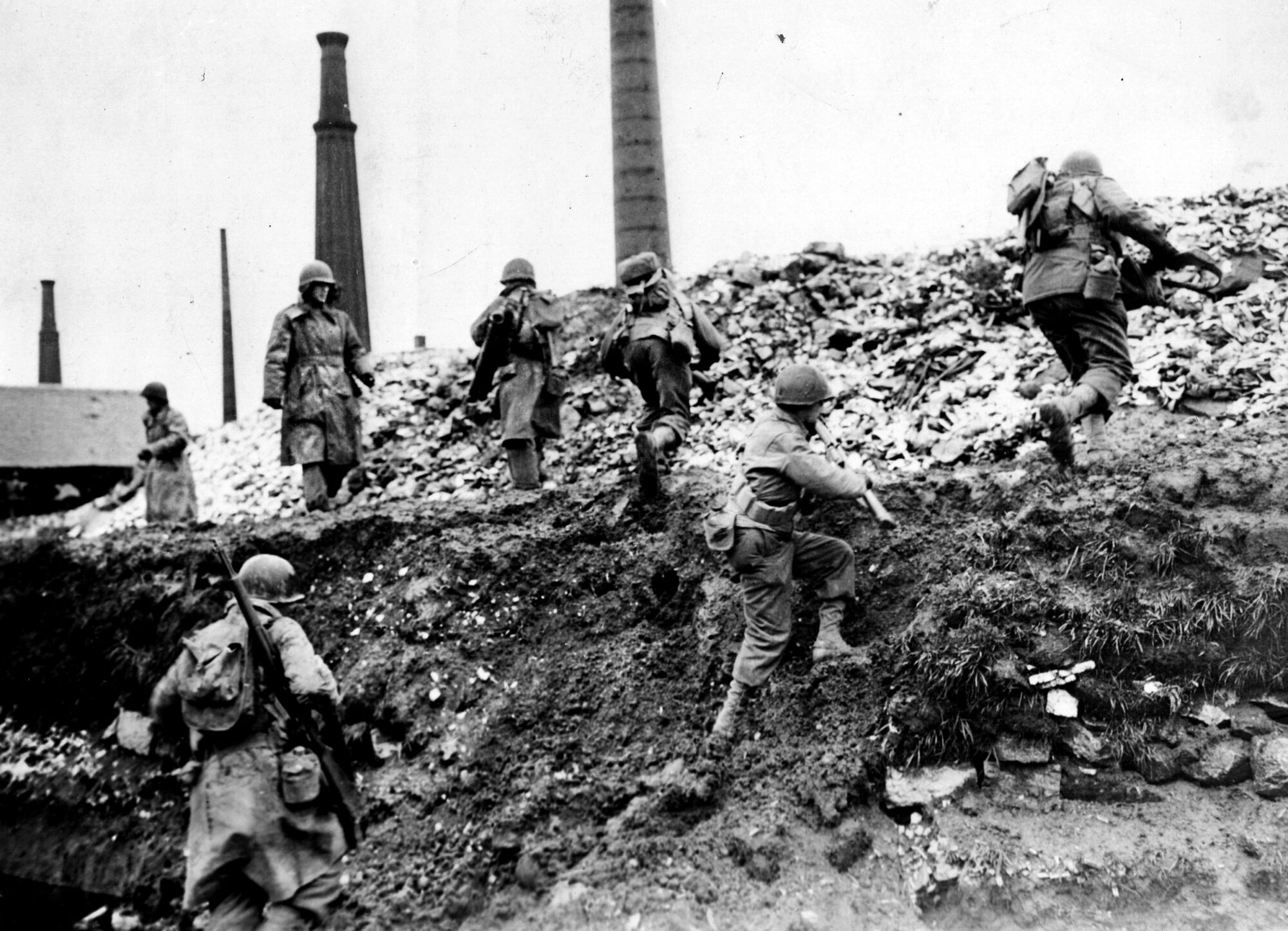
Earlier that brisk November 13, 1944, elements of the 2d Battalion had attacked Achain. For the past six days the 35th Infantry Division had led Lieut. Gen. George S. Patton’s 3d Army on its drive up the Saar River Valley of Lorraine in northeastern France, headed toward Germany. Achain was just one more enemy-held town that needed to be cleared out. Second Battalion commander Maj. Frederick C. Roecker had been told Achain was lightly defended.
Companies F and G advanced toward Achain on a broad front; before them lay over 1,500 yards of open terrain. As the two companies closed to about 700 yards, the town’s Nazi defenders unleashed a violent fusillade of rifle and automatic weapons fire. Company F sought refuge in a nearby orchard, where the heavy enemy fire soon pinned down its members. Company G moved to its right, intent on flanking the town along its east side. For some reason, Staff Sergeant Junior J. Spurrier, a Company G squad leader, decided he would attack the town on his own from the west.
Alone, Spurrier worked his way across the open field. As he approached the orchard shielding Company F, Spurrier stumbled upon an enemy outpost. Before the Germans could respond Spurrier killed two and sent the others fleeing. From there he made his way into Achain. Much to his delight, he found the streets filled with Germans. Using his Browning Automatic Rifle, Spurrier cleared out several enemy strong points, killing several Germans and capturing six.
As Spurrier fought his way through the village from the west, Company G and the newly arrived Company E battled their way into the eastern edge of town. The companies set up command posts in adjacent buildings. A short distance behind them came Lieutenant Sutter and his operations crew. Once in the town Sutter set up a battalion CP and a prisoner of war enclosure. It was about that time he heard the firing of Spurrier’s BAR.
While Companies E and G fought their way into Achain, Spurrier had taken up a position in a window on the second floor of the building that became Company E’s command post. From there he unleashed magazine after magazine of heavy .30 caliber BAR rounds at nearby German positions. As Lieutenant Sutter watched, German rounds splattered the concrete around the window. A few minutes later Spurrier showed up at the battalion CP. He sauntered up to First Lieut. Abraham R. Berkson, the battalion S-2. “How many prisoners you got, sir?” Spurrier asked.
“Six,” Berkson responded.
“Don’t worry, lieutenant, we are going to have some more in a little while.”
With that Spurrier climbed up on a table below a window at the rear of the building. He fired his BAR through the window into a building across the street until his weapon jammed. Spurrier swapped BARs with a Company E soldier then returned to his window. He fired that weapon until he used up all his ammunition. Then he scrounged up an M-1 and fired that at the neighboring building.
The next time either Sutter or Berkson saw Spurrier, he was dashing across the street carrying a German Panzerfaust anti-tank bazooka. A few minutes earlier, Company G’s commander, First Lieut. John E. Davis, watched as an enemy sniper fired an automatic burst of fire at Spurrier. “That must have made him mad,” Davis later said, “for he took up a Panzerfaust and fired it into the building, killing the sniper.”
Without waiting to see the results of his handi-work, Spurrier took off, looking for more weapons. He found two more German Panzerfaust and fired those into his target. He then took an American bazooka and sent three rockets flying into the building.

Seconds later flames crackled from the building’s windows. Soon, a coughing German captain, his lieutenant, and fourteen enlisted men staggered from the building, their hands in the air. Spurrier rounded them up and delivered them to Berkson. “Here you go, lieutenant,” he told Berkson. Under questioning, the German captain proved to be the commander of the unit defending Achain.
Not content with his success, Spurrier set out again. Several nearby riflemen warned him about a sniper in a building just up from the one that had housed the German captain. Bounding from doorway to doorway, Spurrier stealthily made his way forward, ignoring the enemy rounds that splattered around him. When he was close enough to the sniper’s lair, he pulled a grenade from his jacket pocket. He tossed it into an open window. Two more quickly followed. The three deadly missiles exploded in a continuous roar.
When the smoke cleared, two Germans stumbled out of the building. Spurrier took them back to Berkson. Mop-up troops later found the bodies of three dead enemy soldiers in this building.

For the rest of that afternoon, Spurrier roamed the village alone, taking prisoners and killing Germans. According to Lieutenant Berkson, Spurrier brought back at least twenty prisoners that day. Lieutenant Davis heard that Spurrier killed at least three more Germans that afternoon.
By late afternoon about two-thirds of Achain had been cleared. Major Roecker ordered outposts set up at the fringes of the town and put Spurrier in charge. Just after dark, as Spurrier inspected the outposts, he heard German voices inside a nearby barn. He crept up, ignited a pile of hay, and captured four more Germans as they fled the flames. After he turned these prisoners over to another man, Spurrier continued on his rounds.
Spurrier was just approaching another outpost when he saw a shadowy figure slinking along the ground toward the unaware sentry. Spurrier yelled a challenge. When the figure failed to answer, Spurrier shot and killed what proved to be another enemy soldier.
Though no one would ever know for sure, witnesses credited Staff Sergeant Spurrier with killing twenty-five German soldiers and capturing twenty. It was a phenomenal total, but the 2d Battalion did not escape unscathed. In all, the already weak battalion suffered 106 casualties, including every officer in Company F. Another fifty battalion members were evacuated due to exposure to the cold, wet weather. And, another German-held French town awaited them the next morning

When Major Roecker learned of Spurrier’s actions that day, he realized that the plucky sergeant’s performance merited formal recognition. So when Lieutenant Davis approached him a few days later and said, “Spurrier should have the Medal of Honor for what he did.” Roecker readily agreed. Normally, he would have put Spurrier in for a Distinguished Service Cross, but he had already been recommended for the army’s second highest award.
Two months earlier, on September 16, 1944, as the 134th Regiment neared Lay St. Christopher, outside of Nancy, a well-protected German strongpoint delayed the regiment’s advance. After several infantry attacks stalled, armored reinforcements arrived. Oblivious to the blizzard of enemy small arms fire, Spurrier climbed aboard a tank destroyer and manned the vehicle’s completely exposed .50 caliber machine gun. Urging the driver forward, Spurrier sent streams of heavy slugs into the enemy bunkers. Several times, when the Germans refused to surrender, Spurrier leapt from the TD and single-handedly assaulted the bunkers. He tossed grenades and fired his M-1 until the defenders either died or surrendered. In all, his adventure on that hillside resulted in over a dozen dead German soldiers and another twenty-two sent off to the prisoner’s cage, plus a recommendation for the DSC.
Since landing with his division in France on July 6, 1944, Spurrier had proved himself to be a superb combat soldier. He was that rare human being who thrived on the adrenaline rush of close quarters combat. Whatever the mission, Spurrier volunteered. He had joined the infantry to kill German soldiers and he was ruthless.
Unfortunately, Spurrier’s conduct off the front line was another matter. He abhorred responsibility and wanted nothing to do with leading men. When not engaged in combat Spurrier focused his attention on finding alcohol and drinking it. He frequently went AWOL in search of souvenirs to sell to the rear echelon troops. He often abandoned the members of his squad to wander the front lines alone, searching for Germans to kill. If the infantry companies had not been so thinly manned, Spurrier probably would have been court-martialed, Lieut. Davis admitted. To Davis, Spurrier was a soldier-of-fortune, a small town rowdy who was barely controllable. And that was not far from the truth.
Born December 22, 1922, in Russell County, Virginia, James Ira Spurrier, Jr., grew up in the abject poverty of the Appalachian Mountains during the Great Depression. With a limited grade school education and few prospects for steady employment, Spurrier spent his time hanging around with similar disaffected young men. Together they caroused the backwoods towns and hamlets, drinking moonshine, chasing girls, and brawling. Soon after his mother died in the summer of 1940 Spurrier traveled to Norton, Virginia, the closest town with an army recruiter. He lied about his age, putting his birth date as September 22, 1922, so he would not need his father’s signature. He also misread the enlistment forms, writing down “Junior” as his first name. Thus, he forever became Junior James Spurrier, Jr., to the U.S. Army.
Trained as a baker, Spurrier served with the 89th Infantry Regiment in Jamaica. In early 1944, when the 89th was recalled to the United States and disbanded, Spurrier was retrained as an infantryman and shipped off to the 35th Infantry Division in England. His nearly four years of service brought him a quick promotion to staff sergeant and command of a rifle squad.
Once the Medal of Honor recommendation was prepared and started its way up the chain-of-command, Spurrier was pulled out of the line for his own safety. Despite his antics, nearly every member of the 134th believed Spurrier had earned the august medal and wanted him alive to wear it. The award would validate the division’s sacrifices across France. Spurrier was assigned to be the driver and runner for Major Roecker. That did not last long. As soon as he could, Spurrier snuck off to the front lines. He roamed the battlefield at will, engaging the Germans wherever he found them. He also uncovered caches of wine and gathered a lot of war booty.
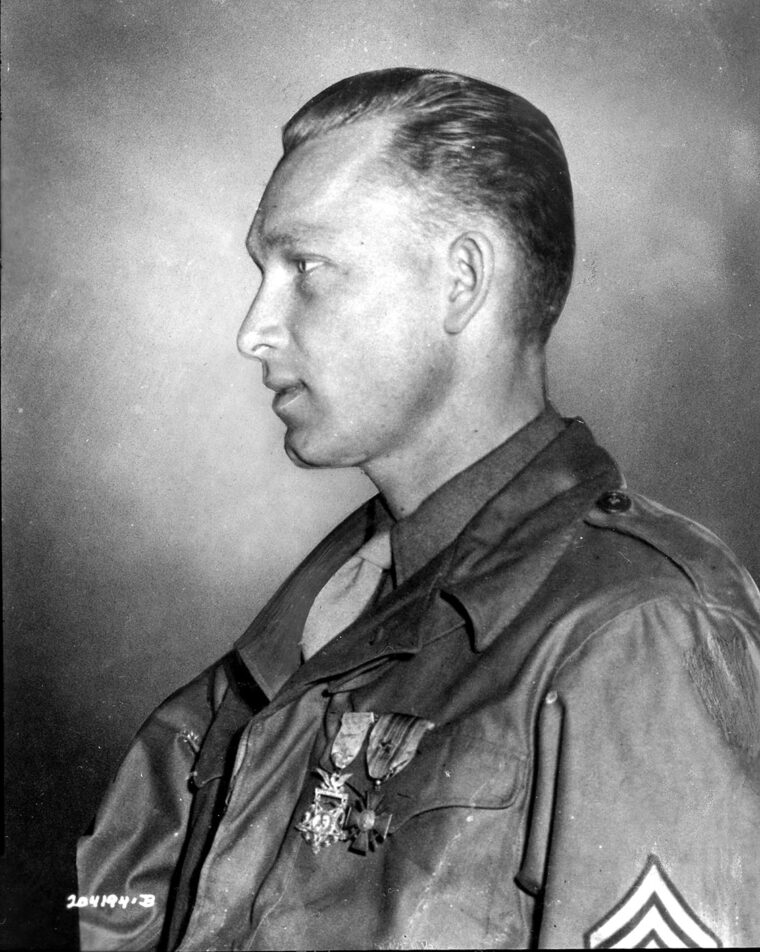
On March 9, 1945, at his headquarters at Gelsenkirchen, Germany, Ninth Army Commander Lt. Gen. William H. Simpson draped the Medal of Honor ribbon around Spurrier’s neck. The army then paraded Spurrier in front of newsmen from Germany to Paris. Though often drunk and frequently nearly out-of-control during the press tour, Spurrier’s behavior was ignored. Instead, he was repeatedly touted as the “One Man Army,” or as “Task Force Spurrier.”
After Roecker moved up to regiment, Maj. Carlysle “Curly” McDannel took command of the 2d Battalion. “Spurrier was not my cup of tea,” McDannel later admitted. “It was as if once he got that medal he thought he could do whatever he wanted and didn’t have to answer to anyone.” In his opinion Spurrier should have been court-martialed for his undisciplined ways. As the war neared its end McDannel nearly got his way.
In Germany, late in April 1945, as the 35th approached the Elbe River, Spurrier stole a command vehicle. Drunk and armed with a BAR, he holed up in a farmhouse, threatening anyone who neared the structure. Under the cover of darkness, McDannel approached the vehicle. As he attempted to disable the sedan, Spurrier lurched from the farmhouse. Brandishing his BAR, Spurrier threatened to kill McDannel if he did not move away from the vehicle.
Back at his headquarters McDannel prepared court-martial papers. Before they were finished the war ended. Among the first veterans to be sent home were living recipients of the Medal of Honor. In late May 1945 Spurrier left the 134th and headed back to the United States. On June 21, 1945 he was honorably discharged at Fort Meade, Maryland. On July 4, 1945, the town of Bluefield, West Virginia, held a major holiday and celebratory parade with Spurrier as the grand marshal. Floats, marching bands, and convertibles bearing dignitaries stretched for over one mile. In the lead vehicle sat a grinning, uncomfortable Spurrier. When the parade ended and Spurrier was formally introduced to the crowd he managed an awkward, “Hello, folks. Thanks a lot.”
Local newspapers carried pictures of Spurrier reuniting with his family and showing off his medals to neighborhood children. Spurrier remained in the national limelight for some time. In 1946 he was pictured with his former regimental commander, Butler B. Miltonburger, presenting a 35th Division pin to President Harry S. Truman, a World War I veteran of the division. Soon, however, the spotlight moved on and Spurrier set about making a living.
Newly married, he opened an automobile repair business in Bluefield. Unfortunately, he knew little about engines and the business struggled. Facing mounting financial pressure, Spurrier returned to the army. On July 16, 1947, he reenlisted. Spurrier was stationed at Fort Meade, Maryland, and Fort Knox, Kentucky, as an information specialist. Although he had enlisted for three years for unknown reasons Spurrier was honorably discharged at Fort Knox in June 1948.
Spurrier next found work as a heavy equipment operator and learned how to repair the newly popular television sets that were making their way into America’s living rooms. Clearly suffering the effects of his extensive combat experience, he continued to abuse alcohol. With his marriage over and unable to hold a job, for the third time in his twenty-eight years Spurrier joined the army. On October 27, 1950, Spurrier reenlisted as a master sergeant with an assignment to a military police battalion at Fort Bragg, North Carolina.

Almost immediately, Spurrier’s problems brought him trouble. In late November 1950 he stole a pistol and an automobile and unlawfully impersonated an agent of the Criminal Investigation Division. He was arrested, charged, and confined to Fort Bragg’s brig. Seeking help from another 35th Division veteran, he wrote to President Truman on December 17, 1950, requesting a personal interview. A week later Truman’s secretary wrote back and advised Spurrier that the president was not available.
Spurrier’s general court-martial convened at Fort Bragg on January 15, 1951. In short order the court found him guilty on all charges. His sentence included a reduction in rank, two years of confinement, and a Bad Conduct Discharge. Incredibly, on March 8, 1951, the unexecuted portion of the sentence was suspended. Apparently wishing to wash their hands of the whole mess, Fort Bragg authorities placed Private Spurrier on orders to Korea and shipped him off to Fort Lawton, Washington.
Spurrier went AWOL from Fort Lawton on April 18, 1951, and was returned to military control at Fort Knox, Kentucky after several escapades. He received a general discharge under honorable conditions on November 17, 1951. Fortunately for him, the Bluefield police had dropped the charges against him so he was free.
After some time in Baltimore, Maryland, where he had family, he finally returned to Bluefield, West Virginia, married and in 1965 fathered a daughter. Life seemed to have improved for Spurrier until May 1969 when he was convicted on charges of obtaining money from a finance company under false pretenses. Sentenced to 1-to-5 years, Spurrier was released on Christmas Eve that year by a probationary pardon issued by Gov. Arch A. Moore.
Spurrier’s brother Joe picked him up and took him to see his daughter in Limestone, Tennessee. The war hero honored his pledge and did not drink again. In the fall of 1971 Spurrier moved back to Baltimore. “I just didn’t find anything down in Tennessee I wanted,” he related. “I can make more money up here.”
On June 1, 1971, Governor Moore granted Spurrier an executive discharge of the balance of his prison sentence. “I’d really like to thank the governor,” Spurrier. “Things are really picking up.” A few weeks earlier Spurrier had reconciled with his estranged wife and returned to her and their daughter. The family ran a small TV repair shop in Baltimore.
By the mid-1970s Spurrier was crippled with arthritis and unable to work. He moved with his daughter to Limestone to be near family members. In a 1980 interview he reflected on his life. “I don’t regret having the medal. A man would have to be stupid not to want it. But I never tried to get one and there are times when I wished I didn’t have it. Then people wouldn’t be looking for so much from me.”
Confined to a wheelchair for the remaining few years of his life, Spurrier died in Limestone on February 24, 1984. His headstone at Mountain Home National Cemetery, Johnson City, Tennessee, is the only testament to his World War II heroics, listing his Medal of Honor, the Distinguished Service Cross, a Bronze Star, and two Purple Hearts.

Join The Conversation
Comments
View All Comments