By Daniel R. Champagne
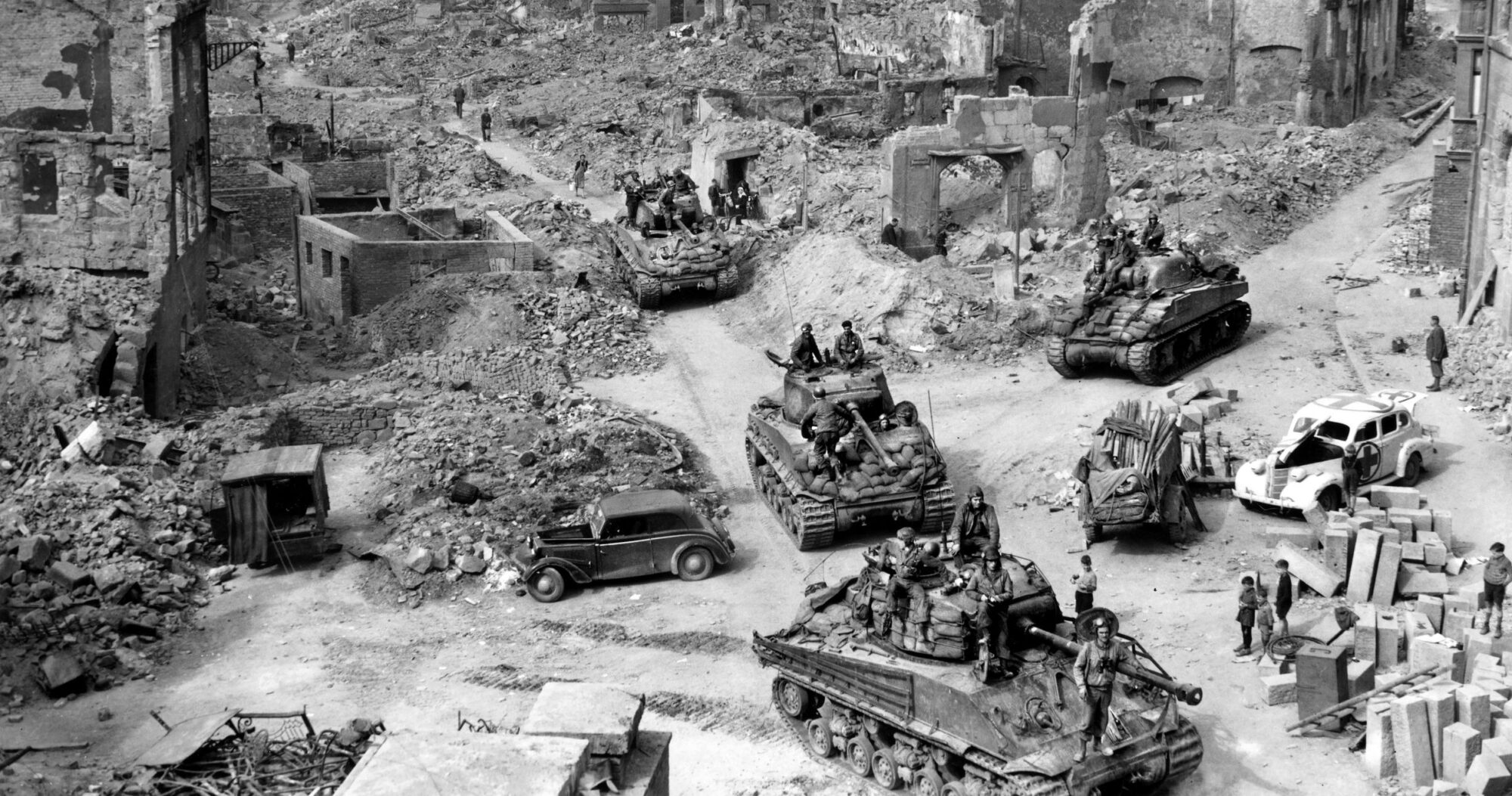
Scouting for the best route for his motor pool through Nuremberg, Germany, 1st Battalion, 15th Regiment Transportation officer Lt. Frank Burke was striding boldly through the rubble-filled streets on the morning of April 17, 1945, when he spotted a cluster of Germans preparing for a counterattack. He ran back to an infantry unit, grabbed a light machine gun, and engaged the superior enemy force—killing a machine gun crew and forcing the others to withdraw. Burke then grabbed a rifle and dashed 100 yards through intense enemy fire, taking cover behind an abandoned tank. He continued to gun down German infantrymen and snipers hidden among the ruins until his M-1 jammed and he was forced to withdraw from the fight long enough to find a replacement and secure a few grenades before jumping back into the fray.
Realizing that his shots were ineffective, Burke “pulled the pins from two grenades, held one in each hand,” and rushed an enemy held building, tossing the grenades as a German soldier simultaneously threw a potato masher at him. All three grenades exploded, killing the Germans and leaving Burke shaken and disoriented. His courageous example along the urban streets of Nuremberg inspired other units to advance and close in on the enemy.
In March of 1945, the Allies had crossed the Rhine River—the last natural barrier protecting the German heartland from the west. The Wehrmacht’s failure to defend this obstacle effectively ended the German illusion that the homeland could still be defended. The forces under Supreme Allied Commander Gen. Dwight D. Eisenhower included Gen. Bernard Montgomery’s 21st Army Group in the north, Gen. Omar Bradley’s 12th Army Group in the center, and Gen. Jacob Dever’s 6th Army Group in the south. Their mission was the destruction of the German armed forces and to end a war, which had been raging for five and a half years.
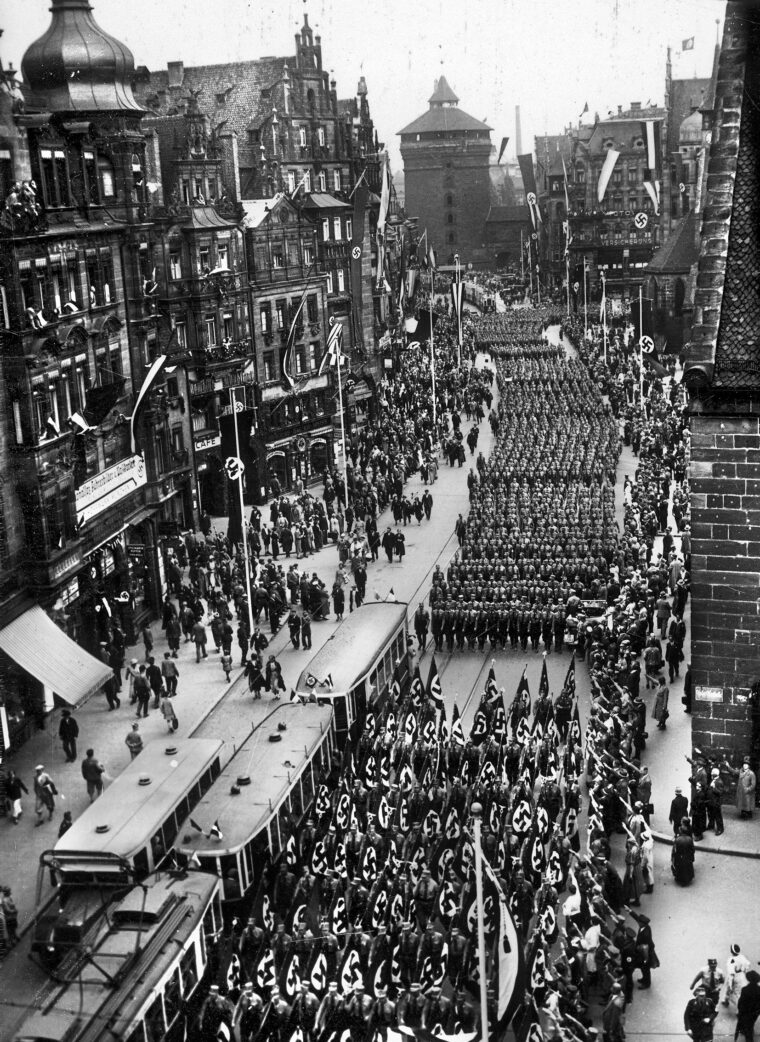
As Germany’s Third Reich began to collapse under the weight of the Allied forces in the spring of 1945, both sides focused their attention on Nuremberg. The Allies viewed the ancient city as a “high-value target,” thus, its capture was critical to break German morale. Nuremberg was the final prize for the U.S. Army in Germany. It was, after all, the shrine of Nazism, which Hitler called the “most German of all German cities.” Gen. Alexander Patch’s 7th Army—part of Dever’s 6th Army Group—had already begun to consolidate a bridgehead when Eisenhower issued orders to advance eastward in the direction of Nuremberg.
The symbolic nature of Nuremberg could not be overlooked. The medieval city was the cradle of Nazism and the center of the Nazi Party, which held its first organized meeting there in 1923. Between 1933-1938, the annual September Nuremberg rallies became massive, carefully choreographed propaganda spectacles designed to project total totalitarian unity. Albert Speer, the Reich’s chief architect, was personally commissioned by Hitler to construct the colossal Zeppelinfeld Stadium to host these tribal gatherings. Moreover, the antisemitic and racist “Nuremberg Laws” that stripped Jewish Germans of their citizenship were introduced at the annual rally in 1935.
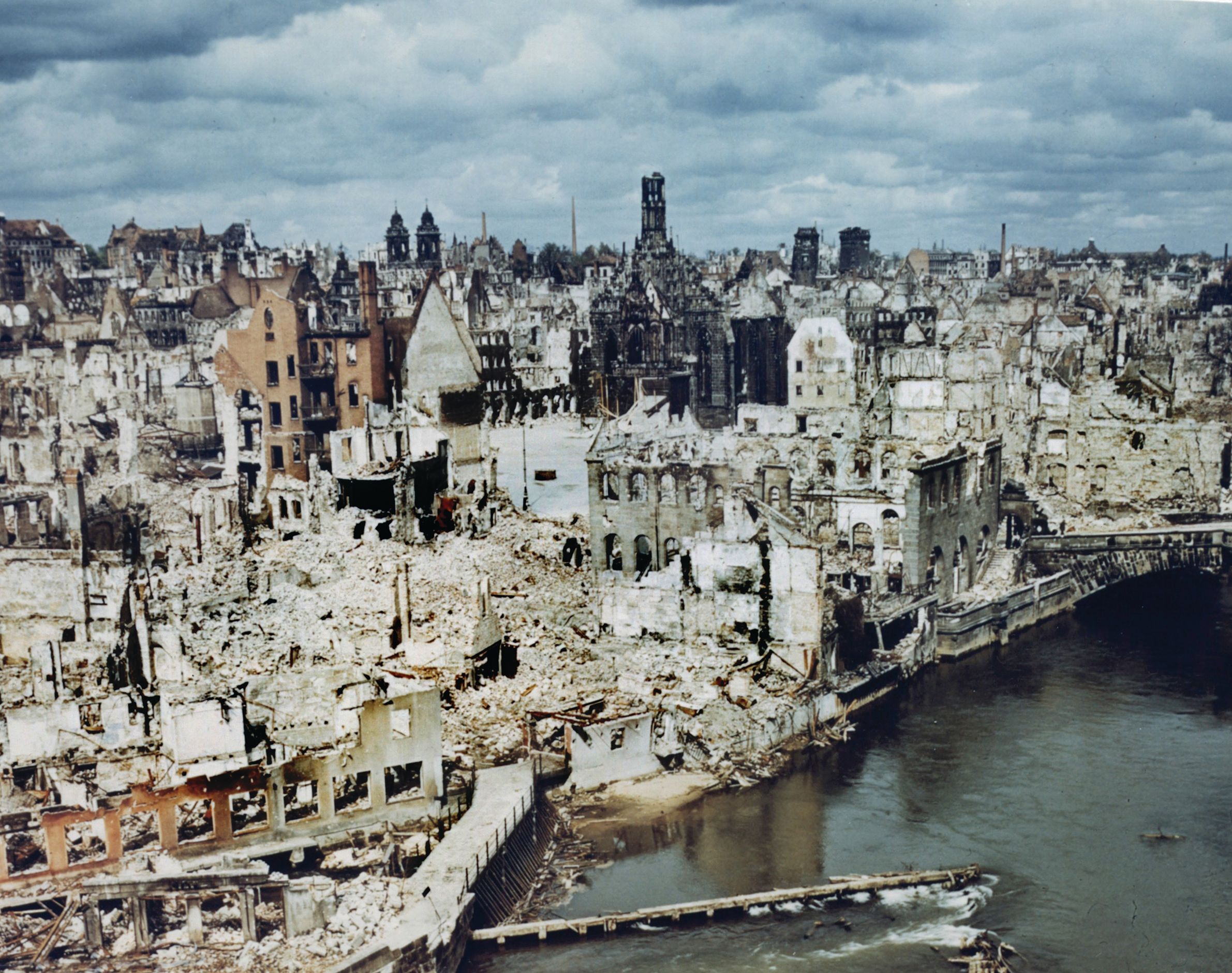
During the war, Nuremberg was also an important military-industrial center. Maschinenfabrik Augsburg-Nurnberg (MAN) had several factories, which produced diesel engine components for U-Boats and Panther Tanks. Siemens-Schuckert-Werke was an electrical engineering company, which supplied the Wehrmacht with various weapons, vehicles and equipment. To weaken the German war effort, the Allied bombing campaigns targeted Nuremberg’s robust industrial centers throughout the war. By the time American forces entered the city, it lay in ruins.
The German units tasked with defending the city were an assortment of mixed units. The Kampfgruppe (battle group) Dirnagel was made up primarily of SS troopers; Kampfgruppe Rienow consisted of Air Force personnel and officer candidates; and the 1st Battalion, 38th SS Panzer Grenadier Regiment was composed of Germans along with foreign conscripts and volunteers. In addition to this force were the Volkssturm (people’s militia), Hitler Youth, the 2nd Mountain Division, and the 17th SS Grenadiers.
The most lethal defense included 150 flak guns, which formed a ring around the city. John Steinke, a private attached to 1st Battalion, 15th Regiment Headquarters, spoke candidly about his trepidation regarding the guns: “Our troops came under heavy fire from hundreds of deadly German 88mm anti-aircraft guns located in the small villages that surrounded the city. Those guns were nerve-wracking as all hell. Just the sound alone would scare the bejesus out of you.”
The Germans were determined to defend the shrine of Nazism. The leading Nazi official in Nuremberg was World War I veteran Karl Holz—the Gauleiter of Franconia. He was determined to make Nuremberg into a fortress to be defended to the last man. The antiaircraft guns that encircled the city were zeroed in on the fast approaching U.S. forces. Roadblocks were also set up throughout the city and snipers were concealed in the remains of standing buildings. The chief of the Nuremberg police begged Holz to save lives by surrendering, arguing that “the defense of Nuremberg is crazy. It can’t be held. It is clear to everyone with even the vaguest of military experience that the measures are inadequate.”
Taking Nuremberg would be especially difficult because, as described by Donald Taggart in The History of the Third Infantry Division,“the outer city or new city bordered the century old walled inner city, which was the fortified Nuremberg from the feudal days.”
Although the Germans had strengthened Nuremberg’s defenses, elements of the U.S. 7th Army continued to advance. Wade Haislip’s XV Corps captured Bamberg, north of Nuremberg, on April 13. American forces then took the city of Bayreuth the following day. By this time, the Germans had relatively few tanks in the region. Reinforcements from the U.S. 14th Armored Division as well as artillery fire, and air strikes from fighter bombers destroyed the only enemy armored force capable of providing an organized resistance against the oncoming American juggernaut.
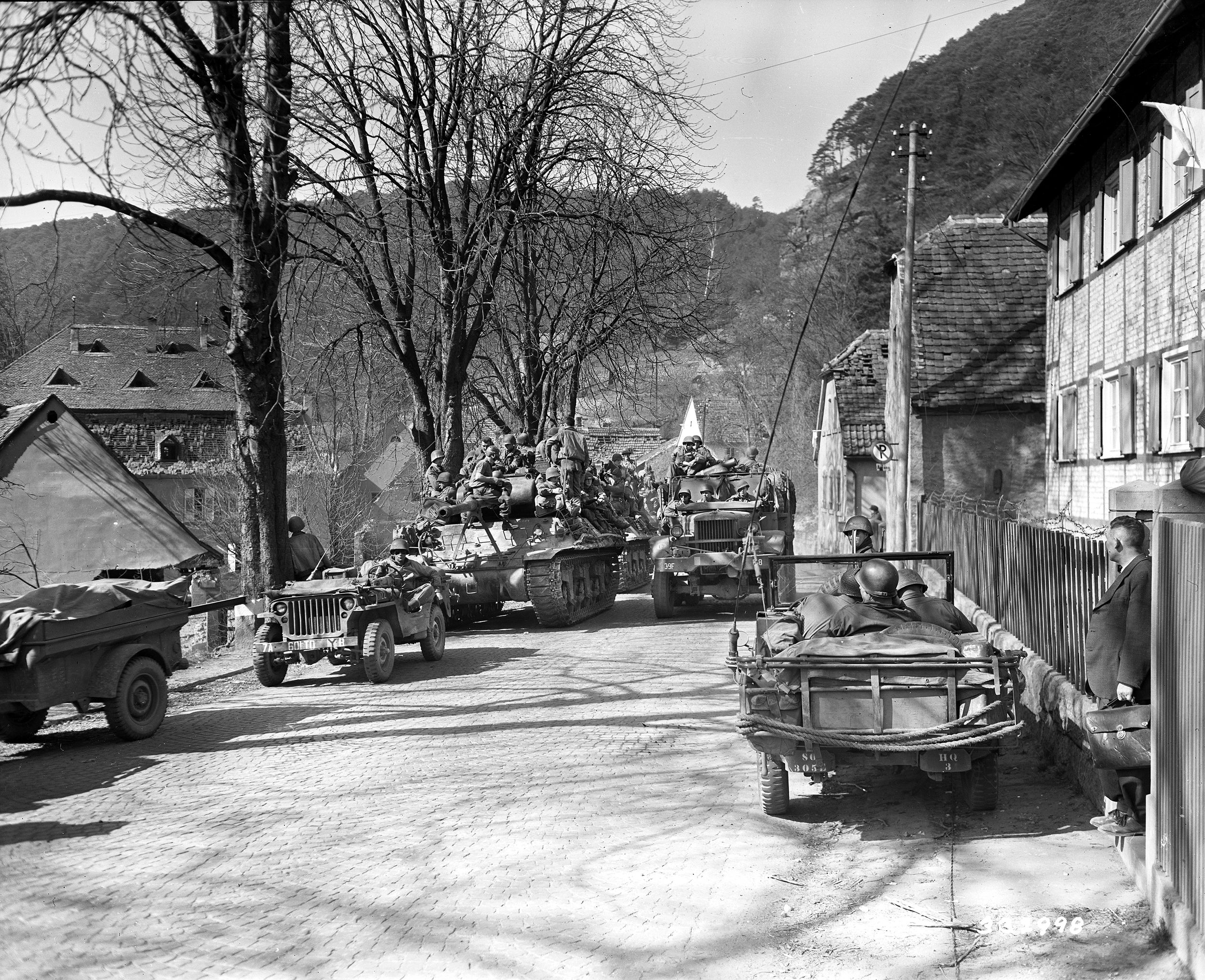
The operational plan for capturing Nuremberg called for its envelopment by elements of the XV Corps. The 3rd Infantry Division would advance on the corps right, cross the Pegnitz River, and attack the city from the north. In the center, the 45th Infantry Division would attack from the southeast. The 14th Armored Division would maintain the corps’ left flank and screen south and east of Nuremberg out to about 15 miles. Similarly, the 106th Cavalry Group would screen southwest of the city and block exits to the south.
In the early morning hours of April 16, the 3rd Infantry Division, commanded by Maj. Gen. John “Iron Mike” O’Daniel, crossed the Pegnitz River from the west side. The 7th Regiment moved through the town of Erlangen and forced a surrender by early afternoon. Although enemy resistance was light, forward movement by the division was slowed by the “successive clearing operations.” However, the 7th would encounter increased small arms fire, automatic weapon and self-propelled gun fire in the fight for the village of Tennenlohe just north of the city. The 15th Regiment faced similar opposition in taking Heroldsberg. Later in the day, both regiments met strong enemy resistance as they moved through the towns of Bueckenbuhl and Kraftshof en route to Nuremberg.
The 45th Infantry Division led by Brigadier General Henry J.D. Meyer approached Nuremberg from the east and southeast. The 179th Regiment began their attack by advancing through the woods to reach the towns of Ruckersdorf and Rothenbach on the outskirts of Nuremberg. At noon, the 179th Regiment’s commander Col. Preston Murphy and executive officer Maj. Frederick Snyder were observing the progress of the leading assault units when they were suddenly hit by mortar fire. The burst came within feet of the two officers and both were wounded by shell fragments. The regiment received increasing amounts of fire from 88mm antitank guns, which defended the city.
By the end of the day, the two attacking divisions were within striking distance and each of their commanders wanted to be there first. Although the end of the war was near, everyone was on edge. In the words of one veteran: “To die at this stage—with the door at the end of the passage, the door into the rose garden already in sight, ajar—would be awful.” As Medal of Honor recipient Audie Murphy recalled, “Hope and fear walk hand in hand. We can see the end… always in a man’s mind is that one lead pill, that one splinter of steel that can lose him the race with the finish line in sight.”
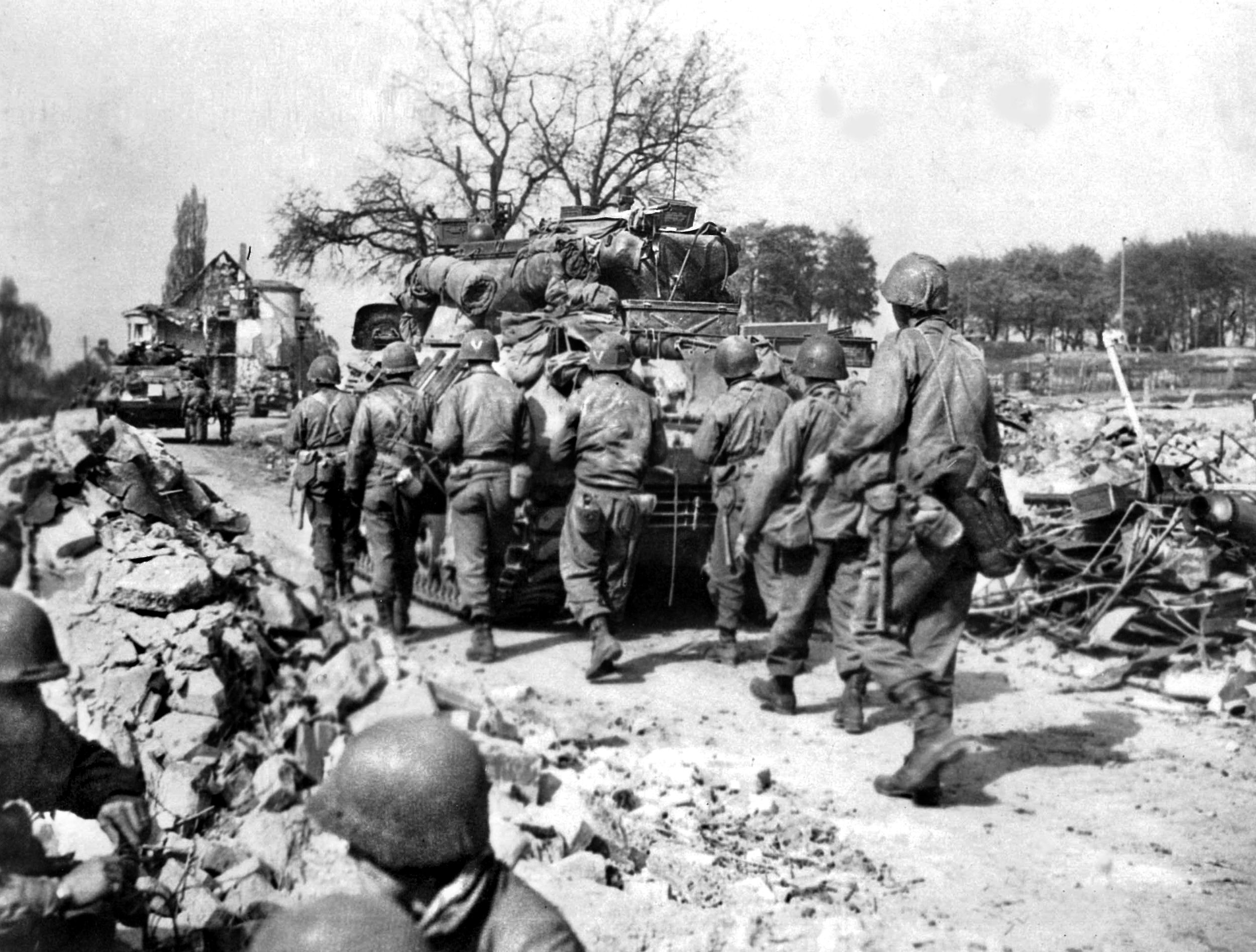
As the XV Corps drew nearer to the city, they were met with ever increasing German resistance. During the advance on Nuremberg, the 441st Anti-Aircraft Artillery Battalion, commanded by Lt. Col. Thomas H. Leary, fired thousands of rounds of ammunition at the enemy. The city was already in shambles by the time the 3rd and 45th Divisions arrived. After countless air raids, the once beautiful medieval metropolis had transformed into a “burned out, unrecognizable charnel house.”

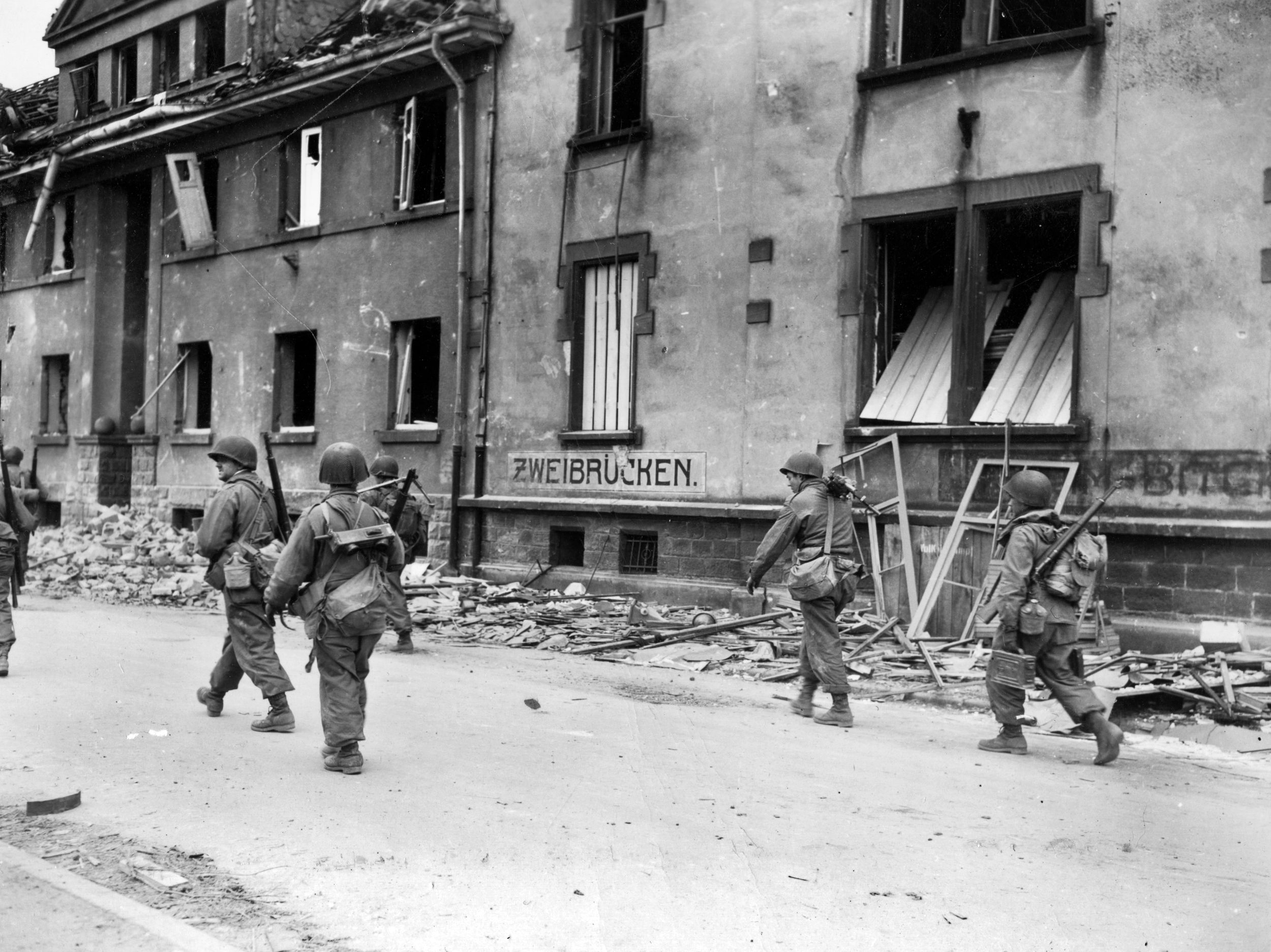
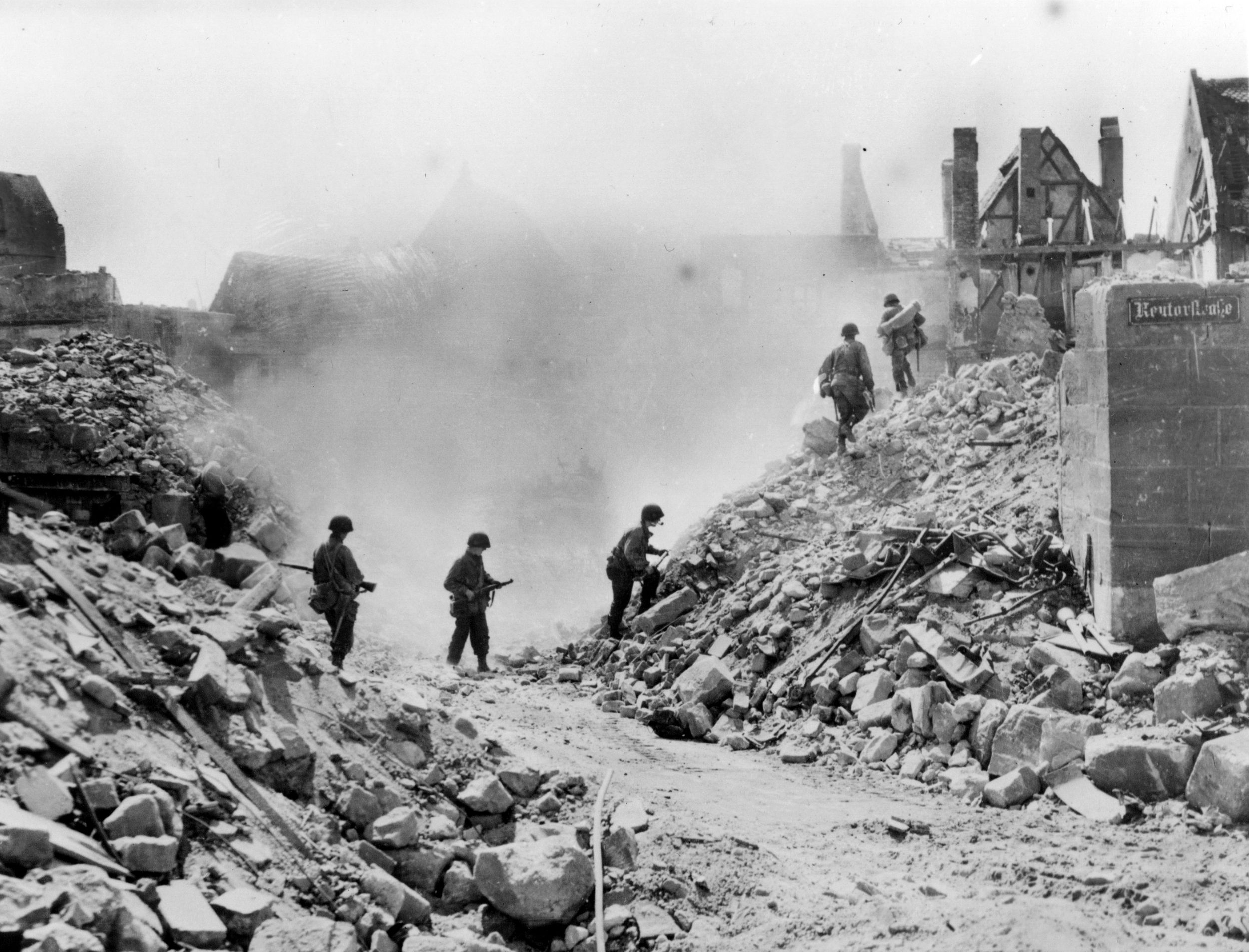
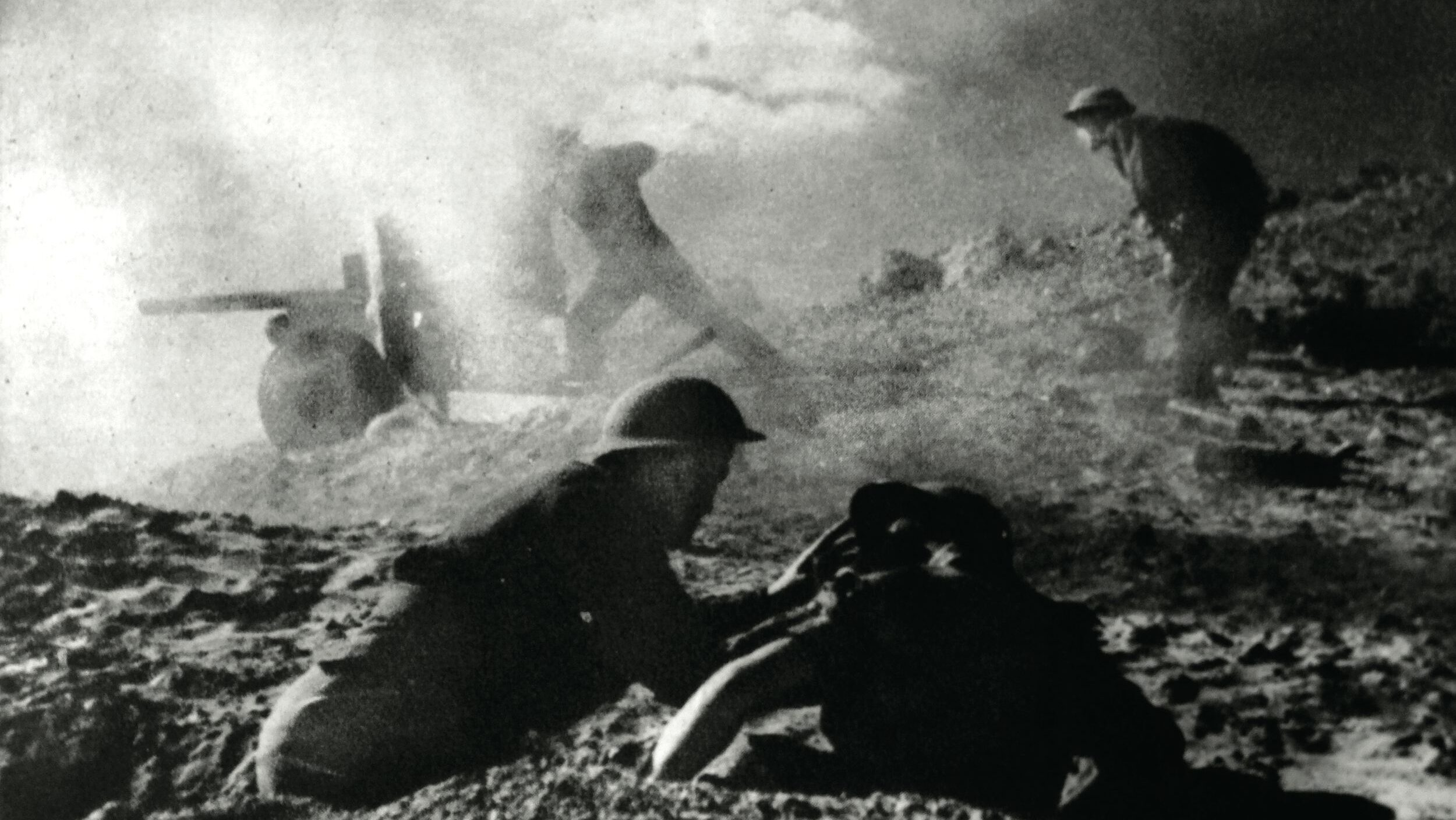
The 3rd Division continued its attack to the south with its three regiments (7th, 15th, 30th) abreast. Once the remaining towns on the northern outskirts of Nuremberg were cleared, the division closed in on the outer city. At dawn on April 17, Lt. Col. Keith Ware’s 1st Battalion, 15th Regiment struck from the northeast and immediately encountered small arms fire, grenade explosions, and tank blasts. German snipers armed with high powered telescopic rifles lurked in the windows of the bombed out buildings. Complicating matters were the hardline Nazi civilians positioned on rooftops and firing Panzerfausts at the oncoming American armor. Once Ware’s men finally entered the city, room to room fighting ensued as they carefully cleared out every enemy infested building.
The division made steady progress, advancing from one ruined building to another. They were on high alert, “looking for snipers, hugging crumbling walls, avoiding branching out, and not dropping their heads.” The Germans were heavily armed and concealed in spider holes and amongst the building ruins. John Steinke eerily recalled the dangers posed by snipers: “On this particular day (April 17), we were receiving heavy sniper fire. Our new lieutenant, who had joined us right after the landings in Southern France, was standing in the middle of the street looking at his map. Suddenly, he was shot in the head and dropped dead; the bullet went right through his helmet. Unfortunately, sometimes the young replacements refused to take the advice from the old veterans. If he had just listened to us, he’d be alive today.”
It was during this urban street fight that Lieutenant Burke committed the acts that earned him the Medal of Honor—single-handedly killing a German machine gun crew and then another group of Germans in his sector with a hand grenade assault.
The 45th Division continued to close in on Nuremberg from the southeast. The 179th Regiment continued the advance with three infantry battalions in column. Overall, enemy resistance was light barring some small arms and 88mm fire. In the center of the Division’s sector, the 180th Regiment’s progress was slowed by enemy machine-gun positions and small arms fire. Leading elements of the regiment destroyed and seized numerous 88mm flak guns, which were concentrating their highly effective fire.
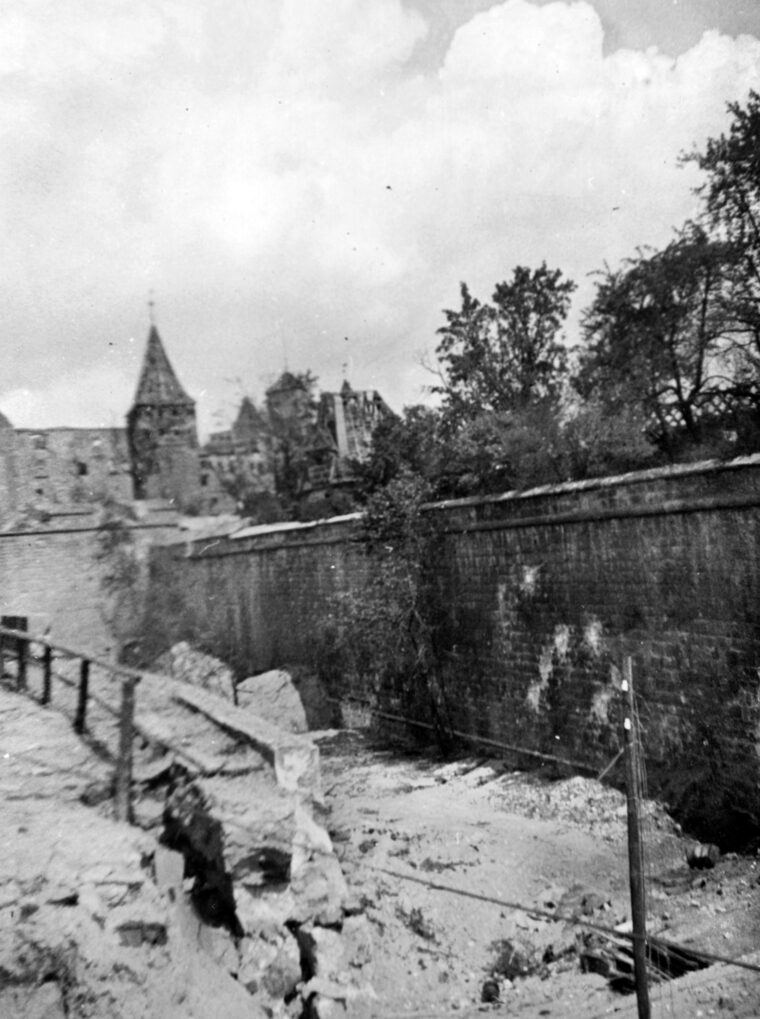
The day would be a momentous one for E Company, 180th Regiment. Supported by tanks and several weapons platoons, E Company attacked a German POW camp and knocked down the perimeter fence, liberating the camp that held 13,000 prisoners. The company was then ordered to take the imposing, but unfinished Kongresshalle (Congress Hall) designed to seat 50,000, which sat on the rally grounds. As the company pressed through a wooded area, E Company commander, Capt. Paul Peterson, witnessed the battlefield struggles of a new lieutenant: “The new officer was leading his platoon in assault fire across a 50-yard fire break straight up on enemy prepared positions. The fire distribution and marching fire were perfect and every man advanced quickly towards the stubborn Germans… However, on reaching the first position the Lieutenant lost control of his platoon. The officer suddenly had stopped and stood looking at a very much dead enemy soldier. The Lieutenant kept repeating, ‘I killed him, I killed him.’” After the incident, Peterson impressed upon the lieutenant the importance of letting go and leading his platoon forward.
At midafternoon on April 17, E Company began attacking the hall itself. After encountering rifle, machine gun and 88mm fire, the Americans reached the hall and began the tedious task of clearing out the structure. “The building was finally reached and their squads started clearing each room,” recalled Peterson. “The enemy was holding out under the two or three fanatical SS troopers so placed to ensure that each person remained to defend the position to the last.” E Company had suffered another four wounded before nightfall; darkness finally brought an end to the fighting.
On the following day, the 3rd and 45th Divisions continued to press into the outer city while the old feudal inner city remained in the crosshairs. Most of the buildings in the city had been reduced to heaps of rubble, which spilled into the streets, making tank navigation extremely difficult. German resistance was tenacious and the daily struggle was characterized by house-to-house fighting. Consequently, buildings had to be carefully cleared out room by room to eradicate enemy positions and snipers.
The 3rd Division advanced with the 7th Regiment on the right, the 15th Regiment in the center, and the 30th Regiment on the left. A Company, 15th Regiment, under the command of Michael J. Daley, moved out at 0500. They were ordered to move south along the Bayreuther Strasse, a main road, which led towards the heart of the old inner city. Throughout the slow and methodical advance, the company encountered heavy German resistance from the basements of buildings, foxholes in the city parks, and prepared 88mm gun emplacements. Waiting up ahead and defending the old city was the 17th SS Panzergrenadier Division, which included the 38th SS Regiment—“SS stalwarts with twin lightning bolts etched on their helmets.”
After an SS sniper killed one of the lead scouts, Daly decided to become point man for his lead platoon. As the regiment advanced further down Bayreuther Strasse, U.S. artillery “ripped through the air,” exploding up ahead into the heart of the old city. Suddenly, machine gun fire from a water tower rained down on Daly’s men. Daly lifted his carbine, aimed and pulled the trigger, silencing the machine gun. Company A followed Daly as he reached the twisted wreckage of what remained of the Nordost Railway Station.
According to 1st Sgt. Roy Kurtz, “We had advanced as far as the Nordost Railroad Station when Lt. Daly, moving far ahead of us as usual, found that the wreckage of a railroad bridge lay across the Bayreuther Strasse, the principal highway into the old city. Swinging around to the right of the bridge, Lt. Daly had just begun to climb upon a low embankment along the railroad when a machine gun suddenly opened up from the other side of the Leipziger Platz. We were caught out in the open by rapid fire. Our men were killed left and right. Aware that his company was in danger of being annihilated, Lt Daly ran full speed toward the machine gun nest to a position fifty yards from the enemy gun. Killing all the Germans with his carbine, he pushed forward until he spotted an enemy anti-tank detachment, which was zeroed in on our attached armor units.”
SSgt. Ivan Ketron, another witness to the action, recalled that “Lt. Daly signaled for the company to halt and again struck out alone. He was taking his life into his own hands and we all knew it. I saw the Lieutenant work his way forward to what was left of a house and opened fire with his carbine. The Krauts replied with a rain of automatic fire, sending eddies of fine white dust from the building he was shooting from… Although the whole Kraut patrol was concentrating on him, Lt. Daly kept firing his carbine until he killed six Germans and silenced the enemy fire. Advancing well ahead of his company, Daly entered a public park before his troops and began reconnoitering the area. While A Company was taking up positions in the park, a German machine gun opened up on it without warning. Instinctively, Lt Daly seized an M-1 from a dead soldier and fired point blank, killing the enemy machine gun crew.”
An executive officer for the 1st Battalion, Major Burton Barr, added that “in four single firefights with a strong enemy Lt. Daly had killed fifteen Germans, destroyed three machine guns and wiped out an entire enemy patrol… His heroism during the battle of Nuremberg will never be forgotten by the officers and enlisted men who fought there.” On August 23, 1945, President Harry S. Truman awarded the Medal of Honor to Lt. Michael Daly for heroism above and beyond the call of duty.
At 0500 on April 18, E Company, 180th Regiment picked up where they left off by reentering the Kongresshalle and clearing rooms using white phosphorus and fragmentation grenades. The remaining Germans surrendered quickly. By 0630, the massive structure was secure. At 0700, the company moved out and encountered growing enemy resistance just a few hours later. Captain Peterson wrote: “The section of the city had been formerly a pretty residential part of Nuremberg. Now it was a jagged mass of ruins with only an occasional house that hadn’t been entirely gutted. The defender used this rubble to the fullest extent possible. The enemy further started at this time to use children and old men to do the observing. The man or child would be noticed walking up to a corner near front line positions, stand for a while, and then slowly amble away. Shortly thereafter artillery and mortar fire would pinpoint the enemy positions. Orders were given to the platoon leaders to “fire on any future observers of this type.”
After they moved out, the company came under heavy fire from an 88mm gun. While two platoons laid down covering fire on the enemy position, Lt. Roy Fee and his 1st platoon maneuvered around the German right flank and destroyed the gun position, killing 20-25 enemy soldiers and taking 3-4 prisoners. After some intense house to house fighting, Fee was killed by machine gun fire when he attacked an enemy roadblock. The company continued their advance well into the evening, encountering heavy resistance from German Panzerfausts and 20mm cannons. By the time hostilities subsided for the day, American forces had cleared and controlled two-thirds of Nuremberg.
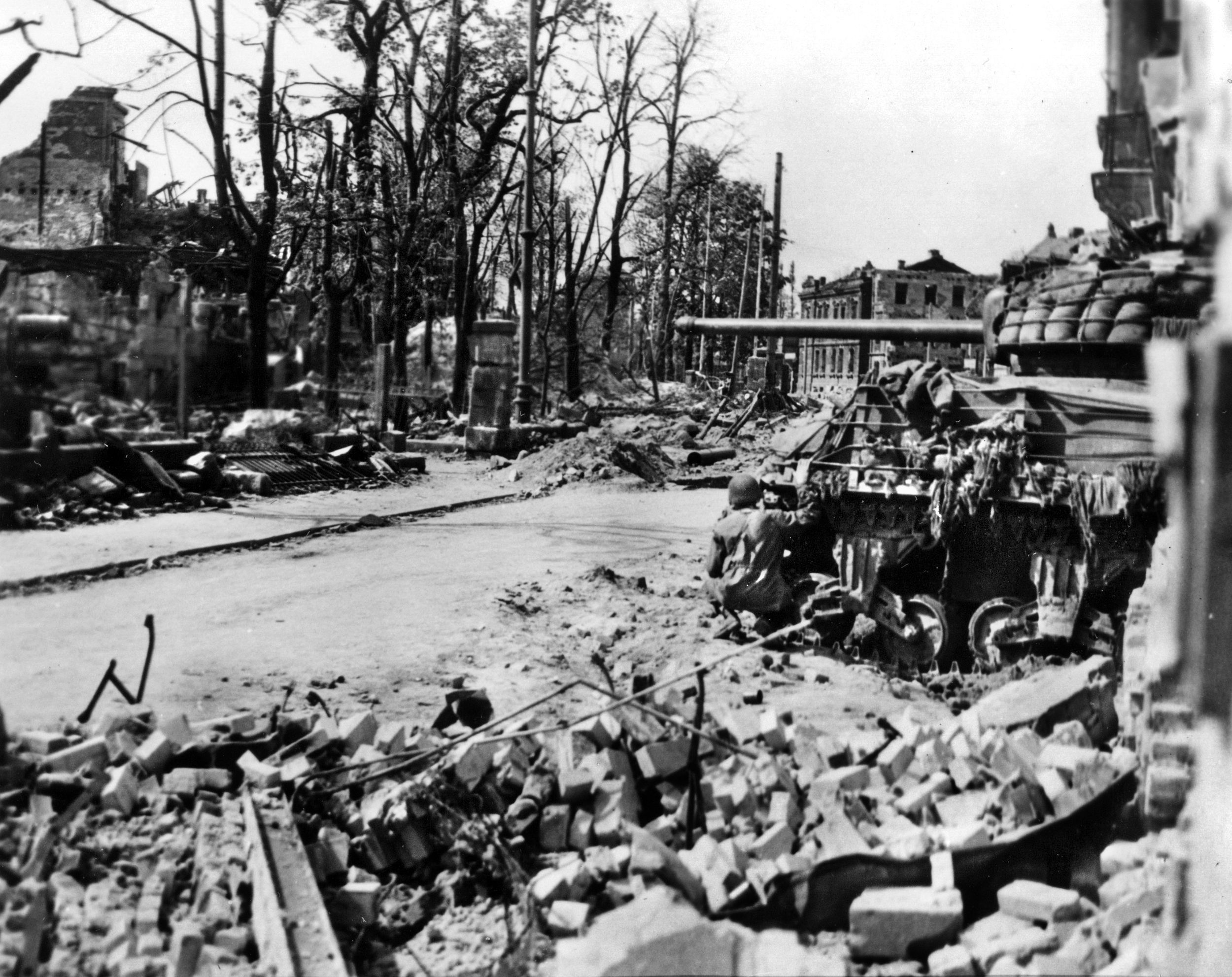
On April 19, the XV Corps continued its final assault to clear Nuremberg. The 3rd and 45th Divisions were set on assaulting the old city center—the former seat of the Holy Roman Empire. The old city presented a formidable obstacle for the Americans. The medieval fortifications, highlighted by its massive surrounding stone wall, withstood numerous bombing raids. Enemy resistance was still intense and units reported enemy fire from both civilians and uniformed troops. However, German artillery lessened as more and more of their gun positions were destroyed or overrun.
Despite heavy German resistance, the 3rd Division was relentless in their assault. That morning, the division once again crossed the Pegnitz River, which snakes through the heart of the city. By 1100 hours, one company of the 7th Regiment entered the old inner city. The rest of the regiment moved up to the walls by evening, where they successfully resisted a counterattack by a “group of suicidal Luftwaffe trainees attacking from the ruins of Nuremberg castle.” The 1st Battalion, 15th Regiment captured a company of Nuremberg’s police force who had been pressed into service as infantry soldiers. By nightfall, the battalion had advanced up to the old Nuremberg walls.
The 30th Regiment, 3rd Division, which had been in division reserve throughout the advance, encountered fierce enemy resistance before a counterattack caused the Germans to withdraw. That afternoon, 2nd Lt. Telesphore Tremblay and his anti-tank crew surrounded the Laufer watch tower on the edge of the walled city. The men shot at the Germans repeatedly before bazookas and a tank destroyer were brought up to direct concentrated fire on the structure. This prompted the surrender of the Germans inside the tower.
Once the leading elements of the 30th Regiment advanced up to the St. Johannis gate—a crucial entry point into the old city—the U.S. Army sent a message to the Germans via loudspeakers: “Your city is completely surrounded and the old city has been entered in several places. People in the occupied part of the city are being treated humanely. Your unconditional surrender will be accepted under the following conditions. Raise white flags over the buildings and open all entrances to the inner city. Otherwise, you will be destroyed.”
At first, there was no response from the enemy, so an M12 155mm assault gun was ordered into position to blast holes in the walls of the medieval fortress. The Germans at St Johannis Gate finally surrendered, allowing the remainder of the 3rd Division a clear path into the city. By 2235 hours, all three regiments of the division had units within the old city walls.
As the eastern sector narrowed, much of the 179th Regiment, 45th Division was located behind the advance of the 180th Regiment. The 1st Battalion, 179th Regiment conducted a division blocking mission, while the 180th was driving deeper into the city. The 1st and 2nd Battalions of the 180th were repeatedly slowed by sniper and machine gun fire. The 3rd Battalion reached the walls of the inner city but was hindered by bazooka fire and snipers.
The 157th Regiment, 45th Division cleared the southern portion of Nuremberg and continued northwest towards Furth. Their objective was to secure the highway between Furth and Nuremberg. Their progress was impeded by strong German resistance and the arduous task of house-to-house fighting. The 3rd Battalion, 157th Regiment, commanded by Lt. Col. Felix Sparks, had not yet advanced up to the old city walls. In the early morning hours of April 19, Sparks followed two companies in his jeep as they pushed forward towards the old city. However, the endless maze of smoldering rubble made it extremely difficult to navigate. The driver advanced cautiously while Sparks tried to identify street signs and landmarks amongst the city ruins. Finally, he spotted the green dome of the opera house roof at the center of Nuremberg. Sparks looked at his driver Turk and said: “Uh oh, I think we’ve gone too far.” Turk stopped so that Sparks could look at his map. Suddenly, machine gun fire rained down on Sparks and his men from high atop the opera house. The burst went between the legs of the men in the backseat and narrowly missed Sparks arm before they all ran for cover in the nearest bombed out building. By the end of the day, the regiment had forward units located at the southern edge of the old city.
At daybreak on April 20, the Germans faced a dire situation. With his countrymen’s ammunition running low, Holz sent a final message to Hitler on his 56th birthday. “My fuehrer: The final struggle for the town of the party has begun. soldiers are fighting bravely; the population is proud and strong,” Holz wrote. “I shall remain in this most German of all towns to fight and to die. These hours my heart beats more than ever in love and faith for the wonderful German Reich and its people. The National Socialist idea shall win and conquer all diabolic schemes.” In the final hours, the Americans would tighten their grip on the city and clear out the last remaining pockets of resistance.
The 3rd Infantry Division started its final assault from the previous day’s positions within the walls of the old city. The advance was slow at first but it became evident that German resistance was weakening. German strong points were repeatedly destroyed by American heavy artillery and air support. At about noon, when the Nuremberg castle fell to the 15th Regiment, the 7th and 30th Regiments moved up to the Adolf Hitler Platz in the heart of the city. There, the 3rd Division would overwhelm the last 200 Germans who continued to hold out to the very end. These stalwarts were finally killed when explosives were lowered into their makeshift tunnel.
The 45th Infantry Division’s final assault was conducted by the 180th Regiment. That morning, E Company and a platoon of tanks were sent through the old medieval wall under the cover of white smoke. During the advance, they encountered only sporadic enemy resistance. Nevertheless, Peterson ordered the tanks forward to suppress the waning German opposition. As the company moved through the war-torn streets of Nuremberg, the “Germans were surrendering in groups of 25-30 at a time.” Once the fighting ended for the day, 750 prisoners had surrendered to E Company.
During the advance on Nuremberg, both the 3rd and 45th divisions had captured thousands of prisoners. In his book, I Remember: Stories of a Combat Infantryman, SSgt. John B. Shirley—commander of L Company, 15th Regiment,—wrote: “One of my memories of the last month of fighting was the large number of German soldiers taken as prisoner. We became casual about taking prisoners, as the Germans wanted to surrender to the Western Allies. They went to great effort to leave the Russian sector so they could be captured by American and British forces rather than the Russians.”
Throughout the day, U.S. units continued to root out the enemy from the rubble. Surrendering Germans emerged from their hiding spots in basements and air raid shelters. Sometime in the afternoon, Holz was found dead in a bunker at the Nuremberg Police Presidium surrounded by a few staunch loyalists but whether he committed suicide or died fighting remains a mystery. After Holz’s death, second-in-command Col. Richard Wolf realized that his forces couldn’t continue the fight and ordered all German troops in the area to surrender. By 1400 hours on April 20—Hitler’s birthday—the crumbled city of Nuremberg was in American hands and all resistance north of the Pegnitz River had ceased.
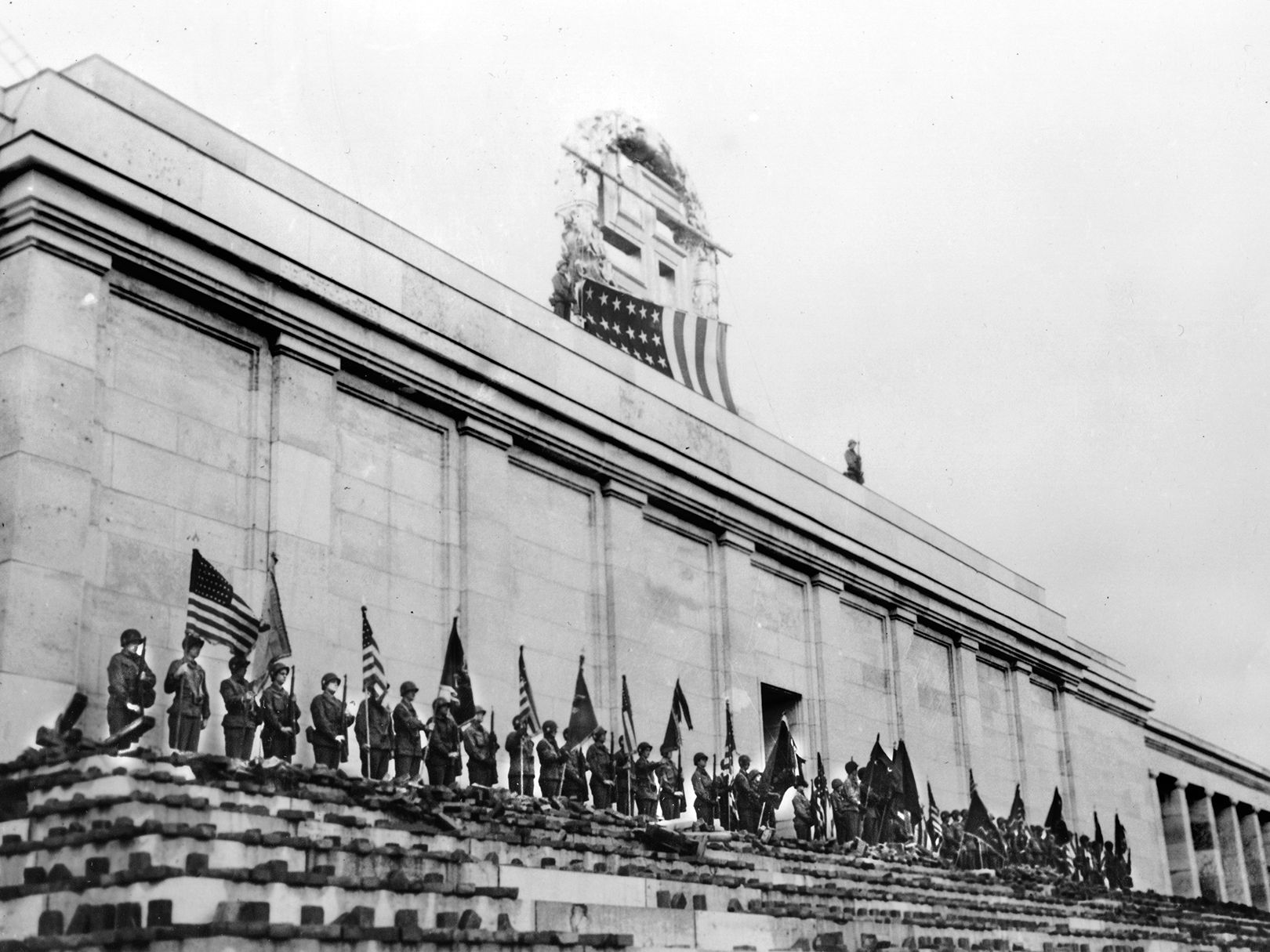
On the following day, the officers and enlisted men who had participated in the assault took part in an elaborate ceremony, culminating in the official raising of the American flag over Nuremberg. Tom Godfrey, a sergeant in B Company, 15th Regiment, described the scene: “During the ceremony, I was on guard duty in one of the buildings; I believe it was the third story. You could look down onto the courtyard (Adolf Hitler Platz) and see the brass and enlisted men all spit and polish down there. The military pomp was an impressive sight.” Third Division Commander, Maj. Gen. John W. O’Daniel, summed up the battle in a heartfelt message to his men: “Through your feats of arms, you have smashed fifty heavy antiaircraft guns, captured four thousand prisoners, and driven the Hun from every house, castle, and bunker in our part of Nuremberg. I congratulate you upon your superior performance.”
The battle of Nuremberg was a significant urban conflict characterized by intense building to building, room to room, and hand to hand combat. The victory was not merely the result of innovative battle tactics but was primarily driven by “battle hardened U.S. soldiers who refused to be denied,” showcasing their determination and resilience in the face of fierce German resistance. The Germans failed in Nuremberg because they were “out manned, out-gunned, and out fought by a superior U.S. force.” The battle was crucial as it marked the end of a major Nazi stronghold and delivered a crushing blow to the faltering German Army.
Retired history teacher Daniel R. Champagne is the author of Dogface Soldiers: The Story of B Company, 15th Regiment, 3rd Infantry Division. He lives in Salem, New Hampshire.
Join The Conversation
Comments
View All Comments