By David H. Lippman
Three German armies surprised the Allies by breaking across the Our River and storming into the Ardennes on December 16, 1944. The Nazi objective was to drive across the woody and hilly terrain, cross the Meuse River, and seize the major port of Antwerp. Doing so would cut the Allies in two, and perhaps force Britain out of the war. Hitler expected the Allies would argue about the best way to contain the German offensive, originally code-named Herbstnebel (Autumn Mist), but changed at the very last minute to Wacht Am Rhein.
As Hitler’s panzers thundered across the roads, they faced a determined, but under-supplied American opposition. Factories back in the states had increased production, but more and more of it was going to the Pacific, to feed Gen. Douglas MacArthur’s liberation of the Philippines. The U.S. Navy had just fought the greatest battle in history at Leyte Gulf and the Allied strategic bombing offensive needed ordnance and aircraft over two continents: Europe and Asia. Vast amounts of American arms went ‘‘Over the Hump’’ to keep China’s Chiang Kai-Shek in the war. Even more went to the British, to be doled out to smaller Allied nations, including forces in exile, the Dutch, Czechs, Greeks, and Poles.
The Americans in Europe had to improvise to keep going. Antwerp’s opening eased a lot of sweat and provided gasoline. But it didn’t provide ammunition. Lt. Gen. George S. Patton’s 3rd Army re-opened an old French artillery factory, engineers worked with the tools, and had it producing 105mm and 155mm shells.
However, measures like these could not help address the biggest problem of manpower shortages. The 71st and 90th Divisions were headed for the Pacific where the casualty rate was appalling.
On December 8, 1944, a week before the Ardennes Offensive, the American high command estimated that there would be an overall deficiency of more than 23,000 riflemen by the end of the month—a serious shortage, exacerbated by the Germans attack.
The solution came from the imperious Lt. Gen. John C.H. (‘‘Jesus Christ Himself’’) Lee—to release and train more than 20,000 infantry riflemen from his Communications Zone (Com Z) units, to serve up the line in platoons alongside existing outfits. But the fact that some of Com Z’s proposed combat infantrymen were African-American would soon become a problem.

Black soldiers, both free and enslaved, had fought for the American colonies from as far back as Queen Anne’s War (1702–1713) up to and including the Revolutionary War—where some fought for the British. Though the Continental Army was largely integrated, the first Black military regiment in U.S. history was the 1st Rhode Island Regiment (1778). During the Civil War, the 1st Kansas Colored Volunteer Infantry was established in 1862, followed by the 54th Massachusetts Volunteer Infantry Regiment in 1863. Established by Congress in 1866, the African-American 9th and 10th Cavalry and 24th and 25th Infantry—the famed ‘‘Buffalo Soldiers’’—saw combat action against Native Americans. These regiments also fought hard in the Spanish-American War and in General John J. Pershing’s Punitive Expedition in Mexico in 1916. For leading African-American troops, Pershing gained the nickname, ‘‘Black Jack’’ Pershing.
Two African-American divisions went to France in 1918, and the 92nd Division was turned over to the French, along with its soon-to-be-legendary ‘‘Harlem Hellfighters,’’ the 369th Infantry. In horizon bleu, they fought so well for the French, Pershing asked to get them back. The French refused. Interestingly, the 369th is now a transportation battalion, befitting a unit drawn from New York City’s trucking and auto repair industries, but it maintains its traditions, and is still called the ‘‘Harlem Hellfighters.’’
After the Great War, most African-American troops went back to service units—pick-and-shovel engineer battalions, stevedore units, and transportation companies, driving supplies at top speed from the Normandy Beaches to the front lines along the legendary ‘‘Red Ball Express.’’
There were some African-American combat units, such as the 761st ‘‘Black Panthers’’ Tank Battalion under Patton and the 969th Artillery Battalion, which helped defend Bastogne. In Italy, there was the 92nd Infantry Division, which included the 442nd Infantry Regiment, mainly composed of second-generation American soldiers of Japanese ancestry (Nisei). The Army Air Force had the legendary Tuskegee Airmen. All served under white officers, including the 92nd, which also suffered from the incompetent Maj. Gen. Ned Almond, who would make things worse in Korea.
Now Lee made an astonishing proposal. 20,000 of his white men would be trained as infantry, along with would 3,000 of his Black men. Some of the Black troops would have to take demotions for the honor of serving in frontline units alongside white men.
Lee’s proposal went up the chain of command to Gen. Dwight D. Eisenhower, who objected to it as being against War Department policy of maintaining segregation. Eisenhower directed modifications to Lee’s plan. Soldiers would have the opportunity to volunteer without regard to color or race, but they would be ‘‘suitably incorporated’’ into their gaining units.
This plan disintegrated on December 26, at the height of the Battle of the Bulge, when there was a desperate need for combat infantrymen, regardless of melanin content. Ike authorized Lee to put out the following message:

1. The Supreme Commander desires to destroy the enemy forces and end hostilities in this theater without delay. Every available weapon at our disposal must be brought to bear upon the enemy. To this end the Commanding General, Com Z, is happy to offer to a limited number of colored troops who have had infantry training, the privilege of joining our veteran units at the front to deliver the knockout blow. The men selected are to be in the grades of Private First Class and Private. Non-commissioned officers may accept reduction in order to take advantage of this opportunity. The men selected are to be given a refresher course with emphasis on weapon training.
2. The Commanding General makes a special appeal to you. It is planned to assign you without regard to color or race to the units where assistance is most needed, and give you the opportunity of fighting shoulder to shoulder to bring about victory. Your comrades at the front are anxious to share the glory of victory with you. Your relatives and friends everywhere have been urging that you be granted this privilege. The Supreme Commander, your Commanding General, and other veteran officers who have served with you are confident that many of you will take advantage of this opportunity and carry on in keeping with the glorious record of our colored troops in our former wars.
3. This letter is to be read confidentially to the troops immediately upon its receipt and made available in Orderly Rooms. Every assistance must be promptly given qualified men to volunteer for this service.

Within two days, the formal plan went out to commanders. Personnel with the highest qualifications would get first priority and no man with an Army General Classification Test score lower than Grade IV would be taken. The number of volunteers would be reported by January 3, 1945, so that quotas could be allocated to units. The men selected were to report to the 16th Reinforcement Depot at Compiegne not later than January 10, 1945.
The plan called for mixing white and Black troops, not on a quota, but as individuals fitted in where needed.
Even so, Ike’s top generals were nervous about the move. His Chief of Staff, Gen. Walter Bedell Smith, wrote that assigning African-American troops ‘‘without regard to color or race to the units where assistance is most needed, and give you the opportunity of fighting shoulder to shoulder to bring about victory’’ was a clear invitation to embarrassment for the War Department. Failing to convince Lee that he should change his letter, he put the matter to Eisenhower, writing: “Although I am now somewhat out of touch with the War Department’s Negro policy, I did, as you know, handle this during the time I was with General Marshall. Unless there has been a radical change, the sentence which I have marked in the attached circular letter will place the War Department in very grave difficulties. It is inevitable that this statement will get out, and equally inevitable that the result will be that every Negro organization, pressure group and newspaper will take the attitude that, while the War Department segregates colored troops into organizations of their own against the desires and pleas of all the Negro race, the Army is perfectly willing to put them in the front lines mixed in units with white soldiers, and have them do battle when an emergency arises. Two years ago, I would have considered the marked statement the most dangerous thing that I had ever seen in regard to negro relations. I have talked with Lee about it, and he can’t see this at all. He believes that it is right that colored and white soldiers should be mixed in the same company. With this belief I do not argue, but the War Department policy is different. Since I am convinced that this circular letter will have the most serious repercussions in the United States, I believe that it is our duty to draw the War Department’s attention to the fact that this statement has been made, to give them warning as to what may happen and any facts which they may use to counter the pressure which will undoubtedly be placed on them. Further, I recommend most strongly that Communications Zone not be permitted to issue any general circulars relating to negro policy until I have had a chance to see them. This is because I know more about the War Department’s and General Marshall’s difficulties with the Negro question than any other man in this theater, including General B. O. Davis whom Lee consulted in the matter—and I say this with all due modesty.”
‘‘B.O. Davis’’ was Brigadier General Benjamin O. Davis, the highest-ranking African-American in the Army, and the advisor on their morale and welfare. Despite his high rank, Davis had trouble finding a coffee shop in Washington, D.C., that would serve him.

Ike and Lee came up with a new directive, which read:
1. The Supreme Commander desires to destroy the enemy forces and end hostilities in this theater without delay. Every available weapon at our disposal must be brought to bear upon the enemy. To this end the Theater Commander has directed the Communications Zone Commander to make the greatest possible use of limited-service men within service units and to survey our entire organization in an effort to produce able bodied men for the front lines. This process of selection has been going on for some time but it is entirely possible that many men themselves, desiring to volunteer for front line service, may be able to point out methods in which they can be replaced in their present jobs. Consequently, Commanders of all grades will receive voluntary applications for transfer to the Infantry and forward them to higher authority with recommendations for appropriate type of replacement. This opportunity to volunteer will be extended to all soldiers without regard to color or race, but preference will normally be given to individuals who have had some basic training in Infantry. Normally, also, transfers will be limited to the grade of Private and Private First Class unless a noncommissioned officer requests a reduction.
2. In the event that the number of suitable Negro volunteers exceeds the replacement needs of Negro combat units, these men will be suitably incorporated in other organizations so that their service and their fighting spirit may be efficiently utilized.
3. This letter may be read confidentially to the troops and made available in Orderly Rooms. Every assistance must be promptly given qualified men who volunteer for this service.
As it turned out, the African-American troops were not needed for the Battle of the Bulge because the Germans were on the run by the middle of January, despite heavy American casualties. But they would be needed as replacements for the continued offensive, and the plan went ahead. In February 1945, the U.S. 9th Army was enduring a struggle for the Roer River, and Patton’s tanks were held up in the Saar. Both generals needed more men.
The U.S. Army’s official history on the subject, ‘‘The Employment of Negro Troops,’’ by Prof. and former Army Maj. Ulysses Lee, wrote that ‘‘4,562 Negro troops had volunteered, many of the noncommissioned officers among them taking reductions in rank to do so. The first 2,800 reported to the Ground Force Reinforcement Command in January and early February, after which the flow of volunteers was stopped. The service units from which these men came parallelled closely the distribution of Negroes by branch: 38 percent came from engineer units, 29 percent from quartermaster, 26 percent from transportation, 3 percent from signal, 2 percent from ordnance, and the remaining 2 percent from units of other branches. 63 percent had formerly had one of the six following military occupational specialties, in order of frequency: truck driver, duty soldier, longshoreman, basic, construction foreman, and cargo checker. Like other volunteers, they were somewhat younger than average—10 percent of the Negro riflemen were 30 years old or older as compared with 20 percent of white riflemen. They had somewhat better educational backgrounds and test scores than the average for Negro soldiers in the European theater but the differences between them and other Negro troops in these respects were not so great as the differences between them and the average white troops. Of the white riflemen in the ETO, 41 percent were high school graduates and 71 percent were in AGCT classes I, II, and III; of the Negro infantry reinforcements, 22 percent were high school graduates and 29 percent were in classes I, II, and III; of all Negroes in ETO, 18 percent were high school graduates and 17 percent were in Classes I, II, and III. The important difference between these soldiers and other Negro troops was, therefore, that they had volunteered on the basis of a call to duty under circumstances unusual to their former Army experience. Only their motivation and their method of employment set them off sharply from other Negro troops. Retraining was conducted at the 16th Reinforcement Depot at Compiegne, which had been retraining individuals as riflemen since November. The Negro trainees were organized into the 47th Reinforcement Battalion, 5th Retraining Regiment, under the command of Col. Alexander George. According to the depot staff, the Negro volunteers approached their work with a will. There were proportionately fewer absentees and fewer disciplinary problems among the Negro trainees than among the white soldiers being retrained as infantrymen.’’
Overall responsibility for training the African-American men went to Gen. Ben Lear, who cut a colorful figure. Canadian-born, the bespectacled Lear had risen from enlisted man to earn general’s stars. He competed in the 1912 Olympics in the equestrian events. He was most noted for the ‘‘Yoo Hoo’’ incident of July 6th, 1941. Lear was playing golf at a country club in Memphis that day, in civilian clothes, when a convoy of 80 U.S. Army trucks carrying men of the 110th Quartermaster Regiment, 35th Infantry Division, rolled past. The troops in the passing trucks subjected a group of women in shorts to a series of whistles and ‘‘lewd and obscene’’ catcalls.

Lear had the convoy stopped, telling their officers that their men’s conduct was unacceptable and that they had disgraced the Army. Lear’s punishment was to make every one of the 350 men in the convoy march 15 miles of the 45-mile trip back to Camp Joseph T. Robinson, Arkansas, in three five-mile sections. Many men straggled and a number collapsed as the mercury neared 100. There was a storm of public criticism of Lear’s actions from people who felt that the soldiers had been harshly and collectively punished when many had done nothing wrong. The commander of the 35th Division, Maj. Gen. Ralph E. Truman, was well-connected politically, his cousin being Senator Harry S. Truman, and some Congressmen called for Lear to be retired. However, in the eyes of the Army, the men’s actions were not a case of sexual harassment, but of indiscipline, and no action was taken against Lear.
The derogatory nickname ‘‘Yoo-Hoo” stuck, but Lear did not. He was retired in 1943, but then brought back to the colors because of all the manpower shortages. His tough demeanor seemed to make him perfect to be Deputy Theater Commander and to oversee the training job.
Lee told Lear: “(Eisenhower) now desires that these colored riflemen reinforcements have their training completed as members of Infantry rifle platoons familiar with the Infantry rifle platoon weapons.” These platoons would be made available to army commanders who would then provide platoon leaders, platoon sergeants, and, if necessary, squad leaders. “It is my feeling,” General Lee said, “that we should afford the volunteers the full opportunity for Infantry riflemen service. Therefore, we should not assign them as Tank or Artillery reinforcements unless they express such preference. To do otherwise would be breaking faith, in my opinion.”
The Replacement Command came up with enough men to create 45 to 47 training platoons, and Lear went straight to work. By March 1, as the Americans approached Germany’s last barrier—the Rhine River—the training had graduated the first 2,253 men, organized into 37 platoons. Twenty-four went to Gen. Omar Bradley’s 12th Army Group and the rest to Lt. Gen. Jacob Devers’ 6th Army Group.
The official history reports: “A second group was distributed later, 12 platoons going to 12th Army Group and four to 6th Army Group. The divisions sent one platoon leader and one sergeant to meet each platoon at the 16th Depot. The possibility of receiving needed replacements, especially in early March when the spring offensive and the crossing of the Rhine were in the offing, was readily accepted by most divisions. Army group and army commanders were given discretion in the use of the platoons. They could be assigned to divisions as platoons or they could be assigned in larger groupings. They could later be grouped into units as large as a battalion if so desired.”
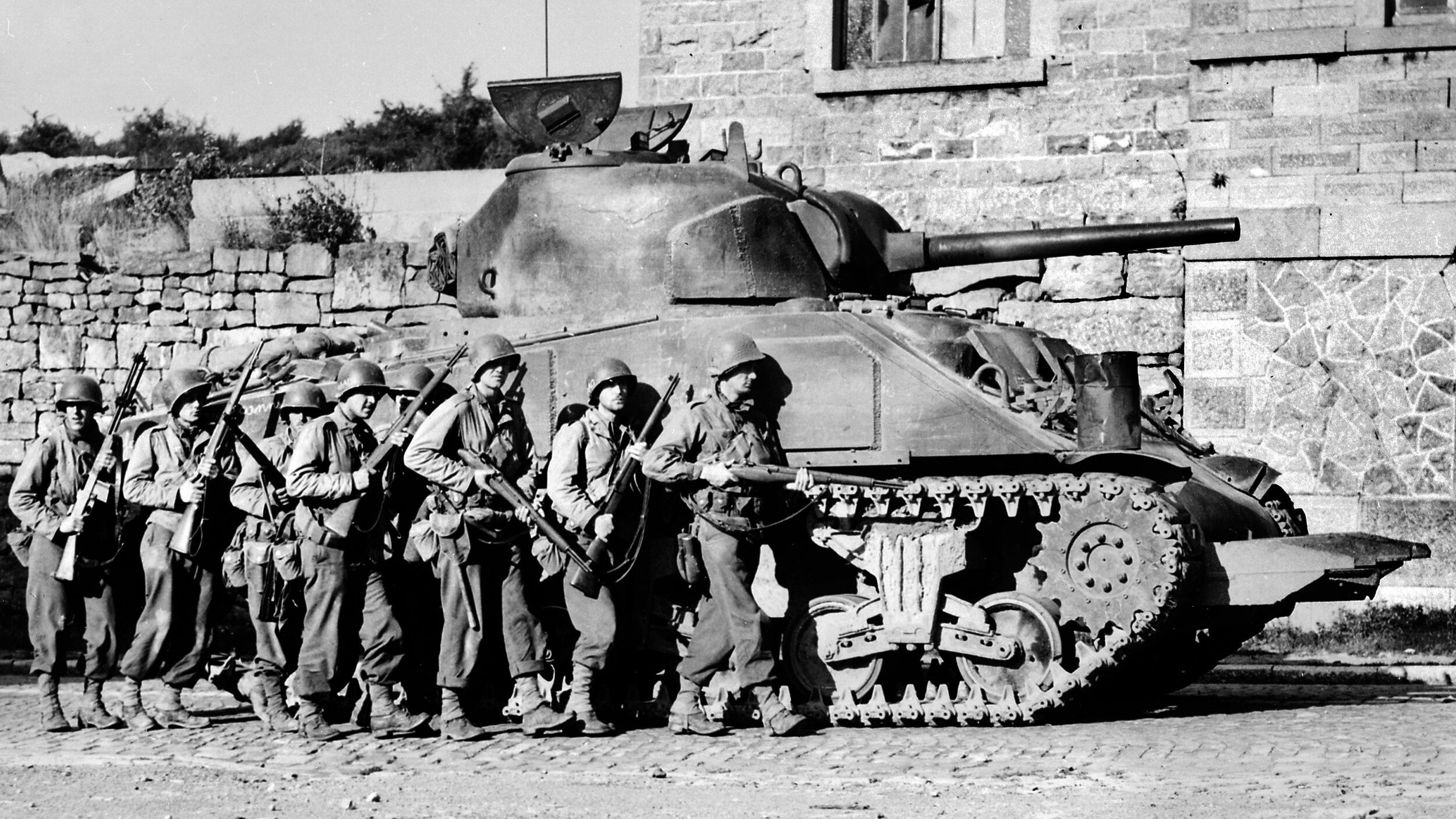
With the platoons distributed, they went to work. In the 12th Army Group, platoons were assigned to divisions in groups of three and the divisions, retaining them as platoons, usually assigned one to each regiment.
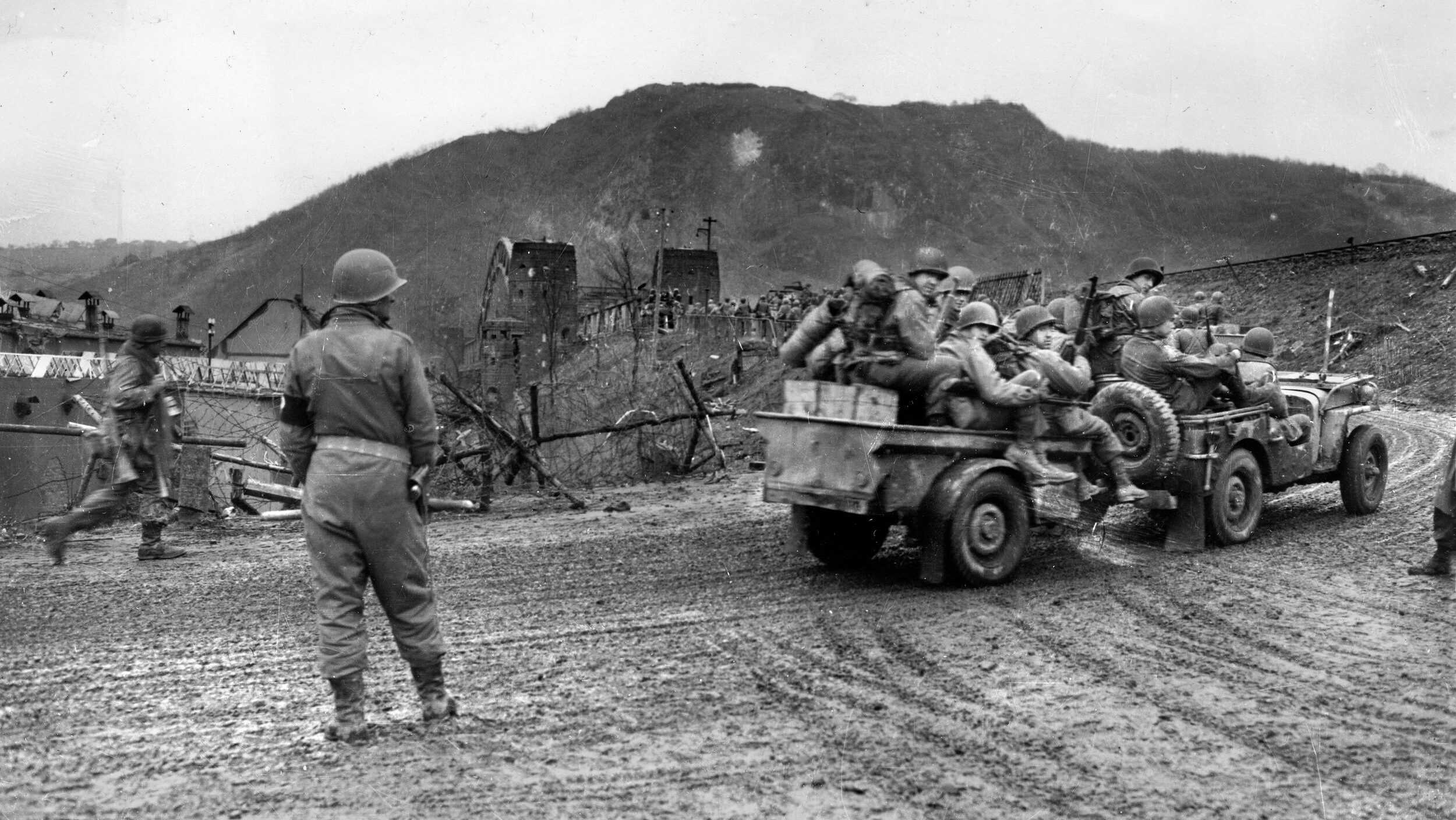
That done, each regiment, in turn, selected a company to which the units went as a fourth rifle platoon. In most divisions, the platoons were given additional training periods of varying lengths before commitment. In the divisions headed across the legendary Remagen Bridge, the platoons arrived just in time for immediate employment.
“Where arrival of the Negro platoons coincided with a period of heavy fighting, their welcome as fresh replacements was warmer than in units that were then engaged in training only. But divisional training periods were valuable both to the platoons and to the divisions’ attitude toward accepting them,” the Official History noted.

“They had had some sort of training before they joined us,” Brig. Gen. Charles Lanham, the Assistant Division Commander of the 104th Infantry Division explained, “but we wanted to make sure they knew all the tricks of infantry fighting. We assigned our best combat leaders as instructors. I watched those lads train and if ever men were in dead earnest, they were.”
In some cases, the platoons were given a very serious training on the division’s achievements, the division patch, and personal welcomes by the division or assistant division commander.
The theory worked, as the Official History noted: “In most instances, the platoons quickly identified themselves with the more than three dozen battalions and companies to which they were distributed. They were employed just as any other platoon within their companies, a point frequently noted by their regiments. Some went to veteran regiments which, like those of the 1st and 9th Divisions, had fought in Europe and Africa. Others went to newer units like the 12th and 14th Armored Divisions, and the 69th, 78th, 99th, and 104th Infantry Divisions.”
Those assigned to the 14th Armored would have a brief but shocking war as they would liberate subcamps of the notorious Dachau concentration camp.
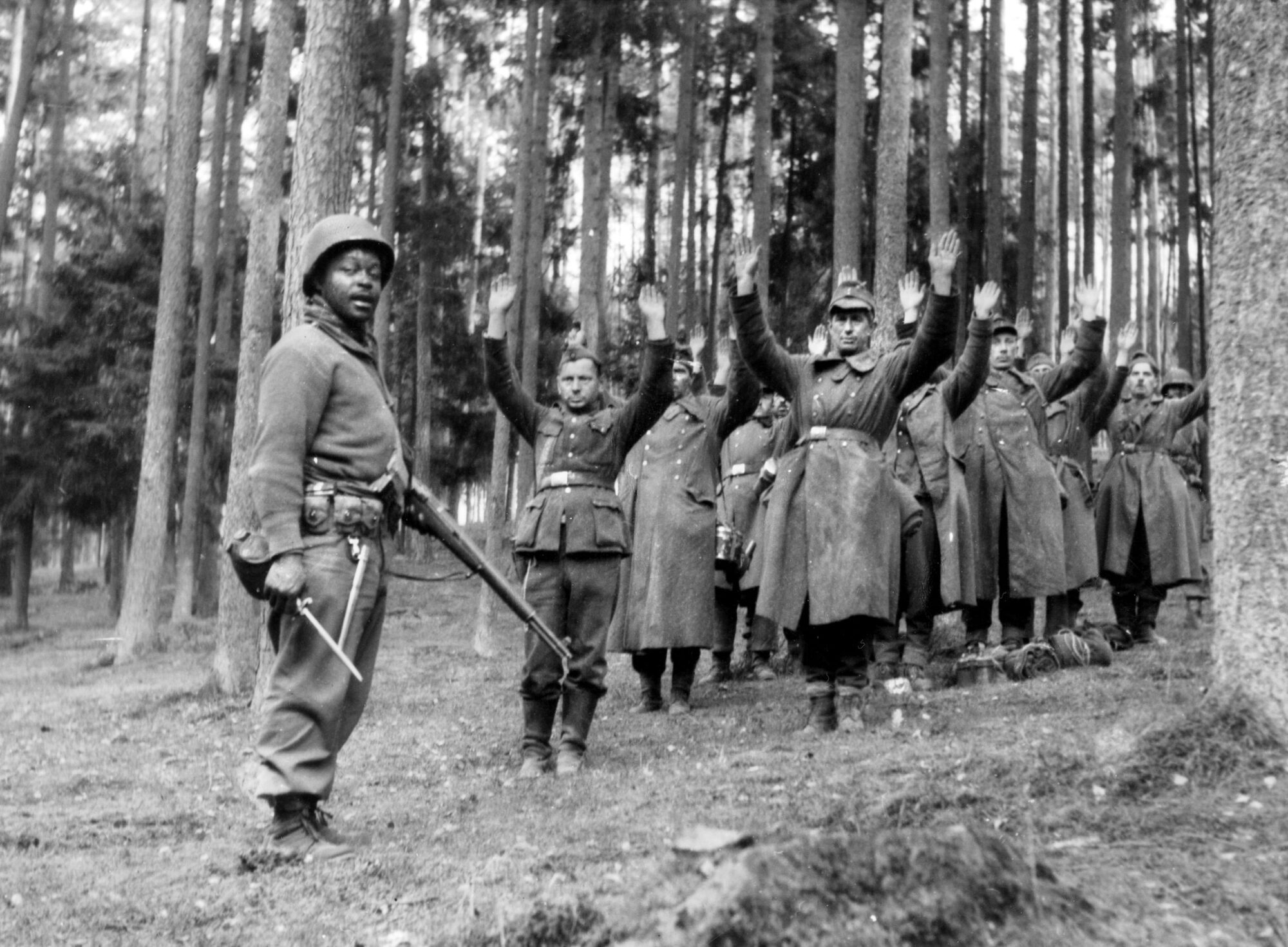
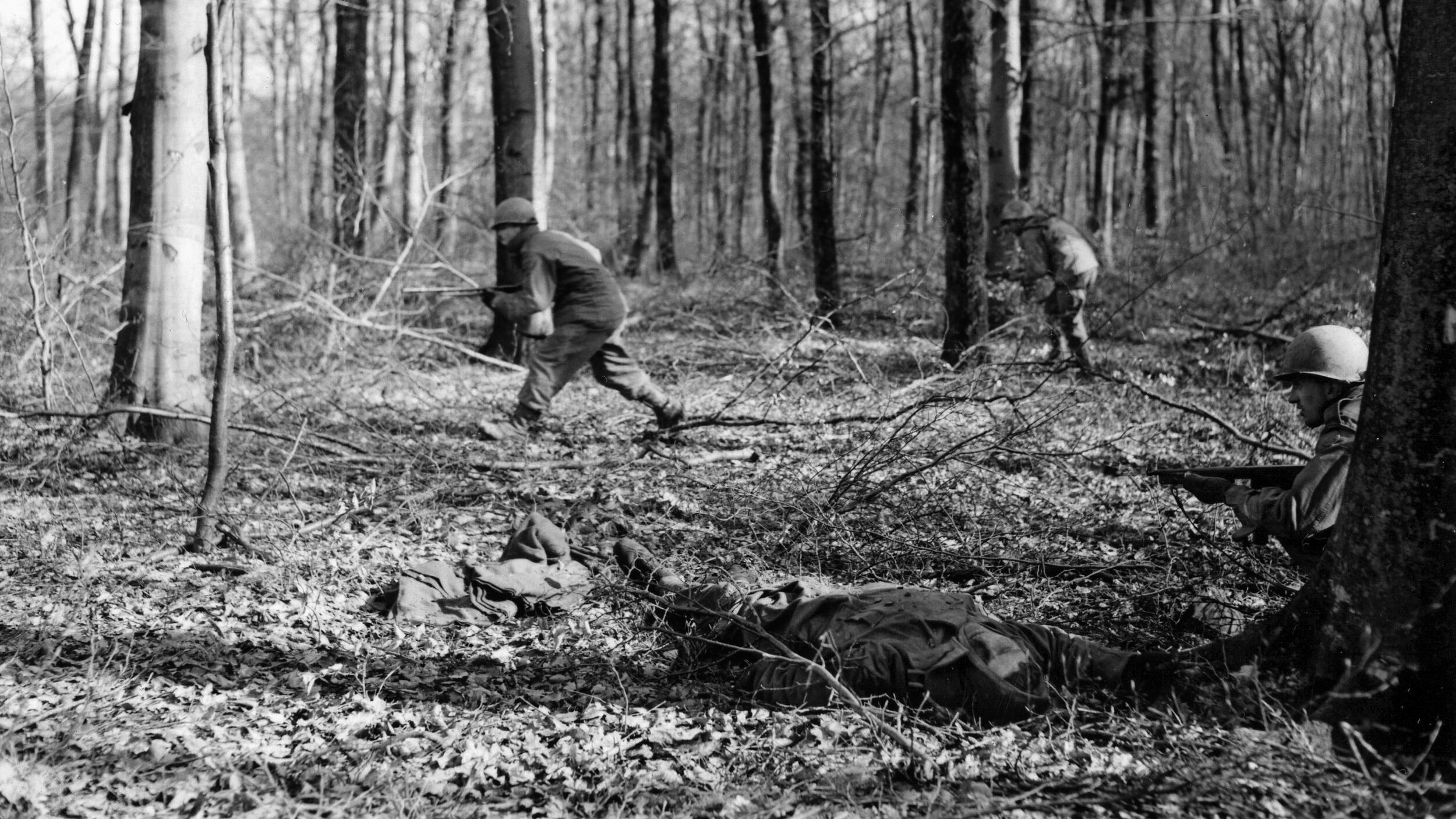
Despite the negative predictions of the War Department and American racists, the integrated platoons fought well.
Illustrating this point, two African American volunteers in the 9th Infantry Division earned major decorations for gallantry in less than six weeks of combat. Pfc. Jack Thomas, in the fifth platoon of E Company, 60th Infantry Regiment, led his squad in an attack against a strongly defended German roadblock, supported by a tank. He lobbed two grenades, wounding several Germans, before picking up the bazooka dropped by a wounded soldier and immobilizing the tank. He then picked up a wounded comrade and carried him to safety amid intense enemy small arms fire. For this action, he earned the Distinguished Service Cross. Another fifth platoon member, Pfc. Edgar E. Zeno of G Company, 39th Infantry Regiment, was awarded the Silver Star after assaulting an enemy position in the face of heavy machine-gun fire, killing seven German soldiers and wounding three more.
Senior officers also paid tribute to their African-American soldiers. The Official History notes that “at the close of the first calendar month after the platoons joined their units, divisions had already formed their impressions of the Negro replacements. The 104th Division, whose platoons had joined while the division was defending the west banks of the Rhine at Cologne, commented: ‘Their combat record has been outstanding. They have without exception proven themselves to be good soldiers. Some are being recommended for the Bronze Star Medal.’”
Davis was pleased, too. When he stopped at 12th Army Group headquarters on his way to observe the platoons a month after they had joined their units, he found that Bradley was well satisfied with the reports of the performance and conduct of the Negro reinforcements. Gen. Courtney Hodges stated that his First Army’s divisions had given excellent reports on their Negro platoons.
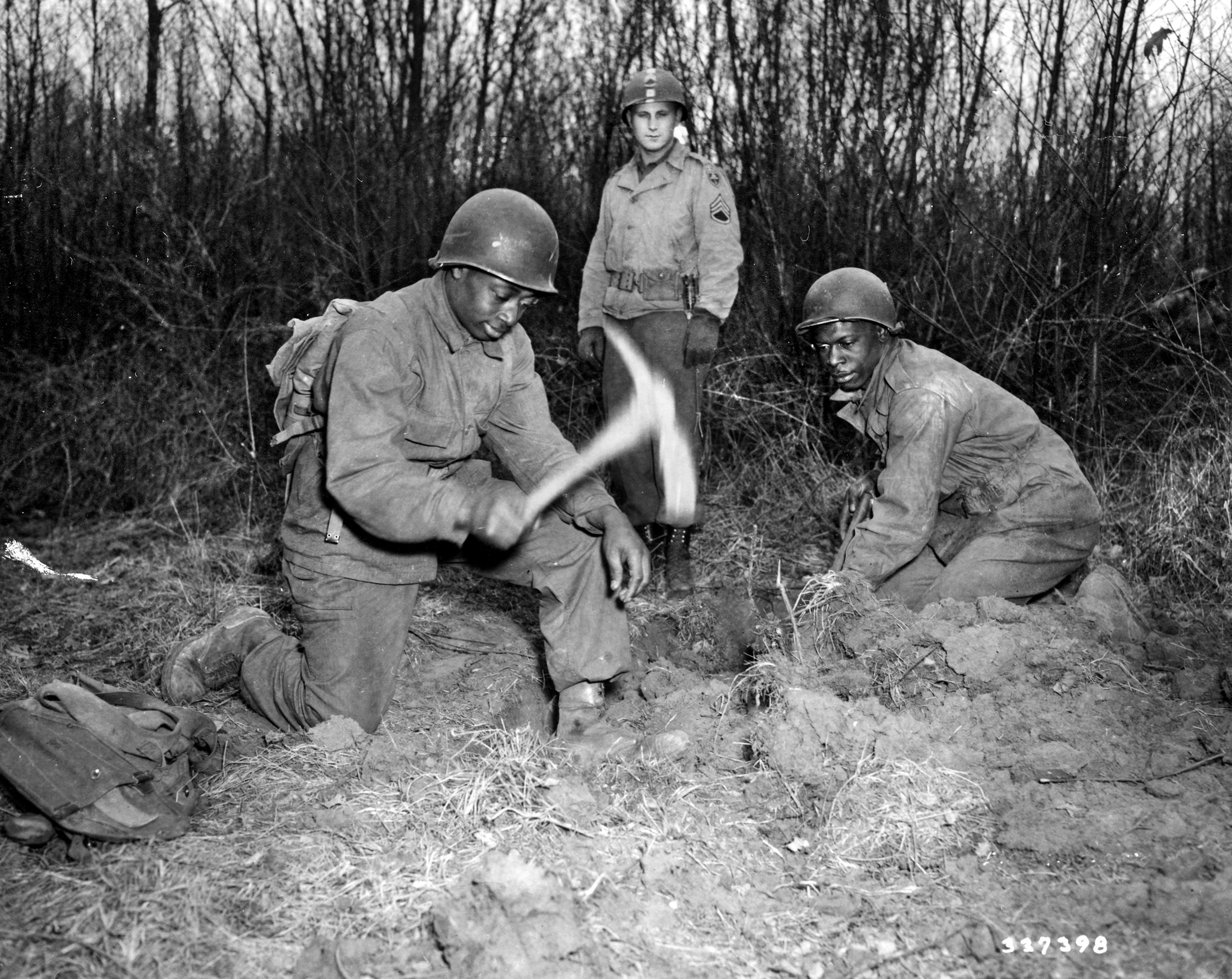
Determined to hear from the men at the front, Davis went down through corps and division to regiment and battalion and finally to a company—Company E of the 60th Regiment, 9th Infantry Division—he found similar reports of satisfaction.
At Company E, the company and platoon commanders and several enlisted men, including the white platoon sergeant, recounted their experiences with enthusiasm. All officers and men, from the regimental commander down, reported high morale and confirmed that the platoon was functioning as planned.
Officers and men in other divisions gave Davis similar reports of their satisfaction with the Negro reinforcements. One division commander, Maj. Gen. Edwin F. Parker of the 78th Division, whose African-American platoons, joining at the Remagen bridgehead, were the first such combat troops east of the Rhine, expressed the wish that he could obtain more of the African-American riflemen.
The 104th Division’s G-1 noted that he gave Davis a very satisfactory report. He told the visiting general:
“Morale: Excellent. Manner of performance: Superior. Men are very eager to close with the enemy and to destroy him. Strict attention to duty, aggressiveness, common sense and judgment under fire has won the admiration of all the men in the company. The colored platoon after initial success continued to do excellent work. Observation discloses that these people observe all the rules of the book. When given a mission they accept it with enthusiasm, and even when losses to their platoon were inflicted the colored boys accepted these losses as part of war, and continued on their mission. The Company Commander, officers, and men of Company F all agree that the colored platoon has a caliber of men equal to any veteran platoon. Several decorations for bravery are in the process of being awarded to the members of colored platoons.”
There were some failures. In Lt. Gen. Alexander “Sandy” Patch’s 7th Army, the African-Americans were rushed to battle. That had problematic results, as the Official History noted:
“The 6th Army Group and 7th Army had not been included in the original discussions of the use of Negro riflemen. On the decision of General Patch, the 12 platoons assigned to Seventh Army were organized into provisional companies and sent to the 12th Armored Division, whose armored infantry battalions had relatively greater shortages than infantry division regiments. The platoons, barely trained as squads and platoons, had had no training as companies at all; the division felt that too little time was available to equip and train them before their first battle. However, the 12th soon found that the reinforcements made a ‘good’ impression.”
Davis investigated and found that the 7th Army had not taken the time to train its African-American replacements. Once it did, the troops performed well.
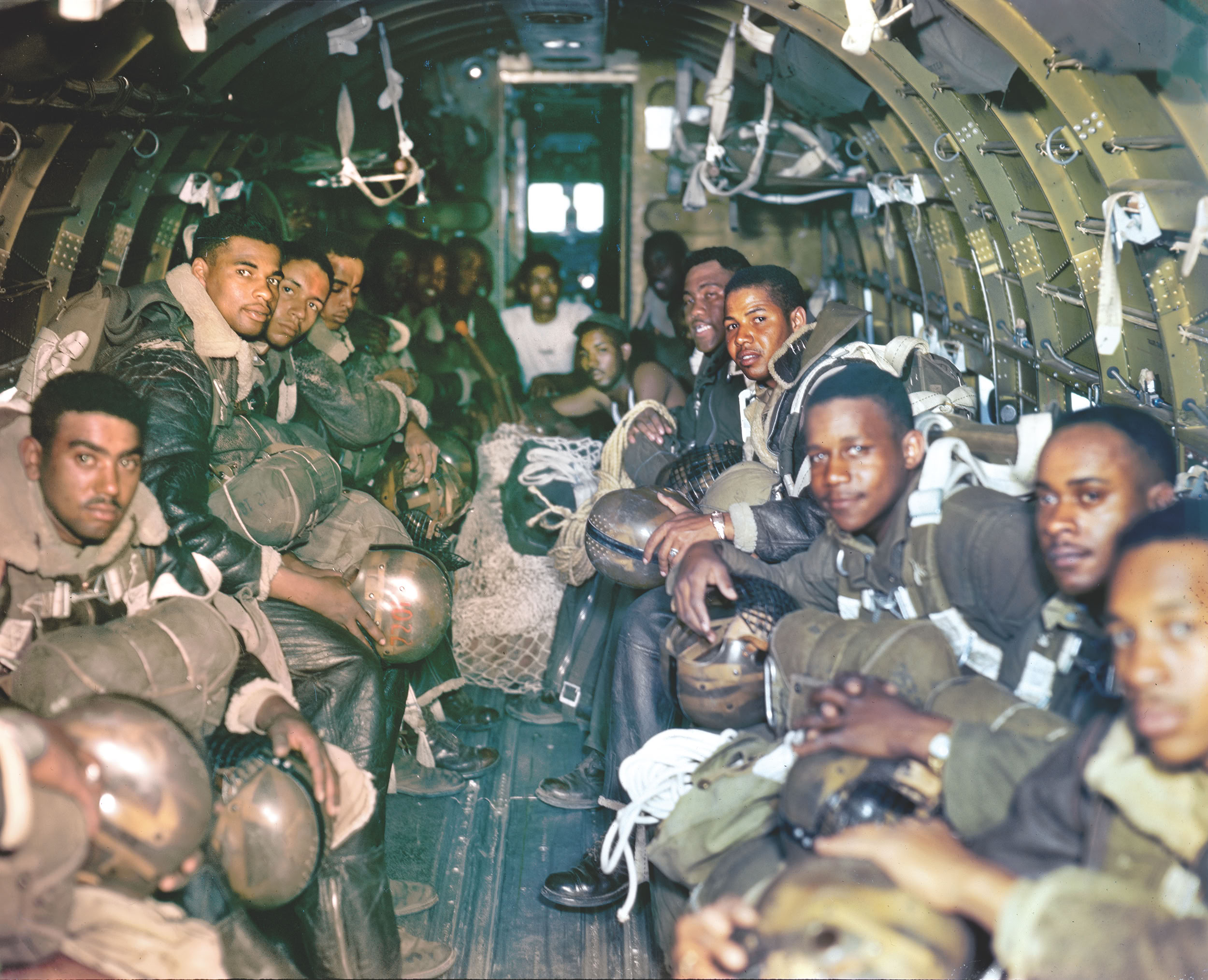
One such unit, 7th Army Provisional Infantry Company No. 1, attached to the 56th Armored Infantry Battalion, had not been committed as a unit but detachments had been used. One of these, riding on a tank near Speyer, Germany, on March 23, 1945, ran into heavy bazooka and small arms fire. According to the Official History, “Sgt. Edward A. Carter, Jr., voluntarily dismounted and attempted to lead a three-man group across an open field. Within a short time, two of his men were killed and the third was seriously wounded. Carter continued toward the enemy emplacement alone. He was wounded five times and was finally forced to take cover. When eight enemy riflemen attempted to capture him, Carter killed six of them and captured the remaining two. He then returned across the field, using his two prisoners as a shield, obtaining from them valuable information on the disposition of enemy troops.”
One battalion commander wrote of his integrated unit, “To date, there has never appeared the slightest sign of race prejudice, or discrimination in this organization. White men and colored men are welded together with a deep friendship and respect born of combat and matured by a realization that such an association is not the impossibility that many of us have been led to believe. Segregation has never been attempted in this unit, and is, in my mind, the deciding factor as to the success or failure of the experiment. When men undergo the same privations, face the same dangers before an impartial enemy, there can be no segregation. My men eat, play, work, and sleep as a company of men, with no regard to color. An interesting sidelight is the fact that the company orientation NCO is colored, the pitcher on the softball team, composed of both races, is colored, and the bugler is colored.”
Though the war wound down in April 1945, the fighting didn’t, as the Americans faced determined SS men with nothing to lose but their lives, paratroopers skilled in last-ditch stands, and Hitler Youth raised on myths and legends, all armed with panzerfaust anti-tank rockets.
One African-American platoon, when faced with heavy automatic weapons fire from outlying buildings in a town which another platoon was already supposed to have taken, made a hasty estimate of the situation and, realizing that its only safety was in the buildings from which its men were receiving fire, broke into a run with all weapons firing, raced three hundred yards under “a hail of enemy fire,” took the buildings and, in a matter of minutes, the entire town.
The battalion commander concluded, “I know I did not receive a superior representation of the colored race as the average AGCT was Class IV. I do know, however, that in courage, coolness, dependability and pride, they are on a par with any white troops I have ever had occasion to work with. In addition, they were, during combat, possessed with a fierce desire to meet with and kill the enemy, the equal of which I have never witnessed in white troops.”
With V-E Day and troops coming home, so did the reports on the great success of the integrated Army. They went up the chain of command and ultimately to the new President, Harry S. Truman. We don’t know specifically what he thought of the reports, but in 1947, he pushed for a Civil Rights Bill, which was defeated in the House and Senate by Republicans and Democrat—the so-called “Dixiecrats.” Stymied, he turned to integrate one bastion of American society: ordering the Armed Forces desegregated by Executive Order, in his role as Commander-in-Chief.
To their credit, the Armed Forces put up very little resistance to Truman’s order, but they had trouble obeying it. The Navy took several years to refit its ships to create integrated berthing spaces. The Air Force, only a year old, did it overnight.
Author David Lippman resides in New Jersey and writes frequently on a variety of topics for WWII History magazine.
Join The Conversation
Comments
View All Comments