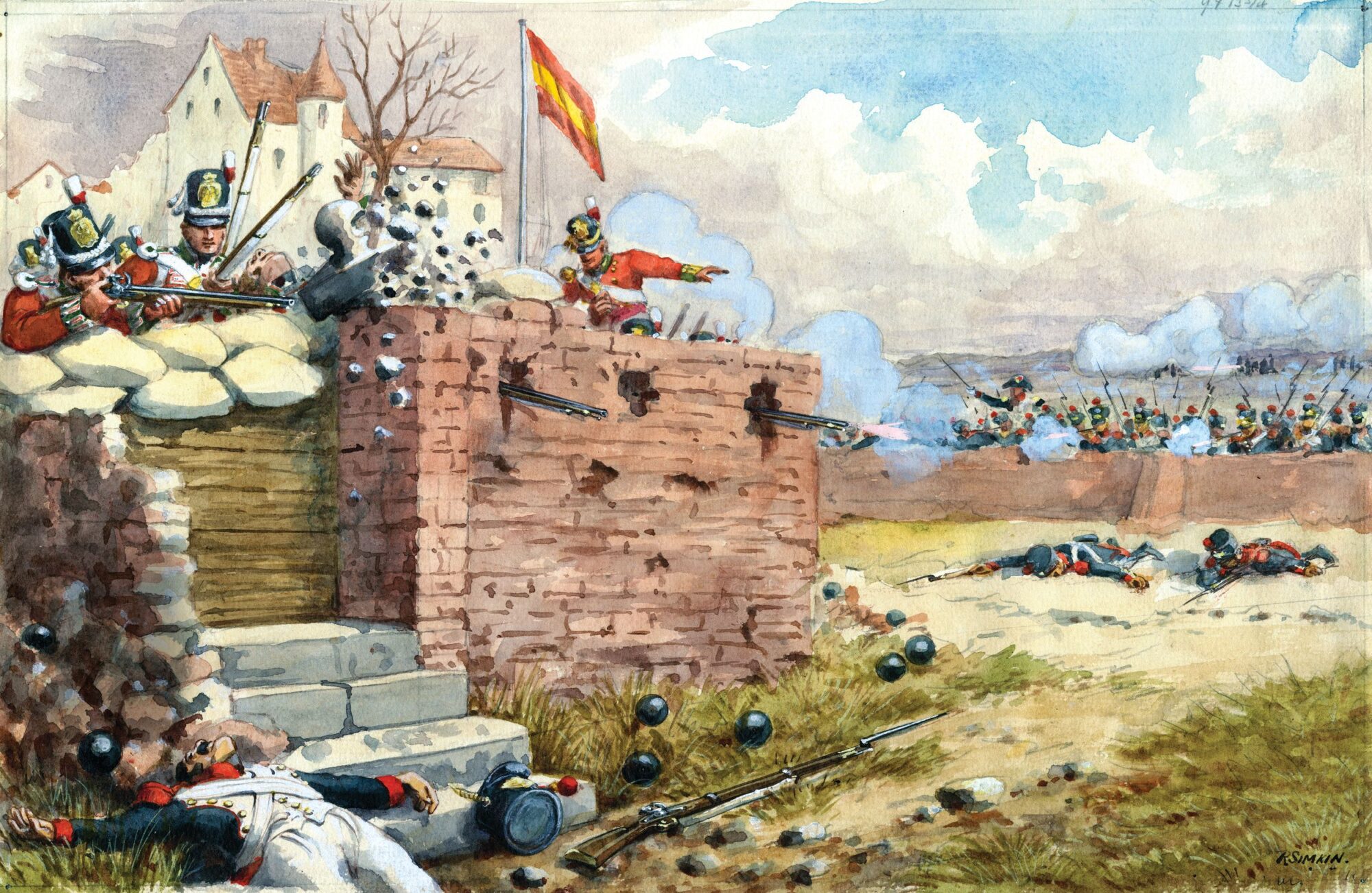
By Robert L. Durham
With a large army and little to oppose him, King Joseph Bonaparte sat in Madrid on the throne of Spain, in January of 1810. The British had retreated into Portugal, and the Spanish posed little threat. They had only 25,000 men to protect a front of 160 miles. The Emperor Napoleon Bonaparte, sure that Spain would come under his sway with diplomacy and a “few cannon shots,” did not worry. But he had misjudged the spirit of the Spanish people who still supported and took pride in their own government—no matter how corrupt—and would never accept the elder Bonaparte as their king.
After winning the Battle of Wagram, July 5-6, 1809, Napoleon negotiated a peace treaty with Austria in October and could send reinforcements to Spain if needed. King Joseph and his chief of staff, Marshal Nicolas Jean de Dieu Soult, now concentrated on the conquest of Andalusia, the southernmost region of Spain. By January 11, they had an army of 60,000 men poised to begin the invasion. Soult boasted to Paris that, with such a host, the victory could be had in a day.
It took a little more than a day, but not much more. By the end of the month, only the Guadal-quivir River separated him from Seville. “Andalusia will soon be pacified,” King Joseph assured his brother. “I hope to enter Cádiz without a shot being fired.” At Joseph’s dinner table that evening, a discussion arose as to whether Seville or Cádiz should be taken first. Cádiz was the new seat of the Spanish Junta, as well as the country’s largest seaport. Voices were raised in favor of securing Cádiz since a single corps would be enough to take Seville. “Give me Seville and I will answer for Cádiz,” Soult said, overruling them all.
Joseph entered Seville on February 1, to the “cheers of the whole populace,” according to his account. More shrewdly, his Master of the Household noted “Cries of ‘Viva el Rey’ arose on every side. No doubt, curiosity and fear had a greater share in that triumphant reception than any other sentiment but . . . it seemed at the time to justify the occupation of Seville.” Soult planned for the First Corps to spend the night in the city and march on Cádiz the next day. By then, however, it would be too late.

Taking Cádiz on the 29th of January would have been easy, for then it was defended only by 2,400 new recruits. The Spanish Junta had ordered the Duke of Albuquerque, stationed north of Cádiz at Mérida with 8,000 men, to attack the French First Corps. Outnumbered three to one, he disobeyed orders and marched to relieve Cádiz, picking up another 2,000 men on the way. Some 3,000 more Spanish troops reinforced the city by sea from Ayamonte.
When the French First Corps arrived at the city gates, they found the fortifications fully manned. Marshal Claud Perrin Victor’s call for the city to surrender received this reply: “Cádiz, faithful to its word, recognizes no king but Ferdinand VII.” Soult’s decision not to take Cádiz first, would prove disastrous for the French.
The 46-year-old Victor had been in the French army for 30 years, starting as a drummer-boy and serving as a private for 10 years. His performance at the sieges of Toulon, Marengo, Jena, and Friedland had led to steady promotions until Napoleon made him a Marshal of the Empire. In 1808, he became the 1st Duke of Belluno and Napoleon sent him to Spain. There he met the British for the first time, at Talavera, and learned to appreciate their fighting spirit.
Within Cádiz, the civilian inhabitants forced the unpopular Spanish Junta to resign, replacing them with a three-man Cortes (Regency), which requested aid from Britain. On orders from the Duke of Wellington, three Portuguese and two British battalions set sail for Cádiz, arriving mid-February and increasing the city’s garrison to 17,000 men.
As a seaport, Cádiz would prove to be hard to subdue. Four British and twelve Spanish battleships, along with their supporting vessels, kept the port open. Joseph requested Napoleon send the Toulon squadron to close the port, but Napoleon did not respond. He knew the British Mediterranean Fleet lay between Toulon and Cádiz.
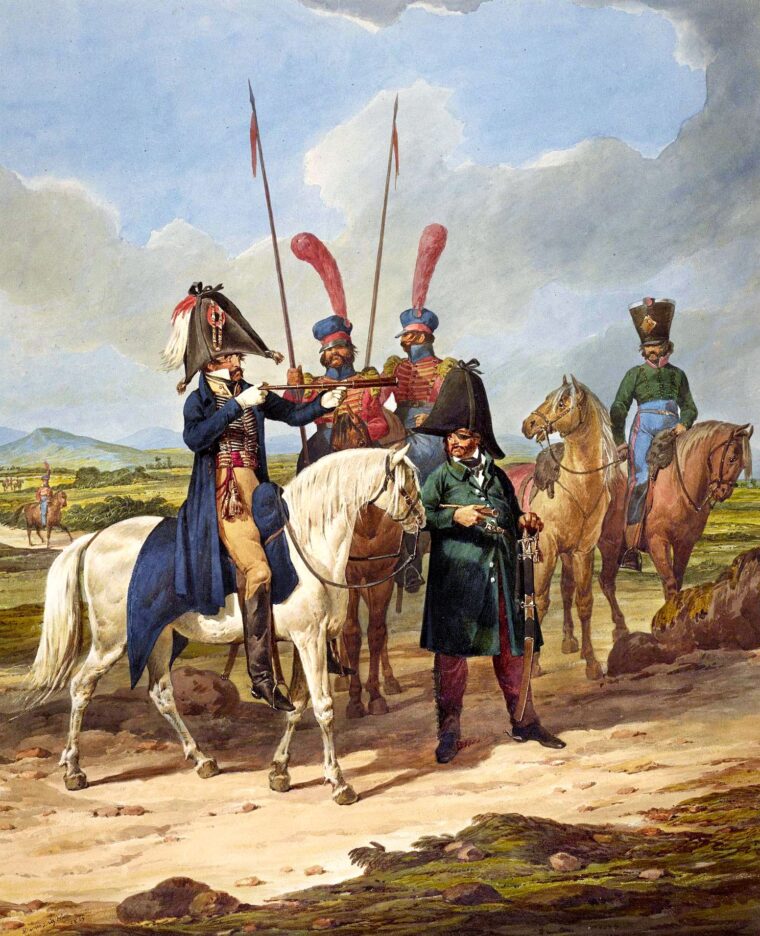
On the landward side, Cádiz was protected by the wide tidal channel of Sancti Petri and its flanking marshes. After crossing the channel, an invading army would have to fight its way up the Isla de Leon, through forts and earthworks, before reaching the Cádiz side of the island. The next barrier was a four-mile sandy spit with a wide ditch across it. Lining the cut was the stone San Fernando battery stretching from shore to shore with the city’s ramparts beyond it. Holding Cádiz benefited the Allies by keeping a significant portion of the French army—some 20,000 men—occupied manning the siege lines.
While Joseph was ensconced in a royal court in Madrid, Soult governed from Seville in far more splendor. “No monarch ever surrounded himself with more majesty: no court was ever so reverential,”one French officer wrote. When Soult went to mass on Sundays, “picked troops lined the route between his palace and the cathedral.”
Although it was difficult to lay siege to Cádiz, the French did seal it off from the rest of Spain. Soult marched north towards Badajoz with 20,000 men early in 1811, reducing to a minimum the number of troops on the siege lines. The Cádiz garrison made plans to take advantage of this by landing troops behind the French to attack them from the rear.
Lieutenant General Thomas Graham masterminded this strategy. A Scottish laird, Graham had no military ambitions until a Toulouse mob disrespected the body of his dead wife. He then raised and outfitted the 90th Foot Regiment at his own expense and became its first colonel. He rose to lieutenant-general through his own merit and his men were dedicated to him. Unfortunately, Graham would not command the expedition. Since the Spanish troops were double those of the British, that honor would go to Gen. Manuel de la Peña y Ruiz del Sotillo. There were 4,900 British troops (including 1,000 from Gibraltar), 332 Portuguese, and 9,600 Spanish. Graham knew the Spanish general to be “weak and timid.” Indeed, De la Peña’s own men thought him an “old woman,” referring to him as Doña Manuela (Lady Manuela).
De la Peña’s plans were for most of the Cádiz garrison, under Gen. José Pascual de Zayas, to build a bridge of boats across the Sancti Petri and assault the French front line. Sailing to Tarifa, some 50 miles southeast of Cádiz, the main Allied army would then march on the rear of the French siege lines. De la Peña would take the advance, followed by Graham in command of the rearguard. Graham embarked first, on February 19, and everything fell apart almost immediately. Strong winds and currents forced them to land at Algeciras, 15 miles short of their goal, on February 23. They had no rations there and had to purchase them from the locals at outrageous prices.

Another setback was that the road to Tarifa was impassable for wheeled vehicles, forcing the Navy to detail sailors to row the guns and horses along the coast to Tarifa. Graham wrote to Vice-Adm. Richard Keats of the Navy that “the great exertions made by the navy in rowing such a distance against a wind” astonished him.
The Spanish also ran into foul weather and were forced to return to Cádiz, where De la Peña refused to permit the troops to disembark. They were “exposed without cover to this terrible weather,” wrote Lt.-Col. James Stanhope. When he spoke to a Spanish officer about this, he was told the men were used to suffering.
When the weather finally calmed, De la Peña set sail and the entire force, nearly 15,000 men, assembled at Tarifa near the end of February and started toward Cádiz on the 28th. They met only light French resistance, but De la Peña insisted on marching at night, believing that he could surprise Victor. Losing their way in the dark, their nights were filled with marching and counter marching as the troops, stumbling against a strong wind, became utterly exhausted.
The morning of March 1, 1811, they reached a convent at Casa Viejas, held by two companies of French infantry that fled when they saw the Allied army. The King’s German Legion (KGL) pursued the French, who formed in line and fired a volley, before throwing down their weapons. The volley killed two KGL Hussars and wounded several more. The pointless bloodshed enraged the Hussars, who charged into the defenseless Frenchmen with sabers drawn and killed them all.
By now Victor had word that a strong Allied force was making its way up the western road from Tarifa. After the aggressive action of the Cádiz garrison, Victor concluded those troops could only be heading for Cádiz and set about preparing a trap along their predicted route.

General Eugène-Casimir Villatte’s division would block the western road, preventing access to the Santi Petri and the Isla de Léon. Under the commands of Generals François Amable Ruffin and Jean François Leval, two other divisions would hide in the thick pine forests near Chiclana waiting to attack the Allied flank when they engaged Villatte’s division.
De la Peña’s column continued towards Cádiz on March 4, moving at an irregular pace that might halt every five minutes or so. The lurching pace tired the Allies so much that they inevitably took the wrong road. When Graham realized they were marching straight into Victor’s camp, he rode to the front to correct their course. They reached their destination on the morning of March 5, 1811, wet, weary, and hungry after 14 hours of marching.
The Allies found a French force barring the road to the Sancti Petri crossing. De la Peña abandoned his plan to attack the French rear and made for the Isla de Leon to get into the city, right back where they started from. Zayas had followed his orders and bridged the river on the night of March 2-3. De la Peña was supposed to engage the rear of Victor’s main divisions, allowing Zayas to attack across the river, and destroy the French siege works. De la Peña’s thoughts now were to fight his way into the city, so he attacked the French division under Gen. Eugene-Casimir Villatte. The French in front of him, only 3,000 strong, abandoned their position. The way now open to the city, De la Peña ordered Graham to cover him.
Graham posted one British and five Spanish battalions, with a small battalion of flank companies of the Rock of Gibraltar garrison, and cavalry from both armies, on Barrosa hill as rearguard. He placed Bvt. Lt.-Col. John Frederick Browne, the commander of the Gibraltar battalion, in charge of this rearguard. Graham would join the Spanish with his main body and, when that was complete, withdraw the rearguard.
Graham set off through the pine wood, the fastest route to join De la Peña. It seemed safe since there was no sign of Victor’s main force. They were in the middle of the woods when Lieutenant von Gruben of the KGL Hussars, reported to Graham that a large body of French were approaching the Barrosa hill from the north—the key to the Allied position. Victor intended to capture it, then assault Graham’s stretched-out line of march. Graham sent a Spanish officer to tell De la Peña of the French advance, then marched back toward the Barrosa hill in the mistaken belief that De la Peña would soon be on his way to support him.
Two French divisions under Marshal Victor converged on Browne’s position on the Barrosa hill. Lt.-Gen. Sir Samuel Ford Whittingham, commander of the cavalry, asked Browne what he intended to do. “I intend to fight the French,” he answered. Whittingham responded that, “you may do as you please, but we are decided on a retreat.” He then led his five squadrons of cavalry and the five Spanish infantry battalions off the hill, fleeing down the coast road to join the baggage train.

French dragoons moved quickly up the hill, riding around the flanks of Browne’s battalion. French artillery and infantry under Gen. François Amable Ruffin moved forward in full dress, the two brigades marching in a compact column of divisions. Seeing he had no chance of holding the hill, Browne sent a message to Graham, reporting he had to retire. He formed his battalion into a close column and ordered them to march toward the pine forest.
Unable to form a square against the French dragoons because of their artillery, Browne sent out skirmishers to keep the enemy horsemen at bay. Major Bussche and a squadron of KGL Hussars came to his aid to help hold the French back. Bussche retired by half-squadrons, one charging the French while the other withdrew. Every time the Hussars charged, the French dragoons retreated behind their infantry, who fired a volley into them. The Hussars experienced many casualties but succeeded in covering Browne’s retreat. When Browne reached the bottom of the hill, the Hussars rode off to join the rest of the cavalry retreating on the coast road. The French now occupied the Barrosa hill.
Graham exploded with rage at Browne’s message and when he caught up to him, demanded to know whether or not he had been given orders to defend the hill. Browne replied that the Spanish had run “long before the enemy came within cannon-shot.” Graham allowed that it was a “bad business,” and ordered Brown to “instantly turn round again and attack.”
Riding up to his Gibraltar battalion of flank soldiers, Browne took off his hat and roared, “General Graham has done you the honour of being the first to attack these fellows. Now, follow me, you rascals!” They “moved forward with four hundred and sixty-eight men and twenty-one officers to attack the position,” Lt. William Blakeney wrote. “[The hill] was now defended by two thousand five hundred infantry and eight pieces of artillery, together with some cavalry. To this force were added two battalions of chosen grenadiers.”
Browne knew he could not engage in a fire fight with the much more numerous French infantry so he ordered his men to make a bayonet charge. “A tremendous roar of cannon and musketry was all at once opened. Ruffin’s whole division pointing at us with muskets, and eight pieces of ordnance sending forth their grape, firing as one salvo,” Blakeney wrote. “[After a second volley] the men were fast falling, and it required the utmost exertion to keep the survivors together, exposed as they were, to a murderous fire of round-shot, grape and musketry.” Browne’s men suffered more than 300 casualties before they were forced to scatter, but bought time for Graham to deploy his troops.
Seeing the Allied force on the verge of being overwhelmed, Graham turned his divisions to deal with threats to his flank and rear. Colonel Wheatley’s brigade was sent to face Leval in the east and Brig.-Gen. William Thomas Dilkes was given orders to retake Barrosa hill.
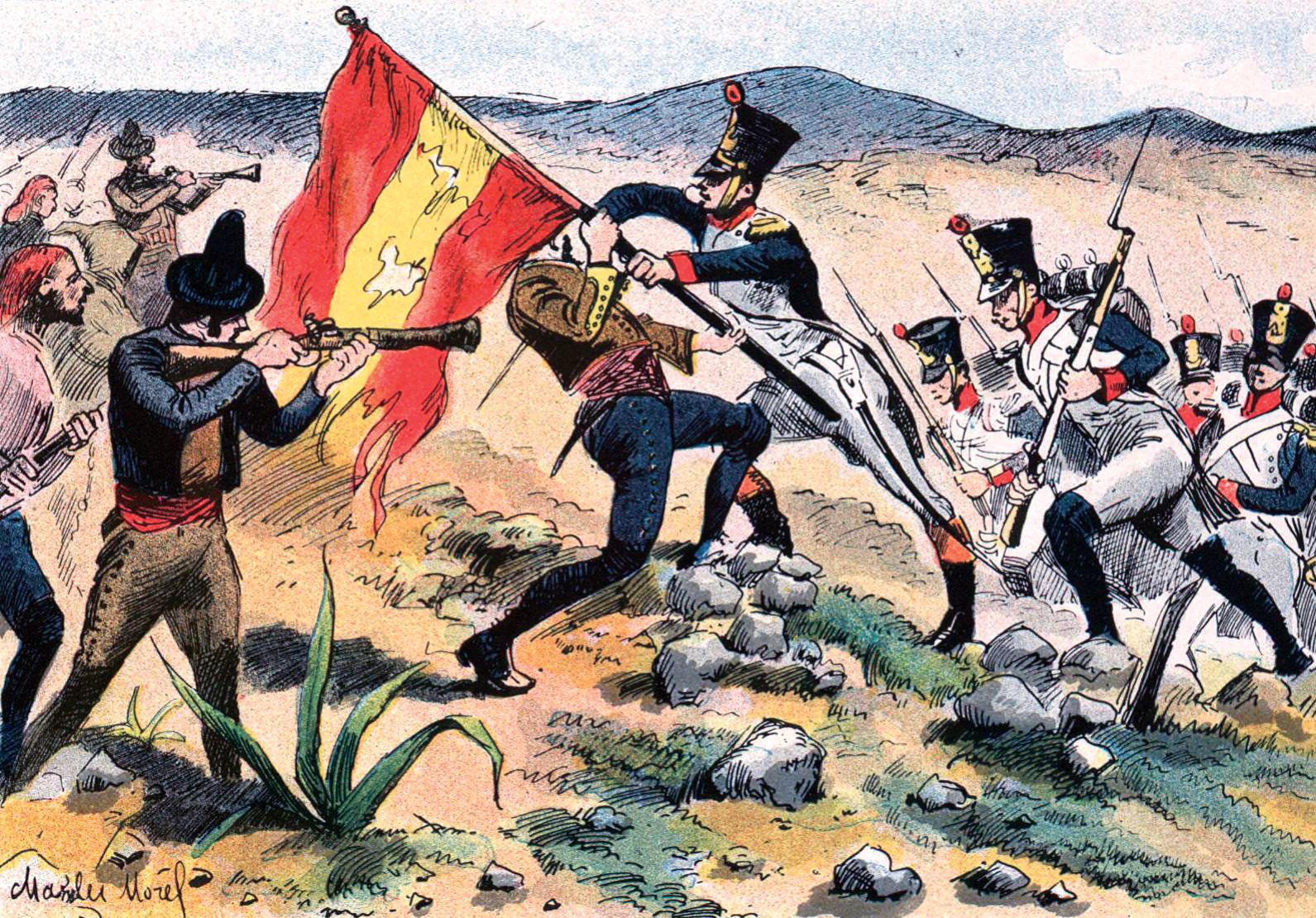
Graham ordered his own two brigades to form as quickly as they could, knowing his exhausted men had “undergone a long and harassing night march and had been about twenty hours under arms with their packs on.” Dilkes’ brigade formed on the right, two battalions of Guards. They advanced in a jagged line, with two companies of Rifles under Lt.-Col. Amos Norcott guarding their open flanks. They came out of the pine wood in “little order indeed, but in a fierce mood,“ Dilkes wrote.
A wounded Blakeney watched their advance from above, writing that, “reckless of the murderous fire which swept their still unformed ranks, they bore steadily onward and having crossed a deep broad and rugged ravine, wherein many a gallant soldier fell to rise no more, they climbed the opposite bank.” They met two Grenadier battalions, two battalions of the 24me Ligne, and the 96me Ligne charging down from the top of the hill. The British brigade numbered less than 1,400 men against more than 2,000 French, attacking in two columns.
The British Guards brigade, strung out in an uneven line, opposed the French battalion columns. As the French charged downhill with drums beating and bayonets fixed against the outnumbered British moving uphill, the outcome appeared obvious. The 1st Guards fired a volley, joined by fire from the Rifles and, incredibly, they stopped the French columns cold. Their fire mowed down the front ranks of both battalion columns of the 24me Ligne. The French survivors tried to return their fire, with no impact. The British 67th infantry battalion came up and added their fire to the conflict.
Victor, watching from the crest of the Barrosa hill, took personal command of his Grenadiers. He waved his white-plumed hat and ordered them to charge. They marched down the slope against the 67th Battalion and the 3rd Guards on the right of Dilkes’ line. They continued downward, through the storm of musketry, until they came to within 10 yards of the British line. They should have continued their attack but stopped and began trading volleys. Both sides suffered overwhelming casualties at such close quarters.
Victor knew everything hinged on the result of this fight. “Conspicuous in the front, the marshal was recognized by both armies waving his plume in circling motion high above his head,” Charles O’Neil wrote. “Again and again were they summoned to the attack, but the lines had hardly closed over their dying comrades, when another volley would again send confusion and death.” Seeing the carnage, Graham moved to the front of his other battalions, 150 yards from the French and uttered just one command, “Charge!”
That command “shot from the centre of the British line to the extremities of its flanks, instantly followed by the well-known British cheer, sure precursor to the rush of British bayonets,” O’Neil wrote. The Brit line pushed back the heavy French infantry even though they were greatly outnumbered. Victor brought the 2/9me Léger and the 1/96me Ligne battalions from his left wing to support his other battalions. The survivors of Browne’s mixed battalion, now less than 300 men, regrouped and started to snipe at the French. “They darted from behind trees, briars, brakes, and out of hollows,” Blakeney wrote.

Browne did little more than distract the French, but it gave time for the Guards to break Ruffin’s line. “Ruffin’s whole division . . . were instantly in whirling motion rolled down into the valley below,” Blakeney wrote. “Their battle was won; and the gallant Graham triumphantly stood on the bristling crest of Barrosa’s blood-drenched hill.” The fight for the Barrosa hill may have ended, but the fight on its right slope had just begun.
In turning his division around in the pine wood, the formations of some of Graham’s battalions had become muddled. The two rear companies of the 67th, part of Maj-Gen. William Wheatley’s brigade, marched off with Dilkes. This squared things when Graham ordered two companies of the Coldstream Guards, part of Dilkes’ brigade, to escort Major Alexander Duncan’s guns to the support of Wheatley.
When one of Duncan’s guns got entangled with a tree the drivers, having no time to disengage the gun, whipped the horses and tore the tree out by the roots. They arrived in time to help Wheatley against a French division trying to cut the British off from De la Peña. Graham sent Lt.-Col. Andrew Barnard’s flank battalions ahead of Wheatley’s Brigade to delay the French until the rest of Wheatley’s men could clear the pine trees and deploy. Barnard’s 95th Rifles, and the 20th Portuguese Caçadores, emerged from the wood in time to meet Leval’s division, scarcely 400 yards away, beating the pas de charge.
“When we reached the plain, and perceived the enemy, never did a finer sight present itself,” remembered one of the Riflemen. “The grenadiers had long waving red plumes in their caps, at least a foot in length; while the light infantry had feathers of the same length and make, but green with yellow tops. The whole of the French army had on their best or holiday suits of clothing, with their arms as bright as silver, and glancing in the sun as they moved in column, gave them really a noble and martial appearance.”
Supported by Duncan’s ten cannons, Wheatley faced 9,000 Frenchmen under Gen. Jean François Leval, who sent his four battalions against the British in two columns of two battalions each. The 1st and 2nd battalions of the 54me Ligne and the composite Grenadier battalion formed the right column. Two battalions of the 8me Ligne and a battalion of the 45me Ligne formed the left. They moved forward in a column of double companies, which meant a frontage of 70 men, 9 ranks deep. Leval, who did not know the Brits were in his front, had his artillery following the columns.
The British Riflemen and Portuguese Caçadores were still disordered as they came out of the pine wood, but they were ready for battle and opened fire on the French right column before it could deploy. Major Thomas Bunbury, in command of a company with the Portuguese, left his recollections: “The advance of the French was a most imposing spectacle, and there was a much more ostentatious display of plumes and martial music than we could have shown under similar circumstances.” The Portuguese were slightly behind the Rifles, who were the first to open fire on the French. The Rifles’ fire was deadly and “it served to arrest their march and caused them to open a desultory fire from their whole line in return. This had considerably deranged their hitherto parade-like formation,” Bunbury observed.

Leval, who met Wheatley’s flank battalions with astonishment, was shocked by the emergence of the rest of his brigade from the wood. Then Duncan brought his 10 guns up to the edge of the wood and wasted no time firing rounds of canister into the French ranks at only 250 yards. Panicking, the French 54me Ligne started to form square, wrongly thinking they were being attacked by cavalry. Realizing their mistake, they tried to form column again, but Barnard’s flank battalions surged around them, firing into the 54me at close range.
Greatly outnumbering the British skirmish line, the 54me formed back into column and marched forward against Barnard. The front two ranks of the 8me Ligne fired in volleys, and they forced back Barnard’s men, who were now taking heavy casualties. The 95th Rifles withdrew but Colonel Busche held his Caçadores to the job. Bunbury told him his men were blocking the fire of Wheatley’s main line, but Busche told him to mind his own business, he would not retreat in the face of the enemy.
He rode in front of the line as musket balls shrieked around him, calling out to his men, “What beautiful music.” Busche’s attitude confused the French. “The French seemed suspicious of an ambuscade,” Bunbury wrote, “halting, vacillating, and then marching again.” Busche presented an easy target though, and a French ball mortally wounded him. The senior captain of the Portuguese ordered his men to retreat, saying, “Boys, I always told you that these mad Englishmen would get us into some such scrape as this. Let us be off: what are we doing here?”
The French were now too close for the caçadores to retreat safely. Bunbury tried to get the Portuguese captain to hold, “I begged they would stay, as, if they attempted to move while the enemy was so near, they would be shot down like mosquitoes,” Bunbury remembered. But the captain and his men turned and ran, taking Bunbury’s company with them. Bunbury tried to stop them, he grabbed one man, but a French volley struck that man down. The French “made dreadful havoc among them.” They were forced to retreat but they held the French columns long enough for Wheatley to deploy his men beside Duncan’s guns. At such close quarters, Duncan’s artillerymen lost heavily. “The action very quickly became general,” reported Duncan, “and I believe a warmer one never took place.”
Leval’s four leading battalions, followed by two in reserve, still advanced in column. The French cannon unlimbered 1,300 yards from Duncan’s guns and engaged them in an artillery duel. Duncan’s two batteries of 10 guns soon silenced the 6 French guns. “Never was artillery better served,” Graham wrote.
The French columns now met Wheatley’s main line. In the British center, the 87th infantry, an Irish battalion led by Lt. Col. Hugh Gough, met the French 8me Ligne. Only the first two French ranks of the 8me could fire, 140 men out of an 800-strong battalion. They faced the 600 Irish of the 87th in line. Both battalions held their fire until they were within 50 yards, with an inevitable result. When they traded volleys, the 87th tore them apart.

This fight of line against column exemplified the regular infantry battle of the Peninsular War. Leval commanded 3,800 men to Wheatley’s 2,400, but the British line overlapped both French flanks. The French battalions never deployed into line, “They never got into line, nor did they ever intend to do so,” wrote William Surtees of the 95th Rifles, “but advanced as a solid body, firing from their front.”
“In all my fighting,” Surtees continued, “I never was in an action where the chances of death were so numerous as this.” The 2/8me Ligne, positioned in the center of the French disposition, came up against the 87th Irish Regiment. Sergeant Peter Facey of the 87th could not help but admire the French infantry, “Justice I must allow them to be the finest regiment I ever beheld in the French service.”
Browne’s light infantry formed on Wheatley’s flanks. The 87th closed to 60 yards, when Major Gough ordered them to fire a volley. The French “waited until we came within about 25 paces of them, before they [1/8me] broke, and as they were in column when they did, they could not get away,” reported Gough. “It was therefore a scene of most dreadful carnage.” The French were helpless against the fury of the Irishmen. Gough admitted he could not bring himself to kill the routed enemy soldiers, “I must own my weakness, as I was in front of the regiment I was in the very middle of them, and I could not cut down one.” The Irish soldiers made up for Gough’s reticence, fighting with fists when their weapons were broken.
Ensign Edward Keough of the 87th pointed to the Imperial Eagle of the 1/8me and called out to his sergeant, “Do you see that, Masterson?” Keough and Patrick Masterson rushed toward the French eagle, shouting Faugh a Ballagh, “clear the way.” Some of the French soldiers, realizing they were about to lose their eagle, tried to escape with it. “They were pursued by our men,” Wright Knox remembered. “They made some resistance and every man of them was cut off.” Keough seized the eagle from the French standard-bearer, but was bayoneted and killed by the color guard. Sergeant Masterman ran his seven-foot-long pike through the standard-bearer’s body and seized the eagle, the first taken in the Peninsula.
To the left of the 87th some of the Coldstream Guards, led on foot by Graham, started to fire at the French. Graham knocked some of their muskets up and yelled, “Cease fire and charge.” The whole British line charged with “the most unearthly howl.”
At this time, the French 45me battalion approached their right and Graham pointed them out, ordering Gough to break off his pursuit of the 8me and face the 45me. “With the greatest difficulty,” Gough stated, “by almost cutting them down, I got the right wing collected, with which we charged the 45th.” Fortunately, the French “broke and fled, for had they done their duty, fatigued as my men were, they must have cut us to pieces.”

The 54me Ligne moved to the right, to outflank the British left and Colonel Belson led his British 28th Regiment to meet them. “We had formed under cover of the 95th [Rifles], and then advanced to meet their right wing, which was coming down in close column—a great advantage,” said Charles Cadell, a 28th officer. “Fire at their legs and spoil their dancing,” Belson shouted. The 28th fired several volleys at them as they tried to change into a line formation. The 54me did not stand a chance as the volleys had a “dreadful” effect. The 28th charged but, initially, were unable to break the superior numbers of the 54me. It took a third try, and they finally succeeded as “the enemy gave way and fled in every direction,” Cadell wrote.
Wheatley’s brigade, supported by Duncan’s artillery, finally drove all the French before them. Leval had only one fresh reserve, his composite Grenadier battalion, and he ordered them to cover the retreat of his broken division. As some of Victor’s dragoons came to aid the rearguard, they were assaulted by the KGL Hussars, who seemed to be ever present at the right time. They “immediately moved towards the enemy, at a short gallop,” Dilkes reported. “They mixed, dispersed, and reformed, the enemy retiring and our hussars pursuing the stragglers.” After dispersing the cavalry, they rode on into the French infantry and artillery, capturing two cannons. The French were routed, fleeing in a “disordered mass.”
If the Spanish cavalry had come into action, the French defeat would have been a disaster. De la Peña, although being urged by his division commanders to go to Graham’s aid, refused and sat timidly aside. He would be court-martialed for his inaction during the battle—refusing to aid his British Allies or pursue retreating French troops. He was acquitted, but relieved of command.
The Battle of Barrosa secured the Allied retreat over the Sancti Petri, but it could have accomplished a lot more, possibly raising the siege of Cádiz. The Allied retreat, after hours of vicious struggle, put them back where they had started.
Severely angered over the Spanish lack of support, Graham reported it to Wellington, who replied that “the conduct of the Spanish throughout this expedition is precisely as I have ever observed it to be. When the moment of action arrives, they are totally incapable of movement and they stand by to see their allies destroyed.”
After his defeat, Victor almost abandoned the siege, but it continued. After Wellington’s victory at Salamanca, July 22, 1812, it became necessary to free the troops in Andalusia to reinforce the French facing Wellington. King Joseph sent an order to Soult, to “evacuate Andalusia and march with your whole army to Toledo.” The French finally lifted the siege of Cádiz on August 25, 1812.

Join The Conversation
Comments
View All Comments