The 2nd Dragoon Regiment traces its lineage to the 16th century as a cavalry regiment, fighting in various wars and engagements across western Europe. In 1776 the regiment became a dragoon unit, expected to fight on foot as well as horseback.
Called up to help suppress the Nancy Mutiny in 1791, the unit went on to fight for the Revolutionary French government during the Wars of the First and Second Coalitions, 1792-1802.
In 1805 the 2nd Dragoon Regiment joined Joachim Murat’s Reserve Cavalry Corps in the Grande Armée of Napoleon. The unit later served in the Peninsular Campaign, seeing action in major battles of the campaign.
Upon Napoleon’s exile in 1814, the regiment briefly returned to service under King Louis XVIII as the Dragoons du Roi. After Napoleon’s return and defeat at Waterloo, the regiment was briefly dissolved, then reformed.
During the Franco-Prussian War, 1870-1871, the 2nd Dragoons fought in several battles, during which most of the unit was briefly taken prisoner.
The unit went on to serve in World War I, and by World War II was redesignated the 2nd Motorized Dragoon Regiment. After France’s surrender, many of the unit’s soldiers joined the Free French Army in North Africa, where the unit was reformed as a tank destroyer unit.
After WWII the unit fought in the French Algerian War, 1957-1961, and in 2005 joined another unit to become the 2nd Dragoon Regiment – Nuclear, Biological and Chemical.
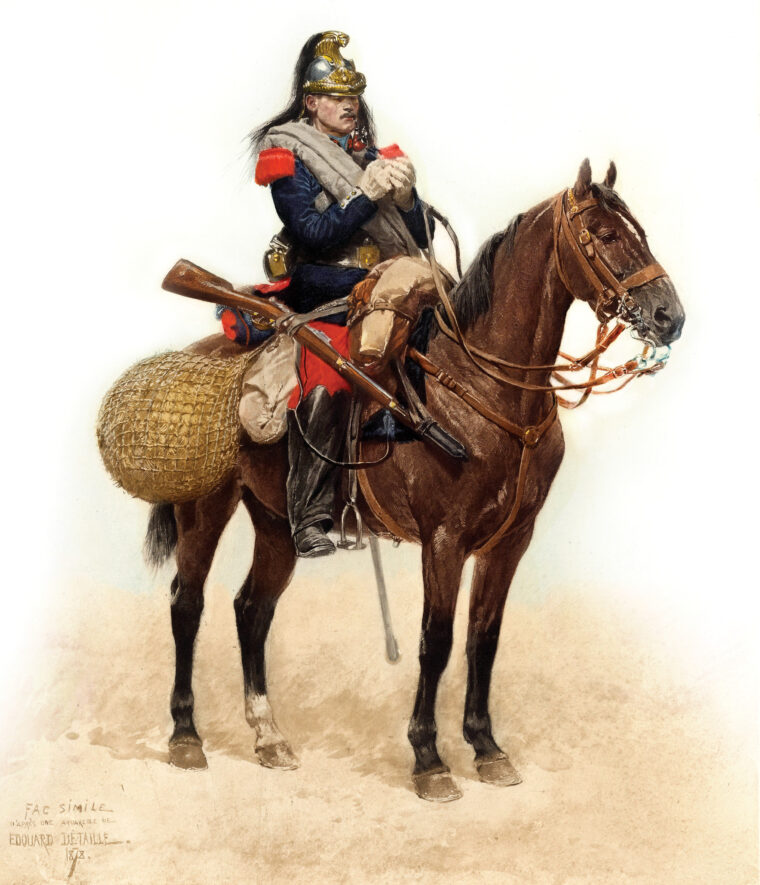
Helmet: French enlisted Cuirassier steel helmet, brass comb with “Medusa” face, black horsehair tail, leopard skin turban under brass chin-scales.
Coat: Dark blue jacket, white collar with black tabs and the numeral 2, white cuff flap, brass buttons, and red epaulettes.
Portmanteau: Dark blue with red grenade device on the ends, and red piping. Carried behind the saddle, with saddlebags on either side.
Carbine: Cavalry pattern 1866 Chassepot breech loading rifle.
Belts: Black leather waistbelt and cartridge pouch sling.
Trousers: Red “pantalon basane” with blue stripe.
Sword: Heavy cavalry sword
(not visible) with a black sling.
BOOTS: Black leather gaiters (or false boots) that could be removed when on foot.

Join The Conversation
Comments
View All Comments