By Glenn Barnett
The history of the epic battle for Luzon Island in the Philippines has been told before. This is one soldier’s story of that desperate fight.
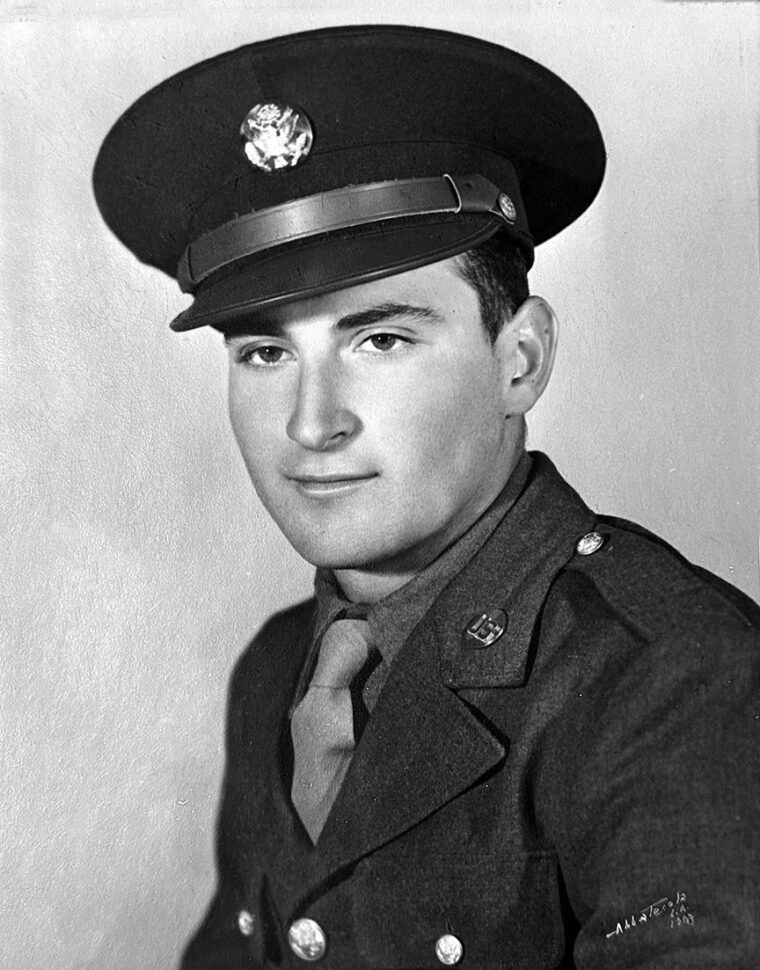
Joe “Peppy” Sciarra graduated from high school in June of 1943 and like most of the male graduates that year, he was drafted the next day. His parents, Italian immigrants who had settled in Los Angeles, would give all four of their sons to the war effort. One son served with the 3rd Army in Europe doing reconnaissance for Gen. George Patton’s headquarters, while the other three, including Joe, served in the Philippines.
The army needed infantry and that was the only choice available to Sciarra. He was sent to Camp Roberts for basic training after which he was assigned to the 27th Infantry Regiment of the 25th Infantry Division. The new recruits took the train to Camp Stoneman in Pittsburg, California.
From there they boarded a Dutch-flagged Liberty ship and steamed out of San Francisco Bay under the Golden Gate Bridge in January of 1944, zigzagging their way in convoy to New Caledonia, a voyage that took 30 days. For many of the men it was their first time on a ship. During the trip they crossed the Equator where white bearded King Neptune initiated the “landlubbers” into his aquatic fraternity.
The French island of New Caledonia would be the home of the new recruits for the next nine months as they toughened up for combat. They were integrated with the veterans of the 27th Infantry Regiment, “Wolfhounds” who had already seen bloody combat on Guadalcanal, New Georgia and Arundel Island. The new men learned the history of the 27th and got advice from the “old-timers” about the enemy, jungle warfare, rain, mud and malaria which would prove invaluable in the fighting to come. Training on New Caledonia emphasized climbing and descending hills and building stamina for what was to come.
Security was tight and the men were not allowed to leave camp for fear of an “incident” involving the natives or the French (especially the women) on the island. There were no USO shows, no leaves and no furloughs. On Sunday, the men played baseball or wrote letters. Sciarra and some of the other Catholics built a church of bamboo and palm fronds for hearing mass. Officers kept their distance. They had their own gathering places and rarely mingled with their men.
The natives of New Caledonia all seemed to have a similar trait. They all had red hair and all of the same shade. This was a passing curiosity to the men of the 27th until they bathed in the local streams. They soon found that mineral deposits in the waters turned their hair red as well.
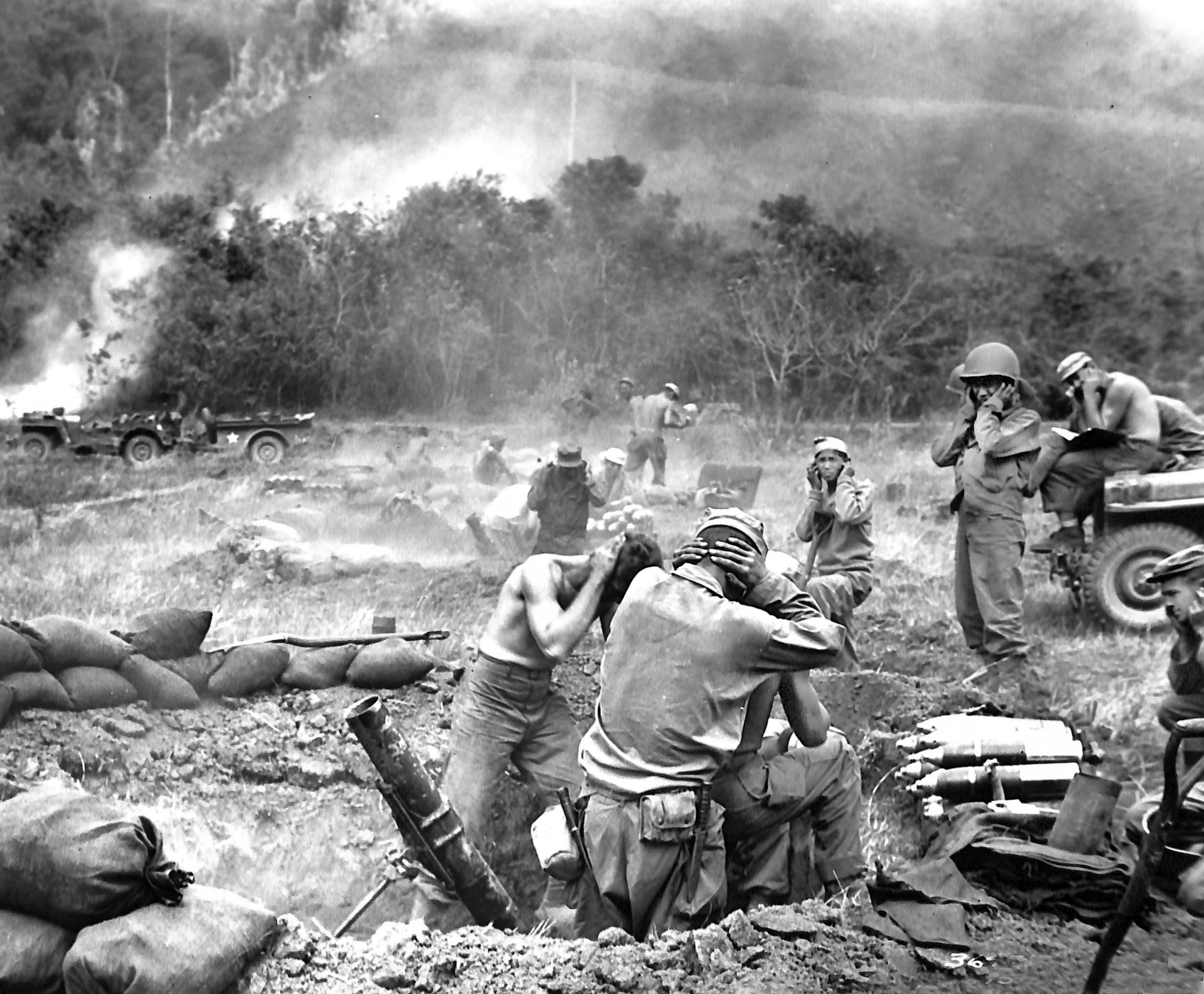
Sciarra was assigned to a heavy weapons platoon of 36 men who trained to use an 81mm mortar. The mortar men would follow closely the advancing infantry and provide fire support. The portable mortar broke down into the three parts: the base plate, tripod and barrel. Each piece weighed about 45 pounds and would be carried by a single man. The other men of the platoon would carry the 11-pound mortar rounds, entrenching tools and other gear. Sciarra was the number two man of his squad and responsible for the mortar tube. With his personal gear, he recalled that, “Everywhere I went in the Philippines I carried nearly 100 pounds on my back.”
Each time the mortar men moved they had to dig a 4x4x4-foot hole to position the mortar and offer some protection for the men firing it. This hole was in addition to the two-man fox holes that they would dig for themselves during combat. Sciarra remembered that in one of his training exercises, he was charged by a local bull while digging the pit for the mortar. He managed to scramble out of the hole just as the bull fell in.
On December 17, 1944, the entire regiment, toughened by their training, sailed to Guadalcanal where the 25th Division had left some of its gear. They made an amphibious landing on the island on December 21 as a rehearsal for the coming landing in the Philippines and spent two days training in the jungle.
On December 24, the regiment shipped out across Iron Bottom Sound to Tulagi harbor where they picked up supplies and spent Christmas day relaxing. On the 29th they moved again. This time they steamed 1,300 miles to Manus Island in the Admiralties, where the men were finally allowed shore leave. Sciarra remembers going ashore and enjoying two “ice cold” beers before shipping out for the Philippines.
Their ship was alone on the vast ocean that first day. At dawn of the second day, more ships appeared in convoy and soon there were more than 100 ships steaming together. The convoy seemed to stretch to the horizon. In the center of this powerful armada was the flagship which housed the overall commander, Gen. Douglas MacArthur.
The battle for Leyte Island was wrapping up as a 68,000-man landing force that included the 25th, 32nd and 33rd Divisions hit the beaches on the main island of Luzon at Lingayen Gulf north of Manila beginning on January 9th. The 27th landed on the 11th at 1400 hours. The men, wearing full gear, scrambled down rope ladders into the bobbing landing craft, trying to time their last step with the surging swells of the ocean. Once aboard the landing craft they churned toward the beach under enemy fire.
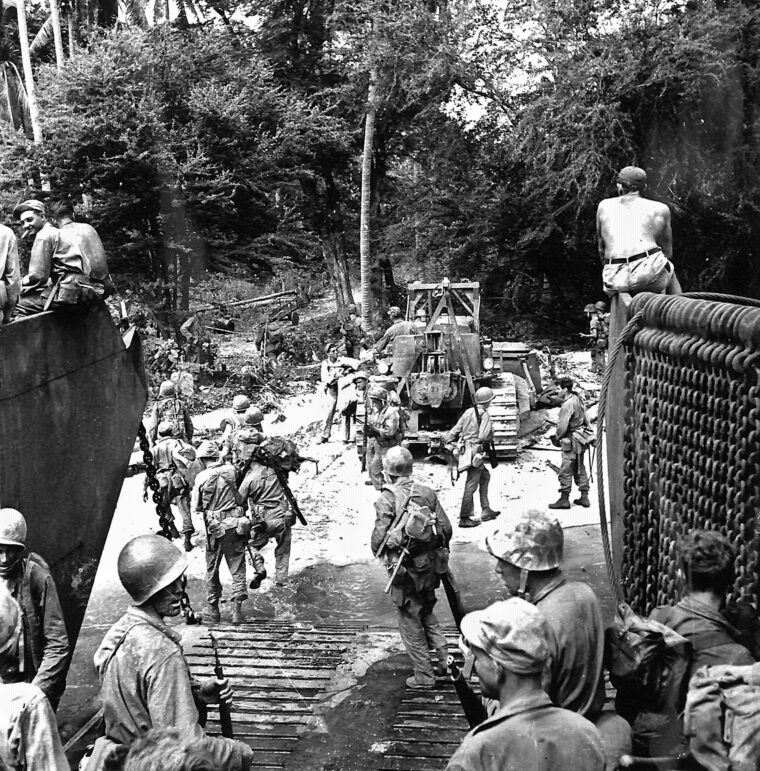
The landing craft carrying Sciarra beached on the lip of a bomb crater just off shore. As he stepped off the craft he was carrying a 60-pound pack and 45-pound mortar tube, and immediately sank in the deep water at the bottom of a crater. Slowly he trudged his way up the other side of the sandy defile and reached the beach. Everything was soaking wet including the prayer book he always carried, and still has to this day.
Exhausted and soaking wet, he found a crater to hide in. But when he looked up he saw that he was surrounded by 55-gallon fuel drums from a previous landing. He hurriedly found another, safer, sanctuary until his platoon could assemble.
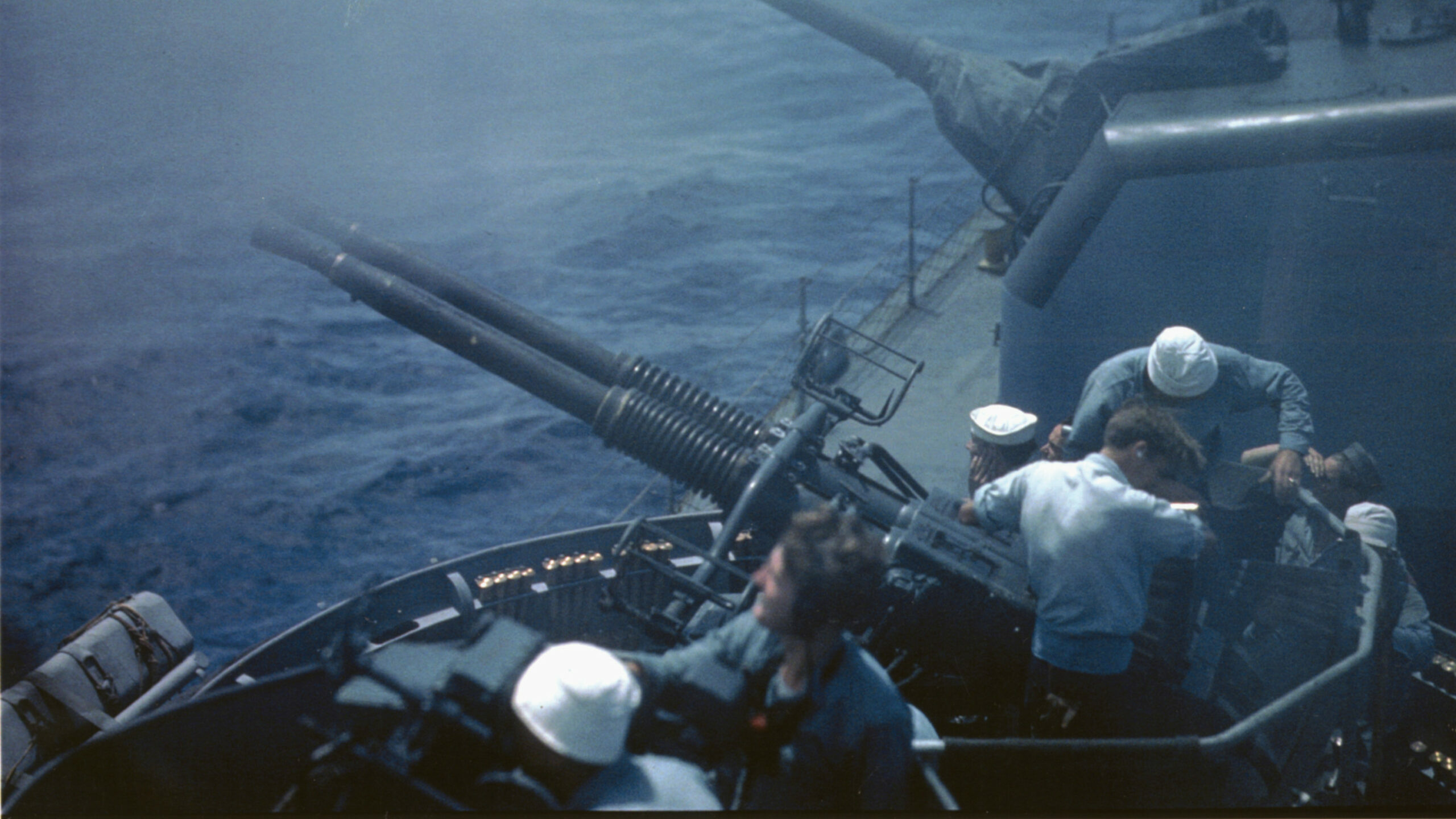
All around him men were setting up antiaircraft guns to fend off the Japanese kamikaze planes that were then taking a heavy toll on shipping out in the gulf, sinking or damaging 30 ships during the landings. While the men were still going ashore at Lingayen, MacArthur announced to the world that the Philippines had been liberated. The men of the 27th could appreciate with grim irony that the battle for Manila would last another 165 days. Some of the survivors would later liken MacArthur’s announcement to the premature declaration of victory in Iraq.

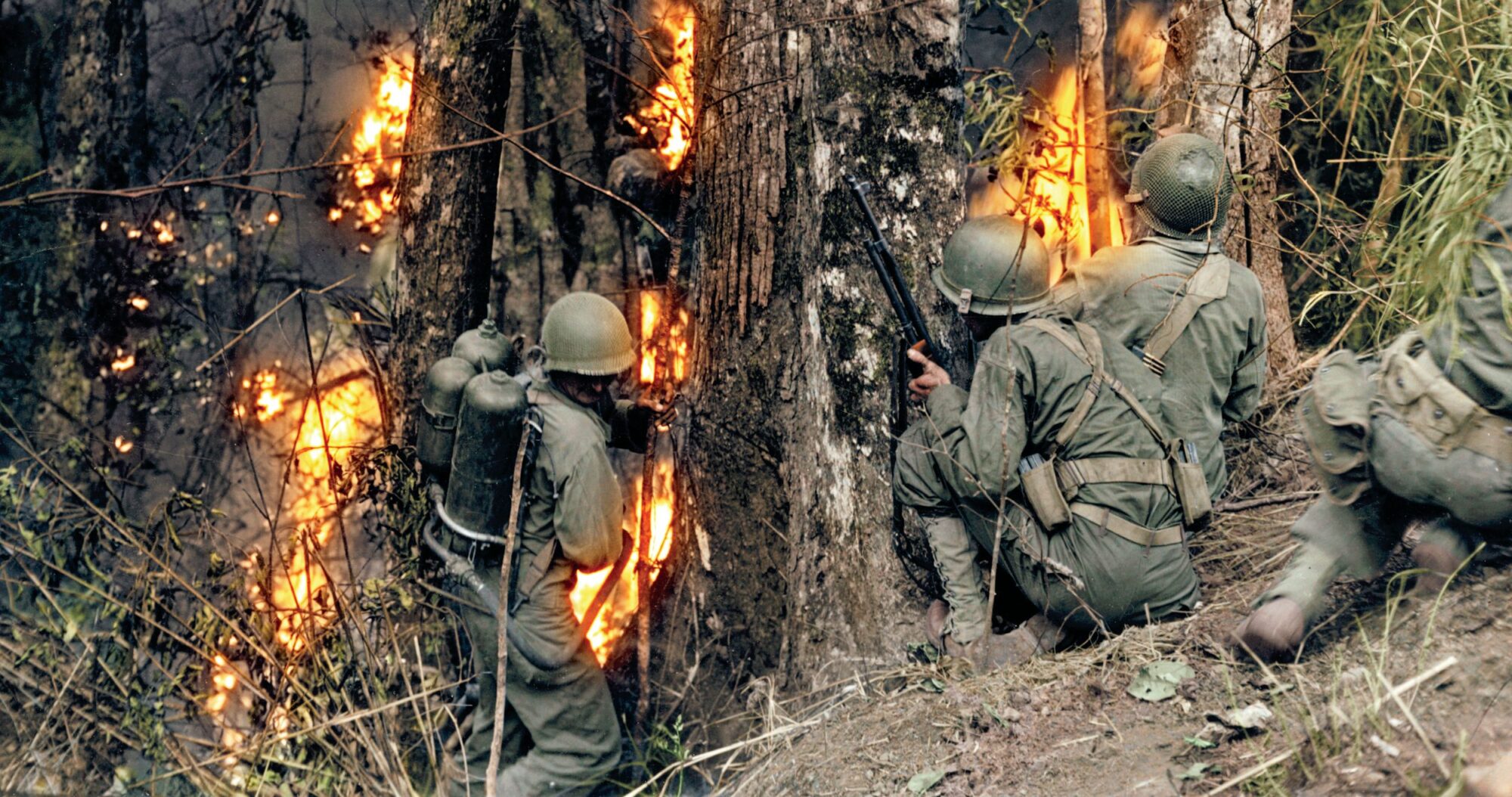
On January 14, the 27th Infantry Regiment moved inland, striking out toward the Caraballo Mountains and Balete Pass—the heavily fortified gateway to the Cagayan Valley, where Japanese Gen. Tomoyuki Yamashita had concentrated his main defensive forces. The Japanese defenses were formidable, built around 45 jagged ridges that guarded the lone highway into the northern valley. An estimated 100,000 Japanese troops were dug into these mountain strongholds. The ensuing battle would be a meat-grinder for both sides. Sciarra recalled that there was not a single day of respite from the fighting.
By truck or on foot the men of the 25th Division moved in the direction of the enemy. Fighting on flat terrain covered with rice paddies they faced an enemy that held all the high ground. The Japanese were armed with antitank guns and the willingness to die to prevent the Americans from getting any closer to their homeland and loved ones.
On the 27th Sciarra’s platoon saw its first action as they engaged in an attack and were ambushed by Japanese artillery and mortar fire. A platoon sergeant stepped on a land mine and was killed instantly. Sciarra and his men set up their mortar in a rice paddy for protection, but the Japanese zeroed in on their position. Shells were bursting all around him. When an officer swore at him to move away from there, he quickly complied. Later he would remember with a smile that, “The F-Word saved my life that day.” He also remembered that a Lieutenant hid behind a tree during the battle, avoiding his duty.
Three men of the platoon were killed in the ambush. Sciarra noted in his journal that they were “S/SGT. Sim Herrin, Section Sergeant, PFC. Benny Aubin, Asst. Gunner, and PFC. Irvin Nelson, Ammo bearer.” Sciarra and his mates carried them out.
On another occasion their Lieutenant ordered the mortar men forward ahead of the infantry when once again they were ambushed. After throwing themselves to the ground and attempting to set up their mortar for defense, they found the enemy fire too accurate and retreated. Sciarra slung his mortar tube across his back and ran. As he rushed away, he felt the ping of shrapnel ricocheting off the tube, saving his life. Even so, a few jagged pieces cut his wrist and hip.
Back at their base, Sciarra marched straight up to the Lieutenant who had sent them forward and gave him a piece of his mind. Sciarra let him know that it was irresponsible to send mortar men forward without infantry support. Rather than being put on report he and the officer would later become fast friends.
On January 30, the regiment attacked the town of Umingan where the headquarters of a Japanese armored division was located. Some 500 of the enemy contested the town. The men of “M” company marched five miles before getting into the fight at 0930. The three-day battle resulted in heavy enemy losses. The mortar men lost one killed in action and three wounded. The Japanese had a very accurate 60mm mortar that they used to good effect.
By February 8, the regiment had moved 23 miles to San Jose at the foothills of the Caraballo Mountains. Setting up their weapons, the mortar crews quickly located and destroyed a Japanese ammunition dump, touching off spectacular secondary explosions. The infantry fought continuously for several days, slowly pushing the enemy off the low hills.
On March 6, near Puncan, the Japanese counter attacked Sciarra’s position. They were repulsed with 31 dead. From then on the Americans followed the ascent and descent of steep ridges through rugged jungle. Tanks could no longer support the advance as there were no roads through the steep slopes. Air support was also problematic as friend and foe were indistinguishable through the jungle canopy. The Japanese always commanded the heights and could only be stung with artillery firing from the base of hills and the 81mm mortars that followed closely behind the ground troops.
The Japanese surrendered a ruined Manila on March 8, but that did not mean that the battle for Luzon was over. Japanese commander, General Yamashita, would continue the fight until August of 1945. For the men of the 27th Infantry Regiment there was no let up in the war.
Sciarra’s journal noted on March 14 that his unit had advanced 2.5 miles but that artillery and sniper fire was heavy. Snipers were always active, killing many and wounding more. They particularly targeted officers and sergeants. As a result, the company or battalion commanders rarely visited the fighting. Sciarra, speaking for the common soldier, later remarked that, “We were on our own.”
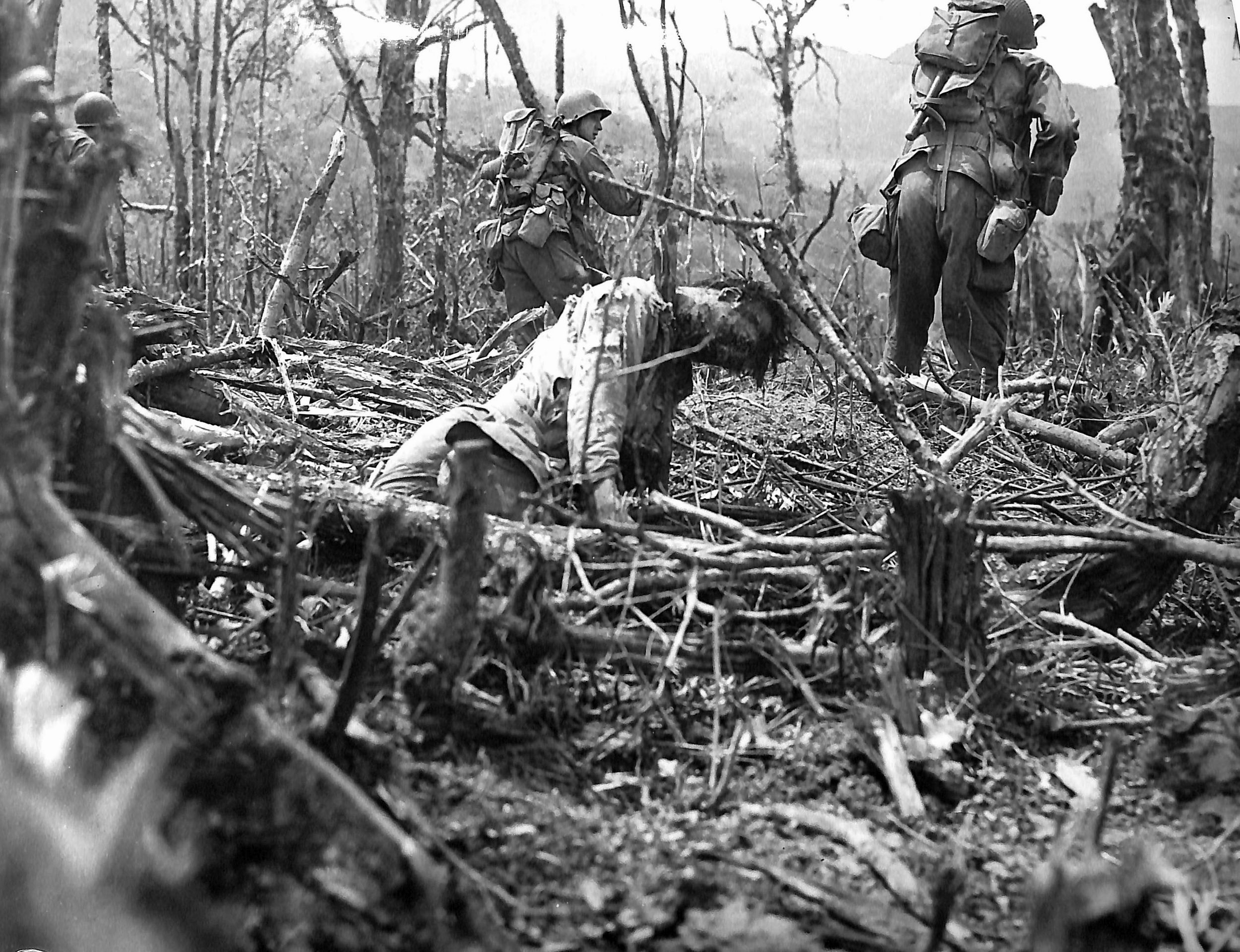
Of course, the war continued. The next day “Max Craig was wounded by a booby trap.” There was bitter fighting on March 31. Sciarra noted five killed and seven wounded. Three days later, three were killed and three wounded.
As the infantry advanced, the mortar men followed close behind. A platoon sergeant embedded with the infantry unrolled phone wire so he could act as an artillery spotter for the mortars from the front. By this time, fire could be so rapid that six mortars could put a hundred shells in the air before the first round landed.
Both artillery and mortars tried to fire their first shots long enough to avoid hitting their own men. The spotters would then direct them back to enemy positions. Even so, shells did fall short with serious consequences. On one occasion, friendly fire from artillery in the valley killed a friend of Sciarra’s who he had just been talking to. “I wrapped him up and kept him near my fox hole for several days because we couldn’t move him during the fighting.” The body began to stink and draw insects in the fetid heat of the jungle.
As the American artillery zeroed in on the hillside redoubts of the Japanese, they dug into the reverse slopes in order to avoid direct fire. When the G.I.s came across these caves and tunnels they found grenades and flame throwers to be ineffectual, so they turned to the Bangalore Torpedo. Normally used to destroy barbed wire or trigger mines, the cylindrical charges encased in a long tube were perfect for imploding the entrance to a man-made cave, burying its occupants alive.
The further the troops advanced into the rugged mountains the more severe their supply problem became. Each man carried his own limited rations and ammunition but re-supply of everything from ammunition and food, to medical equipment had to be laboriously carried in on foot, while the dead and wounded were carried out the same way. Sometimes there were no supplies. When men came off the line for rest and re-supply, their ragged clothes were burned because they had become infested with lice. Vermin were the constant companions of jungle fighters on both sides.
At night, each unit set up a perimeter which was typically surrounded by strings that held empty cans. If someone breached the perimeter a hail of bullets would greet them, friend or foe. It was not safe to be about at night. There was also a foxhole buddy system for the two-man shelters. Each would take two hours of sleep while his mate kept watch. Battle fatigue can take many forms. Even today Sciarra can only sleep two hours at a time.
One day during the long battle, the sound of an incoming round caused Sciarra to slam himself to the ground for safety. He fell on a rock which badly chipped a tooth. The damage to his teeth and a possible concussion was severe enough for him to be evacuated. After walking to level ground, he was laid on a stretcher and carried out on a jeep while still under fire from the enemy. The doctor at the forward Portable Surgical Hospital (the forerunner of the M.A.S.H. units of the Korean War), gave him a clean bill of health and he was sent back to the front the same day.
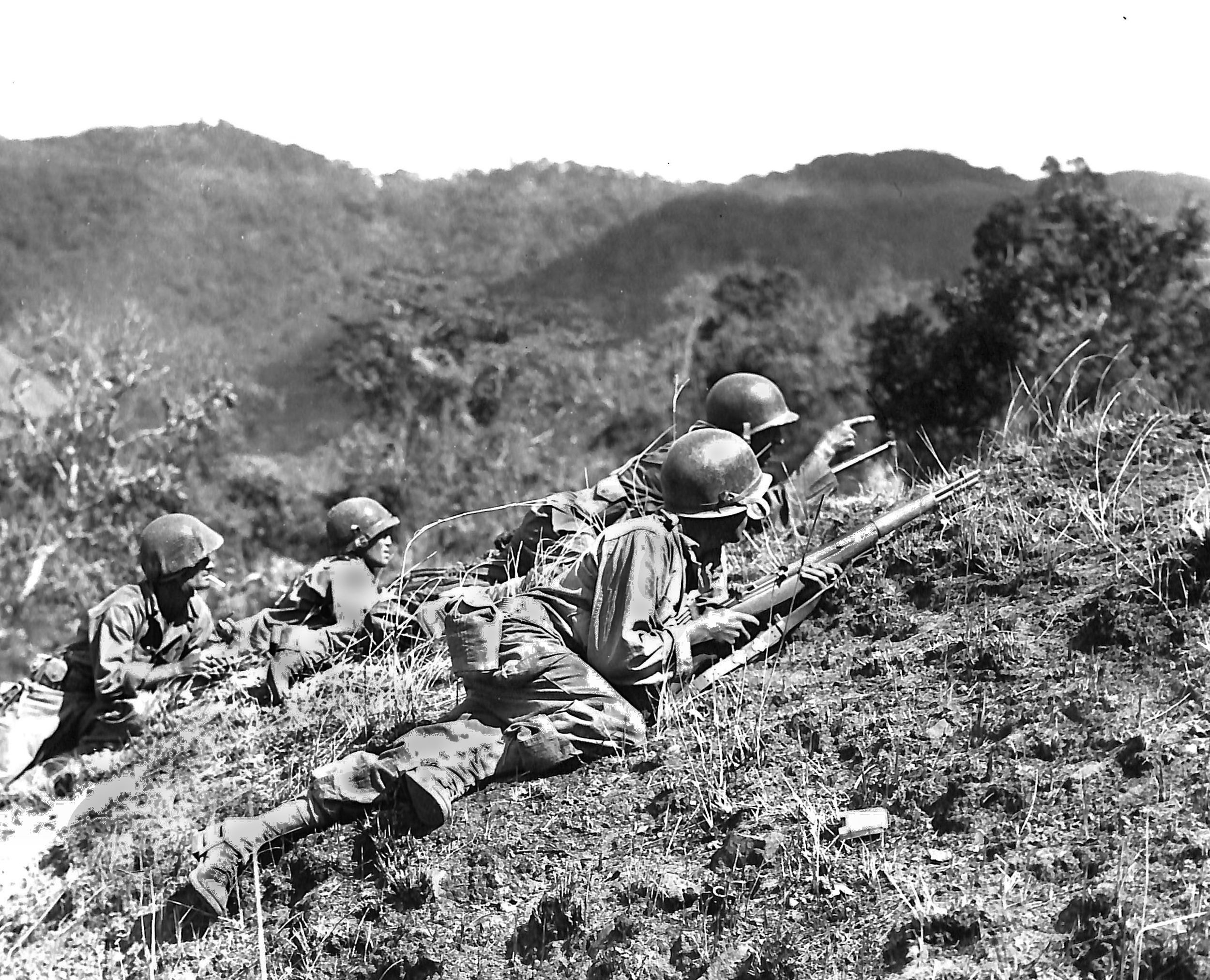
The jeep that carried him back stopped about two mountain ridges short of his position and dropped him off in late afternoon to walk back to his platoon. He hurried as fast as he could—for to be out after dark would mean certain death from the bypassed enemy still hiding in the hills or from friendly fire.
The Japanese were painstakingly eliminated from one ridge at a time until the Balete Pass was within five miles of advanced forces of the Americans. However, by then the supply problems and the scattering of units over the tortured jungle terrain forced a halt to regroup and re-supply even while the fighting continued.
One day, the lieutenant whom Sciarra had once scolded found him and, without fanfare, told him that he had been promoted to platoon sergeant. He then turned and walked away. At 20 years old Sciarra was one of the youngest sergeants in the army. Many of the 36 men in the platoon were his friends. Some were older and more experienced so Sciarra was careful not to lord it over anyone. He believed in cooperation and he got it.
On May 3, as the mortar men dug in around Lone Tree Hill, the desperate Japanese launched a “Banzai” charge up the naked hillside. Both sides suffered heavy losses. Sciarra’s diary notes that on May 8, Cpl. Joe Taylor of the 148th Infantry Regiment was killed. He was due to be rotated home the next day. Such tragedy was commonplace on Luzon.
The goal of the fighting now was to clear out Balete Pass and the road to Manila. One of the first soldiers to reach the pass was Brig. Gen. James Leo Dalton II, who was killed there by a sniper. He would be remembered by his men as one of the few officers who led from the front. The pass would be renamed Dalton Pass in his honor, but for the soldiers who fought there it would always be known as “Bloody Pass.”
The mortar men reached the pass on May 20 and two days later they moved out to the north to secure the area around the all important position. They reached the town of Santa Fe which was completely demolished. It would not be an unusual sight. As the Japanese retreated, they blew up infrastructure as part of their own “scorched earth” policy.
By the end of June the men of the 27th reached Clark Field, the primary air base on the island. They would move to nearby Tarlac and set themselves up at Camp Patrick. For them, the war in the Philippines was over. They now began training for their next assignment, which would be the invasion of Japan. During their stay at Camp Patrick, Sciarra borrowed a jeep to visit with one of his brothers who was stationed in recaptured Manila.
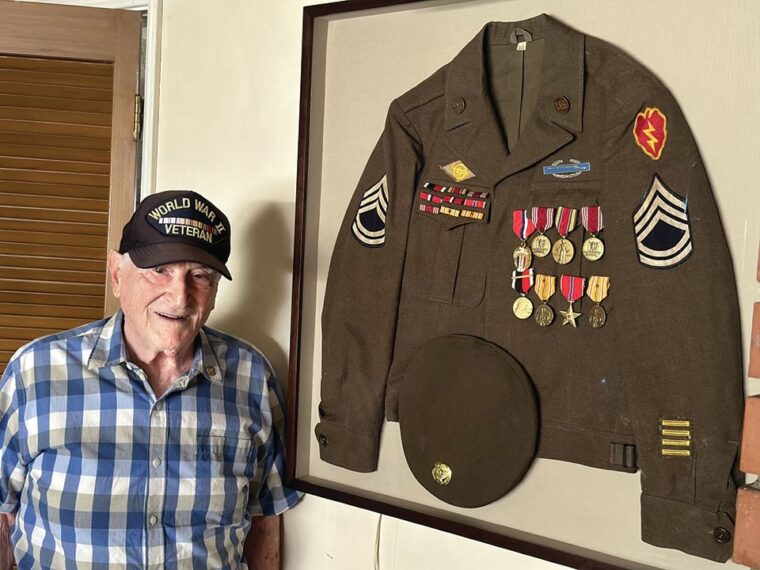
Training for the invasion was abruptly interrupted by the announcement of the atomic bomb that was dropped on Hiroshima. The hardened veterans learned that a single bomb of unimaginable destructive power had destroyed an entire city and two days later another city was wiped out. Sciarra and his mates did not celebrate the end of the war. To them it seemed a bit of an anti-climax that they would not fight in Japan after all. Rather than prepare for an invasion, the 27th prepared for a new role, that of occupation.
On September 24, the regiment pulled up stakes at Camp Patrick and traveled by rail back to Lingayen Gulf where they boarded a transport bound for Japan. It would prove a rough crossing. A powerful typhoon raged through the South China Sea tossing ships around like toys. Steaming around the worst of the storm, they finally arrived at the southern Japanese island of Honshu on October 7.
After some uncertainty as to their final destination the regiment landed at Nagoya, a city in ruins, on the 27th. They proceeded by rail to Gifu aerodrome where they oversaw the destruction of Japanese war material and manufacturing capability.
At first, the wary warriors feared Japanese treachery but were very surprised to find that the enemy they encountered in Japan, in contrast to those they had been fighting, greeted them with kindness and submission. The entire country seemed strangely to have changed overnight from a posture of fighting to the death to one of tentatively accepting their occupiers.
While Sciarra was in Japan, the symptoms of malaria that he had contracted in the Philippines sickened him with fever and aching. He was confined to the hospital for four weeks. Recurring attacks of malaria would continue even after he returned to the United States in February of 1946.
For his courage under fire in the Philippines, Sciarra was awarded the Bronze Star.
Once home from the Pacific War, he owned and operated a meat market, called “Peppy’s Meats” in Alhambra, California, for 32 years. He joined the local Rotary Club in 1958 and has been a member ever since. Peppy’s marriage to Lucille, with whom he had one son, lasted 74 years until her death. In retirement he has sponsored “Peppy’s Walk” for the past 27 years, raising more than $145,000 for Children’s Hospital of Los Angeles. Peppy has spoken about his World War II experiences at numerous events both locally and around the United States.
Join The Conversation
Comments
View All Comments